steering MITSUBISHI LANCER 2015 8.G Owner's Guide
[x] Cancel search | Manufacturer: MITSUBISHI, Model Year: 2015, Model line: LANCER, Model: MITSUBISHI LANCER 2015 8.GPages: 434, PDF Size: 16.59 MB
Page 148 of 434
Twin Clutch SST (Sportronic Shif
t Transmission) (if so equipped) Features and controls 5-79
5
N00543000040
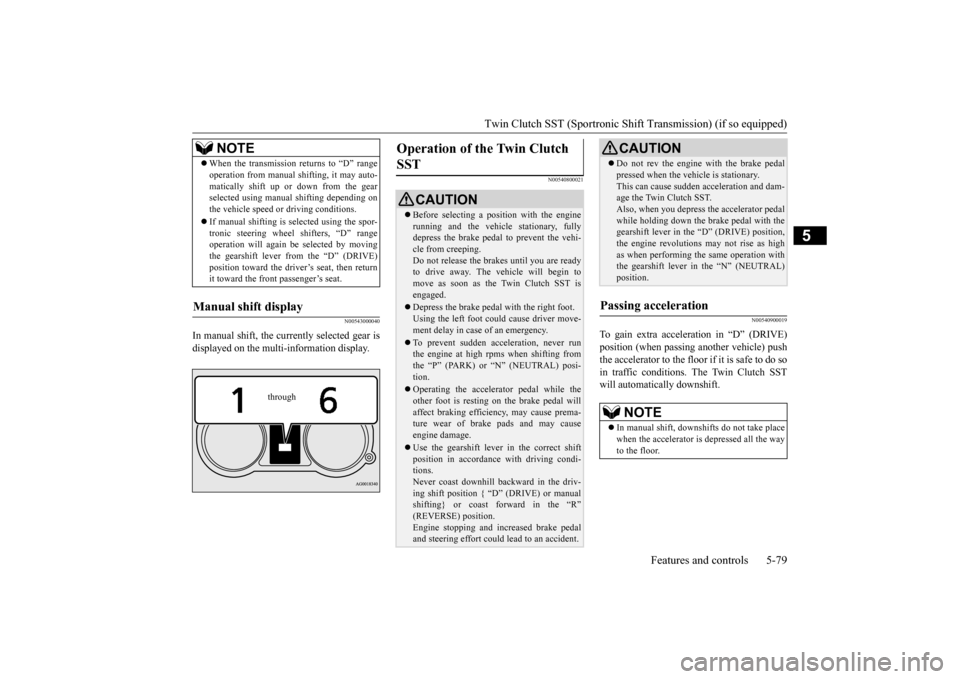
In manual shift, the currently selected gear is displayed on the multi-information display.
N00540800021
N00540900019
To gain extra acceleration in “D” (DRIVE) position (when passing another vehicle) pushthe accelerator to the floor
if it is safe to do so
in traffic conditions. The Twin Clutch SST will automatically downshift.
When the transmission returns to “D” range operation from manual shifting, it may auto- matically shift up or down from the gear selected using manual shifting depending on the vehicle speed or driving conditions. If manual shifting is selected using the spor- tronic steering wheel shifters, “D” rangeoperation will again be selected by moving the gearshift lever from the “D” (DRIVE) position toward the driver’s seat, then returnit toward the front passenger’s seat.
Manual shift display
NOTE
through
Operation of the Twin Clutch SST
CAUTION Before selecting a position with the engine running and the vehicle stationary, fullydepress the brake pedal to prevent the vehi- cle from creeping. Do not release the brakes until you are readyto drive away. The vehicle will begin to move as soon as the Twin Clutch SST is engaged. Depress the brake pedal with the right foot. Using the left foot could cause driver move-ment delay in case of an emergency. To prevent sudden acceleration, never run the engine at high rpms when shifting from the “P” (PARK) or “N” (NEUTRAL) posi- tion. Operating the accelerator pedal while the other foot is resting on the brake pedal willaffect braking efficiency, may cause prema- ture wear of brake pads and may cause engine damage. Use the gearshift lever in the correct shift position in accordance with driving condi- tions. Never coast downhill backward in the driv-ing shift position { “D” (DRIVE) or manual shifting} or coast forward in the “R” (REVERSE) position.Engine stopping and increased brake pedal and steering effort could lead to an accident.
Do not rev the engine with the brake pedal pressed when the vehicle is stationary. This can cause sudden acceleration and dam- age the Twin Clutch SST. Also, when you depress the accelerator pedalwhile holding down the brake pedal with the gearshift lever in the “D” (DRIVE) position, the engine revolutions may not rise as highas when performing the same operation with the gearshift lever in the “N” (NEUTRAL) position.
Passing acceleration
NOTE
In manual shift, downshifts do not take place when the accelerator is depressed all the way to the floor.CAUTION
BK0210300US.bo
ok 79 ページ 2014年4月8日 火曜日 午前10時46分
Page 155 of 434
All-wheel driving operation 5-86 Features and controls
5
N00530600169
Full-time 4WD vehicles are propelled by engine power distributed constantly andappropriately to all 4 wheels. Not only does this ensure enhanced handling on dry, paved roads but also permits bettertraction when driving on slippery, wet orsnow-covered roads and when moving out of mud. These vehicles, however, are not designedfor off-road use, and are unsuitable for driving on bumpy ground that may cause excessive strain.
Full-time 4WD vehicles
should be driven only under the same condi- tions as are suitable for ordinary front-wheel drive vehicles. Electronically controlled 4WD system vehi- cles are propelled by engine power distrib- uted constantly and appropriately to all 4 wheels. Not only does this ensure enhanced handling on dry, paved roads but also permits better
traction when driving on slippery, wet or snow-covered roads and when moving out of mud. These vehicles, however, are not designedfor off-road use, and are unsuitable for driving on bumpy ground that may cause excessive strain.
Electronically controlled
4WD system vehicles should be driven only under the same conditions as are suitable for ordinary front-wheel drive vehicles. When turning a sharp corner in “4WD LOCK” position at low speed, a slight differ- ence in steering may be experienced similarto feeling as if the brakes were applied. This is called tight corner braking and results from each of the four tires being at a different dis-tance from the corner. The phenomenon is typical of 4-wheel drive vehicles. If this occurs, either straighten out the steeringwheel, or change to “2WD” or “4WD AUTO” mode. Set the drive mode-selector to “4WD AUTO” conditions, and then gradually depress theaccelerator pedal for a smooth start.
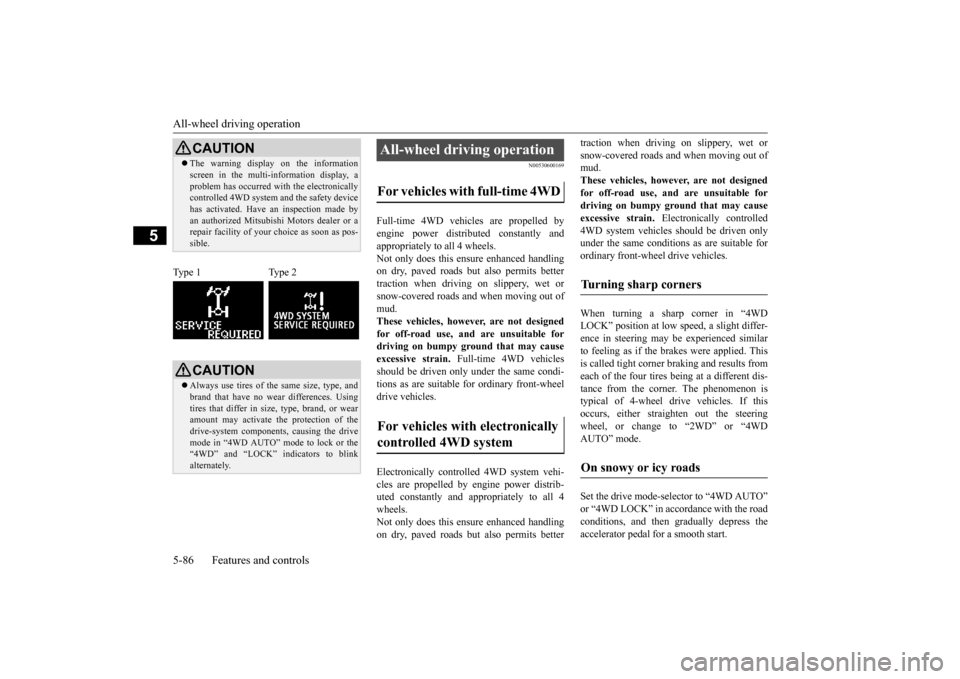
CAUTION The warning display on the information screen in the multi-information display, a problem has occurred with the electronically controlled 4WD system and the safety device has activated. Have an inspection made byan authorized Mitsubishi Motors dealer or a repair facility of your choice as soon as pos- sible.
Type 1 Type 2
CAUTION Always use tires of the same size, type, and brand that have no wear differences. Using tires that differ in size, type, brand, or wear amount may activate the protection of thedrive-system components, causing the drive mode in “4WD AUTO” mode to lock or the “4WD” and “LOCK” indicators to blinkalternately.
All-wheel driving operation For vehicles with full-time 4WD For vehicles with electronically controlled 4WD system
Turning sharp corners On snowy or icy roads
BK0210300US.bo
ok 86 ページ 2014年4月8日 火曜日 午前10時46分
Page 159 of 434
Brake assist system 5-90 Features and controls
5
N00567300076
The brake assist system is a device assisting drivers who cannot depress the brake pedal firmly such as in emergency stop situationsand provides greater braking force. If the brake pedal is depressed suddenly, the brakes will be applied with more force than usual.
N00562600032
The hill start assist makes it easy to start off on a steep uphill slope by preventing thevehicle from moving backwards. It keeps the braking force for about 2 seconds when you move your foot from the brake pedal to theaccelerator pedal.
N00562700062
1. Stop the vehicle completely using thebrake pedal.2. Release the brake pedal and the hill start assist will maintain the braking force applied while stopping for approximately2 seconds.
WA R N I N G Driving with worn brake pads will make it harder to stop, and can cause an accident.
Brake assist system
CAUTION The brake assist system is not a device designed to exercise braking force greaterthan its capacity. Make sure to always keep a sufficient distance between vehicles in front of you without relying too much on the brakeassist system.NOTE
Once the brake assist system is operational, it maintains great braking force even if the brake pedal is lightly released. To stop its operation, completely removeyour foot from the brake pedal.
The brake assist system may become opera- tional when the brake pedal is fully depressed even if it has not been depressed suddenly. When the brake assist system is in use while driving, you may feel as if the depressed brake pedal is soft, the pedal moves in smallmotions in conjunction with the operation noise, or the vehicle body and the steering wheel vibrate. This occurs when the brakeassist system is operating normally and does not indicate faulty operation. Continue to depress the brake pedal. You may hear an operation noise when the brake pedal is suddenly or fully depressedwhile stationary. This does not indicate a malfunction and the brake assist system is operating normally.
Hill start assist (vehicles with Twin Clutch SST)
NOTE
CAUTION Do not overly rely on the hill start assist to prevent backwards movement of the vehicle. Under certain circumstances, even when hill start assist is activated, the vehicle may move backwards if the brake pedal is not suf-ficiently depressed, if the vehicle is heavily loaded, or if the road is very steep or slip- pery. The hill start assist is not designed to keep the vehicle stopped in place on uphill slopesfor more than 2 seconds. When facing uphill, do
not rely on using the
hill start assist to maintain a stopped position as an alternative to depressing the brake pedal.Doing so could cause an accident. Do not turn the ignition switch to the “LOCK” or “ACC” position while the hill start assist is operating. The hill start assist could stop operating, which could result inan accident.
To operate
BK0210300US.bo
ok 90 ページ 2014年4月8日 火曜日 午前10時46分
Page 160 of 434
Anti-lock braking system
Features and controls 5-91
5
3. Depress the accelerator pedal and the hill start assist gradually will decrease the braking force as the vehicle starts moving.
N00562800063
If an abnormal condition occurs in the sys- tem, the following display/indicator will turnon.
Warning display
N00517900309
The anti-lock braking system helps prevent the wheels from locking up when braking.This helps you keep co
ntrol of your vehicle
and its direction.
When using the anti-lock brakes (sudden braking), steering is slightly different from normal driving conditions. Use thesteering wheel carefully. Always keep a safe distance from the vehicle in front of you. Even if your vehi-cle is equipped with the anti-lock braking system, leave a greater braking distance when:• Driving on gravel or snow-coveredroads. • Driving on uneven road surfaces. Operation of anti-lock braking system is not restricted to situations where brakes are applied suddenly. This system may also prevent the wheels from lockingwhen you drive over manholes, steel roadwork plates, road markings, or any uneven road surface. When the anti-lock braking system is in use, you may feel the brake pedal vibrat- ing and hear a unique sound. You mayalso feel as if the pedal resists being pressed. In this situation, si
mply hold the brake
pedal down firmly. Do not pump the brake, which will result in reduced braking performance.
NOTE
The hill start assist is activated when all of the following conditions are met. • The engine is running. (The hill start assist will not be activated while the engine is starting or immediatelyafter the engine is started.) • The gearshift lever is in any position other than “P” (PARK) or “N” (NEUTRAL). • The vehicle is completely stationary, with the brake pedal depressed. • The parking brake is released. The hill start assist w
ill not operate if the
accelerator pedal is depressed before thebrake pedal is released. The hill start assist also operates when reversing on an uphill slope.
Warning display
-
ASC indicator
CAUTION If the warning is displayed, the hill start assist will not operate. Start off carefully. Park your vehicle in a safe place and stop the engine. Restart the engine and check whether the display/indicator goes out, in which case the hill start assist is
again working normally.
If they remain displayed or reappear fre- quently, it is not necessary to stop the vehicle immediately, but the vehicle should beinspected by an authorized Mitsubishi Motors dealer or a repair facility of your choice as soon as possible.
Anti-lock braking system
Driving hints
BK0210300US.bo
ok 91 ページ 2014年4月8日 火曜日 午前10時46分
Page 163 of 434
Active Stability Control (ASC) (if so equipped) 5-94 Features and controls
5
N00559100118
The Active Stability Control (ASC) takes overall control of the anti-lock braking sys- tem, traction control function and skid control function to help maintain the vehicle’s controland traction. Please read
this section in con-
junction with the page on the anti-lock brak- ing system, traction control function and skidcontrol function. Anti-lock braking system (ABS)
P.5-91
Traction control function
P.5-94
Skid control function
P.5-94
N00559200034
On slippery surfaces, the traction control function prevents the drive wheels from spin-ning excessive, thus helping the vehicle to start moving from a stop
ped condition. It also
provides sufficient driving force and steering performance as the vehicle turns while press- ing the acceleration pedal.
N00559300035
The skid control function is designed to helpthe driver maintain control of the vehicle on slippery roads or during rapid steeringmaneuvers. It works by controlling the engine output and the brake on each wheel.
N00559400179
The ASC is automatically activated when the ignition switch is turned to the “ON” posi- tion. You can deactivate the system by press- ing down the “ASC OFF” switch for 3seconds or longer.
Active Stability Control (ASC)
(if so equipped)
CAUTION Do not over-rely on the ASC. Even the ASC cannot prevent the natural laws of physicsfrom acting on the vehicl
e. This system, like
any other system, has limits and cannot help you to maintain traction and control of thevehicle in all circumstances. Reckless driv- ing can lead to accidents. It is the driver’s responsibility to drive carefully, This means taking into account the traffic, road and envi- ronmental conditions. Be sure to use the same specified type and size of tire on all four wheels. Otherwise, theASC may not work properly.
Do not install any aftermarket limited slip differential (LSD) on your vehicle. The ASC may stop functioning properly.NOTE
An operation noise may be emitted from the engine compartment in the following situa- tions. The sound is associated with checkingthe operations of the ASC. At this time, you may feel a shock from the brake pedal if you depress it. These do not indicate a malfunc-tion. • When the ignition switch is set to the “ON” position. • When the vehicle is driven for a while after the engine is turned on.
When the ASC is activated, you may feel a vibration in the vehicle body or hear a whin- ing sound from the engine compartment. This indicates that the system is operatingnormally. It does not indicate a malfunction. When the anti-lock braking system warning light is illuminated, the ASC is not active.
Traction control function
CAUTION
CAUTION When driving a vehicle on a snowy or icy road, be sure to install snow tires and drive the vehicle at moderate speeds.
Skid control function
NOTE
The skid control function operates at speeds of about 9 mph (15 km/h) or higher.
“ASC OFF” switch
BK0210300US.bo
ok 94 ページ 2014年4月8日 火曜日 午前10時46分
Page 165 of 434
Power steering system 5-96 Features and controls
5
N00559500196
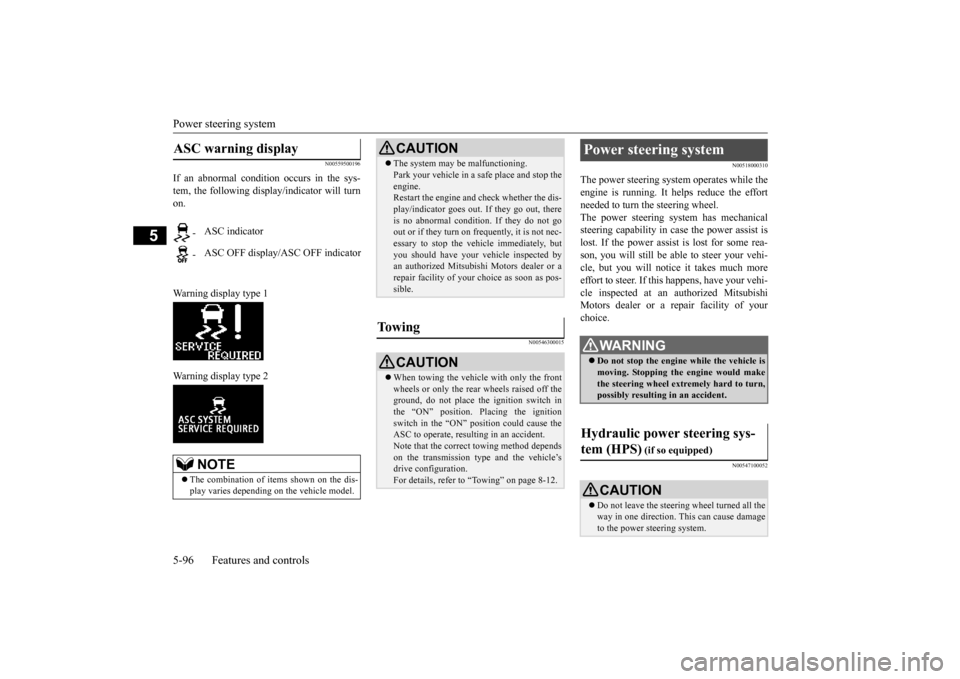
If an abnormal condition occurs in the sys- tem, the following disp
lay/indicator will turn
on. Warning display type 1 Warning display type 2
N00546300015
N00518000310
The power steering system operates while the engine is running. It helps reduce the effortneeded to turn the steering wheel. The power steering system has mechanical steering capability in case the power assist islost. If the power assist is lost for some rea- son, you will still be able to steer your vehi- cle, but you will notice it takes much moreeffort to steer. If this happens, have your vehi-cle inspected at an authorized Mitsubishi Motors dealer or a repair facility of your choice.
N00547100052
ASC warning display
-
ASC indicator
-
ASC OFF display/ASC OFF indicatorNOTE
The combination of items shown on the dis- play varies depending on the vehicle model.
CAUTION The system may be malfunctioning. Park your vehicle in a safe place and stop the engine. Restart the engine and check whether the dis- play/indicator goes out. If they go out, thereis no abnormal condition. If they do not go out or if they turn on frequently, it is not nec- essary to stop the vehicle immediately, butyou should have your vehicle inspected by an authorized Mitsubishi Motors dealer or a repair facility of your choice as soon as pos-sible.
To w i n g
CAUTION When towing the vehicle with only the front wheels or only the rear wheels raised off theground, do not place the ignition switch in the “ON” position. Placing the ignition switch in the “ON” position could cause theASC to operate, resulting in an accident. Note that the correct towing method depends on the transmission type and the vehicle’s drive configuration. For details, refer to
“Towing” on page 8-12.
Power steering system
WA R N I N GDo not stop the engine while the vehicle is moving. Stopping the engine would make the steering wheel extremely hard to turn,possibly resulting in an accident.
Hydraulic power steering sys- tem (HPS)
(if so equipped)
CAUTION Do not leave the steering wheel turned all the way in one direction. This can cause damage to the power steering system.
BK0210300US.bo
ok 96 ページ 2014年4月8日 火曜日 午前10時46分
Page 166 of 434
Cruise control (if so equipped) Features and controls 5-97
5
N00547200053
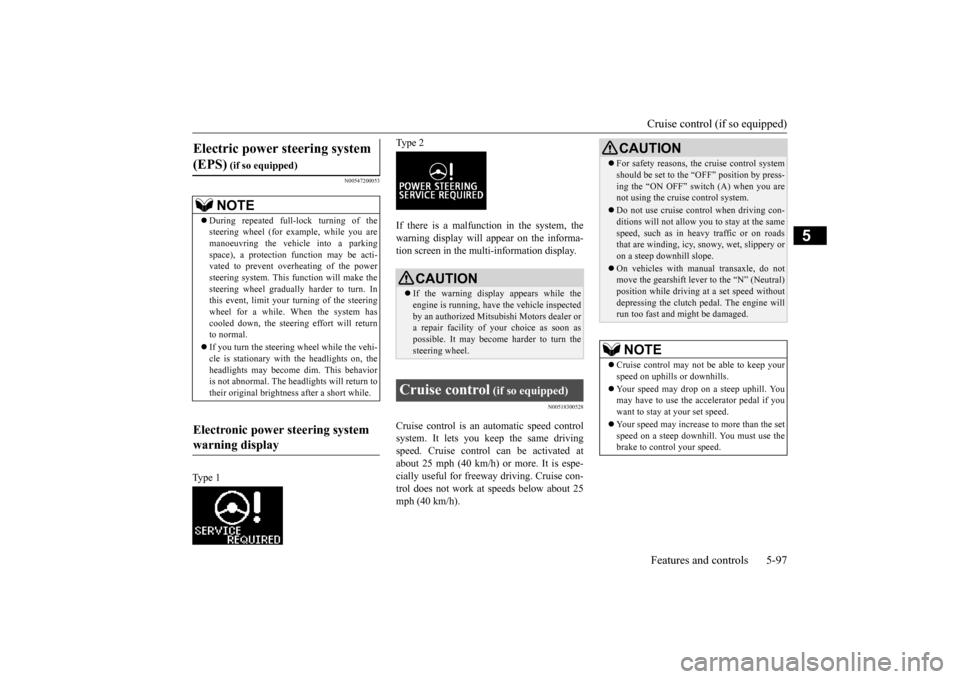
Type 1
Type 2 If there is a malfunction in the system, the warning display will appear on the informa- tion screen in the multi-information display.
N00518300528
Cruise control is an automatic speed control system. It lets you keep the same driving speed. Cruise control can be activated atabout 25 mph (40 km/h) or more. It is espe-cially useful for freeway driving. Cruise con- trol does not work at speeds below about 25 mph (40 km/h).
Electric power steering system (EPS)
(if so equipped)NOTE
During repeated full-lock turning of the steering wheel (for example, while you are manoeuvring the vehicle into a parkingspace), a protection function may be acti- vated to prevent overheating of the power steering system. This function will make thesteering wheel gradually harder to turn. In this event, limit your tu
rning of the steering
wheel for a while. When the system hascooled down, the steering effort will return to normal. If you turn the steering wheel while the vehi- cle is stationary with the headlights on, the headlights may become dim. This behavioris not abnormal. The headlights will return to their original brightness after a short while.
Electronic power steering system warning display
CAUTION If the warning display appears while the engine is running, have the vehicle inspected by an authorized Mitsubishi Motors dealer ora repair facility of your choice as soon as possible. It may become harder to turn the steering wheel.
Cruise control
(if so equipped)
CAUTION For safety reasons, the cruise control system should be set to the “OFF” position by press- ing the “ON OFF” switch (A) when you are not using the cruise control system. Do not use cruise control when driving con- ditions will not allow you to stay at the same speed, such as in heavy traffic or on roadsthat are winding, icy, snowy, wet, slippery or on a steep downhill slope. On vehicles with manual transaxle, do not move the gearshift lever to the “N” (Neutral) position while driving at a set speed withoutdepressing the clutch pedal. The engine will run too fast and might be damaged. NOTE
Cruise control may not be able to keep your speed on uphills or downhills. Your speed may drop on a steep uphill. You may have to use the accelerator pedal if you want to stay at your set speed. Your speed may increase to more than the set speed on a steep downhill. You must use the brake to control your speed.
BK0210300US.bo
ok 97 ページ 2014年4月8日 火曜日 午前10時46分
Page 173 of 434

Tire pressure monitoring system 5-104 Features and controls
5
Each tire, including the spare (if provided), should be checked monthly when cold and inflated to the inflation pressure recom-mended by the vehicle manufacturer on thevehicle placard or tire inflation pressure label. (If your vehicle has tires of a different size than the size indicated on the vehicle placardor tire inflation pressure label, you should determine the proper tire inflation pressure for those tires.)As an added safety feature, your vehicle has been equipped with a tire pressure monitoring system (TPMS) that illuminates a low tirepressure telltale when one or more of your tires is significantly under-inflated. Accordingly, when the low tire pressure tell-tale illuminates, you should stop and check your tires as soon as possible, and inflate them to the proper pressure. Driving on a sig-
nificantly under-inflated tire causes the tire tooverheat and can lead to tire failure. Under-inflation also reduces fuel efficiency and tire tread life, and may affect the vehi-cle’s handling and stopping ability. Please note that the TPMS is not a substitute for proper tire maintenance, and it is the driver’sresponsibility to maintain correct tire pres- sure, even if under-inflation has not reached the level to trigger illumination of the TPMSlow tire pressure telltale.Your vehicle has also been equipped with a TPMS malfunction indicator to indicate when the system is not operating properly. TheTPMS malfunction indicator is combined with the low tire pressure telltale. When the system detects a malfunction, thetelltale will flash for approximately one min- ute and then remain continuously illuminated. This sequence will continue upon subsequentvehicle start-ups as long as the malfunction exists. When the malfunction indicator is illumi-nated, the system may not be able to detect or signal low tire pressure as intended. TPMS malfunctions may occur for a varietyof reasons, including the installation of replacement or alternate tires or wheels on the vehicle that prevent the TPMS from function-ing properly. Always check the TPMS mal- function telltale after replacing one or more tires or wheels on your vehicle to ensure that
the replacement or alternate tires and wheelsallow the TPMS to continue to function prop- erly.
N00532800439
1. If the tire pressure monitoring systemwarning light illuminates, avoid hard braking, sharp steering maneuvers andhigh speeds. You should stop and adjust the tires to the proper inflation pressure as soon as possible. Adjust the spare tire atthe same time. Refer to “Tires” on page 9-17.
Type 1 Type 2NOTE
If the warning light/display illu- minates while driving
NOTE
In addition, the warning display is displayed on the information screen in the multi-infor- mation display.When inspecting or adjusting the tire pres-sure, do not apply excessive force to the valve stem to avoid breakage.After inspecting or adjusting the tire pres-sure, always reinstall the valve cap on the valve stem. Without the valve cap, dirt or moisture couldget into the valve, resulting in damage to the tire inflation pressure sensor.Do not use metal valve caps, which maycause a metal reaction, resulting in corrosion and damage of the tire inflation pressure sen-sors.
SC00000600-3.f
m 104 ページ 2014年4月16日 水曜日 午前9時38分
Page 174 of 434
Tire pressure monitoring system
Features and controls 5-105
5
2. If the tire pressure monitoring system warning light remains illuminated after you have been driving for about 20 min- utes after you adjust the tire inflation pres-sure, one or more of the tires may have apuncture. Inspect the tire and if it has a puncture, have it repaired by an autho- rized Mitsubishi Motors dealer as soon aspossible.
The tire pressure monitoring system may not work normally in the following circum- stances: A wireless facility or device using the same frequency is near the vehicle. Snow or ice is stuck inside the fenders and/or on the wheels. The tire inflation pressure sensor’s battery is dead. Wheels other than Mitsubishi genuine wheels are being used. Wheels that are not fitted with tire infla- tion pressure sensors are being used. Wheels whose ID co
des are not memo-
rized by the vehicle are used. Compact spare tire is fitted on a road wheel.
A window tint that affects the radio wave signals is installed.
N00532900179
If new wheels with new tire inflation pressuresensors are installed, their ID codes must beprogrammed into the tire pressure monitoring system. Have tire and wheel replacement per- formed by an authorized Mitsubishi Motorsdealer to avoid the risk of damaging the tire inflation pressure sensors. If the wheel replacement is not done by an authorizedMitsubishi Motors dealer, it is not covered by your warranty.
Once adjustments have been made, the warn- ing light will go off after a few minutes of driving.WA R N I N G If the warning light/display illuminates while you are driving, avoid hard braking, sharp steering maneuvers and high speeds. Driving with an under-inflated tireadversely affects vehicle performance and can result in an accident.CAUTION If a tire has a puncture, replace that tire with the spare tire. Driving on a punctured tire could lead to an accident. The warning light/display may not illuminate immediately in the event of a tire blowout orrapid leak.NOTE
NOTE
To avoid the risk of damage to the tire infla- tion pressure sensors, have any punctured tire repaired by an authorized Mitsubishi Motors dealer. If the tire repair is not done by an authorized Mitsubishi Motors dealer, it isnot covered by your warranty. Do not use an aerosol puncture-repair prod- uct on any tire. Such a spray could damage the tire inflation pressure sensors. Have any puncture repaired by an authorized Mitsubi-shi Motors dealer.
NOTE
Tire inflation pressures vary with the ambi- ent temperature. If the vehicle is subjected to large variations in ambient temperature, thetire inflation pressures may be under-inflated (causing the warning light/display to come on) when the ambient temperature is rela-tively low. If the warning light/display comes on, adjust the tire inflation pressure.
Whenever the tires and wheels are replaced with new ones
BK0210300US.book
105 ページ 2014年4月8日 火曜日 午前10時46分
Page 204 of 434
Indicator light, warning light, an
d information screen display list Features and controls 5-135
5
N00558101323
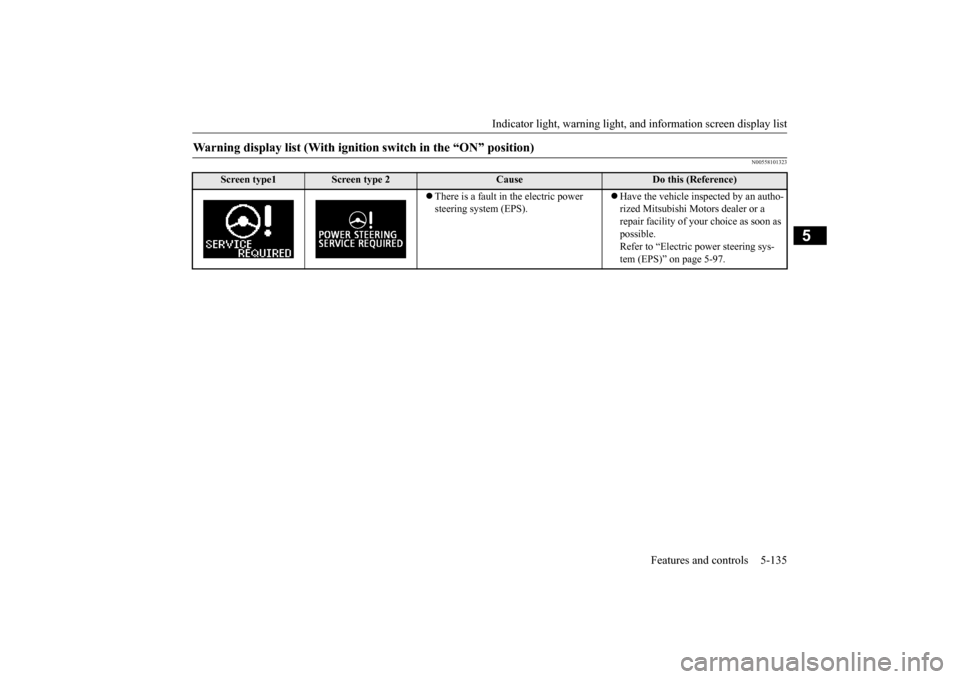
Warning display list (With ignition switch in the “ON” position)
Screen type1
Screen type 2
Cause
Do this (Reference)
There is a fault in the electric power steering system (EPS).
Have the vehicle inspected by an autho- rized Mitsubishi Motors dealer or a repair facility of your choice as soon as possible. Refer to “Electric power steering sys- tem (EPS)” on page 5-97.
BK0210300US.book
135 ページ 2014年4月8日 火曜日 午前10時46分