change time MITSUBISHI LANCER 2015 8.G Repair Manual
[x] Cancel search | Manufacturer: MITSUBISHI, Model Year: 2015, Model line: LANCER, Model: MITSUBISHI LANCER 2015 8.GPages: 434, PDF Size: 16.59 MB
Page 345 of 434
Engine overheating 8-4 For emergencies
8
If you drive your vehicle with a low battery charge, after the engine has been started by
using jumper cables, the engine may misfire. This can cause the anti-lock braking system warning light to blink on and off. This is only due to the low battery voltage. It is not aproblem with the brake system. If this hap- pens, fully charge the battery and ensure the charging system is operating properly.
N00836500323
When the engine has overheated, the infor- mation screen in the multi-information dis- play will be interrupted and the enginecoolant temperature warning display will appear. The screen will then change to the engine coolant temperature display screen and “ ” will flash. If this happens: 1. Stop the vehicle in a safe place. Turn on the hazard warning flashers. 2. With the engine still running, carefullyraise the engine hood to vent the engine compartment. 3. Check that the cooling fan is running. Ifthe fan is not turning, stop the engine immediately and contact an authorized Mitsubishi Motors dealer or a repair facil-ity of your choice for assistance.
4. If you see steam or spray coming from under the hood, turn off the engine.5. If you do not see steam or spray coming from under the hood, leave the engine on until the bar graph for the engine coolanttemperature warning display on the multi-information display goes down. When it is in the middle of the normal zone, you can start driving again. If the bar graphstays in the red zone, turn off the engine. 6. When you do not see any more steam or spray, open the hood. Look for obvious leaks, such as a split radiator hose. Becareful as components will be hot. Any leak source must be repaired.
WA R N I N G Charging your battery while it is still in your vehicle might cause the battery to catch fire and explode. If you have to charge it while in the vehicle, disconnect the negative terminal. Keep sparks, cigarettes and flames away from the battery because the battery mayexplode. Keep your work area well vented when charging or using the battery in an enclosed space. Remove all the caps before charging the battery. Electrolyte (battery acid) is corrosive diluted sulphuric acid. If electrolyte comes in contact with your hands, eyes, clothes,or the painted surface of your vehicle, thoroughly flush with water. If electrolyte gets in your eyes, flush them immediatelyand thoroughly with water, and get prompt medical attention. Always wear protective clothing and gog- gles when working near the battery. Keep the battery out of the reach of chil- dren.
As your vehicle has anti-lock brakes
Engine overheating
WA R N I N G To avoid personal injury, keep hands, hair, jewelry and clothes away from the cooling fan. The cooling fan can start at any time.WA R N I N G Before raising the engine hood, check to see if there is steam or spray coming from under the hood. Steam or spray comingfrom an overheated engine could seriously scald you. Do not open the hood until there is nosteam or spray.
BK0210300US.bo
ok 4 ページ 2014年4月8日 火曜日 午前10時46分
Page 348 of 434
How to change a tire
For emergencies 8-7
8
6. Get the jack, bar and wheel nut wrench ready.Refer to “Tools and jack” on page 8-5.
N00849600298
The compact spare tire is designed to savespace in the trunk. Its lighter weight makes it easier to use if a flat tire occurs.
N00849701300
1. Lift up the luggage floor board. For front-wheel drive vehicles, pull theluggage floor board (A) rearward to release the hooks (B), and then lift it up.
WA R N I N G Be sure to apply chocks or blocks to the correct tire when jacking up the vehicle. If the vehicle moves while jacked up, the jack could slip out of position, leading to an accident.NOTE
The chocks shown in the illustration do not come with your vehicle. It is recommended that you purchase chocks or blocks and keepthem in the vehicle for use if needed. If chocks or blocks are not available, use stones or any other objects that are large enough to hold the wheel in position.
Spare tire information Compact spare tire
WA R N I N G Tires, including spare tire, degrade over time with age even when they are not being used. It is recommended that tires over 6 years generally be replaced even if damage is not obvious.CAUTION While the compact spare tire is stowed, the inflation pressure should be checked at least once a month to assure that it remains at therecommended inflation pressure. See the tire and loading information placard attached to the driver’s door sill.Refer to “Tire and loading information plac- ard” on page 11-3. Driving with an improperly inflated tire can cause an accident. If you have no choice but to drive with an under-inflated tire, keepyour speed down and avoid sudden steering or braking, if possible
. Inflate the tire to the
correct pressure as soon as possible. Refer to“Tire inflation pressures” on page 9-21. The compact spare tire should be used only temporarily. While the compact spare tire is being used, the tire pressure monitoring sys- tem will not function properly. Have the tire replaced or repaired at an authorized Mit- subishi Motors dealer or a repair facility ofyour choice as soon as possible. If your vehicle has aluminum type wheels, you can use the same wheel nuts on the com- pact spare tire wheel.
Do not go over 50 mph (80 km/h) when driv- ing with the compact spare tire. Avoid fast starting and braking when driving with the compact spare tire. Do not drive through automatic car washes and over obstacles that could possibly dam-age the underside of your vehicle. Because the compact spare tire is smaller than the original tire, there is less clearance betweenthe ground and your vehicle. Because the compact spare tire is designed only for your vehicle, do not use it on any other vehicle. Do not put the compact spare tire on a differ- ent wheel, and do not put standard tires, snow tires, wheel covers or trim rings on thecompact spare wheel. Otherwise, you could damage these parts or other parts on your vehicle. Do not use snow chain with your compact spare tire. Using a chain could cause damageto your vehicle and loss of the chains.
To remove the compact spare tire
CAUTION
BK0210300US.bo
ok 7 ページ 2014年4月8日 火曜日 午前10時46分
Page 350 of 434
How to change a tire
For emergencies 8-9
8
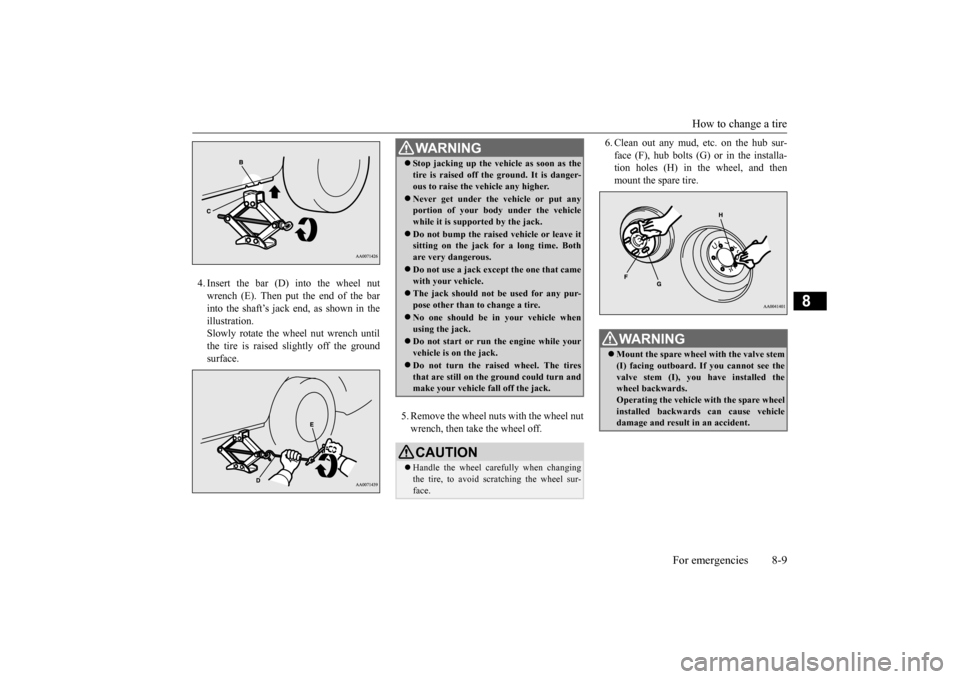
4. Insert the bar (D) into the wheel nut wrench (E). Then put the end of the barinto the shaft’s jack end, as shown in the illustration. Slowly rotate the wheel nut wrench untilthe tire is raised slightly off the ground surface.
5. Remove the wheel nuts with the wheel nut wrench, then take the wheel off.
6. Clean out any mud, etc. on the hub sur- face (F), hub bolts (G) or in the installa- tion holes (H) in the wheel, and then mount the spare tire.
WA R N I N G Stop jacking up the vehicle as soon as the tire is raised off the ground. It is danger- ous to raise the vehicle any higher. Never get under the vehicle or put any portion of your body under the vehicle while it is support
ed by the jack.
Do not bump the raised vehicle or leave it sitting on the jack for a long time. Both are very dangerous. Do not use a jack except the one that came with your vehicle. The jack should not be used for any pur- pose other than to change a tire. No one should be in your vehicle when using the jack. Do not start or run the engine while your vehicle is on the jack. Do not turn the raised wheel. The tires that are still on the ground could turn andmake your vehicle fall off the jack. CAUTION Handle the wheel carefully when changing the tire, to avoid scratching the wheel sur- face.
WA R N I N G Mount the spare wheel with the valve stem (I) facing outboard. If you cannot see the valve stem (I), you have installed the wheel backwards.Operating the vehicle with the spare wheel installed backwards can cause vehicle damage and result in an accident.
BK0210300US.bo
ok 9 ページ 2014年4月8日 火曜日 午前10時46分
Page 379 of 434
Tires 9-22 Vehicle care and maintenance
9
Tire pressures should be checked, and adjusted if necessary, at least once a month. Pressures should be checked more often whenever weather temperatures changeseverely, because tire pressures change with outdoor temperatures. The pressures listed on the placard are always “cold inflation pres-sure”. Cold inflation pressure
is measured after the
vehicle has been parked for at least threehours or is driven less than 1 mile (1.6 km)after having been parked for three hours. Cold inflation pressure must not go above the maximum values molded into the tire side-wall. After driving several miles, your tire inflation pressure may increase 14 to 41 KPA, 2 to 6 PSI from the cold inflation pressure.Do not let air out of the tires to get back to the specified cold pressure, or your tire pressure will be too low.Check your tires each time you refuel. If one tire looks lower than the others, check the pressure for all of them.You should also take the following safety pre- cautions:
Keep your tires inflated to the recom- mended pressures. (See the tire and load- ing information placard attached to the sill of the driver’s door.) Stay within the recommended load limits. Make sure that the weight of any load in your vehicle is evenly distributed. Drive at safe speeds. After filling your tires to the correct pres- sure, check them for damage and airleaks. Be sure to reinstall the caps on thevalve stems.
N00939600368
N00939700154
The following maintenance steps are recom- mended: Check tire pressures regularly.
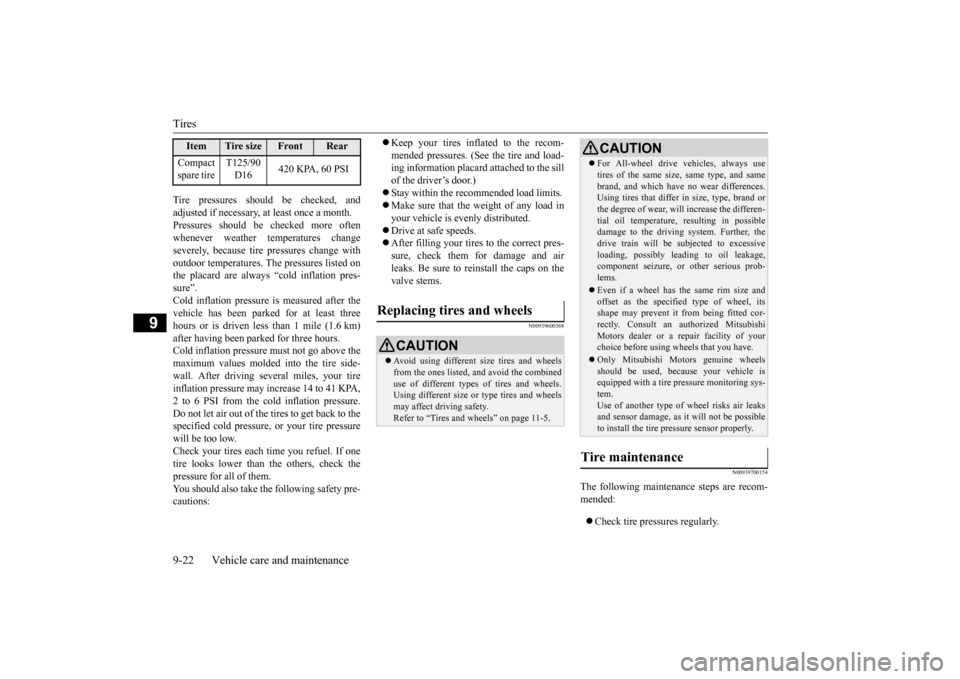
Compact spare tire
T125/90 D16
420 KPA, 60 PSI
Item
Tire size
Front
Rear
Replacing tires and wheels
CAUTION Avoid using different size tires and wheels from the ones listed, and avoid the combined use of different types of tires and wheels.Using different size or type tires and wheels may affect driving safety. Refer to “Tires and wheels” on page 11-5.
For All-wheel drive vehicles, always use tires of the same size, same type, and same brand, and which have no wear differences. Using tires that differ in size, type, brand or the degree of wear, will increase the differen-tial oil temperature, resulting in possible damage to the driving system. Further, the drive train will be subjected to excessiveloading, possibly leading to oil leakage, component seizure, or other serious prob- lems. Even if a wheel has the same rim size and offset as the specified type of wheel, itsshape may prevent it from being fitted cor- rectly. Consult an authorized Mitsubishi Motors dealer or a repair facility of yourchoice before using wheels that you have. Only Mitsubishi Motors genuine wheels should be used, because your vehicle is equipped with a tire pressure monitoring sys- tem.Use of another type of wheel risks air leaks and sensor damage, as it will not be possible to install the tire pressure sensor properly.
Tire maintenance
CAUTION
BK0210300US.bo
ok 22 ページ 2014年4月8日 火曜日 午前10時46分
Page 383 of 434

Emission-control system maintenance 9-26 Vehicle care and maintenance
9
and Environment Canada. The emission-con- trol system is made of: a positive crankcase ventilation system an evaporative emission-control system an exhaust emission-control system
The maintenance services listed in the “WARRANTY AND MAINTENANCE MANUAL” must be performed at the times or mileages listed to keep the emission-con-trol system working properly. These, and allthe other “general” maintenance services listed in this manual, need to be performed to keep your vehicle running properly and reli-ably. You may need more frequent maintenance if you drive your vehicle in harsh conditions such as dusty areas or do a lot of start-and-stop driving. To be sure the emission-control system works properly, have your vehicle inspected and maintained by an authorized MitsubishiMotors dealer or a repair facility of your choice following the schedule in the “WAR- RANTY AND MAINTENANCE MAN-UAL”. You should also have an inspection and ser- vice any time you suspect a malfunction.
N00940900215
Spark plugs must fire properly for goodengine performance and emission-control.Do not reuse them by cleaning or regapping. Change them at the mileage listed in the “WARRANTY AND MAINTENANCEMANUAL”.
N00941000037
Check the hose surfaces for any heat andmechanical damage, hard and brittle rubber,cracking, tears, cuts and abrasions. Pay spe- cial attention to the hoses closest to high heat sources such as the exhaust manifold. Checkall the hose connections, such as clamps and couplings, to make sure they are secure and that there are no leaks. If you see any wear ordamage, replace the hoses immediately.
N00950100050
Have the valve clearance checked at anauthorized Mitsubishi Motors dealer at themileage specified in the “WARRANTY AND MAINTENANCE MANUAL”. If the engine sounds abnormally loud, haveadjustments made by an authorized Mitsubishi Motors dealer.
N00941300085
Check these regularly for damage or leaks in the fuel lines and connections. Check the fuel tank filler cap for damage or looseness. Pay special attention to the fuel lines closest to
NOTE
To meet government regulations and pro- mote cleaner air, your vehicle is equipped with an onboard diagnostic system (OBD). The engine electronic control module that controls OBD functions stores various data(especially about the exhaust emissions). This data will be erased if the battery cable is disconnected, which could make a rapiddiagnosis difficult. Do not disconnect the battery cable when the engine malfunction indicator (“SERVICE ENGINE SOON” or“Check engine light”) is on.
Spark plugs
NOTE
Use the spark plugs listed under “Engine specifications” on page 11-5 or plugs that are exactly the same. Other plugs could causeengine damage, performance problems or radio noise.
Fuel hoses Intake valve clearance Fuel system (tank, pipe line and connection, and fuel tank filler cap)
BK0210300US.bo
ok 26 ページ 2014年4月8日 火曜日 午前10時46分
Page 385 of 434
For cold and snowy weather 9-28 Vehicle care and maintenance
9
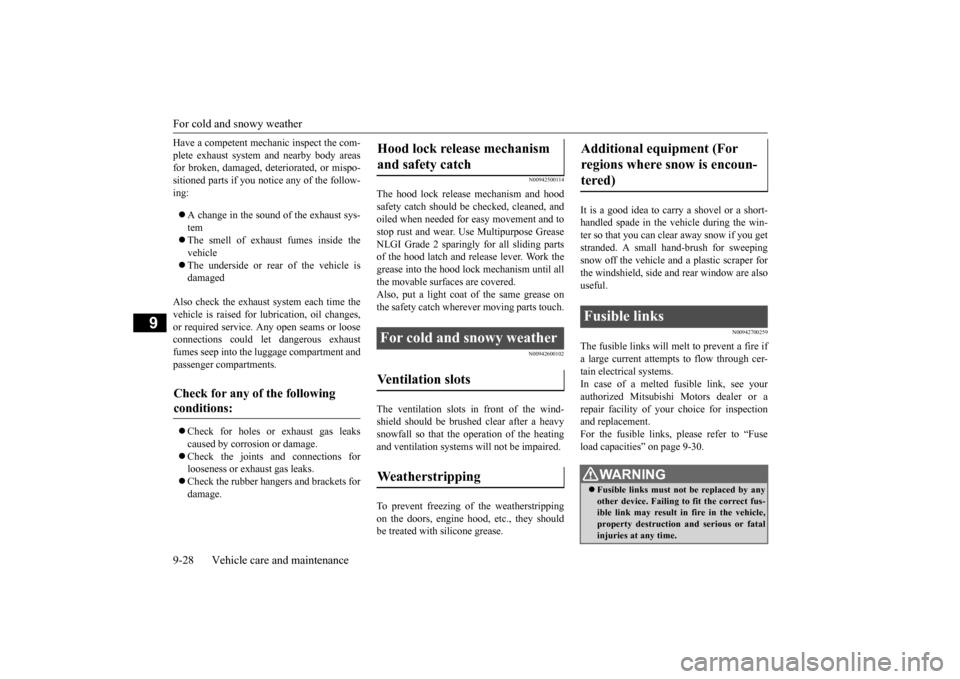
Have a competent mechanic inspect the com- plete exhaust system and nearby body areas for broken, damaged, deteriorated, or mispo- sitioned parts if you notice any of the follow-ing: A change in the sound of the exhaust sys- tem The smell of exhaust fumes inside the vehicle The underside or rear of the vehicle is damaged
Also check the exhaust system each time the vehicle is raised for lubrication, oil changes,or required service. Any open seams or loose connections could let dangerous exhaust fumes seep into the luggage compartment andpassenger compartments. Check for holes or exhaust gas leaks caused by corrosion or damage. Check the joints and connections for looseness or exhaust gas leaks. Check the rubber hangers and brackets for damage.
N00942500114
The hood lock release mechanism and hoodsafety catch should be checked, cleaned, and oiled when needed for easy movement and to stop rust and wear. Use Multipurpose GreaseNLGI Grade 2 sparingly for all sliding parts of the hood latch and release lever. Work the grease into the hood lock mechanism until allthe movable surfaces are covered.Also, put a light coat of the same grease on the safety catch wherever moving parts touch.
N00942600102
The ventilation slots in front of the wind-shield should be brushed clear after a heavy snowfall so that the operation of the heatingand ventilation systems will not be impaired. To prevent freezing of the weatherstripping on the doors, engine hood, etc., they should be treated with silicone grease.
It is a good idea to carry a shovel or a short- handled spade in the vehicle during the win- ter so that you can clear away snow if you getstranded. A small hand-brush for sweeping snow off the vehicle and a plastic scraper for the windshield, side and rear window are alsouseful.
N00942700259
The fusible links will melt
to prevent a fire if
a large current attempts to flow through cer-tain electrical systems. In case of a melted fusible link, see your authorized Mitsubishi Motors dealer or arepair facility of your choice for inspection and replacement. For the fusible links, please refer to “Fuseload capacities” on page 9-30.
Check for any of the following conditions:
Hood lock release mechanism and safety catch For cold and snowy weather Ventilation slots Weatherstripping
Additional equipment (For regions where snow is encoun- tered) Fusible links
WA R N I N G Fusible links must not be replaced by any other device. Failing to fit the correct fus- ible link may result in fire in the vehicle,property destruction and serious or fatal injuries at any time.
BK0210300US.bo
ok 28 ページ 2014年4月8日 火曜日 午前10時46分
Page 427 of 434

Alphabetical index 12-2
12
Coming home light
...........................
5-151
Consumer information
........................
10-2
Continuously variable transmission (CVT)
....
5-61Fluid
.....................
...............
9-11
, 11-6
Selector lever operation
...................
5-61
Sports mode
..................
.................
5-66
Coolant (engine)
..........................
9-8
, 11-6
Cruise control
....................
.................
5-97
Indicator
...................
.....................
5-98
Cup holder
....................
...................
5-190
D
Daytime running lights
Bulb capacity
................
.................
9-34
Replacement
.................
.................
9-38
Defogger (rear window)
....................
5-158
Defrosting or defogging (windshield, door windows)
...............
7-12
, 7-17
, 7-22
, 7-27
Digital clock
Time setting
..................
.................
7-59
Dimensions
...................
.....................
11-4
Dimmer (high/low beam change)
.......
5-150
Disc brake pads
.................
.................
9-27
Dome light
Bulb capacity
................
.................
9-36
Replacement
.................
.................
9-47
Switch
......................
...................
5-186
Dome light/Reading lights
Bulb capacity
..................
................
9-36
Replacement
...................
................
9-46
Switch
.....................
.....................
5-186
Doors
Lock
.......................
.......................
5-35
Power door locks
............................
5-37
Drive mode indicator
...........................
5-85
Drive mode-selector
............................
5-84
Driving during cold weather
..................
6-4
Driving, alcohol and drugs
....................
6-2
E
Electric rear window defogger switch
..5-158
Electronic immobilizer (Anti-theft starting system)
.....................
................
5-4
, 5-28
Electronically controlled 4WD system
..5-84
Drive mode indicator
.......................
5-85
Drive mode-selector
........................
5-84
Emergency key
...................
................
5-23
Emission-control system maintenance
...
9-25
Engine
Compartment
..................
.................
9-5
Coolant
...................
................
9-8
, 11-6
Hood
.......................
........................
9-3
Oil and oil filter
.......................
9-6
, 11-6
Overheating
....................
.................
8-4
Serial number
.................
................
11-2
Specifications
.................
................
11-5
Engine coolant temperature display
....
5-117
Exhaust system
..................
.................
9-27
F
Filling the fuel tank
...............
................
3-4
Floor console box
.............................
5-189
Floor mat
......................
.......................
6-2
Fluid
..........................
........................
11-6
AWC control fluid
..........................
9-12
Brake fluid
............................
9-13
, 11-6
Clutch fluid
...........................
9-13
, 11-6
Continuously variable transmission (CVT) fluid
....................
...............
9-11
, 11-6
Engine coolant
........................
9-8
, 11-6
Power steering fluid
...............
9-14
, 11-6
Twin Clutch Sportron
ic shift transmission
(Twin Clutch SST) fluid
.......
9-12
, 11-6
Washer fluid
.................
.................
11-6
Fluid capacities and lubricants
.............
11-6
Fog lights
Bulb capacity
................
.................
9-34
Indicator
...................
...................
5-143
Replacement
.........................
9-41
, 9-42
Switch
......................
...................
5-153
Free-hand advanced security transmitter (F.A.S.T.-key)
.................
.................
5-12
Front console boxes
..........................
5-189
Front console tray
.............................
5-189
Front seats
.........................
...................
4-3
BK0210300US.bo
ok 2 ページ 2014年4月8日 火曜日 午前10時46分
Page 430 of 434
Alphabetical index
12-5
12
Sun visors
.....................
...................
5-184
Supplemental Restraint System
............
4-21
How the Supplement Restraint System works
.....................
.....................
4-24
Servicing
..................
.....................
4-36
Warning light/display
......................
4-27
T
Tank capacity
..............................
3-4
, 11-6
Theft-alarm system
System
......................
.....................
5-42
Time Setting
..................
.....................
7-59
Tire pressure monitoring system
.........
5-102
Warning light/display
....................
5-103
Tires
..........................
........................
9-17
How to change a tire
.........................
8-6
Inflation pressure
............................
9-21
Maintenance
..................
.................
9-22
Quality grading
...............................
10-2
Replacing tires and wheels
...............
9-22
Rotation
....................
.....................
9-23
Size (tire and wheel)
.......................
11-5
Snow tires
.....................
.................
9-24
Tire and loading information placard
.6-7
,
11-3 Tire chains
....................
.................
9-24
Tread wear indicators
......................
9-23
Tissue holder
.....................
...............
5-190
Tools
.........................
..........................
8-5
Storage
.........................
...................
8-5
Towing
........................
......................
8-12
Trailer towing
.....................
...............
6-11
Transfer oil
......................
..................
9-12
Trunk area light
Replacement
...................
...............
9-48
Trunk lid
.........................
..................
5-39
Turbocharger operation
.......................
5-59
Turn signal light
Indicators
....................
.................
5-143
Turn signal lights
Bulb capacity
..................
...............
9-34
Lever
......................
.....................
5-152
Replacement
...................
...............
9-40
Twin Clutch SST (Sportronic Shift Transmission)
...................
...............
5-70
Fluid
....................
.................
9-12
, 11-6
Gearshift lever operation
.................
5-70
Gearshift lever position display
........
5-71
Manual shift
....................
...............
5-76
Manual shift display
.......................
5-79
Twin Clutch SST control mode display
....
5-76 Twin Clutch SST control mode switch
.....
5-75 Warning display
.............................
5-72
U
USB input terminal
............................
5-181
How to connect an iPod
.................
5-182
USB input terminal device
How to connect a USB memory
.....
5-181
V
Vanity mirror
.....................
...............
5-184
Vehicle care precautions
......................
9-48
Vehicle dimensions
.............................
11-4
Vehicle labeling
.................
.................
11-2
Vehicle preparation before driving
..........
6-3
Vehicle weights
.................
.................
11-4
Vents
............................
.......................
7-2
W
Warning lights
...................
...............
5-144
Washer
Fluid
..................
...................
9-13
, 11-6
Switch
......................
...................
5-157
Windshield washer
........................
5-157
Waxing
......................
........................
9-51
Weights
........................
.....................
11-4
Welcome light
...................
...............
5-151
Wheel
Covers
......................
.....................
8-11
Specification
.................
.................
11-5
Wiper
Rain sensor
...................
...............
5-155
Windshield
....................
...............
5-154
BK0210300US.bo
ok 5 ページ 2014年4月8日 火曜日 午前10時46分