light MITSUBISHI LANCER 2016 8.G User Guide
[x] Cancel search | Manufacturer: MITSUBISHI, Model Year: 2016, Model line: LANCER, Model: MITSUBISHI LANCER 2016 8.GPages: 392, PDF Size: 13.12 MB
Page 16 of 392
If this problem occurs...2-6
Quick index
2
Problem
Do this
Ref. page
The brakes are not functioning prop- erly after driving through wate
r.
Dry
out
the brakes
by
driving
slowly whil
e lightly pressing the brake pedal.
P.6-5
The CVT makes no engine speed to vehicle speed ratio change when accelerating.
The
initial
movement
of
the vehicle is slow when the vehicle starts
moving.
(for vehicles with CVT)
There may be a problem in the CVT
.
If the
or
warning lights on the multi-infor
mation display will not turn o
ff, or if
they are coming on frequently
, please have
the vehicle checked at your nearest Mitsubi-
shi Motors deale
r.
P.5-67
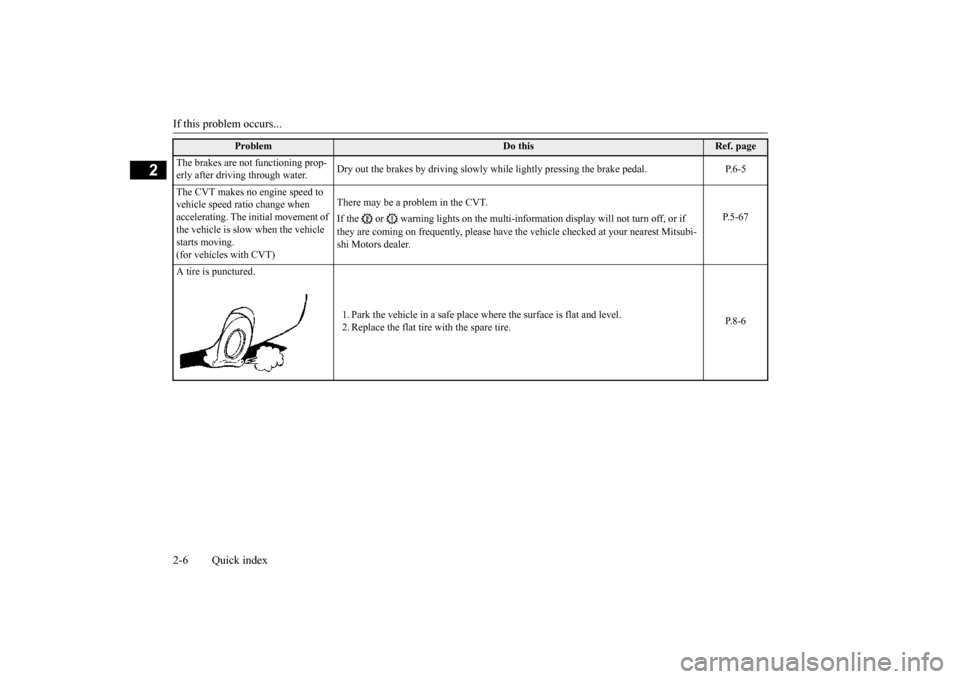
A tire is punctured.
1.Park
the
vehicle
in a safe
place
where
the
surface
is flat
and
level.
2.Replace the flat tire with the spare tire.
P.8-6
Page 21 of 392
Modifications to and racing of your vehicle
General information
3-5
3
7.To close,
turn
the
fuel
tank
filler
cap
slowly
clockwise
until
you
hear
clicking
sounds,
then
gently
push
the
fuel
tank
filler door closed.
N00301600
048
This
vehicle
should
not
be
modified
with
non-Mitsubishi
Motors
genuine
parts.
Mit-
subishi
Motors
designs
and
manufactures
high
quality
vehicles
with
an
emphasis
on
safety
and
durabilit
y. Modifications
using
non-Mitsubishi
Motors
genuine
parts
may
affect
the
performance,
safety
and/or
durabil-
ity
of
your
vehicle,
and
may
violate
applica-
ble state and/or federal regulations. DAMAGE
OR
PERFORMANCE
PROB-
LEMS
RESUL
TING
FR
OM
MODIFICA-
TIONS
TO OR
RACING
OF
YOU
R
VEHICLE
ARE
NOT
COVERED
UNDER
W
ARRANTY
.
Examples
of
modifications
to
your
vehicle
that
can
cause
damage
or
performance
prob-
lems
include
the
following:
Failure
to use
Mitsubishi
Motors
genuine
partsFailure
to use
required
fuel
and
fluids
Failure to use proper size tires and wheelsModification
of
the
fuel,
intake,
exhaust,
emission,
suspension,
engine,
drive
train
or electrical wiring systems
Modification
of
any
onboard
com-
puter/control
module,
including
repro-
gramming,
or
replacing/adding
chips
to
any
onboard
computer/control
module
Review
the
Warranty
and
Maintenance
Man-
ual
for
further
details
regarding
warranty
cov-
erage.
N00301700
182
The
installation
of
accessories,
optional
parts,
etc.,
should
only
be
carried
out
within
the
limits
prescribed
by
law
in the
driving
area
and
in
accordance
with
the
guidelines
and
warnings
contained
within
the
documents
accompanying
this
vehicle.
Only
Mitsubis
hi
Motors
approved
acces
-
sories should be fitted to your vehicle.Improper
installation
of
electrical
parts
could
cause
fire.
Refer
to
the
“Modifica-
tion/alterations
to
the
electrical
or
fuel
systems”
section
with
in this
owner
’s man
-
ual.
W
AR
NING
Make
sur
e the
fuel
cap
is secur
ely closed.
If the
fuel
cap
is loose,
fuel
could
leak,
resulting
in a fire.
CAUTIONIf you
need
to replace
the fuel
tank
filler
cap
,
use only
the
cap
specified
for
your
model
vehicle. NOTE
If the
fuel
tank
filler
cap
is not
tight
while
driving,
the
engine
malfunction
indicator
(“SER
VICE
ENGINE
SOON”
or
“Check
engin
e light”)
may
come
on when
the
onboard
diagnostic
(OBD)
system
performs
a self check.
Always
tigh
ten
the
fuel
tan
k filler
cap
until
you
hear
clicking
sounds.
The indicator
will go off after drivin
g several
times.
If the
indicator
does not go off, con
-
tact
your authorized
Mitsubishi
Mot
ors
dealer
or a repair
facility
of your
choice
as
soon
as possible.
Modifications to and racing of your vehicle
Installation of accessories
CAUTIONBef
ore any electr
ical
or
electronic
accesso-
ries are installed,
consult
an
authorized
Mit-
subishi
Motors
dealer
.
Page 27 of 392
Front seats
Seat and restraint systems
4-3
4
Safety
equipment
cannot
prevent
injury
or
death
in all motor
vehicle
accidents.
You
can
help
reduce
the
risk
of
injury
or
death,
how-
ever
, by
following
the
instructions
in this
manual.
N00401801
442
Position
the
driver
’s seat
as far
back
as possi-
ble
while
maintaining
a position
that
still
enables
you
to
fully
apply
the
pedals,
easily
control
the
steering
wheel
and
safely
operate
the vehicle.
N00401901
355
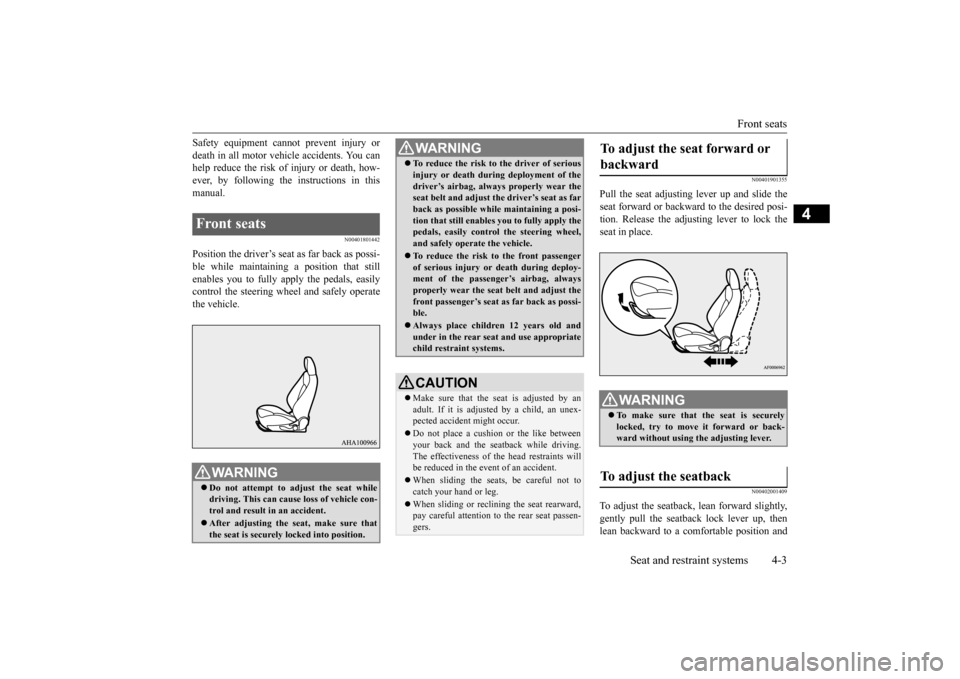
Pull
the
seat
adjusting
lever
up
and
slide
the
seat
forward
or
backward
to the
desired
posi-
tion.
Release
the
adjusting
lever
to
lock
the
seat in place.
N00402001
409
To adjust
the
seatback,
lean
forward
slightly
,
gently
pull
the
seatback
lock
lever
up,
then
lean
backward
to
a comfortable
position
and
Fr
ont seats W
AR
NING
Do
not
attempt
to
adjust
the
seat
while
drivin
g. This can
cause
loss
of veh
icle
con
-
trol and
resul
t in an
accid
ent.
After
adjusting
the
seat,
make
sur
e that
the
seat
is secur
ely locked
into
position.
To reduce
the
risk
to the
driver
of serious
injur
y or death
during
deployment
of the
driver
’s airbag,
always
properly
wear
the
seat belt and adjust t
he driv
er’s seat as far
bac
k as possi
ble while
mai
ntai
ning
a posi
-
tion
that still
enables you
to fully
appl
y the
pedals,
easily
contr
ol
the
steering
wheel,
and safely
operate
the
vehicle.
To reduce
the
risk
to the
front
passenger
of serious
injur
y or death
during
deploy-
men
t of
the passenger
’s airb
ag,
alw
ays
properly
wear the
seat belt and
adjust
the
front
passenger
’s seat
as far
back
as possi-
ble.Always
place
children 12
years
old
and
under
in the
rear seat and
use
appr
opriate
child restraint syste
ms.
CAUTIONMake
sure
that
the
seat
is adjus
ted
by
an
adult.
If it is adjus
ted
by
a child,
an
unex-
pected
accident
might
occur
.
Do
not
place
a cushion
or the
like
between
your
back
and
the
seatback
while
driving.
The
effectiveness
of the
head
restraints
will
be reduced
in the
event
of an accident.
When
sliding
the
seats
, be
careful
not
to
catch your hand or leg.When
sliding
or reclining
the
seat
rearward,
pay
careful atten
tion
to the rear seat
passen-
gers.W
AR
NING
To adjust the seat forward or backward
W
AR
NING
To make
sur
e that
the
seat
is
secur
ely
lock
ed, try
to
move
it forw
ard
or
back
-
war
d wi
thout usi
ng the
adjusti
ng
lev
er.
To adjust the seatback
Page 29 of 392
Rear seats
Seat and restraint systems
4-5
4
The
indicator
light
(A)
will
illuminate
while
the
heater
is on.
N00402500
162
N00402900
195
The
rear
seatbacks
can
be
folded
forward
to
provide
additional
luggage
compartment
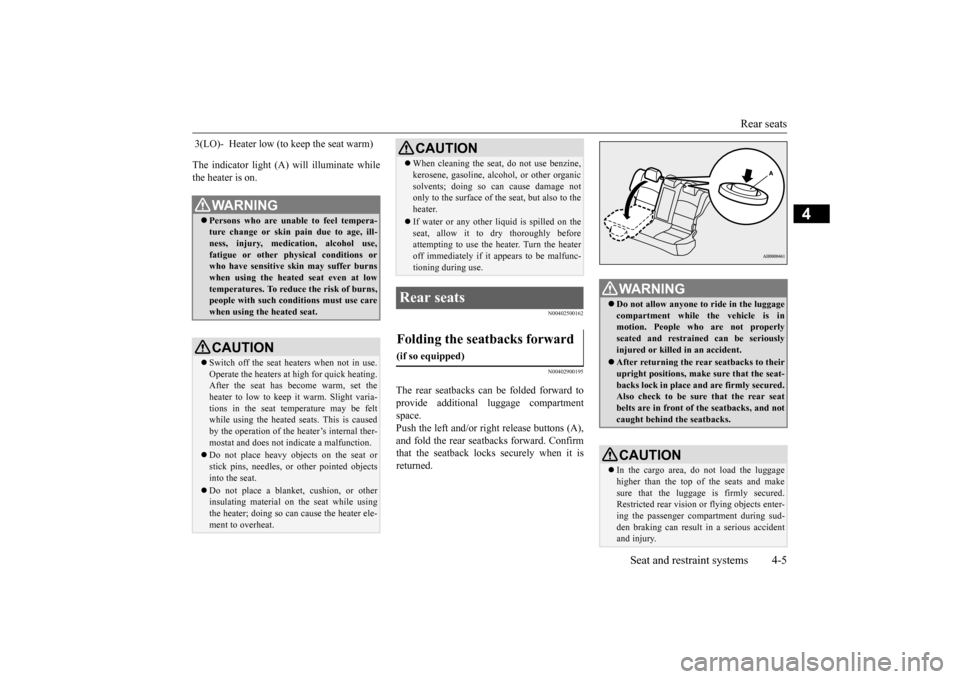
space.Push
the
left
and/or
right
release
buttons
(A),
and
fold
the
rear
seatbacks
forward.
Confirm
that
the
seatback
locks
securely
when
it is
returned.
3(LO)-
Heater
low
(to
keep
the
seat
warm)
W
AR
NING
Pers
ons
who
are una
ble to
feel
temp
era-
ture change
or
skin
pai
n due
to age, ill-
ness,
injury
, medication,
alcohol
use,
fatigue
or
other
physical
conditions
or
who
have
sensi
tive ski
n may
suffer
bur
ns
whe
n usi
ng
the
heate
d seat
even at
low
temperatur
es. To reduce
the
risk
of bur
ns,
people
with suc
h condi
tions
must
use
care
when
using
the
heated
seat.
CAUTIONSwitch
off the seat
heaters
whe
n not
in use
.
Ope
rate
the heaters
at high
for
quick
heating.
After
the
seat
has
become
warm,
set
the
heater
to low
to keep
it warm. Slight
varia-
tions
in the seat
temp
erature
may
be felt
while
using
the heated
seats.
This is cause
d
by
the ope
ration
of the heater
’s internal
ther-
mostat
and
does
not
indicate
a malfunction.
Do not place
heavy
objects
on the seat
or
stick
pins, needles,
or other poin
ted
objects
into
the
seat.
Do
not
place
a blanket,
cushi
on,
or
other
insulating
mater
ial
on
the seat
while
using
the
heater;
doing
so can
cause
the
heater
ele-
men
t to ove
rheat.
When
cleaning
the
seat,
do
not
use
benzine,
kerosene,
gasoline,
alcohol,
or other
organic
solvents
; doing
so can
caus
e damage
not
only
to the
surface
of the
seat,
but
also
to the
heater
.
If water
or any
other liqui
d is spilled
on
the
seat,
allow
it
to dry
thoroughl
y before
attempting
to use
the
heater
. Turn
the
heater
off immediately
if it appears
to be
malfunc-
tioning d
uring use
.
Rear seats Folding the seatbacks forward
(if so equipped)
CAUTION
W
AR
NING
Do
not
allow
anyone
to ride
in the
luggage
comp
artmen
t while
the veh
icle
is in
motion
. Peop
le
who
are not
properly
seate
d and
restrained can
be seriousl
y
injur
ed or killed in an accident.
After
retu
rning the rear
seatb
acks
to their
upright
posi
tions,
make
sur
e that
the
seat-
bac
ks lock in place and
are firm
ly secu
red.
Also
check
to
be sur
e that
the
rear seat
belts
are in front of the seatb
acks,
and
not
cau
ght behind
the seatb
acks.
CAUTIONIn
the cargo
area, do
not
load the lugga
ge
highe
r than the top
of
the seats
and
mak
e
sure
that
the lugga
ge is firmly
secure
d.
Res
tricted
rear
vision
or flying
objects
enter
-
ing
the
passenger
compartment
during
sud-
den bra
king
can
result
in a serious
accid
ent
and
injury
.
Page 34 of 392
Seat
belts
4-10
Seat and restraint systems
4
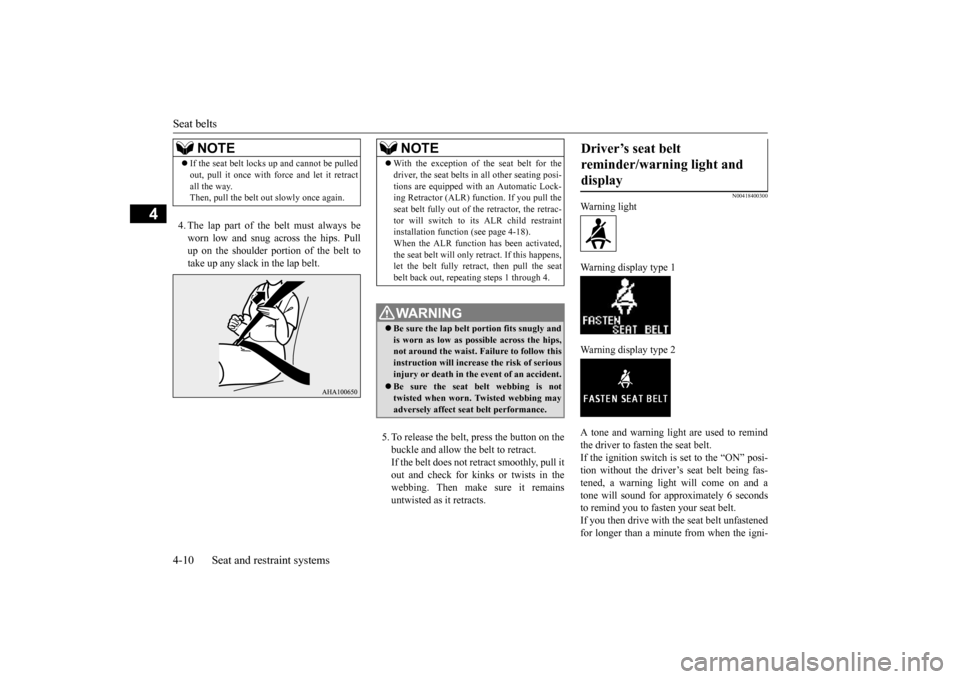
4.The
lap
part
of
the
belt
must
always
be
worn
low
and
snug
across
the
hips.
Pull
up
on
the
shoulder
portion
of
the
belt
to
take
up
any
slack
in the
lap
belt.
5.To release
the
belt,
press
the
button
on
the
buckle and allow the belt to retract. If the
belt
does
not
retract
smoothly
, pull
it
out
and
check
for
kinks
or
twists
in
the
webbing.
Then
make
sure
it
remains
untwisted as it retracts.
N0041840
0300
Warning light
Warning display type 1
Warning display type 2
A tone
and
warning
light
are
used
to remind
the driver to fasten the seat belt.If the
ignition
switch
is set
to the
“ON”
posi-
tion
without
the
driver
’s seat
belt
being
fas-
tened,
a warning
light
will
come
on
and
a
tone
will
sound
for
approximately
6 seconds
to remind you to fasten your seat belt.If you
then
drive
with
the
seat
belt
unfastened
for
longer
than
a minute
from
when
the
igni-
NOTE
If the
seat
belt
locks
up
and
cannot
be pulled
out,
pull it once
with force
and
let
it retract
all
the way.
Then, pull
the
belt
out slowl
y once again
.
NOTE
With
the
exception
of
the
seat
belt
for
the
driver
, the
seat
belts
in all
other
seating
posi-
tions
are equi
ppe
d with an Aut
omatic
Lock-
ing
Retractor
(AL
R)
function.
If you
pull
the
seat
belt
fully
out
of the retracto
r, the retrac-
tor
will
switch
to its ALR child restrain
t
installation
function
(see
page
4-18).
When the ALR function
has been
activ
ated
,
the
seat
belt
will
only
retract.
If this
happens,
let
the belt
fully
retract,
then pull
the
seat
belt
back
out,
repeating
steps
1 through
4.
W
AR
NING
Be
sur
e the
lap
belt por
tion
fits snugl
y and
is worn
as low
as pos
sible
acr
oss the
hips,
not around
the waist. Failu
re to follow
this
instru
ction
will increas
e the risk
of seriou
s
injury
or death
in the
event
of an
accident.
Be sur
e the
seat
belt webbi
ng
is not
twisted
when
worn.
Twisted
webbing
may
adversely affect seat belt performance.
Driver
’s seat belt
reminder/warning light and
display
Page 35 of 392
Seat
belts
Seat and restraint systems
4-11
4
tion
switch
was
turned
on,
the
warning
light
will
come
on
and
blink
repeatedly
and
the
tone
will
sound
intermittentl
y.
The
warning
light
and
the
tone
will
stop
after
approximately 90 seconds.If
you
then
repeatedly
stop
and
start
your
vehicle
with
the
seat
belt
unfastened,
the
warning
light/display
and
tone
will
remind
you
to
fasten
your
seat
belt
every
time
the
vehicle
starts
moving.
You
will
also
be
reminded
to fasten
your
seat
belt
in this
way
when
you
remove
your
seat
belt
while
driv-
ing.
The
warning
light
and
the
tone
go
off
when
the
seat
belt
is fastened.
N00418300
165
The
front
passenger
seat
belt
warning
light
is
located in the instrument panel.When
the
key
is turned
to the
“ON”
position,
this
indicator
normally
comes
on
and
goes
off
a few seconds later
.
The
light
comes
on
when
a person
sits
on
the
front
passenger
seat
but
does
not
fasten
the
seat
belt.
It goes
off when
the
seat
belt
is sub-
sequently fastened.
N00406300
315
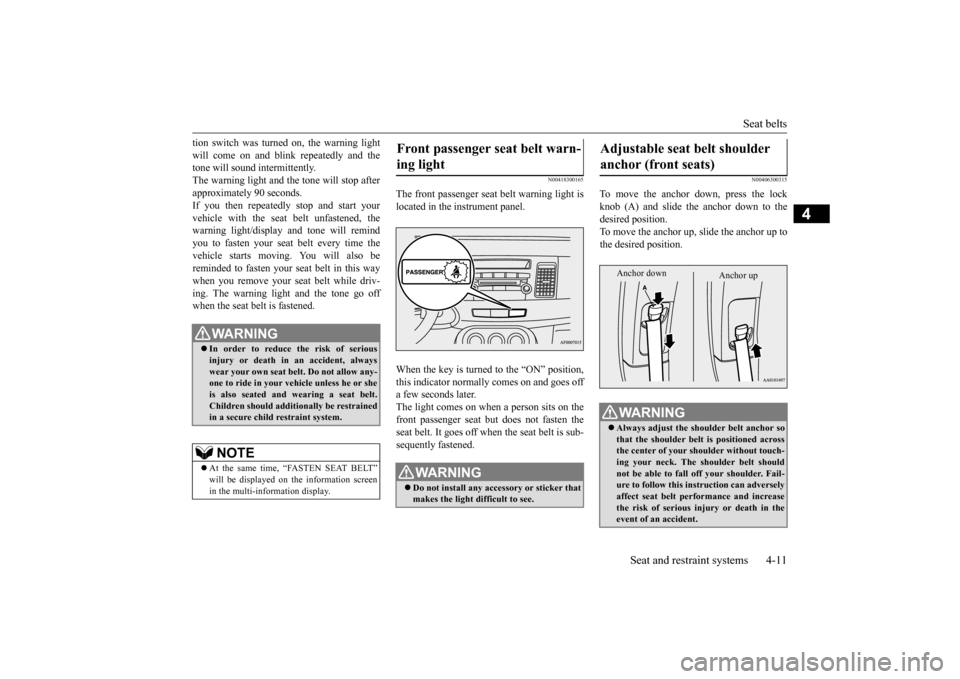
To move
the
anchor
down,
press
the
lock
knob
(A)
and
slide
the
anchor
down
to
the
desired position. To move
the
anchor
up,
slide
the
anchor
up
to
the desired position.
W
AR
NING
In
order
to
reduce
the
risk
of
serious
injury
or
death
in
an
accident,
always
wear
your own
seat belt. Do
not
allow
any-
one to ride in your vehicle unless he or she is also
seate
d and
wearing
a seat
belt.
Child
ren sho
uld addition
ally
be restrain
ed
in a secu
re child
restraint syste
m.
NOTE
At the same
time,
“FASTEN
SEAT BELT”
will be display
ed on
the information
screen
in the multi-information
display
.
Fr
ont passenger seat belt warn-
ing light
W
AR
NING
Do not install
any accessory
or stick
er that
makes the light difficult to see.
Adjustable seat belt shoulder anchor (fr
ont seats)
W
AR
NING
Always
adjust
the
shoulder
belt
anchor
so
that
the
shoul
der belt is posi
tione
d across
the
center
of your
shoul
der without
touc
h-
ing
your
neck.
The
shoul
der
belt shoul
d
not
be able
to fall
off
your
shoul
der. Fail-
ure to follow
this instr
uction
can
advers
ely
affect
seat belt perfor
mance
and
increase
the
risk
of serious
injur
y or death
in the
event of an accident.Anchor
down
Anchor
up
Page 37 of 392
Child restraint systems
Seat and restraint systems
4-13
4
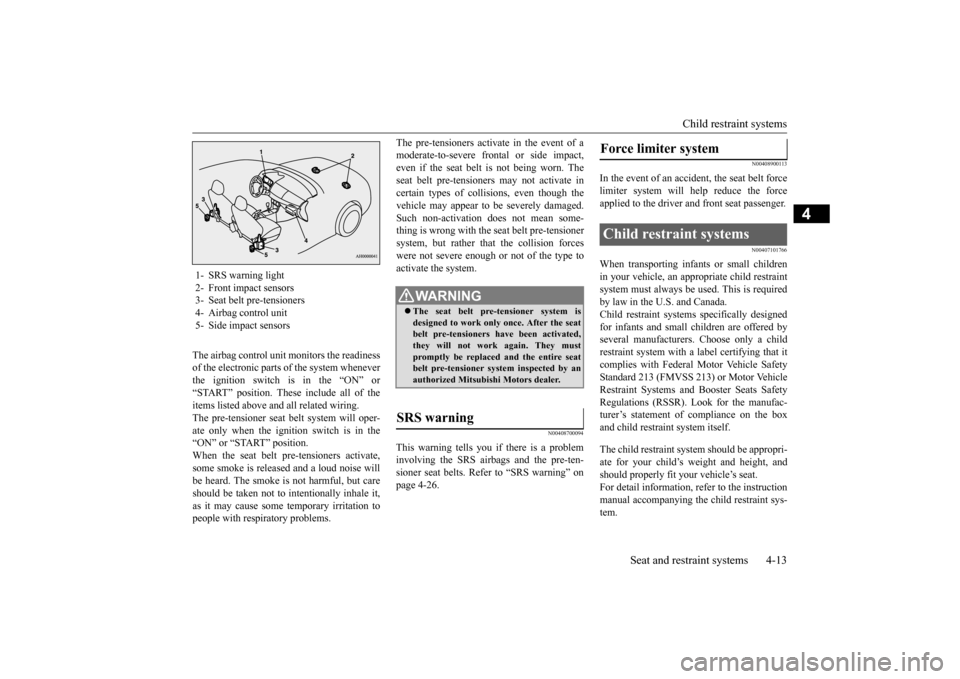
The
airbag
control
unit
monitors
the
readiness
of the
electronic
parts
of the
system
whenever
the
ignition
switch
is
in
the
“ON”
or
“ST
ART” position.
These
include
all
of
the
items listed above and all related wiring. The
pre-tensioner
seat
belt
system
will
oper
-
ate
only
when
the
ignition
switch
is
in
the
“ON”
or “ST
ART” position.
When
the
seat
belt
pre-tensioners
activate,
some
smoke
is released
and
a loud
noise
will
be
heard.
The
smoke
is not
harmful,
but
care
should
be
taken
not
to intentionally
inhale
it,
as
it may
cause
some
temporary
irritation
to
people with respiratory problems.
The
pre-tensioners
activate
in
the
event
of
a
moderate-to-severe
frontal
or
side
impact,
even
if the
seat
belt
is not
being
worn.
The
seat
belt
pre-tensioners
may
not
activate
in
certain
types
of
collisions,
even
though
the
vehi
cle
may
appea
r to be
severely
damaged.
Such
non-activation
does
not
mean
some-
thing
is wrong
with
the
seat
belt
pre-tensioner
system,
but
rather
that
the
collision
forces
were
not
severe
enough
or
not
of
the
type
to
activate the system.
N00408700
094
This
warning
tells
you
if there
is a problem
involving
the
SRS
airbags
and
the
pre-ten-
sioner
seat
belts.
Refer
to “SRS
warning”
on
page 4-26.
N0040890
0113
In the
event
of an
accident,
the
seat
belt
force
limiter
system
will
help
reduce
the
force
applied
to the
driver
and
front
seat
passenger
.
N00407101
766
When
transporting
infants
or
small
children
in your
vehicle,
an
appropriate
child
restraint
system
must
always
be
used.
This
is required
by law in the U.S. and Canada.Child
restraint
systems
specifically
designed
for
infants
and
small
children
are
offered
by
several
manufacturers.
Choose
only
a child
restraint
system
with
a label
certifying
that
it
complies
with
Federal
Motor
Vehicle
Safety
Standard
213
(FMVSS
213)
or Motor
Vehicle
Restraint
Systems
and
Booster
Seats
Safety
Regulations
(RSSR).
Look
for
the
manufac-
turer
’s statement
of
compliance
on
the
box
and child restraint system itself. The
child
restraint
system
should
be
appropri-
ate
for
your
child’
s weight
and
height,
and
should properly fit your vehicle’
s seat.
For
detail
information,
refer
to the
instruction
manual
accompanying
the
child
restraint
sys-
tem.
1-
SRS warning light
2-
Front impact sensors
3-
Seat belt pre-tensioners
4-
Airbag control unit
5-
Side impact sensors
W
AR
NING
The
seat
belt
pre-tensioner
system
is
designe
d to wor
k onl
y once.
After
the
seat
belt pre-tensi
oners
have
been
activate
d,
they
will
not
work
again.
They
must
promptl
y be replaced
and
the
entire seat
belt
pre-tension
er
system
inspected
by an
authorized
Mitsubi
shi
Motors
dealer
.
SRS
warning
For
ce limiter system
Child r
estraint systems
Page 44 of 392
Maintenance and inspection of seat belts4-20
Seat and restraint systems
4
Systems
and
Booster
Seats
Safety
Regula-
tions.
N0040700
0221
The
seat
belt
webbing
may
be
cleaned
with
mild
soap
or deter
gent
solution.
Do
not
use
an
organic
solvent.
Allow
the
belts
to dry
in the
shade.
Do
not
allow
them
to retract
until
com-
pletely
dry
. Do
not
attempt
to
bleach
or
re-
dye
the
belts.
The
color
may
rub
off and
the
webbing strength may be a
ffected.
Regularly
check
your
seat
belt
buckles
and
their
release
mechanisms
for
positive
engage-
ment
and
release
of the
latch
plate.
Check
the
retractors
for
automatic
locking
when
in
the
Automatic
Locking
Retractor
function.
The
entire
seat
belt
assembly
should
be
replaced
if the
webbing
shows
any
obvious
cuts,
tears,
increase
in
thickness
in
any
sec-
tion
of
the
webbing
from
broken
fibers,
or
severe
fading
from
sunlight.
All
of these
con-
ditions
indicate
a weakening
of
the
belt,
which
may
adversely
affect
seat
belt
perfor
-
mance
in an
accident.
N0040770
1805
This
vehicle
is equipped
with
a Supplemental
Restraint
System
(SRS),
which
includes
air-
bags for the driver and passengers.The
SRS
front
airbags
are
designed
to supple-
ment
the
primary
protection
of
the
driver
and
front
passenger
seat
belt
systems
by
provid-
ing
those
occupants
with
protection
against
head
and
chest
injuries
in certain
moderate
to
severe frontal collisions. The
SRS
front
airbags,
together
with
sensors
at
the
front
of
the
vehicle
and
sensors
attached
to the
front
seats,
form
an
advanced
airbag system.The
SRS
driver
’s knee
airbag
is designed
to
supplement
the
primary
protection
of
the
driver
’s seat
belt
system.
It can
reduce
the
forward
movement
of
the
driver
’s lower
legs
and
provide
increased
overall
body
protection
in
certain
moderate
to
severe
frontal
colli-
sions. The
SRS
side
airbags
(if so
equipped)
and
the
curtain
airbags
(if
so
equipped)
are
also
designed
to
supplement
the
seat
belts.
The
SRS
side
airbags
provide
the
driver
and
front
passenger
with
protection
against
chest
inju-
ries
by
deploying
the
bag
on
the
side
W
AR
NING
Any
child
who
is too
small
to
properly
wear
a seat
belt
must
be properly
restrain
ed in an appr
opriate
child
restrain
t system,
to
reduce
their
risk
of
serious
injury or d
eath
in an accid
ent.
A child should never be left unattended in,or
unsupervised,
around
your
vehicle.
When you
leave
the veh
icle
alw
ays
tak
e
the ch
ild out
as well.
Childr
en can die f
rom heat str
oke if left o
r
trapped
inside
the
vehicle,
especially
on
hot
days
.
Keep
you
r veh
icle
lock
ed and
the trunk
lid
close
d whe
n not
in use
. Keep
your
vehicle
keys
away
from
children.
Never
allow
children to play
in the
trunk
of you
r vehicle.
Maintenance
and
inspection
of seat belts
W
AR
NING
Do
not
attempt
to
repair
or
replace
any
part
of the
seat
belt
assemblies.
This
work
shoul
d be done
by an
authorized
Mitsubishi
Motors
dealer
. Failur
e to have
an
authorized
Mitsubishi
Motors
dealer
perform
the
wor
k coul
d reduce
the
effec-
tiveness
of the
belts
and
could
result
in a
serious
injury o
r death
in an accid
ent.
Supplemental Restraint Sys-tem (SRS) - airbag
Page 47 of 392
Supplemental Restraint System (SRS) - airbag
Seat and restraint systems
4-23
4
N00407801
545
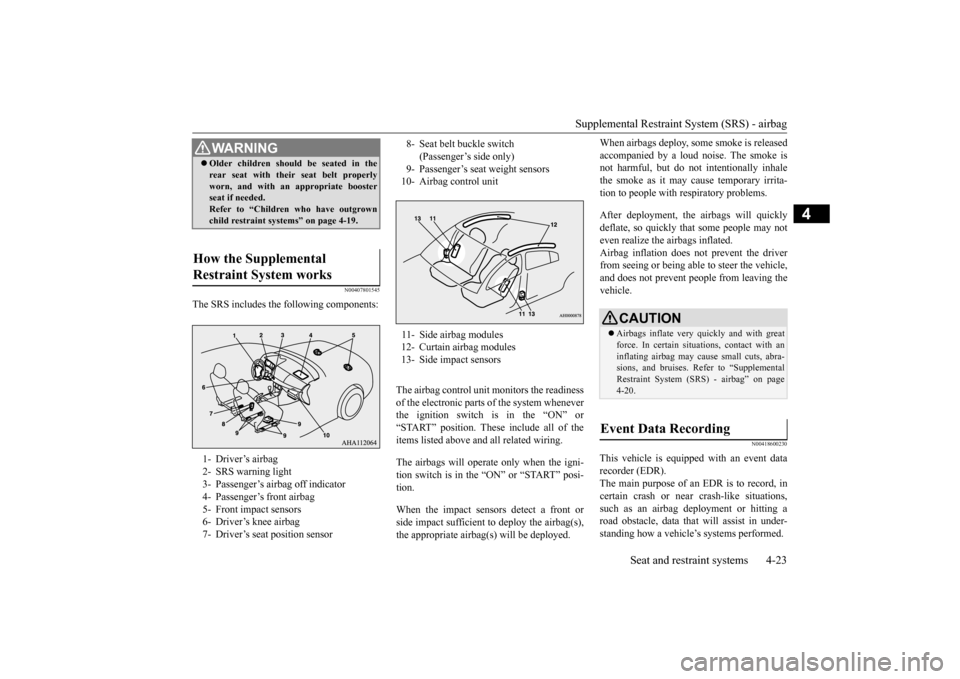
The SRS includes the following components:
The
airbag
control
unit
monitors
the
readiness
of the
electronic
parts
of the
system
whenever
the
ignition
switch
is
in
the
“ON”
or
“ST
ART”
position.
These
include
all
of
the
items listed above and all related wiring. The
airbags
will
operate
only
when
the
igni-
tion
switch
is in the
“ON”
or
“ST
ART”
posi-
tion. When
the
impact
sensors
detect
a front
or
side
impact
suf
ficient
to deploy
the
airbag(s),
the appropriate airbag(s) will be deployed.
When
airbags
deploy
, some
smo
ke
is relea
sed
accompanied
by
a loud
noise.
The
smoke
is
not
harmful,
but
do
not
intentionally
inhale
the
smoke
as
it may
cause
temporary
irrita-
tion to people with respiratory problems.After
deployment,
the
airbags
will
quickly
deflate,
so
quickly
that
some
people
may
not
even
realize
the
airbags
inflated.
Airbag
inflation
does
not
prevent
the
driver
from
seeing
or being
able
to steer
the
vehicle,
and
does
not
prevent
people
from
leaving
the
veh
icle.
N00418600
230
This
vehicle
is equipped
with
an
event
data
recorder
(EDR).
The
main
purpos
e of
an
ED
R is to record,
in
certain
crash
or
near
crash-like
situations,
such
as
an
airbag
deployment
or
hitting
a
road
obstacle,
data
that
will
assist
in
under
-
standing how a vehicle’
s systems performed.
W
AR
NING
Older
childr
en
should
be
seated
in
the
rear
seat
with
their
seat
belt
properly
worn,
and
with
an
appr
opriate
booster
seat
if needed.
Refer
to
“Childr
en who
have
outgr
own
child
restraint
systems”
on
page
4-19.
How the Supplemental Restraint System works 1-
Driver
’s airbag
2-
SRS warning light
3-
Passenger
’s airbag of
f indicator
4-
Passenger
’s front airbag
5-
Front impact sensors
6-
Driver
’s knee
airbag
7-
Driver
’s seat
position
sensor
8-
Seat
belt
buckle
switch
(Passenger
’s side only)
9-
Passenger
’s seat weight sensors
10-
Airbag control unit
11-
Side airbag modules
12-
Curtain airbag modules
13-
Side impact sensors
CAUTIONAirba
gs
inflate
ver
y quick
ly and
with great
force.
In certain
situations,
con
tact
with an
inflating
airbag
may
cause
small
cuts, abra
-
sions, and
brui
ses. Ref
er to
“Supplemen
tal
Restraint
System
(SRS)
- airbag”
on
page
4-20.
Event Data Recording
Page 50 of 392
Supplemental Restraint System (SRS) - airbag4-26
Seat and restraint systems
4
N0040830
1619
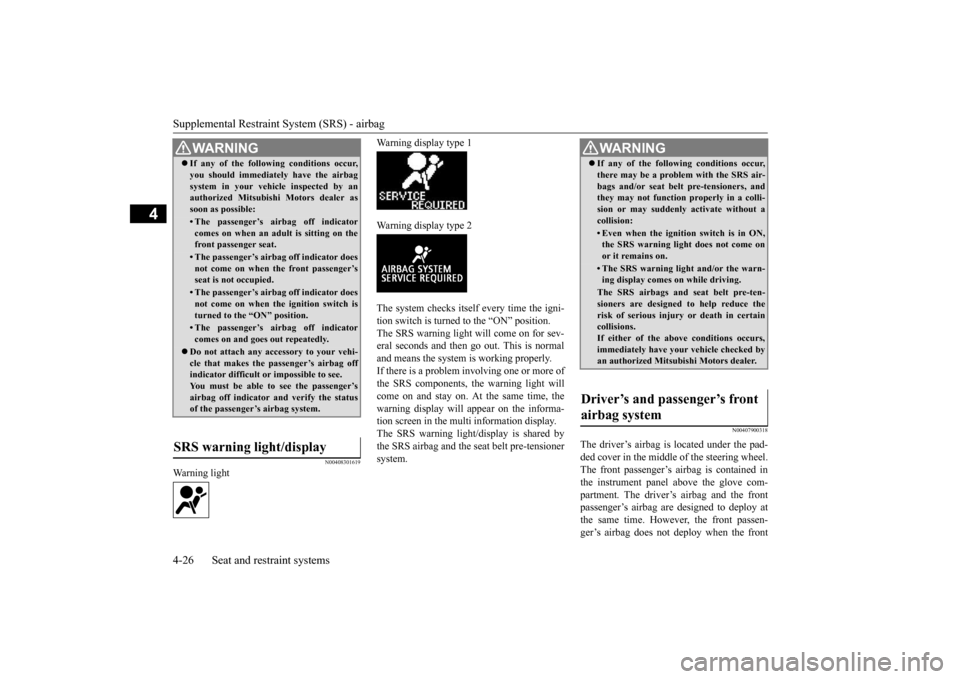
Warning light
Warning display type 1Warning display type 2The
system
checks
itself
every
time
the
igni-
tion switch is turned to the “ON” position. The
SRS
warning
light
will
come
on
for
sev-
eral
seconds
and
then
go
out.
This
is normal
and means the system is working properly
.
If there
is a problem
involving
one
or more
of
the
SRS
components,
the
warning
light
will
come
on
and
stay
on.
At
the
same
time,
the
warning
display
will
appear
on
the
informa-
tion screen in the multi information display
.
The
SRS
warning
light/display
is shared
by
the
SRS
airbag
and
the
seat
belt
pre-tensioner
system.
N0040790
0318
The
driver
’s airbag
is located
under
the
pad-
ded
cover
in the
middle
of the
steering
wheel.
The
front
passenger
’s airbag
is contained
in
the
instrument
panel
above
the
glove
com-
partment.
The
driver
’s airbag
and
the
front
passenger
’s airbag
are
designed
to
deploy
at
the
same
time.
However
, the
front
passen-
ger
’s airbag
does
not
deploy
when
the
front
W
AR
NING
If any
of
the
followi
ng
condi
tions
occu
r,
you
shoul
d imme
diately
have
the
airbag
syste
m in your
vehicle
inspect
ed by
an
authorized
Mitsubi
shi
Motor
s dealer
as
soon
as possible:
•The
passenger
’s airbag
off
indicator
comes
on
when
an
adult
is sitting
on
the
front
passenger
seat.
•The
passenger
’s airbag
off
indicator
does
not
com
e on
whe
n the
front
passe
nge
r’s
seat is no
t occupied
.
•The
passenger
’s airbag
off
indicator
does
not
come
on
when
the
ignition
switch
is
tur
ned to the
“ON” position.
•The
passenger
’s airbag
off
indicator
comes
on
and
goes
out
repeatedly
.
Do
not
attach
any
accessory
to your
vehi-
cle
that
make
s the
passe
nge
r’s airbag
off
indicator
difficu
lt or
impossi
ble to see.
You must
be able
to
see
the
passe
nge
r’s
airbag
off
indicator
and
verify
the
status
of the
passe
nge
r’s airbag
syste
m.
SRS warning light/display
W
AR
NING
If any
of
the
followi
ng
condi
tions
occu
r,
there may
be a problem
with the SRS
air-
bags
and/or
seat
belt
pre-tension
ers
, and
they
may
not
function
properly
in a colli-
sion
or
may
suddenly
activate
without
a
collis
ion:
•Even whe
n the
igni
tion
swi
tch is in ON,
the
SRS
war
ning
light
doe
s not
come
on
or it remains
on.
•The SRS
war
ning
light
and/
or the
war
n-
ing display
comes
on while
drivin
g.
The SRS
airb
ags
and
seat
belt
pre-ten
-
sioners
are designe
d to
help
reduce
the
risk
of serious
injur
y or death
in certai
n
collisions.If either
of
the
above
conditions
occurs,
immediately
have
your
vehicle
checked
by
an
authorized
Mitsubishi
Motors
dealer
.
Driver
’s and passenge
r’s fr
ont
airbag system