lock MITSUBISHI LANCER 2016 8.G User Guide
[x] Cancel search | Manufacturer: MITSUBISHI, Model Year: 2016, Model line: LANCER, Model: MITSUBISHI LANCER 2016 8.GPages: 392, PDF Size: 13.12 MB
Page 29 of 392
Rear seats
Seat and restraint systems
4-5
4
The
indicator
light
(A)
will
illuminate
while
the
heater
is on.
N00402500
162
N00402900
195
The
rear
seatbacks
can
be
folded
forward
to
provide
additional
luggage
compartment
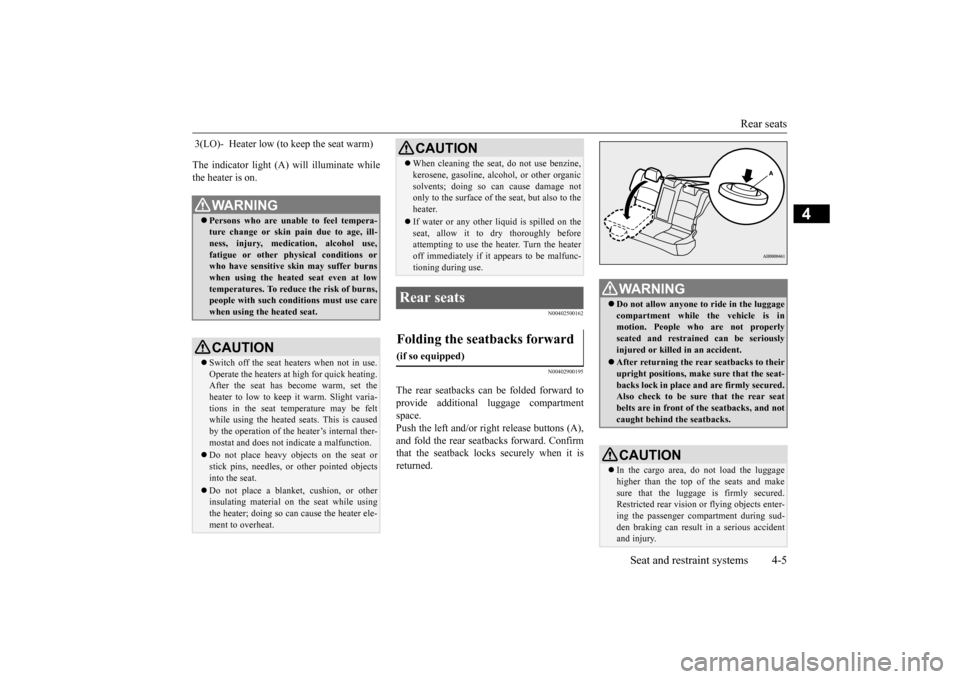
space.Push
the
left
and/or
right
release
buttons
(A),
and
fold
the
rear
seatbacks
forward.
Confirm
that
the
seatback
locks
securely
when
it is
returned.
3(LO)-
Heater
low
(to
keep
the
seat
warm)
W
AR
NING
Pers
ons
who
are una
ble to
feel
temp
era-
ture change
or
skin
pai
n due
to age, ill-
ness,
injury
, medication,
alcohol
use,
fatigue
or
other
physical
conditions
or
who
have
sensi
tive ski
n may
suffer
bur
ns
whe
n usi
ng
the
heate
d seat
even at
low
temperatur
es. To reduce
the
risk
of bur
ns,
people
with suc
h condi
tions
must
use
care
when
using
the
heated
seat.
CAUTIONSwitch
off the seat
heaters
whe
n not
in use
.
Ope
rate
the heaters
at high
for
quick
heating.
After
the
seat
has
become
warm,
set
the
heater
to low
to keep
it warm. Slight
varia-
tions
in the seat
temp
erature
may
be felt
while
using
the heated
seats.
This is cause
d
by
the ope
ration
of the heater
’s internal
ther-
mostat
and
does
not
indicate
a malfunction.
Do not place
heavy
objects
on the seat
or
stick
pins, needles,
or other poin
ted
objects
into
the
seat.
Do
not
place
a blanket,
cushi
on,
or
other
insulating
mater
ial
on
the seat
while
using
the
heater;
doing
so can
cause
the
heater
ele-
men
t to ove
rheat.
When
cleaning
the
seat,
do
not
use
benzine,
kerosene,
gasoline,
alcohol,
or other
organic
solvents
; doing
so can
caus
e damage
not
only
to the
surface
of the
seat,
but
also
to the
heater
.
If water
or any
other liqui
d is spilled
on
the
seat,
allow
it
to dry
thoroughl
y before
attempting
to use
the
heater
. Turn
the
heater
off immediately
if it appears
to be
malfunc-
tioning d
uring use
.
Rear seats Folding the seatbacks forward
(if so equipped)
CAUTION
W
AR
NING
Do
not
allow
anyone
to ride
in the
luggage
comp
artmen
t while
the veh
icle
is in
motion
. Peop
le
who
are not
properly
seate
d and
restrained can
be seriousl
y
injur
ed or killed in an accident.
After
retu
rning the rear
seatb
acks
to their
upright
posi
tions,
make
sur
e that
the
seat-
bac
ks lock in place and
are firm
ly secu
red.
Also
check
to
be sur
e that
the
rear seat
belts
are in front of the seatb
acks,
and
not
cau
ght behind
the seatb
acks.
CAUTIONIn
the cargo
area, do
not
load the lugga
ge
highe
r than the top
of
the seats
and
mak
e
sure
that
the lugga
ge is firmly
secure
d.
Res
tricted
rear
vision
or flying
objects
enter
-
ing
the
passenger
compartment
during
sud-
den bra
king
can
result
in a serious
accid
ent
and
injury
.
Page 30 of 392
Head restraints4-6
Seat and restraint systems
4
N0040300
0294
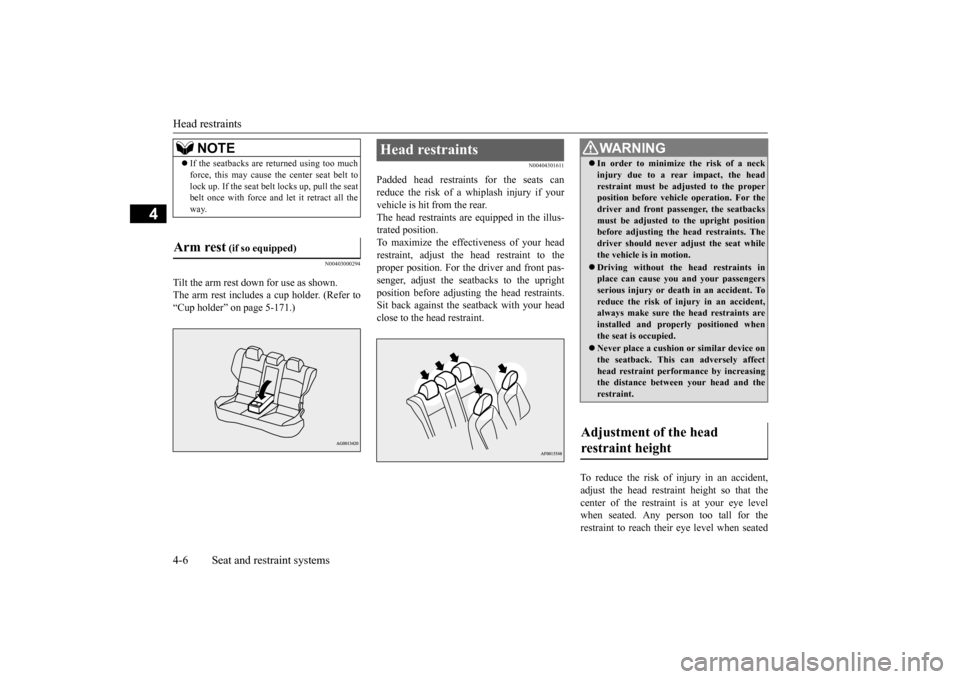
Tilt the arm rest down for use as shown.The
arm
rest
includes
a cup
holder
. (Refer
to
“Cup holder” on page 5-171
.)
N004043
01611
Padded
head
restraints
for
the
seats
can
reduce
the
risk
of
a whiplash
injury
if your
vehicle is hit from the rea
r.
The
head
restraints
are
equipped
in the
illus-
trated position. To maximize
the
effectiveness
of
your
head
restraint,
adjust
the
head
restraint
to
the
proper
position.
For
the
driver
and
front
pas-
senger
, adjust
the
seatbacks
to
the
upright
position
before
adjusting
the
head
restraints.
Sit
back
against
the
seatback
with
your
head
close to the head restraint.
To reduce
the
risk
of
injury
in
an
accident,
adjust
the
head
restraint
height
so
that
the
center
of
the
restraint
is
at
your
eye
level
when
seat
ed.
Any
person
too tall
for
the
restraint
to reach
their
eye
level
when
seated
NOTE
If the seatb
acks
are returne
d using
too
much
force,
this may
cause
the cen
ter seat
belt
to
lock up.
If the seat
belt
locks up,
pull
the seat
belt
once
with
force
and
let
it retract
all
the
way.
Arm
rest (if so equipped)
Head r
estraints
W
AR
NING
In
order
to
minimize
the
risk
of
a neck
injur
y due
to
a rear impac
t, the
head
restraint
must
be
adjusted
to
the
proper
position
befor
e vehi
cle
operation
. For
the
driv
er
and
front
passe
nge
r, the
seatbac
ks
must
be adjuste
d to
the
upright
posi
tion
befor
e adjusting
the
head
restraints.
The
driver
should
never
adjust
the
seat
while
the vehicle is in motion.Driving
without
the
head
restraints
in
place
can
cause
you
and
you
r passengers
serious
injury
or
death
in an accid
ent. To
reduce
the
risk
of
injur
y in an
accid
ent,
always
make
sur
e the
head
restraints
are
installed
and
properly
posi
tione
d whe
n
the seat is occupied. Never place a cushi
on
or similar device
on
the
seatbac
k.
Thi
s can
advers
ely
affect
head
restraint
perfor
mance
by
increasing
the
distance
between
your
head
and
the
restraint.
Adjustment of the head restraint height
Page 31 of 392
Head
restraints
Seat and restraint systems
4-7
4
should
raise
the
restraint
to the
highest
locked
positi
on.
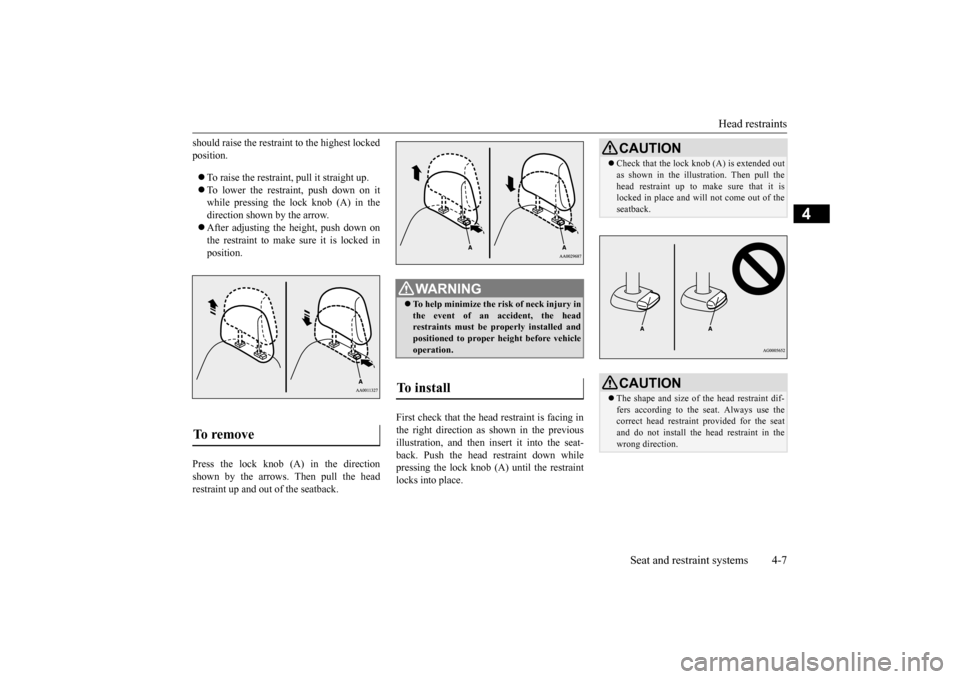
To raise the restraint, pull it straight up.
To lower
the
restraint,
push
down
on
it
while
pressing
the
lock
knob
(A)
in
the
direction
shown
by
the
arrow
.
After
adjusting
the
height,
push
down
on
the
restraint
to
make
sure
it is locked
in
position.
Press
the
lock
knob
(A)
in
the
direction
shown
by
the
arrows.
Then
pull
the
head
restraint up and out of the seatback.
First
check
that
the
head
restraint
is facing
in
the
right
direction
as
shown
in
the
previous
illustration,
and
then
insert
it into
the
seat-
back.
Push
the
head
restraint
down
while
pressing
the
lock
knob
(A)
until
the
restraint
locks into place.
To r
emove
W
AR
NING
To help
min
imize
the risk
of neck
injury in
the even
t of
an accid
ent,
the head
restraints
must
be
properly
installed
and
positione
d to proper
height
befor
e vehicle
operat
ion.
To install
CAUTIONCheck
that
the
lock
knob
(A)
is extended
out
as
shown
in
the
illustration.
Then
pull
the
head
restraint
up
to
make
sure
that
it is
locked
in place
and
will
not
come
out
of the
seatback.CAUTIONThe
shape
and
size
of the
head
restraint
dif-
fers accordi
ng
to
the seat.
Always
use
the
correct
head
restrain
t pro
vided for
the
seat
and
do
not
install
the
head
restraint
in the
wrong
direction.
Page 32 of 392
Seat
belts
4-8
Seat and restraint systems
4
N0040600
0439
Seat
belts
are
installed
in your
vehicle
to help
reduce
the
risk
of injury
to the
driver
and
pas-
senger
in
the
event
of
an
accident.
Always
use the provided seat belts. Carefully
review
the
following
information
for proper seat belt usage.
N0040620
1470
All
seats
are
equipped
with
a seat
belt
which
uses
one
combined
lap-and-shoulder
belt
with
an emer
gency locking retractor
.
Seat belts
W
AR
NING
To help
reduce
the
risk
of injur
y or death
in an accid
ent,
seat
belts
and
child
restrain
t systems
must
alw
ays
be use
d.
Refer
to “Child
restraint
systems”
on
page
4-13 for
addi
tional
infor
mati
on.
Never use
one
seat belt for
mor
e than
one
person. Never
carry
mor
e people
in
your
vehicle
tha
n the
re are seat belts.
Always adjust the seat
belt for a snug
fit.
Alway
s place
the
shoul
der
belt over
your
shoulder
and
acr
oss your
chest.
Never
put
it behind
you
or under
your
arm.
Always
wear
the
lap
belt
as low
as possible
acr
oss your
hips,
not
around
your
waist.
Never
modi
fy
or
alter
the
seat
belts
in
your
vehicle.
To reduce
the risk
to the driver
of seriou
s
injury
or
death
durin
g deploymen
t of the
driver
’s airb
ag,
alw
ays
properly
wear
the
seat belt and
adjust
the
driv
er’s seat as far
bac
k as possi
ble while
mai
ntai
ning
a posi
-
tion
that
still
enables
you
to fully
appl
y the
pedals,
easily
contr
ol
the
steering
wheel,
and safely
operate
the
veh
icle.
To reduce
the
risk
to a front
seat passe
n-
ger
of serious
injury
or death
from a
deployi
ng airb
ag,
make
sur
e the
passenge
r
alw
ays
wears
the
seat
belt properly
,
remai
ns
seate
d all
the
way
bac
k and
upright
in their
seat,
and
moves
the
seat
as
far
bac
k as possi
ble. Refer to “Supplem
en-
tal
Restraint
System
(SRS)
- airbag”
on
page
4-20
for
addi
tional infor
mati
on.
Never
hold
an
infant
or child
in your
arms
or
on
your lap
whe
n rid
ing in this vehicle
even
whe
n you are wearin
g your seat belt.
Never
place
any par
t of the
seat
belt you
are wearing
around
an
infant
or
child.
Failur
e to follow
these
simple
instructions
create
s a risk
of serious
injury
or death
to
your
child
in the
event
of an
accident
or
sudden
stop.
W
AR
NING
Child
ren 12
years old and
under
shoul
d
always
rid
e in the
rear seat and
be prop-
erly
restrained. Thi
s reduces
their
risk
of
serious
injur
y or death
in an
accid
ent,
especia
lly due
to a deployi
ng
front
passe
n-
ger
airbag.
Refer
to “Child
restraint
sys-
tems”
on
page
4-13
for
addi
tional
infor
mati
on.
Any
child who
is too
small
to
properly
wear
a seat
belt must
be properly
restrained in an
appr
opriat
e child
restraint
syste
m.
Child
ren 12
yea
rs old
and
under
should
be
seated
only
in
the
rear seat
to
reduce
their
risk
of
serious
injur
y or death
in an
accid
ent,
especia
lly
from
the
deployment
of a front
passenger
airbag.Infants
MUST
be placed
in a rear-facin
g
child safe
ty seat and
positione
d in the
rear
seat.In
the
event
of
an
accident,
all
seat
belt
assemblies,
including
retractors
and
attach
men
t hardwa
re, sho
uld be inspected
by
an
authorized
Mitsubi
shi
Motor
s
dealer
to determ
ine whe
ther
replacem
ent
is necessary
.
Seat belt instructions
W
AR
NING
Page 33 of 392
Seat
belts
Seat and restraint systems
4-9
4
This
system
is designed
to provide
both
com-
fort
and
safet
y. It permit
s full
exten
sion
and
automatic
retraction
of
the
belts
during
nor
-
mal
vehicle
operation.
A
sensing
device
inside
the
belt
retractor
is designed
to lock
the
retractor
in
the
event
of
a sudden
change
in
the vehicle
’s motion.
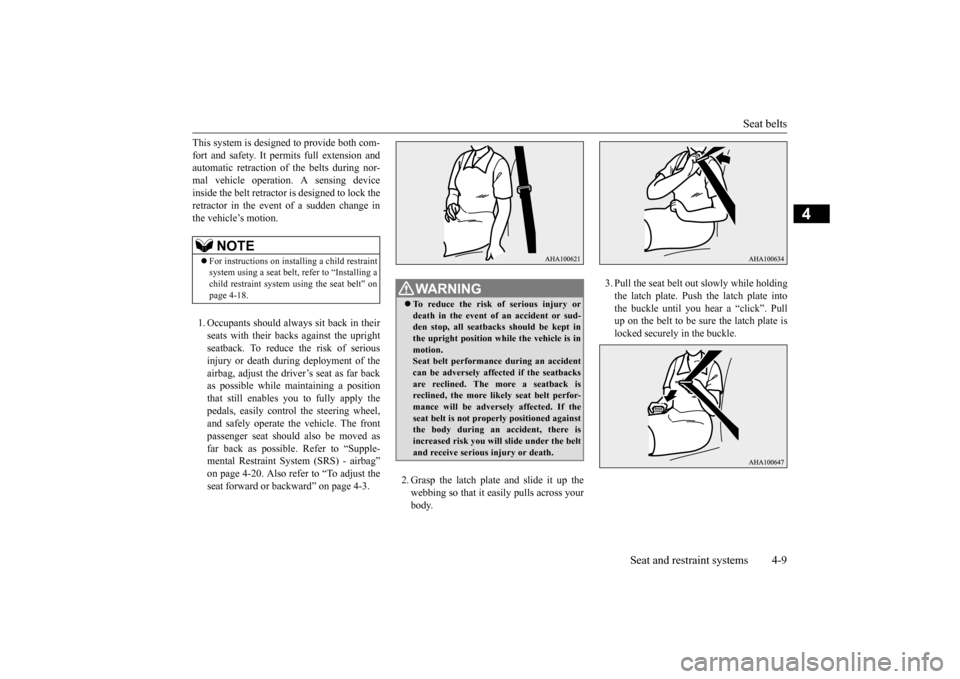
1.Occupants
should
always
sit
back
in their
seats
with
their
backs
against
the
upright
seatback.
To reduce
the
risk
of
serious
injury
or
death
during
deployment
of
the
airbag,
adjust
the
driver
’s seat
as
far
back
as possible
while
maintaining
a pos
ition
that
still
enables
you
to
fully
apply
the
pedals,
easily
control
the
steering
wheel,
and
safely
operate
the
vehicle.
The
front
passenger
seat
should
also
be
moved
as
far
back
as
possible.
Refer
to
“Supple-
mental
Restraint
System
(SRS)
- airbag”
on
page
4-20.
Also
refer
to “To adjust
the
seat forward or backward” on page 4-3.
2.Grasp
the
latch
plate
and
slide
it up
the
webbing
so
that
it easily
pulls
across
your
body
.
3.Pull
the
seat
belt
out
slowly
while
holding
the
latch
plate.
Push
the
latch
plate
into
the
buckle
until
you
hear
a “click”.
Pull
up
on
the
belt
to be
sure
the
latch
plate
is
locked securely in the buckle.
NOTE
For
instructions
on
installing
a child restrain
t
system
using
a seat
belt,
refer
to “Installing
a
child
restraint
system
using
the
seat
belt”
on
page
4-18.
W
AR
NING
To reduce
the
risk
of
serious
injury
or
death
in the
event
of an
accident
or
sud-
den stop,
all
seatbacks
sho
uld be kept
in
the
upright
position
while
the
vehicle
is in
motion.Seat
belt performance
during
an accid
ent
can
be
adversely
affected
if the
seatbacks
are reclined.
The
mor
e a seatback
is
reclined,
the
mor
e likely
seat
belt
perfor
-
mance
will
be
adversely
affected.
If the
seat
belt
is not
properly
positioned
against
the
body durin
g an
accid
ent,
the
re is
increas
ed risk
you
will slide under
the
belt
and
receive s
erious
injur
y or
death.
Page 34 of 392
Seat
belts
4-10
Seat and restraint systems
4
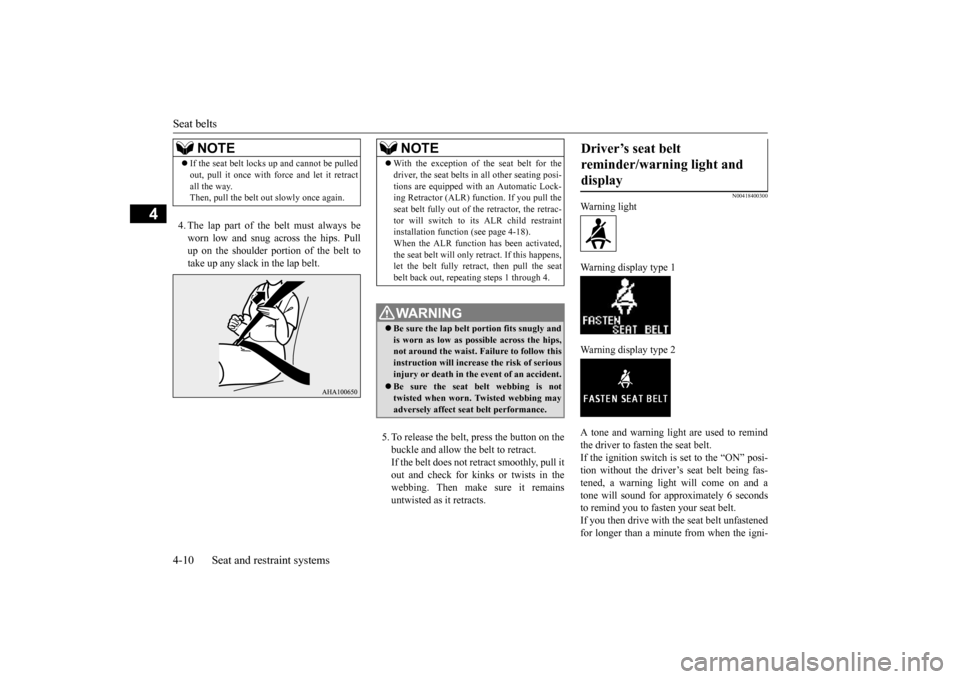
4.The
lap
part
of
the
belt
must
always
be
worn
low
and
snug
across
the
hips.
Pull
up
on
the
shoulder
portion
of
the
belt
to
take
up
any
slack
in the
lap
belt.
5.To release
the
belt,
press
the
button
on
the
buckle and allow the belt to retract. If the
belt
does
not
retract
smoothly
, pull
it
out
and
check
for
kinks
or
twists
in
the
webbing.
Then
make
sure
it
remains
untwisted as it retracts.
N0041840
0300
Warning light
Warning display type 1
Warning display type 2
A tone
and
warning
light
are
used
to remind
the driver to fasten the seat belt.If the
ignition
switch
is set
to the
“ON”
posi-
tion
without
the
driver
’s seat
belt
being
fas-
tened,
a warning
light
will
come
on
and
a
tone
will
sound
for
approximately
6 seconds
to remind you to fasten your seat belt.If you
then
drive
with
the
seat
belt
unfastened
for
longer
than
a minute
from
when
the
igni-
NOTE
If the
seat
belt
locks
up
and
cannot
be pulled
out,
pull it once
with force
and
let
it retract
all
the way.
Then, pull
the
belt
out slowl
y once again
.
NOTE
With
the
exception
of
the
seat
belt
for
the
driver
, the
seat
belts
in all
other
seating
posi-
tions
are equi
ppe
d with an Aut
omatic
Lock-
ing
Retractor
(AL
R)
function.
If you
pull
the
seat
belt
fully
out
of the retracto
r, the retrac-
tor
will
switch
to its ALR child restrain
t
installation
function
(see
page
4-18).
When the ALR function
has been
activ
ated
,
the
seat
belt
will
only
retract.
If this
happens,
let
the belt
fully
retract,
then pull
the
seat
belt
back
out,
repeating
steps
1 through
4.
W
AR
NING
Be
sur
e the
lap
belt por
tion
fits snugl
y and
is worn
as low
as pos
sible
acr
oss the
hips,
not around
the waist. Failu
re to follow
this
instru
ction
will increas
e the risk
of seriou
s
injury
or death
in the
event
of an
accident.
Be sur
e the
seat
belt webbi
ng
is not
twisted
when
worn.
Twisted
webbing
may
adversely affect seat belt performance.
Driver
’s seat belt
reminder/warning light and
display
Page 35 of 392
Seat
belts
Seat and restraint systems
4-11
4
tion
switch
was
turned
on,
the
warning
light
will
come
on
and
blink
repeatedly
and
the
tone
will
sound
intermittentl
y.
The
warning
light
and
the
tone
will
stop
after
approximately 90 seconds.If
you
then
repeatedly
stop
and
start
your
vehicle
with
the
seat
belt
unfastened,
the
warning
light/display
and
tone
will
remind
you
to
fasten
your
seat
belt
every
time
the
vehicle
starts
moving.
You
will
also
be
reminded
to fasten
your
seat
belt
in this
way
when
you
remove
your
seat
belt
while
driv-
ing.
The
warning
light
and
the
tone
go
off
when
the
seat
belt
is fastened.
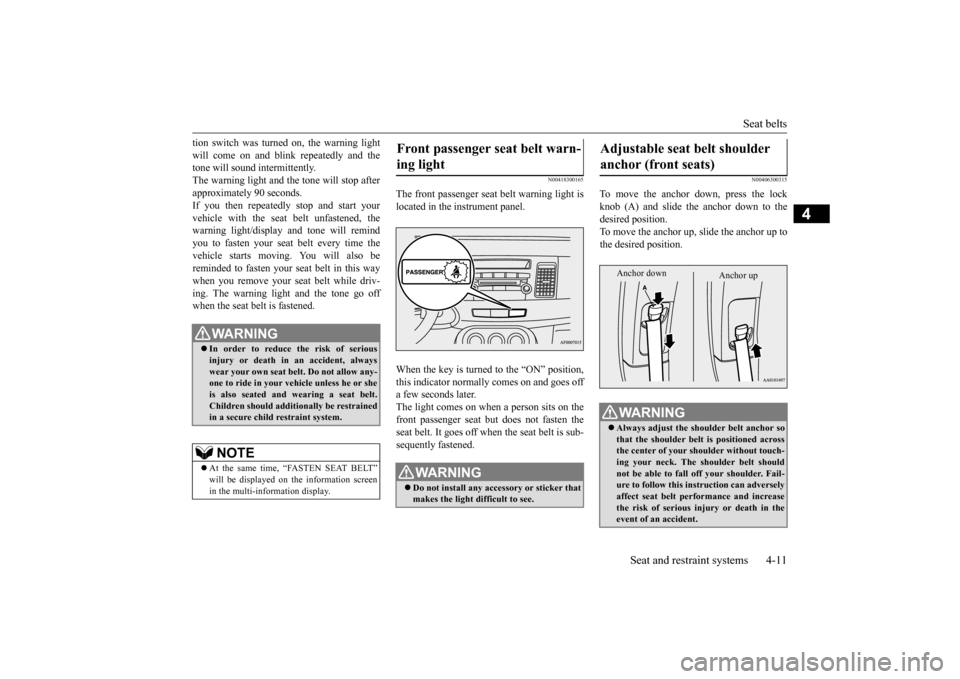
N00418300
165
The
front
passenger
seat
belt
warning
light
is
located in the instrument panel.When
the
key
is turned
to the
“ON”
position,
this
indicator
normally
comes
on
and
goes
off
a few seconds later
.
The
light
comes
on
when
a person
sits
on
the
front
passenger
seat
but
does
not
fasten
the
seat
belt.
It goes
off when
the
seat
belt
is sub-
sequently fastened.
N00406300
315
To move
the
anchor
down,
press
the
lock
knob
(A)
and
slide
the
anchor
down
to
the
desired position. To move
the
anchor
up,
slide
the
anchor
up
to
the desired position.
W
AR
NING
In
order
to
reduce
the
risk
of
serious
injury
or
death
in
an
accident,
always
wear
your own
seat belt. Do
not
allow
any-
one to ride in your vehicle unless he or she is also
seate
d and
wearing
a seat
belt.
Child
ren sho
uld addition
ally
be restrain
ed
in a secu
re child
restraint syste
m.
NOTE
At the same
time,
“FASTEN
SEAT BELT”
will be display
ed on
the information
screen
in the multi-information
display
.
Fr
ont passenger seat belt warn-
ing light
W
AR
NING
Do not install
any accessory
or stick
er that
makes the light difficult to see.
Adjustable seat belt shoulder anchor (fr
ont seats)
W
AR
NING
Always
adjust
the
shoulder
belt
anchor
so
that
the
shoul
der belt is posi
tione
d across
the
center
of your
shoul
der without
touc
h-
ing
your
neck.
The
shoul
der
belt shoul
d
not
be able
to fall
off
your
shoul
der. Fail-
ure to follow
this instr
uction
can
advers
ely
affect
seat belt perfor
mance
and
increase
the
risk
of serious
injur
y or death
in the
event of an accident.Anchor
down
Anchor
up
Page 36 of 392
Seat belt use during pregnancy4-12
Seat and restraint systems
4
N0040670
1215
When
your
seat
belt,
even
fully
extended,
is
not
long
enough,
a seat
belt
extender
must
be
obtained.
The
extender
may
be
used
for
either
of the
front
seats.
N0040680
0121
Seat
belts
work
for
everyone,
including
preg-
nant
women.
Like
all
occupants,
pregnant
women
are
more
likely
to be
seriously
injured
or
killed
in
an
accident
if they
do
not
wear
seat
belts.
N0041770
0609
The
driver
’s and
front
passenger
’s seats
each
have a seat belt equipped with a pre-tensioner system.
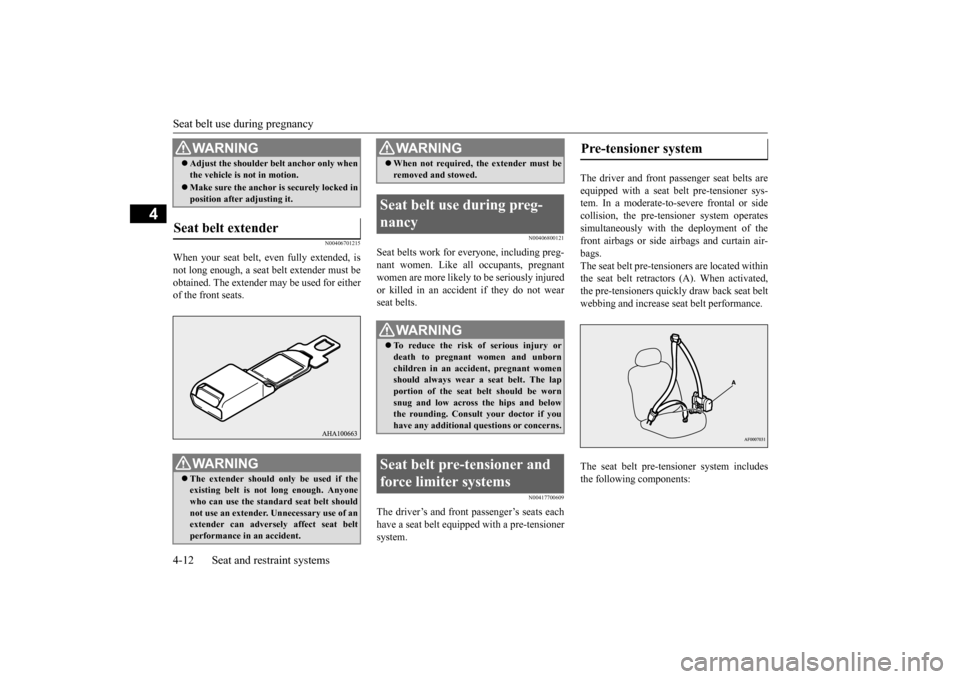
The
driver
and
front
passenger
seat
belts
are
equipped
with
a seat
belt
pre-tensioner
sys-
tem.
In
a moderate-to-severe
frontal
or
side
collision,
the
pre-tensioner
system
operates
simultaneously
with
the
deployment
of
the
front
airbags
or
side
airbags
and
curtain
air-
bags.The
seat
belt
pre-tensioners
are
located
within
the
seat
belt
retractors
(A).
When
activated,
the
pre-tensioners
quickly
draw
back
seat
belt
webbing and increase seat belt performance. The
seat
belt
pre-tensioner
system
includes
the following components:
Adjust
the
shoulder
belt
anchor
only
when
the
vehicle
is not
in motion.
Mak
e sur
e the anchor is secu
rely
lock
ed in
position
after
adjusting
it.
Seat belt extender
W
AR
NING
The
extender
should
only
be
used
if the
exis
ting belt
is not
lon
g enough. Anyon
e
who
can
use
the
standar
d seat belt shoul
d
not
use
an
exte
nde
r. Unnecessar
y use
of an
exte
nder
can
advers
ely
affect
seat
belt
performance
in an
accident.
W
AR
NING
When not requi
red, the extender
must
be
removed
and
stow
ed.
Seat belt use during pr
eg-
nancy
W
AR
NING
To reduce
the
risk
of
serious
injur
y or
death
to
pregn
ant women
and
unborn
children in an
accid
ent,
pregnant
wome
n
sho
uld alw
ays
wear
a seat
belt.
The lap
por
tion
of
the
seat
belt shoul
d be wor
n
snug
and
low
acr
oss
the
hips
and
below
the
rounding.
Consult
your
doctor
if you
have any
addi
tional
que
stions
or con
cerns.
Seat belt pr
e-tensioner and
for
ce limiter systems W
AR
NING
Pr
e-tensioner system
Page 42 of 392
Child
restraint
systems
4-18
Seat and restraint systems
4
N0040730
1508
With
the
exception
of
the
driver
, the
seat
belt
in all other
seating
positions
can
be
converted
from
normal
Eme
rgency
Locking
Retractor
(ELR)
mode
to Automatic
Locking
Retractor
(ALR)
mode.
This
means
that
when
you
pull
the
seat
belt
fully
out
of
the
retractor
, the
retractor
will
switch
to its
ALR
child
restraint
installation
function.
Always
use
the
ALR
child
restraint
installation
function
when
you
install
a child
restraint
system
using
the
seat
bel
t.
Children
12
years
old
and
under
should
always
be
restrained
in
the
rear
seat,
when-
ever
possible,
although
the
front
passenger
seat belt can also be converted to ALR mode.
1.Place
the
child
restraint
system
on
the
seat
where you wish to install it.To help
assure
proper
fitting
of
the
child
restraint
system,
always
remove
the
head
restraint.2.Route
the
seat
belt
through
the
child
restraint
system
according
to
the
instruc-
tions
provided
by
the
child
restraint
sys-
tem
manufacturer
. Then
insert
the
seat
belt
latch
plate
into
the
buckle.
Make
sure
you
hear
a “click”
when
you
insert
the
latch plate into the buckle.
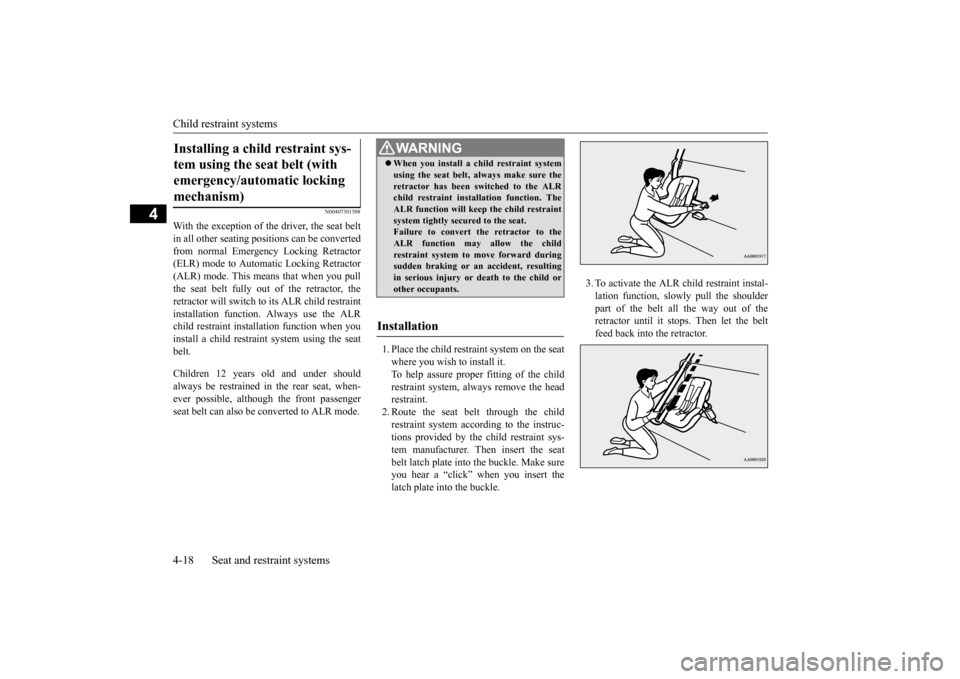
3.To activate
the
ALR
child
restraint
instal-
lation
function,
slow
ly
pull
the
shoulder
part
of
the
belt
all
the
way
out
of
the
retractor
until
it stops.
Then
let
the
belt
feed back into the retractor
.
Installing a child r
estraint sys-
tem using the seat belt (with emergency/automatic locking mechanism)
W
AR
NING
Whe
n you
install
a child restraint
syste
m
usi
ng
the
seat belt,
always
make
sur
e the
retractor
has
been
swi
tched to
the
ALR
child restraint
installati
on
func
tion.
The
ALR
func
tion
will keep
the
child restraint
system
tightly
secur
ed to the
seat.
Failur
e to
convert
the
retractor
to
the
ALR func
tion
may allow
the
child
restraint
system to move
for
war
d durin
g
sudden
braking
or
an
accident,
resulting
in serious
injury
or
death
to the
child
or
other
occupa
nts.
Installation
Page 43 of 392
Child restraint systems
Seat and restraint systems
4-19
4
4.After
the
belt
has
retracted,
tug
on
it.
If
the
belt
is in
the
ALR
function,
you
will
not
be
able
to
pull
it out.
If the
webbing
can
be
pulled
out
from
retracto
r, the
ALR
function
has
not
been
activated
and
you
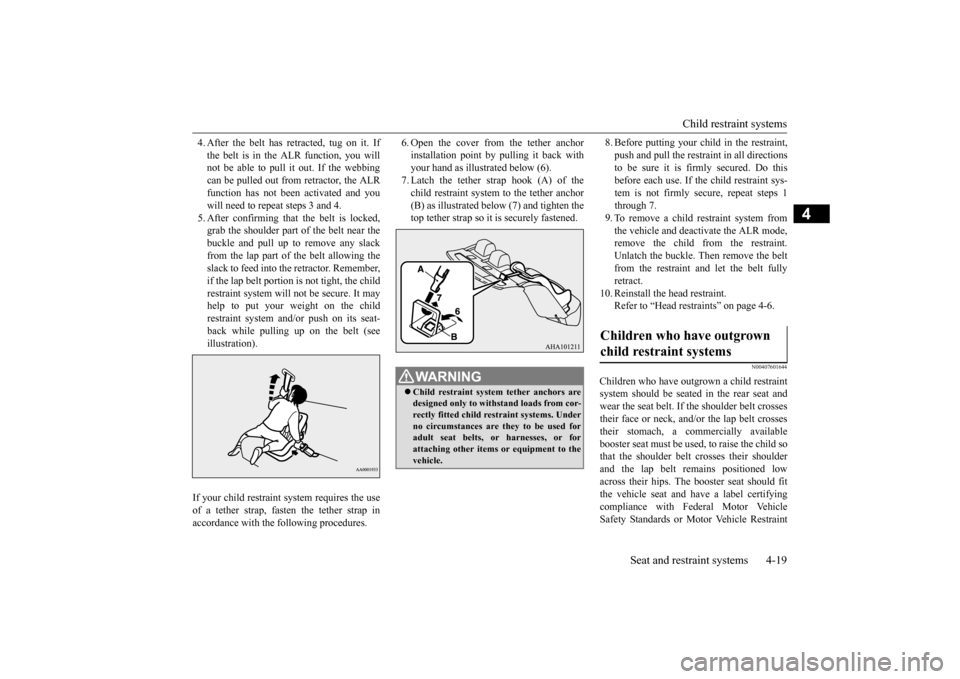
will need to repeat steps 3 and 4.5.After
confirming
that
the
belt
is locked,
grab
the
shoulder
part
of
the
belt
near
the
buckle
and
pull
up
to
remove
any
slack
from
the
lap
part
of
the
belt
allowing
the
slack
to feed
into
the
retractor
. Remember
,
if the
lap
belt
portion
is not
tight,
the
child
restraint
system
will
not
be
secure.
It may
help
to
put
your
weight
on
the
child
restraint
system
and/or
push
on
its
seat-
back
while
pulling
up
on
the
belt
(see
illustration).
6.Open
the
cover
from
the
tether
anchor
installation
point
by
pulling
it back
with
your hand as illustrated below (6).7.Latch
the
tether
strap
hook
(A)
of
the
child
restraint
system
to the
tether
anchor
(B)
as illustrated
below
(7)
and
tighten
the
top tether strap so it is securely fastened.
8.Before
putting
your
child
in the
restraint,
push
and
pull
the
restraint
in all directions
to
be
sure
it is
firmly
secured.
Do
this
before
each
use.
If the
child
restraint
sys-
tem
is
not
firmly
secure,
repeat
steps
1
through 7.9.To remove
a child
restraint
system
from
the
vehicle
and
deactivate
the
ALR
mode,
remove
the
child
from
the
restraint.
Unlatch
the
buckle.
Then
remove
the
belt
from
the
restraint
and
let
the
belt
fully
retract.
10.
Reinstall the head restraint.Refer to “Head restraints” on page 4-6.
N00407601
644
Children
who
have
outgrown
a child
restraint
system
should
be
seated
in
the
rear
seat
and
wear
the
seat
belt.
If the
shoulder
belt
crosses
their
face
or
neck,
and/or
the
lap
belt
crosses
their
stomach,
a
commercially
available
booster
seat
must
be
used,
to raise
the
child
so
that
the
shoulder
belt
crosses
their
shoulder
and
the
lap
belt
remains
positioned
low
across
their
hips.
The
booster
seat
should
fit
the
vehicle
seat
and
have
a label
certifying
compliance
with
Federal
Motor
Vehicle
Safety
Standards
or
Motor
Vehicle
Restraint
If your
child
restraint
system
requires
the
use
of
a tether
strap,
fasten
the
tether
strap
in
accordance with the following procedures.
W
AR
NING
Child
restraint
syste
m tether
anc
hors
are
designed
only
to withstand
loads
from
cor
-
rectly fitted child r
estraint systems. Under
no circumsta
nces
are the
y to be use
d for
adul
t seat
belts,
or
har
nesses,
or for
attach
ing
other
items
or
equi
pme
nt to the
vehicle.
Childr
en who have outg
rown
child r
estraint systems