wheel MITSUBISHI LANCER 2016 8.G Owners Manual
[x] Cancel search | Manufacturer: MITSUBISHI, Model Year: 2016, Model line: LANCER, Model: MITSUBISHI LANCER 2016 8.GPages: 392, PDF Size: 13.12 MB
Page 2 of 392
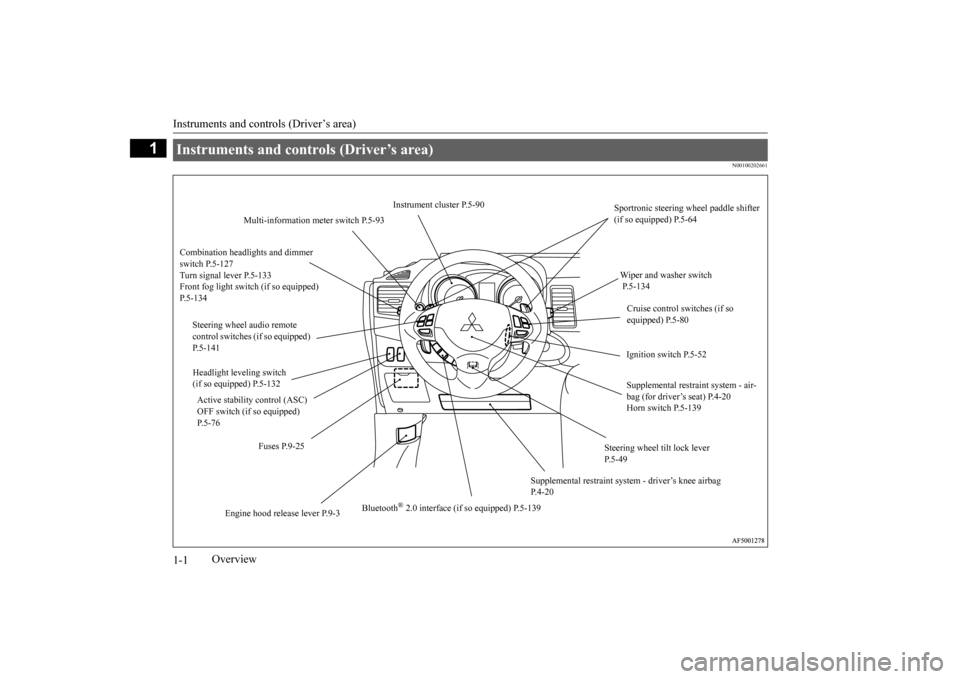
Instruments and controls (Driver’s area)1-1
1
Overview
N0010020
2661
Instruments and contr
ols (Driver
’s ar
ea)
Instrument clus
ter P.5-90
Sportronic steering wheel paddle shifter (if so equipped) P
.5-64
Multi-information meter switch P
.5-93
Com
bination headlight
s and dimmer
switch
P.5-127
Turn signal leve
r P.5-133
Front fog light switch (if so equipped)P.5-134
Wiper and wa
sher switch
P.5-134Cruise control switches (if so equi
ppe
d) P.5-80
Steering
wheel
audio
remote
cont
rol switche
s (if so equi
ppe
d)
P.5-141
Ignition switch P
.5-52
Headlight
leveling
switch
(if so equip
ped
) P.5-132
Supplemental re
straint
system - air
-
bag (for
driver’s seat)
P.4-20
Horn switch P
.5-139
Active stability control (
ASC)
OFF switch (if so equipped) P.5-76
Fuses
P.9-25
Steering wheel tilt lock lever P.5-49
Supplemental
restraint
system -
driver
’s knee airbag
P.4-20
Bluetoot
h® 2.0 interface (if so equipped) P
.5-139
Engine hood rele
ase
lever
P.9-3
Page 9 of 392
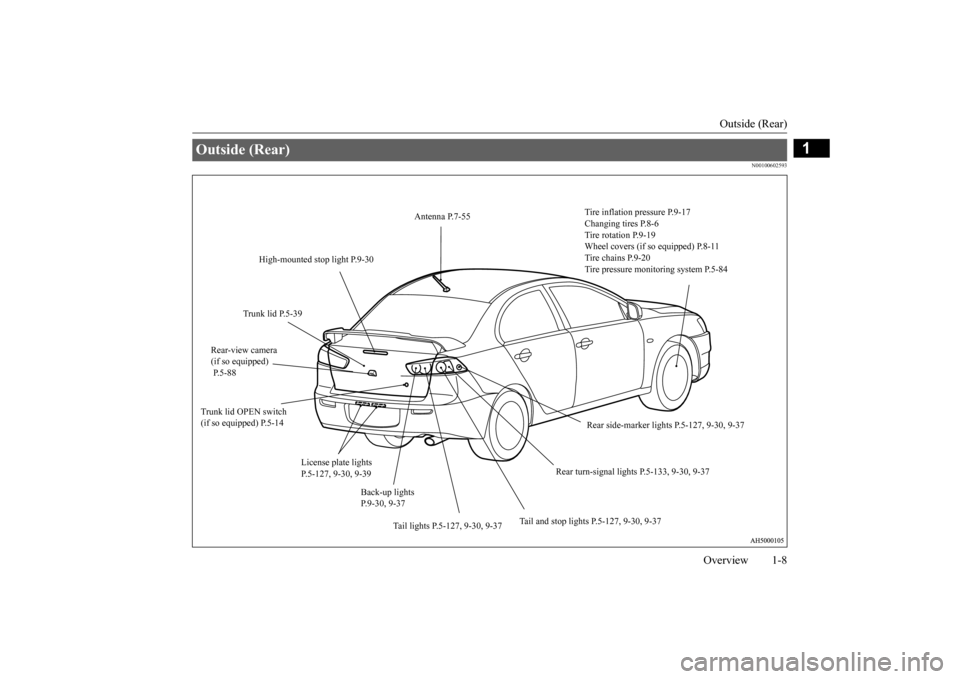
Outside (Rear)
Overview
1-8
1
N00100602
593
Outside (Rear)
Tire inflation pressure P
.9-17
Changing
tires
P.8-6
Tire rotation P
.9-19
Wheel covers (if so
equipped) P
.8-1
1
Tire chains P
.9-20
Tire pressure monitoring system P
.5-84
Antenna
P.7-55
High-m
ounted st
op light
P.9-30
Trunk
lid
P.5-39
Rear
-view
camera
(if so equipped)
P.5-88
Trunk lid OPE
N switch
(if so equipped) P
.5-14
Rear
side-marker
lights
P.5-127,
9-30,
9-37
License
plate lights
P.5-127, 9
-30, 9-39
Rear t
urn-si
gnal light
s P.5-133, 9-30, 9-37
Back-up light
s
P.9-30, 9-37
Tail and
stop
lights
P.5-127,
9-30,
9-37
Tail lights
P.5-127,
9-30,
9-37
Page 13 of 392
If this problem occurs...
Quick index
2-3
2
N00200901
949
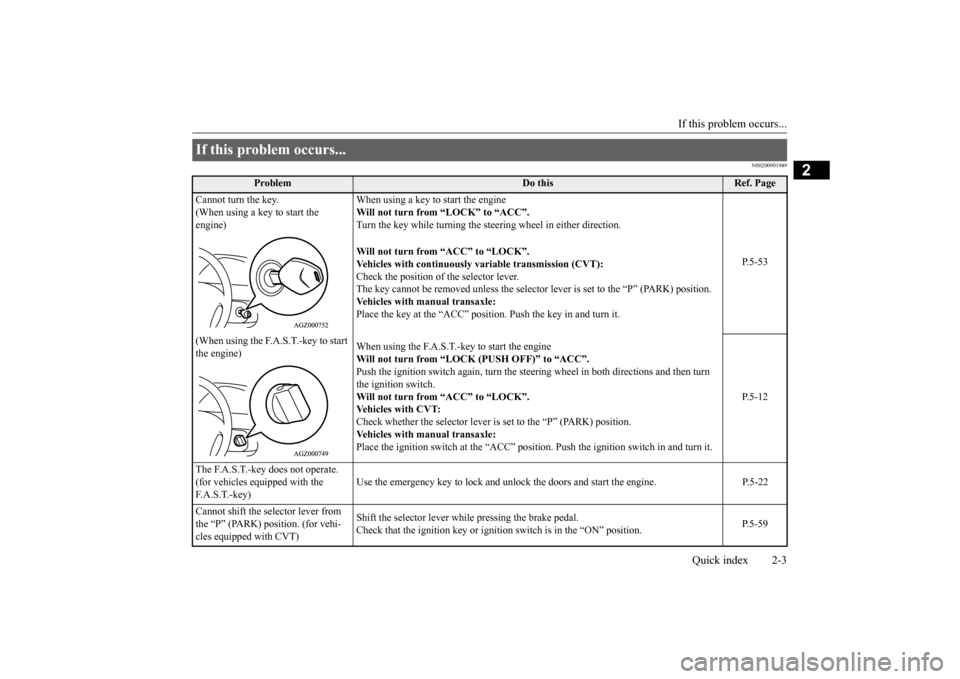
If this pr
oblem occurs... Problem
Do this
Ref. Page
Cannot turn the ke
y.
(When using a key to start the engine)
When using a key to start the engineWill not turn fr
om “LOCK” to “ACC”.
Turn the key while turning the steering wheel in either direction.
P.5-53
Will not turn fr
om “ACC” to “LOCK”.
Vehicles
with
continuously
variable
transmission
(CVT):
Check
the
position
of the
selector
lever
.
The key cannot be removed unless the selector lever is set to the “P” (P
ARK) position.
Vehicles
with
manual
transaxle:
Place the key at the “ACC” position. Push the key in and turn it.
(Whe
n using
the F.A.S.T
.-key
to start
the engine)
When using the F
.A.S.T
.-key to start the engine
Will not turn fr
om “LOCK (PUSH OFF)” to “ACC”.
Push the ignition switch again, turn the steeri
ng wheel in both directions and then turn
the ignition switch.Will not turn fr
om “ACC” to “LOCK”.
Vehicles
with
CVT
:
Check whether the selector lever is set to the “P” (P
ARK) position.
Vehicles
with
manual
transaxle:
Place the ignition switch at the “ACC” positi
on. Push the ignition switch in and turn it.
P.5-12
The F
.A.S.T
.-key does not operate.
(for vehicles equipped with the F.A.S.T
.-key)
Use the emer
gency key to lock and unlock the doors and start the engine.
P.5-22
Cannot shift the selector lever from the “P” (P
ARK) position. (for vehi-
cles equipped with CVT)
Shift the selector lever while pressing the brake pedal. Check
that
the
ignition
key
or ignition
switch is in the “ON” position.
P.5-59
Page 15 of 392
If this problem occurs...
Quick index
2-5
2
Problem
Do this
Ref. page
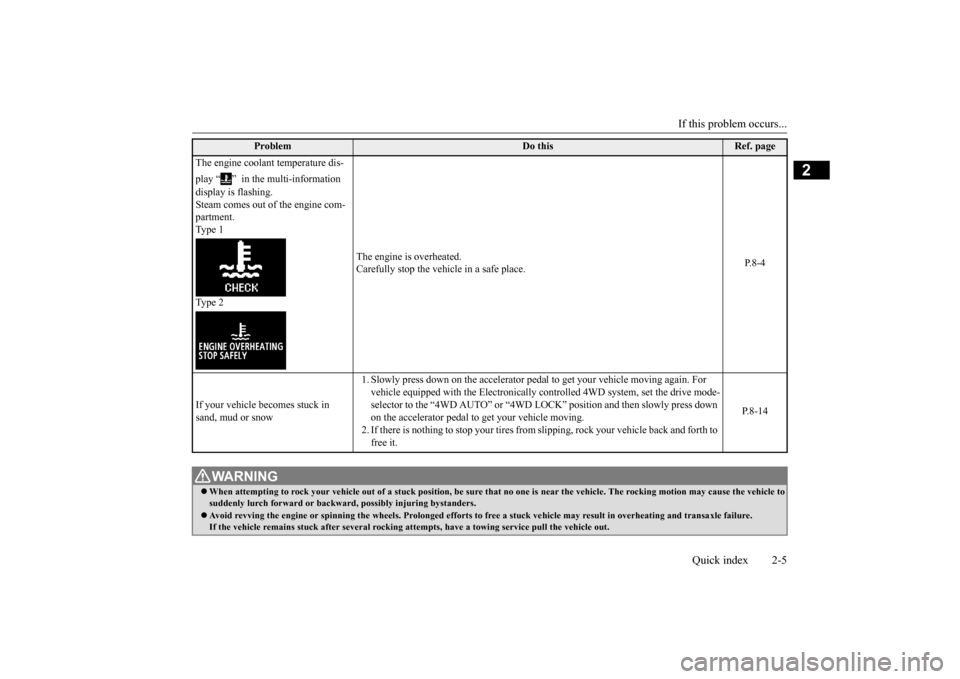
The engine coolant temperature dis-play “
” in the multi-information
display is flashing.Steam comes out of the engine com-partment. Type 1Type 2
The
engine
is overheated.
Carefully stop the vehicle in a safe place.
P.8-4
If your vehicle becomes stuck in sand, mud or snow
1.Slowly press down on the accelerator peda
l to get your vehicle moving again. For
vehicle
equipped
with
the
Electronically
controlled
4WD
system,
set
the
drive
mode-
selector
to the
“4WD
AUT
O” or “4WD
LO
CK”
position
and
then
slowly
press
down
on the accelerator pedal to get your vehicle moving.2.If there
is nothing
to stop
your
tires
from
slipping,
rock
your
vehicle
back
and
forth
to
free it.
P.8-14
W
AR
NING
When
attempting
to rock
your
vehicle
out
of a stuck
position,
be
sur
e that
no
one
is near
the
vehicle.
The
rocking
motion
may
cause
the
vehicle
to
sudde
nly lurch forw
ard
or bac
kwar
d, possi
bly injurin
g bystanders
.
Avoid
revving
the
engine
or spinning
the
wheels. Pr
olonged efforts to fr
ee a stuck ve
hicle may r
esult in overheating and transa
xle
failu
re.
If the
vehicle
remai
ns stuc
k after
severa
l rock
ing
attempts,
have
a towing
service
pull
the
vehicle
out.
Page 20 of 392
Filling the fuel tank3-4
General information
3
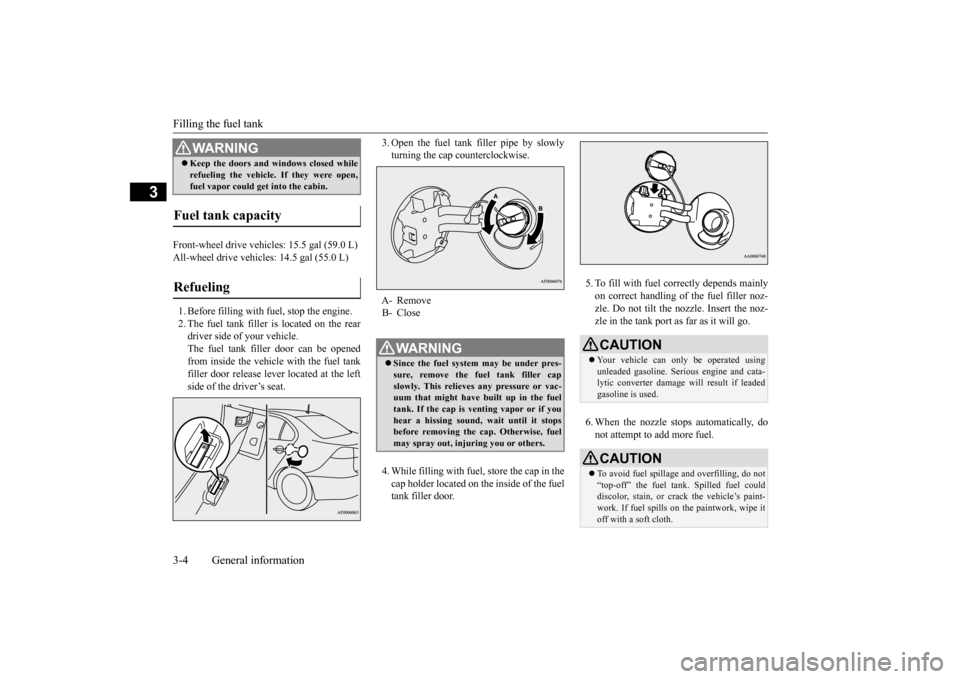
Front-wheel drive vehicles: 15.5 gal (59.0 L)All-wheel drive vehicles: 14.5 gal (55.0 L)1.Before filling with fuel, stop the engine.2.The
fuel
tank
filler
is located
on
the
rear
driver side of your vehicle. The
fuel
tank
filler
door
can
be
opened
from
inside
the
vehicle
with
the
fuel
tank
filler
door
release
lever
located
at the
left
side of the driver
’s seat.
3.Open
the
fuel
tank
filler
pipe
by
slowly
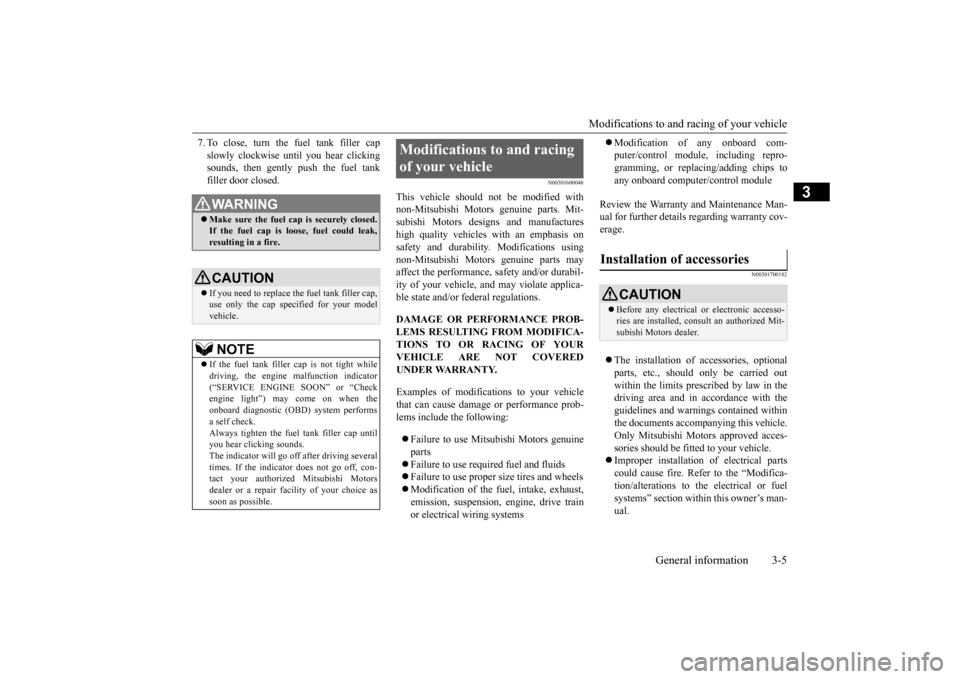
turning the cap counterclockwise.4.While
filling
with
fuel,
store
the
cap
in the
cap
holder
located
on
the
inside
of the
fuel
tank filler door
.
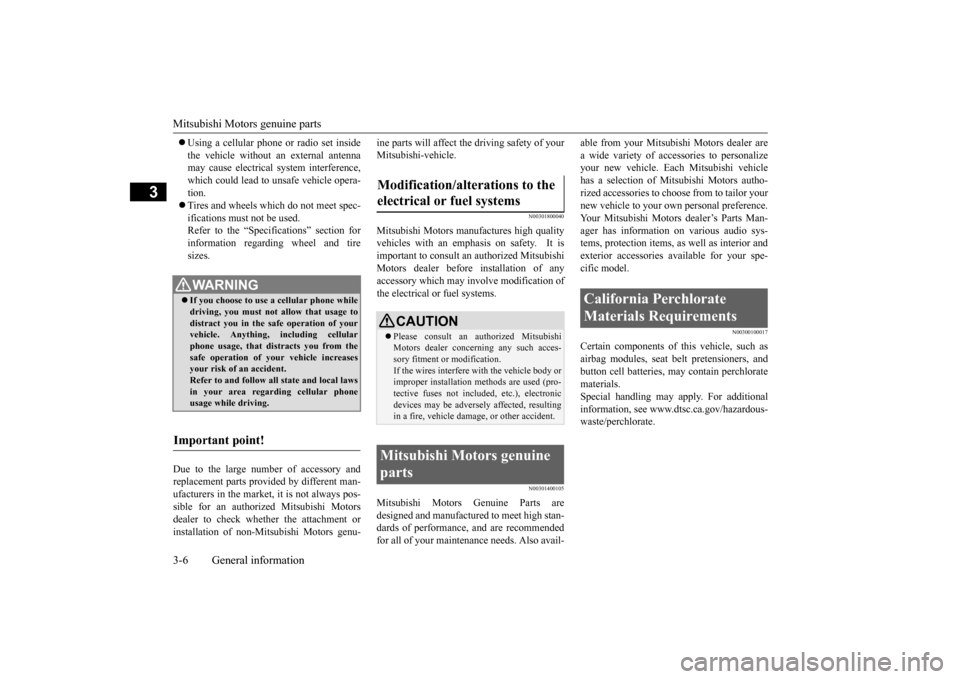
5.To fill
with
fuel
correctly
depends
mainly
on
correct
handling
of
the
fuel
filler
noz-
zle.
Do
not
tilt
the
nozzle.
Insert
the
noz-
zle in the tank port as far as it will go.6.When
the
nozzle
stops
automatically
, do
not attempt to add more fuel.
Keep
the
doors
and
windows
clos
ed while
refuelin
g the
veh
icle.
If the
y were ope
n,
fuel vapor
could get
into the
cabin.
Fuel tank capacity Refueling
W
AR
NING
A-Remove
B-
Close W
AR
NING
Since
the
fuel
system
may
be
under
pres-
sur
e, remove
the
fuel
tank
filler
cap
slowly
. This
relieves
any
pressur
e or
vac-
uum
that
might
have
built
up
in the
fuel
tank.
If the
cap
is venting
vapor
or if you
hear
a hissing
sound,
wait
until
it stops
befor
e removin
g the
cap.
Otherw
ise, fue
l
may
spray
out,
injuring
you
or others.
CAUTIONYour
vehicle
can
onl
y be ope
rated
using
unlead
ed gasolin
e. Serious
engi
ne and
cata-
lytic
conve
rter damag
e will
result
if lead
ed
gasoline
is used.
CAUTIONTo avoi
d fuel
spillag
e and
ove
rfilling,
do
not
“top-of
f”
the
fuel
tank.
Spilled
fuel
could
discolor
, stain,
or crack
the
vehicle’
s paint-
work.
If fuel
spills
on
the
paintw
ork,
wipe
it
off with
a soft
cloth.
Page 21 of 392
Modifications to and racing of your vehicle
General information
3-5
3
7.To close,
turn
the
fuel
tank
filler
cap
slowly
clockwise
until
you
hear
clicking
sounds,
then
gently
push
the
fuel
tank
filler door closed.
N00301600
048
This
vehicle
should
not
be
modified
with
non-Mitsubishi
Motors
genuine
parts.
Mit-
subishi
Motors
designs
and
manufactures
high
quality
vehicles
with
an
emphasis
on
safety
and
durabilit
y. Modifications
using
non-Mitsubishi
Motors
genuine
parts
may
affect
the
performance,
safety
and/or
durabil-
ity
of
your
vehicle,
and
may
violate
applica-
ble state and/or federal regulations. DAMAGE
OR
PERFORMANCE
PROB-
LEMS
RESUL
TING
FR
OM
MODIFICA-
TIONS
TO OR
RACING
OF
YOU
R
VEHICLE
ARE
NOT
COVERED
UNDER
W
ARRANTY
.
Examples
of
modifications
to
your
vehicle
that
can
cause
damage
or
performance
prob-
lems
include
the
following:
Failure
to use
Mitsubishi
Motors
genuine
partsFailure
to use
required
fuel
and
fluids
Failure to use proper size tires and wheelsModification
of
the
fuel,
intake,
exhaust,
emission,
suspension,
engine,
drive
train
or electrical wiring systems
Modification
of
any
onboard
com-
puter/control
module,
including
repro-
gramming,
or
replacing/adding
chips
to
any
onboard
computer/control
module
Review
the
Warranty
and
Maintenance
Man-
ual
for
further
details
regarding
warranty
cov-
erage.
N00301700
182
The
installation
of
accessories,
optional
parts,
etc.,
should
only
be
carried
out
within
the
limits
prescribed
by
law
in the
driving
area
and
in
accordance
with
the
guidelines
and
warnings
contained
within
the
documents
accompanying
this
vehicle.
Only
Mitsubis
hi
Motors
approved
acces
-
sories should be fitted to your vehicle.Improper
installation
of
electrical
parts
could
cause
fire.
Refer
to
the
“Modifica-
tion/alterations
to
the
electrical
or
fuel
systems”
section
with
in this
owner
’s man
-
ual.
W
AR
NING
Make
sur
e the
fuel
cap
is secur
ely closed.
If the
fuel
cap
is loose,
fuel
could
leak,
resulting
in a fire.
CAUTIONIf you
need
to replace
the fuel
tank
filler
cap
,
use only
the
cap
specified
for
your
model
vehicle. NOTE
If the
fuel
tank
filler
cap
is not
tight
while
driving,
the
engine
malfunction
indicator
(“SER
VICE
ENGINE
SOON”
or
“Check
engin
e light”)
may
come
on when
the
onboard
diagnostic
(OBD)
system
performs
a self check.
Always
tigh
ten
the
fuel
tan
k filler
cap
until
you
hear
clicking
sounds.
The indicator
will go off after drivin
g several
times.
If the
indicator
does not go off, con
-
tact
your authorized
Mitsubishi
Mot
ors
dealer
or a repair
facility
of your
choice
as
soon
as possible.
Modifications to and racing of your vehicle
Installation of accessories
CAUTIONBef
ore any electr
ical
or
electronic
accesso-
ries are installed,
consult
an
authorized
Mit-
subishi
Motors
dealer
.
Page 22 of 392
Mitsubishi Motors genuine parts3-6
General information
3
Using
a cellular
phone
or
radio
set
inside
the
vehicle
without
an
external
antenna
may
cause
electrical
system
interference,
which
could
lead
to unsafe
vehicle
opera-
tion.Tires
and
wheels
which
do
not
meet
spec-
ifications must not be used. Refer
to
the
“Specifications”
section
for
information
regarding
wheel
and
tire
sizes.
Due
to
the
large number
of
accessory
and
replacement
parts
provided
by
different
man-
ufacturers
in the
market,
it is not
always
pos-
sible
for
an
authorized
Mitsubishi
Motors
dealer
to
check
whether
the
attachment
or
installation
of
non-Mitsubishi
Motors
genu-
ine
parts
will
affect
the
driving
safety
of your
Mitsubishi-vehicle.
N0030180
0040
Mitsubishi
Motors
ma
nufactures
high
quality
vehicles
with
an
emphasis
on
safety
. It
is
important
to consult
an
authorized
Mitsubishi
Motors
dealer
before
installation
of
any
accessory
which
may
involve
modification
of
the electrical or fuel systems.
N0030140
0105
Mitsubishi
Motors
Genuine
Parts
are
designed
and
manufactured
to meet
high
stan-
dards
of
performance,
and
are
recommended
for
all
of your
maintenance
needs.
Also
avail-
able
from
your
Mitsubishi
Motors
dealer
are
a wide
variety
of
accessories
to
personalize
your
new
vehicle.
Each
Mitsubishi
vehicle
has
a selection
of
Mitsubishi
Motors
autho-
rized
accessories
to choose
from
to tailor
your
new
vehicle
to your
own
personal
preference.
Your
Mitsubishi
Motors
dealer
’s Parts
Man-
ager
has
information
on
various
audio
sys-
tems,
protection
items,
as well
as interior
and
exterior
accessories
available
for
your
spe-
cific model.
N0030010
0017
Certain
components
of
this
vehicle,
such
as
airbag
modules,
seat
belt
pretensioners,
and
button
cell
batteries,
may
contain
perchlorate
materials.Special
handling
may
apply
. For
additional
information,
see
www
.dtsc.ca.gov/hazardous-
waste/perchlorate.
W
AR
NING
If you
choose
to use
a cellu
lar phone
while
driv
ing,
you
must
not
allow
that
usage
to
distract
you
in the
safe
operation
of your
vehicle.
Anything,
including
cellular
pho
ne usage,
that
distracts
you
from
the
safe
operati
on
of
your
vehicle
increase
s
your
risk
of an
accident.
Refer to and
follow
all state and
local laws
in your
area
regard
ing cellu
lar phone
usage
while
driving.
Important
point!
Modification/alterations to the electrical or fuel systems
CAUTIONPlease
consult
an
authorized
Mitsubishi
Motors
dealer
concerning
any
such
acces-
sory
fitment
or modification.
If the
wires
interfere
with
the
vehicle
body
or
improper
installation
methods
are
used
(pro-
tective
fuses
not
included,
etc.),
electronic
devices
may
be
adversely
affected,
resulting
in a fire, vehicle damage, or other accident.
Mitsubishi Motors genuine parts
California
Per
chlorate
Materials Requir
ements
Page 27 of 392
Front seats
Seat and restraint systems
4-3
4
Safety
equipment
cannot
prevent
injury
or
death
in all motor
vehicle
accidents.
You
can
help
reduce
the
risk
of
injury
or
death,
how-
ever
, by
following
the
instructions
in this
manual.
N00401801
442
Position
the
driver
’s seat
as far
back
as possi-
ble
while
maintaining
a position
that
still
enables
you
to
fully
apply
the
pedals,
easily
control
the
steering
wheel
and
safely
operate
the vehicle.
N00401901
355
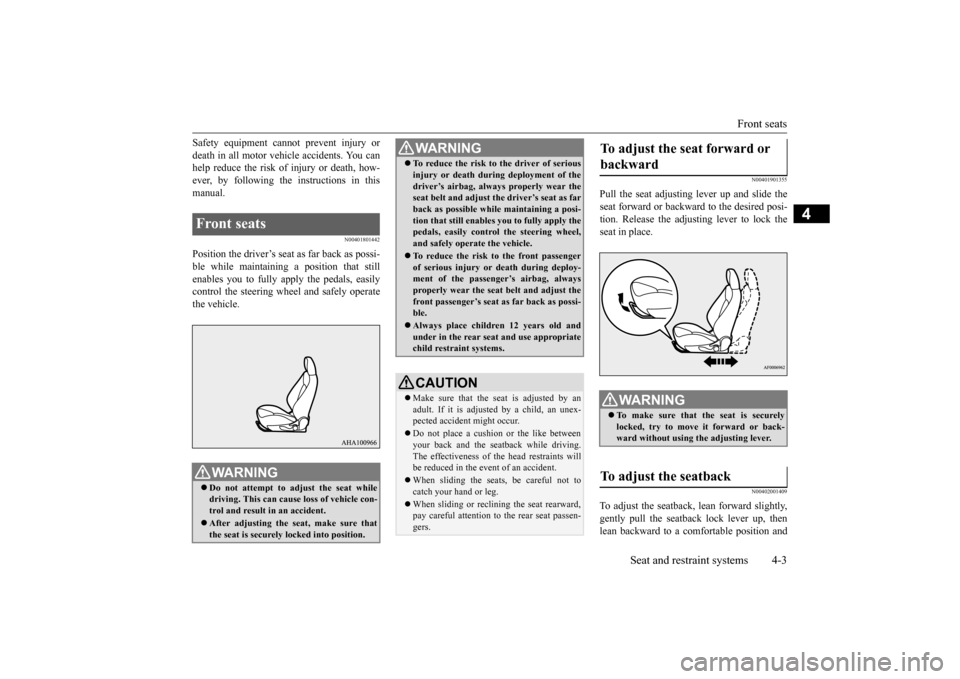
Pull
the
seat
adjusting
lever
up
and
slide
the
seat
forward
or
backward
to the
desired
posi-
tion.
Release
the
adjusting
lever
to
lock
the
seat in place.
N00402001
409
To adjust
the
seatback,
lean
forward
slightly
,
gently
pull
the
seatback
lock
lever
up,
then
lean
backward
to
a comfortable
position
and
Fr
ont seats W
AR
NING
Do
not
attempt
to
adjust
the
seat
while
drivin
g. This can
cause
loss
of veh
icle
con
-
trol and
resul
t in an
accid
ent.
After
adjusting
the
seat,
make
sur
e that
the
seat
is secur
ely locked
into
position.
To reduce
the
risk
to the
driver
of serious
injur
y or death
during
deployment
of the
driver
’s airbag,
always
properly
wear
the
seat belt and adjust t
he driv
er’s seat as far
bac
k as possi
ble while
mai
ntai
ning
a posi
-
tion
that still
enables you
to fully
appl
y the
pedals,
easily
contr
ol
the
steering
wheel,
and safely
operate
the
vehicle.
To reduce
the
risk
to the
front
passenger
of serious
injur
y or death
during
deploy-
men
t of
the passenger
’s airb
ag,
alw
ays
properly
wear the
seat belt and
adjust
the
front
passenger
’s seat
as far
back
as possi-
ble.Always
place
children 12
years
old
and
under
in the
rear seat and
use
appr
opriate
child restraint syste
ms.
CAUTIONMake
sure
that
the
seat
is adjus
ted
by
an
adult.
If it is adjus
ted
by
a child,
an
unex-
pected
accident
might
occur
.
Do
not
place
a cushion
or the
like
between
your
back
and
the
seatback
while
driving.
The
effectiveness
of the
head
restraints
will
be reduced
in the
event
of an accident.
When
sliding
the
seats
, be
careful
not
to
catch your hand or leg.When
sliding
or reclining
the
seat
rearward,
pay
careful atten
tion
to the rear seat
passen-
gers.W
AR
NING
To adjust the seat forward or backward
W
AR
NING
To make
sur
e that
the
seat
is
secur
ely
lock
ed, try
to
move
it forw
ard
or
back
-
war
d wi
thout usi
ng the
adjusti
ng
lev
er.
To adjust the seatback
Page 32 of 392
Seat
belts
4-8
Seat and restraint systems
4
N0040600
0439
Seat
belts
are
installed
in your
vehicle
to help
reduce
the
risk
of injury
to the
driver
and
pas-
senger
in
the
event
of
an
accident.
Always
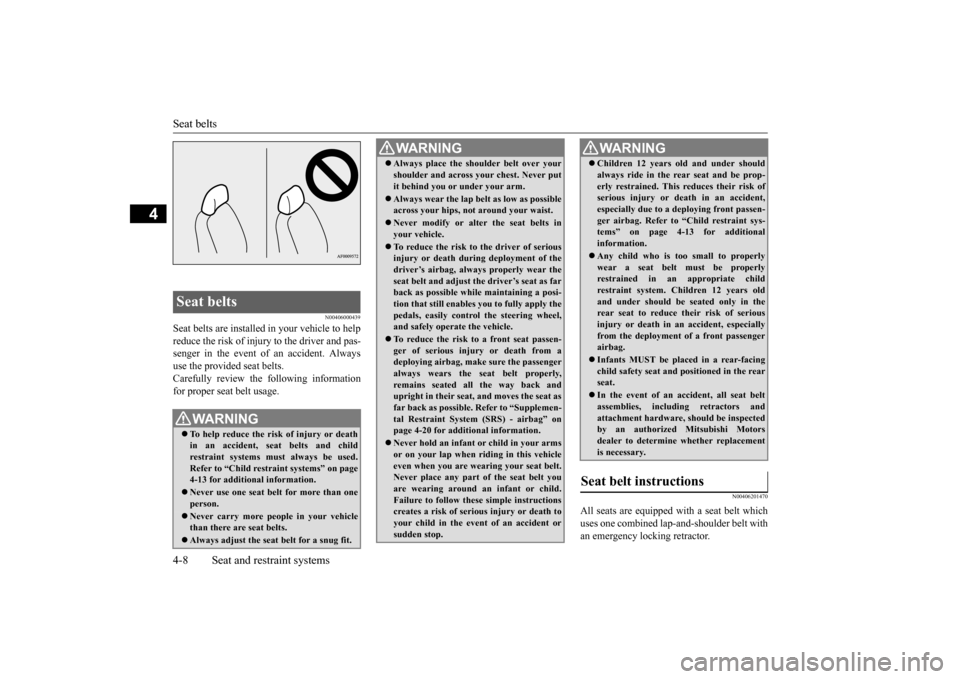
use the provided seat belts. Carefully
review
the
following
information
for proper seat belt usage.
N0040620
1470
All
seats
are
equipped
with
a seat
belt
which
uses
one
combined
lap-and-shoulder
belt
with
an emer
gency locking retractor
.
Seat belts
W
AR
NING
To help
reduce
the
risk
of injur
y or death
in an accid
ent,
seat
belts
and
child
restrain
t systems
must
alw
ays
be use
d.
Refer
to “Child
restraint
systems”
on
page
4-13 for
addi
tional
infor
mati
on.
Never use
one
seat belt for
mor
e than
one
person. Never
carry
mor
e people
in
your
vehicle
tha
n the
re are seat belts.
Always adjust the seat
belt for a snug
fit.
Alway
s place
the
shoul
der
belt over
your
shoulder
and
acr
oss your
chest.
Never
put
it behind
you
or under
your
arm.
Always
wear
the
lap
belt
as low
as possible
acr
oss your
hips,
not
around
your
waist.
Never
modi
fy
or
alter
the
seat
belts
in
your
vehicle.
To reduce
the risk
to the driver
of seriou
s
injury
or
death
durin
g deploymen
t of the
driver
’s airb
ag,
alw
ays
properly
wear
the
seat belt and
adjust
the
driv
er’s seat as far
bac
k as possi
ble while
mai
ntai
ning
a posi
-
tion
that
still
enables
you
to fully
appl
y the
pedals,
easily
contr
ol
the
steering
wheel,
and safely
operate
the
veh
icle.
To reduce
the
risk
to a front
seat passe
n-
ger
of serious
injury
or death
from a
deployi
ng airb
ag,
make
sur
e the
passenge
r
alw
ays
wears
the
seat
belt properly
,
remai
ns
seate
d all
the
way
bac
k and
upright
in their
seat,
and
moves
the
seat
as
far
bac
k as possi
ble. Refer to “Supplem
en-
tal
Restraint
System
(SRS)
- airbag”
on
page
4-20
for
addi
tional infor
mati
on.
Never
hold
an
infant
or child
in your
arms
or
on
your lap
whe
n rid
ing in this vehicle
even
whe
n you are wearin
g your seat belt.
Never
place
any par
t of the
seat
belt you
are wearing
around
an
infant
or
child.
Failur
e to follow
these
simple
instructions
create
s a risk
of serious
injury
or death
to
your
child
in the
event
of an
accident
or
sudden
stop.
W
AR
NING
Child
ren 12
years old and
under
shoul
d
always
rid
e in the
rear seat and
be prop-
erly
restrained. Thi
s reduces
their
risk
of
serious
injur
y or death
in an
accid
ent,
especia
lly due
to a deployi
ng
front
passe
n-
ger
airbag.
Refer
to “Child
restraint
sys-
tems”
on
page
4-13
for
addi
tional
infor
mati
on.
Any
child who
is too
small
to
properly
wear
a seat
belt must
be properly
restrained in an
appr
opriat
e child
restraint
syste
m.
Child
ren 12
yea
rs old
and
under
should
be
seated
only
in
the
rear seat
to
reduce
their
risk
of
serious
injur
y or death
in an
accid
ent,
especia
lly
from
the
deployment
of a front
passenger
airbag.Infants
MUST
be placed
in a rear-facin
g
child safe
ty seat and
positione
d in the
rear
seat.In
the
event
of
an
accident,
all
seat
belt
assemblies,
including
retractors
and
attach
men
t hardwa
re, sho
uld be inspected
by
an
authorized
Mitsubi
shi
Motor
s
dealer
to determ
ine whe
ther
replacem
ent
is necessary
.
Seat belt instructions
W
AR
NING
Page 33 of 392
Seat
belts
Seat and restraint systems
4-9
4
This
system
is designed
to provide
both
com-
fort
and
safet
y. It permit
s full
exten
sion
and
automatic
retraction
of
the
belts
during
nor
-
mal
vehicle
operation.
A
sensing
device
inside
the
belt
retractor
is designed
to lock
the
retractor
in
the
event
of
a sudden
change
in
the vehicle
’s motion.
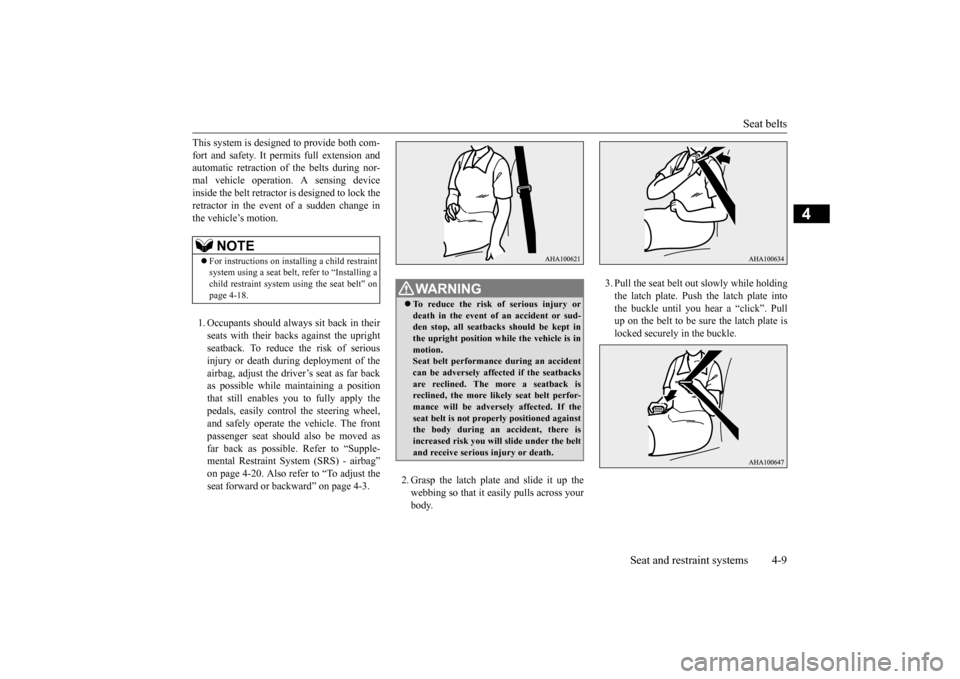
1.Occupants
should
always
sit
back
in their
seats
with
their
backs
against
the
upright
seatback.
To reduce
the
risk
of
serious
injury
or
death
during
deployment
of
the
airbag,
adjust
the
driver
’s seat
as
far
back
as possible
while
maintaining
a pos
ition
that
still
enables
you
to
fully
apply
the
pedals,
easily
control
the
steering
wheel,
and
safely
operate
the
vehicle.
The
front
passenger
seat
should
also
be
moved
as
far
back
as
possible.
Refer
to
“Supple-
mental
Restraint
System
(SRS)
- airbag”
on
page
4-20.
Also
refer
to “To adjust
the
seat forward or backward” on page 4-3.
2.Grasp
the
latch
plate
and
slide
it up
the
webbing
so
that
it easily
pulls
across
your
body
.
3.Pull
the
seat
belt
out
slowly
while
holding
the
latch
plate.
Push
the
latch
plate
into
the
buckle
until
you
hear
a “click”.
Pull
up
on
the
belt
to be
sure
the
latch
plate
is
locked securely in the buckle.
NOTE
For
instructions
on
installing
a child restrain
t
system
using
a seat
belt,
refer
to “Installing
a
child
restraint
system
using
the
seat
belt”
on
page
4-18.
W
AR
NING
To reduce
the
risk
of
serious
injury
or
death
in the
event
of an
accident
or
sud-
den stop,
all
seatbacks
sho
uld be kept
in
the
upright
position
while
the
vehicle
is in
motion.Seat
belt performance
during
an accid
ent
can
be
adversely
affected
if the
seatbacks
are reclined.
The
mor
e a seatback
is
reclined,
the
mor
e likely
seat
belt
perfor
-
mance
will
be
adversely
affected.
If the
seat
belt
is not
properly
positioned
against
the
body durin
g an
accid
ent,
the
re is
increas
ed risk
you
will slide under
the
belt
and
receive s
erious
injur
y or
death.