Tire MITSUBISHI LANCER 2017 8.G Workshop Manual
[x] Cancel search | Manufacturer: MITSUBISHI, Model Year: 2017, Model line: LANCER, Model: MITSUBISHI LANCER 2017 8.GPages: 385, PDF Size: 14.34 MB
Page 338 of 385
Tires
Vehicle care and maintenance 9-19
9
N00939700154
The following maintenance steps are recom- mended: Check tire pressures regularly. Have regular maintenance done on the wheel balance and front and rear suspen- sion alignment. Rotate your tires regularly as described in the “Tire rotation” section on page 9-19.
N00939800214
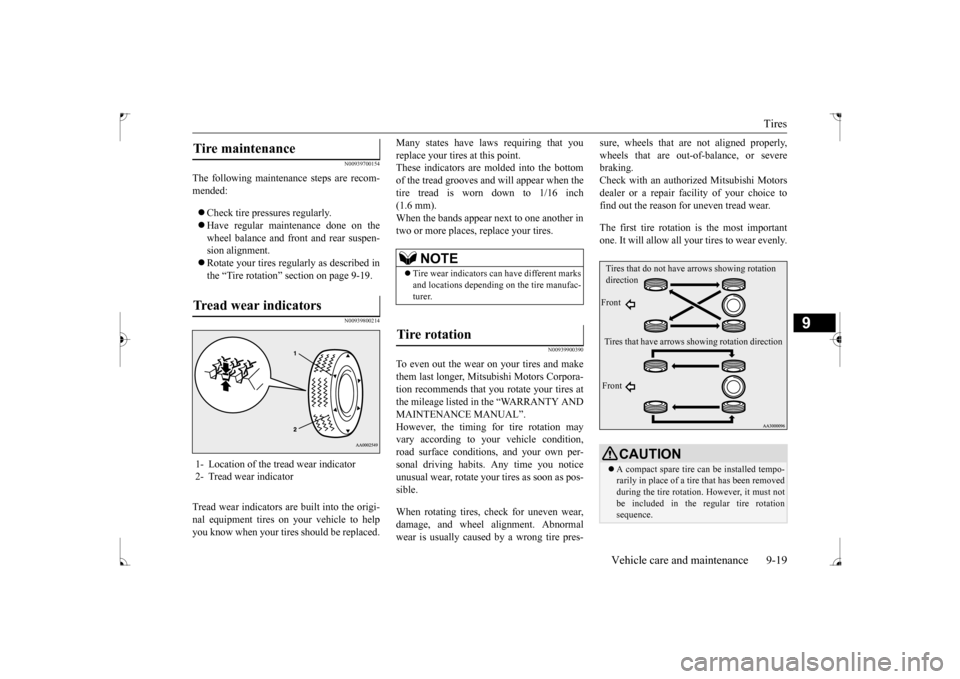
Tread wear indicators are built into the origi-nal equipment tires on your vehicle to helpyou know when your tires should be replaced.
Many states have laws requiring that you replace your tires at this point. These indicators are molded into the bottom of the tread grooves and will appear when thetire tread is worn down to 1/16 inch (1.6 mm). When the bands appear next to one another intwo or more places, replace your tires.
N00939900390
To even out the wear on your tires and makethem last longer, Mitsubishi Motors Corpora- tion recommends that you rotate your tires at the mileage listed in the “WARRANTY ANDMAINTENANCE MANUAL”. However, the timing for tire rotation may vary according to your vehicle condition,road surface conditions, and your own per- sonal driving habits. Any time you notice unusual wear, rotate your tires as soon as pos-sible. When rotating tires, check for uneven wear, damage, and wheel alignment. Abnormal wear is usually caused by a wrong tire pres-
sure, wheels that are not aligned properly, wheels that are out-of-balance, or severe braking. Check with an authorized Mitsubishi Motorsdealer or a repair faci
lity of your choice to
find out the reason for uneven tread wear. The first tire rotation is the most important one. It will allow all your tires to wear evenly.
Tire maintenance Tread wear indicators 1- Location of the tread wear indicator 2- Tread wear indicator
NOTE
Tire wear indicators can have different marks and locations depending on the tire manufac- turer.
Tire rotation
CAUTION A compact spare tire can be installed tempo- rarily in place of a tire that has been removed during the tire rotation. However, it must notbe included in the regular tire rotation sequence.Tires that do not have
arrows showing rotation
direction Front Tires that have arrows showing rotation direction Front
BK0237700US.bo
ok 19 ページ 2016年4月15日 金曜日 午前11時28分
Page 339 of 385
Clutch pedal free play (if so equipped) 9-20 Vehicle care and maintenance
9
N00940000359
In some areas of the country, snow tires are required for winter driving. If snow tires arerequired in your area, you must choose snow tires of the same size and type as the original tires provided with your vehicle. Snow tiresshould also be installed on all four wheels. Otherwise your safety and vehicle handling can be reduced.Even where laws may permit it, snow tiresshould not be operated at sustained speeds over 75 mph (120 km/h).
N00940100129 N00940201097
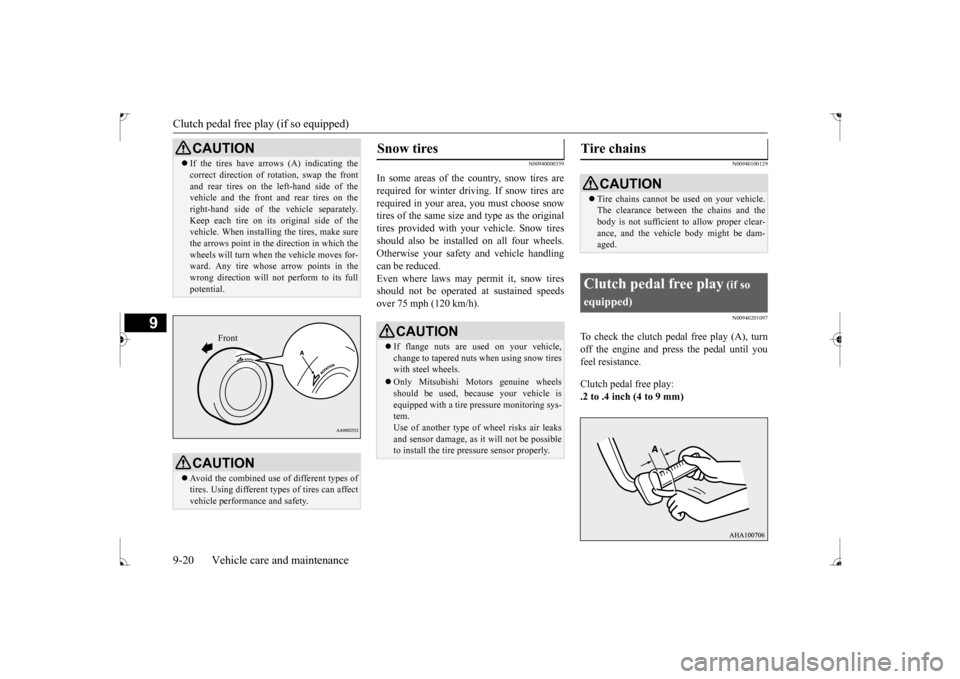
To check the clutch pedal free play (A), turn off the engine and press the pedal until you feel resistance. Clutch pedal free play: .2 to .4 inch (4 to 9 mm)
CAUTION If the tires have arrows (A) indicating the correct direction of rotation, swap the front and rear tires on the left-hand side of the vehicle and the front and rear tires on the right-hand side of the vehicle separately.Keep each tire on its original side of the vehicle. When installing the tires, make sure the arrows point in the direction in which thewheels will turn when the vehicle moves for- ward. Any tire whose arrow points in the wrong direction will not perform to its fullpotential.CAUTION Avoid the combined use of different types of tires. Using different types of tires can affectvehicle performance and safety.
Front
Snow tires
CAUTION If flange nuts are used on your vehicle, change to tapered nuts when using snow tireswith steel wheels. Only Mitsubishi Motors genuine wheels should be used, because your vehicle is equipped with a tire pressure monitoring sys- tem.Use of another type of wheel risks air leaks and sensor damage, as it will not be possible to install the tire pressure sensor properly.
Tire chains
CAUTION Tire chains cannot be used on your vehicle. The clearance between the chains and the body is not sufficient to allow proper clear- ance, and the vehicle body might be dam-aged.
Clutch pedal free play
(if so
equipped)
BK0237700US.bo
ok 20 ページ 2016年4月15日 金曜日 午前11時28分
Page 342 of 385
General maintenance
Vehicle care and maintenance 9-23
9
N00941300085
Check these regularly for damage or leaks in the fuel lines and connections. Check the fuel tank filler cap for damage or looseness. Payspecial attention to the fuel lines closest to high heat sources such as the exhaust mani- fold.
N00941400116
If the fuel-vapor vent line is clogged or dam-aged, the fuel-vapor mixture will escape, pol- luting the air. Have the system checked at an authorizedMitsubishi Motors dealer at the mileage spec-
ified in the “WARRANTY AND MAINTE- NANCE MANUAL”.
N00941500159
The next pages list the maintenance servicerecommended by Mitsubishi Motors Corpo- ration. In addition to the general maintenance that needs to be perfor
med at the times listed,
there are other parts which do not usuallyneed regular maintenance. But, if any of these parts stops working prop- erly, your vehicle performance could suffer.Have these items checked if you notice a problem with them. See your authorized Mitsubishi Motors dealer for assistance, if you have any questions.
N00941600033
Good brakes are essen
tial to safe driving.
Check the brake pads and brake linings for wear and check the rear wheel cylinders forleaks. For good braking performance, replace the brake pads with the
same type pads as the
originals.
N00941700047
Brake hoses and tubing should be checkedfor: Severe surface cracking, scuffing or worn spots. If the fabric casing of the hose is showing through any cracks or worn spots in the rubber hose cover, the hose shouldbe replaced. The brakes can fail if thehose wears through. Improper installation may cause twisting, or wheel, tire or chassis interference.
N00941800077
Check the following parts for damage andgrease leaks: Ball joint boots of the front suspension and steering linkage Bellows on both ends of the drive shaft
N00942200108
Fuel system (tank, pipe line and connection, and fuel tank filler cap)
WA R N I N G If you see a fuel leak or if you smell fuel, do not run the engine. Any spark (includ-ing from the ignition), flame or smoking material could cause an explosion or fire. Call an authorized Mitsubishi Motorsdealer or a repair facility of your choice for assistance.
Evaporative emission control system (except evaporative emission canister)
General maintenance Disc brake pads, rear drum brake linings and rear wheel cylinders
Brake hoses Ball joint, steering linkage seals and drive shaft boots Exhaust system
WA R N I N G Carbon monoxide gas from your vehicle’s exhaust is poisonous. Breathing these fumes can cause unconsciousness or death.
BK0237700US.bo
ok 23 ページ 2016年4月15日 金曜日 午前11時28分
Page 355 of 385
Replacement of light bulbs 9-36 Vehicle care and maintenance
9
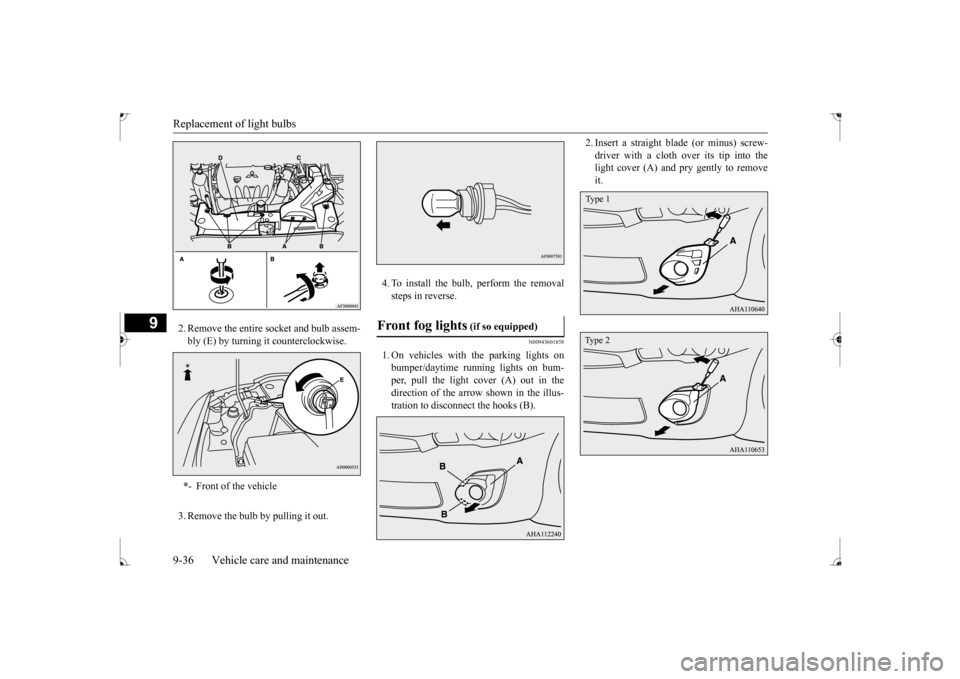
2. Remove the entire socket and bulb assem- bly (E) by turning it counterclockwise. 3. Remove the bulb by pulling it out.
4. To install the bulb, perform the removal steps in reverse.
N00943601858
1. On vehicles with the parking lights onbumper/daytime running lights on bum-per, pull the light cover (A) out in thedirection of the arrow shown in the illus- tration to disconnect the hooks (B).
2. Insert a straight blade (or minus) screw- driver with a cloth over its tip into the light cover (A) and pry gently to remove it.
* - Front of the vehicle
Front fog lights
(if so equipped)
Type 1Type 2
BK0237700US.bo
ok 36 ページ 2016年4月15日 金曜日 午前11時28分
Page 364 of 385
Cleaning the outside of your vehicle Vehicle care and maintenance 9-45
9
N00946100059
If painted surfaces have been severely dam- aged and lost their original luster and colortone, polish the surface lightly with a fine polishing compound. Avoid limiting your polishing to the damaged surface only; polisha somewhat wider area, moving the polishing cloth in one direction. After polishing, flush the compound from the surface and apply acoat of wax to regain a beautiful luster.
N00946200063
Small cracks and scratches in the paint coatshould be touched up as soon as possible withtouch-up paint to prevent corrosion. Check body areas facing the road or the tires carefully for damage to the paint caused byflying stones, etc. The paint code number for your vehicle can be found on the vehicle information code plate in the engine compart-ment.
N00946300178
Use a sponge or chamois to clean these parts.If a vehicle wax sticks to a gray or blackrough surface of the bumper, molding or lights, the surface may appear white in color. In this case, wipe it
off using lukewarm water
and a soft cloth or chamois.
N00946400065
To prevent spots and corrosion of chrome parts, wash with water, dry thoroughly, and apply a nonabrasive automotive wax. If thechrome is severely damaged or pitted, use a commercially available chrome polish.
N00946500196
1. Remove dirt using a wet sponge. 2. Use a mild detergent on any dirt that can-not be removed easily with water. Rinse off the detergent after washing the wheel.3. Dry the wheel thoroug
hly using a chamois
leather or a soft cloth.
Do not use gasoline, kerosene, benzine or paint thinners to remove road tar or other dirt from the vehicle surface. Do not put wax on the areas having black matte coating because it can cause uneven discoloration, patches, blurs, etc. If these get wax on them, wipe the wax off right awaywith a soft cloth and warm water. On vehicles with sunroof, be careful not to apply any wax on the weatherstrip (black rubber) when waxing the area around the sunroof opening.If stained with wax, the weatherstrip cannot maintain a weatherproof seal with the sun- roof.
Polishing
CAUTION
Damaged paint Cleaning plastic parts
CAUTION Do not use a scrubbing brush or other rough scrubber as these may damage the plastic surface. Do not use wax containing compounds (pol- ishing powder) which may damage the plas-tic surface.
Do not let the plastic parts get soiled with gasoline, oil, brake fluids, engine oils, greases, paint thinner, and sulfuric acid (bat- tery electrolyte). These fluids, etc., may crack, stain or discolor the plastic parts.If any of these get on the plastic parts, wipe them up with a soft cloth or chamois and a mild solution of soap and water. Then rinsethem immediately with water.
Chrome parts Aluminum wheels (if so equipped)
CAUTION
BK0237700US.bo
ok 45 ページ 2016年4月15日 金曜日 午前11時28分
Page 367 of 385
Consumer information (For vehicles sold in U.S.A.) 10-2 Customer assistance/Reporting Safety Defects
10
N01047100100
This information is provided in compliance with the requirements of the National High-way Traffic Safety Administration, Depart- ment of Transportation. It provides the purchasers and/or prospective purchaserswith information on reporting safety defects. DOT quality grades - All passenger vehicle tires must conform to Federal Safety Require-ments in addition to these grades. The spe- cific grade rating in each grade category is shown on the side wall of the tires on yourvehicle. The treadwear grade is a comparative rating based on the wear rate of the tire when tested under controlled conditions on a specified government test course. For example, a tiregraded 150 would wear one and one-half (11/2) times as well on the government course
as a tire graded 100. The relative performance of tires depends upon the actual conditions of
their use, however, and may depart signifi- cantly from the norm due to variations in driving habits, service practices and differ- ences in road characteristics and climate. The traction grades, from highest to lowest, are AA, A, B and C. Those grades representthe tire’s ability to stop on wet pavement asmeasured under controlled conditions on specified government test surfaces of asphalt and concrete. A tire marked C may have poortraction performance. The temperature grades are A (the highest), B and C, representing the tire’s resistance to thegeneration of heat and its ability to dissipate heat when tested under controlled conditions on a specified indoor laboratory test wheel.Sustained high temperature can cause the
material of the tire to degenerate and reduce tire life, and excessive temperature can lead to sudden tire failure. The grade C corre- sponds to a level of performance which allpassenger car tires must meet under the Fed- eral Motor Vehicle Safety Standard No. 109. Grades B and A represent higher levels ofperformance on the laboratory test wheel than the minimum required by law.
N01047201485
If you believe that your vehicle has a defect which could cause a crash or could cause injury or death, you should immediately inform the National Highway Traffic SafetyAdministration (NHTSA) in addi- tion to notifying Mitsubishi Motors Corporation.
Consumer information (For vehicles sold in U.S.A.) Uniform tire quality grading Treadwear
Traction AA, A, B, C
WA R N I N G The traction grade assigned to this tire is based on straight-ahead braking traction tests, and does not include acceleration, cornering, hydroplaning, or peak tractioncharacteristics.
Temperature A, B, C
WA R N I N G The temperature grade for this tire is established for a tire that is properly inflated and not overloaded. Excessive speed, underinflation, or excessive load-ing, either separately or in combination, can cause heat buildup and possible tire failure.
Reporting Safety Defects
BK0237700US.bo
ok 2 ページ 2016年4月15日 金曜日 午前11時28分
Page 372 of 385
11
SpecificationsVehicle labeling ....
.................................................
........................ 11-2
Vehicle dimensions
................................................
........................ 11-4
Vehicle weights ...............
............................................................... 11-4
Engine specifications
.............................................
........................ 11-5
Battery .......................................
..................................................... 11-5
Tires and wheels .............
............................................................... 11-5
Refill capacities ..............
............................................................... 11-6
BK0237700US.bo
ok 1 ページ 2016年4月15日 金曜日 午前11時28分
Page 374 of 385
Vehicle labeling
Specifications 11-3
11
N01148100528
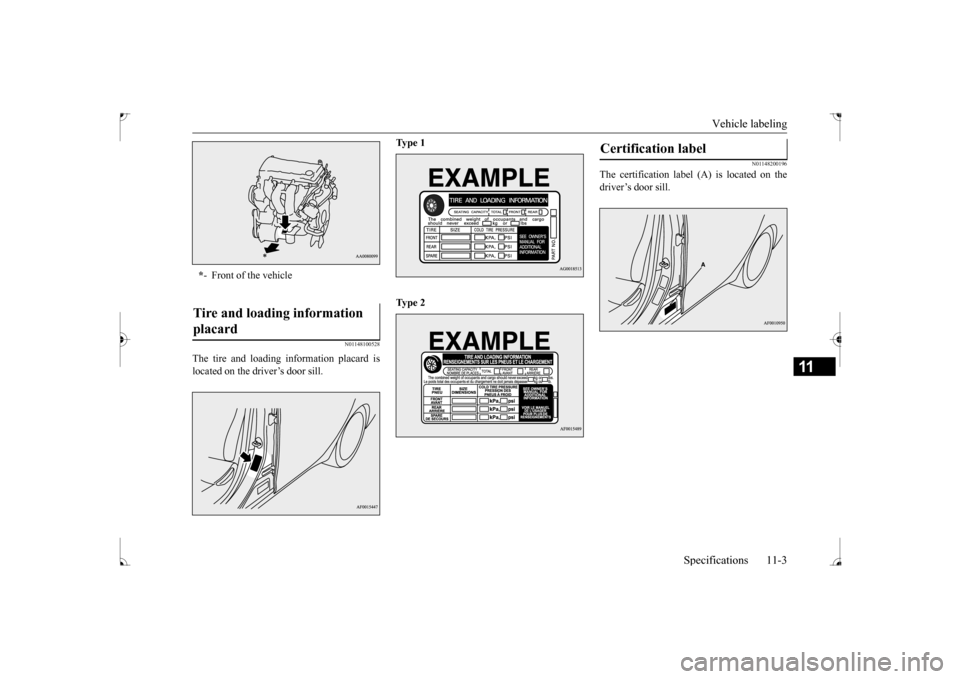
The tire and loading information placard is located on the driver’s door sill.
Ty p e 1 Ty p e 2
N01148200196
The certification label (A) is located on the driver’s door sill.
* - Front of the vehicleTire and loading information placard
Certification label
BK0237700US.bo
ok 3 ページ 2016年4月15日 金曜日 午前11時28分
Page 375 of 385

Vehicle dimensions 11-4 Specifications
11
N01147501607 N01147601956
GVWR: maximum total weight (load) limit specified for the vehicle GAWR: maximum weight (load) limit sp
ecified for the front or rear axle
Seating capacity: the number of maximum occupantsVehicle dimensions
Item
Vehicles with 16 inch tire
Vehicles with 18 inch tire
Overall length 182.1 in (4,625 mm) Overall width 69.4 in (1,760 mm) Overall height 58.3 in (1,480 mm) 58.7 in (1,490 mm)Wheel base 103.7 in (2,635 mm) Vehicle weights
Item
2.0 liter
2.4 liter
Front-wheel drive vehicles
All-wheel drive vehicles
Gross vehicle weight rating (GVWR) 3,969 lb
(1,800 kg) 4,079 lb (1,850
kg) 4,190 lb (1,900 kg)
Gross axle weight rating (GAWR)
Front 2,227 lb (1,010 kg) 2,227 lb
(1,010 kg) 2,227 lb (1,010 kg)
Rear 2,007 lb (910 kg) 2,007 lb (910 kg) 2,117 lb (960 kg)
Vehicle capacity weight 827 lb (375 kg)Maximum roof load 110 lb (50 kg)Seating capacity 5 persons
NOTE
Roof load is important because it affects the vehicle capacity
weight. Refer to “Loading cargo on the roof” on page 6-10.
BK0237700US.bo
ok 4 ページ 2016年4月15日 金曜日 午前11時28分
Page 376 of 385
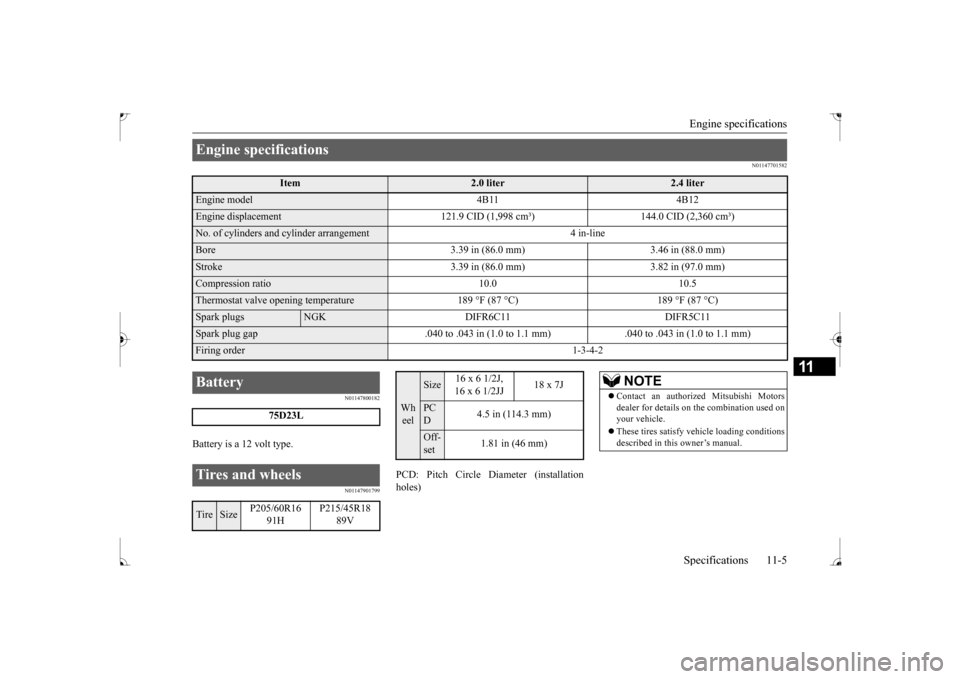
Engine specifications Specifications 11-5
11
N01147701582
N01147800182
Battery is a 12 volt type.
N01147901799
PCD: Pitch Circle Diameter (installation holes)
Engine specifications
Item
2.0 liter
2.4 liter
Engine model 4B11 4B12Engine displacement 121.9 CID (1,998 cm³) 144.0 CID (2,360 cm³)No. of cylinders and cylinder arrangement 4 in-lineBore 3.39 in (86.0 mm) 3.46 in (88.0 mm)Stroke 3.39 in (86.0 mm) 3.82 in (97.0 mm)Compression ratio 10.0 10.5Thermostat valve opening temperature 189 °F (87 °C) 189 °F (87 °C)Spark plugs
NGK DIFR6C11 DIFR5C11
Spark plug gap .040 to .043 in (1.0 to
1.1 mm) .040 to .043 in (1.0 to 1.1 mm)
Firing order 1-3-4-2Battery
75D23L
Tires and wheels Tire
Size
P205/60R16
91H
P215/45R18
89V
Wheel
Size
16 x 6 1/2J, 16 x 6 1/2JJ
18 x 7J
PC D
4.5 in (114.3 mm)
Off- set
1.81 in (46 mm)
NOTE
Contact an authorized Mitsubishi Motors dealer for details on the combination used on your vehicle. These tires satisfy vehicle loading conditions described in this owner’s manual.
BK0237700US.bo
ok 5 ページ 2016年4月15日 金曜日 午前11時28分