weight MITSUBISHI LANCER 2017 8.G Owners Manual
[x] Cancel search | Manufacturer: MITSUBISHI, Model Year: 2017, Model line: LANCER, Model: MITSUBISHI LANCER 2017 8.GPages: 385, PDF Size: 14.34 MB
Page 41 of 385
Child restraint systems 4-14 Seat and restraint systems
4
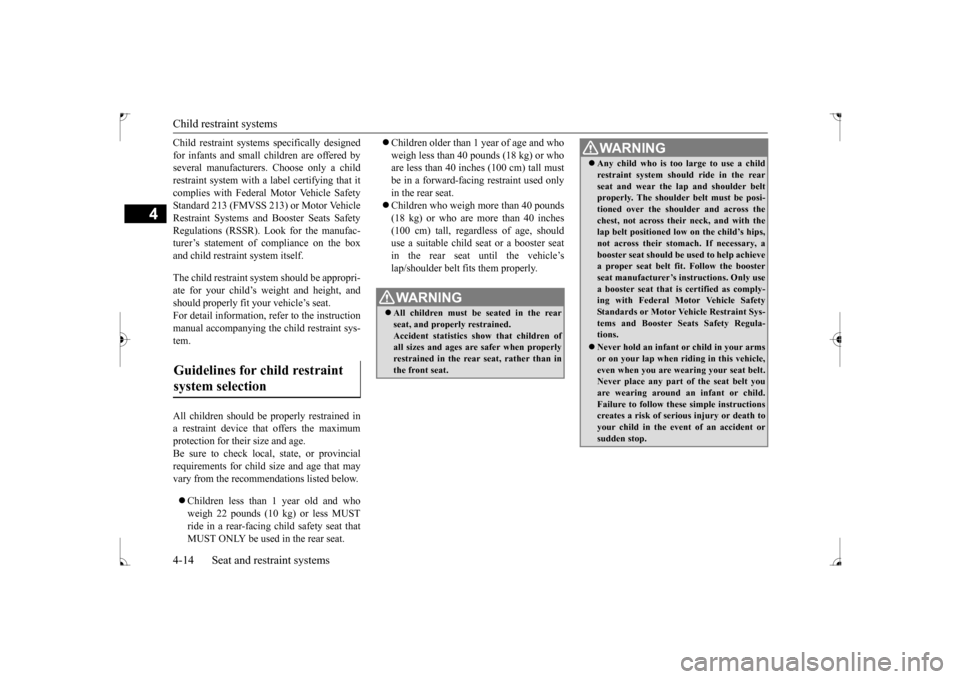
Child restraint systems specifically designed for infants and small children are offered by several manufacturers. Choose only a child restraint system with a label certifying that itcomplies with Federal Motor Vehicle Safety Standard 213 (FMVSS 213) or Motor Vehicle Restraint Systems and Booster Seats SafetyRegulations (RSSR). Look for the manufac- turer’s statement of compliance on the box and child restraint system itself. The child restraint system should be appropri- ate for your child’s weight and height, andshould properly fit your vehicle’s seat. For detail information, refer to the instruction manual accompanying the child restraint sys-tem. All children should be properly restrained in a restraint device that offers the maximum protection for their size and age.Be sure to check local, state, or provincial requirements for child size and age that may vary from the recommendations listed below. Children less than 1 year old and who weigh 22 pounds (10 kg) or less MUST ride in a rear-facing child safety seat that MUST ONLY be used in the rear seat.
Children older than 1
year of age and who
weigh less than 40 pounds (18 kg) or who are less than 40 inches (100 cm) tall must be in a forward-facing restraint used onlyin the rear seat. Children who weigh more than 40 pounds (18 kg) or who are more than 40 inches(100 cm) tall, regardless of age, should use a suitable child seat or a booster seat in the rear seat until the vehicle’slap/shoulder belt fits them properly.
Guidelines for child restraint system selection
WA R N I N G All children must be seated in the rear seat, and properly restrained. Accident statistics show that children ofall sizes and ages are safer when properly restrained in the rear seat, rather than in the front seat.
Any child who is too large to use a child restraint system should ride in the rear seat and wear the lap and shoulder belt properly. The shoulder belt must be posi- tioned over the shoulder and across thechest, not across their neck, and with the lap belt positioned low on the child’s hips, not across their stomach. If necessary, abooster seat should be used to help achieve a proper seat belt fit. Follow the booster seat manufacturer’s instructions. Only usea booster seat that is certified as comply- ing with Federal Motor Vehicle Safety Standards or Motor Vehicle Restraint Sys-tems and Booster Seats Safety Regula- tions. Never hold an infant or child in your arms or on your lap when riding in this vehicle, even when you are wearing your seat belt.Never place any part of the seat belt you are wearing around an infant or child. Failure to follow these simple instructionscreates a risk of serious injury or death to your child in the event of an accident or sudden stop.WA R N I N G
BK0237700US.bo
ok 14 ページ 2016年4月15日 金曜日 午前11時28分
Page 42 of 385
Child restraint systems
Seat and restraint systems 4-15
4
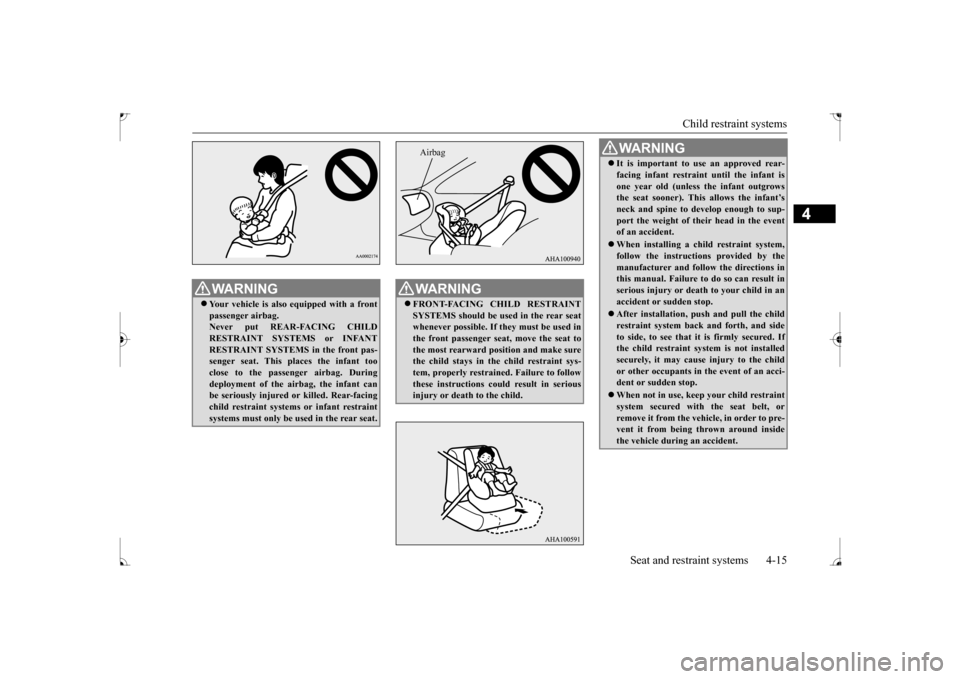
WA R N I N G Your vehicle is also equipped with a front passenger airbag. Never put REAR-FACING CHILDRESTRAINT SYSTEMS or INFANT RESTRAINT SYSTEMS in the front pas- senger seat. This places the infant tooclose to the passenger airbag. During deployment of the airbag, the infant can be seriously injured or killed. Rear-facingchild restraint systems
or infant restraint
systems must only be used in the rear seat.
WA R N I N G FRONT-FACING CHILD RESTRAINT SYSTEMS should be used in the rear seat whenever possible. If they must be used inthe front passenger seat, move the seat to the most rearward position and make sure the child stays in th
e child restraint sys-
tem, properly restrained. Failure to follow these instructions could result in serious injury or death to the child.Airbag
WA R N I N G It is important to use an approved rear- facing infant restraint until the infant is one year old (unless the infant outgrows the seat sooner). This allows the infant’s neck and spine to develop enough to sup-port the weight of their head in the event of an accident. When installing a child restraint system, follow the instructions provided by the manufacturer and follow the directions inthis manual. Failure to do so can result in serious injury or death to your child in an accident or sudden stop. After installation, push and pull the child restraint system back and forth, and sideto side, to see that it is firmly secured. If the child restraint system is not installed securely, it may cause injury to the childor other occupants in the event of an acci- dent or sudden stop. When not in use, keep your child restraint system secured with the seat belt, or remove it from the vehicle, in order to pre-vent it from being thrown around inside the vehicle during an accident.
BK0237700US.bo
ok 15 ページ 2016年4月15日 金曜日 午前11時28分
Page 46 of 385
Child restraint systems
Seat and restraint systems 4-19
4
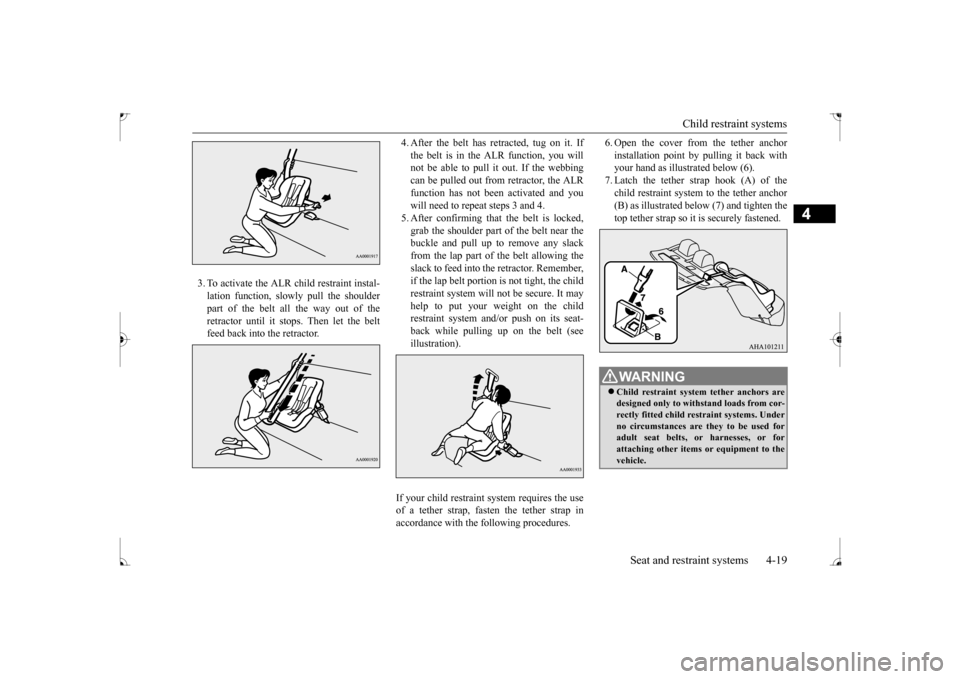
3. To activate the ALR child restraint instal- lation function, slowly pull the shoulder part of the belt all the way out of theretractor until it stops. Then let the belt feed back into the retractor.
4. After the belt has retracted, tug on it. If the belt is in the ALR function, you will not be able to pull it out. If the webbing can be pulled out from retractor, the ALRfunction has not been activated and you will need to repeat steps 3 and 4. 5. After confirming that the belt is locked,grab the shoulder part of the belt near the buckle and pull up to remove any slack from the lap part of the belt allowing theslack to feed into the retractor. Remember,if the lap belt portio
n is not tight, the child
restraint system will not be secure. It may help to put your weight on the childrestraint system and/or push on its seat- back while pulling up on the belt (see illustration).
6. Open the cover from the tether anchor installation point by pulling it back with your hand as illustrated below (6). 7. Latch the tether strap hook (A) of thechild restraint system to the tether anchor (B) as illustrated below (7) and tighten the top tether strap so it is securely fastened.
If your child restraint system requires the use of a tether strap, fasten the tether strap in accordance with the following procedures.
WA R N I N G Child restraint system tether anchors are designed only to withstand loads from cor- rectly fitted child restraint systems. Under no circumstances are they to be used foradult seat belts, or harnesses, or for attaching other items or equipment to the vehicle.
BK0237700US.bo
ok 19 ページ 2016年4月15日 金曜日 午前11時28分
Page 50 of 385
Supplemental Restraint System (SRS) - airbag
Seat and restraint systems 4-23
4
N00407801590
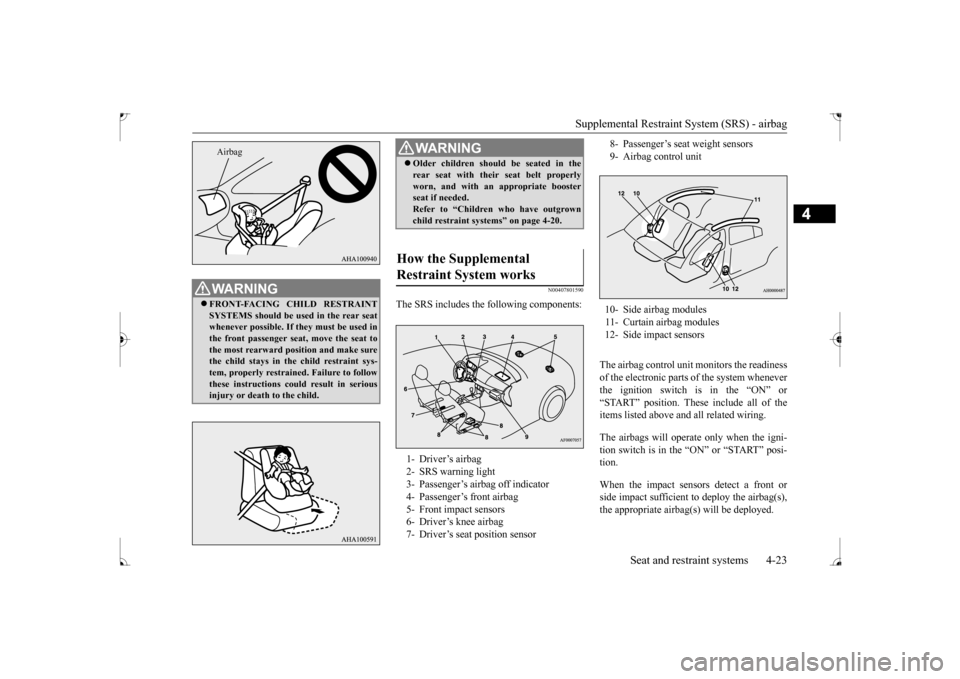
The SRS includes the following components:
The airbag control unit monitors the readiness of the electronic parts of the system wheneverthe ignition switch is in the “ON” or “START” position. These include all of the items listed above and all related wiring. The airbags will operate only when the igni- tion switch is in the “ON” or “START” posi- tion. When the impact sensors detect a front or side impact sufficient to deploy the airbag(s),the appropriate airbag(s) will be deployed.
WA R N I N G FRONT-FACING CHILD RESTRAINT SYSTEMS should be used in the rear seat whenever possible. If they must be used inthe front passenger seat, move the seat to the most rearward position and make sure the child stays in th
e child restraint sys-
tem, properly restrained. Failure to follow these instructions could result in serious injury or death to the child.Airbag
WA R N I N G Older children should be seated in the rear seat with their seat belt properly worn, and with an appropriate booster seat if needed. Refer to “Children who have outgrownchild restraint systems” on page 4-20.
How the Supplemental Restraint System works 1- Driver’s airbag 2- SRS warning light 3- Passenger’s airbag off indicator 4- Passenger’s front airbag5- Front impact sensors 6- Driver’s knee airbag 7- Driver’s seat position sensor
8- Passenger’s seat weight sensors9- Airbag control unit 10- Side airbag modules 11- Curtain airbag modules12- Side impact sensors
BK0237700US.bo
ok 23 ページ 2016年4月15日 金曜日 午前11時28分
Page 52 of 385
Supplemental Restraint System (SRS) - airbag
Seat and restraint systems 4-25
4
N00418000247
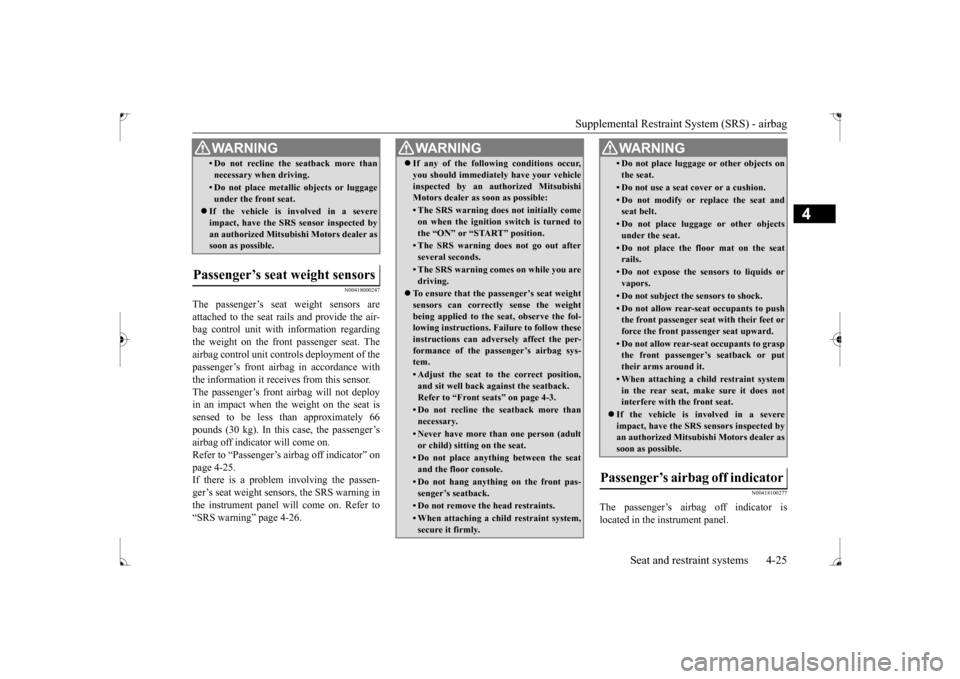
The passenger’s seat weight sensors are attached to the seat rails and provide the air- bag control unit with information regarding the weight on the front passenger seat. Theairbag control unit controls deployment of the passenger’s front airbag in accordance with the information it receives from this sensor.The passenger’s front airbag will not deploy in an impact when the weight on the seat is sensed to be less than approximately 66pounds (30 kg). In this case, the passenger’s airbag off indicator will come on. Refer to “Passenger’s airbag off indicator” onpage 4-25. If there is a problem involving the passen- ger’s seat weight sensors, the SRS warning inthe instrument panel will come on. Refer to “SRS warning” page 4-26.
N00418100277
The passenger’s airbag off indicator is located in the instrument panel.
• Do not recline the seatback more than necessary when driving.• Do not place metallic objects or luggage under the front seat.
If the vehicle is involved in a severe impact, have the SRS sensor inspected byan authorized Mitsubishi Motors dealer as soon as possible.
Passenger’s seat weight sensors
WA R N I N G
WA R N I N G If any of the following conditions occur, you should immediately have your vehicle inspected by an authorized Mitsubishi Motors dealer as soon as possible:• The SRS warning does not initially comeon when the ignition switch is turned to the “ON” or “START” position.• The SRS warning does not go out afterseveral seconds.• The SRS warning comes on while you aredriving.
To ensure that the passenger’s seat weight sensors can correctly sense the weightbeing applied to the seat, observe the fol- lowing instructions. Failure to follow these instructions can adversely affect the per-formance of the passenger’s airbag sys- tem.• Adjust the seat to the correct position,and sit well back against the seatback. Refer to “Front seats” on page 4-3.• Do not recline the seatback more thannecessary.• Never have more than one person (adultor child) sitting on the seat.• Do not place anything between the seatand the floor console.• Do not hang anything on the front pas-senger’s seatback.• Do not remove the head restraints.• When attaching a child restraint system,secure it firmly.
• Do not place luggage or other objects on the seat.• Do not use a seat cover or a cushion.• Do not modify or replace the seat andseat belt.• Do not place luggage or other objectsunder the seat.• Do not place the floor mat on the seatrails.• Do not expose the sensors to liquids orvapors.• Do not subject the sensors to shock.• Do not allow rear-seat occupants to push the front passenger seat with their feet or force the front passenger seat upward.• Do not allow rear-seat occupants to graspthe front passenger’s seatback or put their arms around it.• When attaching a child restraint systemin the rear seat, make sure it does notinterfere with the front seat.
If the vehicle is involved in a severe impact, have the SRS sensors inspected by an authorized Mitsubishi Motors dealer as soon as possible.
Passenger’s airbag off indicator
WA R N I N G
BK0237700US.bo
ok 25 ページ 2016年4月15日 金曜日 午前11時28分
Page 53 of 385
Supplemental Restraint System (SRS) - airbag 4-26 Seat and restraint systems
4
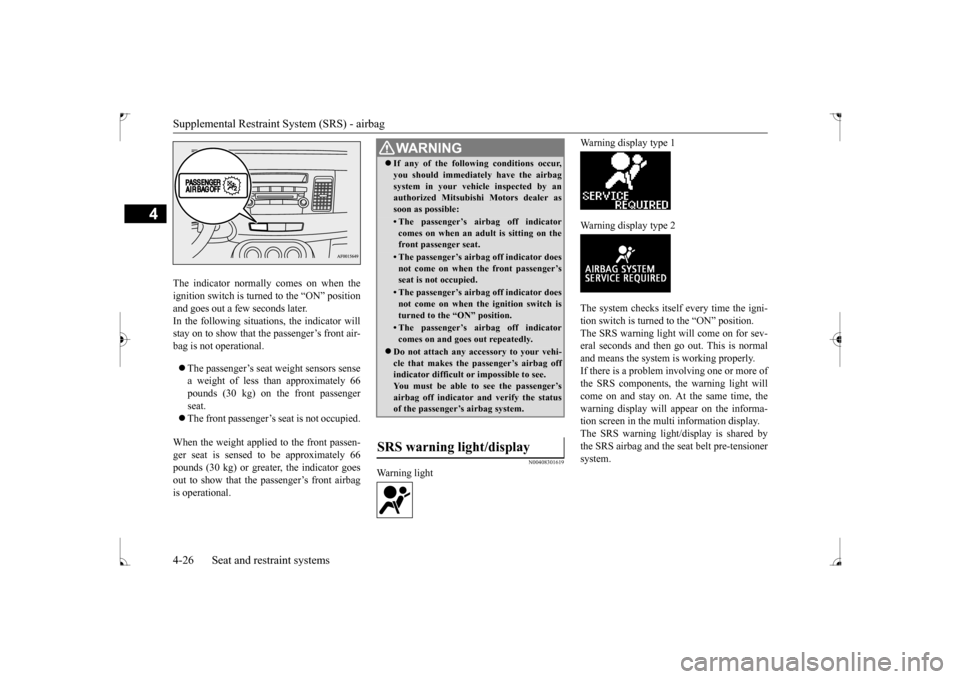
The indicator normally comes on when the ignition switch is turned to the “ON” positionand goes out a few seconds later. In the following situa
tions, the indicator will
stay on to show that the passenger’s front air-bag is not operational. The passenger’s seat weight sensors sense a weight of less than approximately 66 pounds (30 kg) on the front passenger seat. The front passenger’s seat is not occupied.
When the weight applied to the front passen- ger seat is sensed to be approximately 66 pounds (30 kg) or greater, the indicator goesout to show that the passenger’s front airbag is operational.
N00408301619
Warning light
Warning display type 1 Warning display type 2The system checks itself every time the igni- tion switch is turned to the “ON” position.The SRS warning light will come on for sev- eral seconds and then go out. This is normal and means the system is working properly.If there is a problem involving one or more of the SRS components, the warning light will come on and stay on. At the same time, thewarning display will appear on the informa- tion screen in the multi information display. The SRS warning light/display is shared bythe SRS airbag and the seat belt pre-tensionersystem.
WA R N I N G If any of the following conditions occur, you should immediately have the airbag system in your vehicle inspected by an authorized Mitsubishi Motors dealer as soon as possible:• The passenger’s airbag off indicatorcomes on when an adult is sitting on thefront passenger seat.• The passenger’s airbag off indicator doesnot come on when the front passenger’s seat is not occupied.• The passenger’s airbag off indicator doesnot come on when the ignition switch is turned to the “ON” position.• The passenger’s airbag off indicatorcomes on and goes out repeatedly.
Do not attach any accessory to your vehi- cle that makes the passenger’s airbag offindicator difficult or impossible to see. You must be able to see the passenger’s airbag off indicator and verify the statusof the passenger’s airbag system.
SRS warning light/display
BK0237700US.bo
ok 26 ページ 2016年4月15日 金曜日 午前11時28分
Page 54 of 385
Supplemental Restraint System (SRS) - airbag
Seat and restraint systems 4-27
4
N00407900318
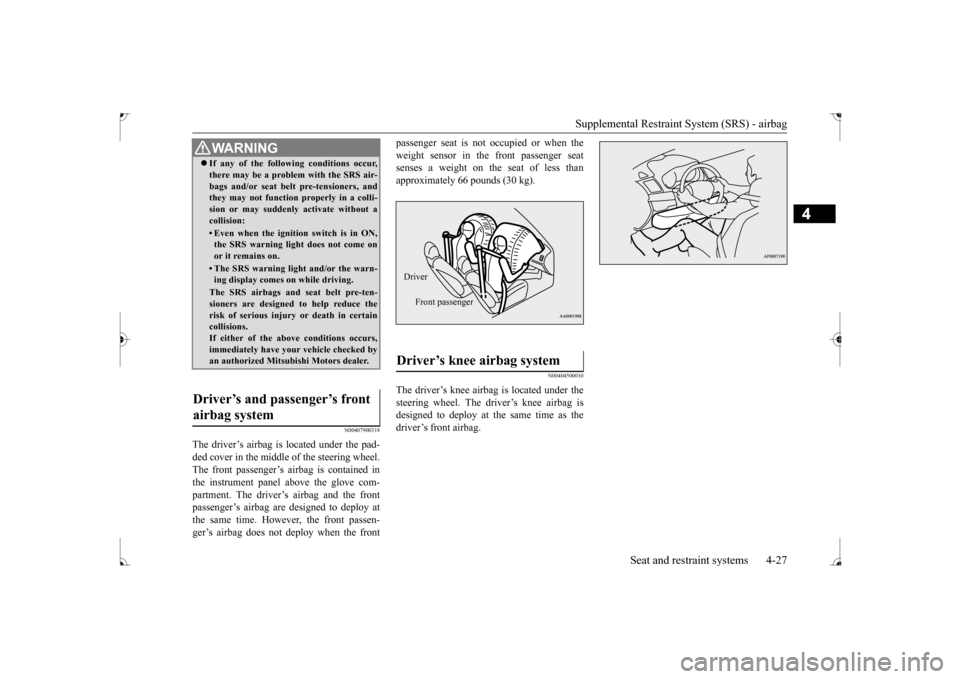
The driver’s airbag is located under the pad- ded cover in the middle of the steering wheel. The front passenger’s airbag is contained in the instrument panel above the glove com-partment. The driver’s airbag and the front passenger’s airbag are designed to deploy at the same time. However, the front passen-ger’s airbag does not deploy when the front
passenger seat is not occupied or when the weight sensor in the front passenger seat senses a weight on the seat of less than approximately 66 pounds (30 kg).
N00404500010
The driver’s knee airbag is located under the steering wheel. The driver’s knee airbag is designed to deploy at the same time as thedriver’s front airbag.
WA R N I N G If any of the following conditions occur, there may be a problem with the SRS air- bags and/or seat belt pre-tensioners, and they may not function properly in a colli- sion or may suddenly activate without acollision:• Even when the ignition switch is in ON,the SRS warning light does not come on or it remains on.• The SRS warning light and/or the warn-ing display comes on while driving.The SRS airbags and seat belt pre-ten-sioners are designed to help reduce the risk of serious injury or death in certaincollisions. If either of the above conditions occurs, immediately have your vehicle checked byan authorized Mitsubishi Motors dealer.
Driver’s and passenger’s front airbag system
Driver’s knee airbag system Driver
Front passenger
BK0237700US.bo
ok 27 ページ 2016年4月15日 金曜日 午前11時28分
Page 154 of 385
Rear-view camera (if so equipped)
Features and controls 5-89
5
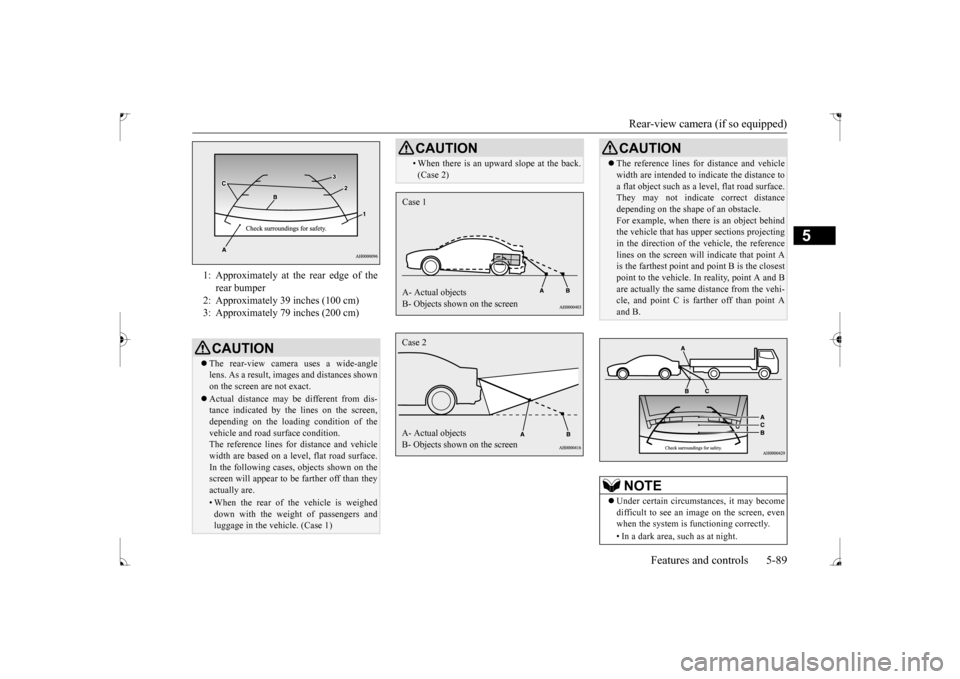
1: Approximately at the rear edge of the
rear bumper
2: Approximately 39 inches (100 cm) 3: Approximately 79 inches (200 cm) CAUTION The rear-view camera uses a wide-angle lens. As a result, images and distances shownon the screen are not exact. Actual distance may be different from dis- tance indicated by the lines on the screen, depending on the loading condition of the vehicle and road surface condition.The reference lines for distance and vehicle width are based on a level, flat road surface. In the following cases, objects shown on thescreen will appear to be farther off than they actually are.• When the rear of the vehicle is weigheddown with the weight of passengers and luggage in the vehicle. (Case 1)
• When there is an upward slope at the back. (Case 2)
Case 1 A- Actual objects B- Objects shown on the screenCase 2 A- Actual objects B- Objects shown on the screen
CAUTION The reference lines for distance and vehicle width are intended to indicate the distance to a flat object such as a level, flat road surface. They may not indicate correct distance depending on the shape of an obstacle.For example, when there is an object behind the vehicle that has upper sections projecting in the direction of the vehicle, the referencelines on the screen will indicate that point A is the farthest point a
nd point B is the closest
point to the vehicle. In reality, point A and Bare actually the same distance from the vehi- cle, and point C is farther off than point A and B.NOTE
Under certain circumstances, it may become difficult to see an image on the screen, even when the system is functioning correctly. • In a dark area, such as at night.
BK0237700US.bo
ok 89 ページ 2016年4月15日 金曜日 午前11時28分
Page 241 of 385
Loading information 6-6 Driving safety
6
Your front bumper can be damaged if you scrape it over curbs or parking stop blocks.Be careful when traveling up or down steep slopes where your bumper can scrape the road. When leaving the vehicle unattended, always carry the key and lock all doors.Always try to park your vehicle in a well lit area.
N00629900349
It is very important to know how much weight your vehicle can carry. This weight iscalled the vehicle capacity weight and includes the weight of all occupants, cargo and non-factory-installed options. The tireand loading information placard located on the driver’s door sill of your vehicle will show how much weight it may properly carry. It is important to familiarize yourself with the following terms before loading your vehicle: Vehicle maximum load on the tire: load on an individual tire that is determined by distributing to each axle its share of the maximum loaded vehicle weight anddividing by two. Vehicle normal load on the tire: load on an individual tire that is determined by dis-tributing to each axle its share of the curb weight, accessory weight, and normal occupant weight and dividing by two.
Maximum loaded vehicle weight: the sum of - (a) Curb weight; (b) Accessory weight;(c) Vehicle capacity weight; and (d) Production options weight. Curb weight: the weight of a motor vehi- cle with standard equipment including the maximum capacity of fuel, oil, and cool- ant. Accessory weight: the combined weight (in excess of those standard items which may be replaced) of automatic transmis- sion, power steering, power brakes, powerwindows, power seats, radio, and heater, to the extent that these items are available as factory- installed equipment (whetherinstalled or not). Vehicle capacity weight: the rated cargo and luggage load plus 150 lbs (68 kg)
*
times the vehicle’s designated seating capacity. Production options weight: the combined weight of those installed regular produc- tion options weighing over 5 lbs (2.3 kg) in excess of those standard items whichthey replace, not previously considered in curb weight or accessory weight, includ- ing heavy duty brakes, ride levelers, roofrack, heavy duty battery, and special trim.
WA R N I N G Leaving the engine running risks injury or death from accidentally moving the gear- shift lever (manual transaxle or the selec- tor lever (CVT) or from the accumulation of toxic exhaust fumes in the passengercompartment.
Where you park
WA R N I N G Do not park your vehicle in areas where combustible materials such as dry grass or leaves can come in contact with a hotexhaust, since a fire could occur.
When leaving the vehicle
Loading information
WA R N I N G Never overload your vehicle. Overloading can damage your vehicle, adversely affectvehicle performance, including handling and braking, cause tire failure, and result in an accident.
BK0237700US.bo
ok 6 ページ 2016年4月15日 金曜日 午前11時28分
Page 242 of 385
Loading information Driving safety 6-7
6
Normal occupant weight: 150 lbs (68 kg)
*
times the number of specified occupants. (In your vehicle the number is 3) Occupant distribution: distribution of occupants in a vehicle as specified. (In your vehicle the distribution is 2 in front, 1 in second row seat)
N00630100309
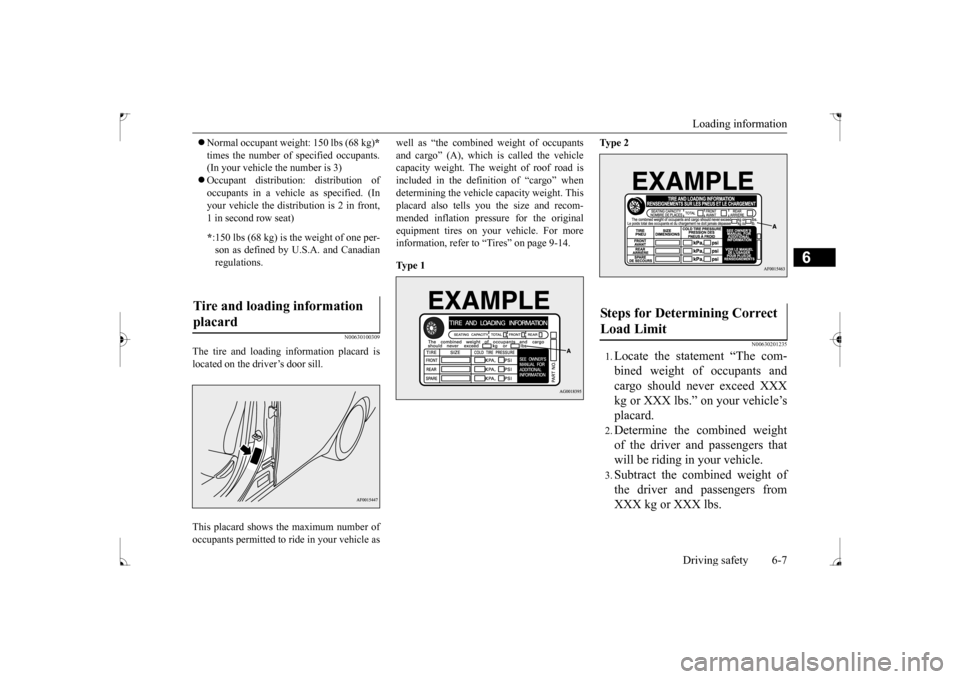
The tire and loading information placard islocated on the driver’s door sill. This placard shows the maximum number of occupants permitted to ride in your vehicle as
well as “the combined weight of occupants and cargo” (A), which is called the vehicle capacity weight. The weight of roof road is included in the definition of “cargo” whendetermining the vehicle capacity weight. This placard also tells you the size and recom- mended inflation pressure for the originalequipment tires on your vehicle. For more information, refer to “Tires” on page 9-14. Ty p e 1
Ty p e 2
N00630201235
1.Locate the statement “The com- bined weight of occupants and cargo should never exceed XXX kg or XXX lbs.” on your vehicle’splacard.2.Determine the combined weightof the driver and passengers thatwill be riding in your vehicle.3.Subtract the combined weight ofthe driver and passengers fromXXX kg or XXX lbs.
* :150 lbs (68 kg) is the weight of one per- son as defined by U.S.A. and Canadian regulations.
Tire and loading information placard
Steps for Determining Correct Load Limit
BK0237700US.bo
ok 7 ページ 2016年4月15日 金曜日 午前11時28分