engine valve MITSUBISHI LANCER EVOLUTION 2007 Service Owners Manual
[x] Cancel search | Manufacturer: MITSUBISHI, Model Year: 2007, Model line: LANCER EVOLUTION, Model: MITSUBISHI LANCER EVOLUTION 2007Pages: 1449, PDF Size: 56.82 MB
Page 743 of 1449
ENGINE ELECTRICAL -Charging System16-11
1
234
5
8.8±1.0 N·m 22±4 N·m
23±3 N·m11±1 N·m
13±1 N·m
8
(Engine oil)
679
10
20±2 N·m 36±6 N·m
1211
44±10 N·m
14±3 N·m
13
1415 18
1617
9.0±1.0 N·m
9.0±1.0 N·m5.0±1.0 N·m
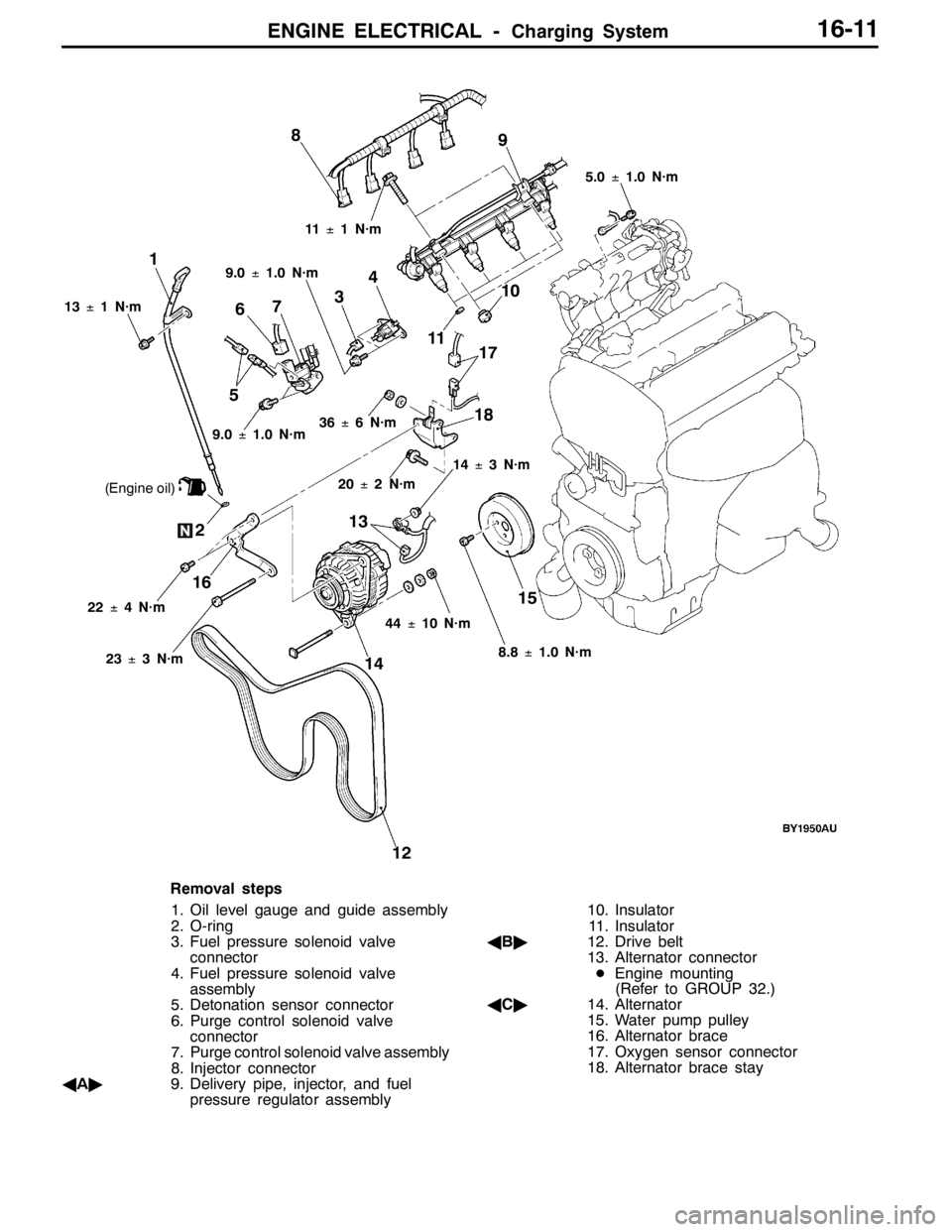
Removal steps
1. Oil level gauge and guide assembly
2. O-ring
3. Fuel pressure solenoid valve
connector
4. Fuel pressure solenoid valve
assembly
5. Detonation sensor connector
6. Purge control solenoid valve
connector
7. Purge control solenoid valve assembly
8. Injector connector
AA"9. Delivery pipe, injector, and fuel
pressure regulator assembly10. Insulator
11. Insulator
AB"12. Drive belt
13. Alternator connector
DEngine mounting
(Refer to GROUP 32.)
AC"14. Alternator
15. Water pump pulley
16. Alternator brace
17. Oxygen sensor connector
18. Alternator brace stay
Page 771 of 1449

17-1
ENGINE AND
EMISSION
CONTROL
CONTENTS
ENGINE CONTROL SYSTEM 2.........
GENERAL INFORMATION 2................
SERVICE SPECIFICATIONS 2...............
ON-VEHICLE SERVICE 2...................
Accelerator Cable Check and
Adjustment 2................................
ACCELERATOR CABLE AND PEDAL 3......
EMISSION CONTROL SYSTEM 4......
GENERAL INFORMATION 4................
Emission Control Device Reference
Table 4.....................................
SERVICE SPECIFICATIONS 5..............
VACUUM HOSE 5..........................
Vacuum Hose Piping Diagram 5..............
Vacuum Circuit Diagram 6....................
Vacuum Hose Check 7......................
Vacuum Hose Installation 7..................
CRANKCASE EMISSION CONTROL
SYSTEM 8................................
General Information 8........................
System Diagram 8..........................
Component Location 9.......................
Positive Crankcase Ventilation System Check 9....
PCV Valve Check 9.........................
EVAPORATIVE EMISSION CONTROL
SYSTEM 10...............................
General Information 10.......................
System Diagram 10..........................
Component Location 10......................
Purge Control System Check 11...............
Purge Port Vacuum Check 11.................
Purge Control Solenoid Valve Check 12.........
Check Valve Check 12.......................
EXHAUST GAS RECIRCULATION (EGR)
SYSTEM 13...............................
General Information 13.......................
Operation 13................................
System Diagram 13..........................
Component Location 14......................
Exhaust Gas Recirculation (EGR) Control System
Check 14...................................
EGR Valve Check 15.........................
EGR Port Vacuum Check 15..................
EGR Control Solenoid Valve Check 16..........
EGR VALVE 17............................
CANISTER 18.............................
CATALYTIC CONVERTER 19................
General Information 19.......................
Page 774 of 1449

ENGINE AND EMISSION CONTROL -Emission Control System17-4
EMISSION CONTROL SYSTEM
GENERAL INFORMATION
The emission control system consists of the following subsystems:
DCrankcase emission control system
DEvaporative emission control system
DExhaust emission control system
ItemsNameSpecification
Crankcase emission
control systemPositive crankcase ventilation (PCV) valveVariable flow type
(Purpose: HC reduction)
Evaporative emission
control systemCanister
Purge control solenoid valve
Check valveEquipped
Duty cycle type solenoid valve
Equipped
(Purpose: HC reduction)
Exhaust emission
control systemAir-fuel ratio control device - MPI systemOxygen sensor feedback type
(Purpose: CO, HC, NOx reduction)
Exhaust gas recirculation system
DEGR valve
DEGR control solenoid valveEquipped
Single type
Duty cycle type solenoid valve
(Purpose: NOx reduction)
Catalytic converterMonolith type
(Purpose: CO, HC, NOx reduction)
EMISSION CONTROL DEVICE REFERENCE TABLE
Related partsCrankcase
emission
control
systemEvaporative
emission
control
systemAir/fuel
ratio
control
systemCatalytic
converterExhaust
gas
recirculation
systemReference
page
PCV valve×17-9
Purge control solenoid valve×17-12
Check valve×17-12
MPI system component××GROUP 13A
Catalytic converter×17-19
EGR valve×17-15
EGR control solenoid valve×17-16
Page 775 of 1449

ENGINE AND EMISSION CONTROL -Emission Control System17-5
SERVICE SPECIFICATIONS
ItemsStandard value
Purge control solenoid valve coil resistance (at 20_C)Ω30 - 34
EGR control solenoid valve coil resistance (at 20_C)Ω29 - 35
VACUUM HOSE
VACUUM HOSE PIPING DIAGRAM
Fuel
pressure
control
solenoid
valve
Oxygen
sensor
(front)
Check
valve
Fuel
pressure
regulator
PCV valve To
fuel tank
Oxygen sensor (rear) From
fuel pump
Air
inletEGR control
solenoid valve
Purge
control
solenoid
valveCanisterFrom
fuel tank
EGR
valve Injector
Three - way
catalytic converter A
P
E
Page 776 of 1449
ENGINE AND EMISSION CONTROL -Emission Control System17-6
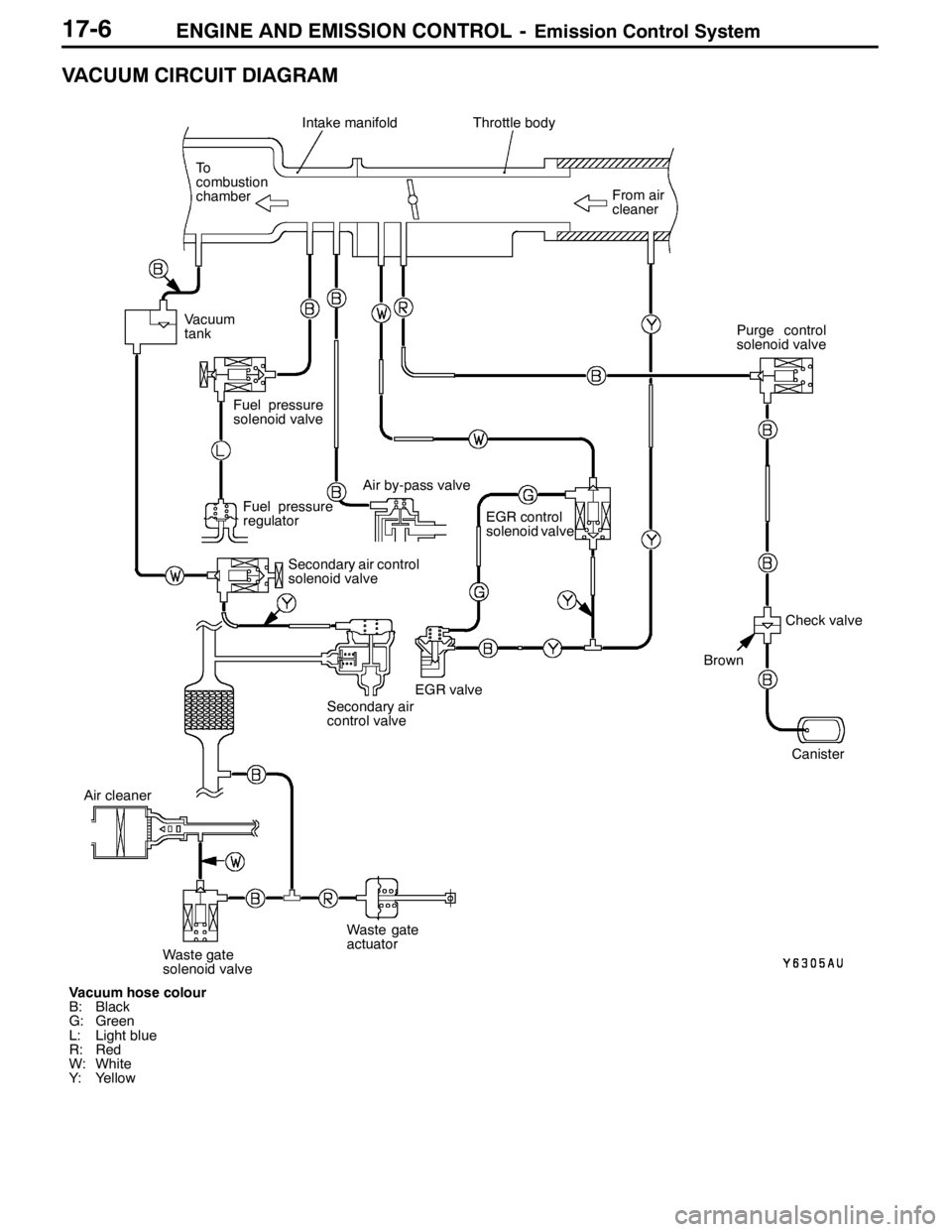
VACUUM CIRCUIT DIAGRAM
Vacuum hose colour
B: Black
G: Green
L: Light blue
R: Red
W: White
Y: YellowFrom air
cleaner
Intake manifoldThrottle body
To
combustion
chamber
Fuel pressure
regulator
EGR control
solenoid valve
Canister
EGR valve
Brown
Check valve Vacuum
tank
Fuel pressure
solenoid valve
Air by-pass valve
Secondary air control
solenoid valve
Secondary air
control valvePurge control
solenoid valve
Air cleaner
Waste gate
solenoid valveWaste gate
actuator
Page 778 of 1449

ENGINE AND EMISSION CONTROL -Emission Control System17-8
CRANKCASE EMISSION CONTROL SYSTEM
GENERAL INFORMATION
The crankcase emission control system prevents
blow-by gases from escaping inside the crankcase
into the atmosphere.
Fresh air is sent from the air cleaner into the
crankcase through the breather hose. The air
becomes mixed with the blow-by gases inside the
crankcase.
The blow-by gas inside the crankcase is drawn
into the intake manifold through the positivecrankcase ventilation (PCV) valve.
The PCV valve lifts the plunger according to the
intake manifold vacuum so as to regulate the flow
of blow-by gas properly. In other words, the blow-by
gas flow is regulated during low load engine
operation to maintain engine stability, while the flow
is increased during high load operation to improve
the ventilation performance.
SYSTEM DIAGRAM
Ventilation hose
PCV valve Breather hose
Page 779 of 1449
ENGINE AND EMISSION CONTROL -Emission Control System
PCV valve
17-9
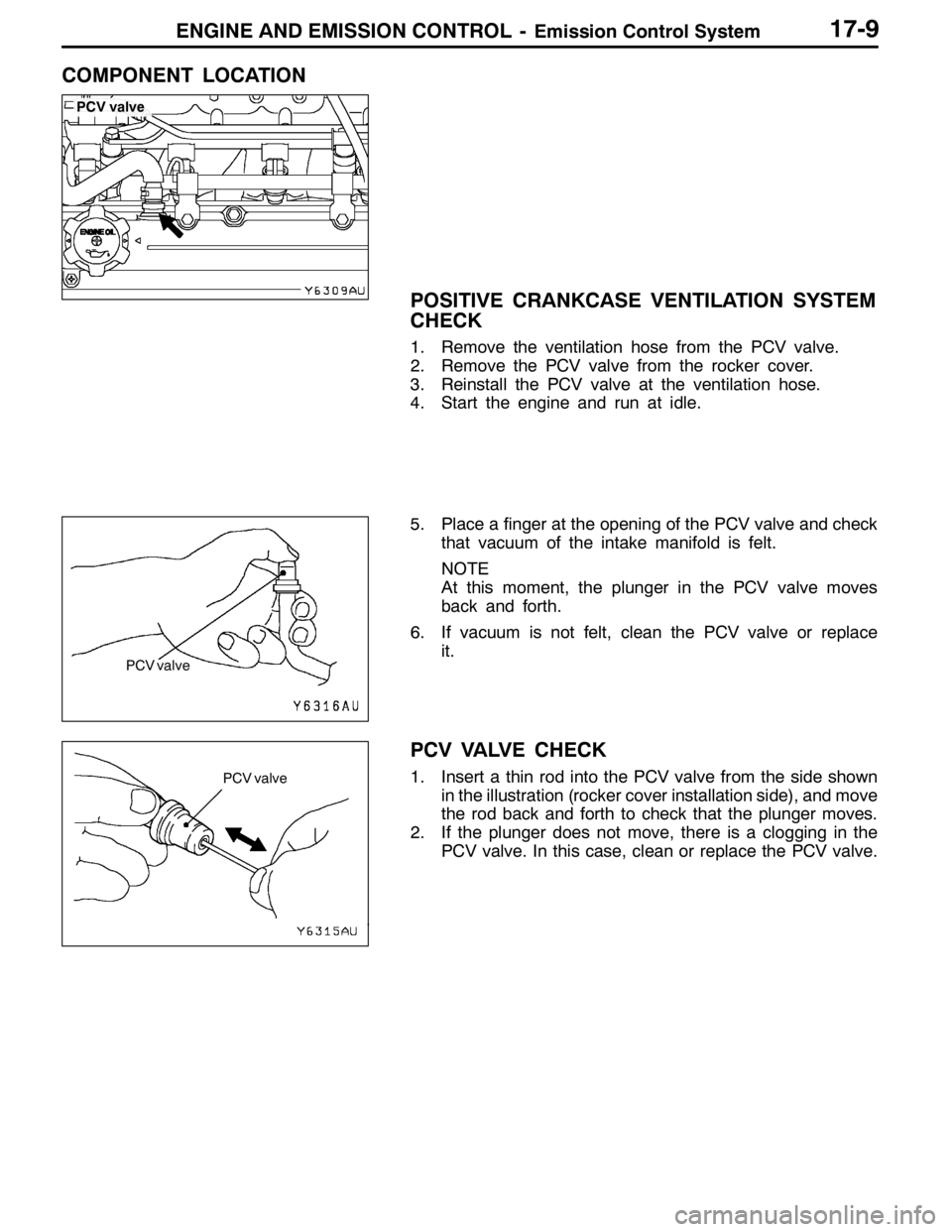
COMPONENT LOCATION
POSITIVE CRANKCASE VENTILATION SYSTEM
CHECK
1. Remove the ventilation hose from the PCV valve.
2. Remove the PCV valve from the rocker cover.
3. Reinstall the PCV valve at the ventilation hose.
4. Start the engine and run at idle.
5. Place a finger at the opening of the PCV valve and check
that vacuum of the intake manifold is felt.
NOTE
At this moment, the plunger in the PCV valve moves
back and forth.
6. If vacuum is not felt, clean the PCV valve or replace
it.
PCV VALVE CHECK
1. Insert a thin rod into the PCV valve from the side shown
in the illustration (rocker cover installation side), and move
the rod back and forth to check that the plunger moves.
2. If the plunger does not move, there is a clogging in the
PCV valve. In this case, clean or replace the PCV valve.
PCV valve
PCV valve
Page 780 of 1449
ENGINE AND EMISSION CONTROL -Emission Control System
Vacuum tank
Alternator
Purge control solenoid valve
17-10
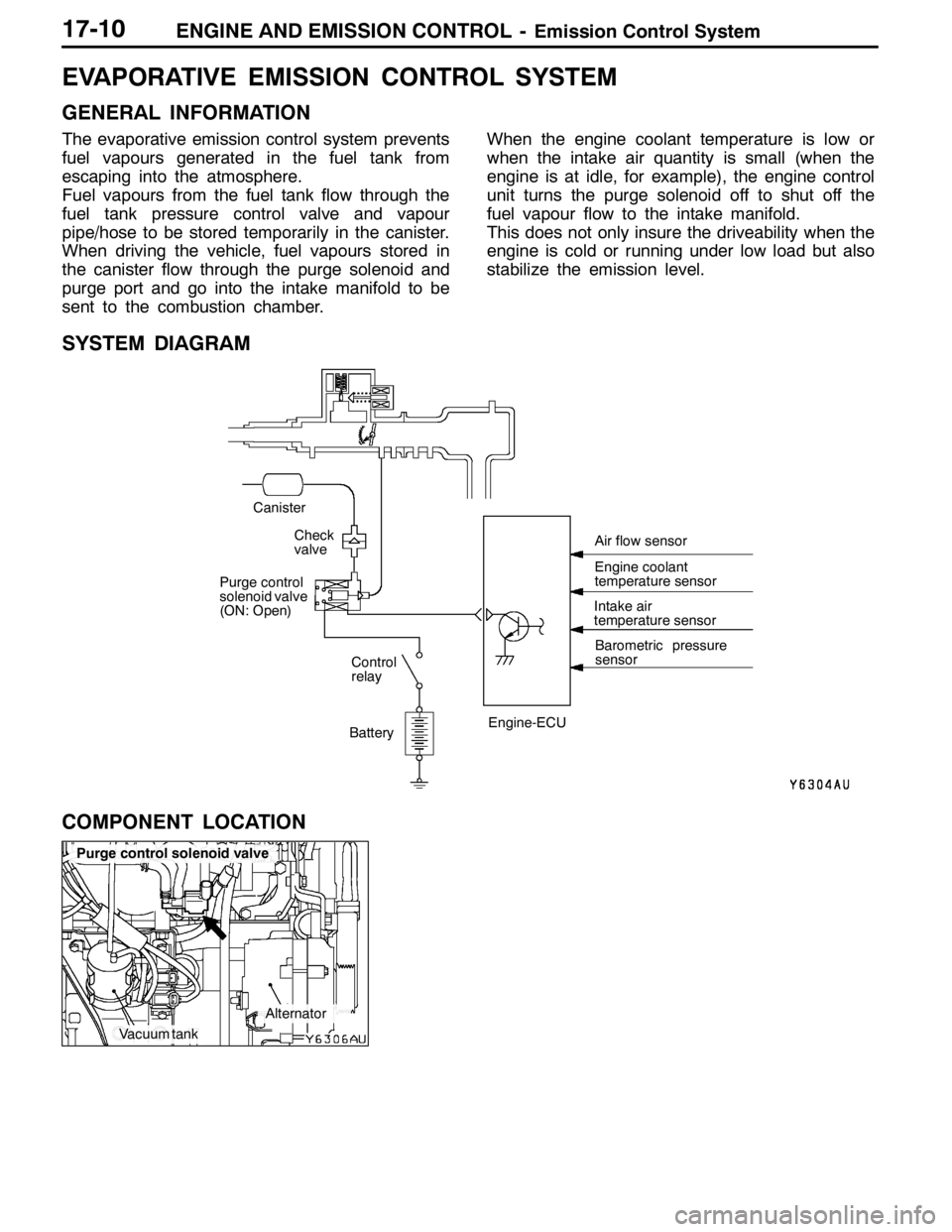
EVAPORATIVE EMISSION CONTROL SYSTEM
GENERAL INFORMATION
The evaporative emission control system prevents
fuel vapours generated in the fuel tank from
escaping into the atmosphere.
Fuel vapours from the fuel tank flow through the
fuel tank pressure control valve and vapour
pipe/hose to be stored temporarily in the canister.
When driving the vehicle, fuel vapours stored in
the canister flow through the purge solenoid and
purge port and go into the intake manifold to be
sent to the combustion chamber.When the engine coolant temperature is low or
when the intake air quantity is small (when the
engine is at idle, for example), the engine control
unit turns the purge solenoid off to shut off the
fuel vapour flow to the intake manifold.
This does not only insure the driveability when the
engine is cold or running under low load but also
stabilize the emission level.
SYSTEM DIAGRAM
BatteryIntake air
temperature sensor
Barometric pressure
sensor
Check
valve
Canister
Control
relay
Purge control
solenoid valve
(ON: Open)
Engine-ECUEngine coolant
temperature sensor Air flow sensor
COMPONENT LOCATION
Page 782 of 1449

ENGINE AND EMISSION CONTROL -Emission Control System17-12
PURGE CONTROL SOLENOID VALVE CHECK
NOTE
When disconnecting the vacuum hose, always make a mark
so that it can be reconnected at original position.
1. Disconnect the vacuum hose from the solenoid valve.
2. Disconnect the harness connector.
3. Connect a hand vacuum pump to nipple (A) of the solenoid
valve (refer to the illustration at left).
4. Check airtightness by applying a vacuum with voltage
applied directly from the battery to the purge control
solenoid valve and without applying voltage.
Battery voltageNormal condition
AppliedVacuum leaks
Not appliedVacuum maintained
5. Measure the resistance between the terminals of the
solenoid valve.
Standard value: 30 - 34Ω(at 20_C)
CHECK VALVE CHECK
Connect a hand vacuum pump to the check valve, apply
vacuum and check the airtightness.
Connected nipple colourNormal condition
BlackVacuum leaks
BrownVacuum is maintained
Battery A
Page 783 of 1449

ENGINE AND EMISSION CONTROL -Emission Control System17-13
EXHAUST GAS RECIRCULATION (EGR) SYSTEM
GENERAL INFORMATION
The exhaust gas recirculation (EGR) system lowers
the nitrogen oxide (NOx) emission level. When the
air/fuel mixture combustion temperature is high,
a large quantity of nitrogen oxides (NOx) is
generated in the combustion chamber. Therefore,
this system recirculates part of emission gas fromthe exhaust port of the cylinder head to the
combustion chamber through the intake manifold
to decrease the air/fuel mixture combustion
temperature, resulting in reduction of NOx.
The EGR flow rate is controlled by the EGR valve
so as not to decrease the driveability.
OPERATION
The EGR valve is being closed and does not
recirculate exhaust gases under one of the following
conditions. Otherwise, the EGR valve is opened
and recirculates exhaust gases.DThe engine coolant temperature is low.
DThe engine is at idle.
DThe throttle valve is widely opened.
SYSTEM DIAGRAM
ON Throttle body
EGR control
solenoid valve
Engine
control
relay
Battery EGR valve
Crank angle sensor
Throttle position sensor Engine-ECU
Engine coolant
temperature sensor Air flow sensor