airbag MITSUBISHI LANCER EVOLUTION 2007 Service Repair Manual
[x] Cancel search | Manufacturer: MITSUBISHI, Model Year: 2007, Model line: LANCER EVOLUTION, Model: MITSUBISHI LANCER EVOLUTION 2007Pages: 1449, PDF Size: 56.82 MB
Page 864 of 1449
MANUAL TRANSMISSION -Sensor, Switch and Relay
SENSOR, SWITCH AND RELAY
REMOVAL AND INSTALLATION
Caution
Before removing the steering wheel and air bag module assembly, be sure to refer to GROUP
52B Precautions in Servicing and Airbag Module Clock Spring.
1
3
2
4
5
Parking brake lever
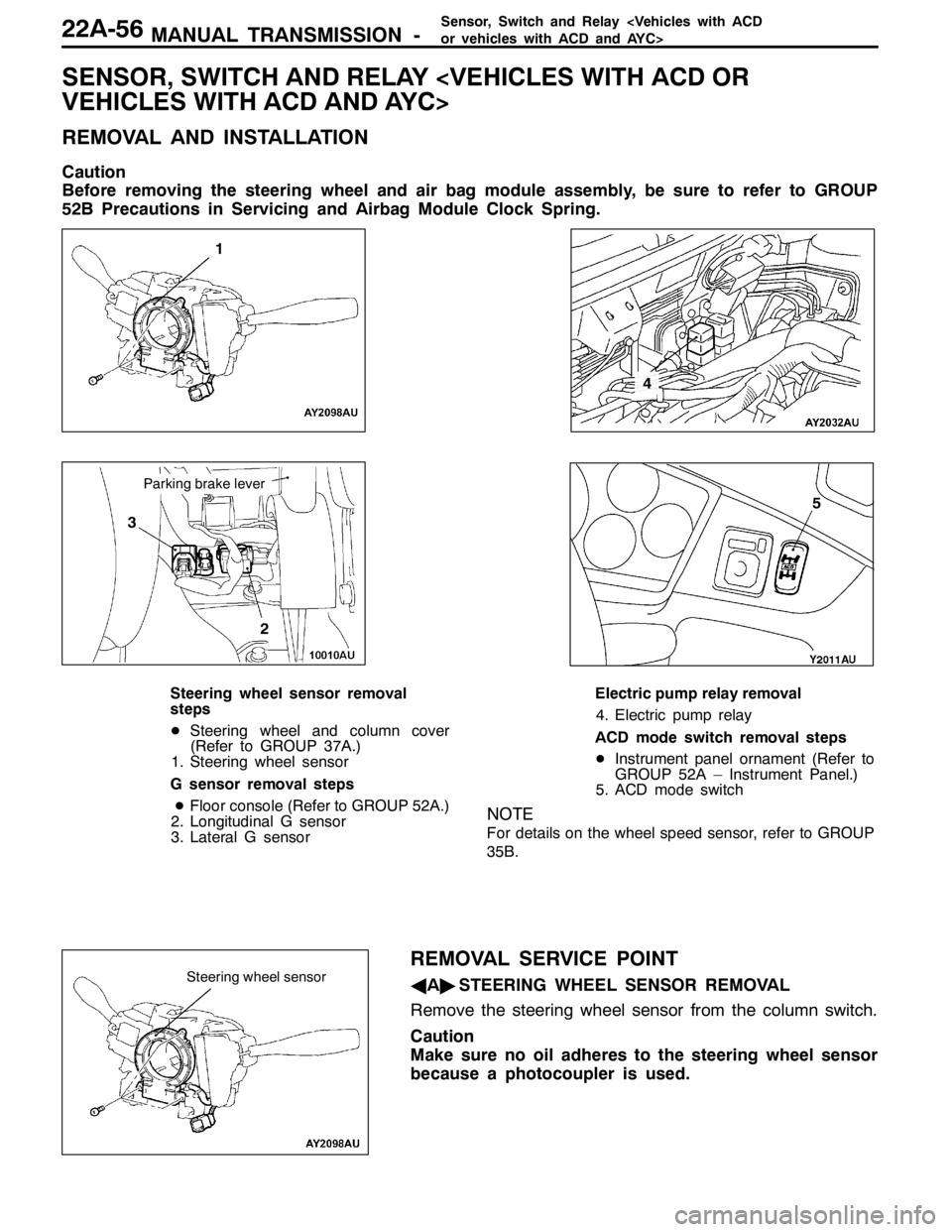
Steering wheel sensor removal
steps
DSteering wheel and column cover
(Refer to GROUP 37A.)
1. Steering wheel sensor
G sensor removal steps
DFloor console (Refer to GROUP 52A.)
2. Longitudinal G sensor
3. Lateral G sensorElectric pump relay removal
4. Electric pump relay
ACD mode switch removal steps
DInstrument panel ornament (Refer to
GROUP 52A – Instrument Panel.)
5. ACD mode switch
NOTE
For details on the wheel speed sensor, refer to GROUP
35B.
REMOVAL SERVICE POINT
AA"STEERING WHEEL SENSOR REMOVAL
Remove the steering wheel sensor from the column switch.
Caution
Make sure no oil adheres to the steering wheel sensor
because a photocoupler is used.Steering wheel sensor
Page 1116 of 1449

STEERING -General Information37A-2
GENERAL INFORMATION
The system has been equipped with the MOMO
leather 3-spoke-type steering wheel with built-in
SRS airbag.
The steering column is equipped with tilt steering
mechanism.
The power steering is an integral rack and piniontype that combines the steering gear and linkage
into one light-weight and compact assembly.
The steering system uses a vane oil pump with
a fluid flow control system, so that steering effort
varies with engine speed.
ItemLancer EVOLUTION-
Steering wheelTypeMOMO 3-spoke typeg
Outside diameter mm380
365
Maximum number of turns2.1
Steering columnColumn mechanismTilt steering
Power steering typeIntegral type
Oil pumpTypeVariable capacity type (vane pump)pp
Basic discharge amount cm3/rev.9.6
Relief pressure MPa8.3 - 9.0
Reservoir typeSeparate type
Pressure switchEquipped
Steering gear and linkageTypeRack and pinionggg
Stroke ratio (Rack stroke/Steering wheel
Maximum turning radius)68.61
Rack stroke mm146
Steering angleInner wheel32°gg
Outer wheel (for reference)27°
Power steering fluidSpecified lubricantsAutomatic transmission fluid DEXRON IIg
Quantity LApproximately 1.0
Page 1127 of 1449
STEERING -Steering Wheel37A-13
REMOVAL SERVICE POINTS
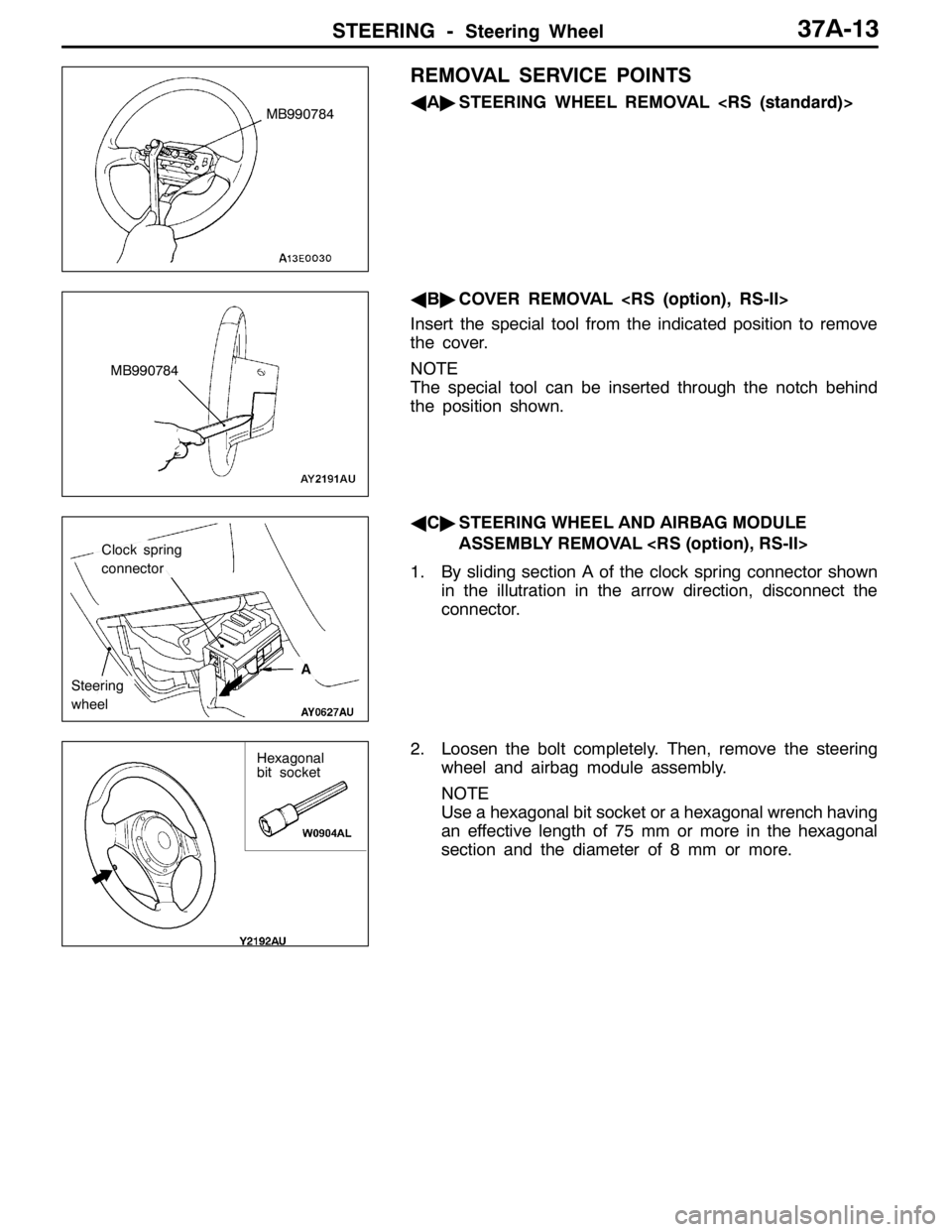
AA"STEERING WHEEL REMOVAL
AB"COVER REMOVAL
Insert the special tool from the indicated position to remove
the cover.
NOTE
The special tool can be inserted through the notch behind
the position shown.
AC"STEERING WHEEL AND AIRBAG MODULE
ASSEMBLY REMOVAL
1. By sliding section A of the clock spring connector shown
in the illutration in the arrow direction, disconnect the
connector.
2. Loosen the bolt completely. Then, remove the steering
wheel and airbag module assembly.
NOTE
Use a hexagonal bit socket or a hexagonal wrench having
an effective length of 75 mm or more in the hexagonal
section and the diameter of 8 mm or more.MB990784
MB990784
Clock spring
connector
Steering
wheel
A
Hexagonal
bit socket
Page 1255 of 1449

SRS -Troubleshooting52B-11
INSPECTION PROCEDURE CLASSIFIED BY DIAGNOSIS CODE
Code No.14, 15, 16, 31, 32, 45, 51, 52, 54, 55, 56, 57, 58, 59
System inside SRS-ECUProbable cause
Malfunction is present inside SRS-ECU. See table below for what each code
tells.DMalfunction of SRS-ECU
Code No.Defective partsTrouble
14Front impact analog G-sensorDNot operating
DAbnormal characteristics
DAbnormal output
15Front impact safing G-sensorDShort in the circuit
16DOpen in the circuit
31DC-DC converterDTerminal voltage of the converter higher than specified for
five seconds or more
32DTerminal voltage of the converter lower than specified for
5 seconds or more (this code is not detected when code
No.41 or 42, which indicates discharged battery, has been
detected)
45Non-volatile memory (EEPROM)DDefective parts inside
51Driver’sairbagmodule(squib)DShortinthecircuit51Driver’sairbag module(squib)
ignitiondrivecircuit
DShortinthecircuit
52ignition drive circuitDOpen in the circuit
54Front passenger’s air bag module
(squib)ignitiondrivecircuit
DShort in the circuit
55(squib)ignitiondrive circuitDOpen in the circuit
56Driver’s seat belt pre-tensioner
(squib)ignitiondrivecircuit
DShort in the circuit
57(squib)ignitiondrive circuitDOpen in the circuit
58Front passenger’s seat belt pre-ten-
sioner(squib)ignitiondrivecircuit
DShort in the circuit
59sioner(squib)ignitiondrive circuitDOpen in the circuit
If the above - mentioned code No. is output, replace the SRS-ECU.
Page 1308 of 1449

SRS -AirBagModuleandSeatBeltPre-tensioner
Disposal Procedures52B-64
AIR BAG MODULE AND SEAT BELT PRE-TENSIONER DISPOSAL
PROCEDURES
Carry out the following procedure of air bag
deployment and seat belt pre-tensioner operation
before disposing the air bag module and seat beltwith pre-tensioner or the vehicle with SRS air bag
and seat belt with pre-tensioner.
DISPOSAL OF AIR BAG MODULE BEFORE
DEPLOYMENT OR SEAT BELT WITH
PRE-TENSIONER BEFORE OPERATION
Caution
1. Carry out deployment of all the air bag modules and
operation of all seat belt pre-tensioners before
disposing the vehicle with SRS air bag and seat belt
with pre-tensioner inside the vehicle.
2. Carry out deployment of the used air bag or operation
of the used seat belt pre-tensioner outside the vehicle
when replacing the air bag module or the seat belt with
pre-tensioner.
3. Carry out deployment of air bag or operation of seat
belt pre-tensioner in a well ventilated place since a lot
of smoke is generated .Do not carry out operation near
a smoke detector.
4. Avoid carrying out operation in a residential area as
much as possible and give a warning when any person
is near by since air bag deployment or seat belt
pre-tensioner operation causes loud operation sound.
5. Prepare ear plugs for those are engaged in air bag
deployment or seat belt pre-tensioner operation or for
those who are near by.
DEPLOYMENT OR OPERATION INSIDE THE VEHICLE
1. Move the vehicle to flat and isolated spot.
2. Disconnect the negative (–) and positive (+) battery cables
from the battery terminals, and then remove the battery
from the vehicle.
Caution
Wait at least 60 seconds after the disconnection of the
battery cables before any further job. (Refer to
P.52B-3.)
3. Carry out deployment of the air bag module and operation
of the seat belt pre-tensioner according to the following
procedure.
Page 1309 of 1449
SRS -AirBagModuleandSeatBeltPre-tensioner
Disposal Procedures52B-65
Driver’s air bag module
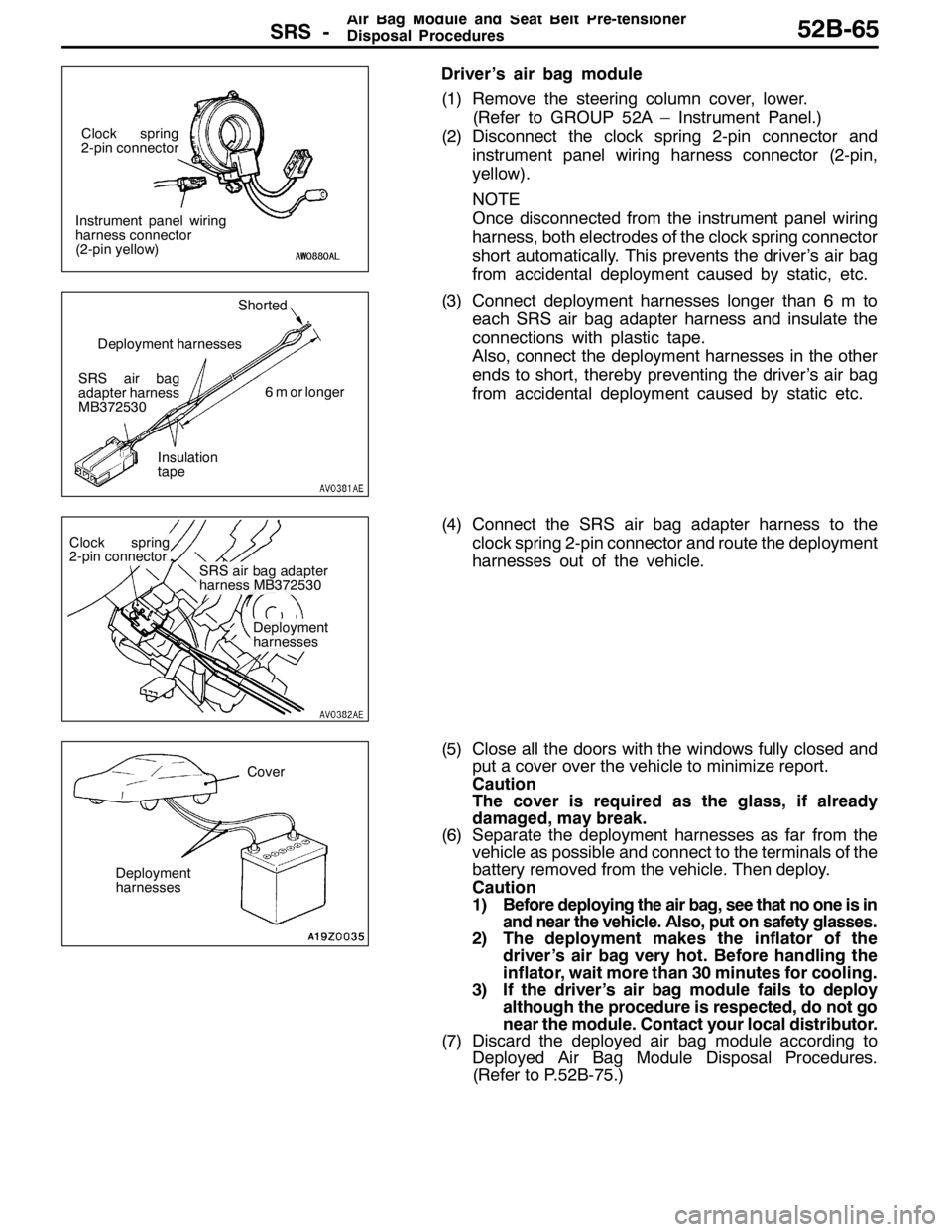
(1) Remove the steering column cover, lower.
(Refer to GROUP 52A – Instrument Panel.)
(2) Disconnect the clock spring 2-pin connector and
instrument panel wiring harness connector (2-pin,
yellow).
NOTE
Once disconnected from the instrument panel wiring
harness, both electrodes of the clock spring connector
short automatically. This prevents the driver’s air bag
from accidental deployment caused by static, etc.
(3) Connect deployment harnesses longer than 6 m to
each SRS air bag adapter harness and insulate the
connections with plastic tape.
Also, connect the deployment harnesses in the other
ends to short, thereby preventing the driver’s air bag
from accidental deployment caused by static etc.
(4) Connect the SRS air bag adapter harness to the
clock spring 2-pin connector and route the deployment
harnesses out of the vehicle.
(5) Close all the doors with the windows fully closed and
put a cover over the vehicle to minimize report.
Caution
The cover is required as the glass, if already
damaged, may break.
(6) Separate the deployment harnesses as far from the
vehicle as possible and connect to the terminals of the
battery removed from the vehicle. Then deploy.
Caution
1) Before deploying the air bag, see that no one is in
and near the vehicle. Also, put on safety glasses.
2) The deployment makes the inflator of the
driver’s air bag very hot. Before handling the
inflator, wait more than 30 minutes for cooling.
3) If the driver’s air bag module fails to deploy
although the procedure is respected, do not go
near the module. Contact your local distributor.
(7) Discard the deployed air bag module according to
Deployed Air Bag Module Disposal Procedures.
(Refer to P.52B-75.)
Instrument panel wiring
harness connector
(2-pin yellow)Clock spring
2-pin connector
SRS air bag
adapter harness
MB372530Shorted
6 m or longer
Insulation
tape Deployment harnesses
Clock spring
2-pin connector
SRS air bag adapter
harness MB372530
Deployment
harnesses
Cover
Deployment
harnesses
Page 1310 of 1449

SRS -AirBagModuleandSeatBeltPre-tensioner
Disposal Procedures52B-66
Front passenger’s air bag module
(1) Remove the glove box.
(Refer to GROUP 52A – Instrument Panel.)
(2) Disconnect the front passenger’s air bag module 2-pin
connector (red) and instrument panel wiring harness
connector (2-pin, red).
NOTE
Once disconnected from the instrument panel wiring
harness, both electrodes of the front passenger’s air
bag module short automatically. This prevents the
front passenger air bag from accidental deployment
caused by static, etc.
(3) Connect deployment harnesses longer than 6 m to
each SRS air bag adapter harness and insulate the
connections with plastic tape.
Also, connect the deployment harnesses in the other
ends to short, thereby preventing the front
passenger’s air bag from accidental deployment
caused by static etc.
(4) Connect the SRS air bag adapter harness to the
front passenger’s air bag module 2-pin connector
(red) and route the deployment harnesses out of the
vehicle.
(5) Close all the doors with the windows fully closed and
put a cover over the vehicle to minimize report.
Caution
The cover is required as the glass, if already
damaged, may break.
Instrument panel wiring
harness connector
(2-pin, red)
Front passen-
ger’s air bag
module 2-pin
connector (red)
SRS air bag
adapter harness
MB686560Shorted
6 m or longer
Insulation
tape Deployment harnesses
Deployment
harnesses SRS air bag
adapter harness
MB686560
Front passenger’s
air bag module 2-pin
connector (red)
Cover
Deployment
harnesses
Page 1311 of 1449
SRS -AirBagModuleandSeatBeltPre-tensioner
Disposal Procedures52B-67
(6) Separate the deployment harnesses as far from the
vehicle as possible and connect to the terminals of the
battery removed from the vehicle. Then deploy.
Caution
1) Before deploying the air bag, see that no one is
in and near the vehicle. Also, put on safety
glasses.
2) The deployment makes the inflator of the front
passenger’s air bag very hot. Before handling
the inflator, wait more than 30 minutes for
cooling.
3) If the front passenger’s air bag module fails to
deploy although the procedure is respected,
do not go near the module. Contact your local
distributor.
(7) Discard the deployed air bag module according to
Deployed Air Bag Module Disposal Procedures.
(Refer to P.52B-75.)
Seat belt pre-tensioner
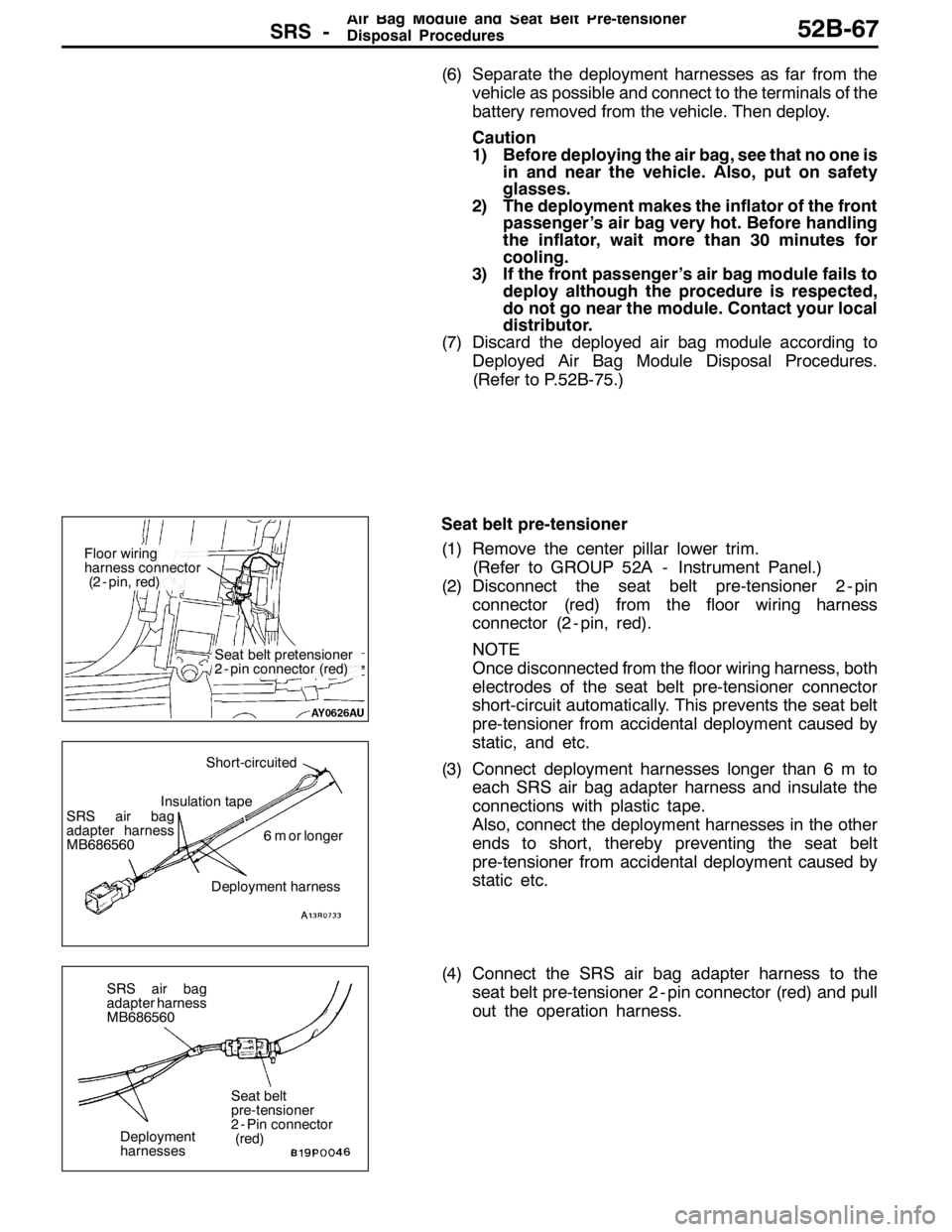
(1) Remove the center pillar lower trim.
(Refer to GROUP 52A - Instrument Panel.)
(2) Disconnect the seat belt pre-tensioner 2 - pin
connector (red) from the floor wiring harness
connector (2 - pin, red).
NOTE
Once disconnected from the floor wiring harness, both
electrodes of the seat belt pre-tensioner connector
short-circuit automatically. This prevents the seat belt
pre-tensioner from accidental deployment caused by
static, and etc.
(3) Connect deployment harnesses longer than 6 m to
each SRS air bag adapter harness and insulate the
connections with plastic tape.
Also, connect the deployment harnesses in the other
ends to short, thereby preventing the seat belt
pre-tensioner from accidental deployment caused by
static etc.
(4) Connect the SRS air bag adapter harness to the
seat belt pre-tensioner 2 - pin connector (red) and pull
out the operation harness.
Seat belt pretensioner
2 - pin connector (red)
Floor wiring
harness connector
(2 - pin, red)
SRS air bag
adapter harness
MB686560
Insulation tapeShort-circuited
6 m or longer
Deployment harness
Deployment
harnesses SRS air bag
adapter harness
MB686560
Seat belt
pre-tensioner
2 - Pin connector
(red)
Page 1312 of 1449

SRS -AirBagModuleandSeatBeltPre-tensioner
Disposal Procedures52B-68
(5) Close all the doors with the windows fully closed and
put a cover over the vehicle to minimize report.
Caution
The cover is required as the glass, if already
damaged, may break.
(6) Separate the deployment harnesses as far from the
vehicle as possible and connect to the terminals of
the battery removed from the vehicle. Then deploy.
Caution
1) Before operating the seat belt pre-tensioner,
see that no one is in or near the vehicle.
2) The operation makes the insulator of the seat
belt pre-tensioner very hot. Before handling
the inflator, wait more than 30 minutes for
cooling.
3) If the seat belt pre-tensioner fails to operate
although the procedure is respected, do not go
near the seat belt pre-tensioner. Contact your
local distributor.
(7) Discard the operated seat belt pre-tensioner accord-
ing to Disposal Procedure. (Refer to P.52B-75.)
DEPLOYMENT OUTSIDE THE VEHICLE
Caution
1. Carry out air bag deployment or seat belt pre-tensioner
operation on large flat place at least 6 m away from any
object or person.
2. Avoid a strong wind weather when carrying out
deployment or operation outside the vehicle. Ignite the
air bag at a place upwind from the air bag module and
the seat belt pre-tensioner even in a breeze weather.
1. Disconnect the negative ( - ) and positive (+) battery cables
from the battery terminals, and then remove the battery
from the vehicle.
Caution
Wait at least 60 seconds before any further job after the
disconnection of the battery cables. (Refer to P.52B-3.)
2. Carry out deployment of the air bag module and operation
of the seat belt pre-tensioner according to the following
procedure.
Driver’s side air bag module
(1) Remove the driver’s air bag module from the vehicle.
(Refer to P.52B-52.)
Caution
Once disconnected, both electrodes of the driver’s air
bag module connector short automatically to prevent
accidental deployment caused by static etc. Still, in
consideration of the accidental deployment, store the
air bag module on flat place with deployment surface
facing up. Also, do not put anything on it.
Cover
Deployment
harnesses
Page 1313 of 1449

SRS -AirBagModuleandSeatBeltPre-tensioner
Disposal Procedures52B-69
(2) Connect deployment harnesses longer than 6 m to
each SRS air bag adapter harness and insulate the
connections with plastic tape.
Also, connect the deployment harness in the other
ends to connect (short-circuit). This prevents the
driver’s air bag module from accidental deployment
caused by static and etc.
(3) Touch the vehicle’s body with bare hands to discharge
static in you.
Caution
Never fail to do Step (3) in order to prevent
accidental deployment caused by static.
(4) Install a nut to the bolt behind the driver’s air bag
module and tie thick wire there for securing.
(5) Route the deployment harnesses connected to the
driver’s air bag module beneath an old tyre and wheel
assembly. Then, using the wire tied to the bolt, secure
the driver’s air bag module to the tyre and wheel
assembly with the deployment surface facing up.
(6) Place three old tyres without wheels on the tyre
secured with the driver’s air bag module.
SRS air bag
adapter harness
MR203491 or
MB628919Deployment
harnessShort-circuited
6 m or longer
Insulation tape
Driver’s air bag module
Deployment
harnesses
Tyres without wheels
Deployment harnesses