torque MITSUBISHI LANCER EVOLUTION 2007 Service Repair Manual
[x] Cancel search | Manufacturer: MITSUBISHI, Model Year: 2007, Model line: LANCER EVOLUTION, Model: MITSUBISHI LANCER EVOLUTION 2007Pages: 1449, PDF Size: 56.82 MB
Page 1120 of 1449

STEERING -Special Tools37A-6
Tool UseName Number
MB991197Bar (long type)DPress fitting of rack housing bearing
DTo press in the oil seal for the rack
MB991214Rack installerRack installation
MB990925Bearing and oil
seal installer setInstallation of the oil seal and bearing
(Refer to GROUP 26 - Special Tools.)
MB991120Needle bearing
pullerRemoval of rack housing needle bearing
MB991203Oil seal and
bearing installerTo press in the valve housing oil seal and
bearing
MB991317Seal ring installerCompression of the seal rings after
replacement of the pinion seal rings
MB990941Torque tube
bearing installerInstallation of valve housing oil seal
MB991561Boot band crimp-
ing toolInstallation of bellows band
MB990776Front axle baseInstallation of dust cover for tie rod end ball joint
Page 1121 of 1449
STEERING -On-vehicle Service37A-7
ON-VEHICLE SERVICE
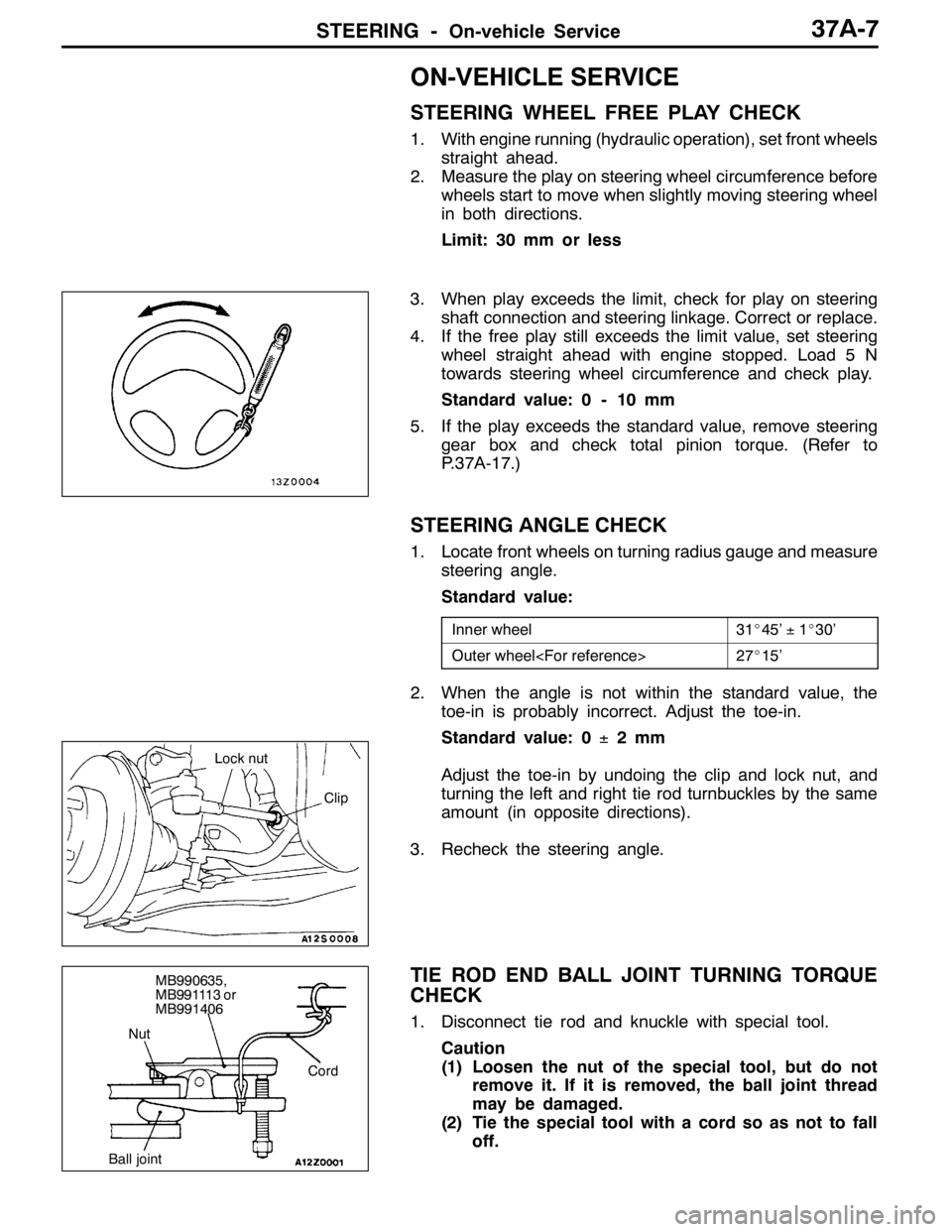
STEERING WHEEL FREE PLAY CHECK
1. With engine running (hydraulic operation), set front wheels
straight ahead.
2. Measure the play on steering wheel circumference before
wheels start to move when slightly moving steering wheel
in both directions.
Limit: 30 mm or less
3. When play exceeds the limit, check for play on steering
shaft connection and steering linkage. Correct or replace.
4. If the free play still exceeds the limit value, set steering
wheel straight ahead with engine stopped. Load 5 N
towards steering wheel circumference and check play.
Standard value: 0 - 10 mm
5. If the play exceeds the standard value, remove steering
gear box and check total pinion torque. (Refer to
P.37A-17.)
STEERING ANGLE CHECK
1. Locate front wheels on turning radius gauge and measure
steering angle.
Standard value:
Inner wheel31_45’±1_30’
Outer wheel
2. When the angle is not within the standard value, the
toe-in is probably incorrect. Adjust the toe-in.
Standard value: 0±2mm
Adjust the toe-in by undoing the clip and lock nut, and
turning the left and right tie rod turnbuckles by the same
amount (in opposite directions).
3. Recheck the steering angle.
TIE ROD END BALL JOINT TURNING TORQUE
CHECK
1. Disconnect tie rod and knuckle with special tool.
Caution
(1) Loosen the nut of the special tool, but do not
remove it. If it is removed, the ball joint thread
may be damaged.
(2) Tie the special tool with a cord so as not to fall
off.
Clip
Lock nut
Cord
Ball jointNutMB990635,
MB991113 or
MB991406
Page 1122 of 1449

STEERING -On-vehicle Service37A-8
2. Move ball joint stud several times and install nut on stud.
Measure ball joint turning torque with special tool.
Standard value: 1.0 - 3.0 N·m
3. When the turning torque exceeds the standard value,
replace tie rod end.
4. When the turning torque is under the standard value,
check ball joint for end play or ratcheting. If none of these,
the joint is still serviceable.
STATIONARY STEERING EFFORT CHECK
1. With the vehicle stopped on a flat, paved surface, turn
the steering wheel to the straight ahead position.
2. Start the engine and set it to 1,000±100 r/min.
3. Attach a spring balance to the outer circumference of
the steering wheel and measure the steering force
required to turn the steering wheel from the straight ahead
position to the left and right (within a range of 0.9 turns).
Also check to be sure that there is no significant fluctuation
of the required steering force.
Standard value:
Steering effort32 N or less
Fluctuation allowance6.0 N or less
4. If the standard values are not met, check and adjust
the related parts.
CHECKING STEERING WHEEL RETURN TO
CENTRE
To make this test, conduct a road test and check as follows.
1. Make both gradual and sudden turns and check the
steering “feeling” to be sure that there is not difference
in the steering force required and the wheel return between
left and right turns.
2. At a speed of 35 km/h, turn the steering wheel 90_and
release the steering wheel after 1 or 2 seconds. If the
steering wheel then returns 70_or more, the return can
be judged to be satisfactory.
NOTE
There will be a momentary feeling or “heaviness” when
the wheel is turned quickly, but this is not abnormal. (This
is because the oil pump discharge amount is especially
apt to be insufficient during idling.)
DRIVE BELT TENSION CHECK
Refer to GROUP 11A - On-vehicle Service.
MB990326
70_70_
Page 1124 of 1449

STEERING -On-vehicle Service37A-10
9. If the level changes more than 5 mm, the air is badly
bled. So, bleed air again.
Caution
(1) If the fluid level rises suddenly after the engine
is stopped, the bleeding is incomplete.
(2) Incomplete bleeding causes abnormal noises
from the pump and the flow-control valve. This
could lessen the life of the pump and the other
parts.
OIL PUMP PRESSURE TEST
1. Disconnect the pressure hose from the oil pump, and
then connect the special tools.
2. Bleed the air, and then turn the steering wheel several
times while the vehicle is not moving so that the
temperature of the fluid rises to approximately 50 - 60_C.
3. Start the engine and idle it at 1,000±100 r/min.
4. Fully close the shut-off valve of the pressure gauge and
measure the oil pump relief pressure to confirm that it
is within the standard value range.
Standard value: 8.4 - 9.0 MPa
5. If the standard value is not met, the oil pump is defective.
So, replace the oil pump. Then, measure oil pressure
again.
6. With the pressure gauge shut - off valve fully open, check
the hydraulic pressure in unladen condition.
Standard value: 0.2 - 0.8 MPa
7. If the standard value is not met, the oil line or steering
gear is probably defective. So, repair and measure oil
pressure again.
8. Turn the steering wheel fully either left or right and check
the retention hydraulic pressure.
Standard value: 8.4 - 9.0 MPa
9. If the pressure is below the standard value, disassemble
and reassemble the steering gear. If above, replace the
oil pump. Then, measure oil pressure again.
10. Remove the special tools, and tighten the pressure hose
to the specified torque.
Tightening torque: 18±3 N·m
11. Bleed the system.
Fluid level change: Within 5 mm
While engine
runningWhile engine
stopped
Temperature
gaugePressure
gauge
(MB990662)Shut-off valve
Oil
pumpOil reservoir
Adapter
(MB990994)
Adapter
(MB990993)
Page 1125 of 1449

STEERING -On-vehicle Service37A-11
POWER STEERING OIL PRESSURE SWITCH
CHECK
1. Disconnect the pressure hose from the oil pump, and
then connect the special tools.
2. Bleed the air, and then turn the steering wheel several
times while the vehicle is not moving so that the
temperature of the fluid rises to approximately 50 - 60_C.
3. The engine should be idling.
4. Disconnect the connection of the connector for the oil
pressure switch, and set an ohmmeter in position.
5. Gradually close the shut-off valve of the pressure gauge
and increase the hydraulic pressure, then check whether
or not the hydraulic pressure that activates the switch
is the standard value.
Standard value: 1.8 - 2.4 MPa
6. Gradually open the shut-off valve and reduce the hydraulic
pressure; then check whether or not the hydraulic pressure
that deactivates the switch is the standard value.
Standard value: 1.0 - 2.4 MPa
7. Remove the special tools, and then tighten the pressure
hose to the specified torque.
Tightening torque: 18±3 N·m
8. Bleed the system.
BALL JOINT DUST COVER CHECK
1. Check the dust cover for cracks or damage by pushing
it with finger.
2. If the dust cover is cracked or damaged, replace the
tie rod end.
NOTE
Cracks or damage of the dust cover may cause damage
of the ball joint.
Temperature
gaugeShut-off valve
Oil
pump
ReservoirAdapter
(MB990993)Pressure
gauge
(MB990662)
Adapter
(MB990994)
Page 1131 of 1449

STEERING - Power Steering Gear Box and Linkage37A-17
17 6 2
3 4
15±3 N·m
57±7 N·m
5
70±10 N·m
Removal steps
1. Crossmember
(Refer to GROUP 32.)
2. Joint cover grommet
3. Return hose connection4. Return tube
5. Pressure hose connection
6. Clamp
7. Steering gear and linkage
INSPECTION
GEAR BOX PINION TOTAL ROTATION TORQUE CHECK
Caution
Secure the steering gear box and linkage in their mounting
positions only. Otherwise, deformation or damage could
result.
1. Using the special tool, turn the pinion gear at a speed
of one rotation per 4 to 6 seconds to measure total rotation
torque.
Standard values:
Total rotation torque: 0.8 – 1.8 N·m
Torque fluctuation: 0.49 N·m or less
NOTE
(1) Remove the bellows from the rack housing before
measuring.
(2) Measure the total rotation torque by turning the special
tool left and right 180_from the neutral position.
2. If the standard values are not met, adjust the pinion total
rotation torque. (Refer to P.37A-26.)
3. In case the adjustment is impossible, disassemble and
check the components, and repair if necessary.
MB991006
Page 1132 of 1449

STEERING - Power Steering Gear Box and Linkage37A-18
TIE ROD SWING RESISTANCE CHECK
1. Swing the tie rod 10 times hardly.
2. With the tie rod end downwards as shown, use a spring
scale to measure swing resistance (swing torque).
Standard value: 8 - 27 N (1.5 - 4.9 N·m)
3. If the measured value is above the standard value, replace
the tie rod.
4. If below, check the ball joint for looseness or ratcheting.
The tie rod is still serviceable when the ball joint swings
smoothly.
TIE ROD END BALL JOINT DUST COVER CHECK
1. Check the dust cover for cracks or damage by pushing
it with finger.
2. If the dust cover is cracked or damaged, replace the
tie rod end. (Refer to P.37A-19, 20.)
NOTE
A cracked or damaged dust cover may damage the ball
joint. Replace the dust cover when it is damaged during
service work.
Page 1133 of 1449
STEERING - Power Steering Gear Box and Linkage37A-19
DISASSEMBLY AND REASSEMBLY
31
30
28
11
10
8
97
5
6
29
2618
33
22
20
Flare nut
21
23
36
32 17
1615
14 13
12 3
19
Steering gear seal set
Repair kit grease35
23
21
19
8
1135
17
32 3129
2811
8 3
4 4
27 25
22±4 N·m
25±4 N·m59±10 N·m
88±10 N·m 52±2 N·m
13±3 N·m
1
2 4
23±2 N·m→-30_
59±10 N·m
34
24
4
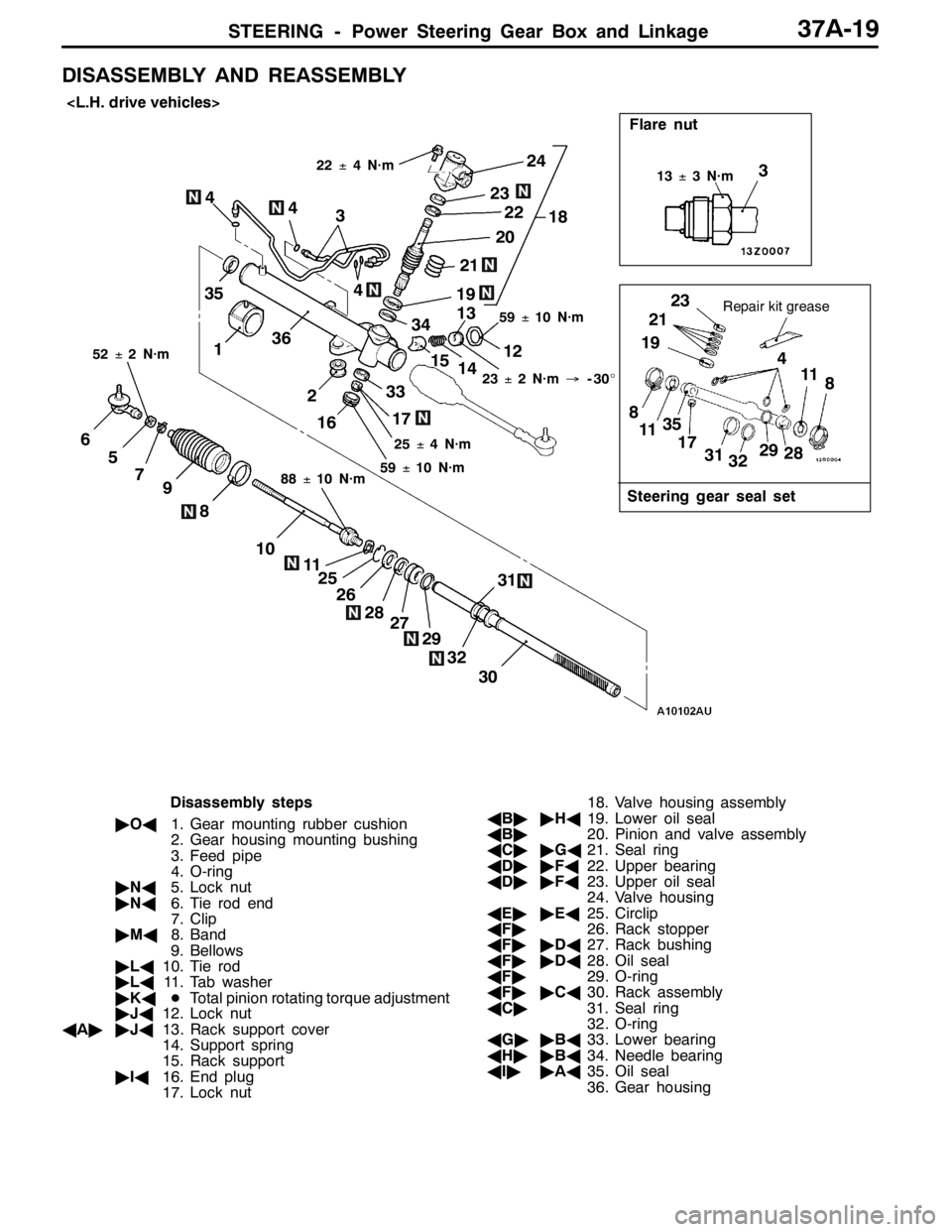
Disassembly steps
"OA1. Gear mounting rubber cushion
2. Gear housing mounting bushing
3. Feed pipe
4. O-ring
"NA5. Lock nut
"NA6. Tie rod end
7. Clip
"MA8. Band
9. Bellows
"LA10. Tie rod
"LA11. Tab washer
"KADTotal pinion rotating torque adjustment
"JA12. Lock nut
AA""JA13. Rack support cover
14. Support spring
15. Rack support
"IA16. End plug
17. Lock nut18. Valve housing assembly
AB""HA19. Lower oil seal
AB"20. Pinion and valve assembly
AC""GA21. Seal ring
AD""FA22. Upper bearing
AD""FA23. Upper oil seal
24. Valve housing
AE""EA25. Circlip
AF"26. Rack stopper
AF""DA27. Rack bushing
AF""DA28. Oil seal
AF"29. O-ring
AF""CA30. Rack assembly
AC"31. Seal ring
32. O-ring
AG""BA33. Lower bearing
AH""BA34. Needle bearing
AI""AA35. Oil seal
36. Gear housing
Page 1134 of 1449
STEERING - Power Steering Gear Box and Linkage37A-20
18
24
23
22
21
20
34
36
33
17
1615
14
13
123
19
3523
21
19
8
1135
17
31
3229
2811
8
3
4 4
31
32
27
29
28
26
25
1110
8
9
756
304
22±4 N·m
25±4 N·m
59±10 N·m
59±10 N·m
88±10 N·m
52±2 N·m
23±2 N·m→–30_
13±3 N·m
1 2
4
Flare nut
Steering gear seal set
Repair kit grease3
4
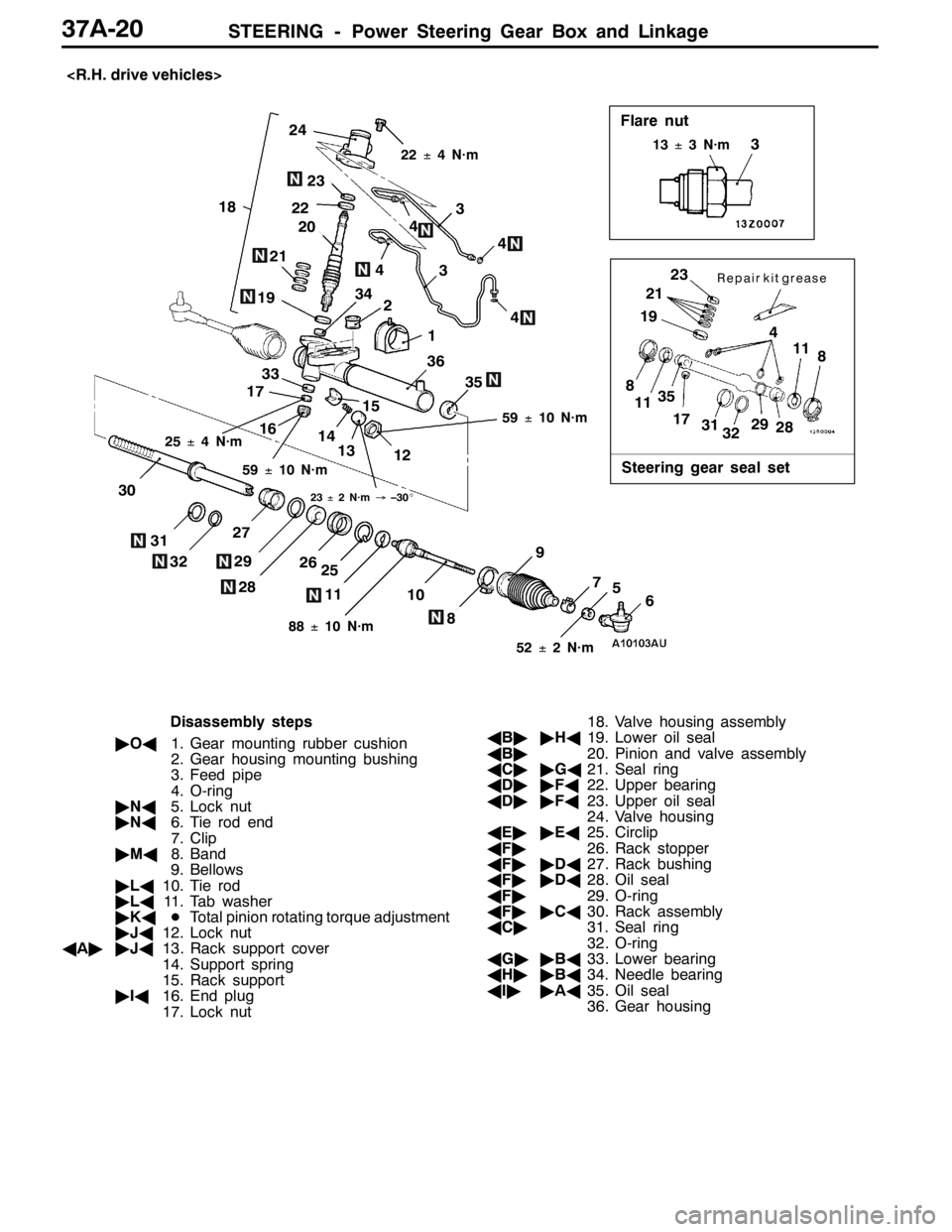
Disassembly steps
"OA1. Gear mounting rubber cushion
2. Gear housing mounting bushing
3. Feed pipe
4. O-ring
"NA5. Lock nut
"NA6. Tie rod end
7. Clip
"MA8. Band
9. Bellows
"LA10. Tie rod
"LA11. Tab washer
"KADTotal pinion rotating torque adjustment
"JA12. Lock nut
AA""JA13. Rack support cover
14. Support spring
15. Rack support
"IA16. End plug
17. Lock nut18. Valve housing assembly
AB""HA19. Lower oil seal
AB"20. Pinion and valve assembly
AC""GA21. Seal ring
AD""FA22. Upper bearing
AD""FA23. Upper oil seal
24. Valve housing
AE""EA25. Circlip
AF"26. Rack stopper
AF""DA27. Rack bushing
AF""DA28. Oil seal
AF"29. O-ring
AF""CA30. Rack assembly
AC"31. Seal ring
32. O-ring
AG""BA33. Lower bearing
AH""BA34. Needle bearing
AI""AA35. Oil seal
36. Gear housing
Page 1140 of 1449

STEERING - Power Steering Gear Box and Linkage37A-26
"HALOWER OIL SEAL INSTALLATION
Using the special tool, press the oil seal into the valve housing.
The upper surface of the oil seal must project outwards about
1 mm from the housing end surface.
Caution
When the oil seal is flush with or lower than the housing
edge, reassemble the components. Otherwise, oil leaks
will result.
"IAEND PLUG INSTALLATION
1. Apply specified sealant to the threaded section of the
end plug, and then install the end plug to the gear housing.
Specified fluid:
3M ATD Part No.8661, 8663 or equivalent
2. Use a punch to bend over the two tabs on the sides
of the end plug to stop the end plug from turning.
"JARACK SUPPORT COVER/LOCKING NUT
INSTALLATION
1. Apply specified sealant to the rack support cover thread.
Specified fluid:
3M ATD Part No.8661, 8663 or equivalent
2. Using the special tool, tighten the rack support cover
to 23±2 N·m.
3. Return the rack support cover by about 30_.
4. Tighten the locking nut to the specified torque, using
the special tool to prevent the rack support cover from
spinning.
"KAPINION TOTAL ROTATION TORQUE ADJUSTMENT
1. Using the special tool, measure total rotation torque by
turning the pinion gear at a speed of one rotation per
4 to 6 seconds.
Standard value:
Total rotation torque: 0.8-1.8 Nm
Torque fluctuation: 0.49 Nm or lessMB990941 Approx. 1 mmOil
seal
Housing
End plugEnd plug
MB991204
MB991006