torque MITSUBISHI LANCER EVOLUTION 2007 Service Owners Manual
[x] Cancel search | Manufacturer: MITSUBISHI, Model Year: 2007, Model line: LANCER EVOLUTION, Model: MITSUBISHI LANCER EVOLUTION 2007Pages: 1449, PDF Size: 56.82 MB
Page 1031 of 1449
FRONT SUSPENSION -On-vehicle Service33A-5
Tightening torque: 52±2 N·m
3. Confirm that the toe-in is at the standard value.
4. Use a turning radius gauge to check that the steering
angle is at the standard value.
Standard value:
Inner wheels31_45’±1_30’
Outer wheels (for reference)27_15’
TOE-OUT ANGLE ON TURNS
To check the steering linkage, especially after the vehicle
has been involved in an accident or if an accident is presumed,
it is advisable to check the toe-out angle on turns in addition
to the wheel alignment.
Conduct this test on the left turn as well as on the right turn.
Standard value:
ItemsSpecifications
Toe-out angle on turns
(inner wheel when outer wheel at 20_)22_00’±1_30’
CAMBER, CASTER AND KINGPIN INCLINATION
Standard value:
ItemsSpecifications
Camber
(Selectable from 2 options)-1_00’±30’* or - 2_00’±30’*
Caster3_55’±30’*
Kingpin inclination13_45’±1_30’
NOTE
1. *: difference between right and left wheels must be less
than 30’
2. Caster and kingpin inclination are preset at the factory
and cannot be adjusted.
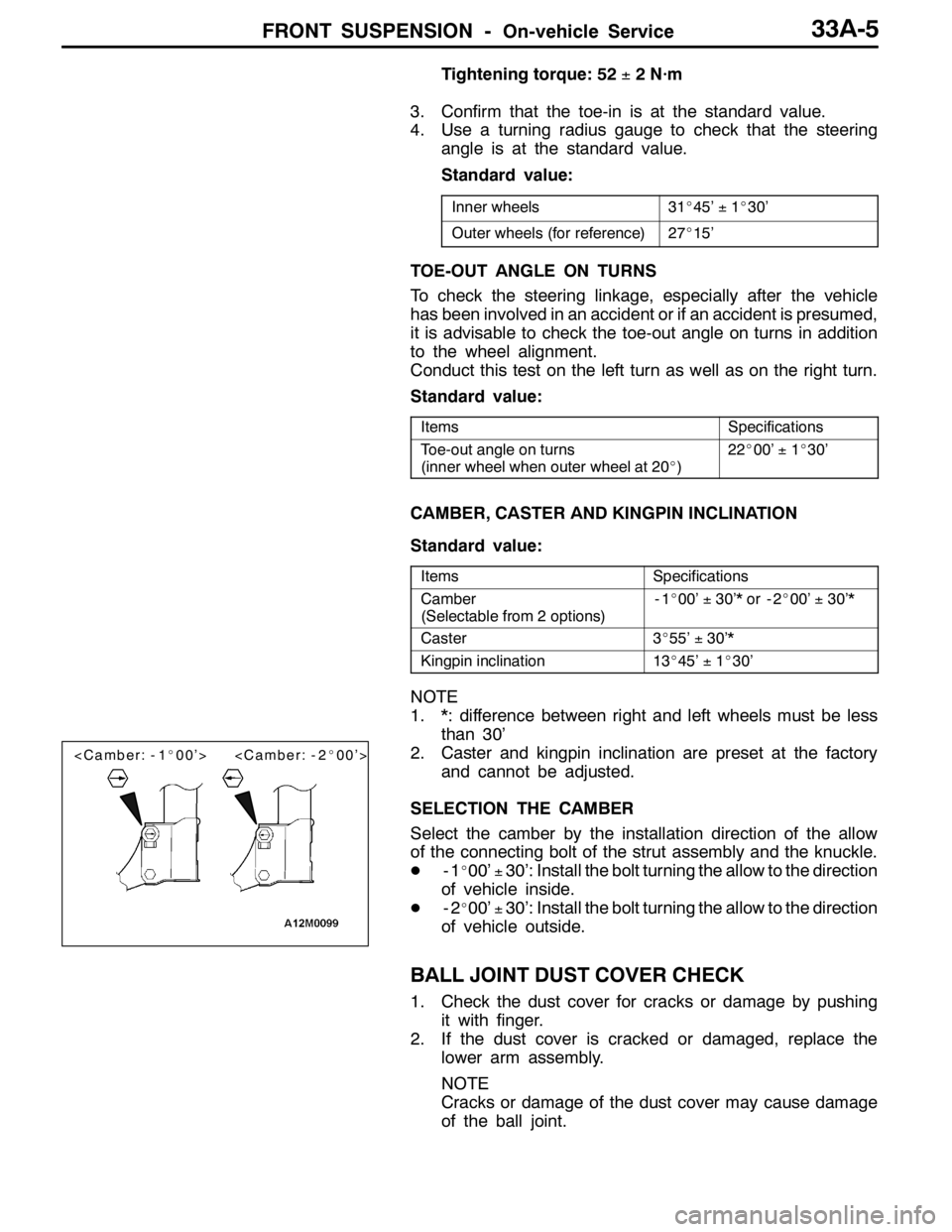
SELECTION THE CAMBER
Select the camber by the installation direction of the allow
of the connecting bolt of the strut assembly and the knuckle.
D-1
_00’±30’: Install the bolt turning the allow to the direction
of vehicle inside.
D-2
_00’±30’: Install the bolt turning the allow to the direction
of vehicle outside.
BALL JOINT DUST COVER CHECK
1. Check the dust cover for cracks or damage by pushing
it with finger.
2. If the dust cover is cracked or damaged, replace the
lower arm assembly.
NOTE
Cracks or damage of the dust cover may cause damage
of the ball joint.
Page 1033 of 1449
FRONT SUSPENSION -Strut Assembly33A-7
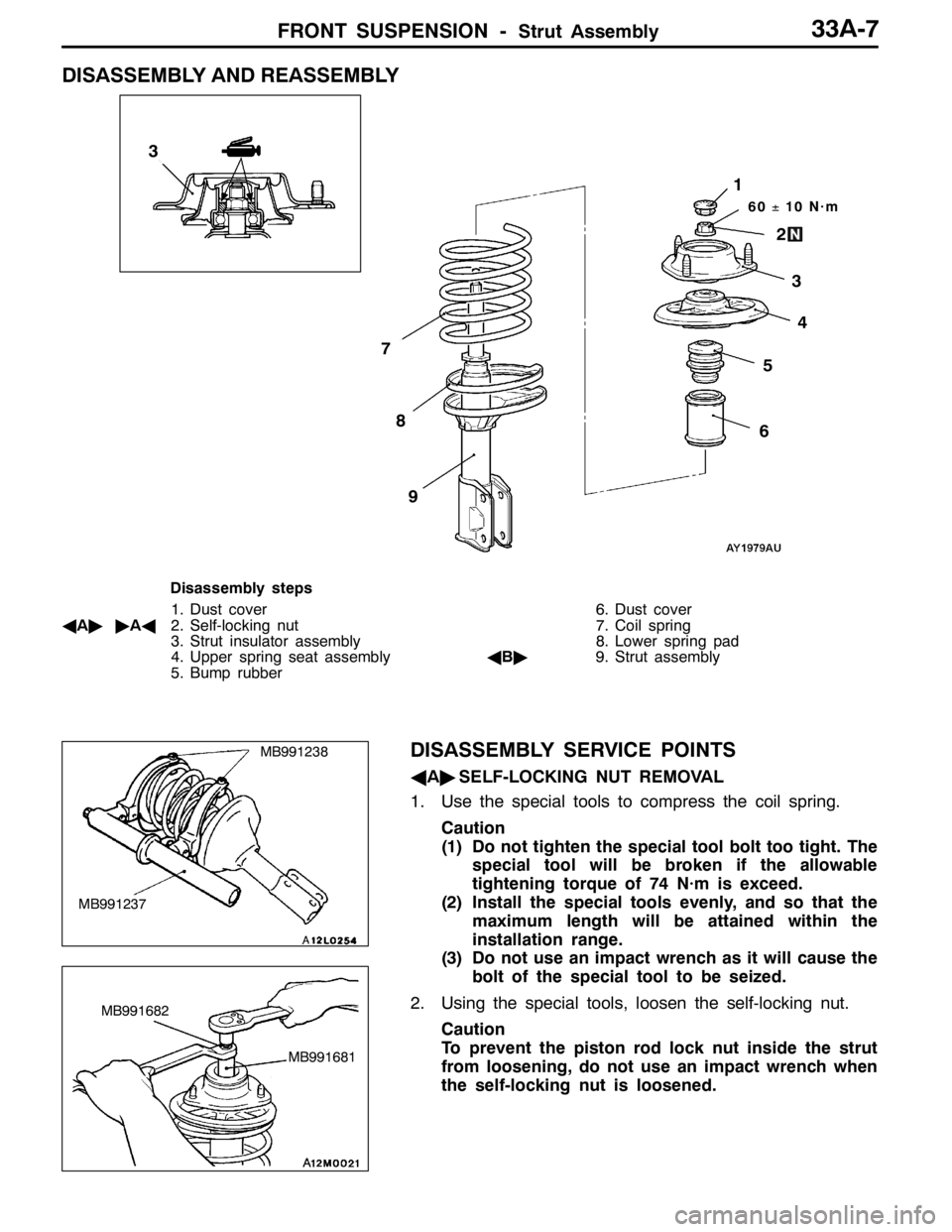
DISASSEMBLY AND REASSEMBLY
60±10 N·m
3
2
1
5
6
7
8
9
4
3
Disassembly steps
1. Dust cover
AA""AA2. Self-locking nut
3. Strut insulator assembly
4. Upper spring seat assembly
5. Bump rubber6. Dust cover
7. Coil spring
8. Lower spring pad
AB"9. Strut assembly
DISASSEMBLY SERVICE POINTS
AA"SELF-LOCKING NUT REMOVAL
1. Use the special tools to compress the coil spring.
Caution
(1) Do not tighten the special tool bolt too tight. The
special tool will be broken if the allowable
tightening torque of 74 N·m is exceed.
(2) Install the special tools evenly, and so that the
maximum length will be attained within the
installation range.
(3) Do not use an impact wrench as it will cause the
bolt of the special tool to be seized.
2. Using the special tools, loosen the self-locking nut.
Caution
To prevent the piston rod lock nut inside the strut
from loosening, do not use an impact wrench when
the self-locking nut is loosened.
MB991237
MB991238
MB991681
MB991682
Page 1034 of 1449
FRONT SUSPENSION -Strut Assembly33A-8
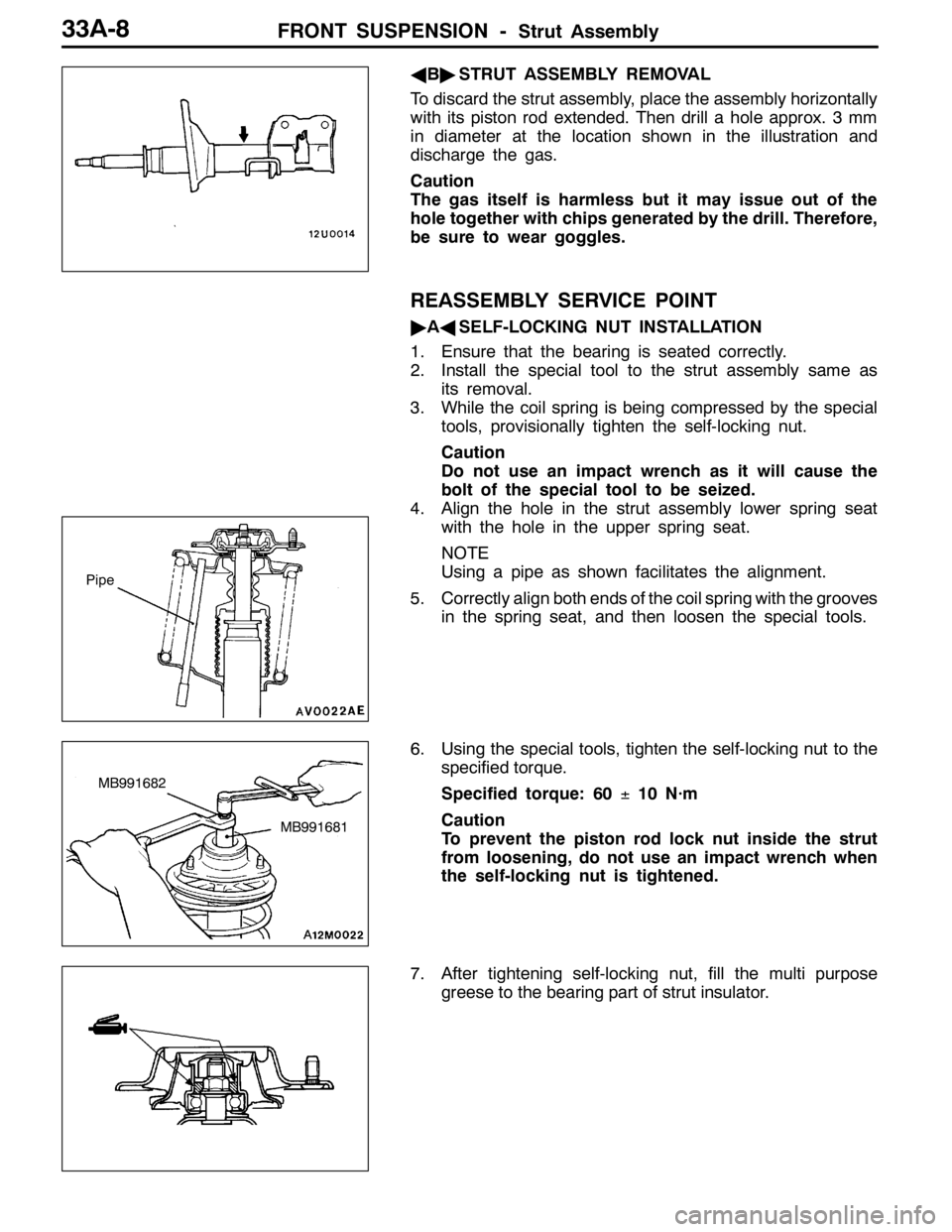
AB"STRUT ASSEMBLY REMOVAL
To discard the strut assembly, place the assembly horizontally
with its piston rod extended. Then drill a hole approx. 3 mm
in diameter at the location shown in the illustration and
discharge the gas.
Caution
The gas itself is harmless but it may issue out of the
hole together with chips generated by the drill. Therefore,
be sure to wear goggles.
REASSEMBLY SERVICE POINT
"AASELF-LOCKING NUT INSTALLATION
1. Ensure that the bearing is seated correctly.
2. Install the special tool to the strut assembly same as
its removal.
3. While the coil spring is being compressed by the special
tools, provisionally tighten the self-locking nut.
Caution
Do not use an impact wrench as it will cause the
bolt of the special tool to be seized.
4. Align the hole in the strut assembly lower spring seat
with the hole in the upper spring seat.
NOTE
Using a pipe as shown facilitates the alignment.
5. Correctly align both ends of the coil spring with the grooves
in the spring seat, and then loosen the special tools.
6. Using the special tools, tighten the self-locking nut to the
specified torque.
Specified torque: 60±10 N·m
Caution
To prevent the piston rod lock nut inside the strut
from loosening, do not use an impact wrench when
the self-locking nut is tightened.
7. After tightening self-locking nut, fill the multi purpose
greese to the bearing part of strut insulator.
Pipe
MB991681
MB991682
Page 1036 of 1449
FRONT SUSPENSION -Lower Arm Assembly33A-10
REMOVAL SERVICE POINT
AA"LOWER ARM AND CROSSMEMBER
DISCONNECTION
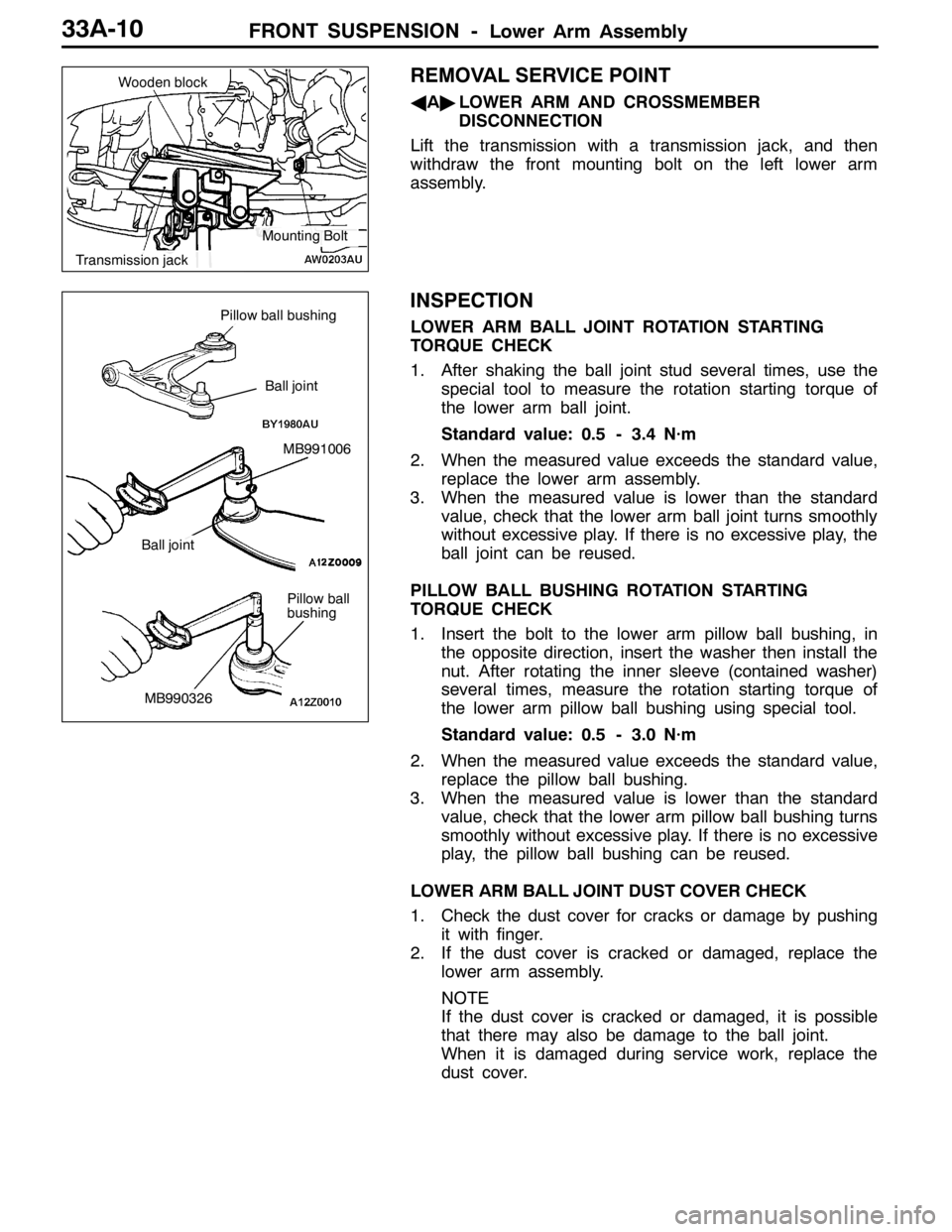
Lift the transmission with a transmission jack, and then
withdraw the front mounting bolt on the left lower arm
assembly.
INSPECTION
LOWER ARM BALL JOINT ROTATION STARTING
TORQUE CHECK
1. After shaking the ball joint stud several times, use the
special tool to measure the rotation starting torque of
the lower arm ball joint.
Standard value: 0.5 - 3.4 N·m
2. When the measured value exceeds the standard value,
replace the lower arm assembly.
3. When the measured value is lower than the standard
value, check that the lower arm ball joint turns smoothly
without excessive play. If there is no excessive play, the
ball joint can be reused.
PILLOW BALL BUSHING ROTATION STARTING
TORQUE CHECK
1. Insert the bolt to the lower arm pillow ball bushing, in
the opposite direction, insert the washer then install the
nut. After rotating the inner sleeve (contained washer)
several times, measure the rotation starting torque of
the lower arm pillow ball bushing using special tool.
Standard value: 0.5 - 3.0 N·m
2. When the measured value exceeds the standard value,
replace the pillow ball bushing.
3. When the measured value is lower than the standard
value, check that the lower arm pillow ball bushing turns
smoothly without excessive play. If there is no excessive
play, the pillow ball bushing can be reused.
LOWER ARM BALL JOINT DUST COVER CHECK
1. Check the dust cover for cracks or damage by pushing
it with finger.
2. If the dust cover is cracked or damaged, replace the
lower arm assembly.
NOTE
If the dust cover is cracked or damaged, it is possible
that there may also be damage to the ball joint.
When it is damaged during service work, replace the
dust cover.
Wooden block
Transmission jack
Mounting Bolt
Pillow ball
bushing
MB991006
Pillow ball bushing
Ball joint
Ball joint
MB990326
Page 1056 of 1449
BASIC BRAKE SYSTEM -On-vehicle Service35A-14
BRAKE DISC THICKNESS CHECK
Caution: Brembo disc brake
Take care not to contact the parts or tools to the caliper
because the paint of caliper will be scratched. And if
there is brake fluid on the caliper, wipe out quickly.
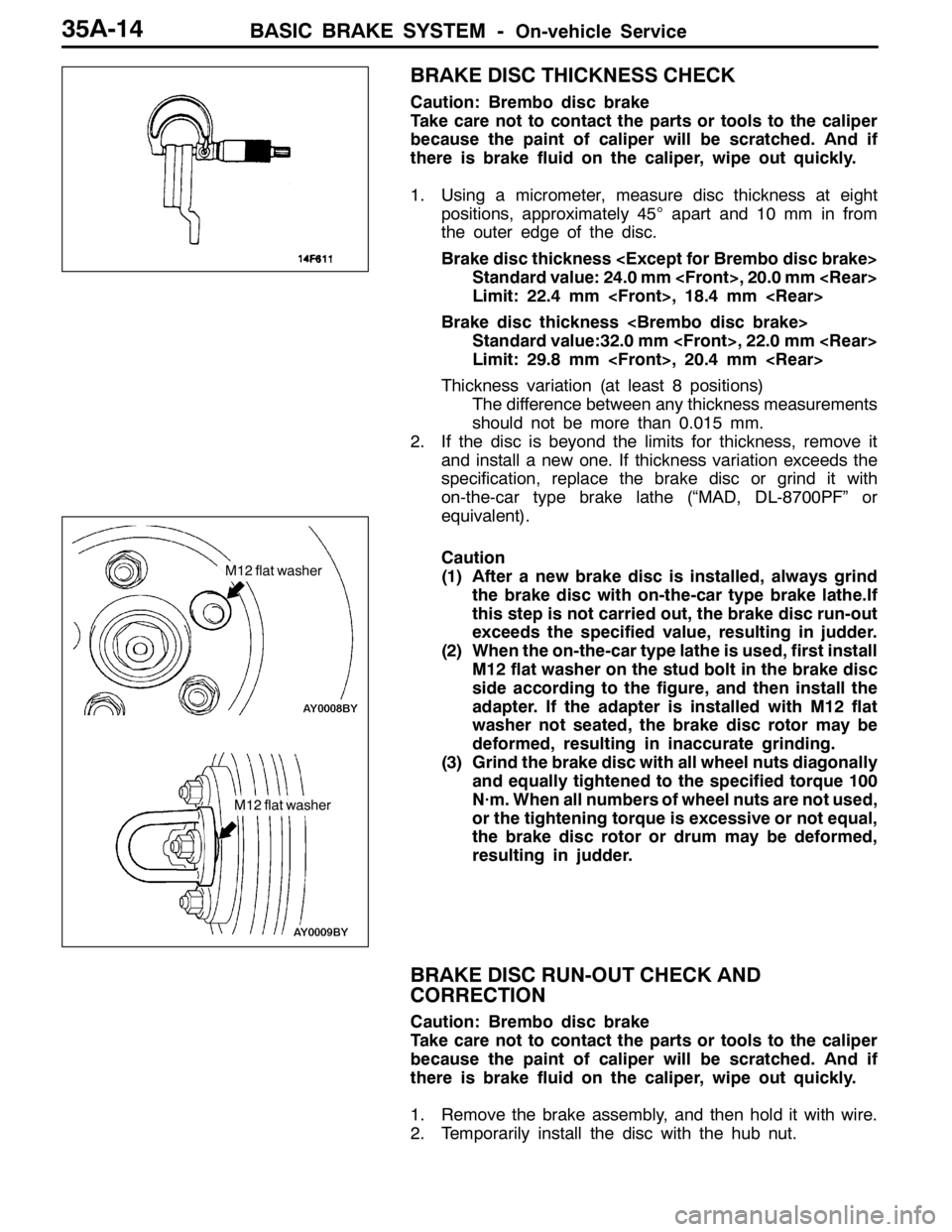
1. Using a micrometer, measure disc thickness at eight
positions, approximately 45°apart and 10 mm in from
the outer edge of the disc.
Brake disc thickness
Standard value: 24.0 mm
Limit: 22.4 mm
Brake disc thickness
Standard value:32.0 mm
Limit: 29.8 mm
Thickness variation (at least 8 positions)
The difference between any thickness measurements
should not be more than 0.015 mm.
2. If the disc is beyond the limits for thickness, remove it
and install a new one. If thickness variation exceeds the
specification, replace the brake disc or grind it with
on-the-car type brake lathe (“MAD, DL-8700PF” or
equivalent).
Caution
(1) After a new brake disc is installed, always grind
the brake disc with on-the-car type brake lathe.If
this step is not carried out, the brake disc run-out
exceeds the specified value, resulting in judder.
(2) When the on-the-car type lathe is used, first install
M12 flat washer on the stud bolt in the brake disc
side according to the figure, and then install the
adapter. If the adapter is installed with M12 flat
washer not seated, the brake disc rotor may be
deformed, resulting in inaccurate grinding.
(3) Grind the brake disc with all wheel nuts diagonally
and equally tightened to the specified torque 100
N·m. When all numbers of wheel nuts are not used,
or the tightening torque is excessive or not equal,
the brake disc rotor or drum may be deformed,
resulting in judder.
BRAKE DISC RUN-OUT CHECK AND
CORRECTION
Caution: Brembo disc brake
Take care not to contact the parts or tools to the caliper
because the paint of caliper will be scratched. And if
there is brake fluid on the caliper, wipe out quickly.
1. Remove the brake assembly, and then hold it with wire.
2. Temporarily install the disc with the hub nut.
M12 flat washer
M12 flat washer
Page 1057 of 1449
BASIC BRAKE SYSTEM -On-vehicle Service35A-15
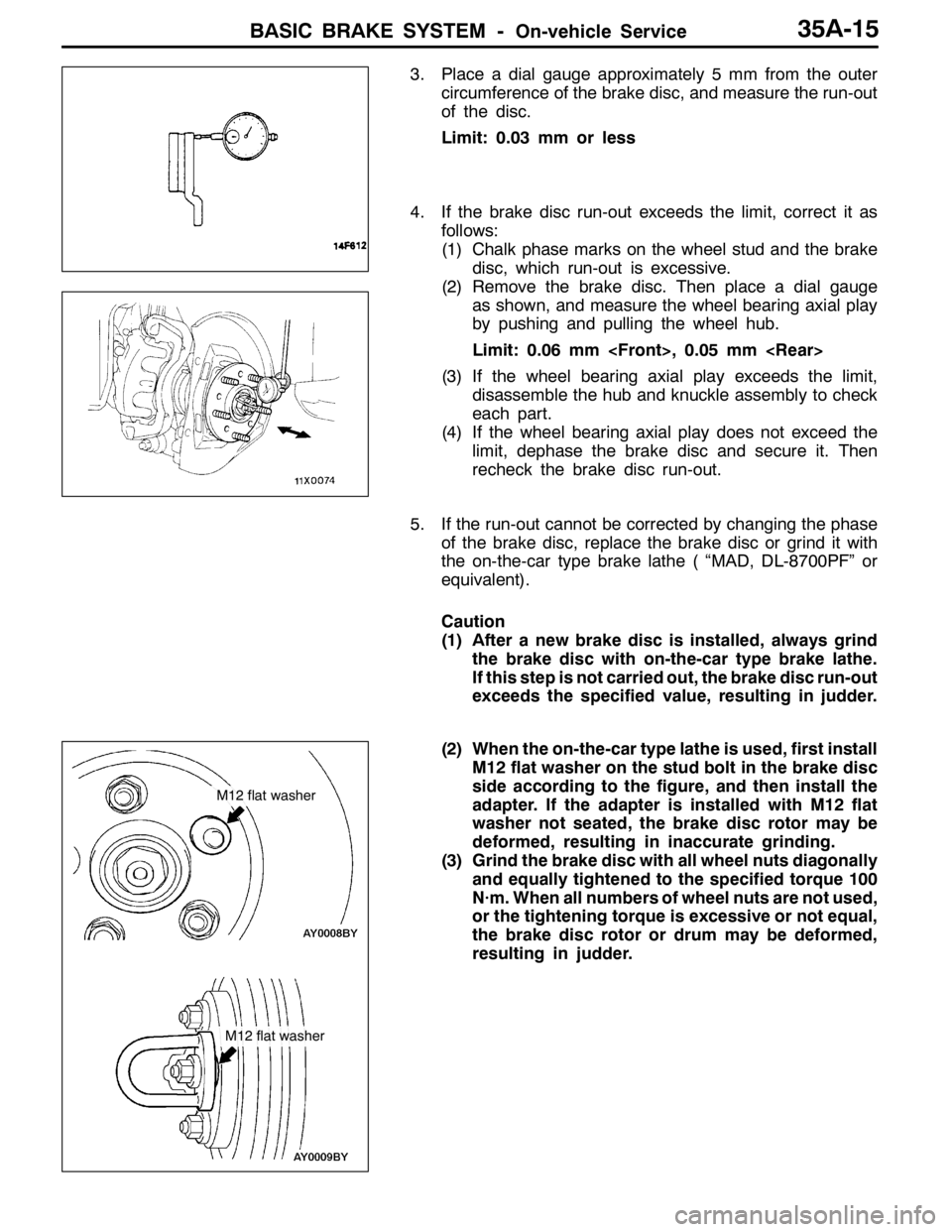
3. Place a dial gauge approximately 5 mm from the outer
circumference of the brake disc, and measure the run-out
of the disc.
Limit: 0.03 mm or less
4. If the brake disc run-out exceeds the limit, correct it as
follows:
(1) Chalk phase marks on the wheel stud and the brake
disc, which run-out is excessive.
(2) Remove the brake disc. Then place a dial gauge
as shown, and measure the wheel bearing axial play
by pushing and pulling the wheel hub.
Limit: 0.06 mm
(3) If the wheel bearing axial play exceeds the limit,
disassemble the hub and knuckle assembly to check
each part.
(4) If the wheel bearing axial play does not exceed the
limit, dephase the brake disc and secure it. Then
recheck the brake disc run-out.
5. If the run-out cannot be corrected by changing the phase
of the brake disc, replace the brake disc or grind it with
the on-the-car type brake lathe ( “MAD, DL-8700PF” or
equivalent).
Caution
(1) After a new brake disc is installed, always grind
the brake disc with on-the-car type brake lathe.
If this step is not carried out, the brake disc run-out
exceeds the specified value, resulting in judder.
(2) When the on-the-car type lathe is used, first install
M12 flat washer on the stud bolt in the brake disc
side according to the figure, and then install the
adapter. If the adapter is installed with M12 flat
washer not seated, the brake disc rotor may be
deformed, resulting in inaccurate grinding.
(3) Grind the brake disc with all wheel nuts diagonally
and equally tightened to the specified torque 100
N·m. When all numbers of wheel nuts are not used,
or the tightening torque is excessive or not equal,
the brake disc rotor or drum may be deformed,
resulting in judder.
M12 flat washer
M12 flat washer
Page 1063 of 1449

BASIC BRAKE SYSTEM -Disc Brake35A-21
INSTALLATION SERVICE POINT
"AADISC BRAKE ASSEMBLY INSTALLATION
1. In order to measure the brake drag force after pad
installation, measure the rotary-sliding resistance of the
hub by the following procedure with the pads removed.
(1) Withdraw the drive shaft. (Refer to GROUP 26, 27.)
(2) Attach the special tool to the front hub assembly as
shown in the illustration, and tighten it to the specified
torque.
Tightening torque:
245±29 N·m
(3) Use a spring balance to measure the rotary-sliding
resistance of the hub in the forward direction.
2. Install the caliper support to the knuckle, and then
assemble the pad and the clip to the caliper support.
Caution
Do not contaminate the friction surfaces of the pads
and brake discs by any oil or grease.
3. Clean the piston and insert it into the cylinder with the
special tool.
4. Be careful that the piston boot does not become caught,
when lowering the caliper assembly and install the guide
pin to the caliper.
5. Start the engine, and then depress the brake pedal two
or three times strongly. Then stop the engine.
6. Turn the brake disc forward 10 times.
7. Use a spring balance to measure the rotary-sliding
resistance of the hub in the forward direction.
8. Calculate the drag force of the disc brake [difference
between the values measured at steps 1 and 7].
Standard value:
51 N or less
9. If that drag force exceeds the standard value, disassemble
the piston assembly. Then check the piston for
contamination or rust, and confirm if the piston or the
piston seal is deteriorated, and if the slide pins slide
smoothly.
1. Find the drag force of the disc brake. (Refer to P.35A-13.)
Standard value: 69 N or less
2. If that drag force exceeds the standard value, disassemble
the piston assembly. Then check the piston for
contamination or rust, and confirm if the piston or the
piston seal is deteriorated.MB990998
Bolt
MB990998Bolt
MB990520
Page 1115 of 1449

37A-1
STEERING
CONTENTS
GENERAL INFORMATION 2..................
SERVICE SPECIFICATIONS 4.................
LUBRICANTS 4..............................
SEALANT 4..................................
SPECIAL TOOLS 4...........................
ON-VEHICLE SERVICE 7.....................
Steering Wheel Free Play Check 7..............
Steering Angle Check 7........................
Tie Rod End Ball Joint Turning Torque Check 7..
Stationary Steering Effort Check 8...............
Checking Steering Wheel Return to Centre 8.....
Drive Belt Tension Check 8.....................Power Steering Fluid Level Check 9.............
Power Steering Fluid Replacement 9.............
Power Steering System Bleeding 9..............
Oil Pump Pressure Test 10.....................
Power Steering Oil Pressure Switch Check 11....
Ball Joint Dust Cover Check 11.................
STEERING WHEEL* 12.......................
STEERING SHAFT* 14.......................
POWER STEERING GEAR BOX AND
LINKAGE* 16................................
POWER STEERING OIL PUMP 29............
POWER STEERING OIL HOSES 30...........
WARNINGS REGARDING SERVICING OF SUPPLEMENTAL RESTRAINT SYSTEM (SRS) EQUIPPED VEHICLES
WARNING!
(1) Improper service or maintenance of any component of the SRS, or any SRS-related component, can lead to personal
injury or death to service personnel (from inadvertent firing of the air bag) or to the driver and passenger (from rendering
the SRS inoperative).
(2) Service or maintenance of any SRS component or SRS-related component must be performed only at an authorized
MITSUBISHI dealer.
(3) MITSUBISHI dealer personnel must thoroughly review this manual, and especially its GROUP 52B - Supplemental
Restraint System (SRS) before beginning any service or maintenance of any component of the SRS or any SRS-related
component.
NOTE
The SRS includes the following components: SRS-ECU, SRS warning lamp, air bag module, clock spring and interconnecting
wiring. Other SRS-related components (that may have to be removed/installed in connection with SRS service or maintenance) are
indicated in the table of contents by an asterisk (*).
Page 1118 of 1449

STEERING -Service Specifications/Lubricants/Sealant/Special Tools37A-4
SERVICE SPECIFICATIONS
ItemsStandard valueLimit
Steering wheel free play mmwhen engine running-30 or less
with engine stopped0-10-
Steering angleInner wheel31_45’±1_30’-
Outer wheel
Ball joint turning torque N·m1.0 - 3.0-
Stationary steering effort NSteering effort32 or less-
Fluctuation allowance6.0 or less-
Oil pump relief pressure MPa8.4 - 9.0-
Pressure under no-load conditions MPa0.2 - 0.8-
Steering gear retention hydraulic pressure MPa8.4 - 9.0-
Oil pressure switch operating
pressureMPa
OFF→ON1.8 - 2.4-
pressure MPaON→OFF1.0 - 2.4-
Total pinion torque N·mTotal rotation torque0.8 - 1.8-
Torque variation0.49 or less-
Tie rod joint swing resistance N (Tie rod joint swing torque N·m)8 - 27 (1.5 - 4.9)-
Opening dimension of special tool (MB991561) mm2.9-
Band crimped width mm2.4 - 2.8-
LUBRICANTS
ItemsSpecified lubricantQuantity
Power steering fluidAutomatic transmission fluid DEXRONIIApprox. 1.0 L
Tie rod bellowsSilicone greaseAs required
Pinion and valve assemblyRepair kit greaseAs required
Rack assembly
SEALANT
ItemsSpecified sealantRemarks
Toe boad (steering shaft cover
mounting bolt hole)3M ATD Part No. 8513 or equivalentDrying sealant
Rack support cover end plug3M ATD Part No. 8661, 8663 or equivalentSemi-drying sealant
SPECIAL TOOLS
ToolNumberNameUse
MB990635,
MB991113 or
MB991406Steering linkage
pullerDisconnection of tie rod end
Page 1119 of 1449

STEERING -Special Tools37A-5
Tool UseName Number
MB991006Preload socketMeasurement of the total pinion torque
MB990326Preload socketMeasurement of the ball joint turning torque
MB990993Power steering oil
pressure gauge
adapter (pump
side)Measurement of oil pressure
MB990994Power steering oil
pressure gauge
adapter (hose
side)
MB990662Oil pressure gauge
assemblyMeasurement of oil pressure
MB991204Torque wrench
socketDAdjustment of rack support
DRemoval of rack support cover
MB990784Ornament removerRemoval of steering wheel cover
MB990803Steering wheel
pullerDisconnection of the steering wheel
MB991199Oil seal and
bearing installerDPress fitting of rack housing bearing
DTo press in the oil seal for the rack