steering MITSUBISHI LANCER EVOLUTION 2007 Service Repair Manual
[x] Cancel search | Manufacturer: MITSUBISHI, Model Year: 2007, Model line: LANCER EVOLUTION, Model: MITSUBISHI LANCER EVOLUTION 2007Pages: 1449, PDF Size: 56.82 MB
Page 1309 of 1449
SRS -AirBagModuleandSeatBeltPre-tensioner
Disposal Procedures52B-65
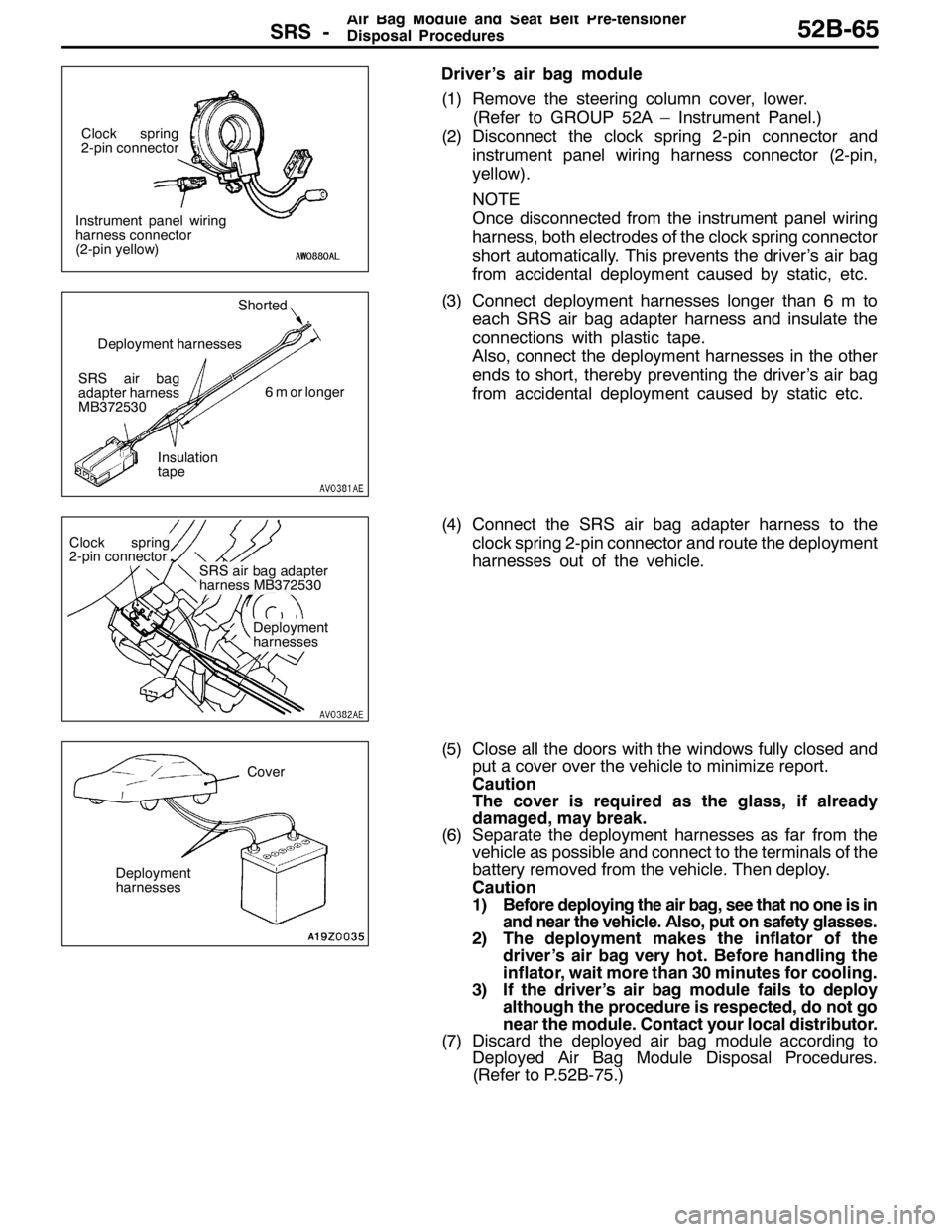
Driver’s air bag module
(1) Remove the steering column cover, lower.
(Refer to GROUP 52A – Instrument Panel.)
(2) Disconnect the clock spring 2-pin connector and
instrument panel wiring harness connector (2-pin,
yellow).
NOTE
Once disconnected from the instrument panel wiring
harness, both electrodes of the clock spring connector
short automatically. This prevents the driver’s air bag
from accidental deployment caused by static, etc.
(3) Connect deployment harnesses longer than 6 m to
each SRS air bag adapter harness and insulate the
connections with plastic tape.
Also, connect the deployment harnesses in the other
ends to short, thereby preventing the driver’s air bag
from accidental deployment caused by static etc.
(4) Connect the SRS air bag adapter harness to the
clock spring 2-pin connector and route the deployment
harnesses out of the vehicle.
(5) Close all the doors with the windows fully closed and
put a cover over the vehicle to minimize report.
Caution
The cover is required as the glass, if already
damaged, may break.
(6) Separate the deployment harnesses as far from the
vehicle as possible and connect to the terminals of the
battery removed from the vehicle. Then deploy.
Caution
1) Before deploying the air bag, see that no one is in
and near the vehicle. Also, put on safety glasses.
2) The deployment makes the inflator of the
driver’s air bag very hot. Before handling the
inflator, wait more than 30 minutes for cooling.
3) If the driver’s air bag module fails to deploy
although the procedure is respected, do not go
near the module. Contact your local distributor.
(7) Discard the deployed air bag module according to
Deployed Air Bag Module Disposal Procedures.
(Refer to P.52B-75.)
Instrument panel wiring
harness connector
(2-pin yellow)Clock spring
2-pin connector
SRS air bag
adapter harness
MB372530Shorted
6 m or longer
Insulation
tape Deployment harnesses
Clock spring
2-pin connector
SRS air bag adapter
harness MB372530
Deployment
harnesses
Cover
Deployment
harnesses
Page 1312 of 1449

SRS -AirBagModuleandSeatBeltPre-tensioner
Disposal Procedures52B-68
(5) Close all the doors with the windows fully closed and
put a cover over the vehicle to minimize report.
Caution
The cover is required as the glass, if already
damaged, may break.
(6) Separate the deployment harnesses as far from the
vehicle as possible and connect to the terminals of
the battery removed from the vehicle. Then deploy.
Caution
1) Before operating the seat belt pre-tensioner,
see that no one is in or near the vehicle.
2) The operation makes the insulator of the seat
belt pre-tensioner very hot. Before handling
the inflator, wait more than 30 minutes for
cooling.
3) If the seat belt pre-tensioner fails to operate
although the procedure is respected, do not go
near the seat belt pre-tensioner. Contact your
local distributor.
(7) Discard the operated seat belt pre-tensioner accord-
ing to Disposal Procedure. (Refer to P.52B-75.)
DEPLOYMENT OUTSIDE THE VEHICLE
Caution
1. Carry out air bag deployment or seat belt pre-tensioner
operation on large flat place at least 6 m away from any
object or person.
2. Avoid a strong wind weather when carrying out
deployment or operation outside the vehicle. Ignite the
air bag at a place upwind from the air bag module and
the seat belt pre-tensioner even in a breeze weather.
1. Disconnect the negative ( - ) and positive (+) battery cables
from the battery terminals, and then remove the battery
from the vehicle.
Caution
Wait at least 60 seconds before any further job after the
disconnection of the battery cables. (Refer to P.52B-3.)
2. Carry out deployment of the air bag module and operation
of the seat belt pre-tensioner according to the following
procedure.
Driver’s side air bag module
(1) Remove the driver’s air bag module from the vehicle.
(Refer to P.52B-52.)
Caution
Once disconnected, both electrodes of the driver’s air
bag module connector short automatically to prevent
accidental deployment caused by static etc. Still, in
consideration of the accidental deployment, store the
air bag module on flat place with deployment surface
facing up. Also, do not put anything on it.
Cover
Deployment
harnesses
Page 1314 of 1449

SRS -AirBagModuleandSeatBeltPre-tensioner
Disposal Procedures52B-70
(7) Separate the deployment harnesses as far from the
driver’s side air bag module as possible and connect
to the terminals of the battery removed from the
vehicle. Then deploy.
Caution
1) Before the deployment, see that no one is near
around the driver’s air bag module.
2) The deployment makes the inflator of the
driver’s air bag very hot. Before handling the
inflator, wait more than 30 minutes for cooling.
3) If the driver’s air bag module fails to deploy
although the procedure is respected, do not go
near the module. Contact your local
distributor.
(8) Discard the deployed air bag module as specified
in Deployed Air Bag Module Disposal Procedures.
(Refer to P.52B-75.)
Driver’s side air bag module
(1) Remove the steering wheel - air bag module assembly
from the vehicle. (Refer to P.52B-52.)
Caution
Once disconnected, both electrodes of the driver’s
air bag module connector short automatically to
prevent accidental deployment caused by static
etc. Still, in consideration of the accidental
deployment, store the air bag module on flat place
with deployment surface facing up. Also, do not
put anything on it.
(2) Prepare two deployment harnesses longer than 6 m
for deployment and connect the terminals in one end
to short-circuit. This is to prevent accidental
deployment caused by static etc.
(3) Touch the vehicle’s body with bare hands to discharge
static in you.
Caution
Never fail to do Step (3) in order to prevent
accidental deployment caused by static.
Deployment harnesses
Shorted Deployment harnesses
6 m or longer
Page 1315 of 1449

SRS -AirBagModuleandSeatBeltPre-tensioner
Disposal Procedures52B-71
(4) Release the secured connector of the steering
wheel - driver’s air bag module assembly to cut off
the connector from the harness with a nipper and
etc. Connect deployment harnesses to each of two
separated harnesses and cover the area with
insulation tape.
(5) Use a rope to tie the steering wheel - driver’s air bag
module assembly to secure old tyres with wheels.
(6) Route the deployment harness connected to driver’s
air bag module beneath old tyres with wheels. Then,
secure the steering wheel - driver’s air bag module
assembly with the deployment surface facing up.
(7) Place three old tyres without wheels on the tyre
secured with the driver’s air bag module.
(8) Separate the deployment harnesses as far from the
driver’s side air bag module as possible and connect
to the terminals of the battery removed from the
vehicle. Then deploy.
Caution
1) Before the deployment, see that no one is near
around the driver’s air bag module.
2) The deployment makes the inflator of the
driver’s air bag very hot. Before handling the
inflator, wait more than 30 minutes for cooling.
3) If the driver’s air bag module fails to deploy
although the procedure is respected, do not go
near the module. Contact your local
distributor.
(9) Discard the deployed air bag module as specified
in Deployed Air Bag Module Disposal Procedures.
(Refer to P.52B-75.)Deployment
harness
Short-circuited area Steering wheel - driver’s air bag
module assembly
Insulation tape
Steering wheel - driver’s air bag module assembly
Deployment
harness
Tyres without wheels
Deployment harnesses
Deployment harnesses
Page 1331 of 1449

CHASSIS ELECTRICAL -Ignition Switch and Immobilizer System54A-11
IGNITION SWITCH
REMOVAL AND INSTALLATION
7
6
15 32
4
8
Removal steps
1. Lower column cover (Refer to GROUP
52A - Instrument Panel.)
2. Upper column cover (Refer to GROUP
52A - Instrument Panel.)
3. Steering Wheel (Refer to GROUP
37A.)
4. Clock spring column switch assembly
(Refer to GROUP 37A - Steering
Shaft.)AA"5. Steering lock cylinder
6. Ignition switch
7. Key reminder switch
8. Immobilizer-ECU
REMOVAL SERVICE POINT
AA"STEERING LOCK CYLINDER REMOVAL
1. Insert key into steering lock cylinder to turn ignition key
to “ACC” position.
2. Insert locking pin with small plus screwdriver, etc., and
remove steering lock cylinder.
Locking pin
Page 1359 of 1449
CHASSIS ELECTRICAL-Column Switch54A-39
INSPECTION
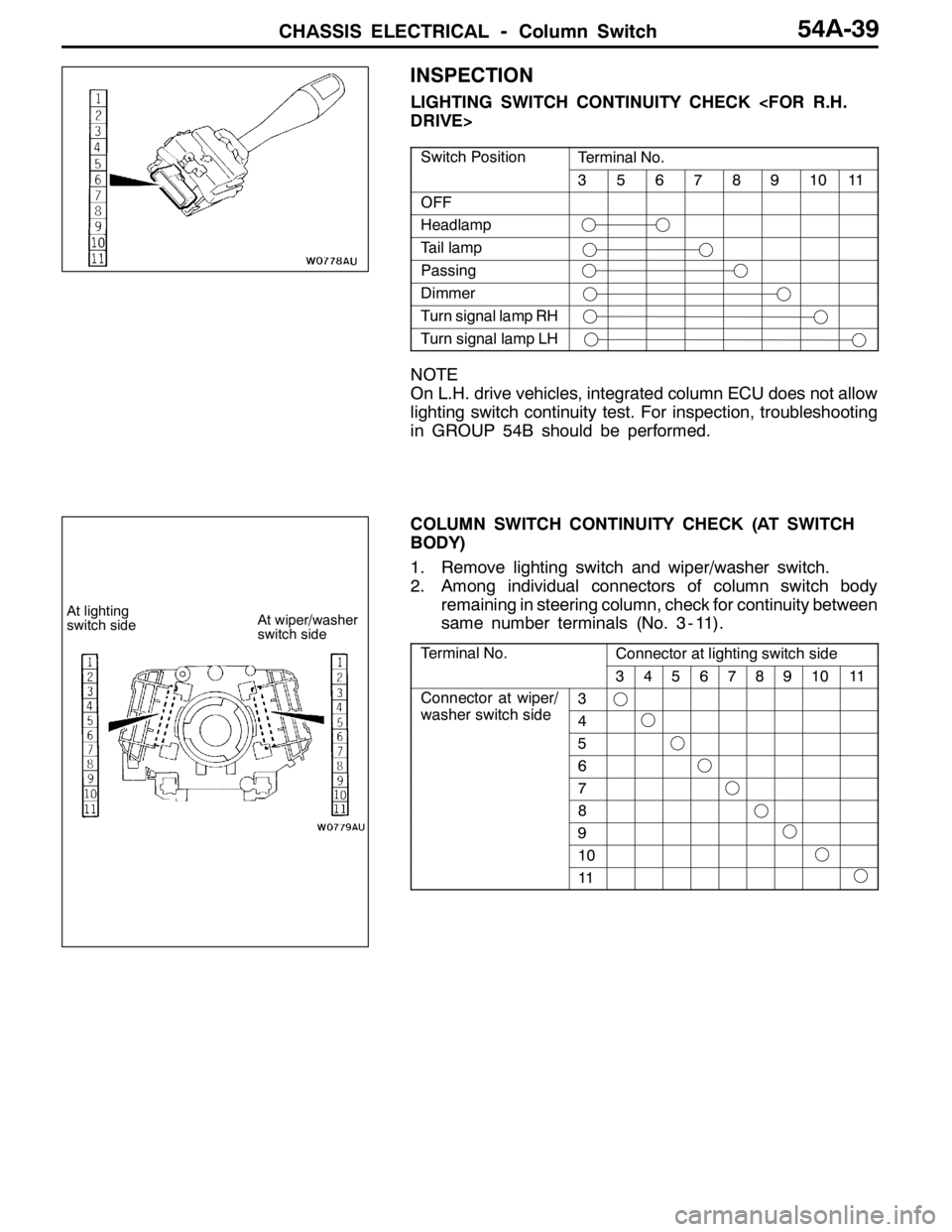
LIGHTING SWITCH CONTINUITY CHECK
Switch PositionTerminal No.
3567891011
OFF
Headlamp
Tail lamp
Passing
Dimmer
Turn signal lamp RH
Turn signal lamp LH
NOTE
On L.H. drive vehicles, integrated column ECU does not allow
lighting switch continuity test. For inspection, troubleshooting
in GROUP 54B should be performed.
COLUMN SWITCH CONTINUITY CHECK (AT SWITCH
BODY)
1. Remove lighting switch and wiper/washer switch.
2. Among individual connectors of column switch body
remaining in steering column, check for continuity between
same number terminals (No. 3 - 11).
Terminal No.Connector at lighting switch side
34567891011
Connector at wiper/
hit hid
3p
washer switch side4
5
6
7
8
9
10
11
At lighting
switch sideAt wiper/washer
switch side
Page 1423 of 1449

HEATER, AIR CONDITIONER AND VENTILATION–On-vehicle Service55-21
REFRIGERANT LEAK REPAIR
LOST CHARGE
If the system has lost all charge due to a leak:
1. Evacuate the system. (See procedure.)
2. Charge the system with approximately one
pound of refrigerant.
3. Check for leaks.
4. Discharge the system.
5. Repair leaks.
6. Replace receiver drier.
Caution
Replacement filter-drier units must be
sealed while in storage. The drier used in
these units will saturate water quickly upon
exposure to the atmosphere. When
installing a drier, have all tools and supplies
ready for quick reassembly to avoid keeping
the system open any longer than necessary.
7. Evacuate and charge system.
LOW CHARGE
If the system has not lost all of its refrigerant charge;
locate and repair all leaks. If it is necessary to
increase the system pressure to find the leak
(because of an especially low charge) add
refrigerant. If it is possible to repair the leak without
discharging the refrigerant system, use the
procedure for correcting low refrigerant level.HANDLING TUBING AND FITTINGS
Kinks in the refrigerant tubing or sharp bends in
the refrigerant hose lines will greatly reduce the
capacity of the entire system. High pressures are
produced in the system when it is operating.
Extreme care must be exercised to make sure that
all connections are pressure tight. Dirt and moisture
can enter the system when it is opened for repair
or replacement of lines or components. The
following precautions must be observed. The
system must be completely discharged before
opening any fitting of connection in the refrigeration
system. Open fittings with caution even after the
system has been discharged. If any pressure is
noticed as a fitting is loosened, allow trapped
pressure to bleed off very slowly.
Never attempt to rebend formed lines to fit. Use
the correct line for the installation you are servicing.
A good rule for the flexible hose lines is keep the
radius of all bends at least 10 times the diameter
of the hose.
Sharper bends will reduce the flow of refrigerant.
The flexible hose lines should be routed so that
they are at least 80 mm from the exhaust manifold.
It is good practice to inspect all flexible hose lines
at least once a year to make sure they are in good
condition and properly routed.
Unified plumbing connections with O-rings, these
O-rings are not reusable.
COMPRESSOR NOISE
You must first know the conditions when the noise
occurs. These conditions are: weather, vehicle
speed, in gear or neutral, engine temperature or
any other special conditions.
Noises that develop during A/C operation can often
be misleading. For example: what sounds like a
failed front bearing or connecting rod, may be
caused by loose bolts, nuts, mounting brackets,
or a loose clutch assembly. Verify accessory drive
belt tension (power steering or alternator).
Improper accessory drive belt tension can cause
a misleading noise when the compressor is
engaged and little or no noise when the compressor
is disengaged.
Drive belts are speed-sensitive. That is, at different
engine speeds, and depending upon belt tension,
belts can develop unusual noises that are often
mistaken for mechanical problems within the
compressor.ADJUSTMENT
1. Select a quiet area for testing. Duplicate
conditions as much as possible. Switch
compressor on and off several times to clearly
identify compressor noise. To duplicate high
ambient conditions (high head pressure),
restrict air flow through condenser. Install
manifold gauge set to make sure discharge
pressure doesn’t exceed 2,070 kPa.
2. Tighten all compressor mounting bolts, clutch
mounting bolt, and compressor drive belt.
Check to assure clutch coil is tight (no rotation
or wobble).
3. Check refrigerant hoses for rubbing or
interference that can cause unusual noises.
4. Check refrigerant charge. (See “Charging
System”.)
5. Recheck compressor noise as in Step 1.
6. If noise still exists, loosen compressor mounting
bolts and retorque. Repeat Step 1.
7. If noise continues, replace compressor and
repeat Step 1.
Page 1430 of 1449
HEATER, AIR CONDITIONER AND VENTILATION-Heater Unit and Blower Assembly55-28
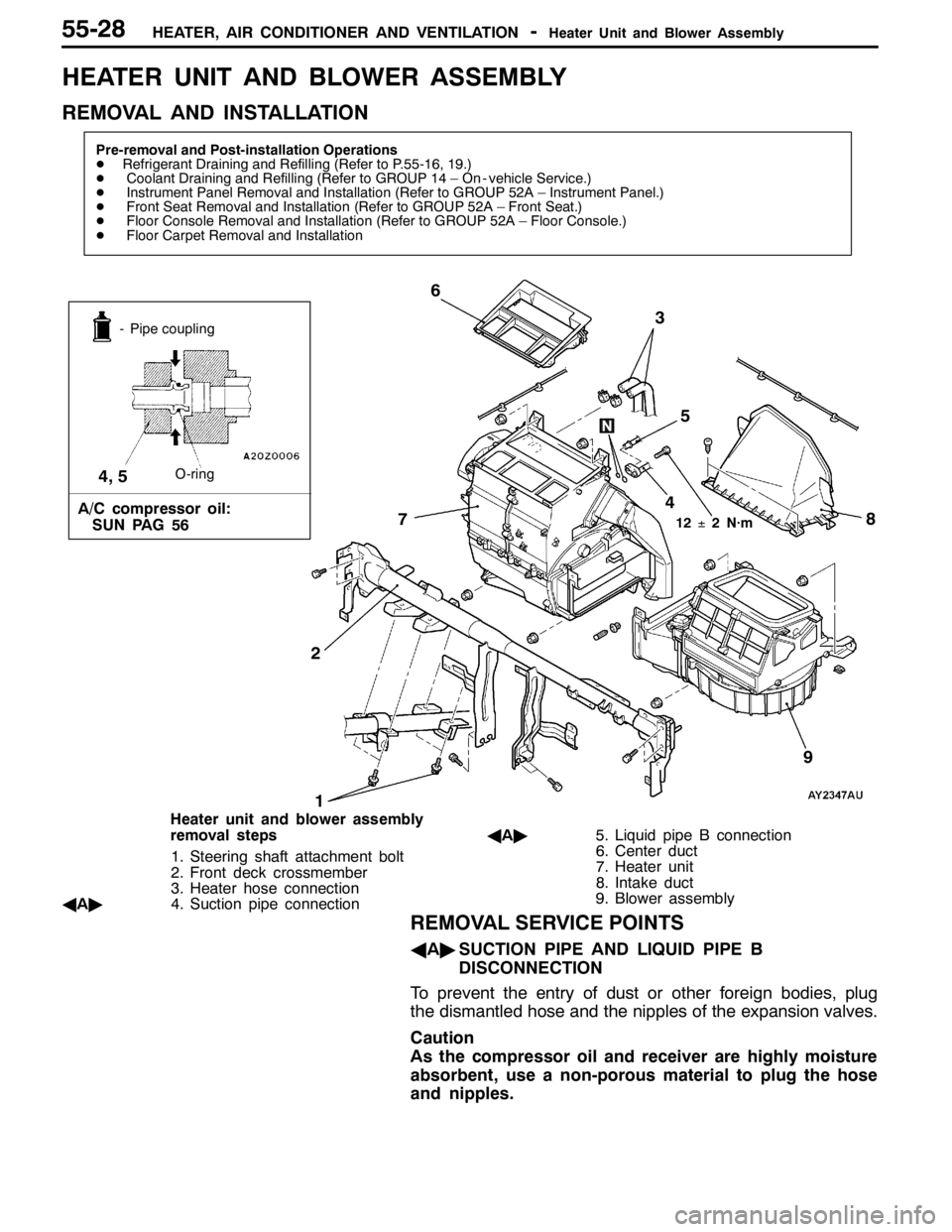
HEATER UNIT AND BLOWER ASSEMBLY
REMOVAL AND INSTALLATION
Pre-removal and Post-installation Operations
DRefrigerant Draining and Refilling (Refer to P.55-16, 19.)
DCoolant Draining and Refilling (Refer to GROUP 14 – On - vehicle Service.)
DInstrument Panel Removal and Installation (Refer to GROUP 52A – Instrument Panel.)
DFront Seat Removal and Installation (Refer to GROUP 52A – Front Seat.)
DFloor Console Removal and Installation (Refer to GROUP 52A – Floor Console.)
DFloor Carpet Removal and Installation
13
5 6
2
12±2 N·m
- Pipe coupling
O-ring
A/C compressor oil:
SUN PAG 56
4, 5
9
7
4
8
Heater unit and blower assembly
removal steps
1. Steering shaft attachment bolt
2. Front deck crossmember
3. Heater hose connection
AA"4. Suction pipe connectionAA"5. Liquid pipe B connection
6. Center duct
7. Heater unit
8. Intake duct
9. Blower assembly
REMOVAL SERVICE POINTS
AA"SUCTION PIPE AND LIQUID PIPE B
DISCONNECTION
To prevent the entry of dust or other foreign bodies, plug
the dismantled hose and the nipples of the expansion valves.
Caution
As the compressor oil and receiver are highly moisture
absorbent, use a non-porous material to plug the hose
and nipples.