oil MITSUBISHI LANCER EVOLUTION 2007 Service Repair Manual
[x] Cancel search | Manufacturer: MITSUBISHI, Model Year: 2007, Model line: LANCER EVOLUTION, Model: MITSUBISHI LANCER EVOLUTION 2007Pages: 1449, PDF Size: 56.82 MB
Page 734 of 1449
ENGINE ELECTRICAL -Charging System16-2
CHARGING SYSTEM
GENERAL INFORMATION
The charging system uses the alternator output
to keep the battery charged at a constant level
under various electrical loads.
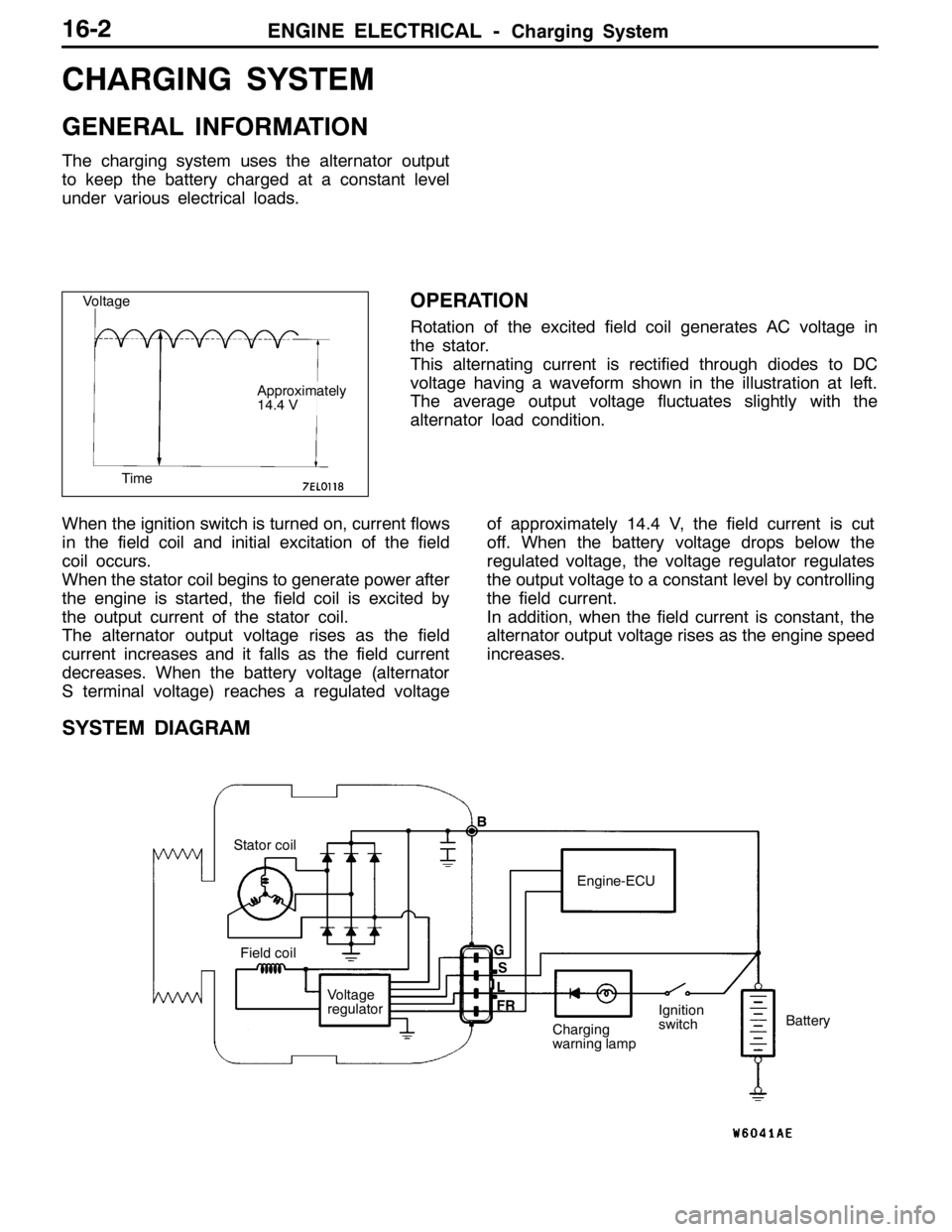
OPERATION
Rotation of the excited field coil generates AC voltage in
the stator.
This alternating current is rectified through diodes to DC
voltage having a waveform shown in the illustration at left.
The average output voltage fluctuates slightly with the
alternator load condition.
When the ignition switch is turned on, current flows
in the field coil and initial excitation of the field
coil occurs.
When the stator coil begins to generate power after
the engine is started, the field coil is excited by
the output current of the stator coil.
The alternator output voltage rises as the field
current increases and it falls as the field current
decreases. When the battery voltage (alternator
S terminal voltage) reaches a regulated voltageof approximately 14.4 V, the field current is cut
off. When the battery voltage drops below the
regulated voltage, the voltage regulator regulates
the output voltage to a constant level by controlling
the field current.
In addition, when the field current is constant, the
alternator output voltage rises as the engine speed
increases.
SYSTEM DIAGRAM
Stator coil
Field coil
Voltage
regulatorEngine-ECU
Charging
warning lampIgnition
switchBattery B
G
L
FRS
Voltage
Time
Approximately
14.4 V
Page 735 of 1449

ENGINE ELECTRICAL -Charging System16-3
ALTERNATOR SPECIFICATIONS
ItemsSpecifications
TypeBattery voltage sensing
Rated output V/A12/90
Voltage regulatorElectronic built-in type
SERVICE SPECIFICATIONS
ItemsStandard valueLimit
Alternator output line voltage drop (at 30 A) V-max. 0.3
Regulated voltage ambient
tempatvoltageregulatorV
-20_C14.2 - 15.4-
temp. atvoltage regulatorV
20_C13.9 - 14.9-
60_C13.4 - 14.6-
80_C13.1 - 14.5-
Output current-70 % of normal output current
Rotor coil resistanceΩApprox. 3 - 5-
Protrusion length of brush mm-2
SPECIAL TOOL
ToolNumberNameUse
MB991519Alternator test
harnessChecking the alternator (S terminal voltage)
Page 742 of 1449

ENGINE ELECTRICAL -Charging System16-10
EXAMPLES OF ABNORMAL WAVEFORMS
NOTE
1. The size of the waveform patterns differs largely, depending on the adjustment of the variable knob
on the analyzer.
2. Identification of abnormal waveforms is easier when there is a large output current (regulator is not
operating). (Waveforms can be observed when the headlamps are illuminated.)
3. Check the conditions of the charging warning lamp (illuminated/not illuminated). Also, check the charging
system totally.
Abnormal waveformsProblem
causeAbnormal waveformsProblem
cause
Example 1Open diodeExample 4Short in
stator coil
Example 2Short in diodeExample 5Open
supplementa-
ry diode
Example 3Broken wire
in stator coil
At this time, the charging warning lamp
is illuminated.
ALTERNATOR
REMOVAL AND INSTALLATION
Caution
If the vehicle is equipped with the Brembo disc brake, during maintenance, take care not to contact
the parts or tools to the caliper because the paint of caliper will be scratched.
Pre-removal and Post-installation Operation
DUnder Cover Removal and Installation (Refer to GROUP 51 - Front Bumper.)
DDrive Belt Tension Check (Refer to GROUP 11A - On-vehicle Service.)
DStrut Tower Bar Removal and Installation (Refer to GROUP 42.)
DCrossmember Bar Removal and Installation (Refer to GROUP 32 - Engine Roll Stopper, Centermember.)
DFront Exhaust Pipe Assembly Removal and Installation (Refer to GROUP 15.)
Page 743 of 1449
ENGINE ELECTRICAL -Charging System16-11
1
234
5
8.8±1.0 N·m 22±4 N·m
23±3 N·m11±1 N·m
13±1 N·m
8
(Engine oil)
679
10
20±2 N·m 36±6 N·m
1211
44±10 N·m
14±3 N·m
13
1415 18
1617
9.0±1.0 N·m
9.0±1.0 N·m5.0±1.0 N·m
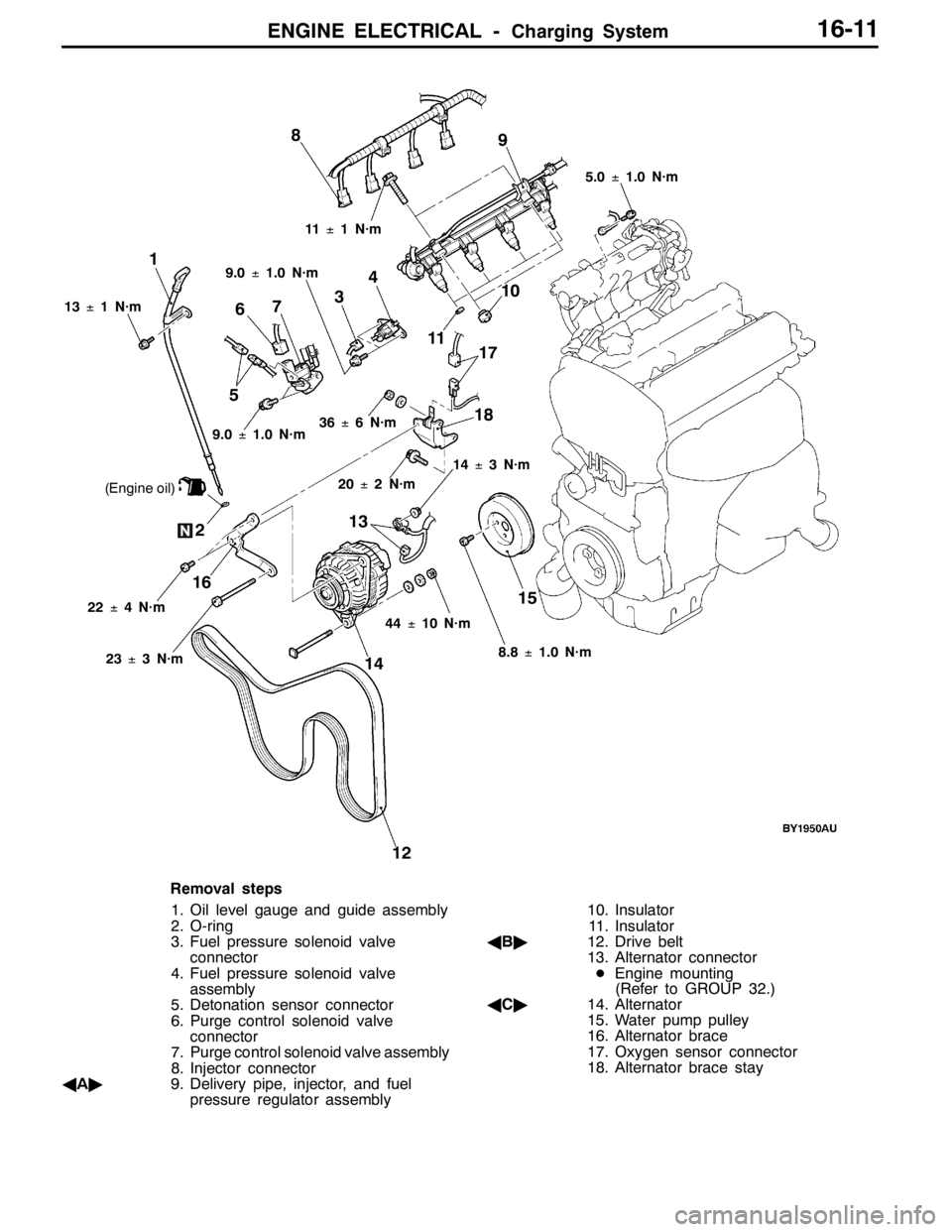
Removal steps
1. Oil level gauge and guide assembly
2. O-ring
3. Fuel pressure solenoid valve
connector
4. Fuel pressure solenoid valve
assembly
5. Detonation sensor connector
6. Purge control solenoid valve
connector
7. Purge control solenoid valve assembly
8. Injector connector
AA"9. Delivery pipe, injector, and fuel
pressure regulator assembly10. Insulator
11. Insulator
AB"12. Drive belt
13. Alternator connector
DEngine mounting
(Refer to GROUP 32.)
AC"14. Alternator
15. Water pump pulley
16. Alternator brace
17. Oxygen sensor connector
18. Alternator brace stay
Page 746 of 1449

ENGINE ELECTRICAL -Charging System16-14
DISASSEMBLY SERVICE POINTS
AA"FRONT BRACKET ASSEMBLY REMOVAL
Insert a flat tip screwdrivers or the like in the clearance between
the front bracket assembly and stator core, to pry open and
separate the stator and front bracket.
Caution
Do not insert a screwdriver too far, or the stator coil gets
damaged.
AB"ALTERNATOR PULLEY REMOVAL
Face pulley side upward, fix the rotor with a work bench
and remove the pulley.
Caution
Use care not to damage the rotor.
AC"STATOR/REGULATOR ASSEMBLY REMOVAL
1. Unsolder the stator with a soldering iron (180 to 250
W). Complete this work within four seconds not to transfer
heat to the diode.
2. When removing rectifier from the regulator assembly,
remove the soldered sections to rectifier.
Caution
(1) Use care to make sure that the heat of the soldering
iron is not transmitted to the diodes for a long period.
(2) Use care that no undue force is exerted to the
lead wires of the diodes.
REASSEMBLY SERVICE POINTS
"AAREGULATOR ASSEMBLY INSTALLATION
After installing the regulator assembly, insert a wire into the
hole provided on the rear bracket while pressing in the brush
to fix the brush.
NOTE
The brush is fixed when a wire is inserted, making rotor
installation easier.
SolderedRectifier
assembly
Soldered
Wire
Rear bracket
BrushWire
Page 747 of 1449

ENGINE ELECTRICAL -Charging System16-15
"BAROTOR INSTALLATION
After installing the rotor, remove the wire used to fix the brush.
INSPECTION
ROTOR CHECK
1. Check the continuity between the rotor coil slip rings,
and replace the rotor if the resistance value is not at
the standard value.
Standard value: 3 - 5Ω
2. Check the continuity between the slip ring and core, and
if there is continuity, replace the rotor.
STATOR CHECK
1. Check the continuity between the coil leads, and if there
is continuity, replace the stator.
2. Check the continuity between the coil and core, and if
there is continuity, replace the stator.
Wire
Page 748 of 1449
ENGINE ELECTRICAL -Charging System16-16
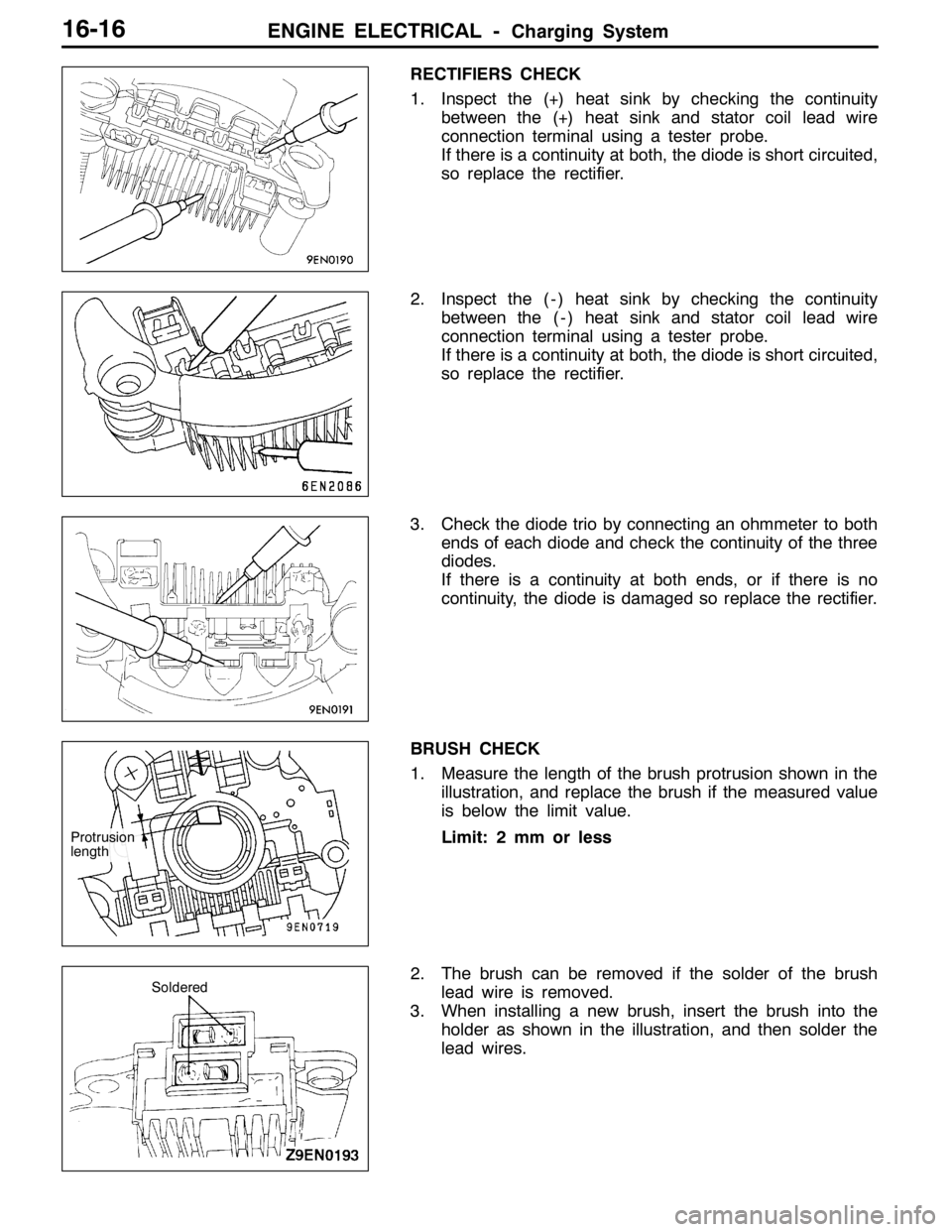
RECTIFIERS CHECK
1. Inspect the (+) heat sink by checking the continuity
between the (+) heat sink and stator coil lead wire
connection terminal using a tester probe.
If there is a continuity at both, the diode is short circuited,
so replace the rectifier.
2. Inspect the ( - ) heat sink by checking the continuity
between the ( - ) heat sink and stator coil lead wire
connection terminal using a tester probe.
If there is a continuity at both, the diode is short circuited,
so replace the rectifier.
3. Check the diode trio by connecting an ohmmeter to both
ends of each diode and check the continuity of the three
diodes.
If there is a continuity at both ends, or if there is no
continuity, the diode is damaged so replace the rectifier.
BRUSH CHECK
1. Measure the length of the brush protrusion shown in the
illustration, and replace the brush if the measured value
is below the limit value.
Limit: 2 mm or less
2. The brush can be removed if the solder of the brush
lead wire is removed.
3. When installing a new brush, insert the brush into the
holder as shown in the illustration, and then solder the
lead wires.
Protrusion
length
Soldered
Page 749 of 1449

ENGINE ELECTRICAL -Starting System16-17
STARTING SYSTEM
GENERAL INFORMATION
If the ignition switch is turned to the “START”
position, current flows in the pull-in and holding
coils provided inside magnetic switch, attracting
the plunger. When the plunger is attracted, the
lever connected to the plunger is actuated to
engage the starter clutch.
On the other hand, attracting the plunger will turn
on the magnetic switch, allowing the B terminaland M terminal to conduct. Thus, current flows to
engage the starter motor.
When the ignition switch is returned to the “ON”
position after starting the engine, the starter clutch
is disengaged from the ring gear.
An overrunning clutch is provided between the
pinion and the armature shaft, to prevent damage
to the starter.
SYSTEM DIAGRAM
Pull-in coilHolding coil
Ignition
switch
BatteryArmature
Brush
YokePlunger
Lever
Over-running
clutch
Pinion shaft
STARTER MOTOR SPECIFICATIONS
ItemsSpecifications
TypeReduction drive with planetary gear
Rated output kW/V1.2/12
No. of pinion teeth8
SERVICE SPECIFICATIONS
ItemsStandard valueLimit
Pinion gap mm0.5 - 2.0-
Commutator outer diameter mm29.428.8
Commutator runout mm0.050.1
Commutator undercut mm0.50.2
Brush length mm-7.0
Page 750 of 1449

ENGINE ELECTRICAL -Starting System16-18
STARTER
REMOVAL AND INSTALLATION
Pre-removal and Post-installation Operation
DUnder Cover Removal and Installation (Refer to GROUP51 - Front Bumper.)
DCrossmember Bar Removal and Installation (Refer to GROUP 32 - Engine Roll Stopper, Centermember.)
DFront Exhaust Pipe Assembly Removal and Installation (Refer to GROUP 15.)
30±3 N·m
1 2
30±3 N·m 13±2 N·m
Removal steps
1. Starter connector
2. Starter
INSPECTION
PINION GAP ADJUSTMENT
1. Disconnect field coil wire from M-terminal of magnetic
switch.
2. Connect a 12 V battery between S-terminal and
M-terminal.
3. Set switch to “ON” position, and pinion will move out.
Caution
This test must be performed quickly (in less than
10 seconds) to prevent coil from burning.
4. Check pinion to stopper clearance (pinion gap) with a
thickness gauge.
Standard value: 0.5 - 2.0 mmS
Switch
Battery
Field coil wire M
B
Stopper
Pinion gap
Pinion
Page 751 of 1449

ENGINE ELECTRICAL -Starting System16-19
5. If pinion gap is out of specification, adjust by adding or
removing gaskets between magnetic switch and front
bracket.
MAGNETIC SWITCH PULL-IN TEST
1. Disconnect field coil wire from M-terminal of magnetic
switch.
2. Connect a 12 V battery between S-terminal and
M-terminal.
Caution
This test must be performed quickly (in less than
10 seconds) to prevent coil from burning.
3. If pinion moves out, then pull-in coil is good. If it doesn’t,
replace magnetic switch.
MAGNETIC SWITCH HOLD-IN TEST
1. Disconnect field coil wire from M-terminal of magnetic
switch.
2. Connect a 12 V battery between S-terminal and body.
Caution
This test must be performed quickly (in less than 10
seconds) to prevent coil from burning.
3. Manually pull out the pinion as far as the pinion stopper
position.
4. If pinion remains out, everything is in order. If pinion moves
in, hold-in circuit is open. Replace magnetic switch.
FREE RUNNING TEST
1. Place starter motor in a vise equipped with soft jaws
and connect a fully-charged 12 V battery to starter motor
as follows:
2. Connect a test ammeter (100-ampere scale) and carbon
pile rheostat in series with battery positive post and starter
motor terminal.
3. Connect a voltmeter (15 V scale) across starter motor.
4. Rotate carbon pile to full-resistance position.
5. Connect battery cable from battery negative post to starter
motor body.
6. Adjust the rheostat until the battery voltage shown by
the voltmeter is 11 V Reduction.
7. Confirm that the maximum amperage is within the
specifications and that the starter motor turns smoothly
and freely.
Current:
max. 90 A
Field coil wire S
M
Battery
B
Field coil wire S
Battery
M S
B
Starter
motorAmmeter
Battery
Voltmeter
Carbon-pile rheostat
A
V