check engine MITSUBISHI LANCER EVOLUTION 2007 Service Repair Manual
[x] Cancel search | Manufacturer: MITSUBISHI, Model Year: 2007, Model line: LANCER EVOLUTION, Model: MITSUBISHI LANCER EVOLUTION 2007Pages: 1449, PDF Size: 56.82 MB
Page 82 of 1449
BODY COLOUR -Body Colour Code/Body Colour ChartsF-2
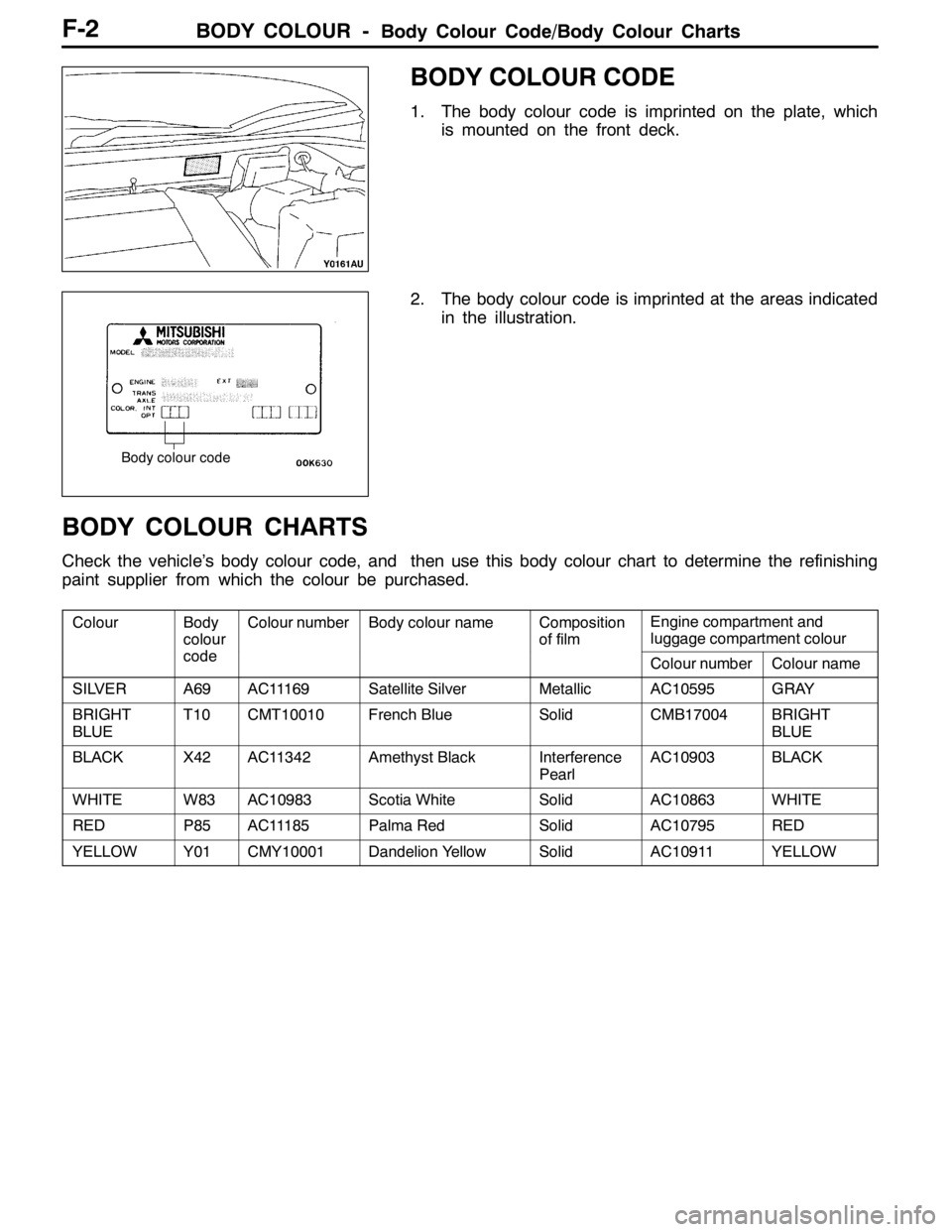
BODY COLOUR CODE
1. The body colour code is imprinted on the plate, which
is mounted on the front deck.
2. The body colour code is imprinted at the areas indicated
in the illustration.
BODY COLOUR CHARTS
Check the vehicle’s body colour code, and then use this body colour chart to determine the refinishing
paint supplier from which the colour be purchased.
ColourBody
colour
d
Colour numberBody colour nameComposition
of filmEngine compartment and
luggage compartment colour
codeColour numberColour name
SILVERA69AC11169Satellite SilverMetallicAC10595GRAY
BRIGHT
BLUET10CMT10010French BlueSolidCMB17004BRIGHT
BLUE
BLACKX42AC11342Amethyst BlackInterference
PearlAC10903BLACK
WHITEW83AC10983Scotia WhiteSolidAC10863WHITE
REDP85AC11185Palma RedSolidAC10795RED
YELLOWY01CMY10001Dandelion YellowSolidAC10911YELLOW
Body colour code
Page 96 of 1449

HOW TO READ THE WIRING DIAGRAMS -Abbreviation SymbolsA-10
ABBREVIATION SYMBOLS
The abbreviation symbols used in wiring diagrams are defined below.
1. Abbreviation symbols used for system name
Abbreviation
symbolsMeaningAbbreviation
symbolsMeaning
A/CAir conditionerEGRExhaust gas recirculation
ABSAnti-skid braking systemETACSElectronic time alarm control system
ACDActive center differentialSRSSupplemental restraint system
AY CActive yaw control
2. Abbreviation symbols used for combination meters
Abbreviation
symbolsMeaningAbbreviation
symbolsMeaning
ABSAnti-skid braking system warning lampSNOWActive center differential mode indicator
lamp
BEAMHigh beam indicator lampSPEEDSpeedmeter
BRAKEBrake warning lampSRSSupplemental restraint system warning
lamp
CHECK
ENGINECheck engine warning lampTARMACActive center differential mode indicator
lamp
CHGCharging warning lampT/GAEngine coolant temperature gauge
DOORDoor-ajar warning lampTACHOTachometer
F/GAFuel gaugeTAILTail, position and licence plate indicator
lamp
FRONT FOGFront fog indicator lamp
lamp
FUELLow fuel warning lampTRIPTripmeter
GRAVELActive center differential mode indicator
lampTURN (LH)Turn signal indicator lamp (LH)
ODOOdometerTURN (RH)Trun signal indicator lamp (RH)
OILOil pressure warning lampWATER
SPRAY
Intercooler water spray indicator lamp
REAR FOGRear fog indicator lamp
SPRAY
3. Abbreviation symbols used for switched and relay
Name of switches and
relaysAbbreviation
symbolsOperation
Blower switchLOBlower operates at low speed
MLBlower operates at medium low speed
MHBlower operates at medium high speed
HIBlower operates at high speed
Page 141 of 1449
SINGLE PART INSTALLATION POSITION -ECU/Sensor
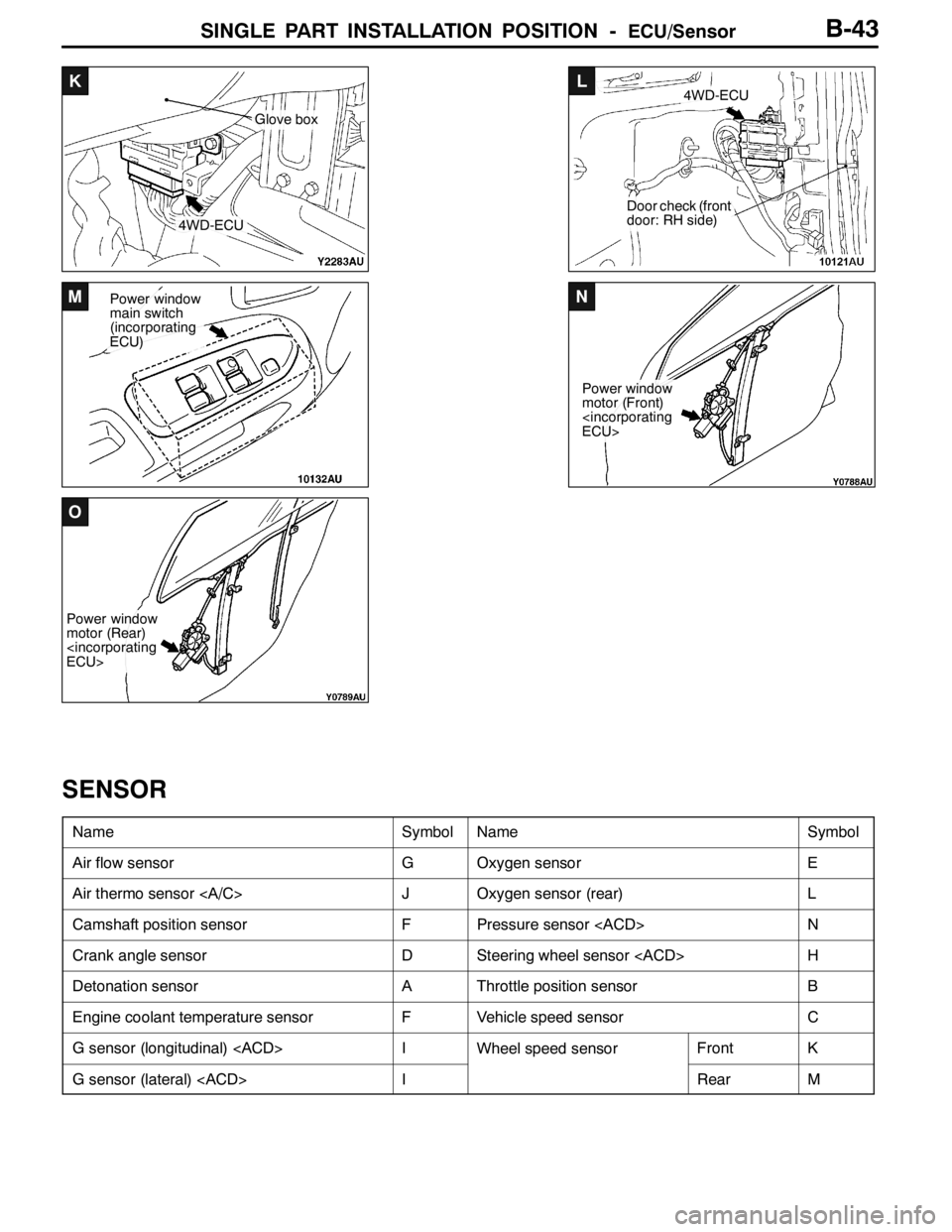
K
4WD-ECU
Glove box
L
Door check (front
door: RH side)
4WD-ECU
MPower window
main switch
(incorporating
ECU)N
Power window
motor (Front)
O
Power window
motor (Rear)
B-43
SENSOR
NameSymbolNameSymbol
Air flow sensorGOxygen sensorE
Air thermo sensor JOxygen sensor (rear)L
Camshaft position sensorFPressure sensor
Crank angle sensorDSteering wheel sensor
Detonation sensorAThrottle position sensorB
Engine coolant temperature sensorFVehicle speed sensorC
G sensor (longitudinal)
G sensor (lateral)
Page 183 of 1449

CIRCUIT DIAGRAMSB-85
CHARGING SYSTEM (See P.B-84.)
OPERATION
When engine is stationary
DWhen the ignition switch is turned to the ON
position, current flows the alternator L terminal
and, at the same time, the charge warning lamp
illuminates.
When engine is started and after engine has
started
DWhen the engine is started, the charge warning
lamp goes out because of the charging voltage
begin applied to the alternator L terminal.
DThe battery voltage being applied to the
alternator S terminal is monitored by the voltage
regulator. Therefore, the amount of electricity
produced by the alternator is controlled by
allowing and cutting off the current flowing to
the field coil.
DThe alternator B terminal supplies power to
each load.TROUBLESHOOTING HINTS
1. Charging indicator lamp does not illuminate
when the ignition switch is turned to ON
position, before the engine starts.
DCheck multi-purpose fuse No.(2).
DCheck the bulb.
2. Charging indicator lamp fails to switch off once
the engine starts.
DCheck voltage regulator of alternator.
3. Discharged or overcharged battery.
DCheck voltage regulator of alternator.
4. Charge warning lamp illuminates dimly.
DCheck combination meter diode (for short).
Page 245 of 1449

CIRCUIT DIAGRAMSB-147
METER AND GAUGE (See P.B-148,152.)
OPERATION
DWhen the ignition switch is at the “ON” position,
the fuel gauge is activated.
DWhen there is much fuel, the unit’s resistance
is small and the current flowing in the circuit
is great, so the gauge’s indicator indicates in
the “Full” area.
DWhen there is little fuel, the unit’s resistance
is high and the current flowing in the circuit
is small, so the gauge’s indicator indicates in
the “Empty” area.
DWhen the ignition switch is at the “ON” position,
the engine coolant temperature gauge is
activated.
DWhen the engine coolant temperature is high,
the unit’s resistance is low and there is a great
flow of current in the circuit, so the gauge’s
indicator indicates in the “H” area.
DWhen the engine coolant temperature is low,
the unit’s resistance is high and there is a small
flow of current in the circuit, so the gauge’s
indicator indicates in the “C” area.TROUBLESHOOTING HINTS
1. Fuel gauge does not operate, or registers
incorrectly.
(1) The fuel gauge indicates “F” when the fuel
gauge unit (sub) connector is disconnected
and the “1” terminal is earthed.
DCheck fuel gauge.
2. Engine coolant temperature gauge does not
operate, or registers incorrectly.
(1) When the engine coolant temperature
gauge is earthed with its connector
unplugged, it registers “H”.
DCheck engine coolant temperature
gauge unit.
Page 253 of 1449

CIRCUIT DIAGRAMSB-155
FUEL WARNING LAMP (See P.B-156.)
OIL PRESSURE WARNING LAMP (See P.B-157.)
BRAKE WARNING LAMP (See P.B-157.)
OPERATION
DWhen the ignition switch is at the “ON” position,
the fuel gauge unit resistance is small when
the fuel level is high, and the fuel gauge unit
resistance is large when the fuel level is low.
When this resistance rises above a specified
value, the fuel warning lamp illuminates to notify
the driver that the fuel level is low.
DWhen the lubrication system fails after engine
starting, resulting in the oil pressure failing to
build up, the oil pressure switch turns on
causing the oil pressure warning lamp to
illuminate.
DWhen the brake fluid level goes down below
a predetermined level with the ignition switch
in the “ON” position, the brake fluid level switch
is activated or the parking brake switch is turned
on, causing the brake warning lamp to
illuminate.TROUBLESHOOTING HINTS
1. No warning lamps illuminate.
DCheck multi-purpose fuse No.(2).
2. Some warning lamps do not illuminate.
DCheck lamp valve.
DCheck the switches and the gauge unit.
Page 380 of 1449

GENERAL -How to Use This Manual00-2
HOW TO USE THIS MANUAL
SCOPE OF MAINTENANCE, REPAIR
AND SERVICING EXPLANATIONS
This manual provides explanations, etc. concerning
procedures for the inspection, maintenance, repair
and servicing of the subject model. Note, however,
that for engine and transmission-related component
parts, this manual covers only on-vehicle
inspections, adjustments, and the removal and
installation procedures for major components.
For detailed information concerning the inspection,
checking, adjustment, disassembly and reassembly
of the engine, transmission and major components
after they have been removed from the vehicle,
please refer to separate manuals covering the
engine and the transmission.
ON-VEHICLE SERVICE
“On-vehicle Service” is procedures for performing
inspections and adjustments of particularly
important locations with regard to the construction
and for maintenance and servicing, but other
inspection (for looseness, play, cracking, damage,
etc.) must also be performed.
INSPECTION
Under this title are presented inspection and
checking procedures to be performed by using
special tools and measuring instruments and by
feeling, but, for actual maintenance and servicing
procedures, visual inspections should always be
performed as well.
INDICATION OF DESTINATION
General Export and GCC are used for convenience
to indicate destination.
NOTE
(1) “General Export” means territories other than
Europe, GCC, Australia, New Zealand, the
U.S.A. and Canada.
(2) “GCC” indicates countries that are members
of the (Persian) Gulf Cooperation Council of
nations.
(3) In some instances, vehicles with other
specifications may be shipped to some
countries.
DEFINITION OF TERMS
STANDARD VALUE
Indicates the value used as the standard for judging
the quality of a part or assembly on inspection
or the value to which the part or assembly is
corrected and adjusted. It is given by tolerance.
LIMIT
Shows the standard for judging the quality of a
part or assembly on inspection and means the
maximum or minimum value within which the part
or assembly must be kept functionally or in strength.
It is a value established outside the range of
standard value.
REFERENCE VALUE
Indicates the adjustment value prior to starting the
work (presented in order to facilitate assembly and
adjustment procedures, and so they can be
completed in a shorter time).
CAUTION
Indicates the presentation of information particularly
vital to the worker during the performance of
maintenance and servicing procedures in order to
avoid the possibility of injury to the worker, or
damage to component parts, or a reduction of
component or vehicle function or performance, etc.
INDICATION OF TIGHTENING TORQUE
Tightening torques (units: N·m) are set to take into
account the central value and the allowable
tolerance. The central value is the target value,
and the allowable tolerance provides the checking
range for tightening torques. If bolts and nuts are
not provided with tightening torques, refer to
P.00-28.
Page 408 of 1449

11A-2
ENGINE
CONTENTS
GENERAL INFORMATION 3..................
SERVICE SPECIFICATIONS 4.................
SEALANTS 4................................
SPECIAL TOOLS 5...........................
ON-VEHICLE SERVICE 7.....................
Drive Belt Tension Check 7.....................
Auto-tensioner Check 7.........................
Ignition Timing Check 9.........................
Idle Speed Check 9............................
Idle Mixture Check 10..........................
Compression Pressure Check 11................Manifold Vacuum Check 12.....................
Lash Adjuster Check 12........................
CRANKSHAFT PULLEY 15....................
CAMSHAFT AND CAMSHAFT OIL
SEAL 16.....................................
OIL PAN 23..................................
CRANKSHAFT OIL SEAL 26..................
CYLINDER HEAD GASKET 28................
TIMING BELT AND TIMING BELT B 34.......
ENGINE ASSEMBLY 43.......................
Page 410 of 1449

ENGINE -Service Specifications/Sealants11A-4
SERVICE SPECIFICATIONS
ItemsStandard valueLimit
Drive belt tensionVibration frequency Hz (Reference)110 - 144-
Tension N (Reference)245 - 412-
Basic ignition timing5_BTDC±3_-
Ignition timingApproximetely
5_BTDC-
Idle speed r/min850±100-
CO contents %0.1 or less-
HC contents ppm100 or less-
Compression pressure (250 - 400 r/min) kPa1,128951
Compression pressure difference of all cylinder kPa-Max. 98
Intake manifold vacuum kPa-Min. 60
Cylinder head bolt shank length mm-99.4
Timing belt B tension
(Whenchecked)
Vibration frequency Hz52 - 92-
(When checked)Deflection mm (Reference)5-10-
Timing belt B tension
(Whenadjusted)
Vibration frequency Hz76 - 92-
(When adjusted)Deflection mm (Reference)5-7-
Timing belt B tension
(Whenreplaced)
Vibration frequency Hz76 - 92-
(When replaced)Deflection mm (Reference)5-7-
Auto-tensioner rod protrusion amount mm3.8 - 4.5-
Auto-tensioner rod sink in amount mmWithin 1-
SEALANTS
ItemsSpecified SealantsRemarks
Rocker coverMITSUBISHI GENUINE PART MD970389 or
equivalent
Semi-drying
sealant
Rocker cover gasket
equivalentsealant
Cylinder head
Camshaft position sensor support
Oil pan
Camshaft end seal3M ATD Part No. 8660 or equivalent
Page 411 of 1449

ENGINE -Special Tools11A-5
SPECIAL TOOLS
ToolNumberNameUse
MB991502MUT-IIsub
assemblyDMeasuring the drive belt tension
DChecking the ignition timing
DChecking the idle speed
DErasing diagnosis code
DMeasuring the timing belt B tension
MB991668Belt tension meter
setDMeasuring the drive belt tension
(used together with MUT-II)
DMeasuring the timing belt B tension
(used together with MUT-II)
MD998727Oil pan removerFor removing the oil pan
MD998781Flywheel stopperFor fixing the flywheel
MD998776Crankshaft
rear oil seal
installerFor pressfitting the crankshaft rear oil seal
MB990938Installer bar
MD998285Crankshaft
front oil seal
guideFor pressfitting the crankshaft front oil seal
MD998382Crankshaft
front oil seal
installer
MB991654Cylinder head bolt
wrenchFor removal and installation of cylinder head
bolts