air condition MITSUBISHI LANCER EVOLUTION 2007 Service User Guide
[x] Cancel search | Manufacturer: MITSUBISHI, Model Year: 2007, Model line: LANCER EVOLUTION, Model: MITSUBISHI LANCER EVOLUTION 2007Pages: 1449, PDF Size: 56.82 MB
Page 282 of 1449

CIRCUIT DIAGRAMSB-184
HEATER AND MANUAL AIR CONDITIONER
Page 381 of 1449

GENERAL -How to Use This Manual00-3
MODEL INDICATIONS
The following abbreviations are used in this manual for classification of model types.
MPI: Indicates the multipoint injection, or engine equipped with the multipoint injection.
DOHC: Indicates an engine with the double overhead camshaft, or a model equipped with such an
engine.
M/T: Indicates the manual transmission, or models equipped with the manual transmission.
A/C: Indicates the air conditioner.
Page 382 of 1449

GENERAL -How to Use This Manual00-4
EXPLANATION OF MANUAL CONTENTS
Indicates procedures to be performed
before the work in that section is started,
and procedures to be performed after
the work in that section is finished.
Indicates (by symbols) where lubrica-
tion is necessary.
Maintenance and Servicing Procedures
The numbers provided within the diagram indi-
cate the sequence for maintenance and servic-
ing procedures.
DRemoval steps:
The part designation number corresponds
to the number in the illustration to indicate
removal steps.
DDisassembly steps:
The part designation number corresponds
to the number in the illustration to indicate
disassembly steps.DInstallation steps:
Specified in case installation is impossible
in reverse order of removal steps. Omitted
if installation is possible in reverse order of
removal steps.
DReassembly steps:
Specified in case reassembly is impossible
in reverse order of disassembly steps.
Omitted if reassembly is possible in reverse
order of disassembly steps.
Classifications of Major Maintenance/Service Points
When there are major points relative to maintenance and servicing procedures
(such as essential maintenance and service points, maintenance and service stan-
dard values, information regarding the use of special tools, etc.), these are ar-
ranged together as major maintenance and service points and explained in detail.
AA": Indicates that there are essential points for removal or disassembly.
"AA: Indicates that there are essential points for installation or reassembly.
Symbols for Lubrication, Sealants and Adhesives
Information concerning the locations for lubrica-
tion and for application of sealants and adhe-
sives is provided, by using symbols, in the dia-
gram of component parts or on the page follow-
ing the component parts page, and explained.: Grease
(multipurpose grease unless there is
a brand or type specified)
: Sealant or adhesive
: Brake fluid or automatic transmission fluid
: Engine oil, gear oil or air conditioner
compressor oil
: Adhesive tape or butyl rubber tape
Component Diagram
A diagram of the component parts is
provided near the front of each section
in order to give a reader a better under-
standing of the installed condition of
component parts.
Page 388 of 1449
GENERAL -How to Use Troubleshooting/Inspection Service Points00-10
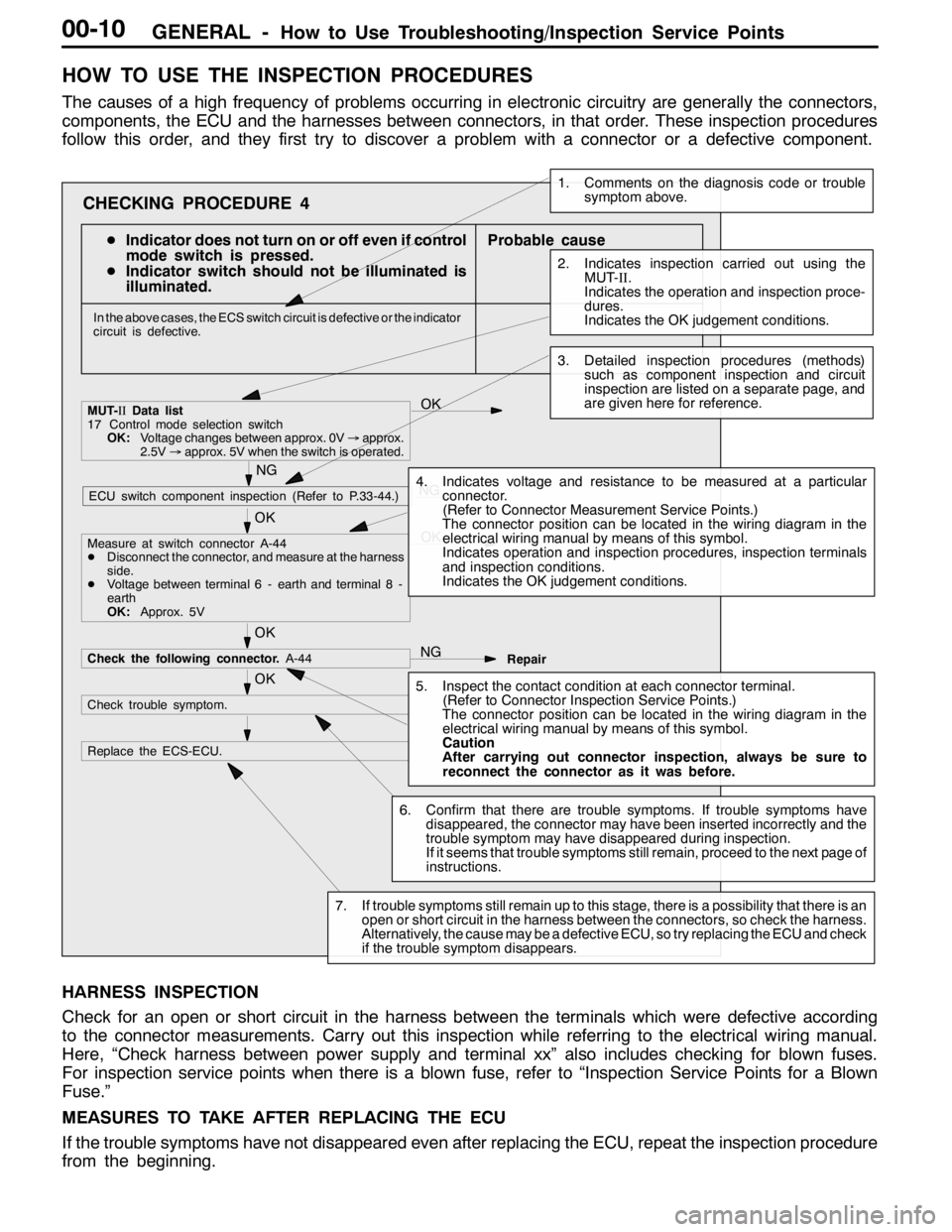
HOW TO USE THE INSPECTION PROCEDURES
The causes of a high frequency of problems occurring in electronic circuitry are generally the connectors,
components, the ECU and the harnesses between connectors, in that order. These inspection procedures
follow this order, and they first try to discover a problem with a connector or a defective component.
DIndicator does not turn on or off even if control
mode switch is pressed.
DIndicator switch should not be illuminated is
illuminated.Probable cause
OK
OK
OK
Measure at switch connector A-44
DDisconnect the connector, and measure at the harness
side.
DVoltage between terminal 6 - earth and terminal 8 -
earth
OK:Approx. 5V
OK
NG
Check the following connector.A-44
Repair
OK
Check trouble symptom.
Replace the ECS-ECU.
In the above cases, the ECS switch circuit is defective or the indicator
circuit is defective.
CHECKING PROCEDURE 4
2. Indicates inspection carried out using the
MUT-II.
Indicates the operation and inspection proce-
dures.
Indicates the OK judgement conditions.
3. Detailed inspection procedures (methods)
such as component inspection and circuit
inspection are listed on a separate page, and
are given here for reference.
5. Inspect the contact condition at each connector terminal.
(Refer to Connector Inspection Service Points.)
The connector position can be located in the wiring diagram in the
electrical wiring manual by means of this symbol.
Caution
After carrying out connector inspection, always be sure to
reconnect the connector as it was before.
6. Confirm that there are trouble symptoms. If trouble symptoms have
disappeared, the connector may have been inserted incorrectly and the
trouble symptom may have disappeared during inspection.
If it seems that trouble symptoms still remain, proceed to the next page of
instructions.
7. If trouble symptoms still remain up to this stage, there is a possibility that there is an
open or short circuit in the harness between the connectors, so check the harness.
Alternatively, the cause may be a defective ECU, so try replacing the ECU and check
if the trouble symptom disappears.
NGECU switch component inspection (Refer to P.33-44.)
NG
1. Comments on the diagnosis code or trouble
symptom above.
MUT-IIData list
17 Control mode selection switch
OK:Voltage changes between approx. 0V→approx.
2.5V→approx. 5V when the switch is operated.
4. Indicates voltage and resistance to be measured at a particular
connector.
(Refer to Connector Measurement Service Points.)
The connector position can be located in the wiring diagram in the
electrical wiring manual by means of this symbol.
Indicates operation and inspection procedures, inspection terminals
and inspection conditions.
Indicates the OK judgement conditions.
HARNESS INSPECTION
Check for an open or short circuit in the harness between the terminals which were defective according
to the connector measurements. Carry out this inspection while referring to the electrical wiring manual.
Here, “Check harness between power supply and terminal xx” also includes checking for blown fuses.
For inspection service points when there is a blown fuse, refer to “Inspection Service Points for a Blown
Fuse.”
MEASURES TO TAKE AFTER REPLACING THE ECU
If the trouble symptoms have not disappeared even after replacing the ECU, repeat the inspection procedure
from the beginning.
Page 397 of 1449

GENERAL -Precautions Before ServiceGENERAL -Precautions Before Service00-19
SERVICING THE ELECTRICAL SYSTEM
Before replacing a component related to the electrical system
and before undertaking any repair procedures involving the
electrical system, be sure to first disconnect the negative
( - ) cable from the battery in order to avoid damage caused
by short-circuiting.
Caution
Before connecting or disconnecting the negative ( - ) cable,
be sure to turn off the ignition switch and the lighting
switch.
(If this is not done, there is the possibility of
semiconductor parts being damaged.)
APPLICATION OF ANTI-CORROSION AGENTS
AND UNDERCOATS
If oil or grease gets onto the oxygen sensor, it will cause
a drop in the performance of the sensor.
Cover the oxygen sensor with a protective cover when applying
anti-corrosion agents and undercoats.
PRE-INSPECTION CONDITION
“Pre-inspection condition” refers to the condition that the
vehicle must be in before proper engine inspection can be
carried out. If you see the words “Set the vehicle to the
pre-inspection condition”. in this manual, it means to set the
vehicle to the following condition.
DEngine coolant temperature: 80 to 90_C
DLamps, electric cooling fan and all accessories: OFF
DM/T: Neutral
DA/T: P range
VEHICLE WASHING
If high-pressure car-washing equipment or steam car-washing
equipment is used to wash the vehicle, be sure to note the
following information in order to avoid damage to plastic
components, etc.
DSpray nozzle distance: Approx. 40 cm or more
DSpray pressure: 3,900 kPa or less
DSpray temperature: 82_C or less
DTime of concentrated spray to one point: within 30 sec.
Approx.
40 cm
Page 418 of 1449
ENGINE -On-vehicle Service11A-12
12. Install the ignition coils and spark plugs.
13. Use the MUT-IIto erase the self-diagnosis codes or
disconnect the battery cable from the battery ( - ) terminal
for 10 seconds or more and then reconnect the cable.
NOTE
This will erase the diagnosis code resulting from the crank
angle sensor connector being disconnected.
MANIFOLD VACUUM CHECK
1. Set the vehicle to the pre-inspection condition.
2. Turn the ignition switch to the “LOCK” (OFF) position.
3. Set the engine tachometer or connect the MUT-II.
4. Check that the idle speed is within the standard value.
NOTE
When using the MUT-II, select the code No.22.
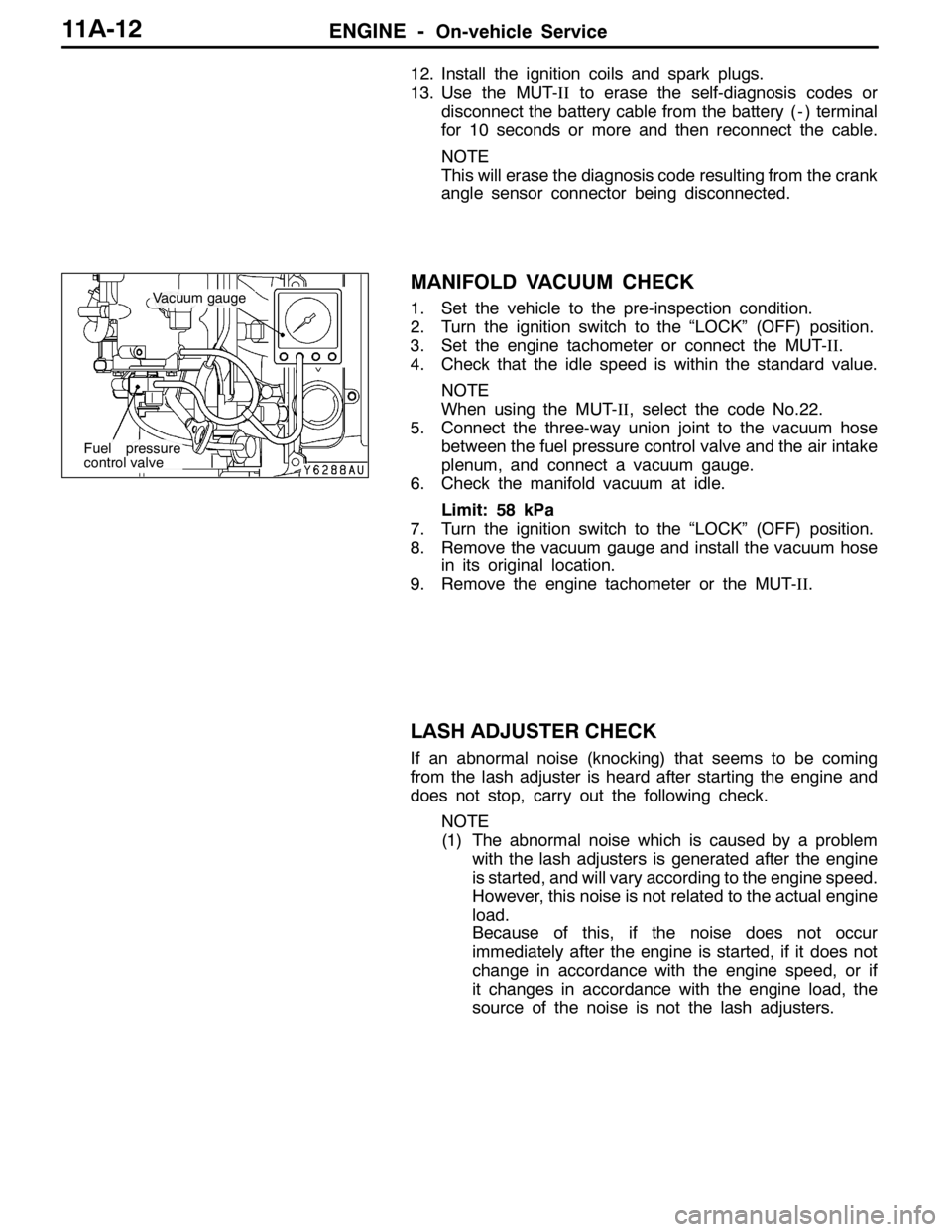
5. Connect the three-way union joint to the vacuum hose
between the fuel pressure control valve and the air intake
plenum, and connect a vacuum gauge.
6. Check the manifold vacuum at idle.
Limit: 58 kPa
7. Turn the ignition switch to the “LOCK” (OFF) position.
8. Remove the vacuum gauge and install the vacuum hose
in its original location.
9. Remove the engine tachometer or the MUT-II.
LASH ADJUSTER CHECK
If an abnormal noise (knocking) that seems to be coming
from the lash adjuster is heard after starting the engine and
does not stop, carry out the following check.
NOTE
(1) The abnormal noise which is caused by a problem
with the lash adjusters is generated after the engine
is started, and will vary according to the engine speed.
However, this noise is not related to the actual engine
load.
Because of this, if the noise does not occur
immediately after the engine is started, if it does not
change in accordance with the engine speed, or if
it changes in accordance with the engine load, the
source of the noise is not the lash adjusters.
Vacuum gauge
Fuel pressure
control valve
Page 535 of 1449

MPI -General Information13A-3
GENERAL INFORMATION
The Multipoint Fuel Injection System consists
of sensors which detect the engine conditions,
the engine-ECU which controls the system
based on signals from these sensors, and
actuators which operate under the control of
the engine-ECU. The engine-ECU carries outactivities such as fuel injection control, idle
speed control and ignition timing control. In
addition, the engine-ECU is equipped with
several diagnosis modes which simplify
troubleshooting when a problem develops.
FUEL INJECTION CONTROL
The injector drive times and injector timing are
controlled so that the optimum air/fuel mixture
is supplied to the engine to correspond to the
continually-changing engine operation condi-
tions.
A single injector is mounted at the intake port
of each cylinder. Fuel is sent under pressure
from the fuel tank by the fuel pump, with the
pressure being regulated by the fuel pressure
regulator. The fuel thus regulated is distributed
to each of the injectors.
Fuel injection is normally carried out once for
each cylinder for every two rotations of the
crankshaft. The firing order is 1-3-4-2. This iscalled sequential fuel injection. The
engine-ECU provides a richer air/fuel mixture
by carrying out “open-loop” control when the
engine is cold or operating under high load
conditions in order to maintain engine
performance. In addition, when the engine is
warm or operating under normal conditions,
the engine-ECU controls the air/fuel mixture
by using the oxygen sensor signal to carry out
“closed-loop” control in order to obtain the
theoretical air/fuel mixture ratio that provides
the maximum cleaning performance from the
three way catalyst.
IDLE AIR CONTROL
The idle speed is kept at the optimum speed
by controlling the amount of air that bypasses
the throttle valve in accordance with changes
in idling conditions and engine load during
idling. The engine-ECU drives the idle speed
control motor to keep the engine running at
the pre-set idle target speed in accordance
with the engine coolant temperature and airconditioner load. In addition, when the air
conditioner switch is turned off and on while
the engine is idling, the idle speed control motor
operates to adjust the throttle valve bypass
air amount in accordance with the engine load
conditions in order to avoid fluctuations in the
engine speed.
IGNITION TIMING CONTROL
The power transistor located in the ignition
primary circuit turns ON and OFF to control
the primary current flow to the ignition coil. This
controls the ignition timing in order to provide
the optimum ignition timing with respect to theengine operating conditions. The ignition timing
is determined by the engine-ECU from the
engine speed, intake air volume, engine coolant
temperature and barometric pressure.
SELF-DIAGNOSIS FUNCTION
DWhen an abnormality is detected in one
of the sensors or actuators related to
emission control, the engine warning lamp
(check engine lamp) illuminates as a
warning to the driver.
DWhen an abnormality is detected in one
of the sensors or actuators, a diagnosis
code corresponding to the abnormality is
output.DThe RAM data inside the engine-ECU that
is related to the sensors and actuators can
be read by means of the MUT-II. In addition,
the actuators can be force-driven under
certain circumstances.
Page 543 of 1449

MPI -TroubleshootingMPI -Troubleshooting13A-11
CONFIRMING FREEZE FRAME DATA
When the engine-ECU detects a malfunction and stores a diagnosis code, it also stores a current status
of the engine. This function is called “Freeze frame” data. By analyzing this “Freeze frame” data with
MUT-II, an effective troubleshooting can be performed.
NOTE
If mulfunctions have been detected in multiple systems, engine-ECU stores one malfunction only, which
has been detected first.
Item No.Data itemUnit/StateItem No.Data itemUnit/State
21Engine coolant temperature
sensor_C81Learn value%
22Crank angle sensorr/min82Feedback%
24Vehicle speedkm/h87Engine load%
FAIL-SAFE FUNCTION REFERENCE TABLE
When the main sensor malfunctions are detected by the diagnosis function, the vehicle is controlled
by means of the pre-set control logic to maintain safe conditions for driving.
Malfunctioning itemControl contents during malfunction
Air flow sensor1. Uses the throttle position sensor signal and engine speed signal (crank angle sensor
signal) to take reading of the basic injector drive time and basic ignition timing from
the pre-set mapping.
2. Fixes the idle speed control servo in the appointed position so idle control is not
performed.
Intake air temperature
sensorControls as if the intake air temperature is 25_C.
Throttle position
sensorNo increase in fuel injection amount during acceleration due to the throttle position sensor
signal.
Engine coolant
temperature sensor1. Controls as if the engine coolant temperature is 80_C.
(Even after sensor signal is correctly recovered, continues until the ignition switch
is set to the “LOCK” (OFF) position.)
2. Rotates radiator fan and condenser fan at high speed.
Camshaft position
sensor1. Inject all fuel cylinders simultaneously. (However, when the No.1 cylinder top dead
centre is not detected at all after the ignition switch is turned to “ON” position.)
2. Shuts off fuel supply after 4 seconds have passed since a failure was detected.
(However, when the No.1 cylinder top dead centre is not detected at all after the
ignition switch is turned to “ON” position.)
Barometric pressure
sensorControls as if the barometric pressure is 101 kPa.
Detonation sensorSwitches the ignition timing from ignition timing for super petrol to ignition timing for standard
petrol.
Alternator FR terminalDoes not control the output of the alternator according to an electrical load. (works as a
normal alternator)
Page 545 of 1449
MPI -Troubleshooting13A-13
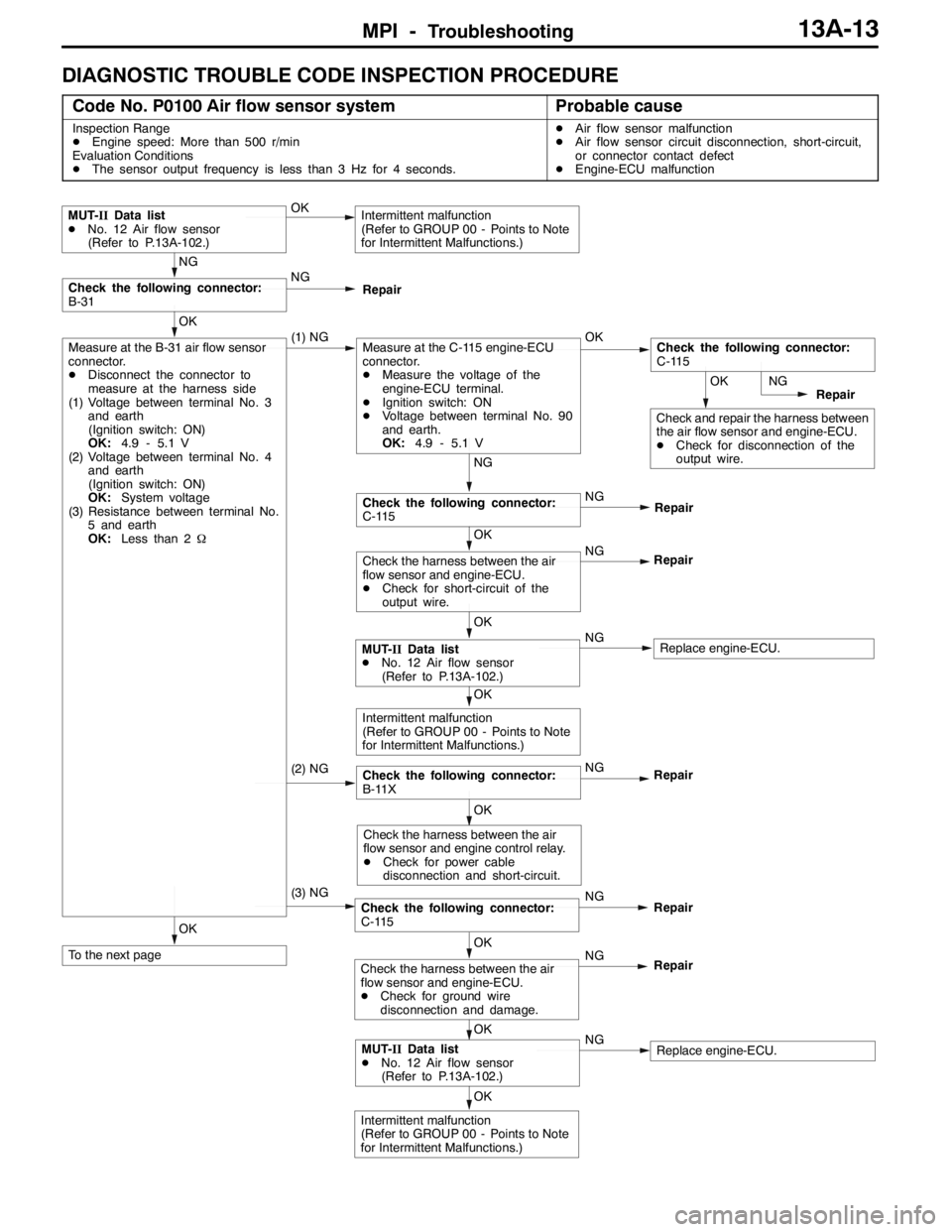
DIAGNOSTIC TROUBLE CODE INSPECTION PROCEDURE
Code No. P0100 Air flow sensor systemProbable cause
Inspection Range
DEngine speed: More than 500 r/min
Evaluation Conditions
DThe sensor output frequency is less than 3 Hz for 4 seconds.DAir flow sensor malfunction
DAir flow sensor circuit disconnection, short-circuit,
or connector contact defect
DEngine-ECU malfunction
OK
Intermittent malfunction
(Refer to GROUP 00 - Points to Note
for Intermittent Malfunctions.)
OK
MUT-IIData list
DNo. 12 Air flow sensor
(Refer to P.13A-102.)NGReplace engine-ECU.
OK
To the next pageOK
Check the harness between the air
flow sensor and engine-ECU.
DCheck for ground wire
disconnection and damage.NG
Repair
(3) NGCheck the following connector:
C-115NG
Repair
OK
Check the harness between the air
flow sensor and engine control relay.
DCheck for power cable
disconnection and short-circuit.
(2) NGCheck the following connector:
B-11XNG
OK
Intermittent malfunction
(Refer to GROUP 00 - Points to Note
for Intermittent Malfunctions.)
OK
MUT-IIData list
DNo. 12 Air flow sensor
(Refer to P.13A-102.)NGReplace engine-ECU.
OK
Check the harness between the air
flow sensor and engine-ECU.
DCheck for short-circuit of the
output wire.NG
Repair
NG
Check the following connector:
C-115NG
Repair
OK
Check and repair the harness between
the air flow sensor and engine-ECU.
DCheck for disconnection of the
output wire.NG
Repair
OK
Measure at the B-31 air flow sensor
connector.
DDisconnect the connector to
measure at the harness side
(1) Voltage between terminal No. 3
and earth
(Ignition switch: ON)
OK:4.9 - 5.1 V
(2) Voltage between terminal No. 4
and earth
(Ignition switch: ON)
OK:System voltage
(3) Resistance between terminal No.
5 and earth
OK:Less than 2Ω(1) NGMeasure at the C-115 engine-ECU
connector.
DMeasure the voltage of the
engine-ECU terminal.
DIgnition switch: ON
DVoltage between terminal No. 90
and earth.
OK:4.9 - 5.1 VOKCheck the following connector:
C-115
NG
Check the following connector:
B-31NG
Repair
MUT-IIData list
DNo. 12 Air flow sensor
(Refer to P.13A-102.)OKIntermittent malfunction
(Refer to GROUP 00 - Points to Note
for Intermittent Malfunctions.)
Repair
Page 547 of 1449
MPI -Troubleshooting13A-15
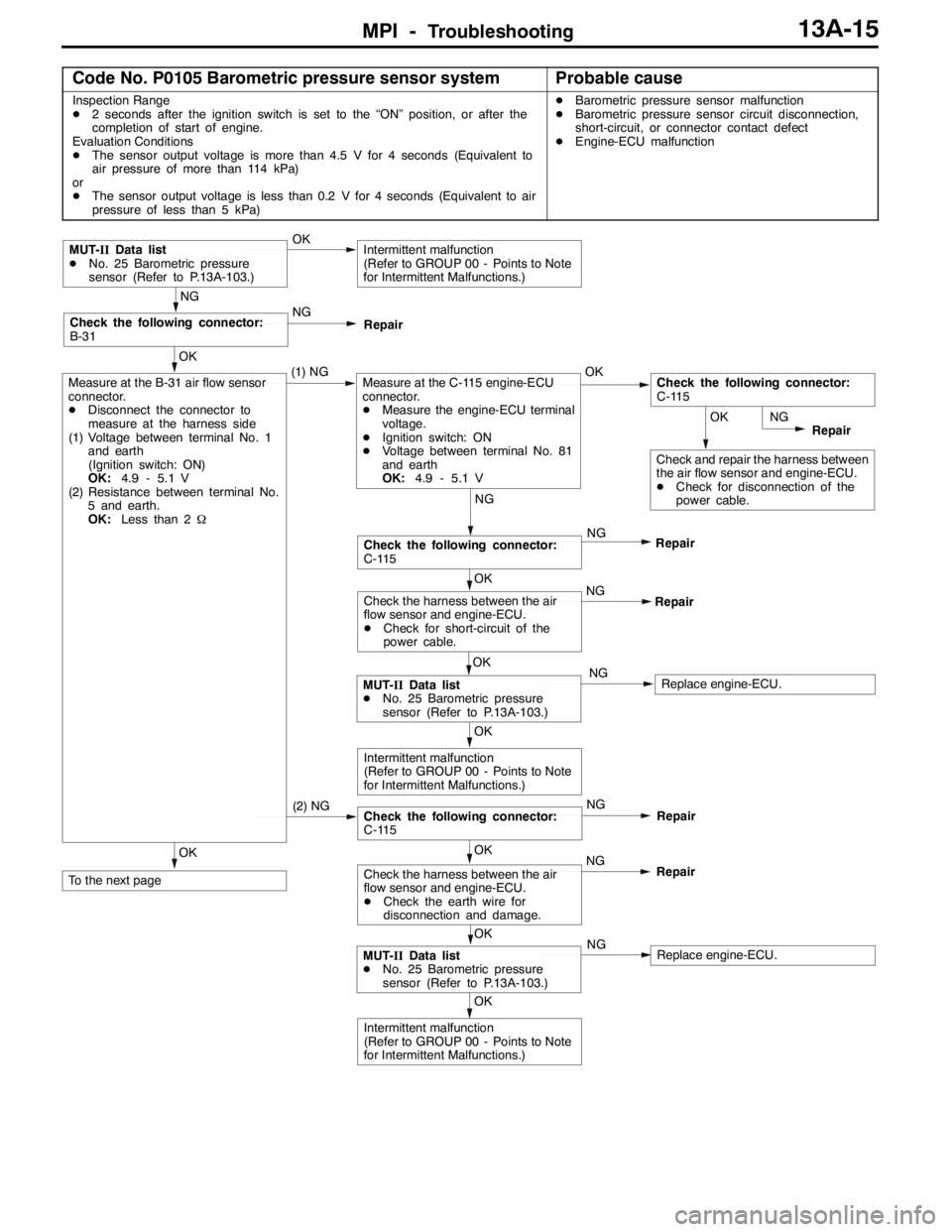
Code No. P0105 Barometric pressure sensor systemProbable cause
Inspection Range
D2 seconds after the ignition switch is set to the “ON” position, or after the
completion of start of engine.
Evaluation Conditions
DThe sensor output voltage is more than 4.5 V for 4 seconds (Equivalent to
air pressure of more than 114 kPa)
or
DThe sensor output voltage is less than 0.2 V for 4 seconds (Equivalent to air
pressure of less than 5 kPa)DBarometric pressure sensor malfunction
DBarometric pressure sensor circuit disconnection,
short-circuit, or connector contact defect
DEngine-ECU malfunction
OK
To the next page
OK
Intermittent malfunction
(Refer to GROUP 00 - Points to Note
for Intermittent Malfunctions.)
OK
MUT-IIData list
DNo. 25 Barometric pressure
sensor (Refer to P.13A-103.)NGReplace engine-ECU.
OK
Check the harness between the air
flow sensor and engine-ECU.
DCheck the earth wire for
disconnection and damage.NG
Repair
(2) NGCheck the following connector:
C-115NG
Repair
OK
Intermittent malfunction
(Refer to GROUP 00 - Points to Note
for Intermittent Malfunctions.)
OK
MUT-IIData list
DNo. 25 Barometric pressure
sensor (Refer to P.13A-103.)NGReplace engine-ECU.
OK
Check the harness between the air
flow sensor and engine-ECU.
DCheck for short-circuit of the
power cable.NG
Repair
NG
Check the following connector:
C-115NG
Repair
OK
Check and repair the harness between
the air flow sensor and engine-ECU.
DCheck for disconnection of the
power cable.NG
Repair
OK
Measure at the B-31 air flow sensor
connector.
DDisconnect the connector to
measure at the harness side
(1) Voltage between terminal No. 1
and earth
(Ignition switch: ON)
OK:4.9 - 5.1 V
(2) Resistance between terminal No.
5 and earth.
OK:Less than 2Ω(1) NGMeasure at the C-115 engine-ECU
connector.
DMeasure the engine-ECU terminal
voltage.
DIgnition switch: ON
DVoltage between terminal No. 81
and earth
OK:4.9 - 5.1 VOKCheck the following connector:
C-115
NG
Check the following connector:
B-31NG
Repair
MUT-IIData list
DNo. 25 Barometric pressure
sensor (Refer to P.13A-103.)OKIntermittent malfunction
(Refer to GROUP 00 - Points to Note
for Intermittent Malfunctions.)