air condition MITSUBISHI LANCER EVOLUTION 2007 Service Service Manual
[x] Cancel search | Manufacturer: MITSUBISHI, Model Year: 2007, Model line: LANCER EVOLUTION, Model: MITSUBISHI LANCER EVOLUTION 2007Pages: 1449, PDF Size: 56.82 MB
Page 580 of 1449
MPI -Troubleshooting13A-48
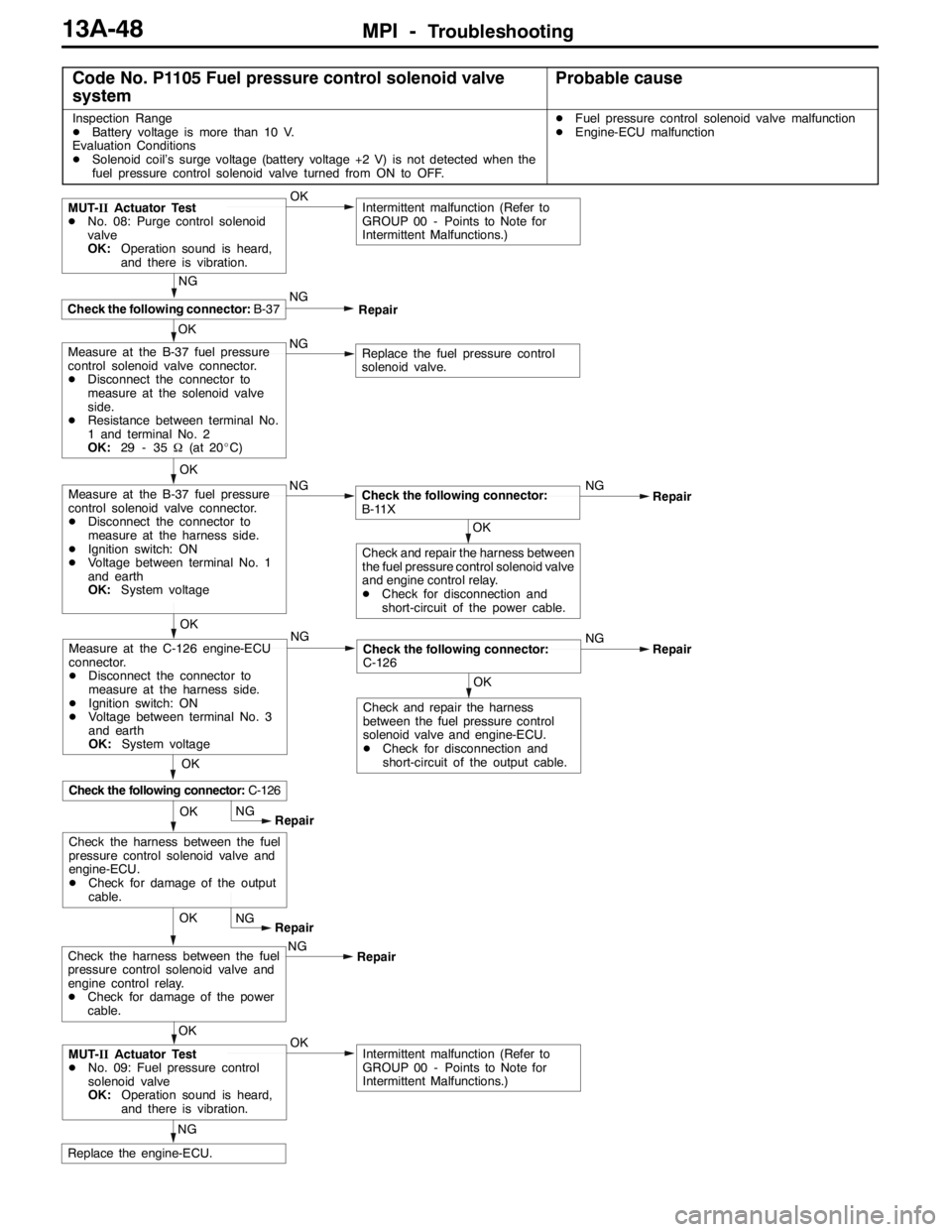
Code No. P1105 Fuel pressure control solenoid valve
systemProbable cause
Inspection Range
DBattery voltage is more than 10 V.
Evaluation Conditions
DSolenoid coil’s surge voltage (battery voltage +2 V) is not detected when the
fuel pressure control solenoid valve turned from ON to OFF.DFuel pressure control solenoid valve malfunction
DEngine-ECU malfunction
OK
NG
Replace the engine-ECU.
OKIntermittent malfunction (Refer to
GROUP 00 - Points to Note for
Intermittent Malfunctions.)MUT-IIActuator Test
DNo. 09: Fuel pressure control
solenoid valve
OK:Operation sound is heard,
and there is vibration.OKNG
Repair
OK
NG
Intermittent malfunction (Refer to
GROUP 00 - Points to Note for
Intermittent Malfunctions.)
OK
Check the following connector:B-37
MUT-IIActuator Test
DNo. 08: Purge control solenoid
valve
OK:Operation sound is heard,
and there is vibration.
NG
Repair
NGNG
Repair
OK
OK
Check and repair the harness
between the fuel pressure control
solenoid valve and engine-ECU.
DCheck for disconnection and
short-circuit of the output cable.
Check the following connector:
C-126
OK
Check the following connector:C-126
Measure at the C-126 engine-ECU
connector.
DDisconnect the connector to
measure at the harness side.
DIgnition switch: ON
DVoltage between terminal No. 3
and earth
OK:System voltageNG
Replace the fuel pressure control
solenoid valve.Measure at the B-37 fuel pressure
control solenoid valve connector.
DDisconnect the connector to
measure at the solenoid valve
side.
DResistance between terminal No.
1 and terminal No. 2
OK:29 - 35Ω(at 20_C)
OK
NG
Measure at the B-37 fuel pressure
control solenoid valve connector.
DDisconnect the connector to
measure at the harness side.
DIgnition switch: ON
DVoltage between terminal No. 1
and earth
OK:System voltage
OKNG
Repair
OK
OKCheck and repair the harness between
the fuel pressure control solenoid valve
and engine control relay.
DCheck for disconnection and
short-circuit of the power cable.
Check the following connector:
B-11X
NG
RepairCheck the harness between the fuel
pressure control solenoid valve and
engine control relay.
DCheck for damage of the power
cable.NG
Repair
OK
Check the harness between the fuel
pressure control solenoid valve and
engine-ECU.
DCheck for damage of the output
cable.
Page 581 of 1449
MPI -Troubleshooting13A-49
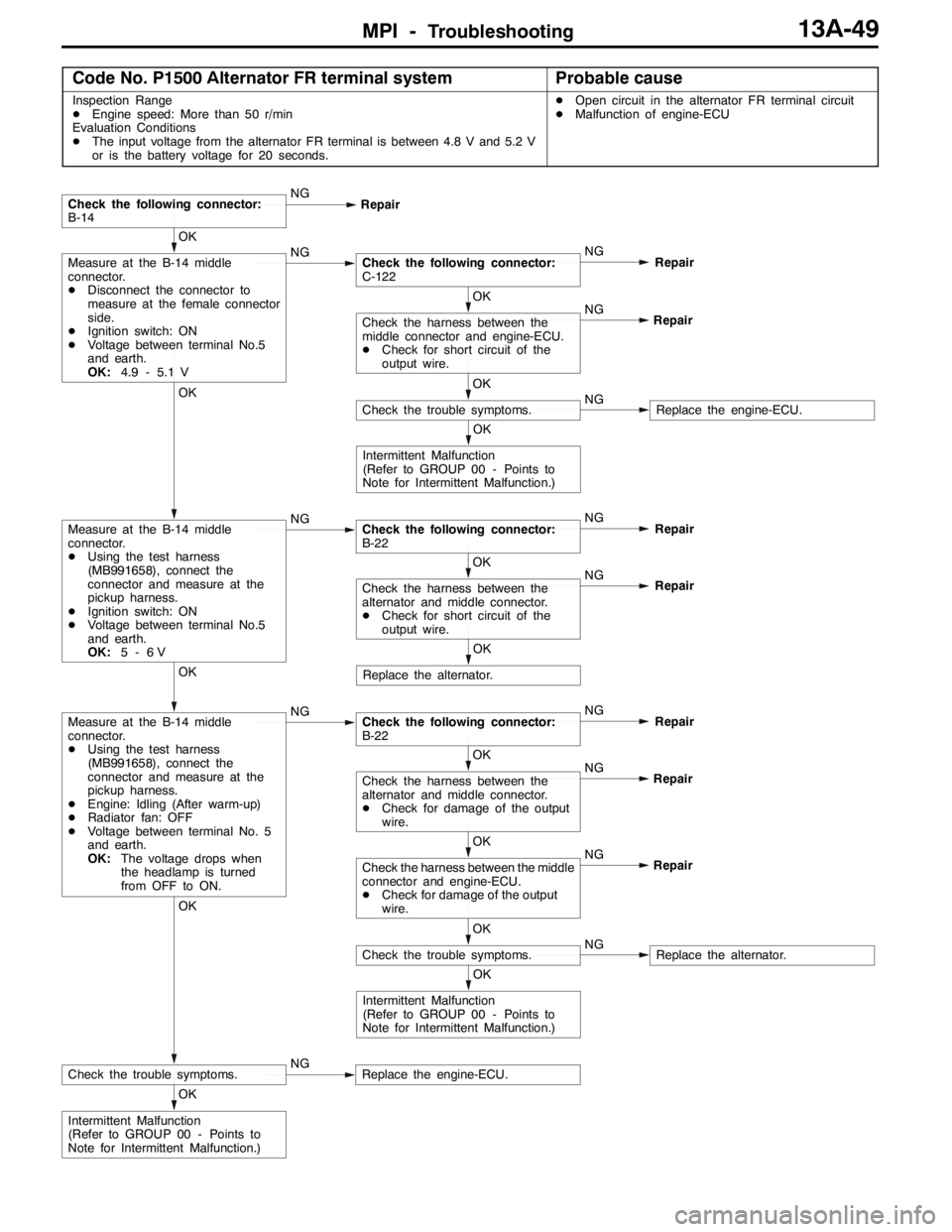
Code No. P1500 Alternator FR terminal systemProbable cause
Inspection Range
DEngine speed: More than 50 r/min
Evaluation Conditions
DThe input voltage from the alternator FR terminal is between 4.8 V and 5.2 V
or is the battery voltage for 20 seconds.DOpen circuit in the alternator FR terminal circuit
DMalfunction of engine-ECU
OK
Intermittent Malfunction
(Refer to GROUP 00 - Points to
Note for Intermittent Malfunction.)
OK
Check the trouble symptoms.NGReplace the engine-ECU.
OK
Intermittent Malfunction
(Refer to GROUP 00 - Points to
Note for Intermittent Malfunction.)
OK
Check the trouble symptoms.NGReplace the alternator. NG
OK
Check the harness between the middle
connector and engine-ECU.
DCheck for damage of the output
wire.Repair NG
OK
Check the harness between the
alternator and middle connector.
DCheck for damage of the output
wire.Repair
OK
Measure at the B-14 middle
connector.
DUsing the test harness
(MB991658), connect the
connector and measure at the
pickup harness.
DEngine: Idling (After warm-up)
DRadiator fan: OFF
DVoltage between terminal No. 5
and earth.
OK:The voltage drops when
the headlamp is turned
from OFF to ON.NGCheck the following connector:
B-22NG
Repair
OK
Replace the alternator.NG
OK
Check the harness between the
alternator and middle connector.
DCheck for short circuit of the
output wire.Repair
OK
Measure at the B-14 middle
connector.
DUsing the test harness
(MB991658), connect the
connector and measure at the
pickup harness.
DIgnition switch: ON
DVoltage between terminal No.5
and earth.
OK:5-6VNGCheck the following connector:
B-22NG
Repair
OK
Intermittent Malfunction
(Refer to GROUP 00 - Points to
Note for Intermittent Malfunction.)
OK
Check the trouble symptoms.NGReplace the engine-ECU. NG
OK
Check the harness between the
middle connector and engine-ECU.
DCheck for short circuit of the
output wire.Repair
OK
Measure at the B-14 middle
connector.
DDisconnect the connector to
measure at the female connector
side.
DIgnition switch: ON
DVoltage between terminal No.5
and earth.
OK:4.9 - 5.1 VNGCheck the following connector:
C-122NG
Repair
Check the following connector:
B-14NG
Repair
Page 582 of 1449
MPI -Troubleshooting13A-50
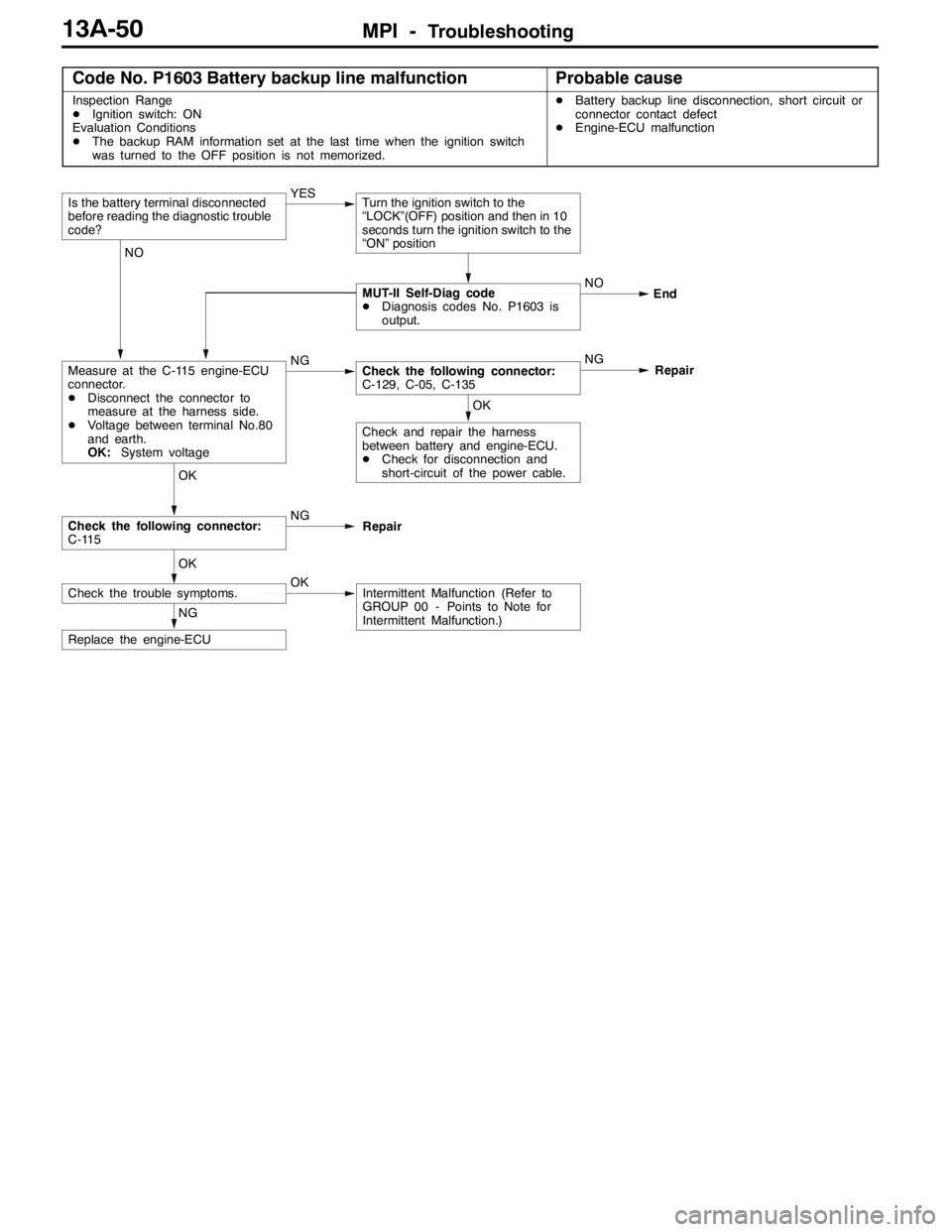
Code No. P1603 Battery backup line malfunctionProbable cause
Inspection Range
DIgnition switch: ON
Evaluation Conditions
DThe backup RAM information set at the last time when the ignition switch
was turned to the OFF position is not memorized.DBattery backup line disconnection, short circuit or
connector contact defect
DEngine-ECU malfunction
NG
Replace the engine-ECU
OK
Check the trouble symptoms.OKIntermittent Malfunction (Refer to
GROUP 00 - Points to Note for
Intermittent Malfunction.)
OK
Check the following connector:
C-115NG
Repair
OK
Check and repair the harness
between battery and engine-ECU.
DCheck for disconnection and
short-circuit of the power cable.
NGCheck the following connector:
C-129, C-05, C-135NG
Repair NO
MUT-II Self-Diag code
DDiagnosis codes No. P1603 is
output.End
NO
Measure at the C-115 engine-ECU
connector.
DDisconnect the connector to
measure at the harness side.
DVoltage between terminal No.80
and earth.
OK:System voltageYES
Turn the ignition switch to the
“LOCK”(OFF) position and then in 10
seconds turn the ignition switch to the
“ON” positionIs the battery terminal disconnected
before reading the diagnostic trouble
code?
Page 583 of 1449
MPI -Troubleshooting13A-51
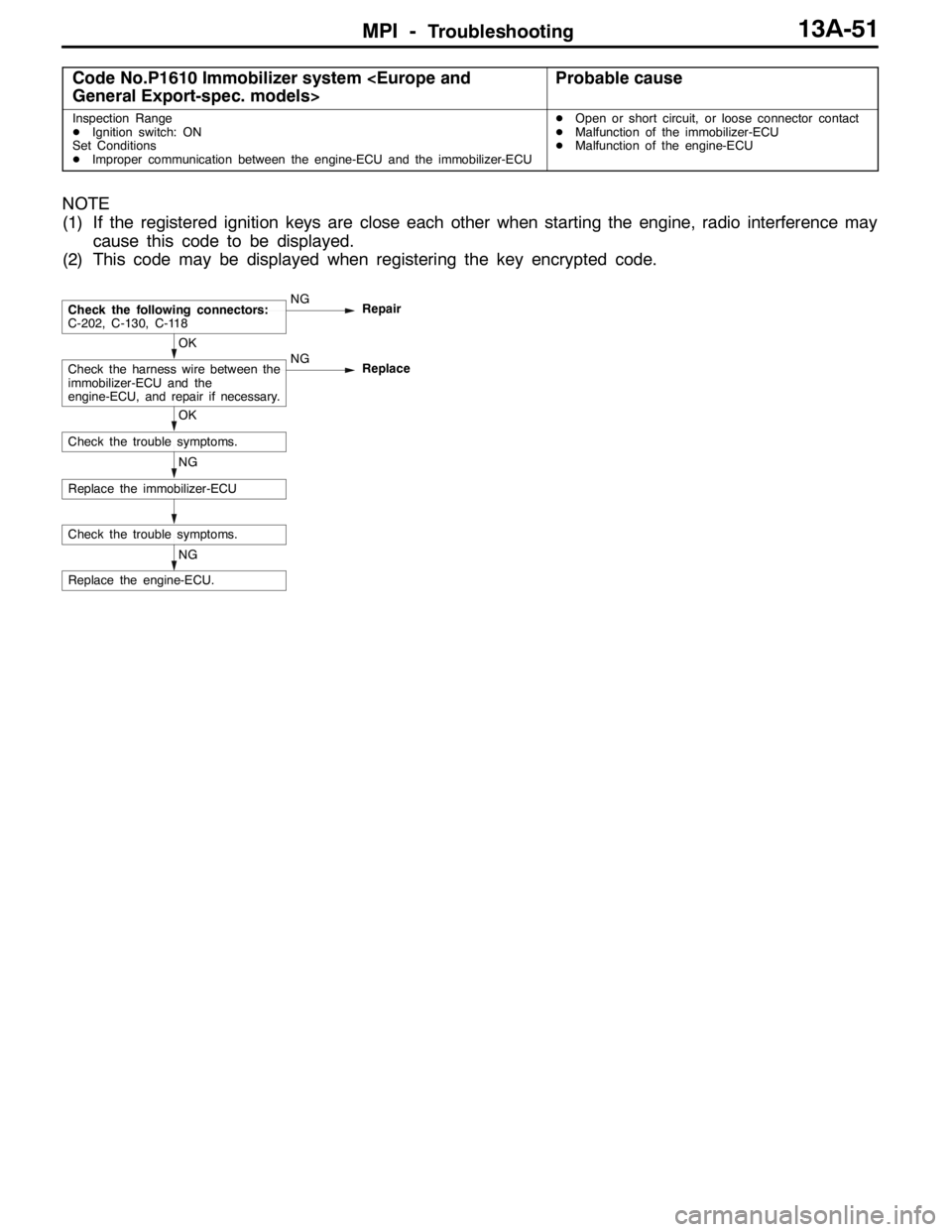
Code No.P1610 Immobilizer system
Inspection Range
DIgnition switch: ON
Set Conditions
DImproper communication between the engine-ECU and the immobilizer-ECUDOpen or short circuit, or loose connector contact
DMalfunction of the immobilizer-ECU
DMalfunction of the engine-ECU
NOTE
(1) If the registered ignition keys are close each other when starting the engine, radio interference may
cause this code to be displayed.
(2) This code may be displayed when registering the key encrypted code.
NG
Replace the engine-ECU.
Check the trouble symptoms.
NG
Replace the immobilizer-ECU
OK
Check the trouble symptoms.
OK
Check the harness wire between the
immobilizer-ECU and the
engine-ECU, and repair if necessary.NG
Replace
Check the following connectors:
C-202, C-130, C-118NG
Repair
Page 634 of 1449
![MITSUBISHI LANCER EVOLUTION 2007 Service Service Manual MPI -Troubleshooting13A-102
DATA LIST REFERENCE TABLE
NOTE
*1. In a new Vehicle [driven approximately 500 km or less], the air flow sensor output frequency time
is sometimes 10% longer than the standa](/img/19/57084/w960_57084-633.png "MITSUBISHI LANCER EVOLUTION 2007 Service Service Manual MPI -Troubleshooting13A-102
DATA LIST REFERENCE TABLE
NOTE
*1. In a new Vehicle [driven approximately 500 km or less], the air flow sensor output frequency time
is sometimes 10% longer than the standa")
MPI -Troubleshooting13A-102
DATA LIST REFERENCE TABLE
NOTE
*1. In a new Vehicle [driven approximately 500 km or less], the air flow sensor output frequency time
is sometimes 10% longer than the standard time.
*2. The injector drive time represents the time when the cranking speed is at 250 r/min or below when
the power supply voltage is 11 V.
*3. In a new vehicle [driven approximately 500 km or less], the injector drive time is sometimes 10%
longer than the standard time.
*4. In a new vehicle [driven approximately 500 km or less], the step of the stepper motor is sometimes
30 steps greater than the standard value.
Item
No.Inspection
itemInspection contentsNormal conditionInspection
procedure
No.Reference
page
11Oxygen
sensor
(front)Engine: After having
warmed up
(Air/fuel mixuture is
made leaner whenWhen at 4,000 r/min,
engine is suddenly de-
celerated200 mV or lessCode No.
P013013A-24
madeleanerwhen
decelerating, and is
made richer when rac-
ing.)When engine is sud-
denly raced600 - 1,000 mV
Engine: After having
warmed up
(The oxygen sensor
(front) signal is used
tochecktheair/fuel
Engine is idling400 mV or less↔
600 - 1,000 mV
(Varies)
to check the air/fuel
mixture ratio, and
control condition is
also checked by the
engine-ECU.)2,500 r/min
12Air flow
sensor*1DEngine coolant
temperature:
Idle operation17 - 43 Hz--
sensor*1temperature:
80 - 95_C
DLightningandall
2,500 r/min40 - 100 Hz
DLightning andall
accessories:
OFF
DTransmission:
NeutralAccelerationAccording to ac-
celeration, fre-
quency is ampli-
fied.
13Intake air
temperature
sensor
Ignition switch: “ON”
or engine runningWhen intake air temper-
ature is - 20_C-20_CCode No.
P011013A-13
sensorWhen intake air tem-
perature is 0_C0_C
When intake air tem-
perature is 20_C20_C
When intake air tem-
perature is 40_C40_C
When intake air tem-
perature is 80_C80_C
Page 636 of 1449

MPI -Troubleshooting13A-104
Item
No.Reference
page Inspection
procedure
No. Normal condition Inspection contents Inspection
item
25Barometric
pressure
Ignition switch: ONAltitude: 0 m101 kPaCode No.
P0105
13A-15
pressure
sensor
Altitude: 0 m95 kPa
P0105
Altitude: 0 m88 kPa
Altitude: 0 m81 kPa
27Power
steering
fluidEngine: Idle operationSteering wheel
stationaryOFFCode No.
P055113A-46
fluid
pressure
switchSteering wheel turningON
28A/C switchEngine: Idle operation
(When A/C switch isA/C switch: OFFOFFProcedure
No. 2613A-92
(WhenA/Cswitchis
ON, A/C compressor
should be operating.)A/C switch: ONON
No.26
34Air flow
sensorEngine: After
warm-upIdle operationONCode No.
P010013A-13
sensor
reset
signal
warm up
3,000 r/minOFF
P0100
37Volumetric
efficiency
DEngine coolant
temperature:
Idle operation15 - 35%--
efficiencytemperature:
85 - 95_C
DLightningand
2,500 r/min15 - 35%
DLightning and
accessories:
OFFExcessive
accellerationAccording to ac-
celeration, volu-
metric efficiency
is increased.
41Injectors*1Engine: CrankingWhen engine coolant
temperature is 0_C
(injection is carried out
for all cylinders simulta-
neously)25 - 37 ms--
When engine coolant
temperature is 20_C15 - 22 ms
When engine coolant
temperature is 80_C4.2 - 6.3 ms
Injectors*2DEngine coolant
temperature:
80–95_C
Engine: Idle operation1.5 - 2.7 ms--
80–95_C
DLamps, electric
cooling fan and
allaccessories:
2,500 r/min1.2 - 2.4 ms
allaccessories:
OFF
DTransmission:
Neutral
When engine is sud-
denly racedIncreases
Page 637 of 1449

MPI -Troubleshooting13A-105
Item
No.Reference
page Inspection
procedure
No. Normal condition Inspection contents Inspection
item
44Ignition ad-
vanceDEngine: After
having warmed
up
DTiming lamp is
set(Thetiming
Engine: Idle operation0-13_BTDC--
set.(Thetiming
lamp is set in
order to check
actual ignition
timing.)
2,500 r/min20 - 40_BTDC
45Idle speed
control
(stepper)
motor
position*
3
DEngine coolant
temperature:
80 - 90_C
DLamps, electric
cooling fan and
all accessories:
OFF
DTransmission:
A/C switch: OFF2 - 25 STEP--
DTransmission:
Neutral
DEngine: Idle
operation
DWhen A/C switch
is ON, A/C
compressor
should be operat-
ing
A/C switch: OFF→ONIncreases by 10 -
70 steps
49A/C relayEngine: After having
warmed up/Engine is
idlingA/C switch: OFFOFF (Compressor
clutch is not oper-
ating)Procedure
No. 2713A-92
A/C switch: ONON (Compressor
clutch is operat-
ing)
59Oxygen
sensor
(rear)Engine: After having
warmed-upWhen engine is sud-
denly raced0 and 600 - 1,000
mV alternate.Code No.
P013613A-27
81LLearned
valueEngine: After having warmed up, running with no
load at 2,500 r/min. (During air/fuel ratio
feedback control)- 12.5 - 12.5%--
82LFeedbackEngine: After having warmed up, running with no
load at 2,500 r/min. (During air/fuel ratio
feedback control)- 20 - 20%--
87LEngine
load
Engine: After having
warmedup
Idle operation15 - 35%--
loadwarmedup
2,500 r/min15 - 35%--
Page 638 of 1449

MPI -Troubleshooting13A-106
Item
No.Reference
page Inspection
procedure
No. Normal condition Inspection contents Inspection
item
A1LOxygen
sensor
(front)Engine: After having
warmed up
(Air/fuel mixture is
made leaner whenWhen at 4,000 r/min,
engine is suddenly de-
celerated200 mV or lessCode No.
P013013A-24
madeleanerwhen
decelerating, and is
made richer when
racing.)When engine is sud-
denly raced600 - 1,000 mV
Engine: After having
warmed up
(By using oxygen
sensorcheckair/fuel
Idle operation400 mV or less↔
600 - 1,000 mV
(altered)
sensor, checkair/fuel
mixture as well as
control status by
engine-ECU)2,500 r/min
A2LOxygen
sensor
(rear)Engine: After having
warmed upWhen engine is sud-
denly raced0 and 600 - 1,000
mV alternate.Code No.
P013613A-27
8ALThrottle
position
sensor
DEngine: After
having warmed
up
Release the accelera-
tor pedal.8 - 16%Code No.
P012013A-21
sensor
(Throttle
position
opening
angle)up
DIgnition switch:
“ON” (Engine
stopped)Depress the accelera-
tor pedal gradually.Increase in re-
sponse to the
pedal depression
stroke.
Depress the accelera-
tor pedal fully.80 - 100%
NOTE
Items marked byLwill not displayed if service data is selected on the check mode.
Page 640 of 1449

MPI -Troubleshooting13A-108
Item
No.Reference
page Inspection
procedure
No. Normal condition Inspection contents Drive contents Inspection
item
21Fan
controllerRadiator fan
motor is
driven.Ignition switch: “ON”Fan motor rotates
at high speed.Procedure
No. 2413A-87
36Secondary
air control
solenoid
valveSolenoid valve
turns from
OFF to ON.Ignition switch: “ON”Sound of opera-
tion can be heard
when solenoid
valve is driven.Procedure
No. 2913A-96
37Condenser
fan (HI)Condensor
fan motor is
driven.Ignition switch: “ON”Fan motor rotates
at high speed.Procedure
No. 2513A-89
38Condenser
fan (LOW)Second air
control
solenoid valveIgnition switch: “ON”Fan motor rotates
at low speed.
CHECK AT THE ENGINE-ECU TERMINALS
TERMINAL VOLTAGE CHECK CHART
1. Connect a needle-nosed wire probe (test harness:
MB991223 or paper clip) to a voltmeter probe.
2. Insert the needle-nosed wire probe into each of the
engine-ECU connector terminals from the wire side, and
measure the voltage while referring to the check chart.
NOTE
(1) Make the voltage measurement with the engine-ECU
connectors connected.
(2) You may find it convenient to pull out the engine-ECU
to make it easier to reach the connector terminals.
(3) The checks can be carried out off the order given
in the chart.
Caution
Short-circuiting the positive (+) probe between a
connector terminal and earth could damage the
vehicle wiring, the sensor, engine-ECU or all of them.
Be careful to prevent this!
3. If voltmeter shows any division from standard value, check
the corresponding sensor, actuator and related electrical
wiring, then repair or replace.
4. After repair or replacement, recheck with the voltmeter
to confirm that the repair has corrected the problem.
Needle-nosed wire probe
Page 642 of 1449

MPI -Troubleshooting13A-110
Terminal No.Normal condition Check condition (Engine condition) Check item
12Power supplyIgnition switch: “ON”System voltage
25
19Air flow sensor reset
signal
Engine: Idle operation0-1V
signal
Engine speed: 3,000 r/min6-9V
21Fan controllerRadiator fan is not operating0 - 0.3 V
Radiator fan is operating0.7 V or more
22Fuel pump relay 2Ignition switch: “ON”System voltage
Engine: Idle operation1 V or less
24A/C load signalDEngine:
Idle operation
DA/C switch: ON
(A/C compressor
runs)DOutdoor air
sensor ambient
temperature:
18_C or more
DA/C setting
temperature:
Minimum
temperature
DA/C air volume:
Maximum1 V or less
DA/C setting
temperature:
indoor
temperature
DA/C air volume:
MinimumSystem voltage
32Condenser fan motor
relay (HI)Fan inactive state
(Engine coolant temperature: 90_C or less)System voltage
Fan high-speed rotation state
(Engine coolant temperature: 105_C or more)1 V or less
33Alternator G terminalDEngine: After warm-up, idle operation
DRadiator fan: Not operating
DHeadlamp: OFF→ON
DStop lamp: OFF→ON
DRear defogger switch: OFF→ONVoltage increases by
0.2 - 3.5 V
34Condenser fan motor
relay (LOW)Fan inactive state
(Engine coolant temperature: 90_C or less)System voltage
Fan low-speed rotation state (Engine coolant
temperature: 95 - 100_C or more)1 V or less
35Intercooler water
spraylamp
Ignition switch: “ON”System voltage
spraylamp
Ignition switch: “LOCK” (OFF)1 V or less
36Engine warning lampIgnition switch: “LOCK” (OFF)→“ON”1 V or less→System
voltage (After several se-
conds have elapsed)