oil change MITSUBISHI LANCER EVOLUTION 2007 Service User Guide
[x] Cancel search | Manufacturer: MITSUBISHI, Model Year: 2007, Model line: LANCER EVOLUTION, Model: MITSUBISHI LANCER EVOLUTION 2007Pages: 1449, PDF Size: 56.82 MB
Page 641 of 1449

MPI -TroubleshootingMPI -Troubleshooting13A-109
Engine-ECU Connector Terminal Arrangement
Terminal No.Check itemCheck condition (Engine condition)Normal condition
1No. 1 injectorWhile engine is idling after having warmed up,
suddenlydepresstheacceleratorpedal
From 11 - 14 V, momentarily
dropsslightly
14No. 2 injector
suddenlydepressthe accelerator pedal.drops slightly
2No. 3 injector
15No. 4 injector
3Fuel pressure control
solenoidvalve
Ignition switch: “ON”System voltage
solenoidvalve
Engine: Cranking→Idle operation
(within approximately 2 minutes or less)1 V or less→System voltage
4Stepper motor coil
startedSystem voltage↔0-6V
(Changes repeatedly)
17Stepper motor coil
5Stepper motor coil
18Stepper motor coil
6EGR control solenoid
valve
Ignition switch: “ON”System Voltage
valve
While engine is idling, suddenly depress the
accelerator pedal.From system voltage,
momentarily drops
8A/C relayDEngine: Idle operation
DA/Cswitch:OFF→ON(A/Ccompressor
System voltage or momen-
tarily6Vormore→1VorDA/Cswitch:OFF→ON(A/Ccompressor
runs)tarily6Vor more→1Vor
less
9Purge control sole-
noidvalve
Ignition switch: “ON”System voltage
noidvalve
Engine: Idle operation1 V or less
10Ignition coil - No.1,
No.4Engine speed: 3,000 r/min0.3 - 3.0 V
23Ignition coil - No.2,
No.3
11Waste gate solenoid
valve
Ignition switch: “ON”System voltage
valve
Engine: After warm-up, idle operation
(When using premium gasoline)1 V or less
Page 662 of 1449

MPI -On-vehicle Service13A-130
14. If any of fuel pressure measured in steps 10 to 13 is out of
specification, troubleshoot and repair according to the
table below.
SymptomProbable causeRemedy
DFuel pressure too low
DFuelpressuredropsafterracing
Clogged fuel filterReplace fuel filter
DFuelpressuredrops after racing
DNo fuel pressure in fuel return
hose
Fuel leaking to return side due to poor
fuel regulator valve seating or settled
springReplace fuel pressure regulator
Low fuel pump delivery pressureReplace fuel pump
Fuel pressure too highBinding valve in fuel pressure
regulatorReplace fuel pressure regulator
Clogged fuel return hose or pipeClean or replace hose or pipe
Same fuel pressure when vacuum
hose is connected and when
disconnected
Damaged vacuum hose or clogged
nippleReplace vacuum hose or clean nipple
disconnectedFuel pressure control system
malfunctionCheck the fuel pressure control
system
15. Stop the engine and check change of fuel pressure gauge
reading. Normal if the reading does not drop within 2
minutes. If it does, observe the rate of drop and
troubleshoot and repair according to the table below.
SymptomProbable causeRemedy
Fuel pressure drops gradually after
engineisstopped
Leaky injectorReplace injector
engineisstopped
Leaky fuel regulator valve seatReplace fuel pressure regulator
Fuel pressure drops sharply
immediately after engine is stoppedCheck valve in fuel pump is held openReplace fuel pump
16. Release residual pressure from the fuel pipe line.
(Refer to P.13A-125.)
17. Remove the fuel pressure gauge and special tool from
the delivery pipe.
Caution
Cover the hose connection with rags to prevent splash
of fuel that could be caused by some residual pressure
in the fuel pipe line.
18. Replace the O-ring at the end of the fuel high pressure
hose with a new one. Furthermore, apply engine oil to
the new O-ring before replacement.
19. Fit the fuel high pressure hose over the delivery pipe
and tighten the bolt to specified torque.
Tightening torque: 5.0±1.0 N·m
20. Check for any fuel leaks by following the procedure in
step 7.
21. Disconnect the MUT-II.
Page 810 of 1449

22A-2
MANUAL
TRANSMISSION
CONTENTS
GENERAL 3.................................
Outline of Changes 3...........................
GENERAL INFORMATION 3..................
SERVICE SPECIFICATION 3..................
LUBRICANTS 3..............................
SPECIAL TOOLS 4...........................
TROUBLESHOOTING
ON-VEHICLE SERVICE 40....................
Transmission Oil Check 40......................
Transmission Oil Replacement 40................
Transfer Oil Check 40..........................
Transfer Oil Replacement 40....................
Fluid Check
Bleeding
Hydraulic Pressure Check
Wheel Speed Sensor Output Voltage
Measurement
TRANSMISSION CONTROL* 46...............
TRANSFER ASSEMBLY 49...................
TRANSMISSION ASSEMBLY 52...............
4WD-ECU
SENSOR, SWITCH AND RELAY
AYC> 56.....................................
HYDRAULIC UNIT Refer to GROUP27B.......
WARNING REGARDING SERVICING OF SUPPLEMENTAL RESTRAINT SYSTEM (SRS) EQUIPPED VEHICLES
WARNING!
(1) Improper service or maintenance of any component of the SRS, or any SRS-related component, can lead to personal
injury or death to service personnel (from inadvertent firing of the air bag) or to driver and passenger (from rendering
the SRS inoperative).
(2) Service or maintenance of any SRS component or SRS-related component must be performed only at an authorized
MITSUBISHI dealer.
(3) MITSUBISHI dealer personnel must thoroughly review this manual, and especially its GROUP 52B - Supplemental
Restraint System (SRS) before beginning any service or maintenance of any component of the SRS or any SRS-related
component.
NOTE
The SRS includes the following components: SRS-ECU, SRS warning lamp, air bag module, clock spring, and interconnecting
wiring. Other SRS-related components (that may have to be removed/installed in connection with SRS service or maintenance) are
indicated in the table of contents by an asterisk (*).
Page 811 of 1449

MANUAL TRANSMISSION -General/General Information/
Service Specification/Lubricants22A-3
GENERAL
OUTLINE OF CHANGE
With the addition of the EVOLUTION-VII, the W5M51 transmission service adjustment procedure has
been set as follows.
GENERAL INFORMATION
ItemsSpecifications
GradeRS, RS IIRS, RS II (With super cross gear)
Transmission modelW5M51
Engine model4G63-DOHC-T/C
Type5-speed, floor-shift
Gear ratio1st2.7852.785
2nd1.9501.950
3rd1.4071.444
4th1.0311.096
5th0.7200.825
Reverse3.4163.416
Final reduction ratio
(Differential gear ratio)4.5294.529
Front limited-slip differential
(Helical-gear type)Not providedProvided
TransferReduction ratio3.3073.307
Limited-slipdifferentialVCU or hydraulic multi plate
clutch (ACD)VCU or hydraulic multi plate
clutch (ACD)
SERVICE SPECIFICATION
ItemStandard value
Hydraulic unit generation oil pressureMPa1.0 - 1.6
LUBRICANTS
ItemSpecified lubricantQuantity L
Transmission oilGear oil SAE 75W-90 or 75W-85W conforming to API GL-42.8
Transfer
oilVehicles without ACD or ve-
hicles without ACD and AYCMITSUBISHI Genuine Gear Oil Part No.8149630 EX,
CASTROL HYPOY LS (GL-5, SAE 90), SHELL-LSD
(GL 5SAE80W90)orequivalent
0.55
Vehicles with ACD or vehicles
with ACD and AYC(GL-5, SAE 80W - 90) or equivalent0.6
FluidPiping between ACD and
hydraulic unitDIA QUEEN ATF SP III0.9
Pipes between ACD and hy-
draulic unit and between AYC
and hydraulic unit1.0
Page 947 of 1449

27B-1
REAR AXLE
CONTENTS
GENERAL INFORMATION 2...................
SERVICE SPECIFICATIONS 3.................
LUBRICANTS 3..............................
SEALANTS 4................................
SPECIAL TOOLS 4...........................
TROUBLESHOOTING (AYC) 8.................
ON-VEHICLE SERVICE 16....................
Rear Axle Total Backlash Check 16...............
Gear Oil Level Check 16........................
Gear Oil Change 17............................
Fluid Level Check 19............................
Bleeding 19....................................
AYC Operation Check 20........................
Oil Pressure Check 21..........................Wheel Bearing Axial Play Check 22...............
Wheel Bearing Rotary-sliding Resistance Check 22.
Hub Bolt Replacement 23.......................
Differential Carrier Oil Seal Replacement 23........
Action When Battery Runs Out 24................
REAR HUB ASSEMBLY 25....................
KNUCKLE 28................................
DRIVE SHAFT 29.............................
DIFFERENTIAL CARRIER
DIFFERENTIAL CARRIER
HYDRAULIC UNIT
Page 963 of 1449

REAR AXLE -On-vehicle Service27B-17
Differential part
1. Remove the filler plug.
2. Check that the gear oil level is within the specified range
from the bottom end of the filler plug hole.
3. If the gear oil level exceeds the standard value, add the
specified gear oil up to the bottom end of the filler plug
hole.
Specified gear oil:
Hypoid gear oil API classification GL-5 or higher
SAE viscosity Number 90, 80W
NOTE
10_C or more: SAE90, less than 10_C: SAE80W
4. Fit the filler plug and tighten it to the specified torque.
Tightening torque: 49±9 N·m
Torque transfer mechanism part
1. Remove the filler plug.
2. Check that the gear oil level is within the specified range
from the bottom end of the filler plug hole.
3. If the gear oil level exceeds the standard value, add the
specified gear oil up to the bottom end of the filler plug
hole.
Specified gear oil: ATF-SP III
4. Fit the filler plug and tighten it to the specified torque.
Tightening torque: 49±9 N·m
GEAR OIL CHANGE
1. Remove the drain plug to discharge the gear oil.
2. Fit the drain plug and tighten it to the specified torque.
Tightening torque: 49±9 N·m
3. Remove the filler plug and add the specified gear oil
up to the bottom end of the filler plug hole.
Filler plug
Upper limit
Lower limitGear oil
6mm
Filler plug
Upper limit
Lower limitGear oil
6mm
Page 998 of 1449
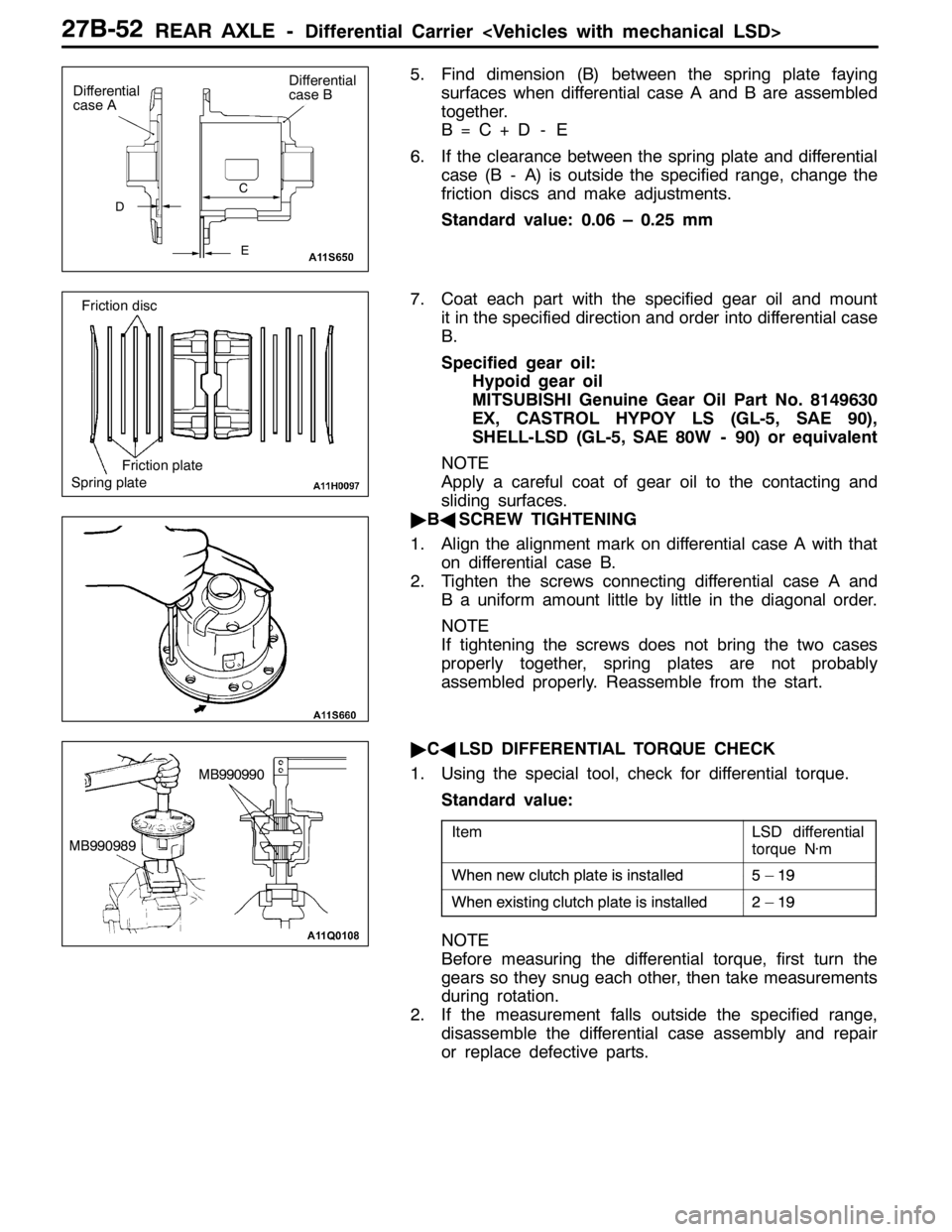
REAR AXLE -Differential Carrier
5. Find dimension (B) between the spring plate faying
surfaces when differential case A and B are assembled
together.
B=C+D - E
6. If the clearance between the spring plate and differential
case (B - A) is outside the specified range, change the
friction discs and make adjustments.
Standard value: 0.06 – 0.25 mm
7. Coat each part with the specified gear oil and mount
it in the specified direction and order into differential case
B.
Specified gear oil:
Hypoid gear oil
MITSUBISHI Genuine Gear Oil Part No. 8149630
EX, CASTROL HYPOY LS (GL-5, SAE 90),
SHELL-LSD (GL-5, SAE 80W - 90) or equivalent
NOTE
Apply a careful coat of gear oil to the contacting and
sliding surfaces.
"BASCREW TIGHTENING
1. Align the alignment mark on differential case A with that
on differential case B.
2. Tighten the screws connecting differential case A and
B a uniform amount little by little in the diagonal order.
NOTE
If tightening the screws does not bring the two cases
properly together, spring plates are not probably
assembled properly. Reassemble from the start.
"CALSD DIFFERENTIAL TORQUE CHECK
1. Using the special tool, check for differential torque.
Standard value:
ItemLSD differential
torque N·m
Whennewclutchplateisinstalled5–19When new clutchplateisinstalled5–19
Whenexistingclutchplateisinstalled2–19When existing clutchplateisinstalled2–19
NOTE
Before measuring the differential torque, first turn the
gears so they snug each other, then take measurements
during rotation.
2. If the measurement falls outside the specified range,
disassemble the differential case assembly and repair
or replace defective parts.
D
Differential
case A
E C
Differential
case B
Spring plateFriction plate Friction disc
MB990990
MB990989
Page 1072 of 1449

ABS <4WD> -General Information35B-2
GENERAL INFORMATION
ABS has been adopted as optional equipment in
RS-IIto maintain directional stability and steering
performance during sudden braking or braking on
slippery road surfaces.
The ABS control method is a 4-sensor, 4-channel
method which provides independent control for all
wheels.
Following system for Lancer EVOLUTION-VII has
been modified from Lancer EVOLUTION-VI Tommi
Makinen Edition.DBy adding lateral G sensor, longitudinal G
sensor and steering wheel sensor, optimized
ABS control at the time of cornering.
DBy inputting parking brake switch signal to
ABS-ECU with pulling parking brake lever, ABS
control has been optimized.
DABS-ECU outputs ABS signal to 4WD-ECU.
DG sensor (lateral), steering wheel sensor and
parking brake switch have been added to the
diagnosis and service data.
DABS-ECU connector has been changed.
EBD CONTROL
In ABS, electronic control method is used by which
the rear wheel brake hydraulic pressure during
braking is regulated by rear wheel control solenoid
valves in accordance with the vehicle’s rate of
deceleration and the front and rear wheel slippage
which are calculated from the each wheel speed
sensor’s signal. EBD control is a control system
which provides a high level of control for both vehicle
braking force and vehicle stability. The system has
the following features:
DBecause the system provides the optimum rear
wheel braking force regardless of the vehicleladen condition and the condition of the road
surface, the system reduces the required pedal
depression force, particularly when the vehicle
is heavily laden or driving on road surfaces
with high frictional coefficients.
DBecause the duty placed on the front brakes
has been reduced, the increases in pad
temperature can be controlled to improve the
wear resistance characteristics of the pad,
during front brakes applying.
DControl valves such as the proportioning valve
are no longer required.
SPECIFICATIONS
ItemSpecifications
ABS control method4-sensor, 4-channel
No. of ABS rotor teethFront43
Rear43
ABS speed sensorTypeMagnet coil typep
Gap between sensor and rotor mm0.85
Page 1123 of 1449

STEERING -On-vehicle Service37A-9
POWER STEERING FLUID LEVEL CHECK
1. Park the vehicle on a flat, level surface, start the engine,
and then turn the steering wheel several times to raise
the temperature of the fluid to approximately 50 - 60_C.
2. With the engine running, turn the wheel all the way to
the left and right several times.
3. Check the fluid in the oil reservoir for foaming or milkiness.
Check the difference of the fluid level when the engine
is stopped, and while it is running. If the change of the
fluid level is 5 mm or more, air bleeding should be done.
POWER STEERING FLUID REPLACEMENT
1. Raise the front wheels on a jack, and then support them
with rigid racks.
2. Disconnect the return hose connection.
3. Connect a vinyl hose to the return hose, and drain the
oil into a container.
4. Disconnect the ignition coil connectors. (Refer to
GROUP16 - Ignition System.)
5. While operating the starting motor intermittently, turn the
steering wheel all the way to the left and right several
times to drain all of the fluid.
6. Connect the return hoses securely, and then secure it
with the clip.
7. Fill the oil reservoir with specified fluid up to the lower
position of the filter, and then bleed air.
Specified fluid:
Automatic transmission fluid DEXRONII
Caution
Do not use ATF-SPIIM and ATF-SPIII.
POWER STEERING SYSTEM BLEEDING
1. Jack up the vehicle and support the front wheels with
rigid racks.
2. Disconnect the ignition coil connectors. (Refer to
GROUP16 - Ignition System.)
3. Cranking the engine with the starter several times
intermittently (during 15 to 20 seconds), turn the steering
wheel left and right fully five or six times.
Caution
(1) During the bleeding, refill the fluid so that the
level never falls below the lower position of the
filter.
(2) Be sure to bleed air only while cranking. If the
bleeding is done with the engine running, the air
will be broken up and absorbed into the fluid.
4. Connect the ignition coil connectors and idle the engine.
5. Turn the steering wheel left and right fully until no bubbles
comes out in the oil reservoir.
6. See that the fluid is not milky and that the fluid level
is up to the specified position on the level gauge.
7. See that the fluid level changes little when the steering
wheel is turned left and right.
8. Check difference in fluid levels between the engine
stopped and running.
Fluid level change: Within 5 mm
While engine
runningWhile engine
stopped
Return hose
Vinyl hose
Page 1124 of 1449

STEERING -On-vehicle Service37A-10
9. If the level changes more than 5 mm, the air is badly
bled. So, bleed air again.
Caution
(1) If the fluid level rises suddenly after the engine
is stopped, the bleeding is incomplete.
(2) Incomplete bleeding causes abnormal noises
from the pump and the flow-control valve. This
could lessen the life of the pump and the other
parts.
OIL PUMP PRESSURE TEST
1. Disconnect the pressure hose from the oil pump, and
then connect the special tools.
2. Bleed the air, and then turn the steering wheel several
times while the vehicle is not moving so that the
temperature of the fluid rises to approximately 50 - 60_C.
3. Start the engine and idle it at 1,000±100 r/min.
4. Fully close the shut-off valve of the pressure gauge and
measure the oil pump relief pressure to confirm that it
is within the standard value range.
Standard value: 8.4 - 9.0 MPa
5. If the standard value is not met, the oil pump is defective.
So, replace the oil pump. Then, measure oil pressure
again.
6. With the pressure gauge shut - off valve fully open, check
the hydraulic pressure in unladen condition.
Standard value: 0.2 - 0.8 MPa
7. If the standard value is not met, the oil line or steering
gear is probably defective. So, repair and measure oil
pressure again.
8. Turn the steering wheel fully either left or right and check
the retention hydraulic pressure.
Standard value: 8.4 - 9.0 MPa
9. If the pressure is below the standard value, disassemble
and reassemble the steering gear. If above, replace the
oil pump. Then, measure oil pressure again.
10. Remove the special tools, and tighten the pressure hose
to the specified torque.
Tightening torque: 18±3 N·m
11. Bleed the system.
Fluid level change: Within 5 mm
While engine
runningWhile engine
stopped
Temperature
gaugePressure
gauge
(MB990662)Shut-off valve
Oil
pumpOil reservoir
Adapter
(MB990994)
Adapter
(MB990993)