brake fluid MITSUBISHI LANCER EVOLUTION 2007 Service Owner's Manual
[x] Cancel search | Manufacturer: MITSUBISHI, Model Year: 2007, Model line: LANCER EVOLUTION, Model: MITSUBISHI LANCER EVOLUTION 2007Pages: 1449, PDF Size: 56.82 MB
Page 976 of 1449
REAR AXLE -Drive Shaft27B-30
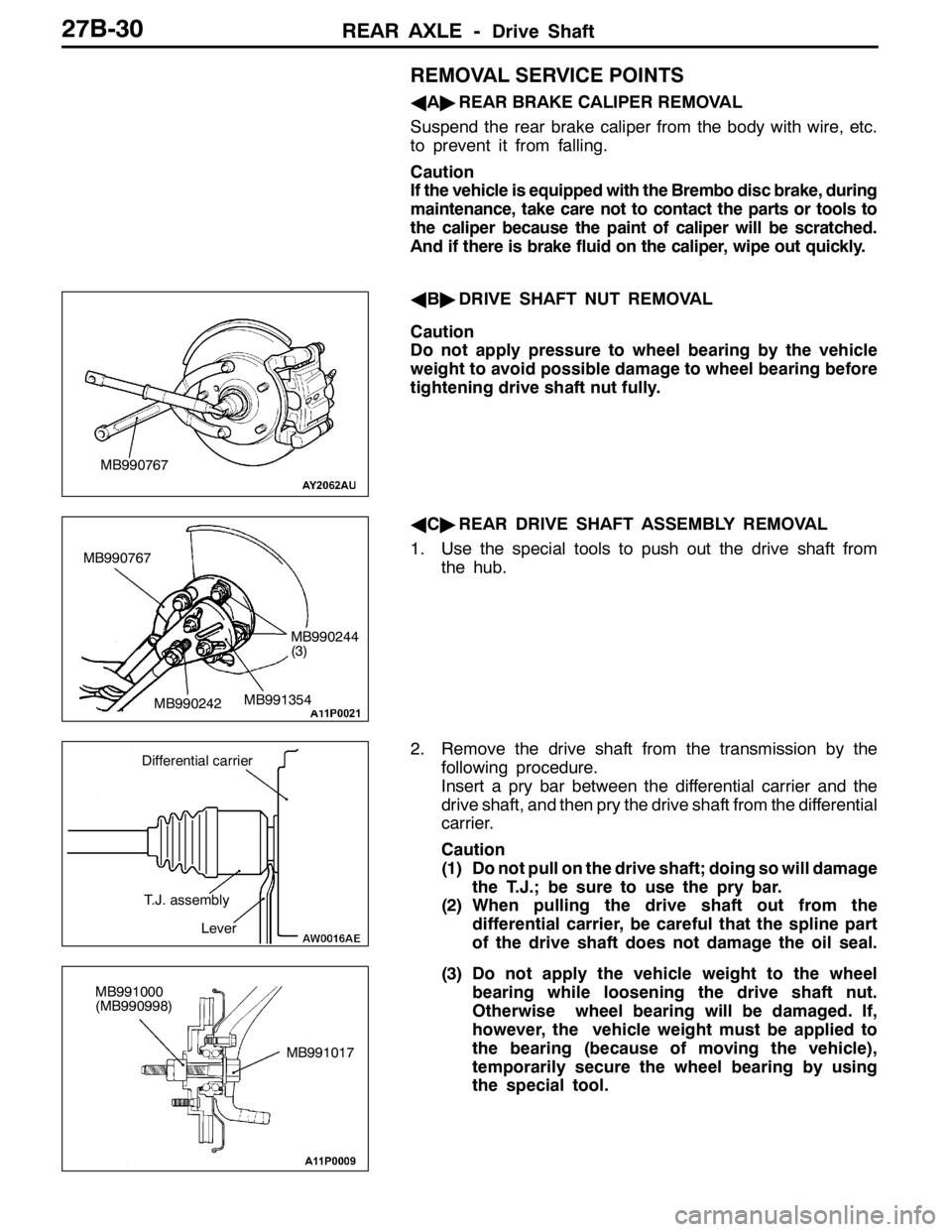
REMOVAL SERVICE POINTS
AA"REAR BRAKE CALIPER REMOVAL
Suspend the rear brake caliper from the body with wire, etc.
to prevent it from falling.
Caution
If the vehicle is equipped with the Brembo disc brake, during
maintenance, take care not to contact the parts or tools to
the caliper because the paint of caliper will be scratched.
And if there is brake fluid on the caliper, wipe out quickly.
AB"DRIVE SHAFT NUT REMOVAL
Caution
Do not apply pressure to wheel bearing by the vehicle
weight to avoid possible damage to wheel bearing before
tightening drive shaft nut fully.
AC"REAR DRIVE SHAFT ASSEMBLY REMOVAL
1. Use the special tools to push out the drive shaft from
the hub.
2. Remove the drive shaft from the transmission by the
following procedure.
Insert a pry bar between the differential carrier and the
drive shaft, and then pry the drive shaft from the differential
carrier.
Caution
(1) Do not pull on the drive shaft; doing so will damage
the T.J.; be sure to use the pry bar.
(2) When pulling the drive shaft out from the
differential carrier, be careful that the spline part
of the drive shaft does not damage the oil seal.
(3) Do not apply the vehicle weight to the wheel
bearing while loosening the drive shaft nut.
Otherwise wheel bearing will be damaged. If,
however, the vehicle weight must be applied to
the bearing (because of moving the vehicle),
temporarily secure the wheel bearing by using
the special tool.
MB990767
MB990767
MB990242MB991354
MB990244
(3)
Differential carrier
T.J. assembly
Lever
MB991017 MB991000
(MB990998)
Page 1022 of 1449

POWER PLANT MOUNT - Crossmember32-8
CROSSMEMBER
REMOVAL AND INSTALLATION
Caution
1. Before removing the steering wheel and air bag module assembly, always refer to GROUP
52B - Service Precautions, Air bag Module and Clock Spring. Also, set the front wheels so
that they are facing straight forward, and remove the ignition key. If you fail to do this, the
SRS clock spring will be damaged, causing the SRS air bag to be inoperative and serious
injury.
2. *
1: Indicates parts which should be initially tightened, and then fully tightened after placing
the vehicle horizontally and loading the full weight of the engine on the vehicle body.
3. *
2: Indicates parts which should be temporarily tightened, and then fully tightened with the
vehicle on the ground in the unladen condition.
Caution
If the vehicle is equipped the Brembo disc brake, during maintenance, take care not to contact
the parts or tools to the caliper because the paint of caliper will be scratched.
Pre-removal Operations
DUnder Cover Removal
(Refer to GROUP 51 - Front Bumper.)
DCentermember, Crossmember Bar Removal
(Refer to P.32-6.)
DFront Exhaust Pipe Removal
(Refer to GROUP 15.)
DSteering Wheel Air Bag Module Assembly Removal
(Refer to GROUP 37A.)
DPower Steering Fluid Draining
(Refer to GROUP 37A - On-vehicle Service.)Post-installation Operations
DCentermember, Crossmember Bar Installation
(Refer to P.32-6.)
DFront Exhaust Pipe Installation
(Refer to GROUP 15.)
DSteering Wheel Air Bag Module Assembly
Installation (Refer to GROUP 37A.)
DPower Steering Fluid Supplying
(Refer to GROUP 37A - On-vehicle Service.)
DPower Steering Fluid Line Bleeding
(Refer to GROUP 37A - On-vehicle Service.)
DPress the dust cover with a finger to check whether
the dust cover is cracked or damaged.
DChecking Steering Wheel Position with Wheels
Straight Ahead
DFront Wheel Alignment Check and Adjustment
(Refer to GROUP 37A - On-vehicle Service.)
DUnder Cover Installation
(Refer to GROUP 51 - Front Bumper.)
Page 1035 of 1449
FRONT SUSPENSION -Lower Arm Assembly33A-9
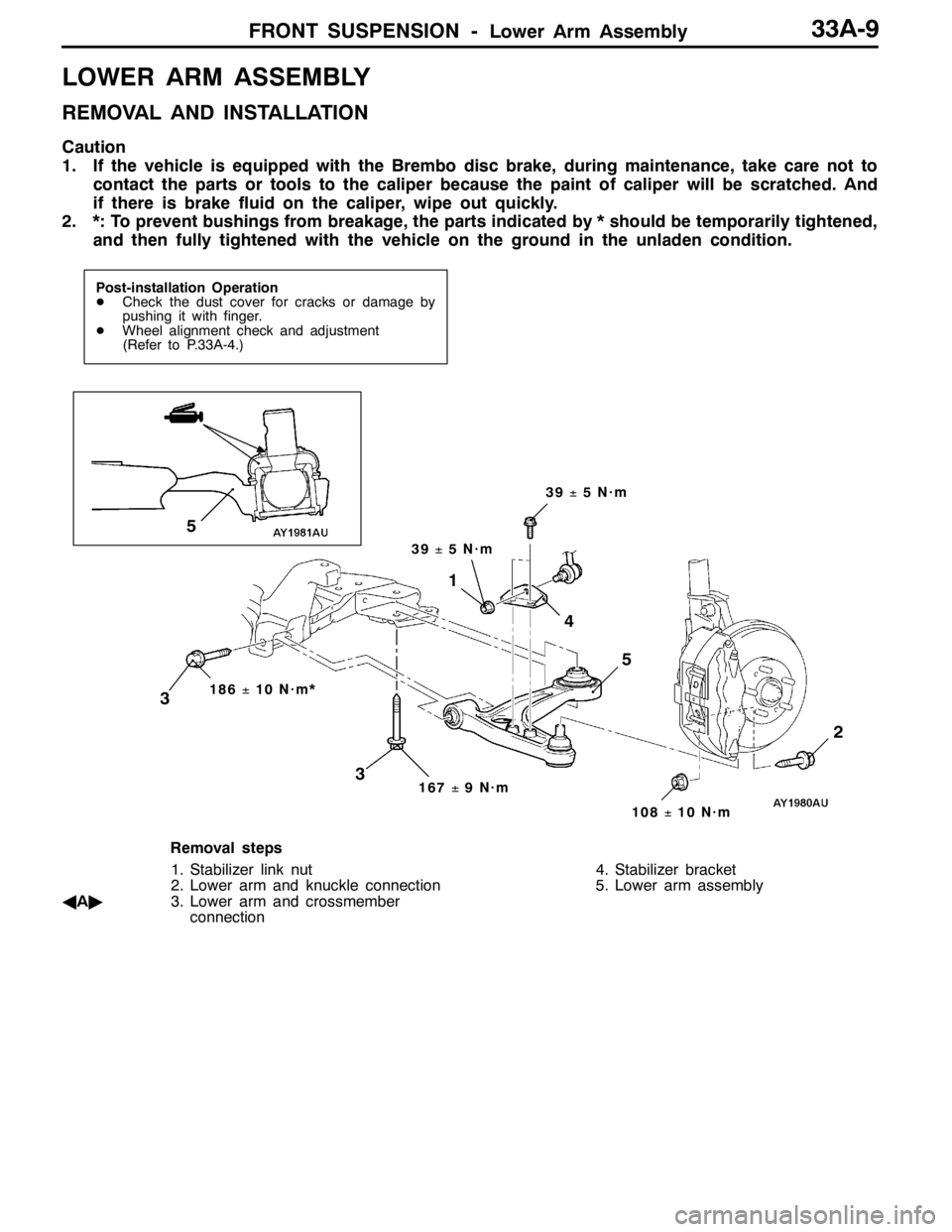
LOWER ARM ASSEMBLY
REMOVAL AND INSTALLATION
Caution
1. If the vehicle is equipped with the Brembo disc brake, during maintenance, take care not to
contact the parts or tools to the caliper because the paint of caliper will be scratched. And
if there is brake fluid on the caliper, wipe out quickly.
2. *: To prevent bushings from breakage, the parts indicated by * should be temporarily tightened,
and then fully tightened with the vehicle on the ground in the unladen condition.
Post-installation Operation
DCheck the dust cover for cracks or damage by
pushing it with finger.
DWheel alignment check and adjustment
(Refer to P.33A-4.)
72
5
186±10 N·m*
3167±9N·m
5
1
3
4
108±10 N·m
39±5N·m
39±5N·m
Removal steps
1. Stabilizer link nut
2. Lower arm and knuckle connection
AA"3. Lower arm and crossmember
connection4. Stabilizer bracket
5. Lower arm assembly
Page 1038 of 1449
FRONT SUSPENSION -Lower Arm Assembly/Stabilizer Bar33A-12
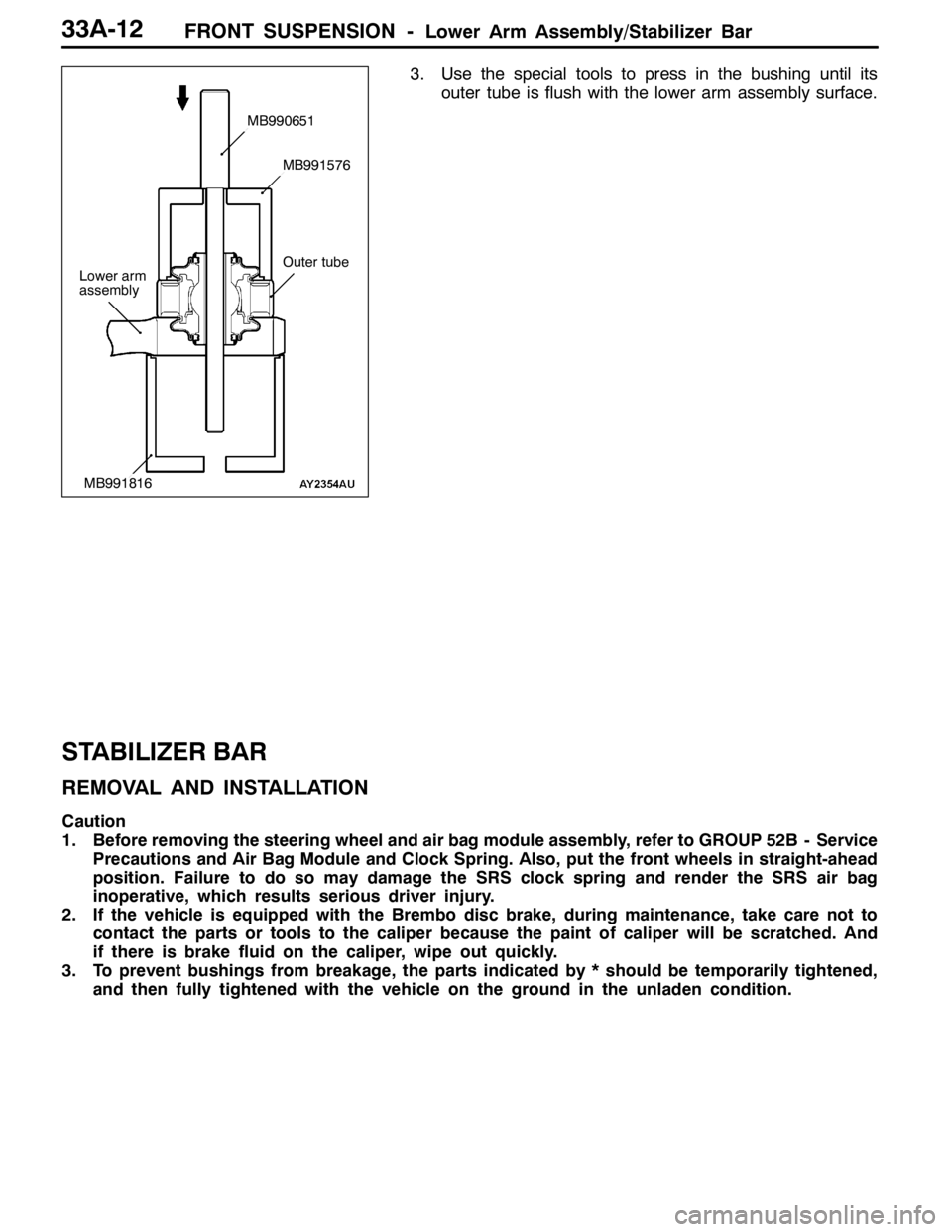
3. Use the special tools to press in the bushing until its
outer tube is flush with the lower arm assembly surface.
STABILIZER BAR
REMOVAL AND INSTALLATION
Caution
1. Before removing the steering wheel and air bag module assembly, refer to GROUP 52B - Service
Precautions and Air Bag Module and Clock Spring. Also, put the front wheels in straight-ahead
position. Failure to do so may damage the SRS clock spring and render the SRS air bag
inoperative, which results serious driver injury.
2. If the vehicle is equipped with the Brembo disc brake, during maintenance, take care not to
contact the parts or tools to the caliper because the paint of caliper will be scratched. And
if there is brake fluid on the caliper, wipe out quickly.
3. To prevent bushings from breakage, the parts indicated by * should be temporarily tightened,
and then fully tightened with the vehicle on the ground in the unladen condition.
Lower arm
assembly
MB990651
MB991576
MB991816
Outer tube
Page 1044 of 1449

35A-2
BASIC BRAKE
SYSTEM
CONTENTS
GENERAL INFORMATION 3..................
SERVICE SPECIFICATIONS 5.................
LUBRICANTS 6..............................
SEALANT 6..................................
SPECIAL TOOLS 6...........................
ON-VEHICLE SERVICE 7.....................
Brake Pedal Check and Adjustment 7............
Brake Booster Operating Test 8.................
Check Valve Operation Check 9.................
Proportioning Valve Function Test
Brake Fluid Level Sensor Check 11.............
Disc Brake Pad Check and Replacement 11......
Disc Brake Rotor Check 13.....................
Brake Disc Thickness Check 14.................
Brake Disc Run-out Check and Correction 14....
BRAKE PEDAL 16...........................
PROPORTIONING VALVE, MASTER
CYLINDER AND BRAKE BOOSTER 17........
Master Cylinder 19.............................
DISC BRAKE 20.............................
Page 1045 of 1449

BASIC BRAKE SYSTEM -General Information35A-3
GENERAL INFORMATION
The brake system offers high dependability and durability along with improved braking performance and
brake sensitivity.
SERVICE PRECAUTION
Take care not to contact the parts or tools to the caliper because the paint of caliper will be scratched.
SPECIFICATIONS
ItemsSpecifications
Master cylinderTypeTandem type
I.D. mm26.9
Brake boosterTypeVacuum type, tandem
Effective dia. of power cylinder mm205 + 230
Boosting ratio4.5 (Pedal depressing force: 230 N)
Rear wheel hydraulic
controlmethod
Vehicles with ABS
control methodVehicles without ABS
Proportioning valves
VehicleswithoutABS
TypeSingle type¢2
Front brakes
RS(standard)
TypeFloating caliper, 2 piston, ventilated disc
Wheel cylinder I.D. mm42.9 (¢2)
Pad thickness mm10.0
Clearance adjustmentAutomatic
Front brakes
Disc effective dia.¢thickness mm263¢32
Wheel cylinder I.D. mm40.0 (¢2), 46.0 (¢2)
Pad thickness mm10.0
Clearance adjustmentAutomatic
Rear brakes
RS(standard)
TypeFloating caliper, 1 piston, ventilated disc
Wheel cylinder I.D. mm34.9
Pad thickness mm10.0
Clearance adjustmentAutomatic
Rear brakes
Disc effective dia.¢thickness mm252¢22
Wheel cylinder I.D. mm40.0 (¢2)
Pad thickness mm9.0
Clearance adjustmentAutomatic
Brake fluidDOT3 or DOT4
Page 1047 of 1449

BASIC BRAKE SYSTEM -Service Specifications35A-5
SERVICE SPECIFICATIONS
ItemsStandard valueLimit
Brake pedal height mm169.1 - 172.1-
Brake pedal play mm3-8-
Brake pedal to floorboard clearance when the brake pedal is depressed mm90 or more-
Brake booster push rod protrusion amount mm8.98 - 9.23-
Proportioning valve
Split point MPa2.70 - 3.19-
Output fluid pressure MPa 3.68 - 4.17-
Output fluid pressure difference between left and right MPa-0.49
Front disc brake
Pad thickness mm10.02.0
Discthicknessmm24 022 4Discthickness mm24.022.4
Disc run-out mm-0.03
Drag force N51 or less-
Brembo front disc brake
Pad thickness mm10.02.0
Discthicknessmm32 029 8Discthickness mm32.029.8
Disc run-out mm-0.03
Drag force N69 or less-
Rear disc brake
Pad thickness mm10.02.0
Discthicknessmm20 018 4Discthickness mm20.018.4
Disc run-out mm-0.03
Drag force N69 or less-
Brembo rear disc brake
Pad thickness mm9.02.0
Discthicknessmm22 020 4Discthickness mm22.020.4
Disc run-out mm-0.03
Drag force N69 or less-
Front wheel bearing axial play mm-0.06
Rear wheel bearing axial play mm-0.05
Page 1048 of 1449

BASIC BRAKE SYSTEM -Lubricants/Sealant/Special Tools35A-6
LUBRICANTS
ItemsSpecified LubricantQuantity
Brake fluidDOT3 or DOT4As required
Piston, wheel cylinder body
Piston boot, piston seal, shimRepair kit grease
Guide pin, lock pin, pin boot
Pad assembly
SEALANT
ItemsSpecified sealantRemarks
Fitting3M ATD Part No. 8661, 8663 or equivalentSemi-drying sealant
SPECIAL TOOLS
ToolNumberNameUse
MB991568Push rod adjusting
socketAdjustment of the brake booster push rod
protrusion amount
AMB990964
A: MB990520Brake tool setPushing-in of the disc brake piston
DDisc brake piston pushing-in
MB990998Front hub remover
and installerProvisional holding of the wheel bearing
Page 1051 of 1449
BASIC BRAKE SYSTEM -On-vehicle Service35A-9
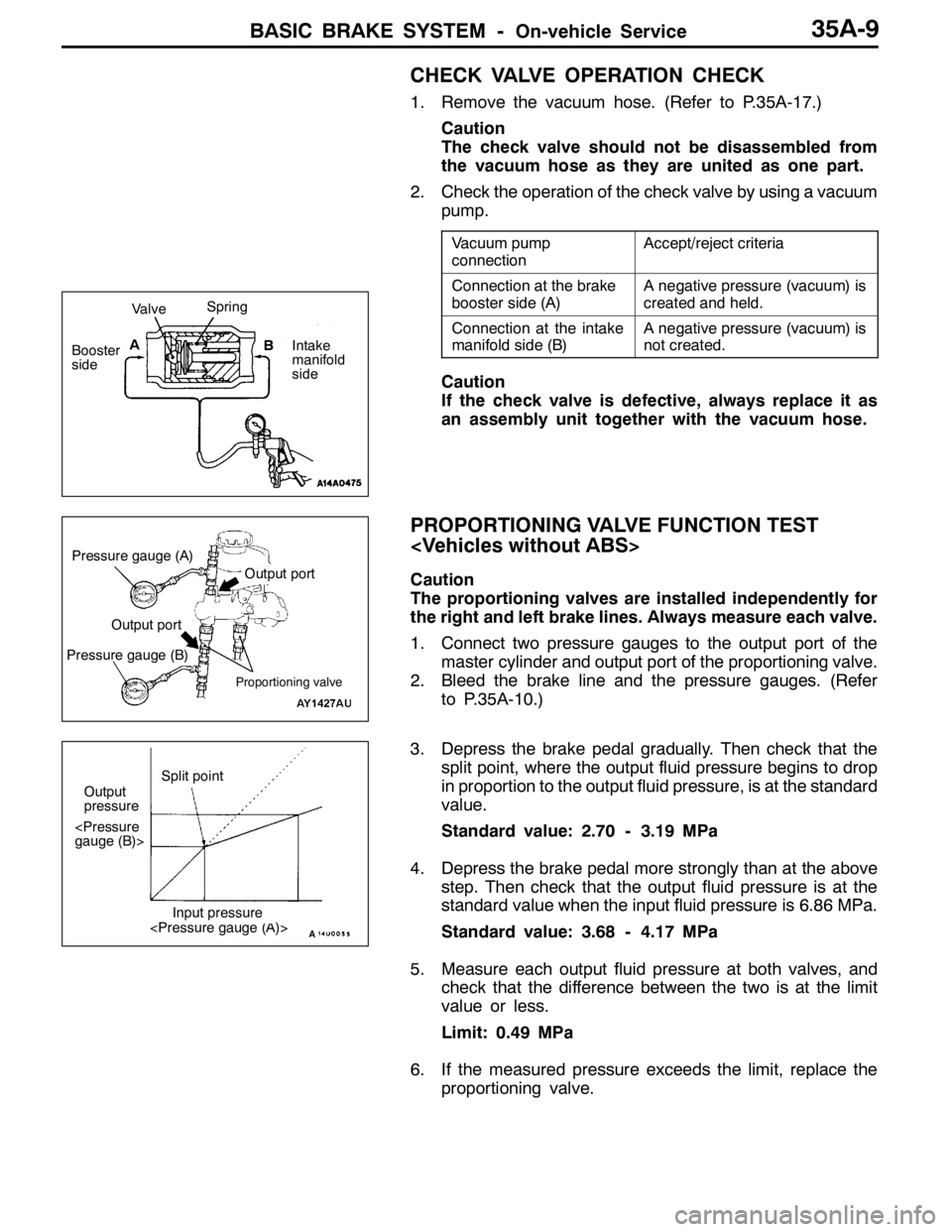
CHECK VALVE OPERATION CHECK
1. Remove the vacuum hose. (Refer to P.35A-17.)
Caution
The check valve should not be disassembled from
the vacuum hose as they are united as one part.
2. Check the operation of the check valve by using a vacuum
pump.
Vacuum pump
connectionAccept/reject criteria
Connection at the brake
booster side (A)A negative pressure (vacuum) is
created and held.
Connection at the intake
manifold side (B)A negative pressure (vacuum) is
not created.
Caution
If the check valve is defective, always replace it as
an assembly unit together with the vacuum hose.
PROPORTIONING VALVE FUNCTION TEST
Caution
The proportioning valves are installed independently for
the right and left brake lines. Always measure each valve.
1. Connect two pressure gauges to the output port of the
master cylinder and output port of the proportioning valve.
2. Bleed the brake line and the pressure gauges. (Refer
to P.35A-10.)
3. Depress the brake pedal gradually. Then check that the
split point, where the output fluid pressure begins to drop
in proportion to the output fluid pressure, is at the standard
value.
Standard value: 2.70 - 3.19 MPa
4. Depress the brake pedal more strongly than at the above
step. Then check that the output fluid pressure is at the
standard value when the input fluid pressure is 6.86 MPa.
Standard value: 3.68 - 4.17 MPa
5. Measure each output fluid pressure at both valves, and
check that the difference between the two is at the limit
value or less.
Limit: 0.49 MPa
6. If the measured pressure exceeds the limit, replace the
proportioning valve.
ValveSpring
Booster
sideA
B
Intake
manifold
side
Pressure gauge (A)
Proportioning valve
Output port
Output port
Pressure gauge (B)
Output
pressureSplit point
Page 1052 of 1449

BASIC BRAKE SYSTEM -On-vehicle Service35A-10
BLEEDING
Caution
Specified brake fluid: DOT3 or DOT4
Always use the specified brake fluid. Avoid using a
mixture of the specified brake fluid and other fluid.
MASTER CYLINDER BLEEDING
The master cylinder used has no check valve, so if bleeding
is carried out by the following procedure, bleeding of air from
the brake pipeline will become easier. (When brake fluid is
not contained in the master cylinder.)
1. Fill the reserve tank with brake fluid.
2. Keep the brake pedal depressed.
3. Have another person cover the master cylinder outlet
with a finger.
4. With the outlet still closed, release the brake pedal.
5. Repeat steps 2 - 4 three or four times to fill the inside
of the master cylinder with brake fluid.
BREMBO DISC BRAKE BLEEDING
Caution
Take care not to contact the parts or tools to the caliper
because the paint of caliper will be scratched. And if
there is brake fluid on the caliper, wipe out quickly.
Connect a vinyl tube to the outer end of the air bleeder screw
to bleed the circuit of air. Then, connect the vinyl tube to
the inner end and bleed the circuit of air. Except for these,
the conventional procedures shall be followed. After the circuit
has been bled of air, tighten both air bleeder screws securely.
BRAKE PIPE LINE BLEEDING
Bleed the air in the sequence shown in the figure.
Air bleeder screw
( ): R.H. drive vehicles
4 (2)
1 (3)
2 (4)
3 (1)
( ): R.H. drive vehicles
4, 6 (1, 3)
2 (5)
1, 3 (4, 6)
5 (2)
Vehicles with ABS
Vehicles without ABS