engine oil MITSUBISHI LANCER EVOLUTION 2007 Service Owner's Manual
[x] Cancel search | Manufacturer: MITSUBISHI, Model Year: 2007, Model line: LANCER EVOLUTION, Model: MITSUBISHI LANCER EVOLUTION 2007Pages: 1449, PDF Size: 56.82 MB
Page 418 of 1449
ENGINE -On-vehicle Service11A-12
12. Install the ignition coils and spark plugs.
13. Use the MUT-IIto erase the self-diagnosis codes or
disconnect the battery cable from the battery ( - ) terminal
for 10 seconds or more and then reconnect the cable.
NOTE
This will erase the diagnosis code resulting from the crank
angle sensor connector being disconnected.
MANIFOLD VACUUM CHECK
1. Set the vehicle to the pre-inspection condition.
2. Turn the ignition switch to the “LOCK” (OFF) position.
3. Set the engine tachometer or connect the MUT-II.
4. Check that the idle speed is within the standard value.
NOTE
When using the MUT-II, select the code No.22.
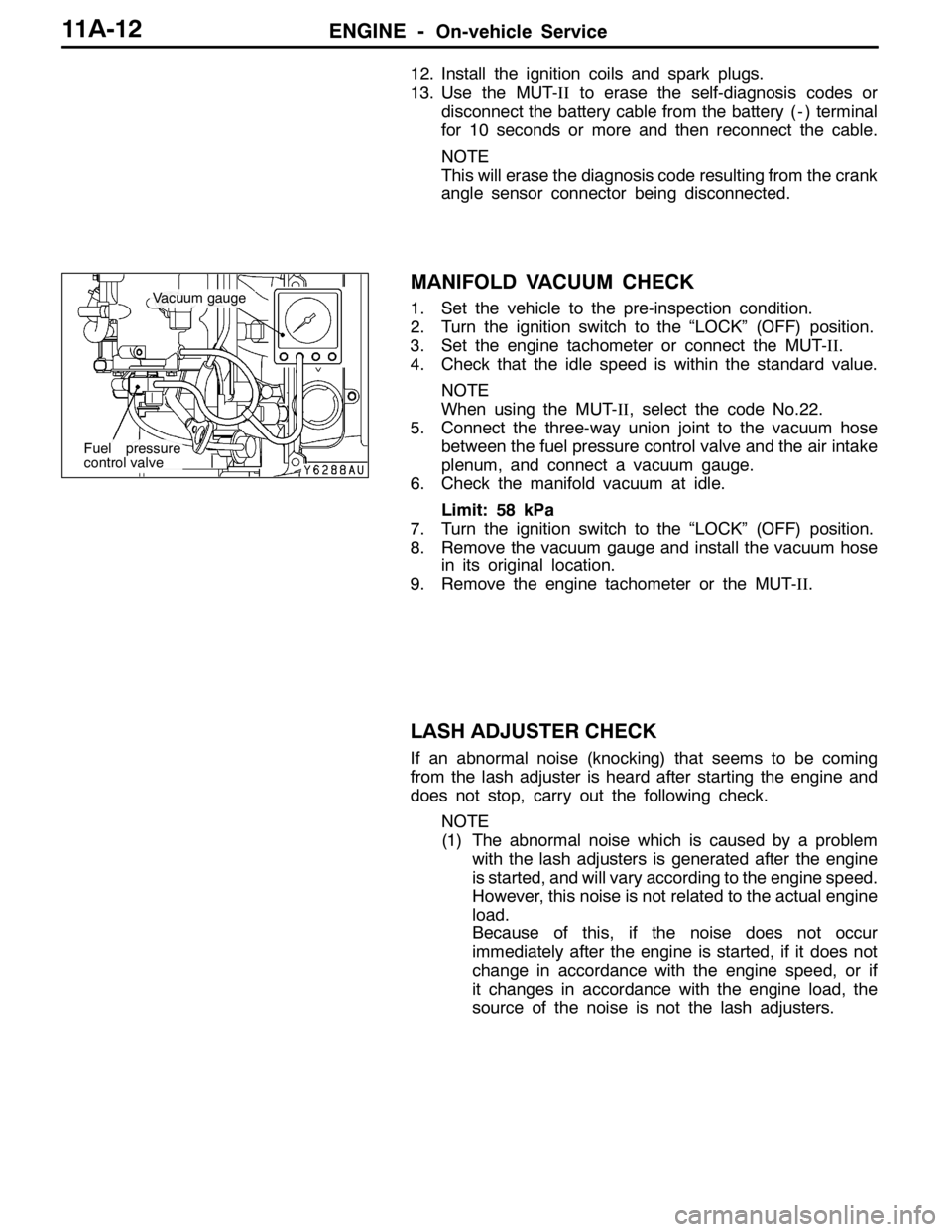
5. Connect the three-way union joint to the vacuum hose
between the fuel pressure control valve and the air intake
plenum, and connect a vacuum gauge.
6. Check the manifold vacuum at idle.
Limit: 58 kPa
7. Turn the ignition switch to the “LOCK” (OFF) position.
8. Remove the vacuum gauge and install the vacuum hose
in its original location.
9. Remove the engine tachometer or the MUT-II.
LASH ADJUSTER CHECK
If an abnormal noise (knocking) that seems to be coming
from the lash adjuster is heard after starting the engine and
does not stop, carry out the following check.
NOTE
(1) The abnormal noise which is caused by a problem
with the lash adjusters is generated after the engine
is started, and will vary according to the engine speed.
However, this noise is not related to the actual engine
load.
Because of this, if the noise does not occur
immediately after the engine is started, if it does not
change in accordance with the engine speed, or if
it changes in accordance with the engine load, the
source of the noise is not the lash adjusters.
Vacuum gauge
Fuel pressure
control valve
Page 419 of 1449

ENGINE -On-vehicle Service11A-13
(2) If there is a problem with the lash adjusters, the noise
will almost never disappear, even if the engine has
been run at idle to let it warm up.
The only case where the noise might disappear is
if the oil in the engine has not been looked after
properly and oil sludge has caused the lash adjusters
to stick.
1. Start the engine.
2. Check that the noise occurs immediately after the engine
is started, and that the noise changes in accordance
with changes in the engine speed.
If the noise does not occur immediately after the engine
is started, or if it does not change in accordance with
the engine speed, the problem is not being caused by
the lash adjusters, so check for some other cause of
the problem. Moreover, if the noise does not change in
accordance with the engine speed, the cause of the
problem is probably not with the engine. (In these cases,
the lash adjusters are normal.)
3. While the engine is idling, check that the noise level does
not change when the engine load is varied.
If the noise level changes, the cause of the noise is
probably parts striking because of worn crankshaft
bearings or connecting rod bearings. (In such cases, the
lash adjusters are normal.)
4. After the engine has warmed up, run it at idle and check
if any noise can be heard.
If the noise has become smaller or disappeared, oil sludge
could make the lash adjusters stick. Clean the lash
adjusters. (Refer to the Engine Workshop Manual.) If not
improved, go to step 5.
5. Bleed air from the lash adjusters.
6. If the noise has not disappeared even after the air
bleeding, clean the lash adjusters.
(Refer to GROUP 11B - Rocker Arms and Camshaft.)
NOTE
(1) If the vehicle is parked on a slope for a long period
of time, the amount of oil inside the lash adjuster
will decrease, and air may get into the high pressure
chamber when starting the engine.
(2) After parking the vehicle for long periods, the oil drains
out of the oil passage, and it takes time for the oil
to be supplied to the lash adjuster, so air can get
into the high pressure chamber.
(3) If either of the above situations occur, the abnormal
noise can be eliminated by bleeding the air from inside
the lash adjusters.
Page 420 of 1449

ENGINE -On-vehicle Service11A-14
1. Check the engine oil and replenish or replace the oil
if necessary.
NOTE
(1) If there is a only small amount of oil, air will be drawn
in through the oil screen and will get into the oil
passage.
(2) If the amount of oil is greater than normal, then the
oil will being mixed by the crankshaft and a large
amount of air may get mixed into the oil.
(3) If the oil is degenerated, air and oil will not separate
easily in oil, and the amount of air mixed into the
oil will increase.
(4) If the air which has been mixed in with the oil due
to any of the above reasons gets into the high pressure
chamber of the lash adjuster, the air inside the high
pressure chamber will be compressed when the valve
is open and the lash adjuster will over-compress,
resulting in abnormal noise when the valve closes.
This is the same effect as if the valve clearance is
adjusted to be too large by mistake. If the air inside
the lash adjusters is then released, the operation
of the lash adjusters will return to normal.
2. Run the engine at idle for 1 - 3 minutes to let it warm
up.
3. With no load on the engine, repeat the drive pattern shown
in the illustration at left and check if the abnormal noise
disappears. (The noise should normally disappear after
10 - 30 repetitions, but if there is no change in the noise
level after 30 repetitions or more, the problem is probably
not due to air inside the lash adjusters.)
4. After the noise has disappeared, repeat the drive pattern
shown in the illustration at left a further 5 times.
5. Run the engine at idle for 1 - 3 minutes and check that
the noise has disappeared.
Good
High-pressure chamber
Gradually open the
throttle valve.
Drive pattern for air bleeding
Close the throttle
valve.
Approx.
3,000 r/min
15
seconds15
seconds
Idle speed
Once
Page 422 of 1449
ENGINE -Crankshaft Pulley/Camshaft and Camshaft Oil Seal11A-16
REMOVAL SERVICE POINT
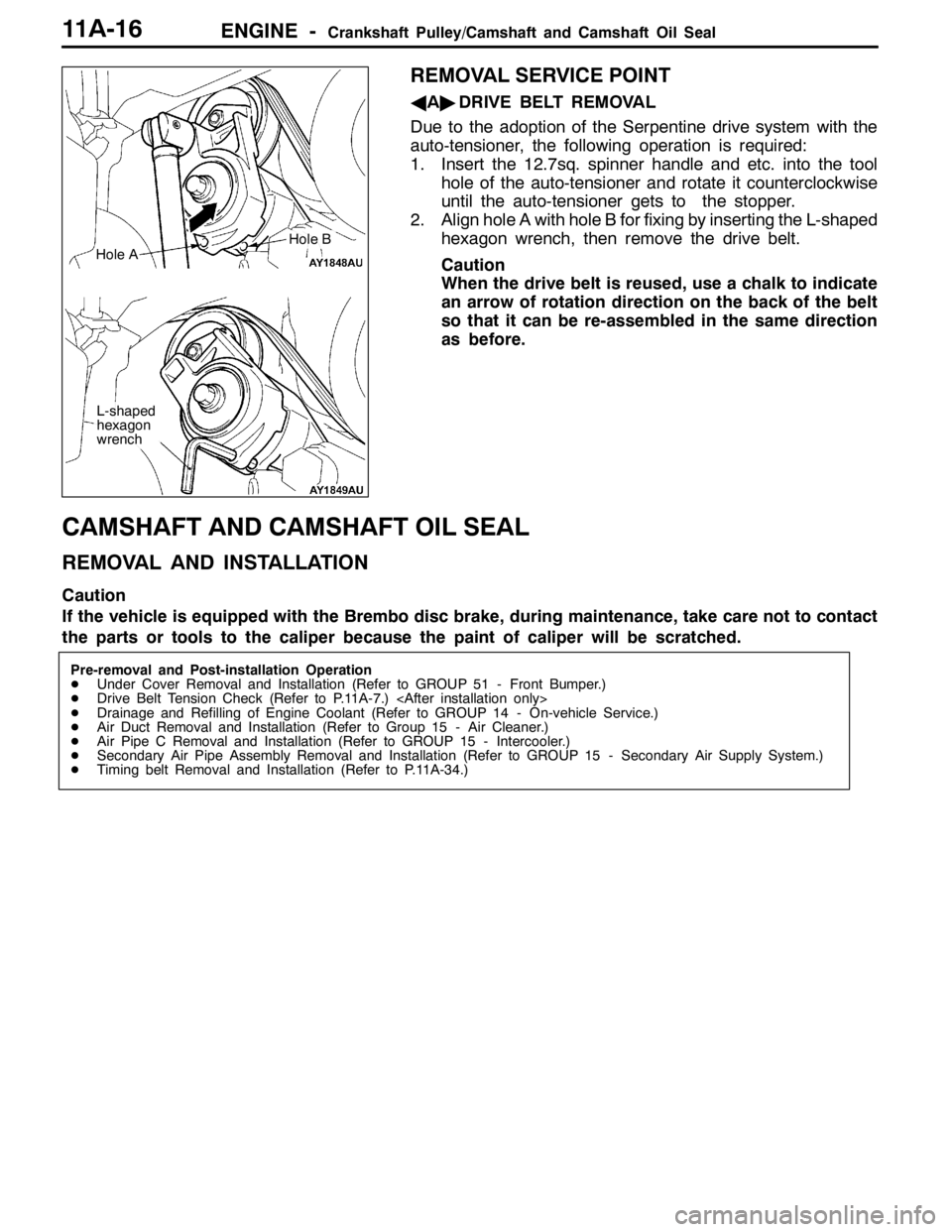
AA"DRIVE BELT REMOVAL
Due to the adoption of the Serpentine drive system with the
auto-tensioner, the following operation is required:
1. Insert the 12.7sq. spinner handle and etc. into the tool
hole of the auto-tensioner and rotate it counterclockwise
until the auto-tensioner gets to the stopper.
2. Align hole A with hole B for fixing by inserting the L-shaped
hexagon wrench, then remove the drive belt.
Caution
When the drive belt is reused, use a chalk to indicate
an arrow of rotation direction on the back of the belt
so that it can be re-assembled in the same direction
as before.
CAMSHAFT AND CAMSHAFT OIL SEAL
REMOVAL AND INSTALLATION
Caution
If the vehicle is equipped with the Brembo disc brake, during maintenance, take care not to contact
the parts or tools to the caliper because the paint of caliper will be scratched.
Pre-removal and Post-installation Operation
DUnder Cover Removal and Installation (Refer to GROUP 51 - Front Bumper.)
DDrive Belt Tension Check (Refer to P.11A-7.)
DDrainage and Refilling of Engine Coolant (Refer to GROUP 14 - On-vehicle Service.)
DAir Duct Removal and Installation (Refer to Group 15 - Air Cleaner.)
DAir Pipe C Removal and Installation (Refer to GROUP 15 - Intercooler.)
DSecondary Air Pipe Assembly Removal and Installation (Refer to GROUP 15 - Secondary Air Supply System.)
DTiming belt Removal and Installation (Refer to P.11A-34.)
Hole A
L-shaped
hexagon
wrench
Hole B
Page 423 of 1449

ENGINE -Camshaft and Camshaft Oil Seal11A-17
2
3 45
67 8
9
1012
11
11±1 N·m
8.8±1.0 N·m3.5±0.5 N·m
5.0±1.0 N·m
13
3.0±0.5 N·m
1
11±1 N·m
Removal steps
1. Accelerator cable connection
2. Center cover
DIgnition coil
(Refer to Group 16 - Ignition System.)
3. Crank angle sensor connector
4. Oxygen sensor connector
5. Control wiring harness connection6. Camshaft position sensor connector
7. Breather hose
8. PCV hose
"KA9. Rocker cover
"JA10. Camshaft end seal
11. Spark plug hole gasket
"IA12. Rocker cover gasket
AA""HA13. Radiator upper hose connection
Page 424 of 1449

ENGINE -Camshaft and Camshaft Oil Seal11A-18
Apply engine oil to all
sliding parts at the time
of installation.
10±2 N·m
89±9 N·m20±1 N·m
22±4 N·m
14±1 N·m
28
29 27 26
20
14 15
16
17 19
18222321
2425
11±1 N·m
30
14. Camshaft position sensor support
cover
15. Camshaft position sensor support
cover gasket
"GA16. Camshaft position sensing cylinder
"FA17. Camshaft position sensor support
AB""EA18. Camshaft sprocket
"DA19. Camshaft oil seal
"CA20. Camshaft bearing cap front"CA21. Camshaft bearing cap rear
"CA22. Camshaft bearing cap No. 2
"CA23. Camshaft bearing cap No. 5
"CA24. Camshaft bearing cap No. 3
"CA25. Camshaft bearing cap No. 4
"BA26. Intake camshaft
"BA27. Exhaust camshaft
28. Rocker arm
"AA29. Lash adjuster
30. Oil delivery body
Page 425 of 1449
ENGINE -Camshaft and Camshaft Oil Seal11A-19
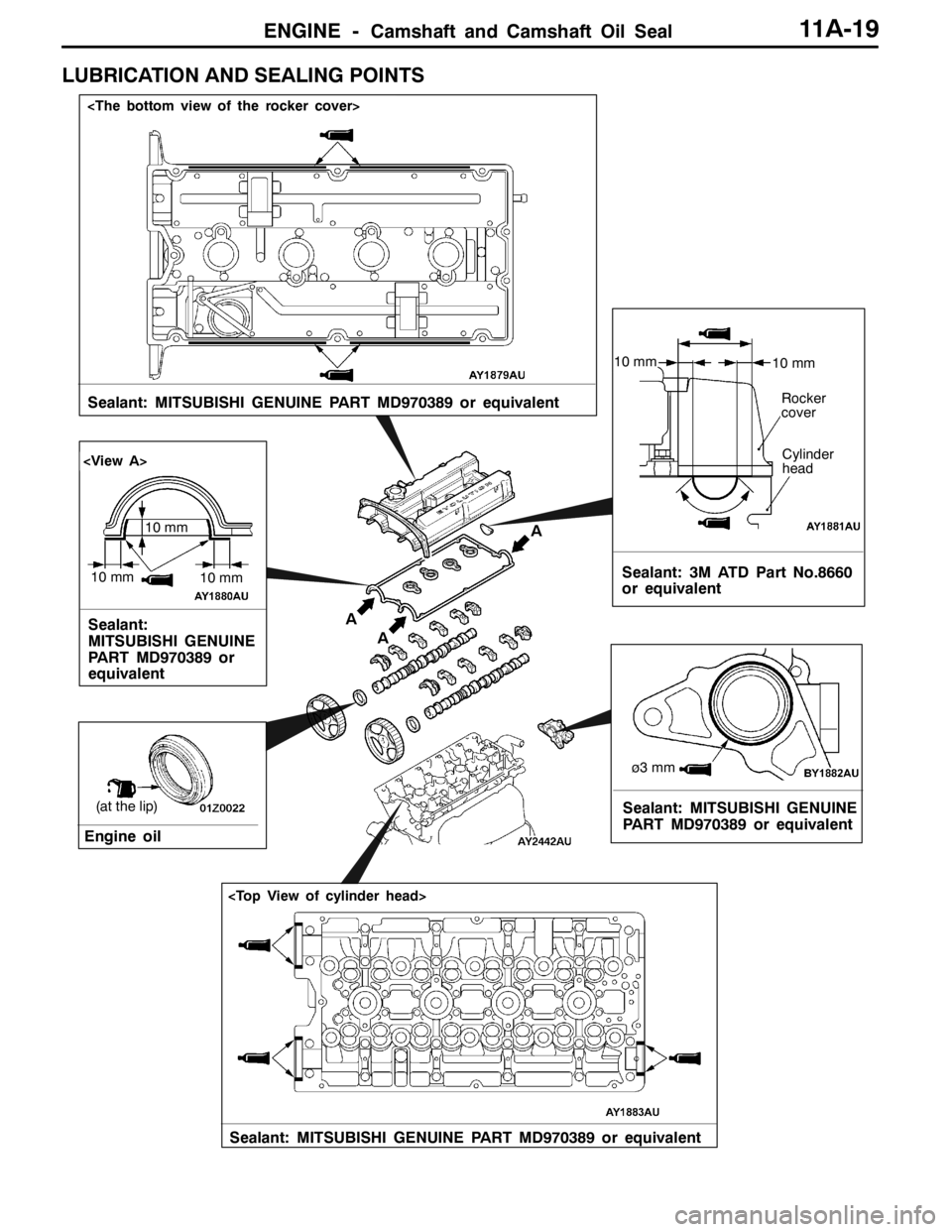
LUBRICATION AND SEALING POINTS
10 mm
10 mm
Sealant: MITSUBISHI GENUINE PART MD970389 or equivalent
(at the lip)
Engine oil
10 mm
Sealant: MITSUBISHI GENUINE
PART MD970389 or equivalent
Sealant: MITSUBISHI GENUINE PART MD970389 or equivalent
Sealant:
MITSUBISHI GENUINE
PART MD970389 or
equivalent
10 mm
10 mm
AA
A
Rocker
cover
Cylinder
head
ø3 mm
Sealant: 3M ATD Part No.8660
or equivalent
Page 426 of 1449
ENGINE -Camshaft and Camshaft Oil Seal11A-20
REMOVAL SERVICE POINTS
AA"RADIATOR UPPER HOSE DISCONNECTION
Indicate the mating marks on the radiator upper hose and
the hose clamp for release.
AB"CAMSHAFT SPROCKET REMOVAL
Hold the hexagon part of the camshaft with a wrench and
loosen the mounting bolt, then remove the camshaft sprocket.
INSTALLATION SERVICE POINTS
"AALASH ADJUSTER INSTALLATION
Caution
When the lash adjuster is reused, always install it after
cleaning and inspecting.
(Refer to GROUP 11B - Rocker Arms and Camshaft.)
"BAEXHAUST CAMSHAFT/INTAKE CAMSHAFT
INSTALLATION
1. Remove sealant remained on the cylinder head.
2. Apply engine oil to the cam and the journal of the camshaft.
3. Install the camshaft to the cylinder head.
Caution
Do not install wrong camshaft at the side of intake
or exhaust.
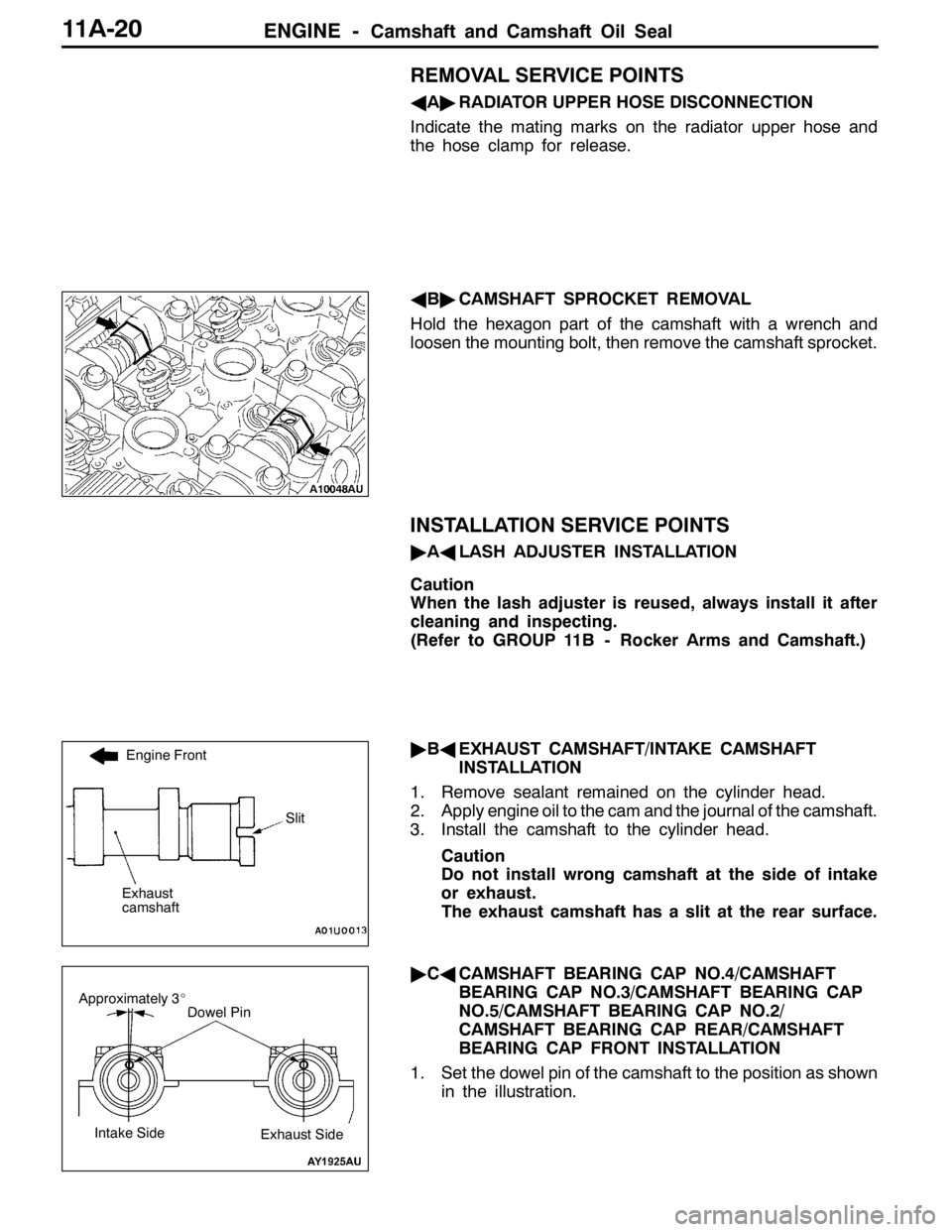
The exhaust camshaft has a slit at the rear surface.
"CACAMSHAFT BEARING CAP NO.4/CAMSHAFT
BEARING CAP NO.3/CAMSHAFT BEARING CAP
NO.5/CAMSHAFT BEARING CAP NO.2/
CAMSHAFT BEARING CAP REAR/CAMSHAFT
BEARING CAP FRONT INSTALLATION
1. Set the dowel pin of the camshaft to the position as shown
in the illustration.
Engine Front
Exhaust
camshaft
Slit
Dowel PinApproximately 3_
Intake SideExhaust Side
Page 427 of 1449
ENGINE -Camshaft and Camshaft Oil Seal11A-21
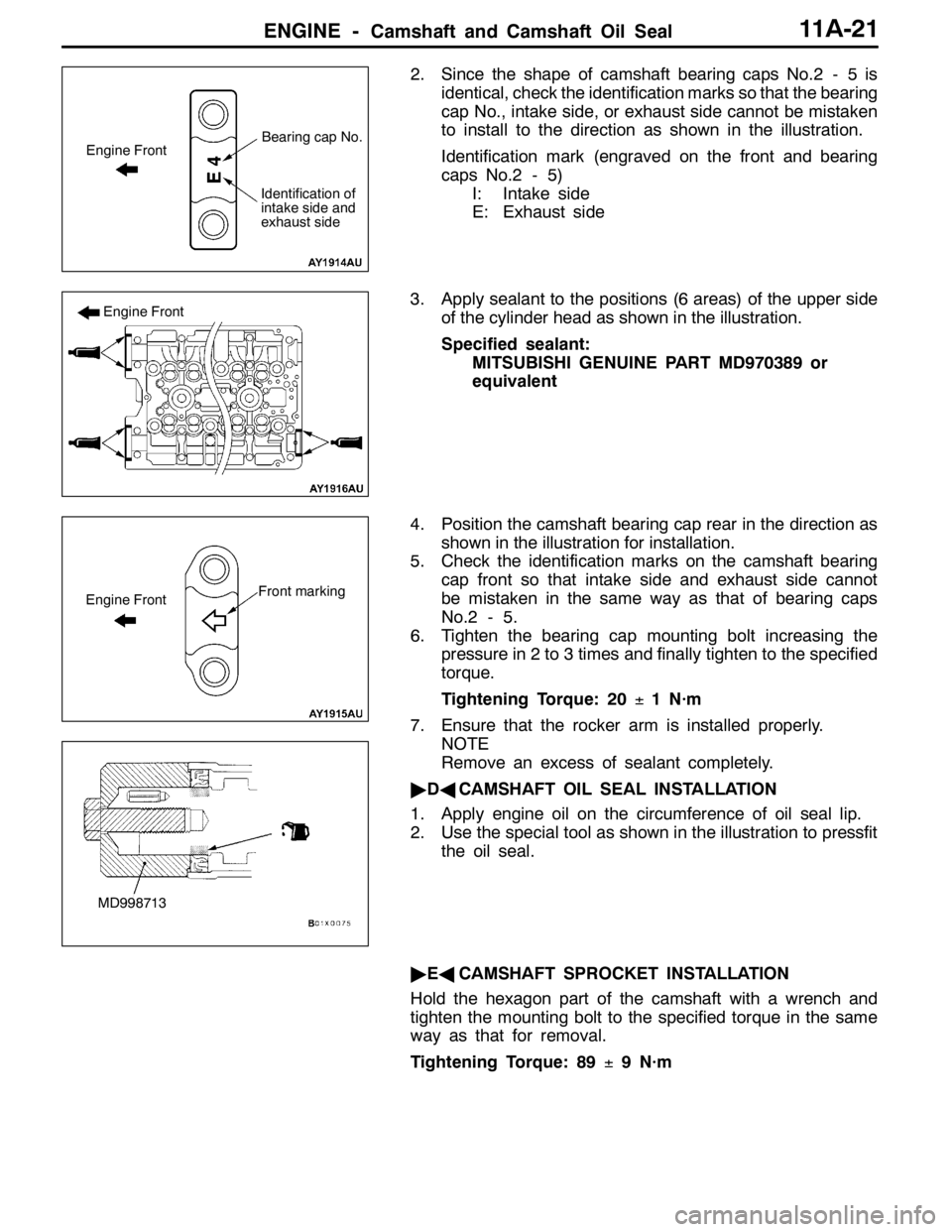
2. Since the shape of camshaft bearing caps No.2 - 5 is
identical, check the identification marks so that the bearing
cap No., intake side, or exhaust side cannot be mistaken
to install to the direction as shown in the illustration.
Identification mark (engraved on the front and bearing
caps No.2 - 5)
I: Intake side
E: Exhaust side
3. Apply sealant to the positions (6 areas) of the upper side
of the cylinder head as shown in the illustration.
Specified sealant:
MITSUBISHI GENUINE PART MD970389 or
equivalent
4. Position the camshaft bearing cap rear in the direction as
shown in the illustration for installation.
5. Check the identification marks on the camshaft bearing
cap front so that intake side and exhaust side cannot
be mistaken in the same way as that of bearing caps
No.2 - 5.
6. Tighten the bearing cap mounting bolt increasing the
pressure in 2 to 3 times and finally tighten to the specified
torque.
Tightening Torque: 20±1 N·m
7. Ensure that the rocker arm is installed properly.
NOTE
Remove an excess of sealant completely.
"DACAMSHAFT OIL SEAL INSTALLATION
1. Apply engine oil on the circumference of oil seal lip.
2. Use the special tool as shown in the illustration to pressfit
the oil seal.
"EACAMSHAFT SPROCKET INSTALLATION
Hold the hexagon part of the camshaft with a wrench and
tighten the mounting bolt to the specified torque in the same
way as that for removal.
Tightening Torque: 89±9 N·m
Engine FrontBearing cap No.
Identification of
intake side and
exhaust side
Engine Front
Front markingEngine Front
MD998713
Page 428 of 1449
ENGINE -Camshaft and Camshaft Oil Seal11A-22
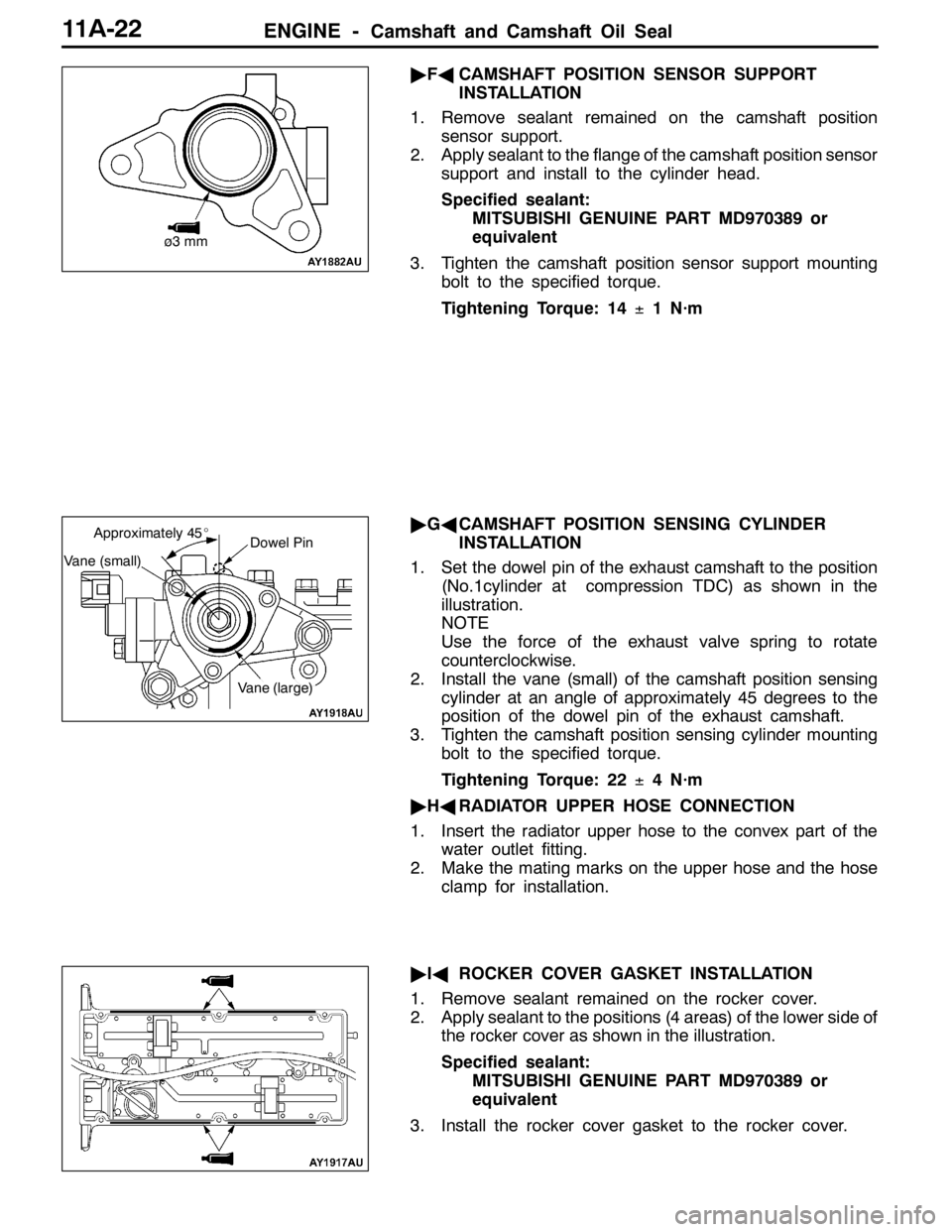
"FACAMSHAFT POSITION SENSOR SUPPORT
INSTALLATION
1. Remove sealant remained on the camshaft position
sensor support.
2. Apply sealant to the flange of the camshaft position sensor
support and install to the cylinder head.
Specified sealant:
MITSUBISHI GENUINE PART MD970389 or
equivalent
3. Tighten the camshaft position sensor support mounting
bolt to the specified torque.
Tightening Torque: 14±1 N·m
"GACAMSHAFT POSITION SENSING CYLINDER
INSTALLATION
1. Set the dowel pin of the exhaust camshaft to the position
(No.1cylinder at compression TDC) as shown in the
illustration.
NOTE
Use the force of the exhaust valve spring to rotate
counterclockwise.
2. Install the vane (small) of the camshaft position sensing
cylinder at an angle of approximately 45 degrees to the
position of the dowel pin of the exhaust camshaft.
3. Tighten the camshaft position sensing cylinder mounting
bolt to the specified torque.
Tightening Torque: 22±4 N·m
"HARADIATOR UPPER HOSE CONNECTION
1. Insert the radiator upper hose to the convex part of the
water outlet fitting.
2. Make the mating marks on the upper hose and the hose
clamp for installation.
"IAROCKER COVER GASKET INSTALLATION
1. Remove sealant remained on the rocker cover.
2. Apply sealant to the positions (4 areas) of the lower side of
the rocker cover as shown in the illustration.
Specified sealant:
MITSUBISHI GENUINE PART MD970389 or
equivalent
3. Install the rocker cover gasket to the rocker cover.
ø3 mm
Dowel Pin
Vane (small)
Approximately 45_
Vane (large)