transmission MITSUBISHI LANCER EVOLUTION 2007 Service Service Manual
[x] Cancel search | Manufacturer: MITSUBISHI, Model Year: 2007, Model line: LANCER EVOLUTION, Model: MITSUBISHI LANCER EVOLUTION 2007Pages: 1449, PDF Size: 56.82 MB
Page 824 of 1449
MANUAL TRANSMISSION - Troubleshooting
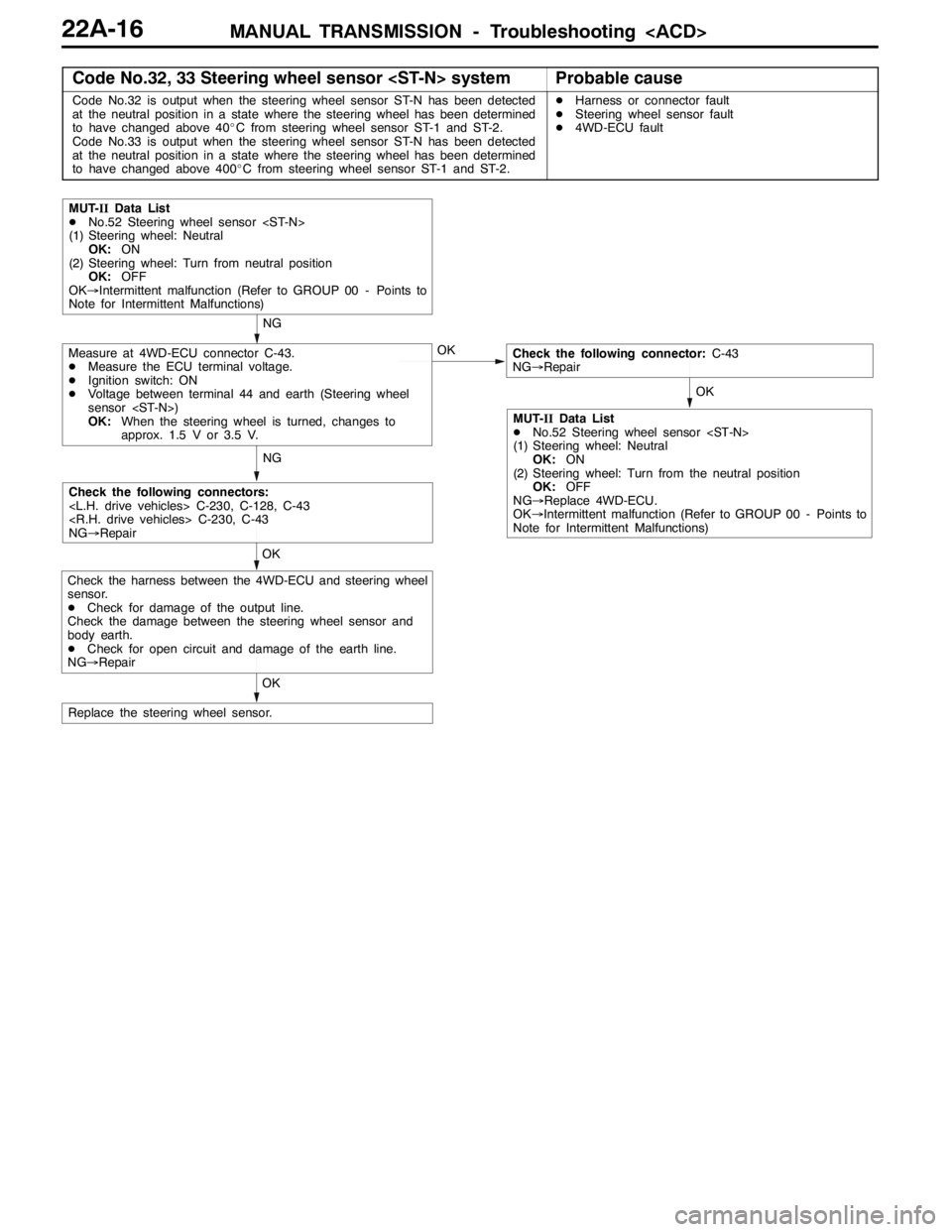
Code No.32, 33 Steering wheel sensor
Code No.32 is output when the steering wheel sensor ST-N has been detected
at the neutral position in a state where the steering wheel has been determined
to have changed above 40_C from steering wheel sensor ST-1 and ST-2.
Code No.33 is output when the steering wheel sensor ST-N has been detected
at the neutral position in a state where the steering wheel has been determined
to have changed above 400_C from steering wheel sensor ST-1 and ST-2.DHarness or connector fault
DSteering wheel sensor fault
D4WD-ECU fault
NG
OK
MUT-IIData List
DNo.52 Steering wheel sensor
(1) Steering wheel: Neutral
OK:ON
(2) Steering wheel: Turn from neutral position
OK:OFF
OK→Intermittent malfunction (Refer to GROUP 00 - Points to
Note for Intermittent Malfunctions)
Check the following connector:C-43
NG→Repair
NG
Check the following connectors:
NG→Repair
OK
Replace the steering wheel sensor.OK
Measure at 4WD-ECU connector C-43.
DMeasure the ECU terminal voltage.
DIgnition switch: ON
DVoltage between terminal 44 and earth (Steering wheel
sensor
OK:When the steering wheel is turned, changes to
approx. 1.5 V or 3.5 V.
MUT-IIData List
DNo.52 Steering wheel sensor
(1) Steering wheel: Neutral
OK:ON
(2) Steering wheel: Turn from the neutral position
OK:OFF
NG→Replace 4WD-ECU.
OK→Intermittent malfunction (Refer to GROUP 00 - Points to
Note for Intermittent Malfunctions)
OK
Check the harness between the 4WD-ECU and steering wheel
sensor.
DCheck for damage of the output line.
Check the damage between the steering wheel sensor and
body earth.
DCheck for open circuit and damage of the earth line.
NG→Repair
Page 825 of 1449
MANUAL TRANSMISSION - Troubleshooting
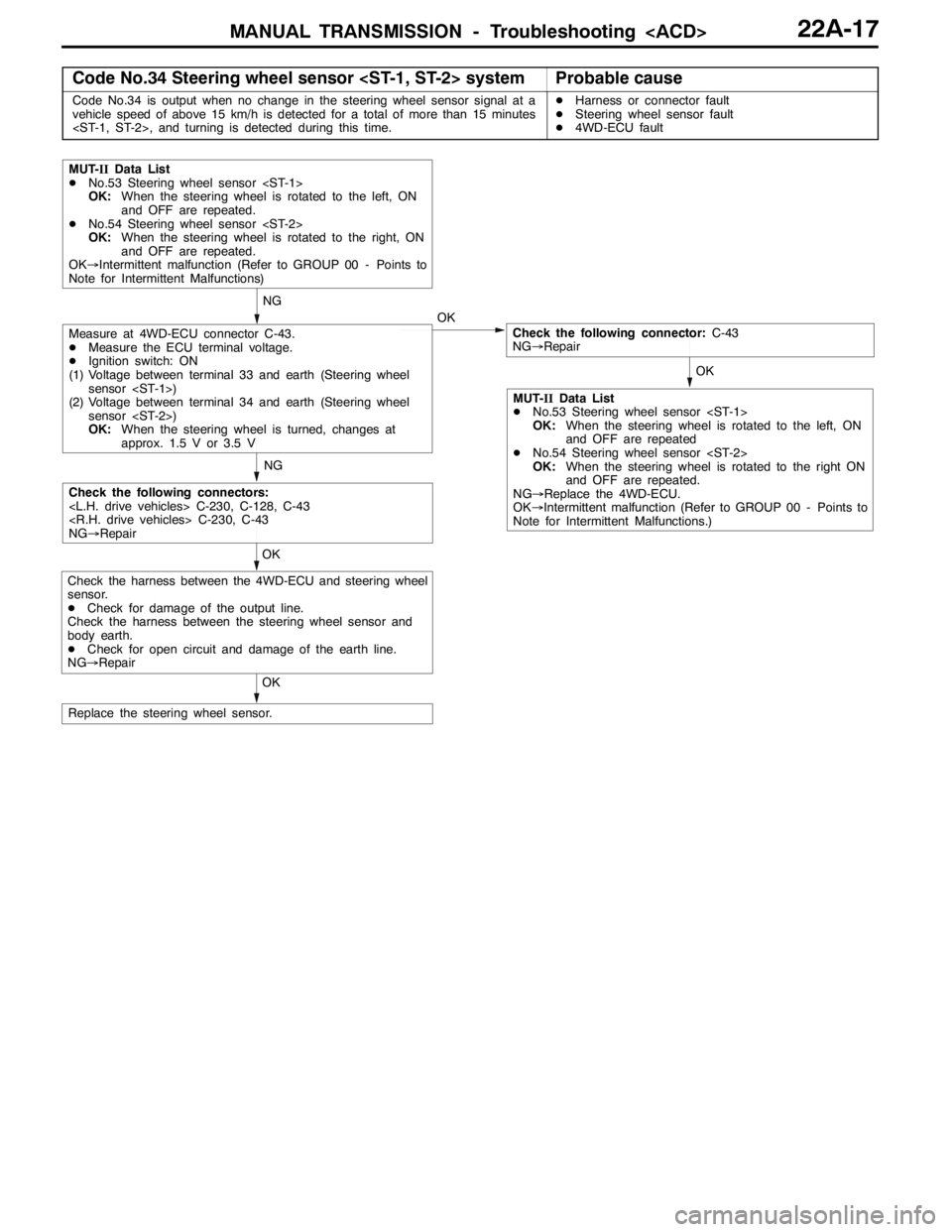
Code No.34 Steering wheel sensor
Code No.34 is output when no change in the steering wheel sensor signal at a
vehicle speed of above 15 km/h is detected for a total of more than 15 minutes
DSteering wheel sensor fault
D4WD-ECU fault
NG
OK
MUT-IIData List
DNo.53 Steering wheel sensor
OK:When the steering wheel is rotated to the left, ON
and OFF are repeated.
DNo.54 Steering wheel sensor
OK:When the steering wheel is rotated to the right, ON
and OFF are repeated.
OK→Intermittent malfunction (Refer to GROUP 00 - Points to
Note for Intermittent Malfunctions)
Check the following connector:C-43
NG→Repair
NG
Check the following connectors:
NG→Repair
OK
Replace the steering wheel sensor.OK
OK
Check the harness between the 4WD-ECU and steering wheel
sensor.
DCheck for damage of the output line.
Check the harness between the steering wheel sensor and
body earth.
DCheck for open circuit and damage of the earth line.
NG→Repair
Measure at 4WD-ECU connector C-43.
DMeasure the ECU terminal voltage.
DIgnition switch: ON
(1) Voltage between terminal 33 and earth (Steering wheel
sensor
(2) Voltage between terminal 34 and earth (Steering wheel
sensor
OK:When the steering wheel is turned, changes at
approx. 1.5 V or 3.5 V
MUT-IIData List
DNo.53 Steering wheel sensor
OK:When the steering wheel is rotated to the left, ON
and OFF are repeated
DNo.54 Steering wheel sensor
OK:When the steering wheel is rotated to the right ON
and OFF are repeated.
NG→Replace the 4WD-ECU.
OK→Intermittent malfunction (Refer to GROUP 00 - Points to
Note for Intermittent Malfunctions.)
Page 826 of 1449
MANUAL TRANSMISSION -Troubleshooting
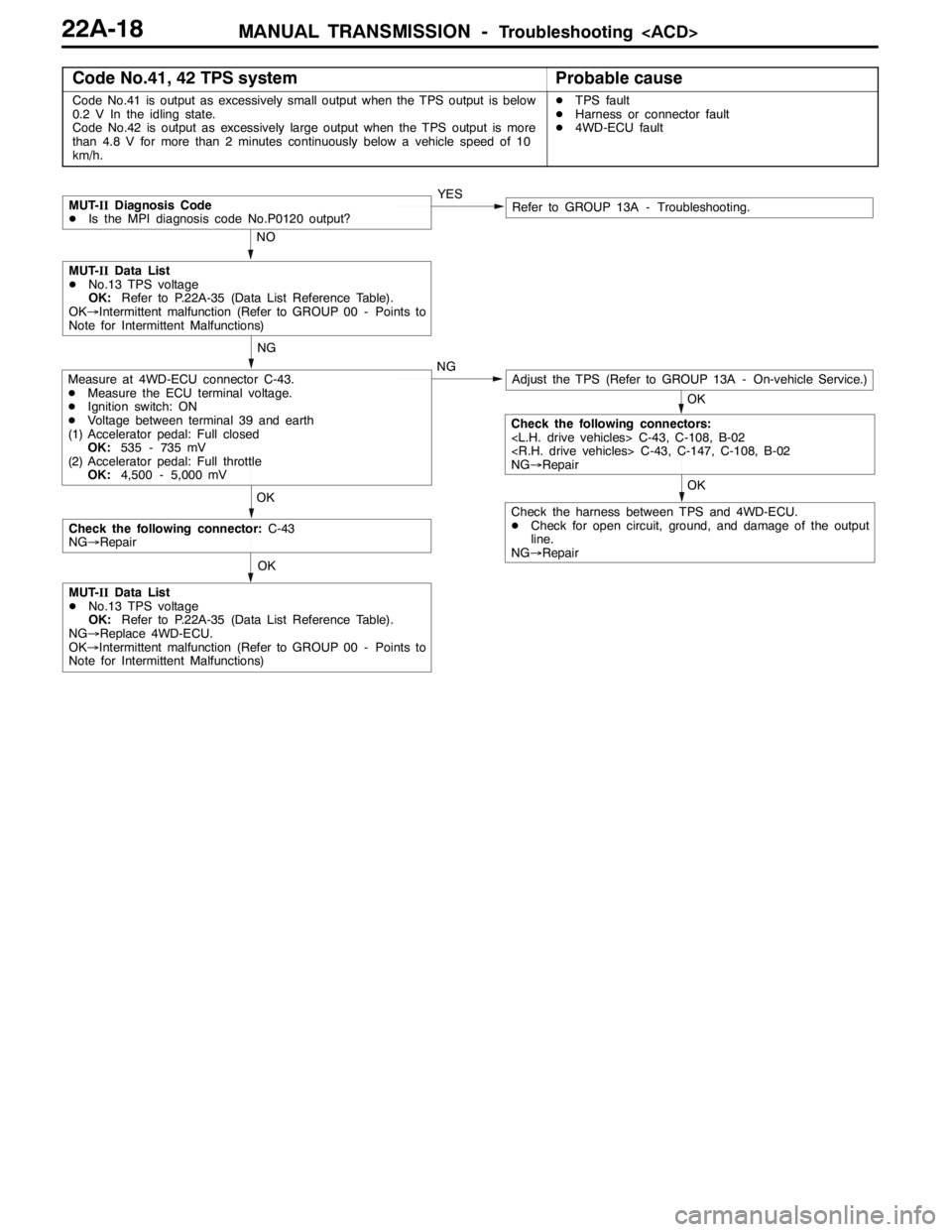
Code No.41, 42 TPS systemProbable cause
Code No.41 is output as excessively small output when the TPS output is below
0.2 V In the idling state.
Code No.42 is output as excessively large output when the TPS output is more
than 4.8 V for more than 2 minutes continuously below a vehicle speed of 10
km/h.DTPS fault
DHarness or connector fault
D4WD-ECU fault
OKOK
NG
NG
NO
Measure at 4WD-ECU connector C-43.
DMeasure the ECU terminal voltage.
DIgnition switch: ON
DVoltage between terminal 39 and earth
(1) Accelerator pedal: Full closed
OK:535 - 735 mV
(2) Accelerator pedal: Full throttle
OK:4,500 - 5,000 mV
Check the following connectors:
NG→Repair
MUT-IIData List
DNo.13 TPS voltage
OK:Refer to P.22A-35 (Data List Reference Table).
OK→Intermittent malfunction (Refer to GROUP 00 - Points to
Note for Intermittent Malfunctions)
OK
Check the following connector:C-43
NG→Repair
MUT-IIData List
DNo.13 TPS voltage
OK:Refer to P.22A-35 (Data List Reference Table).
NG→Replace 4WD-ECU.
OK→Intermittent malfunction (Refer to GROUP 00 - Points to
Note for Intermittent Malfunctions)
Check the harness between TPS and 4WD-ECU.
DCheck for open circuit, ground, and damage of the output
line.
NG→RepairOK
Adjust the TPS (Refer to GROUP 13A - On-vehicle Service.)
YESRefer to GROUP 13A - Troubleshooting.MUT-IIDiagnosis Code
DIs the MPI diagnosis code No.P0120 output?
Page 827 of 1449
MANUAL TRANSMISSION - Troubleshooting
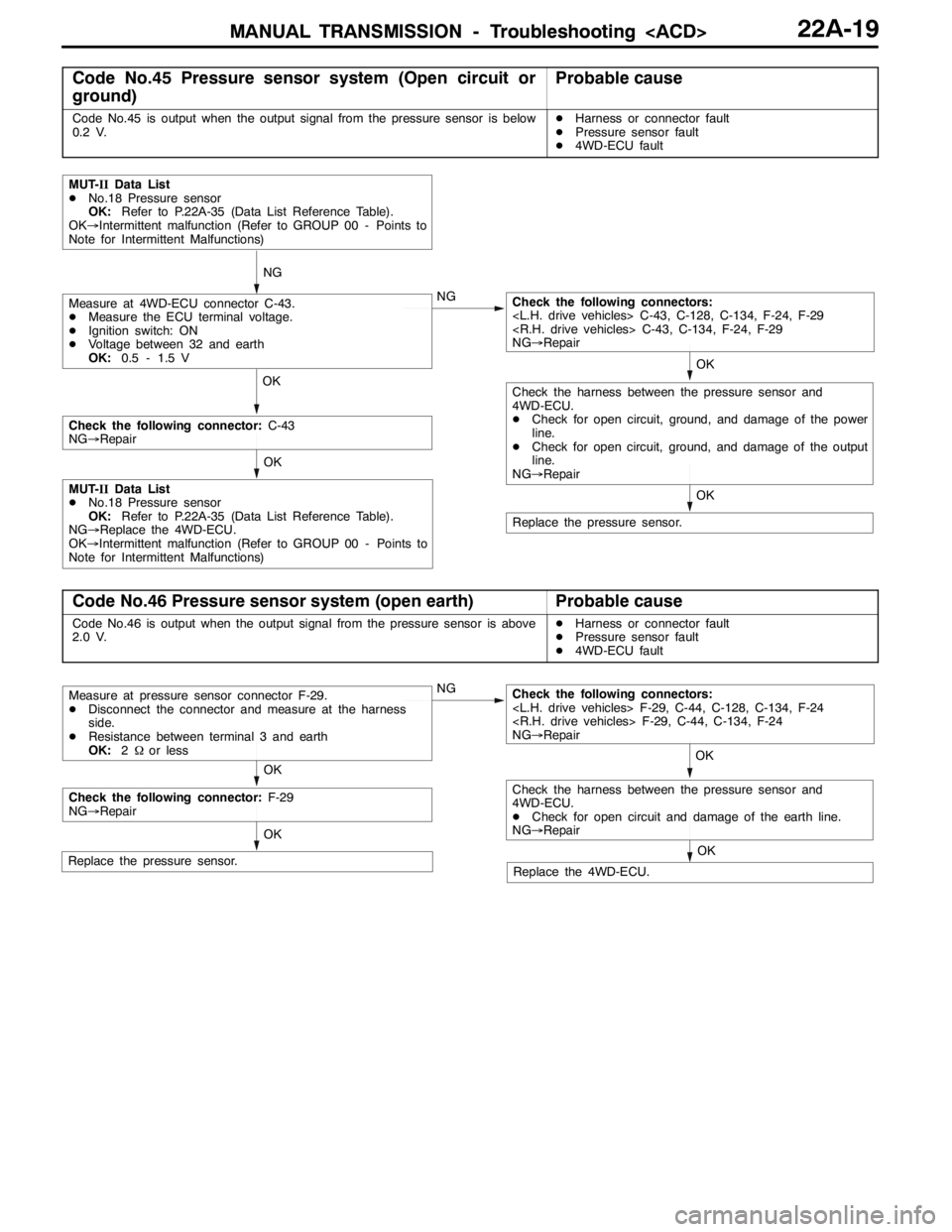
Code No.45 Pressure sensor system (Open circuit or
ground)Probable cause
Code No.45 is output when the output signal from the pressure sensor is below
0.2 V.DHarness or connector fault
DPressure sensor fault
D4WD-ECU fault
NG
MUT-IIData List
DNo.18 Pressure sensor
OK:Refer to P.22A-35 (Data List Reference Table).
OK→Intermittent malfunction (Refer to GROUP 00 - Points to
Note for Intermittent Malfunctions)
OK
OK NG
Check the harness between the pressure sensor and
4WD-ECU.
DCheck for open circuit, ground, and damage of the power
line.
DCheck for open circuit, ground, and damage of the output
line.
NG→Repair
OK
Replace the pressure sensor.
Measure at 4WD-ECU connector C-43.
DMeasure the ECU terminal voltage.
DIgnition switch: ON
DVoltage between 32 and earth
OK:0.5 - 1.5 VCheck the following connectors:
NG→Repair
MUT-IIData List
DNo.18 Pressure sensor
OK:Refer to P.22A-35 (Data List Reference Table).
NG→Replace the 4WD-ECU.
OK→Intermittent malfunction (Refer to GROUP 00 - Points to
Note for Intermittent Malfunctions)
OK
Check the following connector:C-43
NG→Repair
Code No.46 Pressure sensor system (open earth)Probable cause
Code No.46 is output when the output signal from the pressure sensor is above
2.0 V.DHarness or connector fault
DPressure sensor fault
D4WD-ECU fault
OKOK NG
Check the harness between the pressure sensor and
4WD-ECU.
DCheck for open circuit and damage of the earth line.
NG→Repair
OK
Replace the pressure sensor.
Measure at pressure sensor connector F-29.
DDisconnect the connector and measure at the harness
side.
DResistance between terminal 3 and earth
OK:2Ωor lessCheck the following connectors:
NG→Repair
Replace the 4WD-ECU.
OK
Check the following connector:F-29
NG→Repair
Page 828 of 1449

MANUAL TRANSMISSION - Troubleshooting
Code No.47 Pressure sensor system (Abnormal power
supply)Probable cause
Code No.47 is output when the pressure sensor power supply voltage is above
4.0V during pressure sensor power OFF or less than 4.0V during pressure
sensor power ON.DHarness or connector fault
DPressure sensor fault
D4WD-ECU fault
NG
MUT-IIData List
DNo.19 Pressure sensor power supply
OK:Approx. 5 V
OK→Intermittent malfunction (Refer to GROUP 00 - Points to
Note for Intermittent Malfunctions)
OKOK NG
Check the harness between the pressure sensor and
4WD-ECU.
DCheck for open circuit, ground and damage of the power
line.
NG→Repair
OK
Replace the pressure sensor.
Measure at 4WD-ECU connector C-43.
DMeasure the ECU terminal voltage.
DIgnition switch: ON
DVoltage between terminal 43 and earth
OK:4.9 - 5.1 VCheck the following connectors:
NG→Repair
OK
Check the following connector:C-43
NG→Repair
MUT-IIData List
DNo.19 Pressure sensor power supply
OK:Approx. 5 V
NG→Replace the 4WD-ECU.
OK→Intermittent malfunction (Refer to GROUP 00 - Points to
Note for Intermittent Malfunctions)
Page 829 of 1449
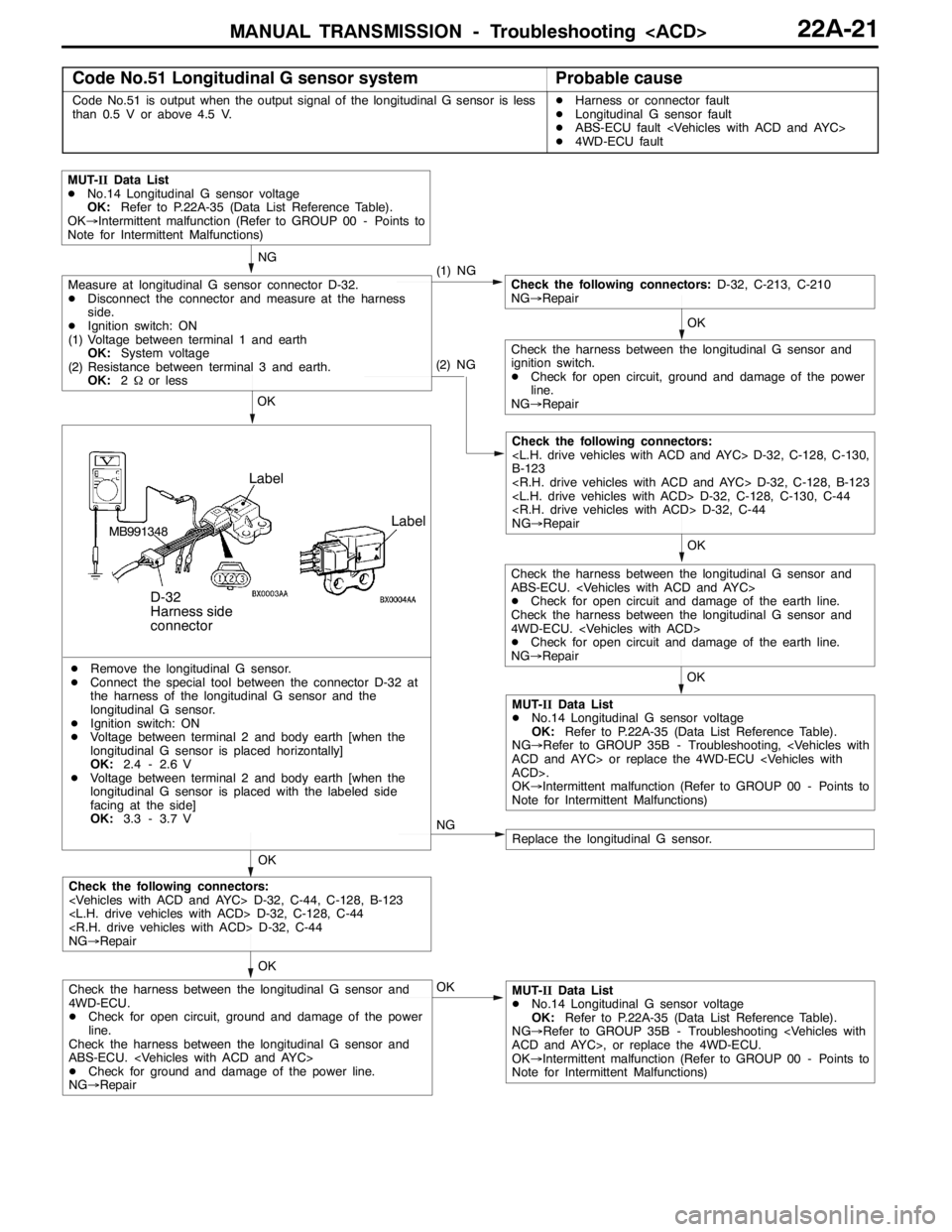
MANUAL TRANSMISSION - Troubleshooting
Code No.51 Longitudinal G sensor systemProbable cause
Code No.51 is output when the output signal of the longitudinal G sensor is less
than 0.5 V or above 4.5 V.DHarness or connector fault
DLongitudinal G sensor fault
DABS-ECU fault
D4WD-ECU fault
MB991348OK
OK
(1) NGNG
Check the following connectors:D-32, C-213, C-210
NG→Repair
MUT-IIData List
DNo.14 Longitudinal G sensor voltage
OK:Refer to P.22A-35 (Data List Reference Table).
OK→Intermittent malfunction (Refer to GROUP 00 - Points to
Note for Intermittent Malfunctions)
Check the harness between the longitudinal G sensor and
ignition switch.
DCheck for open circuit, ground and damage of the power
line.
NG→Repair
Measure at longitudinal G sensor connector D-32.
DDisconnect the connector and measure at the harness
side.
DIgnition switch: ON
(1) Voltage between terminal 1 and earth
OK:System voltage
(2) Resistance between terminal 3 and earth.
OK:2Ωor less
(2) NG
OK
Check the following connectors:
B-123
NG→Repair
OK
Check the harness between the longitudinal G sensor and
ABS-ECU.
DCheck for open circuit and damage of the earth line.
Check the harness between the longitudinal G sensor and
4WD-ECU.
DCheck for open circuit and damage of the earth line.
NG→Repair
MUT-IIData List
DNo.14 Longitudinal G sensor voltage
OK:Refer to P.22A-35 (Data List Reference Table).
NG→Refer to GROUP 35B - Troubleshooting,
OK→Intermittent malfunction (Refer to GROUP 00 - Points to
Note for Intermittent Malfunctions)
NG
DRemove the longitudinal G sensor.
DConnect the special tool between the connector D-32 at
the harness of the longitudinal G sensor and the
longitudinal G sensor.
DIgnition switch: ON
DVoltage between terminal 2 and body earth [when the
longitudinal G sensor is placed horizontally]
OK:2.4 - 2.6 V
DVoltage between terminal 2 and body earth [when the
longitudinal G sensor is placed with the labeled side
facing at the side]
OK:3.3 - 3.7 V
Label
D-32
Harness side
connector
Label
Replace the longitudinal G sensor.
OK
OK
Check the following connectors:
NG→Repair
OKMUT-IIData List
DNo.14 Longitudinal G sensor voltage
OK:Refer to P.22A-35 (Data List Reference Table).
NG→Refer to GROUP 35B - Troubleshooting
OK→Intermittent malfunction (Refer to GROUP 00 - Points to
Note for Intermittent Malfunctions)Check the harness between the longitudinal G sensor and
4WD-ECU.
DCheck for open circuit, ground and damage of the power
line.
Check the harness between the longitudinal G sensor and
ABS-ECU.
DCheck for ground and damage of the power line.
NG→Repair
Page 830 of 1449
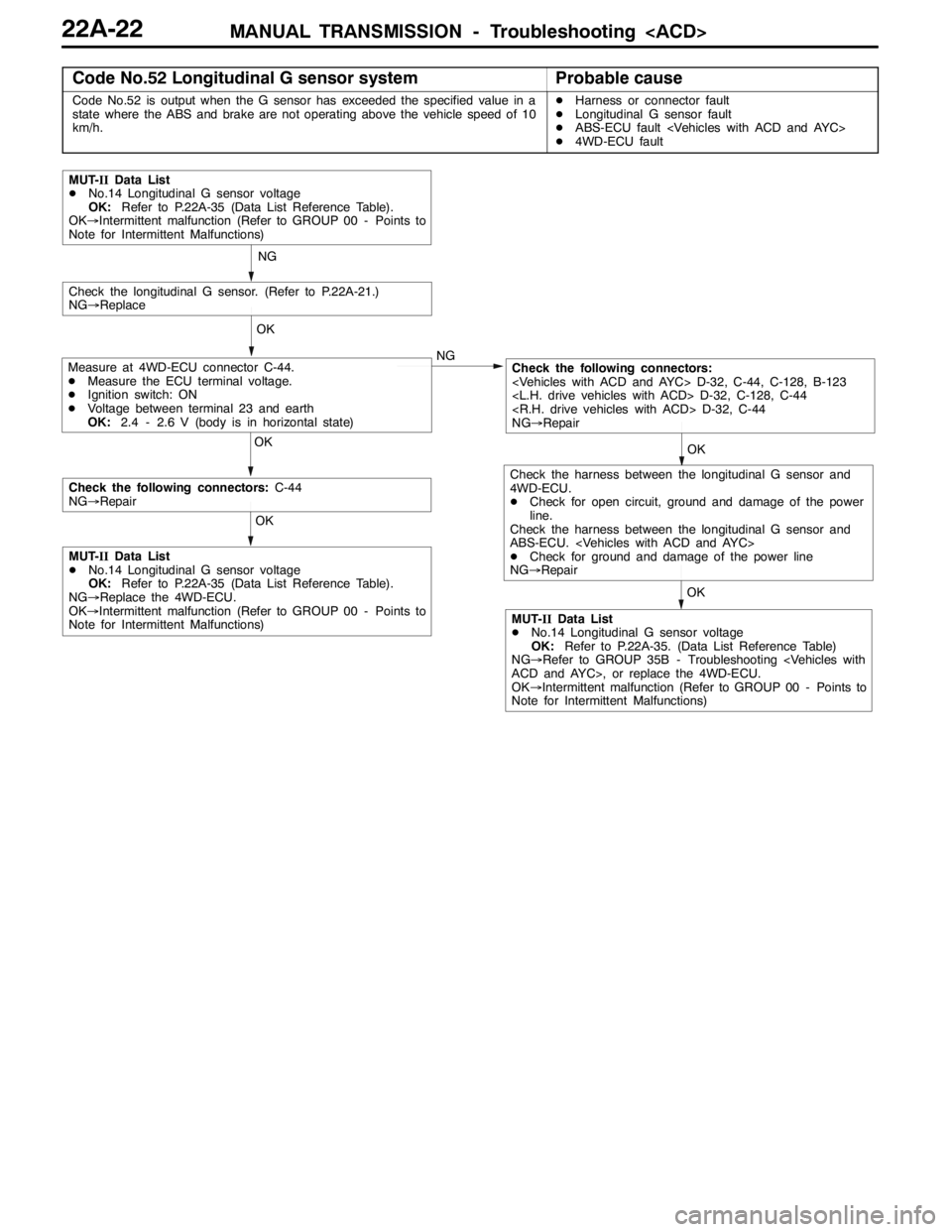
MANUAL TRANSMISSION - Troubleshooting
Code No.52 Longitudinal G sensor systemProbable cause
Code No.52 is output when the G sensor has exceeded the specified value in a
state where the ABS and brake are not operating above the vehicle speed of 10
km/h.DHarness or connector fault
DLongitudinal G sensor fault
DABS-ECU fault
D4WD-ECU fault
OK
NG
MUT-IIData List
DNo.14 Longitudinal G sensor voltage
OK:Refer to P.22A-35 (Data List Reference Table).
OK→Intermittent malfunction (Refer to GROUP 00 - Points to
Note for Intermittent Malfunctions)
OK
Check the following connectors:
NG→Repair NG
Check the longitudinal G sensor. (Refer to P.22A-21.)
NG→Replace
OK
MUT-IIData List
DNo.14 Longitudinal G sensor voltage
OK:Refer to P.22A-35. (Data List Reference Table)
NG→Refer to GROUP 35B - Troubleshooting
OK→Intermittent malfunction (Refer to GROUP 00 - Points to
Note for Intermittent Malfunctions)OK
Check the harness between the longitudinal G sensor and
4WD-ECU.
DCheck for open circuit, ground and damage of the power
line.
Check the harness between the longitudinal G sensor and
ABS-ECU.
DCheck for ground and damage of the power line
NG→Repair
Measure at 4WD-ECU connector C-44.
DMeasure the ECU terminal voltage.
DIgnition switch: ON
DVoltage between terminal 23 and earth
OK:2.4 - 2.6 V (body is in horizontal state)
OK
Check the following connectors:C-44
NG→Repair
MUT-IIData List
DNo.14 Longitudinal G sensor voltage
OK:Refer to P.22A-35 (Data List Reference Table).
NG→Replace the 4WD-ECU.
OK→Intermittent malfunction (Refer to GROUP 00 - Points to
Note for Intermittent Malfunctions)
Page 831 of 1449
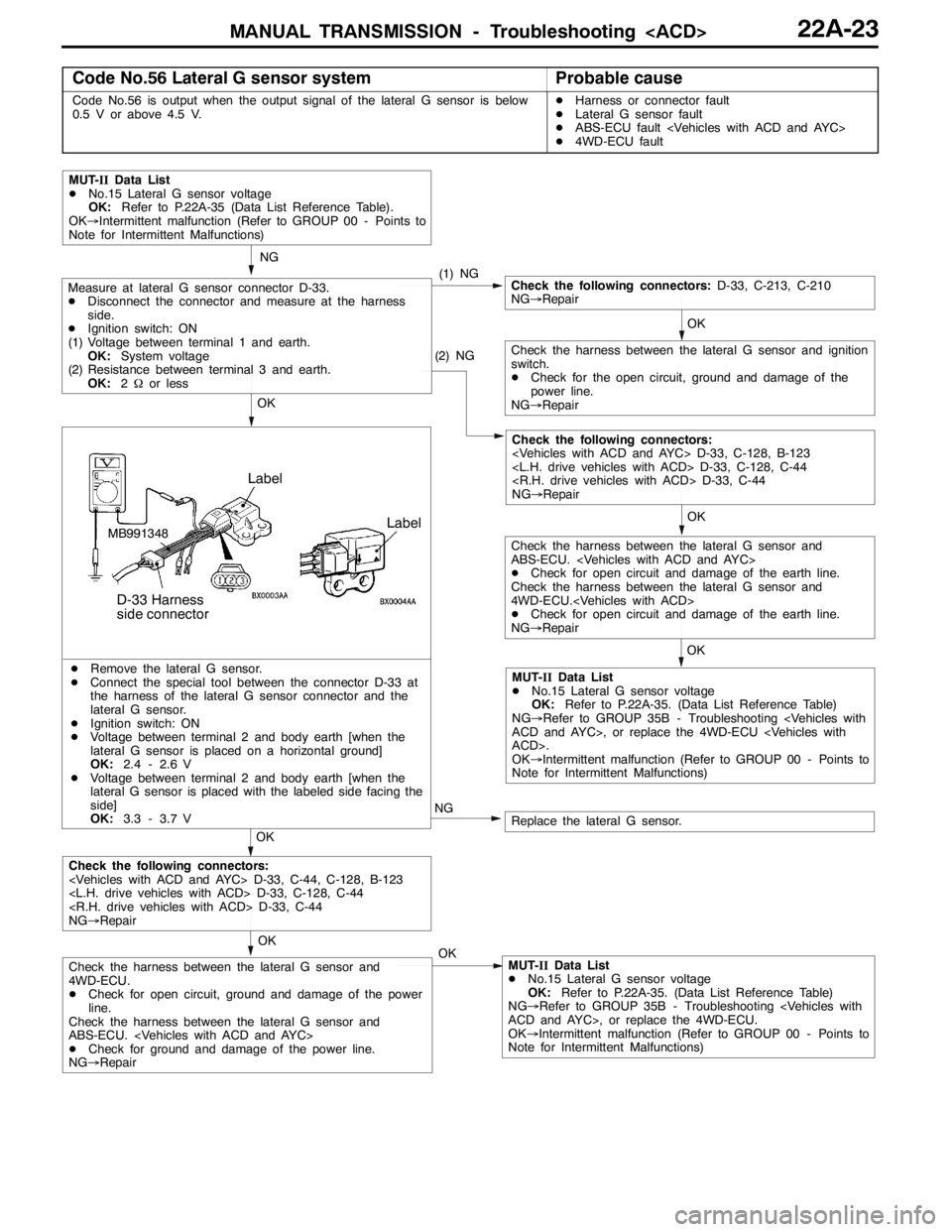
MANUAL TRANSMISSION - Troubleshooting
Code No.56 Lateral G sensor systemProbable cause
Code No.56 is output when the output signal of the lateral G sensor is below
0.5 V or above 4.5 V.DHarness or connector fault
DLateral G sensor fault
DABS-ECU fault
D4WD-ECU fault
OK
OK
(1) NG
NG
Check the following connectors:D-33, C-213, C-210
NG→Repair
MUT-IIData List
DNo.15 Lateral G sensor voltage
OK:Refer to P.22A-35 (Data List Reference Table).
OK→Intermittent malfunction (Refer to GROUP 00 - Points to
Note for Intermittent Malfunctions)
Check the harness between the lateral G sensor and ignition
switch.
DCheck for the open circuit, ground and damage of the
power line.
NG→Repair
Measure at lateral G sensor connector D-33.
DDisconnect the connector and measure at the harness
side.
DIgnition switch: ON
(1) Voltage between terminal 1 and earth.
OK:System voltage
(2) Resistance between terminal 3 and earth.
OK:2Ωor less
(2) NG
OK
Check the following connectors:
NG→Repair
OK
Check the harness between the lateral G sensor and
ABS-ECU.
DCheck for open circuit and damage of the earth line.
Check the harness between the lateral G sensor and
4WD-ECU.
DCheck for open circuit and damage of the earth line.
NG→Repair
MUT-IIData List
DNo.15 Lateral G sensor voltage
OK:Refer to P.22A-35. (Data List Reference Table)
NG→Refer to GROUP 35B - Troubleshooting
OK→Intermittent malfunction (Refer to GROUP 00 - Points to
Note for Intermittent Malfunctions)
NGDRemove the lateral G sensor.
DConnect the special tool between the connector D-33 at
the harness of the lateral G sensor connector and the
lateral G sensor.
DIgnition switch: ON
DVoltage between terminal 2 and body earth [when the
lateral G sensor is placed on a horizontal ground]
OK:2.4 - 2.6 V
DVoltage between terminal 2 and body earth [when the
lateral G sensor is placed with the labeled side facing the
side]
OK:3.3 - 3.7 V
Label
D-33 Harness
side connector
LabelMB991348
Replace the lateral G sensor.
OK
OK
Check the following connectors:
NG→Repair
OKMUT-IIData List
DNo.15 Lateral G sensor voltage
OK:Refer to P.22A-35. (Data List Reference Table)
NG→Refer to GROUP 35B - Troubleshooting
OK→Intermittent malfunction (Refer to GROUP 00 - Points to
Note for Intermittent Malfunctions)Check the harness between the lateral G sensor and
4WD-ECU.
DCheck for open circuit, ground and damage of the power
line.
Check the harness between the lateral G sensor and
ABS-ECU.
DCheck for ground and damage of the power line.
NG→Repair
Page 832 of 1449
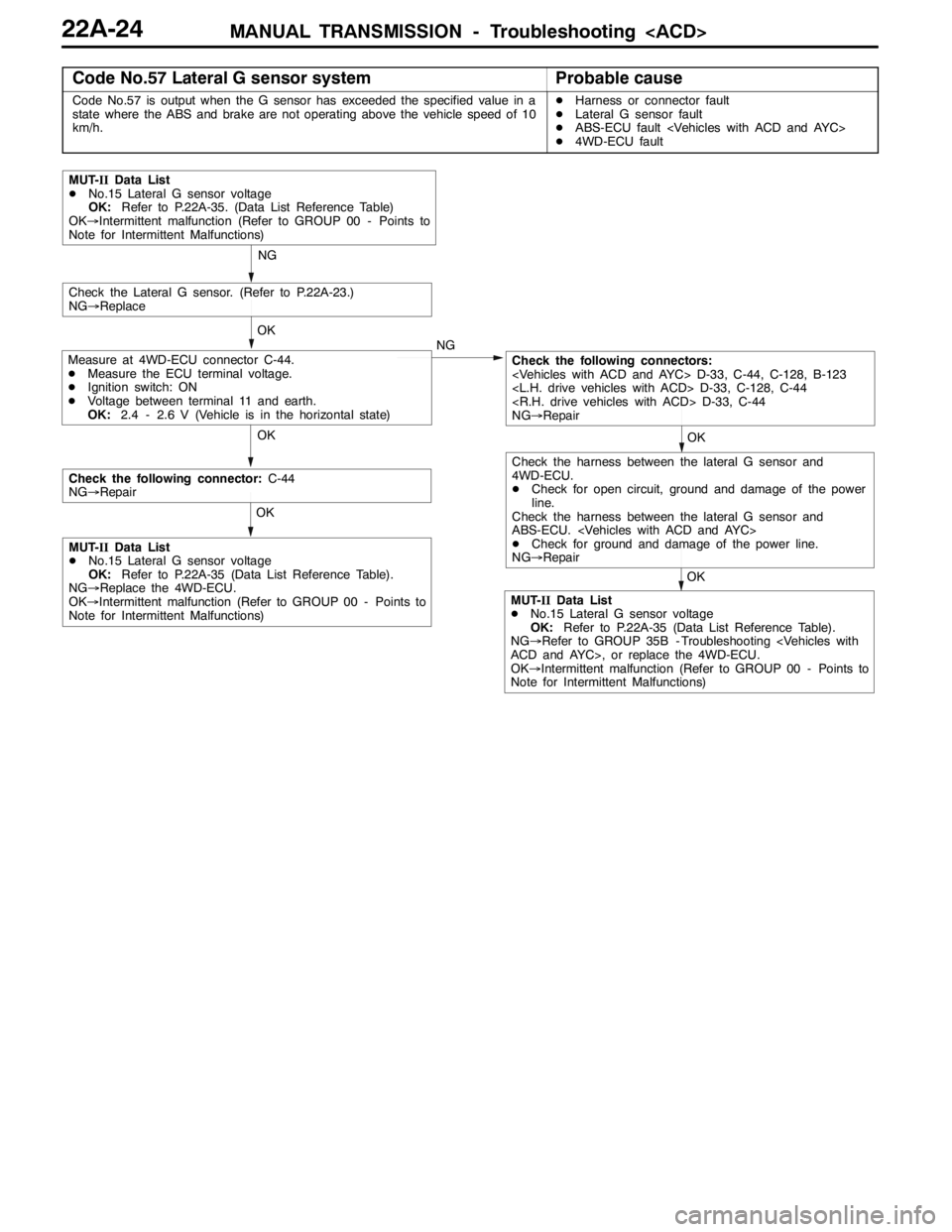
MANUAL TRANSMISSION - Troubleshooting
Code No.57 Lateral G sensor systemProbable cause
Code No.57 is output when the G sensor has exceeded the specified value in a
state where the ABS and brake are not operating above the vehicle speed of 10
km/h.DHarness or connector fault
DLateral G sensor fault
DABS-ECU fault
D4WD-ECU fault
OK
NG
MUT-IIData List
DNo.15 Lateral G sensor voltage
OK:Refer to P.22A-35. (Data List Reference Table)
OK→Intermittent malfunction (Refer to GROUP 00 - Points to
Note for Intermittent Malfunctions)
OK
Check the following connectors:
NG→Repair NG
Check the Lateral G sensor. (Refer to P.22A-23.)
NG→Replace
OK
MUT-IIData List
DNo.15 Lateral G sensor voltage
OK:Refer to P.22A-35 (Data List Reference Table).
NG→Refer to GROUP 35B - Troubleshooting
OK→Intermittent malfunction (Refer to GROUP 00 - Points to
Note for Intermittent Malfunctions)OK
Check the harness between the lateral G sensor and
4WD-ECU.
DCheck for open circuit, ground and damage of the power
line.
Check the harness between the lateral G sensor and
ABS-ECU.
DCheck for ground and damage of the power line.
NG→Repair
Measure at 4WD-ECU connector C-44.
DMeasure the ECU terminal voltage.
DIgnition switch: ON
DVoltage between terminal 11 and earth.
OK:2.4 - 2.6 V (Vehicle is in the horizontal state)
OK
Check the following connector:C-44
NG→Repair
MUT-IIData List
DNo.15 Lateral G sensor voltage
OK:Refer to P.22A-35 (Data List Reference Table).
NG→Replace the 4WD-ECU.
OK→Intermittent malfunction (Refer to GROUP 00 - Points to
Note for Intermittent Malfunctions)
Page 833 of 1449
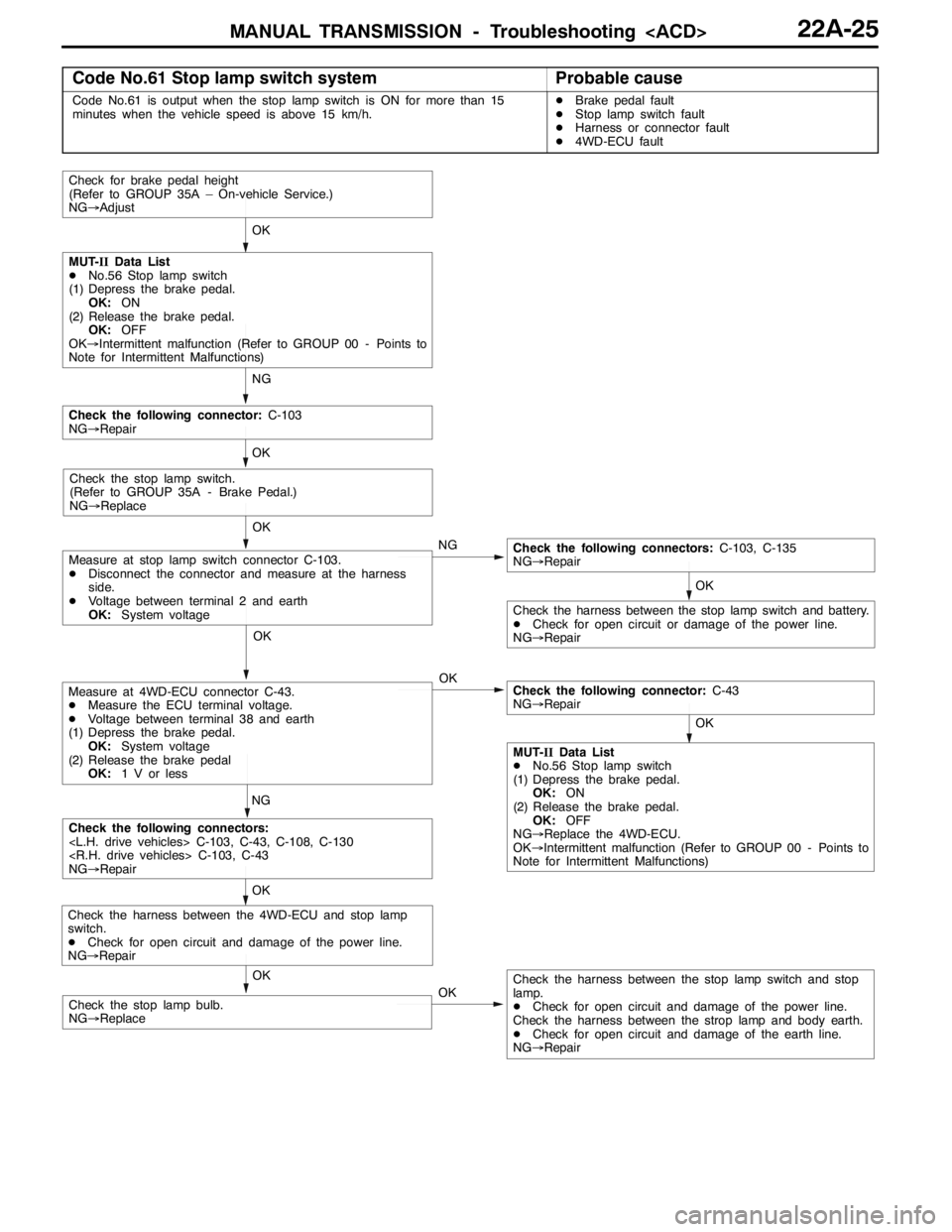
MANUAL TRANSMISSION - Troubleshooting
Code No.61 Stop lamp switch systemProbable cause
Code No.61 is output when the stop lamp switch is ON for more than 15
minutes when the vehicle speed is above 15 km/h.DBrake pedal fault
DStop lamp switch fault
DHarness or connector fault
D4WD-ECU fault
OK
OK
OK
NG
OK
Check for brake pedal height
(Refer to GROUP 35A – On-vehicle Service.)
NG→Adjust
NG
MUT-IIData List
DNo.56 Stop lamp switch
(1) Depress the brake pedal.
OK:ON
(2) Release the brake pedal.
OK:OFF
OK→Intermittent malfunction (Refer to GROUP 00 - Points to
Note for Intermittent Malfunctions)
OK
Check the following connector:C-103
NG→Repair
Check the stop lamp switch.
(Refer to GROUP 35A - Brake Pedal.)
NG→Replace
NG
OK
Check the following connectors:C-103, C-135
NG→Repair
Check the harness between the stop lamp switch and battery.
DCheck for open circuit or damage of the power line.
NG→Repair
OK
Measure at stop lamp switch connector C-103.
DDisconnect the connector and measure at the harness
side.
DVoltage between terminal 2 and earth
OK:System voltage
Measure at 4WD-ECU connector C-43.
DMeasure the ECU terminal voltage.
DVoltage between terminal 38 and earth
(1) Depress the brake pedal.
OK:System voltage
(2) Release the brake pedal
OK:1 V or less
OK
Check the following connectors:
NG→Repair
OKCheck the harness between the stop lamp switch and stop
lamp.
DCheck for open circuit and damage of the power line.
Check the harness between the strop lamp and body earth.
DCheck for open circuit and damage of the earth line.
NG→Repair
Check the harness between the 4WD-ECU and stop lamp
switch.
DCheck for open circuit and damage of the power line.
NG→Repair
Check the following connector:C-43
NG→Repair
MUT-IIData List
DNo.56 Stop lamp switch
(1) Depress the brake pedal.
OK:ON
(2) Release the brake pedal.
OK:OFF
NG→Replace the 4WD-ECU.
OK→Intermittent malfunction (Refer to GROUP 00 - Points to
Note for Intermittent Malfunctions)
OK
Check the stop lamp bulb.
NG→Replace