idle MITSUBISHI LANCER EVOLUTION 2007 Service Workshop Manual
[x] Cancel search | Manufacturer: MITSUBISHI, Model Year: 2007, Model line: LANCER EVOLUTION, Model: MITSUBISHI LANCER EVOLUTION 2007Pages: 1449, PDF Size: 56.82 MB
Page 643 of 1449

MPI -Troubleshooting13A-111
Terminal No.Normal condition Check condition (Engine condition) Check item
37Power steering fluid
pressure switchEngine: Idling after
warming upWhen steering wheel
is stationarySystem voltage
When steering wheel
is turned1 V or less
38Engine control relayIgnition switch: “LOCK” (OFF)System voltage
Ignition switch: “ON”1 V or less
39Fuel pump relay 3While engine is idling, suddenly depress the
accelerator pedal.Temporarily rises slightly
from 1 V or less.
41Alternator FR
terminalDEngine: After warm-up, idle operation
DRadiator fan: Not operating
DHead lamp: OFF→ON
DStop lamp: OFF→ON
DRear deffogger switch: OFF→ONVoltage decrease
44Intercooler water
spray switch (Auto)DIgnition switch: “ON”
DIntercooler water spray switch: ON1 V or less
DIgnition switch: “ON”
DIntercooler water spray switch: OFFSystem voltage
45A/C switchEngine: Idle operationTurn the A/C switch
OFF0.5 V or less
DA/C switch: ON
DA/C setting
temperature
When room tem-
perature is 25_C
or more: Max
Cool
When room tem-
perature is 25_C
or less: Max. HotSystem voltage
53Secondary air control
solenoid valveIgnition switch: “ON”System voltage
54Oxygen sensor
heater(Rear)
Engine: Idling after warming up1 V or less
heater(Rear)
Engine speed: 5,000r/minSystem voltage
55Intercooler water
sprayrelay
Ignition switch: “ON”System voltage
spray relay
Ignition switch: “LOCK” (OFF)1 V or less
58Tachometer signalEngine speed: 3,000r/min0.3 - 3.0 V
60Oxygen sensor
heater(front)
Engine: Idling after warming up1 V or less
heater(front)
Engine speed: 5,000r/minSystem voltage
71Ignition switch - STEngine: Cranking8 V or more
Page 644 of 1449

MPI -Troubleshooting13A-112
Terminal No.Normal condition Check condition (Engine condition) Check item
72Intake air
temperature sensorIgnition switch: “ON”Intake air
temperature: - 20_C3.8 - 4.4 V
Intake air
temperature: 0_C3.2 - 3.8 V
Intake air
temperature: 20_C2.3 - 2.9 V
Intake air
temperature: 40_C1.5 - 2.1 V
Intake air
temperature: 60_C0.8 - 1.4 V
Intake air
temperature: 80_C0.4 - 1.0 V
75Oxygen sensor
(Rear)DTransmission: Second gear
DDriving with the throttle widely open
DEngine: 3,500 r/min or more0.6 - 1.0 V
76Oxygen sensor (front)Engine: Running at 2,500 r/min after warmed
up (Check using a digital type voltmeter)0↔0.8 V
(Changes repeatedly)
80Backup power supplyIgnition switch: “LOCK” (OFF)System voltage
81Sensor impressed
voltageIgnition switch: “ON”4.9 - 5.1 V
82Ignition switch - IGIgnition switch: “ON”System voltage
83Engine coolant
temperature sensorIgnition switch: “ON”Coolant temperature:
-20_C3.9 - 4.5 V
Coolant temperature:
0_C3.2 - 3.8 V
Coolant temperature:
20_C2.3 - 2.9 V
Coolant temperature:
40_C1.3 - 1.9 V
Coolant temperature:
60_C0.7 - 1.3 V
Coolant temperature:
80_C0.3 - 0.9 V
84Throttle position
sensorIgnition switch: “ON”Set throttle valve to
idle position0.535 - 0.735 V
Fully open throttle
valve4.5 - 5.0 V
85Barometric pressure
sensor
Ignition switch: “ON”Altitude: 0 m3.8 - 4.2 V
sensor
Altitude: 600 m3.5 - 3.9 V
Altitude: 1,200 m3.2 - 3.8 V
Altitude: 1,800 m3.0 - 3.4 V
Page 645 of 1449

MPI -Troubleshooting13A-113
Terminal No.Normal condition Check condition (Engine condition) Check item
86Vehicle speed sensorDIgnition switch: “ON”
DMove the vehicle slowly forward0↔5V
(Changes repeatedly)
88Camshaft position
sensor
Engine: Cranking0.4 - 3.0 V
sensor
Engine: Idle operation0.5 - 2.0 V
89Crank angle sensorEngine: Cranking0.4 - 4.0 V
Engine: Idle operation1.5 - 2.5 V
90Air flow sensorEngine: Idle operation2.2 - 3.2 V
Engine speed: 2,500 r/min
91Intercooler water
spray switch (Manual)DIgnition switch: “ON”
DIntercooler water spray switch: ON1 V or less
DIgnition switch: “ON”
DIntercooler water spray switch: OFFSystem voltage
Page 648 of 1449

MPI -Troubleshooting13A-116
INSPECTION PROCEDURE USING AN
ANALYZER
AIR FLOW SENSOR
Measurement Method
1. Disconnect the air flow sensor connector, and connect
the special tool (test harness: MB991709) in between.
(All terminals should be connected.)
2. Connect the analyzer special patterns pickup to air flow
sensor connector terminal No. 3.
Alternate Method (Test harness not available)
1. Connect the analyzer special patterns pickup to
engine-ECU terminal No. 65.
Standard Wave Pattern
Observation conditions
FunctionSpecial patterns
Pattern heightLow
Pattern selectorDisplay
Engine r/minIdle speed
Standard wave pattern
(V)
10
0The time (cycle time) T is reduced when
the amount of intake air increases.
Times T1 and T2 are equal.
Time T
T1 T2
Observation conditions (from conditions above engine speed is increased by racing.)
Time (V)
10
0T
Wave Pattern Observation Points
Check that cycle time T becomes shorter and the frequency increases when the engine speed is increased.
Analyzer
Special
patterns
pickup
Page 650 of 1449

MPI -Troubleshooting13A-118
Standard Wave Pattern
Observation condition
FunctionSpecial patterns
Pattern heightLow
Pattern selectorDisplay
Engine r/minIdle speed
Standard Wave Pattern
Crank angle
sensor output
wave pattern(V)
75_BTDC2 engine revolutions
(1 camshaft revolution)
5_BTDCThe time (cycle time) T is
reduced when the engine
speed increases
0
Camshaft position
sensor output
wave pattern
TDC: Top dead centre131_49_
No. 1 TDC No. 3 TDC No. 4 TDC No. 2 TDCTime
056_34_
Wave Pattern Observation Points
Check that cycle time T becomes shorter when the engine speed increases.
Examples of Abnormal Wave Patterns
DExample 1
Cause of problem
Sensor interface malfunction
Wave pattern characteristics
Rectangular wave pattern is output even when the engine
is not started.
Page 651 of 1449

MPI -Troubleshooting13A-119
DExample 2
Cause of problem
Loose timing belt
Abnormality in sensor disk
Wave pattern characteristics
Wave pattern is displaced to the left or right.
INJECTOR
Measurement Method
1. Disconnect the injector connector, and then connect the
special tool (test harness: MB991348) in between.
(All terminals should be connected.)
2. Connect the analyzer special patterns pickup to terminal
No. 2 of the injector connector.
Alternate Method (Test harness not available)
1. Connect the analyzer special patterns pickup to
engine-ECU terminal No. 1. (When checking the No. 1
cylinder.)
2. Connect the analyzer special patterns pickup to
engine-ECU terminal No. 14. (When checking the No.
2 cylinder.)
3. Connect the analyzer special patterns pickup to
engine-ECU terminal No. 2. (When checking the No. 3
cylinder.)
4. Connect the analyzer special patterns pickup to
engine-ECU terminal No. 15. (When checking the No.
4 cylinder.)
Standard Wave Pattern
Observation conditions
FunctionSpecial patterns
Pattern heightVariable
Variable knobAdjust while viewing the wave pattern
Pattern selectorDisplay
Engine r/minIdle speed
Special
patterns
pickupAnalyzer
Page 653 of 1449

MPI -Troubleshooting13A-121
IDLE SPEED CONTROL SERVO (STEPPER MOTOR)
Measurement Method
1. Disconnect the idle speed control servo connector, and
connect the special tool (test harness: MB991709) in
between.
2. Connect the analyzer special patterns pickup to the idle
speed control servo-side connector terminal No. 1,
terminal No. 3, terminal No. 4 and terminal No. 6
respectively.
Alternate Method (Test harness not available)
1. Connect the analyzer special patterns pickup to
engine-ECU terminal No. 4, connection terminal No. 5,
connection terminal No. 17, and connection terminal No.
18 respectively.
Standard Wave Pattern
Observation conditions
FunctionSpecial patterns
Pattern heightHigh
Pattern selectorDisplay
Engine conditionWhen the engine coolant temperature is 20_C or below, turn the ignition switch from “LOCK”
(OFF) position to “ON” position (without starting the engine).
While the engine is idling, turn the A/C switch to ON.
Immediately after starting the warm engine
Standard wave pattern
Stepper
motor
control
signal
wave
pattern(V)
30
20
10The wave pattern
appears for an
instant, but soon
disappears.Point B
Coil reverse electromotive
force (Approx. 3×10 V)Point A
Induced electromotive force
from the motor turning
Time
Special
patterns
pickupAnalyzer
Page 658 of 1449

MPI -On-vehicle Service13A-126
THROTTLE BODY (THROTTLE VALVE AREA)
CLEANING
1. Remove the air intake hose from the throttle body.
2. Spray cleaning fluid on a clean cloth.
3. Wipe off the dirt around the throttle valve with the cloth
sprayed with cleaning fluid.
Caution
(1) Do not spray the cleaning fluid directly to the
throttle valve.
(2) Make sure the cleaning fluid does not enter the
motor from the bypass line. Also make sure it
does not enter the sensor through the shaft.
(3) Be careful not to rub off the molybden applied
around the throttle valve shaft.
4. Attach the air intake hose.
5. Adjust the basic idle speed. (Refer to P.13A-127.)
THROTTLE POSITION SENSOR ADJUSTMENT
1. Connect the MUT-IIto the diagnosis connector.
When not using the MUT-II, proceed as follows:
(1) Disconnect the throttle position sensor connector, and
connect the special tool (test harness: MB991536)
between the disconnected connector taking care not
to confuse the terminal to be connected.
(2) Connect digital voltmeter between the terminal No.
2 and the terminal No. 4 of the throttle position sensor
connector.
2. Turn the ignition switch to “ON” position (but do not start
the engine).
3. Check the output voltage of the throttle position sensor.
Standard value: 535 - 735 mV
Throttle valve molybdenum
application section15 mm
15 mm
Equipment side connectorThrottle
position
sensor
Throttle
body
MB991536
Throttle position sensor
Page 659 of 1449

MPI -On-vehicle Service13A-127
4. If not within the standard value, loosen the throttle position
sensor mounting bolts. Then rotate the sensor body to
adjust.
5. Turn the ignition switch to “LOCK” (OFF) position.
6. Remove the MUT-II. If the MUT-IIis not used, remove
the special tool, and then connect the throttle position
sensor connector.
7. If a diagnosis code is displayed, erase the diagnosis code
by using the MUT-IIor disconnect the negative battery
cable from the battery terminal and then leave it for at
least ten seconds. After that, reconnect the battery cable,
and then let the engine run at idle for approximately 10
minutes.
BASIC IDLE SPEED ADJUSTMENT
NOTE
(1) The basic idling speed has been adjusted by the
speed adjusting screw by the manufacturer, and there
should usually be no need for readjustment.
(2) If the adjustment has been changed by mistake, the
idle speed may become too high or the idle speed
may drop too low when loads from components such
as the A/C are placed on the engine. If this occurs,
adjust by the following procedure.
(3) The adjustment, if made, should be made after first
confirming that the spark plugs, the injectors, the idle
speed control servo, the compression pressure, etc.,
are all normal.
1. Before inspection and adjustment, set the vehicle to the
pre-inspection condition.
2. Connect the MUT-IIto the diagnosis connector (16-pin).
NOTE
When the MUT-IIis connected, the diagnosis control
terminal should be earthed.
3. Start the engine and run at idle.
4. Select the item No. 30 of the MUT-IIActuator test.
NOTE
This holds the idle speed control servo at the basic step
to adjust the basic idle speed.
5. Check the basic idle speed.
Standard value: 850±100 r/min
NOTE
(1) The engine speed may be 20 to 100 r/min lower
than indicated above for a new vehicle [driven
approximately 500 km or less], but no adjustment
is necessary.
(2) If the engine stalls or the engine speed is low even
though the vehicle has been driven approximately
500 km or more, it is probable that deposits are
adhered to the throttle valve, so clean it. (Refer to
P.13A-126.)
Page 660 of 1449
MPI -On-vehicle Service13A-128
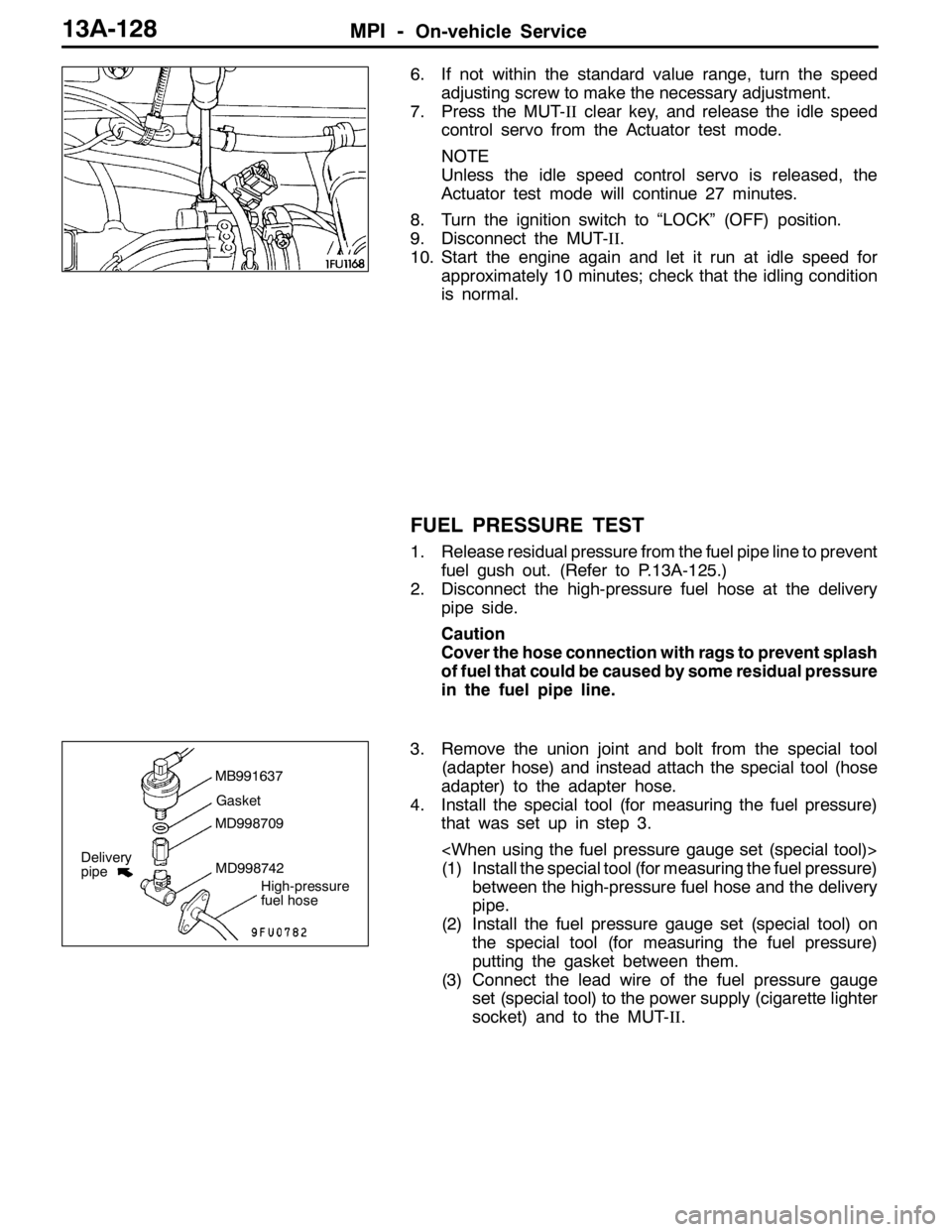
6. If not within the standard value range, turn the speed
adjusting screw to make the necessary adjustment.
7. Press the MUT-IIclear key, and release the idle speed
control servo from the Actuator test mode.
NOTE
Unless the idle speed control servo is released, the
Actuator test mode will continue 27 minutes.
8. Turn the ignition switch to “LOCK” (OFF) position.
9. Disconnect the MUT-II.
10. Start the engine again and let it run at idle speed for
approximately 10 minutes; check that the idling condition
is normal.
FUEL PRESSURE TEST
1. Release residual pressure from the fuel pipe line to prevent
fuel gush out. (Refer to P.13A-125.)
2. Disconnect the high-pressure fuel hose at the delivery
pipe side.
Caution
Cover the hose connection with rags to prevent splash
of fuel that could be caused by some residual pressure
in the fuel pipe line.
3. Remove the union joint and bolt from the special tool
(adapter hose) and instead attach the special tool (hose
adapter) to the adapter hose.
4. Install the special tool (for measuring the fuel pressure)
that was set up in step 3.
(1) Install the special tool (for measuring the fuel pressure)
between the high-pressure fuel hose and the delivery
pipe.
(2) Install the fuel pressure gauge set (special tool) on
the special tool (for measuring the fuel pressure)
putting the gasket between them.
(3) Connect the lead wire of the fuel pressure gauge
set (special tool) to the power supply (cigarette lighter
socket) and to the MUT-II.
MB991637
Gasket
MD998709
MD998742
High-pressure
fuel hose
Delivery
pipe