ECU MITSUBISHI LANCER EVOLUTION 2014 10.G User Guide
[x] Cancel search | Manufacturer: MITSUBISHI, Model Year: 2014, Model line: LANCER EVOLUTION, Model: MITSUBISHI LANCER EVOLUTION 2014 10.GPages: 338, PDF Size: 40.99 MB
Page 42 of 338
Child restraint systems
Seat and restraint systems 4-17
4
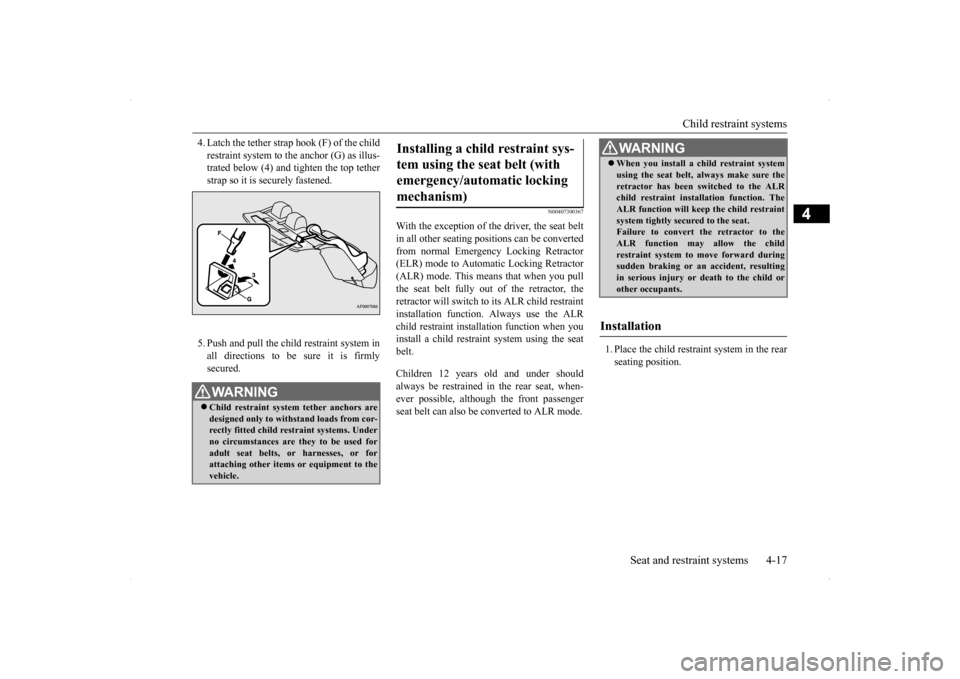
4. Latch the tether strap hook (F) of the child restraint system to the anchor (G) as illus- trated below (4) and tighten the top tether strap so it is securely fastened. 5. Push and pull the ch
ild restraint system in
all directions to be sure it is firmlysecured.
N00407300367
With the exception of the driver, the seat beltin all other seating positions can be convertedfrom normal Emergency Locking Retractor (ELR) mode to Automatic Locking Retractor (ALR) mode. This means that when you pullthe seat belt fully out of the retractor, theretractor will switch to its ALR child restraint installation function. Always use the ALR child restraint installa
tion function when you
install a child restraint system using the seat belt. Children 12 years old and under should always be restrained in the rear seat, when-ever possible, although the front passenger seat belt can also be converted to ALR mode.
1. Place the child restraint system in the rear seating position.
WA R N I N G Child restraint system tether anchors are designed only to withstand loads from cor-rectly fitted child restraint systems. Under no circumstances are they to be used for adult seat belts, or harnesses, or forattaching other items or equipment to the vehicle.
Installing a child restraint sys- tem using the seat belt (with emergency/automatic locking mechanism)
WA R N I N G When you install a child restraint system using the seat belt, always make sure the retractor has been switched to the ALR child restraint installation function. The ALR function will keep the child restraintsystem tightly secured to the seat. Failure to convert the retractor to the ALR function may allow the childrestraint system to move forward during sudden braking or an accident, resulting in serious injury or death to the child orother occupants.
Installation
BK0200800US.bo
ok 17 ページ 2013年2月14日 木曜日 午後2時28分
Page 43 of 338
Child restraint systems 4-18 Seat and restraint systems
4
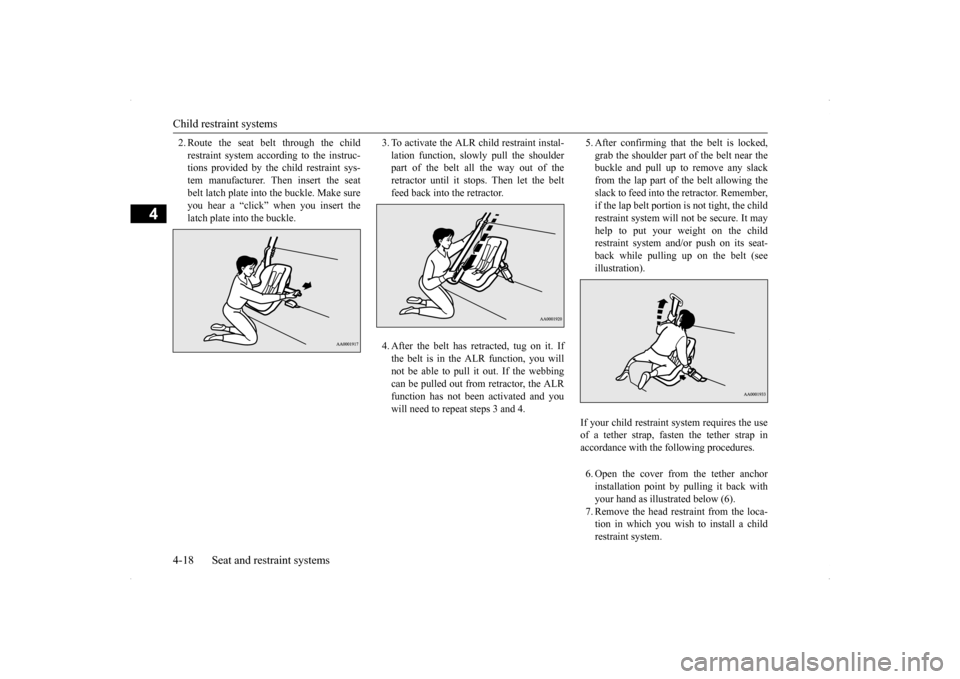
2. Route the seat belt through the child restraint system according to the instruc- tions provided by the child restraint sys- tem manufacturer. Then insert the seatbelt latch plate into the buckle. Make sure you hear a “click” when you insert the latch plate into the buckle.
3. To activate the ALR child restraint instal- lation function, slow
ly pull the shoulder
part of the belt all the way out of the retractor until it stops. Then let the beltfeed back into the retractor. 4. After the belt has retracted, tug on it. If the belt is in the ALR function, you willnot be able to pull it out. If the webbing can be pulled out from retractor, the ALR function has not been activated and youwill need to repeat steps 3 and 4.
5. After confirming that the belt is locked, grab the shoulder part of the belt near the buckle and pull up to remove any slack from the lap part of the belt allowing theslack to feed into the retractor. Remember, if the lap belt portion is not tight, the child restraint system will not be secure. It mayhelp to put your weight on the child restraint system and/or push on its seat- back while pulling up on the belt (seeillustration). 6. Open the cover from the tether anchor installation point by pulling it back with your hand as illustrated below (6).7. Remove the head restraint from the loca- tion in which you wish to install a child restraint system.
If your child restraint system requires the use of a tether strap, fasten the tether strap in accordance with the following procedures.
BK0200800US.bo
ok 18 ページ 2013年2月14日 木曜日 午後2時28分
Page 44 of 338
Maintenance and inspection of seat belts
Seat and restraint systems 4-19
4
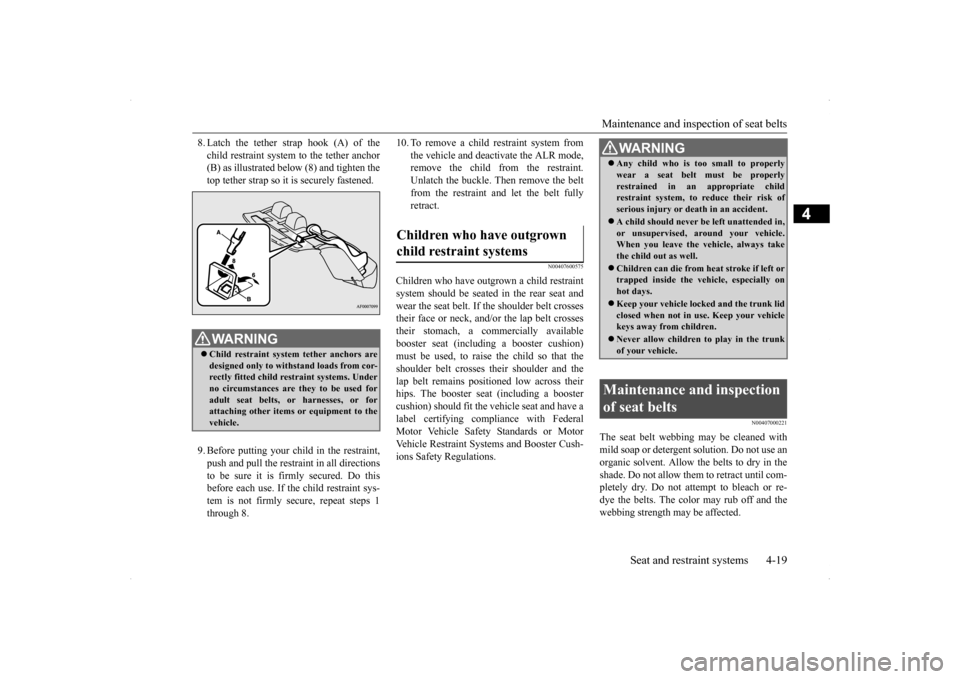
8. Latch the tether strap hook (A) of the child restraint system to the tether anchor (B) as illustrated below (8) and tighten the top tether strap so it is securely fastened. 9. Before putting your child in the restraint, push and pull the restraint in all directions to be sure it is firmly secured. Do this before each use. If the child restraint sys-tem is not firmly secure, repeat steps 1 through 8.
10. To remove a child restraint system from
the vehicle and deactivate the ALR mode, remove the child from the restraint. Unlatch the buckle. Then remove the beltfrom the restraint and let the belt fully retract.
N00407600575
Children who have outgrown a child restraintsystem should be seated in the rear seat and wear the seat belt. If the shoulder belt crossestheir face or neck, and/or the lap belt crosses their stomach, a commercially available booster seat (including a booster cushion)must be used, to raise the child so that the shoulder belt crosses their shoulder and the lap belt remains positioned low across theirhips. The booster seat (including a booster cushion) should fit the vehicle seat and have a label certifying compliance with FederalMotor Vehicle Safety Standards or Motor Vehicle Restraint Systems and Booster Cush- ions Safety Regulations.
N00407000221
The seat belt webbing may be cleaned withmild soap or detergent solution. Do not use anorganic solvent. Allow the belts to dry in the shade. Do not allow them to retract until com- pletely dry. Do not attempt to bleach or re-dye the belts. The color may rub off and the webbing strength may be affected.
WA R N I N G Child restraint system tether anchors are designed only to withstand loads from cor-rectly fitted child restraint systems. Under no circumstances are they to be used for adult seat belts, or harnesses, or forattaching other items or equipment to the vehicle.
Children who have outgrown child restraint systems
WA R N I N G Any child who is too small to properly wear a seat belt must be properly restrained in an appropriate child restraint system, to reduce their risk of serious injury or death in an accident. A child should never be left unattended in, or unsupervised, around your vehicle.When you leave the vehicle, always take the child out as well. Children can die from he
at stroke if left or
trapped inside the vehicle, especially on hot days. Keep your vehicle locked and the trunk lid closed when not in use. Keep your vehiclekeys away from children. Never allow children to play in the trunk of your vehicle.
Maintenance and inspection of seat belts
BK0200800US.bo
ok 19 ページ 2013年2月14日 木曜日 午後2時28分
Page 49 of 338

Supplemental Restraint System (SRS) - airbag 4-24 Seat and restraint systems
4
cle or the EDR is needed. In addition to the vehicle manufacturer, other parties, such as law enforcement, that have the special equip- ment, can read the information if they haveaccess to the vehicle or the EDR.
N00417900193
The driver’s seat position sensor is attachedto the seat rail and provides the airbag controlunit with information on the seat’s fore-aft position. The airbag control unit controls deployment of the driver’s front airbag inaccordance with the information it receives from this sensor. If there is a problem involving the driver’sseat position sensor, the SRS warning in the instrument panel will come on. Refer to “SRS warning light/display” on page 4-25.
N00418000306
The passenger’s seat weight sensors areattached to the seat rails and provide the air- bag control unit with information regarding the weight on the front passenger seat. Theairbag control unit controls deployment of the passenger’s front airbag in accordance with the information it receives from this sensor.The passenger’s front airbag will not deploy in an impact when the weight on the seat is sensed to be less than approximately 66pounds (30 kg). In this case, the passenger’s airbag off indicator will come on. Refer to “Passenger’s airbag off indicator” onpage 4-25. If there is a problem involving the passen- ger’s seat weight sensors, the SRS warning inthe instrument panel will come on. Refer to “SRS warning light/display” on page 4-25.
Driver’s seat position sensor
WA R N I N G If the SRS warning comes on, have the vehicle inspected by an authorized Mit- subishi Motors dealer as soon as possible. Please observe the following instructions to ensure that the driver’s seat position sensor can operate correctly.• Adjust the seat to the correct position,and sit well back against the seatback. Refer to “Front seats” on page 4-3.• Do not recline the seatback more thannecessary when driving.
• Do not place metallic objects or luggage under the front seat.
If the vehicle is involved in a severe impact, have the SRS sensor inspected byan authorized Mitsubishi Motors dealer as soon as possible.
Passenger’s seat weight sensors
WA R N I N G
WA R N I N G If any of the following conditions occur, you should immediately have your vehicle inspected by an authorized Mitsubishi Motors dealer as soon as possible:• The SRS warning does not initially comeon when the ignition switch is turned to the “ON” or “START” position.• The SRS warning does not go out afterseveral seconds.• The SRS warning comes on while you aredriving.
To ensure that the passenger’s seat weight sensors can correctly sense the weightbeing applied to the seat, observe the fol- lowing instructions. Failure to follow these instructions can adversely affect the per-formance of the passenger’s airbag sys- tem.• Adjust the seat to the correct position,and sit well back against the seatback. Refer to “Front seats” on page 4-3.• Do not recline the seatback more thannecessary.• Never have more than one person (adultor child) sitting on the seat.• Do not place anything between the seatand the floor console.• Do not hang anything on the front pas-senger’s seatback.• When attaching a child restraint system,secure it firmly.• Do not place luggage or other objects onthe seat.
BK0200800US.bo
ok 24 ページ 2013年2月14日 木曜日 午後2時28分
Page 57 of 338
Supplemental Restraint System (SRS) - airbag 4-32 Seat and restraint systems
4
N00408200477
A side airbag and curtain airbag are designed to deploy when the vehicle suffers a moderate
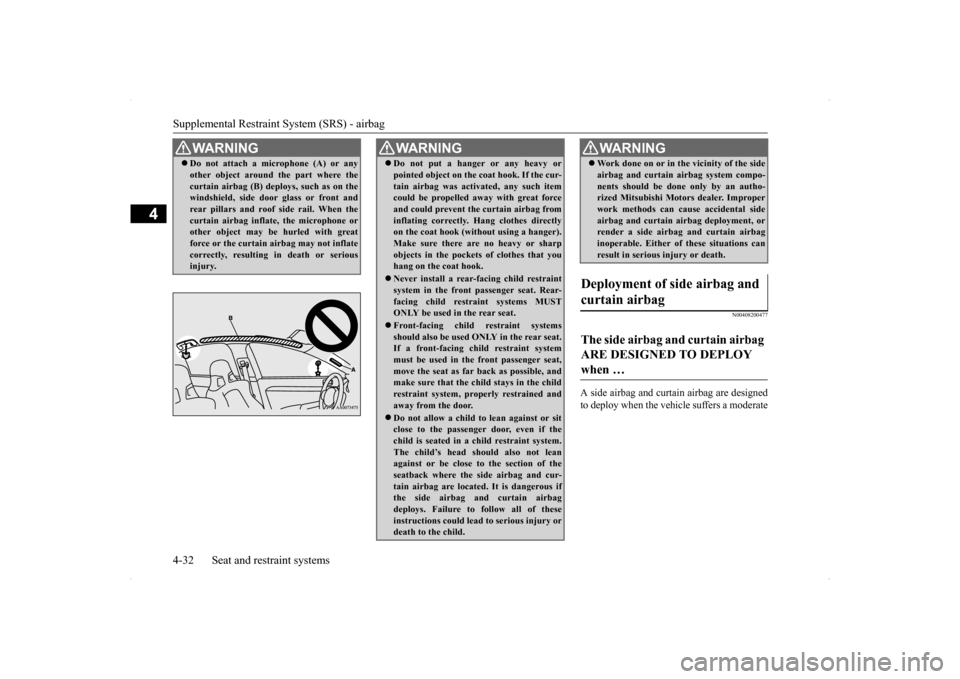
WA R N I N G Do not attach a microphone (A) or any other object around the part where the curtain airbag (B) deploys, such as on the windshield, side door glass or front and rear pillars and roof side rail. When thecurtain airbag inflate, the microphone or other object may be hurled with great force or the curtain airbag may not inflatecorrectly, resulting in death or serious injury.
WA R N I N G Do not put a hanger or any heavy or pointed object on the coat hook. If the cur- tain airbag was activated, any such item could be propelled away with great force and could prevent the curtain airbag frominflating correctly. Hang clothes directly on the coat hook (without using a hanger). Make sure there are no heavy or sharpobjects in the pockets of clothes that you hang on the coat hook. Never install a rear-facing child restraint system in the front passenger seat. Rear- facing child restraint systems MUSTONLY be used in the rear seat. Front-facing child restraint systems should also be used ONLY in the rear seat. If a front-facing child restraint system must be used in the front passenger seat,move the seat as far back as possible, and make sure that the child stays in the child restraint system, properly restrained andaway from the door. Do not allow a child to lean against or sit close to the passenger door, even if the child is seated in a child restraint system. The child’s head should also not leanagainst or be close to the section of the seatback where the side airbag and cur- tain airbag are located. It is dangerous if the side airbag and curtain airbag deploys. Failure to follow all of theseinstructions could lead to serious injury or death to the child.
Work done on or in the vicinity of the side airbag and curtain airbag system compo- nents should be done only by an autho- rized Mitsubishi Motors dealer. Improper work methods can cause accidental sideairbag and curtain airbag deployment, or render a side airbag and curtain airbag inoperable. Either of these situations canresult in serious injury or death.
Deployment of side airbag and curtain airbag The side airbag and curtain airbag ARE DESIGNED TO DEPLOY when …
WA R N I N G
BK0200800US.bo
ok 32 ページ 2013年2月14日 木曜日 午後2時28分
Page 62 of 338
5
Features and controlsBreak-in period ................
.................................................................5-3
Keys .....................................................
.............................................5-3
Electronic immobilizer (Anti-theft starting system) .........................5-4 Keyless entry system (if so equipped) ..............................................5-7Free-hand Advanced Security Transmitter (F.A.S.T.-key) (if so equipped)................................
..................................................... 5-11
Door locks........................
...............................................................5-34
Power door locks .............
...............................................................5-36
“Child safety locks” for
rear door...................................................5-37
Trunk lid ....................................
.....................................................5-37
Inside emergency trunk lid
release .................................................5-39
Theft-alarm system ..........
...............................................................5-40
Power windows................
...............................................................5-42
Sunroof (if so equipped
) .........................................
........................5-44
Parking brake ...................
...............................................................5-47
Steering wheel tilt lock lever ..........................................................5-47Inside day/night rearview
mirror ....................................................5-48
Outside rearview mirr
ors ................................................................5-49
Ignition switch .................
...............................................................5-50
Steering wheel lock..........
...............................................................5-52
Starting and stopping the e
ngine ....................................................5-53
Turbocharger operation
...........................................
........................5-55
Clutch pedal operation (if so equipped)..........................................5-56Manual transaxle (if so equipped) ..................................................5-57 Twin Clutch SST (Sportronic Shif
t Transmission) (if so equipped)
...................................................................
..................................5-58
All-wheel drive system
...........................................
........................5-70
Cautions on handling of all-wheel drive vehicles ..........................5-70
S-AWC (Super-All Wheel
Control)................................................ 5-71
Anti-lock braking syst
em ......................................
......................... 5-74
Active stability control
(ASC) .....................
................................... 5-76
Limited-slip differenti
al.........................................
......................... 5-79
Service brake ..................
.................................................
............... 5-79
Brake assist system
................................................
......................... 5-80
Power steering system
...........................................
......................... 5-80
Cruise control .................
.................................................
............... 5-81
Tire pressure monitoring
system .................................................... 5-85
Instrument cluster .
.................................................
......................... 5-89
Multi-information disp
lay .....................................
......................... 5-91
Indicator light, warning light, and information screen display list
.................................................................
................................. 5-111
Indicators ..................................
.................................................... 5-121
Warning lights.................
.................................................
............. 5-122
Information screen disp
lay ...................................
....................... 5-123
Combination headlights and dimmer switch ............................... 5-125 Turn signal lever ...
.................................................
....................... 5-131
Hazard warning flasher
switch ..................................................... 5-131
Front fog light switch
............................................
....................... 5-131
Wiper and washer swit
ch ......................................
....................... 5-132
Electric rear window def
ogger switch .......................................... 5-136
Horn switch ..............................
.................................................... 5-137
Link System ..............................
.................................................... 5-137
Bluetooth
® 2.0 interface ...........
.................................................... 5-137
USB input terminal .........
.................................................
............. 5-158
Sun visors .................................
.................................................... 5-161
12 V power outlet ...........
.................................................
............. 5-162
BK0200800US.bo
ok 1 ページ 2013年2月14日 木曜日 午後2時28分
Page 65 of 338
![MITSUBISHI LANCER EVOLUTION 2014 10.G User Guide Electronic immobilizer (Anti-theft starting system) 5-4 Features and controls
5
N00509101820
[For vehicles equipped with the Free-hand Advanced Security Transmitter (F.A.S.T.- key)] For information on](/img/19/7475/w960_7475-64.png "MITSUBISHI LANCER EVOLUTION 2014 10.G User Guide Electronic immobilizer (Anti-theft starting system) 5-4 Features and controls
5
N00509101820
[For vehicles equipped with the Free-hand Advanced Security Transmitter (F.A.S.T.- key)] For information on")
Electronic immobilizer (Anti-theft starting system) 5-4 Features and controls
5
N00509101820
[For vehicles equipped with the Free-hand Advanced Security Transmitter (F.A.S.T.- key)] For information on operations for vehiclesequipped with the Free-hand Advanced Secu- rity Transmitter (F.A.S.T.-key), refer to “Free-hand Advanced Security Transmitter(F.A.S.T.-key)”: “Electronic immobilizer (Anti-theft starting system)” on page 5-27. [Except for vehicles equipped with the Free- hand Advanced Security Transmitter(F.A.S.T.-key)] The electronic immobilizer is designed to sig- nificantly reduce the possibility of vehicletheft. The purpose of the system is to immo- bilize the vehicle if an invalid start is
attempted. A valid start attempt can only be achieved (subject to certain conditions) using a key “registered” to the immobilizer system. All of the keys provided with your new vehi-cle have been programmed to the vehicle’s electronics.
• Keep away from devices that produce mag- netism, such as audio systems, computers and televisions. • Keep away from devices that emit strong electromagnetic waves, such as cellular phones, wireless devices and high fre- quency equipment (including medicaldevices). • Do not clean with ultrasonic cleaners.• Do not leave the key where it may be exposed to high temperature or high humid-ity.
If you lose your key, to prevent the theft of the vehicle immediately contact an autho- rized Mitsubishi Motors dealer. If you notify an authorized MitsubishiMotors dealer of the key number, they can make a new key. The key number is stamped on the key number plate. Keep the key num-ber plate in a safe place separate from the key itself. No keys other than those registered in advance can be used to start the engine. Refer to “Electronic immobilizer (Anti-theftstarting system)” on page 5-4. Refer to “Free-hand Advanced Security Transmitter (F.A.S.T.-key)”: “Electronic immobilizer (Anti-theft starting system)” on page 5-27.NOTE
When the theft-alarm is in the system opera- tional status, the alarm operates if a door is opened after using the key, the door lock knob or the power door lock to unlock the vehicle. The system does not enter the preparation status if the keyless entry system or theF.A.S.T.-key operation was not used to lock the vehicle.
Electronic immobilizer (Anti-theft starting system)
NOTE
NOTE
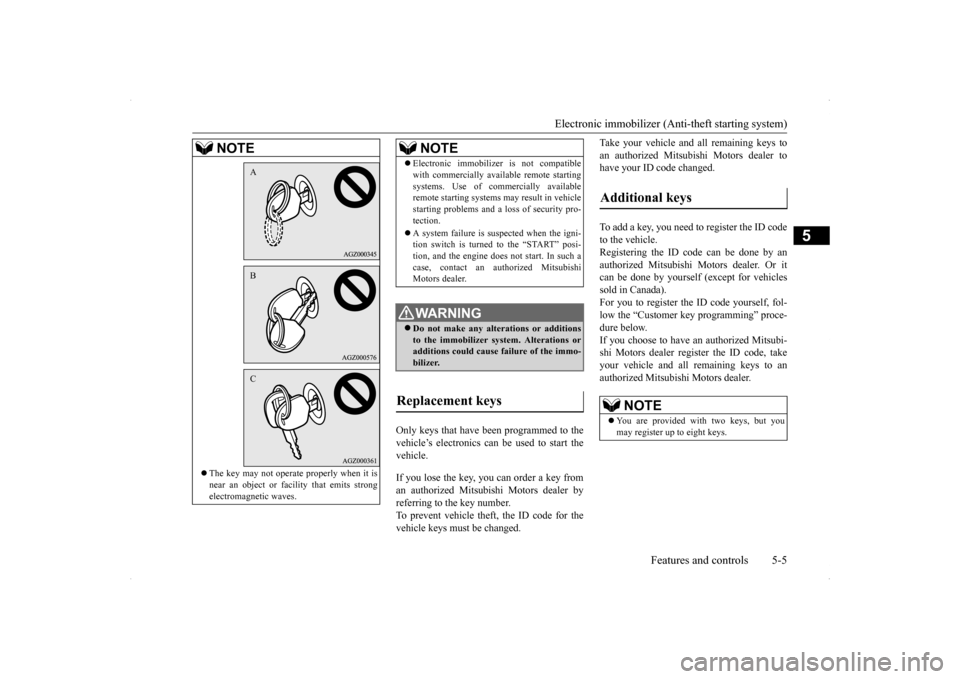
Do not attach additional keys or accessories to the ignition key. Such objects could pre- vent the driver’s knee airbag from inflating normally. Refer to “Deployment of front air-bags” on page 4-27. In the following cases, the vehicle may not be able to recognize the registered ID code from the key. This means the engine will not start even when the key is turned to the“START” position. • When the key contacts a key ring or other metallic or magnetic object (Type A) • When the key grip contacts metal of another key (Type B) • When the key contacts or is close to other immobilizer keys (including keys of other vehicles) (Type C)
In cases like the above, move the offending object(s) away from the key and turn the key back to the “ACC” or “LOCK” position. Then try to start the engine again. If the engine does not start,
contact an authorized
Mitsubishi Motors dealer.
BK0200800US.bo
ok 4 ページ 2013年2月14日 木曜日 午後2時28分
Page 66 of 338
Electronic immobilizer (Ant
i-theft starting system)
Features and controls 5-5
5
Only keys that have been programmed to the vehicle’s electronics can be used to start thevehicle. If you lose the key, you can order a key from an authorized Mitsubishi Motors dealer by referring to the key number.To prevent vehicle theft, the ID code for the vehicle keys must be changed.
Take your vehicle and all remaining keys to an authorized Mitsubishi Motors dealer to have your ID code changed. To add a key, you need to register the ID code to the vehicle. Registering the ID code can be done by anauthorized Mitsubishi Motors dealer. Or itcan be done by yourself (except for vehicles sold in Canada). For you to register the ID code yourself, fol-low the “Customer key programming” proce- dure below. If you choose to have an authorized Mitsubi-shi Motors dealer register the ID code, take your vehicle and all remaining keys to an authorized Mitsubishi Motors dealer.
The key may not operate properly when it is near an object or facility that emits strongelectromagnetic waves.NOTE
ABC
Electronic immobilizer is not compatible with commercially available remote starting systems. Use of commercially available remote starting systems may result in vehicle starting problems and a lo
ss of security pro-
tection. A system failure is suspected when the igni- tion switch is turned to the “START” posi- tion, and the engine does not start. In such a case, contact an authorized MitsubishiMotors dealer.WA R N I N G Do not make any alterations or additions to the immobilizer system. Alterations or additions could cause failure of the immo-bilizer.
Replacement keys
NOTE
Additional keys
NOTE
You are provided with two keys, but you may register up to eight keys.
BK0200800US.bo
ok 5 ページ 2013年2月14日 木曜日 午後2時28分
Page 72 of 338
Free-hand Advanced Security Transmit
ter (F.A.S.T.-key) (if so equipped)
Features and controls 5-11
5
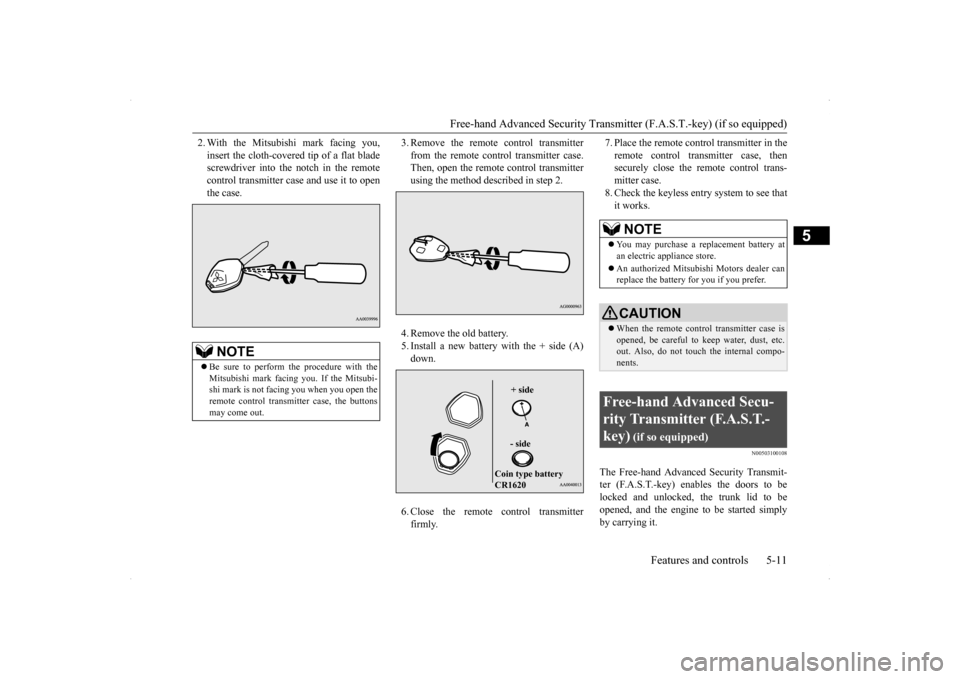
2. With the Mitsubishi mark facing you, insert the cloth-covered tip of a flat blade screwdriver into the notch in the remote control transmitter case and use it to openthe case.
3. Remove the remote control transmitter from the remote control transmitter case. Then, open the remote control transmitter using the method described in step 2. 4. Remove the old battery. 5. Install a new battery with the + side (A)down. 6. Close the remote control transmitter firmly.
7. Place the remote control transmitter in the remote control transmitter case, then securely close the remote control trans- mitter case.8. Check the keyless entry system to see that it works.
N00503100108
The Free-hand Advanced Security Transmit- ter (F.A.S.T.-key) enables the doors to be locked and unlocked, the trunk lid to be opened, and the engine to be started simplyby carrying it.
NOTE
Be sure to perform the procedure with the Mitsubishi mark facing you. If the Mitsubi-shi mark is not facing you when you open the remote control transmitter case, the buttons may come out.
+ side - side
Coin type battery CR1620
NOTE
You may purchase a replacement battery at an electric appliance store. An authorized Mitsubishi Motors dealer can replace the battery for you if you prefer.CAUTION When the remote control transmitter case is opened, be careful to keep water, dust, etc. out. Also, do not touch the internal compo-nents.
Free-hand Advanced Secu- rity Transmitter (F.A.S.T.-key)
(if so equipped)
BK0200800US.bo
ok 11 ページ 2013年2月14日 木曜日 午後2時28分
Page 73 of 338
Free-hand Advanced Security Transmitter (F.A.S.T.-key) (if so equipped) 5-12 Features and controls
5
The F.A.S.T.-key can also be used as the remote control transmitter of the keyless entry system. Refer to “Free-hand Advanced SecurityTransmitter (F.A.S.T.-key)”: “Keyless entry system” on page 5-29.
The operations possible with the F.A.S.T.- key can be modified as stated below. (Keyless entry operations are possible.) For details, contact an authorized Mitsubi-shi Motors dealer. • Enabling only the locking and unlocking of the doors and the opening of the trunklid • Enabling only the starting of the engine • Deactivating the F.A.S.T.-key
The F.A.S.T.-key must be carried by the driver. The F.A.S.T.-key is required for vehicle operations such as locking and unlocking the doors, opening the trunk lid, and starting the engine. When leaving the vehicle, make sure you are carrying the F.A.S.T.-key and then lock the vehi-cle.
WA R N I N G Individuals who use implantable pace- makers or implantable cardiovascular- defibrillators should keep away from the external and internal
transmitters. The
electromagnetic waves used in the F.A.S.T.-key may affect the operation of implantable pacemakers and implantablecardiovascular-defibrillators.
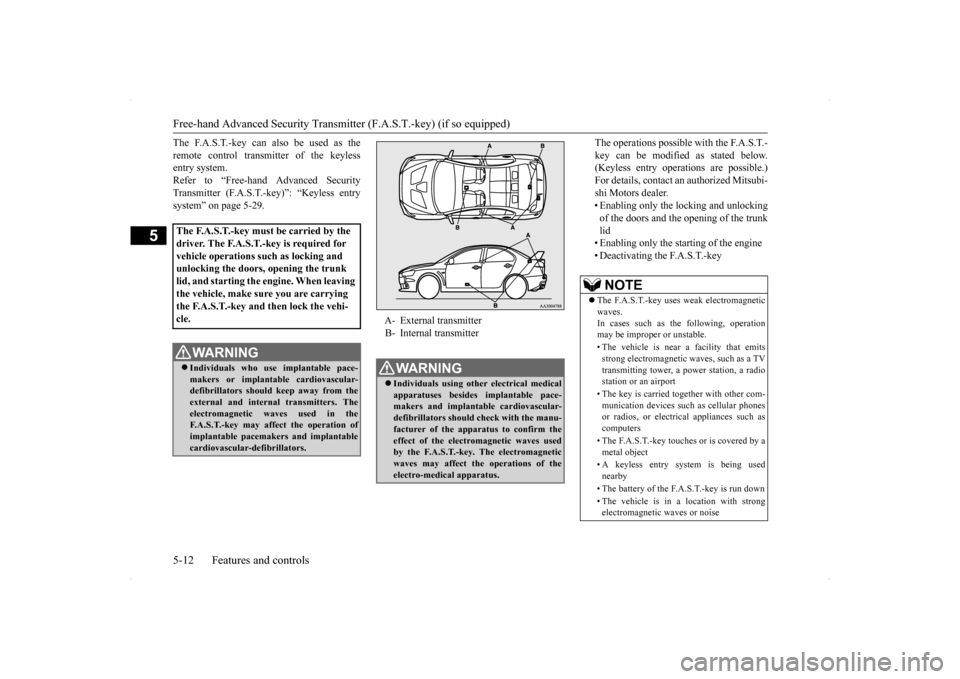
A- External transmitter B- Internal transmitterWA R N I N G Individuals using other electrical medical apparatuses besides implantable pace-makers and implantable cardiovascular- defibrillators should check with the manu- facturer of the apparatus to confirm the effect of the electromagnetic waves used by the F.A.S.T.-key. The electromagneticwaves may affect the operations of the electro-medical apparatus.
NOTE
The F.A.S.T.-key uses weak electromagnetic waves.In cases such as the following, operation may be improper or unstable. • The vehicle is near a facility that emits strong electromagnetic waves, such as a TV transmitting tower, a power station, a radiostation or an airport • The key is carried together with other com- munication devices such as cellular phones or radios, or electrical appliances such as computers • The F.A.S.T.-key touches or is covered by a metal object • A keyless entry system is being used nearby • The battery of the F.A.S.T.-key is run down• The vehicle is in a location with strong electromagnetic waves or noise
BK0200800US.bo
ok 12 ページ 2013年2月14日 木曜日 午後2時28分