brake fluid MITSUBISHI LANCER EVOLUTION 2014 10.G User Guide
[x] Cancel search | Manufacturer: MITSUBISHI, Model Year: 2014, Model line: LANCER EVOLUTION, Model: MITSUBISHI LANCER EVOLUTION 2014 10.GPages: 338, PDF Size: 40.99 MB
Page 183 of 338
Warning lights 5-122 Features and controls
5
N00520300147 N00520400483
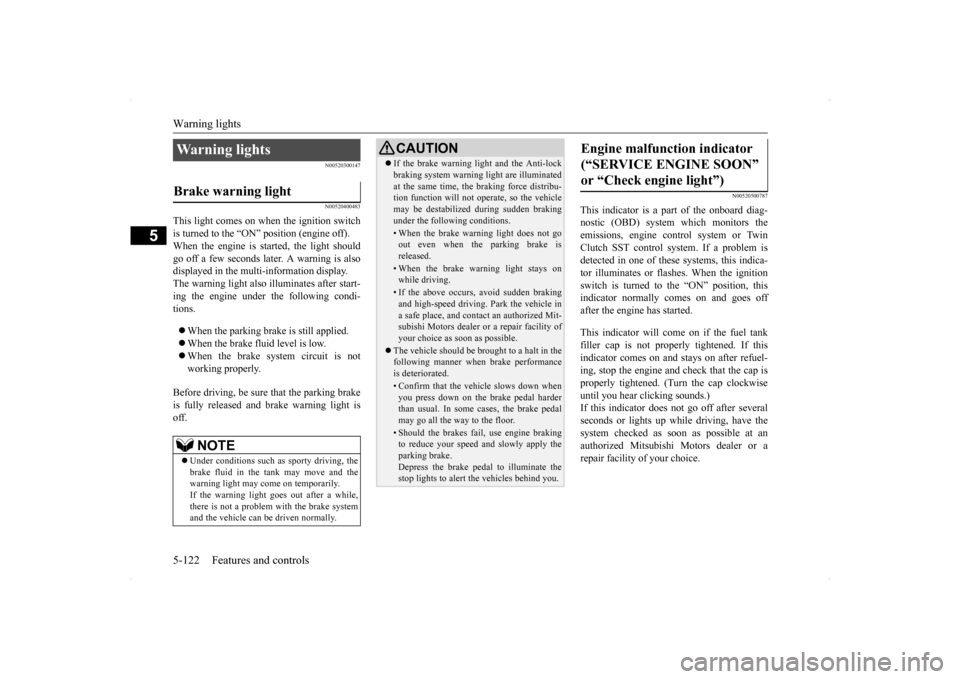
This light comes on when the ignition switch is turned to the “ON” position (engine off).When the engine is started, the light should go off a few seconds later. A warning is also displayed in the multi-information display.The warning light also illuminates after start-ing the engine under the following condi- tions. When the parking brake is still applied. When the brake fluid level is low. When the brake system circuit is not working properly.
Before driving, be sure that the parking brake is fully released and brake warning light isoff.
N00520500787
This indicator is a part of the onboard diag- nostic (OBD) system which monitors the emissions, engine control system or TwinClutch SST control sy
stem. If a problem is
detected in one of these systems, this indica- tor illuminates or flashes. When the ignitionswitch is turned to the “ON” position, thisindicator normally comes on and goes off after the engine has started. This indicator will come on if the fuel tank filler cap is not properly tightened. If thisindicator comes on and stays on after refuel- ing, stop the engine and check that the cap is properly tightened. (Turn the cap clockwiseuntil you hear clicking sounds.) If this indicator does not go off after several seconds or lights up while driving, have thesystem checked as soon as possible at an authorized Mitsubishi Motors dealer or a repair facility of your choice.
Warning lights Brake warning light
NOTE
Under conditions such as sporty driving, the brake fluid in the tank may move and the warning light may come on temporarily.If the warning light goes out after a while, there is not a problem with the brake system and the vehicle can be driven normally.
CAUTION If the brake warning light and the Anti-lock braking system warning light are illuminated at the same time, the braking force distribu- tion function will not operate, so the vehicle may be destabilized during sudden brakingunder the following conditions.• When the brake warning light does not goout even when the parking brake is released.• When the brake warning light stays onwhile driving.• If the above occurs, avoid sudden brakingand high-speed driving. Park the vehicle in a safe place, and contact an authorized Mit-subishi Motors dealer or a repair facility of your choice as soon as possible.
The vehicle should be brought to a halt in the following manner when brake performance is deteriorated.• Confirm that the vehicle slows down whenyou press down on the brake pedal harderthan usual. In some cases, the brake pedal may go all the way to the floor.• Should the brakes fail, use engine brakingto reduce your speed and slowly apply the parking brake.Depress the brake pedal to illuminate the stop lights to alert the vehicles behind you.
Engine malfunction indicator (“SERVICE ENGINE SOON” or “Check engine light”)
BK0200800US.book
122 ページ 2013年2月14日 木曜日 午後2時28分
Page 185 of 338
Information screen display 5-124 Features and controls
5
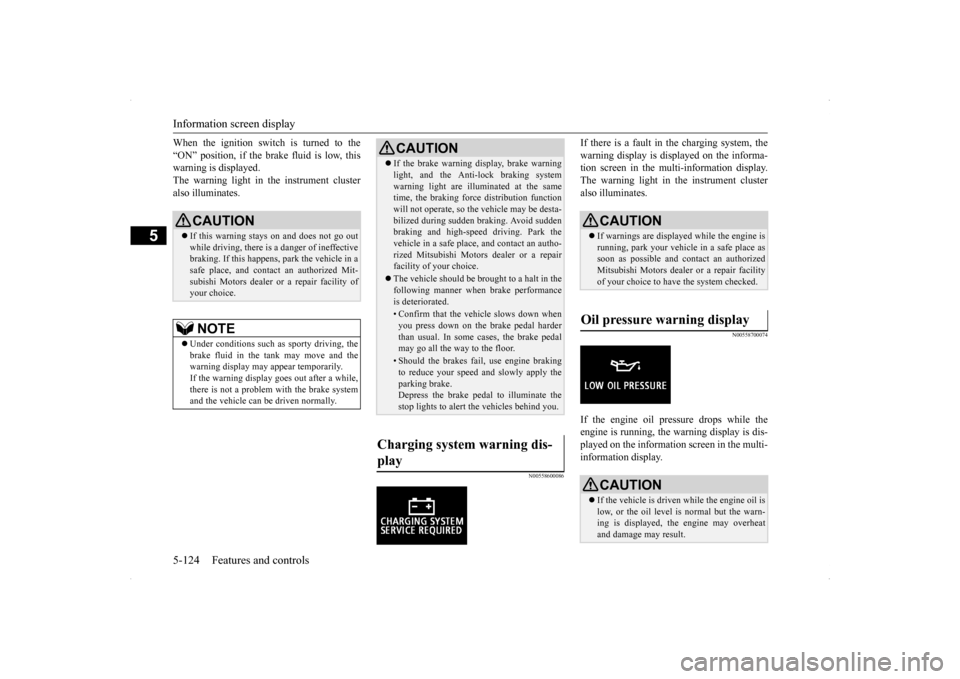
When the ignition switch is turned to the “ON” position, if the brake fluid is low, this warning is displayed. The warning light in the instrument clusteralso illuminates.
N00558600086
If there is a fault in the charging system, thewarning display is displayed on the informa- tion screen in the multi-information display. The warning light in the instrument clusteralso illuminates.
N00558700074
If the engine oil pressure drops while theengine is running, the warning display is dis-played on the information screen in the multi-information display.
CAUTION If this warning stays on and does not go out while driving, there is a danger of ineffective braking. If this happens, park the vehicle in asafe place, and contact an authorized Mit- subishi Motors dealer or a repair facility of your choice.NOTE
Under conditions such as sporty driving, the brake fluid in the tank may move and the warning display may appear temporarily.If the warning display goes out after a while, there is not a problem with the brake system and the vehicle can be driven normally.
CAUTION If the brake warning display, brake warning light, and the Anti-lock braking system warning light are illuminated at the same time, the braking force distribution function will not operate, so the vehicle may be desta-bilized during sudden braking. Avoid sudden braking and high-speed driving. Park the vehicle in a safe place, and contact an autho-rized Mitsubishi Motors dealer or a repair facility of your choice. The vehicle should be brought to a halt in the following manner when brake performance is deteriorated.• Confirm that the vehicle slows down whenyou press down on the brake pedal harderthan usual. In some cases, the brake pedal may go all the way to the floor.• Should the brakes fail, use engine brakingto reduce your speed and slowly apply the parking brake.Depress the brake pedal to illuminate the stop lights to alert the vehicles behind you.
Charging system warning dis- play
CAUTION If warnings are displayed while the engine is running, park your vehicle in a safe place as soon as possible and contact an authorizedMitsubishi Motors dealer or a repair facility of your choice to have the system checked.
Oil pressure warning display
CAUTION If the vehicle is driven while the engine oil is low, or the oil level is normal but the warn- ing is displayed, the engine may overheat and damage may result.
BK0200800US.book
124 ページ 2013年2月14日 木曜日 午後2時28分
Page 272 of 338
9
Vehicle care and maintenanceService precautions ..........
.................................................................9-2
Catalytic converter .
.................................................
..........................9-2
Engine hood ...............................
.......................................................9-3
View of the engine co
mpartment ......................................................9-5
Engine oil and oil filt
er ...........................................
..........................9-5
Engine coolant .................
.................................................................9-7
Air cleaner filter.....
.................................................
..........................9-8
Manual transaxle oil (if so
equipped) ...............................................9-9
Twin Clutch Sportronic shift trans
mission (Twin Clutch SST) fluid (if
so equipped) ...........................
.......................................................9-9
Transfer oil.......................
.................................................................9-9
Rear axle oil .....................
.................................................................9-9
AWC control fluid ...........
.................................................................9-9
Washer fluid .....................
...............................................................9-10
Brake fluid/Clutch fluid (if
so equipped)........................................9-10
Power steering fluid
................................................
........................ 9-11
Battery........................................
..................................................... 9-11
Tires ...........................................
.....................................................9-12
Clutch pedal free play (if so equipped)...........................................9-19Brake pedal free play
..............................................
........................9-19
Parking brake lever stroke ..............................................................9-19 Parking brake break-in
............................................
........................9-20
Wiper blades ..............................
.....................................................9-20
Emission-control system maintenance ...........................................9-20 General maintenance
..............................................
........................9-21
For cold and snowy weat
her ..........................................................9-23
Fusible links .....................
...............................................................9-23
Fuses ..........................................
.....................................................9-23
Replacement of light bul
bs ....................................
......................... 9-28
Vehicle care precautions
........................................
......................... 9-40
Cleaning the inside of you
r vehicle ................................................ 9-40
Cleaning the outside of your
vehicle .............................................. 9-42
BK0200800US.bo
ok 1 ページ 2013年2月14日 木曜日 午後2時28分
Page 276 of 338
View of the engine compartment
Vehicle care and maintenance 9-5
9
Unlatch the prop from the engine hood and put it back in its retainer. Slowly lower the engine hood about 8 inches (20 cm), then let it drop from its own weight.
N00937600641
N00937701971
It is normal for an engi
ne to use oil. You may
need to add oil between the recommended oil change intervals. Before starting the engine,check the engine oil level. Refill if necessary. To check the oil level, remove the dipstick, wipe it off, and gently insert it all the way into the crankcase. Slowly remove it again.The oil level must not go above the line on the dipstick. If the level does not reach the line, which shows the smallest amount of oil required,remove the oil filler cap on the engine valve cover, and fill to with
in the “Good” range.
To close
CAUTIONBe careful not to trap your hands or fingers when closing the engine hood. Make sure the engine hood is firmly closed before driving.If you drive without the engine hood com- pletely closed, it could open up while driv- ing.NOTE
If this does not close the engine hood prop- erly, drop it again from a slightly higher position.
Do not push down strongly on the engine hood. Depending on how strongly or where you push down, you could create a dent in the vehicle body. If you drive with the engine hood left open, warning display is displayed on the informa- tion screen in the multi-information display.
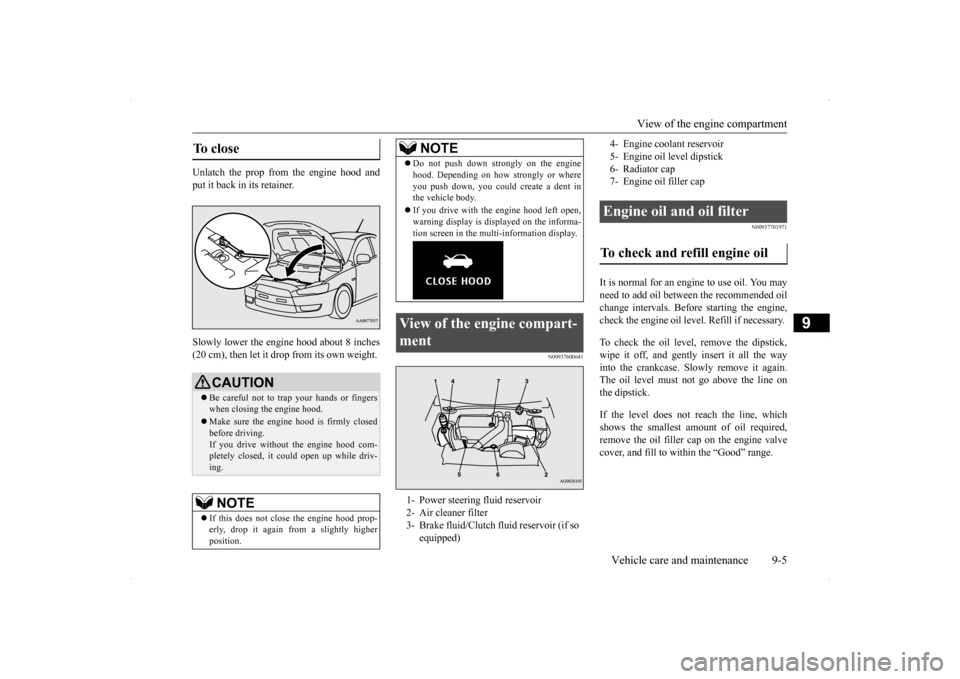
View of the engine compart- ment 1- Power steering fluid reservoir 2- Air cleaner filter 3- Brake fluid/Clutch fluid reservoir (if so
equipped)NOTE
4- Engine coolant reservoir 5- Engine oil level dipstick6- Radiator cap 7- Engine oil filler capEngine oil and oil filter To check and refill engine oil
BK0200800US.bo
ok 5 ページ 2013年2月14日 木曜日 午後2時28分
Page 281 of 338
Washer fluid 9-10 Vehicle care and maintenance
9
N00938600257
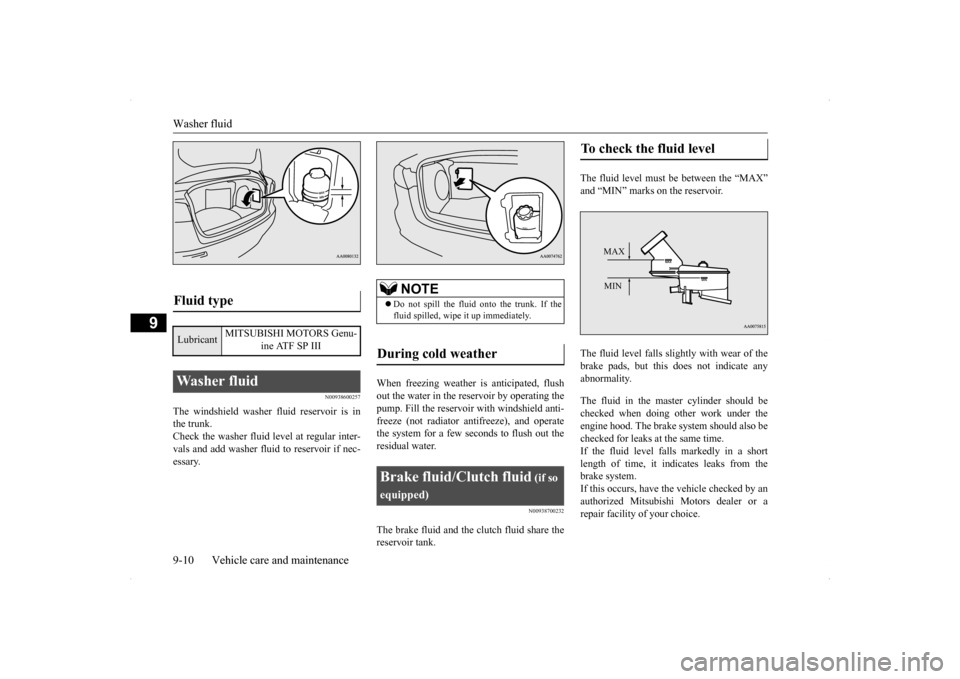
The windshield washer fluid reservoir is in the trunk. Check the washer fluid level at regular inter- vals and add washer fluid to reservoir if nec-essary.
When freezing weather is anticipated, flush out the water in the reservoir by operating the pump. Fill the reservoir with windshield anti-freeze (not radiator antifreeze), and operate the system for a few seconds to flush out the residual water.
N00938700232
The brake fluid and the clutch fluid share thereservoir tank.
The fluid level must be between the “MAX” and “MIN” marks on the reservoir. The fluid level falls slightly with wear of the brake pads, but this does not indicate any abnormality. The fluid in the master cylinder should be checked when doing other work under theengine hood. The brake system should also be checked for leaks at the same time. If the fluid level falls markedly in a shortlength of time, it indicates leaks from the brake system. If this occurs, have the vehicle checked by anauthorized Mitsubishi Motors dealer or a repair facility of your choice.
Fluid type Lubricant
MITSUBISHI MOTORS Genu-
ine ATF SP III
Washer fluid
NOTE
Do not spill the fluid onto the trunk. If the fluid spilled, wipe it up immediately.
During cold weather Brake fluid/Clutch fluid
(if so
equipped)
To check the fluid level
MAX MIN
BK0200800US.bo
ok 10 ページ 2013年2月14日 木曜日 午後2時28分
Page 282 of 338
Power steering fluid
Vehicle care and maintenance 9-11
9
Use brake fluid conforming to DOT 3 or DOT 4. The reservoir cap must be tightlysealed to keep dirt and water out.
N00939000391
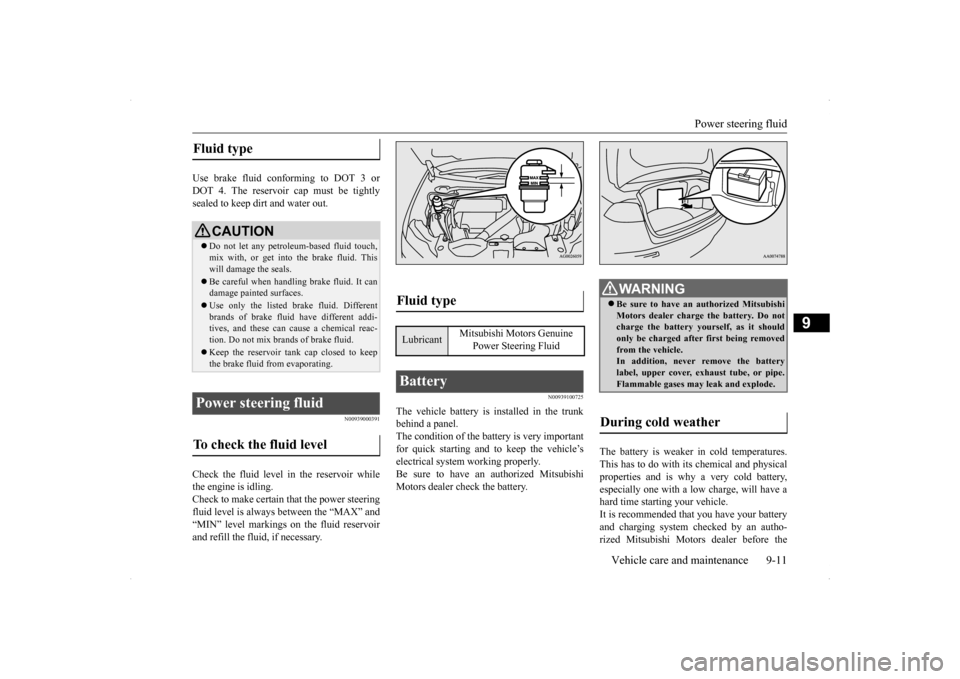
Check the fluid level in the reservoir while the engine is idling. Check to make certain that the power steeringfluid level is always between the “MAX” and “MIN” level markings on the fluid reservoir and refill the fluid, if necessary.
N00939100725
The vehicle battery is installed in the trunkbehind a panel. The condition of the battery is very important for quick starting and to keep the vehicle’selectrical system working properly. Be sure to have an authorized Mitsubishi Motors dealer check the battery.
The battery is weaker in cold temperatures. This has to do with its chemical and physical properties and is why a very cold battery,especially one with a low charge, will have a hard time starting your vehicle. It is recommended that you have your batteryand charging system checked by an autho- rized Mitsubishi Motors dealer before the
Fluid type
CAUTION Do not let any petroleum-based fluid touch, mix with, or get into
the brake fluid. This
will damage the seals. Be careful when handling brake fluid. It can damage painted surfaces. Use only the listed brake fluid. Different brands of brake fluid have different addi-tives, and these can cause a chemical reac- tion. Do not mix brands of brake fluid. Keep the reservoir tank cap closed to keep the brake fluid from evaporating.
Power steering fluid To check the fluid level
Fluid type Lubricant
Mitsubishi Motors Genuine
Power Steering Fluid
Battery
WA R N I N G Be sure to have an authorized Mitsubishi Motors dealer charge the battery. Do not charge the battery yourself, as it shouldonly be charged after first being removed from the vehicle. In addition, never remove the batterylabel, upper cover, exhaust tube, or pipe. Flammable gases may leak and explode.
During cold weather
BK0200800US.bo
ok 11 ページ 2013年2月14日 木曜日 午後2時28分
Page 315 of 338
Cleaning the outside of your vehicle 9-44 Vehicle care and maintenance
9
cloth in one direction. After polishing, flush the compound from the surface and apply a coat of wax to regain a beautiful luster.
N00946200018
Small cracks and scratches in the paint coatshould be touched up as soon as possible with touch-up paint to prevent corrosion.Check body areas facing the road or the tirescarefully for damage to the paint caused by flying stones, etc. The
paint code number for
your vehicle can be found on the vehicleinformation code plate in the engine compart- ment.
N00946300178
Use a sponge or chamois to clean these parts.If a vehicle wax sticks to a gray or black rough surface of the bumper, molding orlights, the surface may appear white in color. In this case, wipe it off using lukewarm water and a soft cloth or chamois.
N00946400010
To prevent spots and corrosion of chromeparts, wash with water, dry thoroughly, and apply a nonabrasive automotive wax. If the chrome is severely damaged or pitted, use acommercially available chrome polish.
N00946500109
1. Remove dirt using a wet sponge.2. Use a mild detergent on any dirt that can- not be removed easily with water. Rinse off the detergent after washing thewheel. 3. Dry the wheel thoroug
hly using a chamois
leather or a soft cloth.
N00946600012
The window glass can
usually be cleaned
using only a sponge and water. Glass cleanercan be used to remove wax, oil, grease, dead insects, etc. After washing the glass, wipe it dry with a clean, dry, soft cloth.
N00946700084
Use a soft cloth and gl
ass cleaner to remove
grease, dead insects, etc., from the wiperblades. Replace the wiper blades when they no longer clean the windshield properly.
Damaged paint Cleaning plastic parts
CAUTION Do not use a scrubbing brush or other rough scrubber as these may damage the plasticsurface.
Do not use wax containing compounds (pol- ishing powder) which may damage the plas- tic surface. Do not let the plastic parts get soiled with gasoline, oil, brake fluids, engine oils, greases, paint thinner, and sulfuric acid (bat- tery electrolyte). These fluids, etc., maycrack, stain or discolor the plastic parts. If any of these get on the plastic parts, wipe them up with a soft cloth or chamois and amild solution of soap and water. Then rinse them immediately with water.
Chrome parts Aluminum wheels
CAUTION
CAUTION Do not use a brush or other hard implement on the wheels. Doing so could scratch the wheels. Do not use any cleaner that contains an abra- sive substance or is acidic or alkaline. Doing so could cause the coating on the wheels to peel or become discolored or stained. Do not directly apply hot water using a steam cleaner or by any other means. Contact with seawater or road salt used for de-icing can cause corrosion. Rinse off suchsubstances as soon as possible.
Window glass Wiper blades
BK0200800US.bo
ok 44 ページ 2013年2月14日 木曜日 午後2時28分
Page 329 of 338
Refill capacities 11-6 Specifications
11
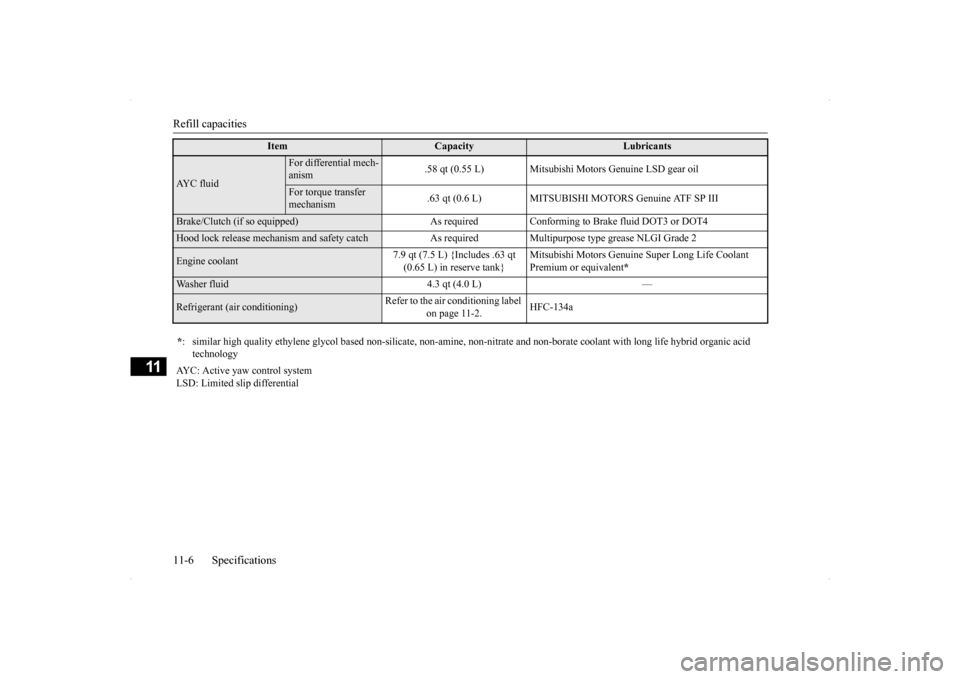
AYC fluid
For differential mech- anism
.58 qt (0.55 L) Mitsubishi Motors Genuine LSD gear oil
For torque transfer mechanism
.63 qt (0.6 L) MITSUBISHI
MOTORS Genuine ATF SP III
Brake/Clutch (if so equipped) As required Conforming to Brake fluid DOT3 or DOT4 Hood lock release mechanism and safety catch As required Multipurpose type grease NLGI Grade 2 Engine coolant
7.9 qt (7.5 L) {Includes .63 qt (0.65 L) in reserve tank}
Mitsubishi Motors Genuine Super Long Life Coolant Premium or equivalent
*
Washer fluid 4.3 qt (4.0 L) — Refrigerant (air conditioning)
Refer to the air conditioning label
on page 11-2.
HFC-134a
* : similar high quality ethylene glycol based non-silicate, non-a
mine, non-nitrate and non-borate coolant with long life hybrid o
rganic acid
technology
AYC: Active yaw control system LSD: Limited slip differential
Item
Capacity
Lubricants
BK0200800US.bo
ok 6 ページ 2013年2月14日 木曜日 午後2時28分
Page 330 of 338
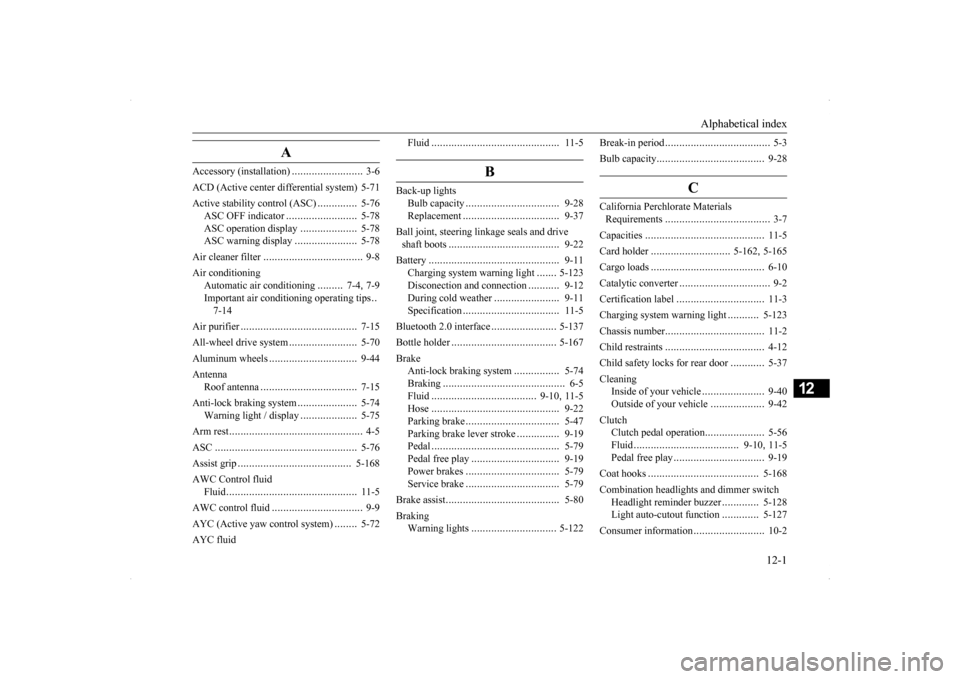
Alphabetical index
12-1
12
A
Accessory (installation)
.........................
3-6
ACD (Active center differential system) 5-71Active stability control (ASC)
..............
5-76
ASC OFF indicator
.........................
5-78
ASC operation display
....................
5-78
ASC warning display
......................
5-78
Air cleaner filter
...................
................
9-8
Air conditioning
Automatic air conditioning
.........
7-4
, 7-9
Important air conditioning operating tips
..
7-14
Air purifier
....................
.....................
7-15
All-wheel drive system
........................
5-70
Aluminum wheels
...............................
9-44
Antenna
Roof antenna
.................
.................
7-15
Anti-lock braking system
.....................
5-74
Warning light / display
....................
5-75
Arm rest
........................
.......................
4-5
ASC
..........................
........................
5-76
Assist grip
.....................
...................
5-168
AWC Control fluid
Fluid
......................
........................
11-5
AWC control fluid
................
................
9-9
AYC (Active yaw control system)
........
5-72
AYC fluid
Fluid
.......................
......................
11-5
B
Back-up lights
Bulb capacity
..................
...............
9-28
Replacement
...................
...............
9-37
Ball joint, steering linkage seals and drive shaft boots
.....................
..................
9-22
Battery
........................
......................
9-11
Charging system warning light
.......
5-123
Disconection and connection
...........
9-12
During cold weather
.......................
9-11
Specification
...................
...............
11-5
Bluetooth 2.0 interface
.......................
5-137
Bottle holder
....................
.................
5-167
Brake
Anti-lock braking system
................
5-74
Braking
.......................
....................
6-5
Fluid
....................
.................
9-10
, 11-5
Hose
.......................
......................
9-22
Parking brake
..................
...............
5-47
Parking brake lever stroke
...............
9-19
Pedal
.......................
......................
5-79
Pedal free play
................
...............
9-19
Power brakes
..................
...............
5-79
Service brake
..................
...............
5-79
Brake assist
......................
..................
5-80
Braking
Warning lights
..............................
5-122
Break-in period
.....................
................
5-3
Bulb capacity
.....................
.................
9-28
C
California Perchlorate Materials Requirements
.....................
................
3-7
Capacities
.....................
.....................
11-5
Card holder
............................
5-162
, 5-165
Cargo loads
...................
.....................
6-10
Catalytic converter
................
................
9-2
Certification label
...............................
11-3
Charging system warning light
...........
5-123
Chassis number
..................
.................
11-2
Child restraints
..................
.................
4-12
Child safety locks for rear door
............
5-37
Cleaning
Inside of your vehicle
......................
9-40
Outside of your vehicle
...................
9-42
Clutch
Clutch pedal operation
.....................
5-56
Fluid
..................
...................
9-10
, 11-5
Pedal free play
...............
.................
9-19
Coat hooks
....................
...................
5-168
Combination headlights and dimmer switch
Headlight reminder buzzer
.............
5-128
Light auto-cutout function
.............
5-127
Consumer information
.........................
10-2
BK0200800US.bo
ok 1 ページ 2013年2月14日 木曜日 午後2時28分
Page 331 of 338
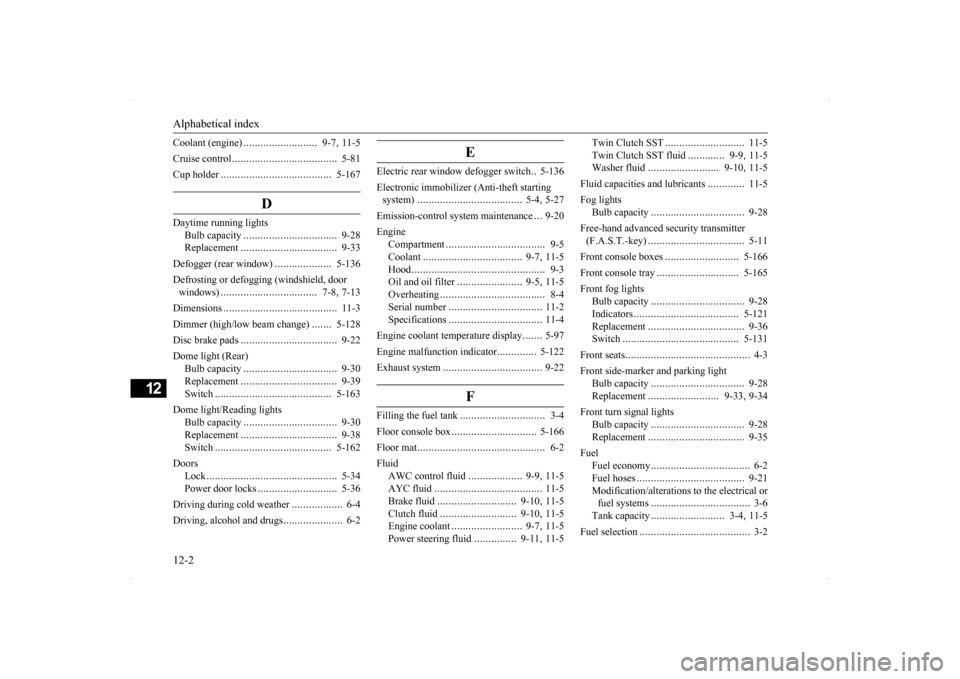
Alphabetical index 12-2
12
Coolant (engine)
..........................
9-7
, 11-5
Cruise control
....................
.................
5-81
Cup holder
....................
...................
5-167
D
Daytime running lights
Bulb capacity
................
.................
9-28
Replacement
.................
.................
9-33
Defogger (rear window)
....................
5-136
Defrosting or defogging (windshield, door windows)
.................
.................
7-8
, 7-13
Dimensions
...................
.....................
11-3
Dimmer (high/low beam change)
.......
5-128
Disc brake pads
.................
.................
9-22
Dome light (Rear)
Bulb capacity
................
.................
9-30
Replacement
.................
.................
9-39
Switch
......................
...................
5-163
Dome light/Reading lights
Bulb capacity
................
.................
9-30
Replacement
.................
.................
9-38
Switch
......................
...................
5-162
Doors
Lock
......................
........................
5-34
Power door locks
............................
5-36
Driving during cold weather
..................
6-4
Driving, alcohol and drugs
.....................
6-2
E
Electric rear window defogger switch
..5-136
Electronic immobilizer (Anti-theft starting system)
.....................
................
5-4
, 5-27
Emission-control system maintenance
...
9-20
Engine
Compartment
..................
.................
9-5
Coolant
...................
................
9-7
, 11-5
Hood
.......................
........................
9-3
Oil and oil filter
.......................
9-5
, 11-5
Overheating
....................
.................
8-4
Serial number
.................
................
11-2
Specifications
.................
................
11-4
Engine coolant temperature display
.......
5-97
Engine malfunction indicator
..............
5-122
Exhaust system
...................
................
9-22
F
Filling the fuel tank
..............................
3-4
Floor console box
..............................
5-166
Floor mat
.........................
....................
6-2
Fluid
AWC control fluid
...................
9-9
, 11-5
AYC fluid
...................
...................
11-5
Brake fluid
............................
9-10
, 11-5
Clutch fluid
...........................
9-10
, 11-5
Engine coolant
.........................
9-7
, 11-5
Power steering fluid
...............
9-11
, 11-5
Twin Clutch SST
............................
11-5
Twin Clutch SST fluid
.............
9-9
, 11-5
Washer fluid
.........................
9-10
, 11-5
Fluid capacities and lubricants
.............
11-5
Fog lights
Bulb capacity
................
.................
9-28
Free-hand advanced security transmitter (F.A.S.T.-key)
.................
.................
5-11
Front console boxes
..........................
5-166
Front console tray
.............................
5-165
Front fog lights
Bulb capacity
................
.................
9-28
Indicators
..................
...................
5-121
Replacement
.................
.................
9-36
Switch
......................
...................
5-131
Front seats
.........................
...................
4-3
Front side-marker and parking light
Bulb capacity
................
.................
9-28
Replacement
.........................
9-33
, 9-34
Front turn signal lights
Bulb capacity
................
.................
9-28
Replacement
.................
.................
9-35
Fuel
Fuel economy
...................
................
6-2
Fuel hoses
.....................
.................
9-21
Modification/alterations to the electrical orfuel systems
...................
................
3-6
Tank capacity
..........................
3-4
, 11-5
Fuel selection
....................
...................
3-2
BK0200800US.bo
ok 2 ページ 2013年2月14日 木曜日 午後2時28分