check oil MITSUBISHI LANCER EVOLUTION 2014 10.G User Guide
[x] Cancel search | Manufacturer: MITSUBISHI, Model Year: 2014, Model line: LANCER EVOLUTION, Model: MITSUBISHI LANCER EVOLUTION 2014 10.GPages: 338, PDF Size: 40.99 MB
Page 288 of 338
Tires
Vehicle care and maintenance 9-17
9
2 to 6 PSI from the cold inflation pressure. Do not let air out of the tires to get back to the specified cold pressure, or your tire pressure will be too low.Check your tires each time you refuel. If one tire looks lower than the others, check the pressure for all of them.You should also take the following safety pre- cautions: Keep your tires inflated to the recom- mended pressures. (See the tire and load-ing information placard attached to thedriver’s door sill.) Stay within the recommended load limits. Make sure that the weight of any load in your vehicle is evenly distributed. Drive at safe speeds. After filling your tires to the correct pres- sure, check them for damage and air leaks. Be sure to reinstall the caps on the valve stems.
N00939600397
N00939700037
The following maintenance steps are recom- mended: Check tire pressures regularly.
Have regular maintenance done on the wheel balance and front and rear suspen- sion alignment. Rotate your tires regularly as described in the “Tire rotation” section on page 9-18.
N00939800201
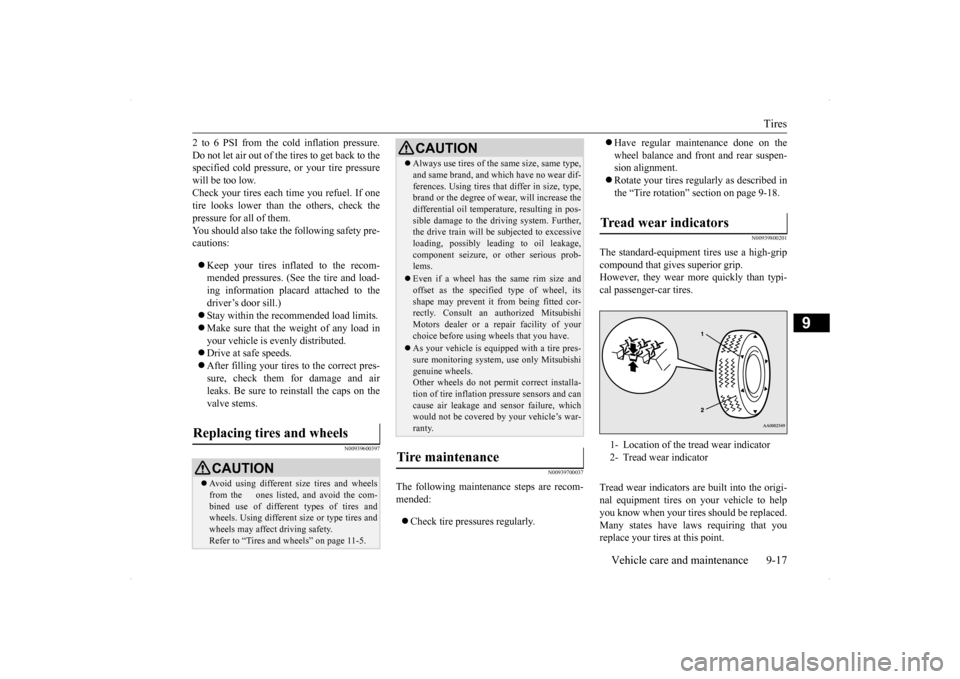
The standard-equipment tires use a high-gripcompound that gives superior grip.However, they wear more quickly than typi- cal passenger-car tires. Tread wear indicators are built into the origi- nal equipment tires on your vehicle to help you know when your tire
s should be replaced.
Many states have laws requiring that you replace your tires at this point.
Replacing tires and wheels
CAUTION Avoid using different size tires and wheels from the ones listed, and avoid the com- bined use of different types of tires and wheels. Using different size or type tires andwheels may affect driving safety. Refer to “Tires and wheels” on page 11-5.
Always use tires of the same size, same type, and same brand, and which have no wear dif- ferences. Using tires that differ in size, type, brand or the degree of wear, will increase the differential oil temperature, resulting in pos-sible damage to the driving system. Further, the drive train will be
subjected to excessive
loading, possibly leading to oil leakage,component seizure, or other serious prob- lems. Even if a wheel has the same rim size and offset as the specified type of wheel, its shape may prevent it from being fitted cor-rectly. Consult an authorized Mitsubishi Motors dealer or a repair facility of your choice before using wheels that you have. As your vehicle is equipped with a tire pres- sure monitoring system, use only Mitsubishigenuine wheels. Other wheels do not permit correct installa- tion of tire inflation pressure sensors and cancause air leakage and sensor failure, which would not be covered by your vehicle’s war- ranty.
Tire maintenance
CAUTION
Tread wear indicators 1- Location of the tread wear indicator 2- Tread wear indicator
BK0200800US.bo
ok 17 ページ 2013年2月14日 木曜日 午後2時28分
Page 293 of 338
General maintenance 9-22 Vehicle care and maintenance
9
there are other parts which do not usually need regular maintenance. But, if any of these pa
rts stops working prop-
erly, your vehicle performance could suffer.Have these items checked if you notice a problem with them. See your authorized Mitsubishi Motors dealer for assistance, if you have any questions.
N00941600062
Good brakes are essential to safe driving. Check the brake pads for wear. For good braking performance, replace the brake padswith the same type pads as the originals.
N00941700047
Brake hoses and tubing should be checkedfor: Severe surface cracking, scuffing or worn spots. If the fabric casing of the hose is showing through any cracks or worn spotsin the rubber hose cover, the hose should be replaced. The brakes can fail if the hose wears through. Improper installation may cause twisting, or wheel, tire or chassis interference.
N00941800077
Check the following parts for damage and grease leaks: Ball joint boots of the front suspension and steering linkage Bellows on both ends of the drive shaft
N00942200108
The best way to k
eep carbon monoxide gas
from entering inside your vehicle is to have the engine exhaust system properly serviced. Have a competent mechanic inspect the com-plete exhaust system and nearby body areas for broken, damaged, deteriorated, or mispo- sitioned parts if you notice any of the follow-ing: A change in the sound of the exhaust sys- tem The smell of exhaust fumes inside the vehicle
The underside or rear of the vehicle is damaged
Also check the exhaust system each time the vehicle is raised for lubrication, oil changes, or required service. Any open seams or looseconnections could let dangerous exhaust fumes seep into the luggage compartment and passenger compartments. Check for holes or exhaust gas leaks caused by corrosion or damage. Check the joints and connections for looseness or exhaust gas leaks. Check the rubber hangers and brackets for damage.
N00942500042
The hood lock release mechanism and hood safety catch should be checked, cleaned, and oiled when needed for easy movement and tostop rust and wear. Use Multipurpose Grease NLGI Grade 2 sparingly for all sliding parts of the hood latch and release lever. Work thegrease into the hood lock mechanism until all the movable surfaces are covered.
Disc brake pads Brake hoses
Ball joint, steering linkage seals and drive shaft boots Exhaust system
WA R N I N G Carbon monoxide gas from your vehicle’s exhaust is poisonous. Breathing these fumes can cause unconsciousness or death.
Check for any of the following conditions: Hood lock release mechanism and safety catch
BK0200800US.bo
ok 22 ページ 2013年2月14日 木曜日 午後2時28分
Page 299 of 338
Replacement of light bulbs 9-28 Vehicle care and maintenance
9
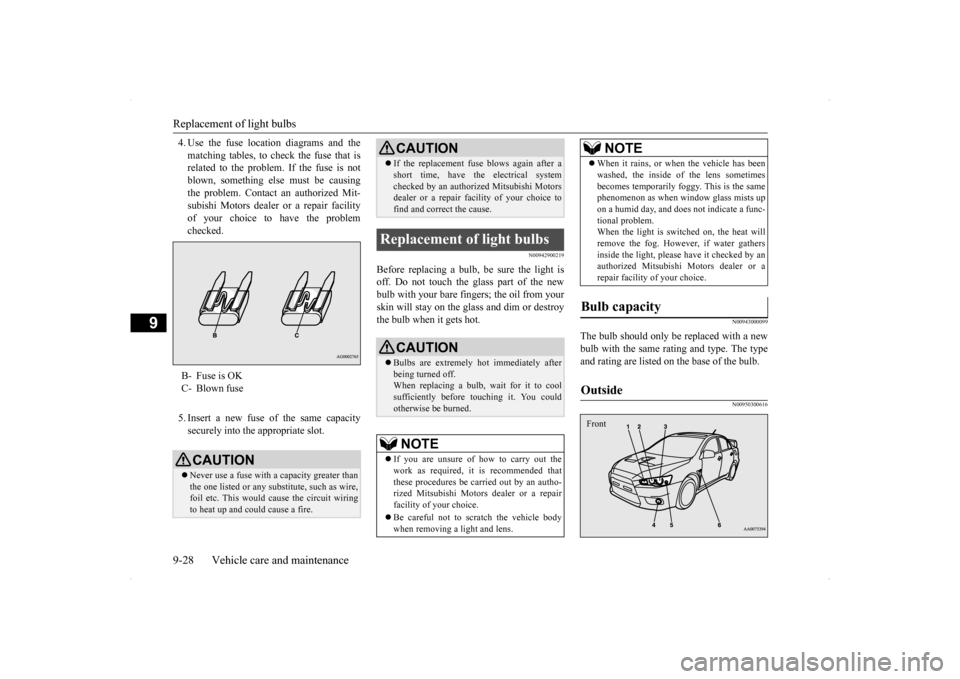
4. Use the fuse location diagrams and the matching tables, to check the fuse that is related to the problem. If the fuse is not blown, something else must be causingthe problem. Contact an authorized Mit- subishi Motors dealer or a repair facility of your choice to have the problemchecked. 5. Insert a new fuse of the same capacity securely into the appropriate slot.
N00942900219
Before replacing a bulb, be sure the light isoff. Do not touch the glass part of the newbulb with your bare fi
ngers; the oil from your
skin will stay on the glass and dim or destroy the bulb when it gets hot.
N00943000099
The bulb should only be replaced with a newbulb with the same ra
ting and type. The type
and rating are listed on the base of the bulb.
N00950300616
B- Fuse is OKC- Blown fuseCAUTION Never use a fuse with a capacity greater than the one listed or any substitute, such as wire, foil etc. This would cause the circuit wiringto heat up and could cause a fire.
If the replacement fuse blows again after a short time, have the electrical system checked by an authorized Mitsubishi Motors dealer or a repair faci
lity of your choice to
find and correct the cause.
Replacement of light bulbs
CAUTION Bulbs are extremely hot immediately after being turned off. When replacing a bulb, wait for it to coolsufficiently before touching it. You could otherwise be burned.NOTE
If you are unsure of how to carry out the work as required, it is recommended that these procedures be carried out by an autho-rized Mitsubishi Motors dealer or a repair facility of your choice. Be careful not to scratch the vehicle body when removing a light and lens.CAUTION
When it rains, or when the vehicle has been washed, the inside of the lens sometimes becomes temporarily foggy. This is the same phenomenon as when window glass mists up on a humid day, and does not indicate a func-tional problem. When the light is switched on, the heat will remove the fog. However, if water gathersinside the light, please have it checked by an authorized Mitsubishi Motors dealer or a repair facility of your choice.
Bulb capacity Outside
NOTE
Front
BK0200800US.bo
ok 28 ページ 2013年2月14日 木曜日 午後2時28分
Page 303 of 338
Replacement of light bulbs 9-32 Vehicle care and maintenance
9
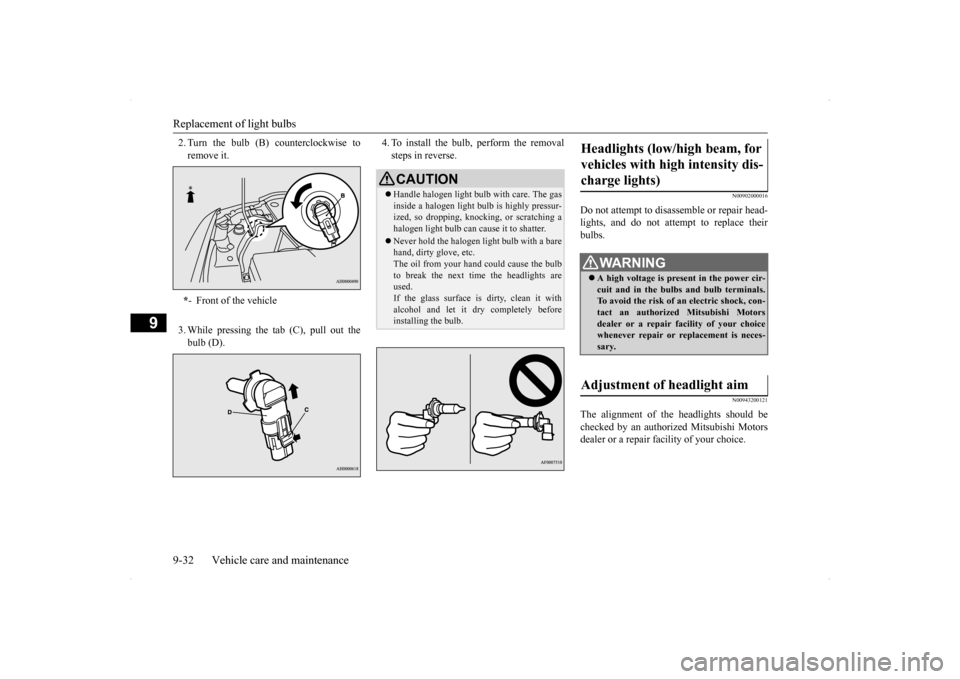
2. Turn the bulb (B) counterclockwise to remove it. 3. While pressing the tab (C), pull out the bulb (D).
4. To install the bulb, perform the removal steps in reverse.
N00902000016
Do not attempt to disassemble or repair head- lights, and do not attempt to replace their bulbs.
N00943200121
The alignment of the headlights should be checked by an authorized Mitsubishi Motors dealer or a repair facility of your choice.
* - Front of the vehicle
CAUTIONHandle halogen light bulb with care. The gas inside a halogen light bulb is highly pressur-ized, so dropping, knocking, or scratching a halogen light bulb can cause it to shatter. Never hold the halogen light bulb with a bare hand, dirty glove, etc. The oil from your hand could cause the bulbto break the next time the headlights are used. If the glass surface is dirty, clean it withalcohol and let it dry completely before installing the bulb.
Headlights (low/high beam, for vehicles with high intensity dis- charge lights)
WA R N I N G A high voltage is present in the power cir- cuit and in the bulbs and bulb terminals.To avoid the risk of an electric shock, con- tact an authorized Mitsubishi Motors dealer or a repair facility of your choicewhenever repair or replacement is neces- sary.
Adjustment of headlight aim
BK0200800US.bo
ok 32 ページ 2013年2月14日 木曜日 午後2時28分
Page 314 of 338
Cleaning the outside of your vehicle Vehicle care and maintenance 9-43
9
Salt and other chemicals spread on winter roads in some geographical areas can have adetrimental effect on the vehicle underbody. You should flush the underbody with a high pressure hose every time you wash the out-side of your vehicle. Take special care to remove mud or other debris which could trap and hold salt andmoisture.
After washing your vehicle, wipe off all waterdrops from the rubber parts around the doors to prevent the doors from freezing.
N00946000221
Wax your vehicle once or twice a year, or when water does not bead up on the paint.Use a soft cloth to put a small amount of wax on the painted surfaces. After the wax has dried, polish with a dry soft cloth.Do not wax your vehicle in direct sunlight. You should wax when the painted surfaces are cool.
N00946100017
If painted surfaces have been severely dam- aged and lost their original luster and color tone, polish the surface lightly with a finepolishing compound. Avoid limiting your polishing to the damaged surface only; polish a somewhat wider area, moving the polishing
When using high-pressure water to wash a vehicle equipped with the F.A.S.T.-key sys- tem, keep the water from spraying on the open button on the trunk. This could cause the trunk to open and flood the inside of thetrunk. Make sure to do the following when using an automatic car wash, with help from either this manual or the car wash operator, to avoid damaging your vehicle:• Fold the outside rear-view mirrors.• Remove the antenna.• If your vehicle is equipped with rearspoiler, check with the car wash operator before using the car wash.• If your vehicle has rain sensor wipers, placethe wiper switch lever in the “OFF” posi- tion to deactivate the rain sensor.
During cold weather
CAUTION
NOTE
When the door is frozen, opening it by force may tear off or crack the rubber gasket installed around the door. Pour warm water to melt the ice. Be sure to thoroughly wipeoff the water after opening the door. To pre- vent freezing of the weatherstripping on the doors, hood, etc., treat with silicone lubri-cant.
Waxing
CAUTION Waxes containing high abrasive compounds should not be used. These waxes remove rust and stain effectively from the paintwork, but are harmful to the finish
on the paint and the
plate, because they also remove clearcoat.They are also harmful to other glossy sur- faces such as the grille, trim, moldings, etc. Do not use gasoline, kerosene, benzine or paint thinners to remove road tar or other dirt from the vehicle surface. Do not put wax on the areas having black matte coating because it can cause unevendiscoloration, patches, blurs, etc. If these get wax on them, wipe the wax off right away with a soft cloth and warm water. If your vehicle is equipped with a sunroof, be careful not to apply any wax on the weather-strip (black rubber) when waxing the area around the sunroof opening. If stained with wax, the weatherstrip cannotmaintain a weatherproof seal with the sun- roof.
Polishing
BK0200800US.bo
ok 43 ページ 2013年2月14日 木曜日 午後2時28分
Page 315 of 338
Cleaning the outside of your vehicle 9-44 Vehicle care and maintenance
9
cloth in one direction. After polishing, flush the compound from the surface and apply a coat of wax to regain a beautiful luster.
N00946200018
Small cracks and scratches in the paint coatshould be touched up as soon as possible with touch-up paint to prevent corrosion.Check body areas facing the road or the tirescarefully for damage to the paint caused by flying stones, etc. The
paint code number for
your vehicle can be found on the vehicleinformation code plate in the engine compart- ment.
N00946300178
Use a sponge or chamois to clean these parts.If a vehicle wax sticks to a gray or black rough surface of the bumper, molding orlights, the surface may appear white in color. In this case, wipe it off using lukewarm water and a soft cloth or chamois.
N00946400010
To prevent spots and corrosion of chromeparts, wash with water, dry thoroughly, and apply a nonabrasive automotive wax. If the chrome is severely damaged or pitted, use acommercially available chrome polish.
N00946500109
1. Remove dirt using a wet sponge.2. Use a mild detergent on any dirt that can- not be removed easily with water. Rinse off the detergent after washing thewheel. 3. Dry the wheel thoroug
hly using a chamois
leather or a soft cloth.
N00946600012
The window glass can
usually be cleaned
using only a sponge and water. Glass cleanercan be used to remove wax, oil, grease, dead insects, etc. After washing the glass, wipe it dry with a clean, dry, soft cloth.
N00946700084
Use a soft cloth and gl
ass cleaner to remove
grease, dead insects, etc., from the wiperblades. Replace the wiper blades when they no longer clean the windshield properly.
Damaged paint Cleaning plastic parts
CAUTION Do not use a scrubbing brush or other rough scrubber as these may damage the plasticsurface.
Do not use wax containing compounds (pol- ishing powder) which may damage the plas- tic surface. Do not let the plastic parts get soiled with gasoline, oil, brake fluids, engine oils, greases, paint thinner, and sulfuric acid (bat- tery electrolyte). These fluids, etc., maycrack, stain or discolor the plastic parts. If any of these get on the plastic parts, wipe them up with a soft cloth or chamois and amild solution of soap and water. Then rinse them immediately with water.
Chrome parts Aluminum wheels
CAUTION
CAUTION Do not use a brush or other hard implement on the wheels. Doing so could scratch the wheels. Do not use any cleaner that contains an abra- sive substance or is acidic or alkaline. Doing so could cause the coating on the wheels to peel or become discolored or stained. Do not directly apply hot water using a steam cleaner or by any other means. Contact with seawater or road salt used for de-icing can cause corrosion. Rinse off suchsubstances as soon as possible.
Window glass Wiper blades
BK0200800US.bo
ok 44 ページ 2013年2月14日 木曜日 午後2時28分