oil MITSUBISHI LANCER EVOLUTION 2014 10.G User Guide
[x] Cancel search | Manufacturer: MITSUBISHI, Model Year: 2014, Model line: LANCER EVOLUTION, Model: MITSUBISHI LANCER EVOLUTION 2014 10.GPages: 338, PDF Size: 40.99 MB
Page 276 of 338
View of the engine compartment
Vehicle care and maintenance 9-5
9
Unlatch the prop from the engine hood and put it back in its retainer. Slowly lower the engine hood about 8 inches (20 cm), then let it drop from its own weight.
N00937600641
N00937701971
It is normal for an engi
ne to use oil. You may
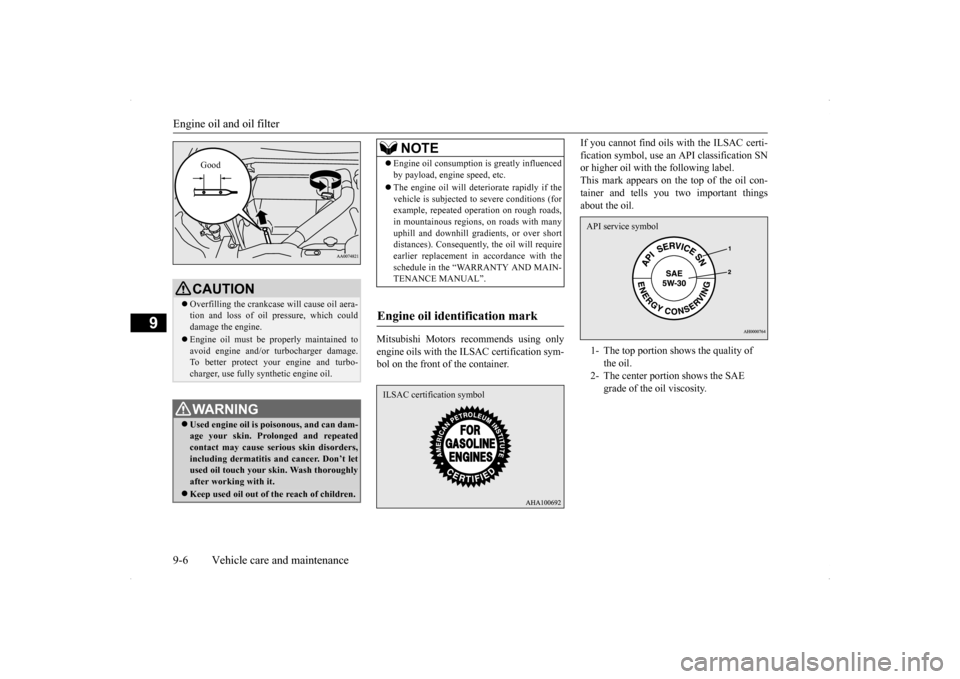
need to add oil between the recommended oil change intervals. Before starting the engine,check the engine oil level. Refill if necessary. To check the oil level, remove the dipstick, wipe it off, and gently insert it all the way into the crankcase. Slowly remove it again.The oil level must not go above the line on the dipstick. If the level does not reach the line, which shows the smallest amount of oil required,remove the oil filler cap on the engine valve cover, and fill to with
in the “Good” range.
To close
CAUTIONBe careful not to trap your hands or fingers when closing the engine hood. Make sure the engine hood is firmly closed before driving.If you drive without the engine hood com- pletely closed, it could open up while driv- ing.NOTE
If this does not close the engine hood prop- erly, drop it again from a slightly higher position.
Do not push down strongly on the engine hood. Depending on how strongly or where you push down, you could create a dent in the vehicle body. If you drive with the engine hood left open, warning display is displayed on the informa- tion screen in the multi-information display.
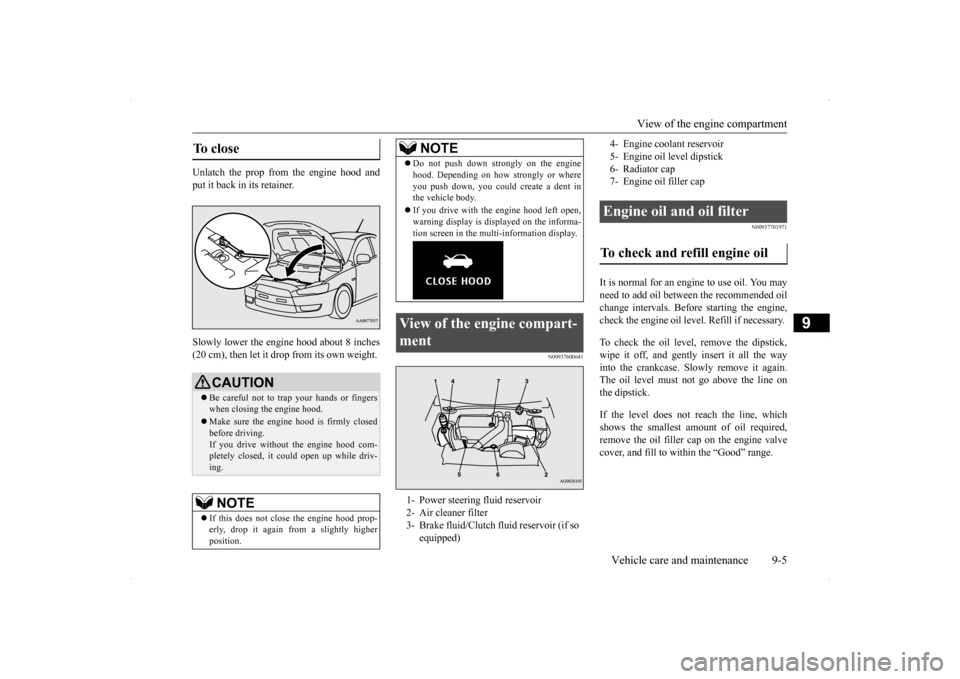
View of the engine compart- ment 1- Power steering fluid reservoir 2- Air cleaner filter 3- Brake fluid/Clutch fluid reservoir (if so
equipped)NOTE
4- Engine coolant reservoir 5- Engine oil level dipstick6- Radiator cap 7- Engine oil filler capEngine oil and oil filter To check and refill engine oil
BK0200800US.bo
ok 5 ページ 2013年2月14日 木曜日 午後2時28分
Page 277 of 338
Engine oil and oil filter 9-6 Vehicle care and maintenance
9
Mitsubishi Motors recommends using only engine oils with the ILSAC certification sym- bol on the front of the container.
If you cannot find oils with the ILSAC certi- fication symbol, use an API classification SN or higher oil with the following label. This mark appears on th
e top of the oil con-
tainer and tells you two important things about the oil.
CAUTION Overfilling the crankcase will cause oil aera- tion and loss of oil pressure, which could damage the engine. Engine oil must be properly maintained to avoid engine and/or turbocharger damage. To better protect your engine and turbo-charger, use fully synthetic engine oil.WA R N I N G Used engine oil is poisonous, and can dam- age your skin. Prolonged and repeatedcontact may cause serious skin disorders, including dermatitis and cancer. Don’t let used oil touch your skin. Wash thoroughlyafter working with it. Keep used oil out of the reach of children.Good
NOTE
Engine oil consumption is greatly influenced by payload, engine speed, etc. The engine oil will deteriorate rapidly if the vehicle is subjected to severe conditions (forexample, repeated operation on rough roads, in mountainous regions, on roads with many uphill and downhill gradients, or over shortdistances). Consequently, the oil will require earlier replacement in accordance with the schedule in the “WARRANTY AND MAIN-TENANCE MANUAL”.
Engine oil identification mark ILSAC certification symbol
1- The top portion shows the quality of
the oil.
2- The center portion shows the SAE
grade of the oil viscosity.
API service symbol
BK0200800US.bo
ok 6 ページ 2013年2月14日 木曜日 午後2時28分
Page 278 of 338
Engine coolant
Vehicle care and maintenance 9-7
9
N00955000100
Always use SAE 5W-30 engine oil.
N00955100042
The oil filter should be replaced at the time or mileage specified in the “WARRANTY ANDMAINTENANCE MANUAL”. Only use high quality replacement filters on this vehicle. The manufacturer’s specifica-tions for Genuine Mitsubishi oil filters require that the filter can withstand a pressure of 256 psi (1.8 MPa). A Genuine Mitsubishioil filter is the best replacement filter. Follow the installation
instructions printed on
the filter.
N00937800568
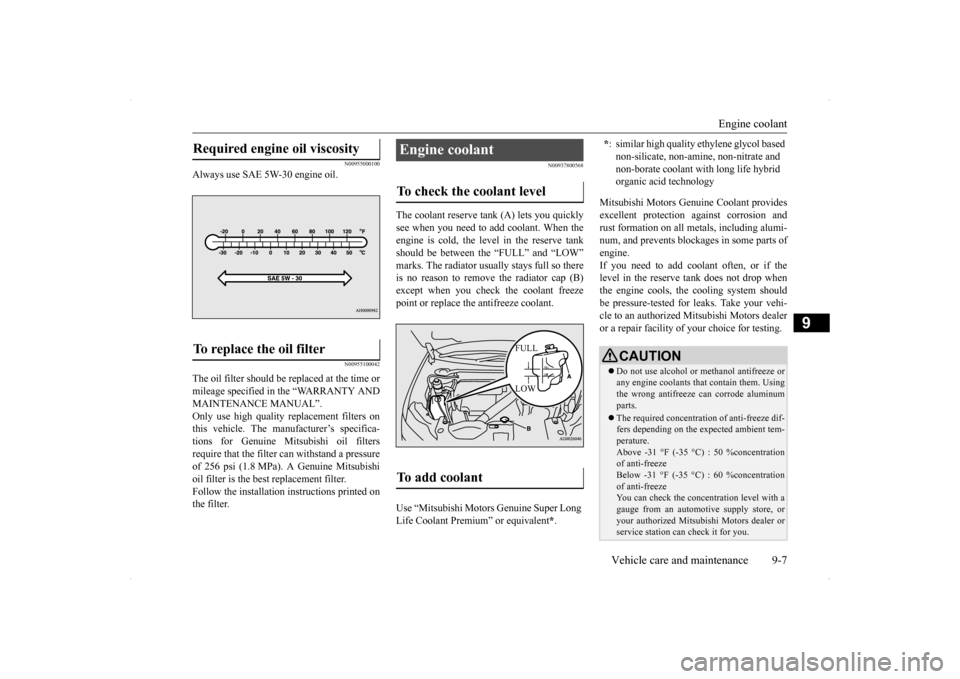
The coolant reserve tank (A) lets you quickly see when you need to add coolant. When the engine is cold, the level in the reserve tankshould be between the “FULL” and “LOW” marks. The radiator usually stays full so there is no reason to remove
the radiator cap (B)
except when you check the coolant freezepoint or replace the antifreeze coolant.
Mitsubishi Motors Genuine Coolant provides excellent protection against corrosion and rust formation on all metals, including alumi- num, and prevents blockages in some parts ofengine. If you need to add co
olant often, or if the
level in the reserve tank does not drop whenthe engine cools, the cooling system shouldbe pressure-tested for leaks. Take your vehi- cle to an authorized Mitsubishi Motors dealer or a repair facility of your choice for testing.
Required engine oil viscosity To replace the oil filter
Engine coolant To check the coolant level To add coolant Use “Mitsubishi Motors Genuine Super Long Life Coolant Premium” or equivalent
*.
FULL LOW
*: similar high quality ethylene glycol based non-silicate, non-amine, non-nitrate and non-borate coolant with long life hybrid organic acid technologyCAUTION Do not use alcohol or methanol antifreeze or any engine coolants that contain them. Using the wrong antifreeze can corrode aluminumparts. The required concentration of anti-freeze dif- fers depending on the expected ambient tem- perature. Above -31 °F (-35 °C) : 50 %concentration of anti-freeze Below -31 °F (-35 °C) : 60 %concentrationof anti-freeze You can check the concentration level with a gauge from an automotive supply store, oryour authorized Mitsubishi Motors dealer or service station can check it for you.
BK0200800US.bo
ok 7 ページ 2013年2月14日 木曜日 午後2時28分
Page 279 of 338
Air cleaner filter 9-8 Vehicle care and maintenance
9
The radiator cap must be tight sealed to pre- vent losing coolant which may result in engine damage. Only use a Genuine Mitsubi-shi Parts radiator cap, or an approved equiva- lent. Do not overfill the reserve tank.
Your vehicle uses a special radiator cap that stays sealed and lets the coolant flow from the reserve tank back to the radiator when the engine cools down. If you needto change the cap, use the exact same kind. Check the coolant freeze point in the radi- ator with the proper gauge, and only when it is safe. If you add antifreeze, the con- tents of the reserve tank must be protectedagainst freezing. Keep the front of the radiator and con- denser clean. If the temperature of the engine coolant does not rise after the engine is warmed- up, take your vehicle to an authorized Mitsubishi Motors dealer or a repair facil-ity of your choice to have the thermostat checked, and replaced if necessary.
N00937901449
The air cleaner filter w
ill get dirty and dusty
from use and not filter properly. Replace it with a new filter using the schedule in the“WARRANTY AND MAINTENANCE MANUAL”.
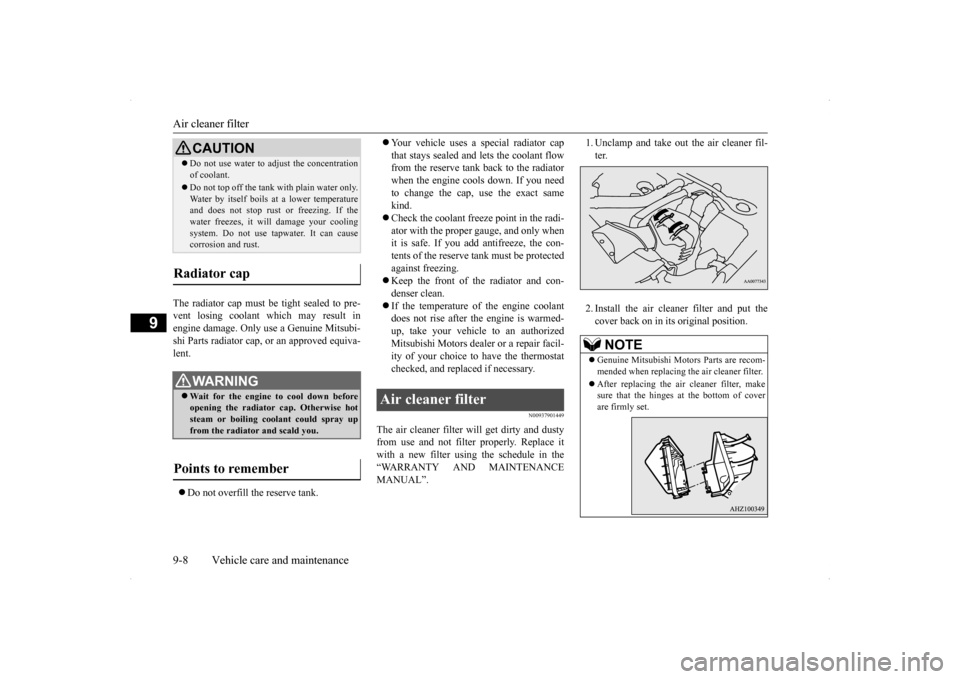
1. Unclamp and take out the air cleaner fil- ter. 2. Install the air cleaner filter and put the cover back on in its original position.
Do not use water to adjust the concentration of coolant. Do not top off the tank with plain water only. Water by itself boils at a lower temperatureand does not stop rust or freezing. If the water freezes, it will damage your cooling system. Do not use tapwater. It can causecorrosion and rust.
Radiator cap
WA R N I N G Wait for the engine to cool down before opening the radiator cap. Otherwise hotsteam or boiling coolant could spray up from the radiator and scald you.
Points to remember
CAUTION
Air cleaner filter
NOTE
Genuine Mitsubishi Moto
rs Parts are recom-
mended when replacing the air cleaner filter. After replacing the air cleaner filter, make sure that the hinges at the bottom of coverare firmly set.
BK0200800US.bo
ok 8 ページ 2013年2月14日 木曜日 午後2時28分
Page 280 of 338
Manual transaxle oil (if so equipped) Vehicle care and maintenance 9-9
9
N00938200165
Whenever the manual transaxle oil level is checked, add oil to maintain the proper level, if necessary. Refill or change the oil according to the table.
N00938300049
The Twin Clutch Sportronic shift transmis-sion (Twin Clutch SST) should be maintained and serviced by an authorized Mitsubishi Motors dealer or a repair facility of yourchoice to obtain the best performance and longest life. It is impor
tant that the transmis-
sion fluid is kept at the correct level.
Use only Mitsubishi Motors Genuine SSTF-I to ensure optimum transmission performance. Mitsubishi Motors Corporation does not rec- ommend the addition of any fluid additives to the transmission.
N00938400255
Whenever the transfer oil level is checked,add oil as necessary to maintain the proper level. Fill or change the oil according to thetable.
N00915200243
Whenever the oil level is checked, add oil asnecessary to maintain the proper level.Fill or change oil according to the table.
N00915300013
Remove the lid on the trunk room right side trim. Check the fluid level in the reservoir 90 min-utes or more after turning the ignition switch to the “LOCK” position. Check to make certain that the AWC controlfluid level is always between the “MAX” and “MIN” level markings on the fluid reservoir and refill the fluid, if necessary.
Manual transaxle oil
(if so
equipped)Oil type
Lubricant
Mitsubishi Motors Genuine NEW MULTI GEAR OIL API
Classification GL-3
Viscosity range
SAE 75W-80
Twin Clutch Sportronic shift transmission (Twin Clutch SST) fluid
(if so equipped)
Fluid type
CAUTION Using the improper transmission fluid may damage the transaxle.
Special additives
Transfer oil Oil type Lubri- cant
Mitsubishi Motors Genuine LSD
gear oil or equivalent
Rear axle oil Oil type Lubri- cant
For differen- tial mecha- nism
Mitsubishi Motors Genuine LSD gear
oil
For torque transfer mechanism
MITSUBISHI MOTORS Genu- ine ATF SP III
AWC control fluid To check the fluid level
BK0200800US.bo
ok 9 ページ 2013年2月14日 木曜日 午後2時28分
Page 288 of 338
Tires
Vehicle care and maintenance 9-17
9
2 to 6 PSI from the cold inflation pressure. Do not let air out of the tires to get back to the specified cold pressure, or your tire pressure will be too low.Check your tires each time you refuel. If one tire looks lower than the others, check the pressure for all of them.You should also take the following safety pre- cautions: Keep your tires inflated to the recom- mended pressures. (See the tire and load-ing information placard attached to thedriver’s door sill.) Stay within the recommended load limits. Make sure that the weight of any load in your vehicle is evenly distributed. Drive at safe speeds. After filling your tires to the correct pres- sure, check them for damage and air leaks. Be sure to reinstall the caps on the valve stems.
N00939600397
N00939700037
The following maintenance steps are recom- mended: Check tire pressures regularly.
Have regular maintenance done on the wheel balance and front and rear suspen- sion alignment. Rotate your tires regularly as described in the “Tire rotation” section on page 9-18.
N00939800201
The standard-equipment tires use a high-gripcompound that gives superior grip.However, they wear more quickly than typi- cal passenger-car tires. Tread wear indicators are built into the origi- nal equipment tires on your vehicle to help you know when your tire
s should be replaced.
Many states have laws requiring that you replace your tires at this point.
Replacing tires and wheels
CAUTION Avoid using different size tires and wheels from the ones listed, and avoid the com- bined use of different types of tires and wheels. Using different size or type tires andwheels may affect driving safety. Refer to “Tires and wheels” on page 11-5.
Always use tires of the same size, same type, and same brand, and which have no wear dif- ferences. Using tires that differ in size, type, brand or the degree of wear, will increase the differential oil temperature, resulting in pos-sible damage to the driving system. Further, the drive train will be
subjected to excessive
loading, possibly leading to oil leakage,component seizure, or other serious prob- lems. Even if a wheel has the same rim size and offset as the specified type of wheel, its shape may prevent it from being fitted cor-rectly. Consult an authorized Mitsubishi Motors dealer or a repair facility of your choice before using wheels that you have. As your vehicle is equipped with a tire pres- sure monitoring system, use only Mitsubishigenuine wheels. Other wheels do not permit correct installa- tion of tire inflation pressure sensors and cancause air leakage and sensor failure, which would not be covered by your vehicle’s war- ranty.
Tire maintenance
CAUTION
Tread wear indicators 1- Location of the tread wear indicator 2- Tread wear indicator
BK0200800US.bo
ok 17 ページ 2013年2月14日 木曜日 午後2時28分
Page 293 of 338
General maintenance 9-22 Vehicle care and maintenance
9
there are other parts which do not usually need regular maintenance. But, if any of these pa
rts stops working prop-
erly, your vehicle performance could suffer.Have these items checked if you notice a problem with them. See your authorized Mitsubishi Motors dealer for assistance, if you have any questions.
N00941600062
Good brakes are essential to safe driving. Check the brake pads for wear. For good braking performance, replace the brake padswith the same type pads as the originals.
N00941700047
Brake hoses and tubing should be checkedfor: Severe surface cracking, scuffing or worn spots. If the fabric casing of the hose is showing through any cracks or worn spotsin the rubber hose cover, the hose should be replaced. The brakes can fail if the hose wears through. Improper installation may cause twisting, or wheel, tire or chassis interference.
N00941800077
Check the following parts for damage and grease leaks: Ball joint boots of the front suspension and steering linkage Bellows on both ends of the drive shaft
N00942200108
The best way to k
eep carbon monoxide gas
from entering inside your vehicle is to have the engine exhaust system properly serviced. Have a competent mechanic inspect the com-plete exhaust system and nearby body areas for broken, damaged, deteriorated, or mispo- sitioned parts if you notice any of the follow-ing: A change in the sound of the exhaust sys- tem The smell of exhaust fumes inside the vehicle
The underside or rear of the vehicle is damaged
Also check the exhaust system each time the vehicle is raised for lubrication, oil changes, or required service. Any open seams or looseconnections could let dangerous exhaust fumes seep into the luggage compartment and passenger compartments. Check for holes or exhaust gas leaks caused by corrosion or damage. Check the joints and connections for looseness or exhaust gas leaks. Check the rubber hangers and brackets for damage.
N00942500042
The hood lock release mechanism and hood safety catch should be checked, cleaned, and oiled when needed for easy movement and tostop rust and wear. Use Multipurpose Grease NLGI Grade 2 sparingly for all sliding parts of the hood latch and release lever. Work thegrease into the hood lock mechanism until all the movable surfaces are covered.
Disc brake pads Brake hoses
Ball joint, steering linkage seals and drive shaft boots Exhaust system
WA R N I N G Carbon monoxide gas from your vehicle’s exhaust is poisonous. Breathing these fumes can cause unconsciousness or death.
Check for any of the following conditions: Hood lock release mechanism and safety catch
BK0200800US.bo
ok 22 ページ 2013年2月14日 木曜日 午後2時28分
Page 297 of 338

Fuses 9-26 Vehicle care and maintenance
9
Engine compartment fuse location table * - Front of the vehicle
No.
Sym- bol
Electrical system
Capac-ity
1 Front fog lights 15 A 2 Engine 7.5 AEngine compartment fuse location
*
Behind the fuse block cover
*
3 Automatic transaxle 20 A 4 Horn 10 A 5 Alternator 7.5 A 6 Headlight washer 20 A 7 Air conditioning 10 A8 ETV 15 A 9 Security horn 20 A 10 Wiper deicer 15 A 11 — — — 12 Power gate 30 A 13
Daytime running
lights
10 A
14
Headlight
(high beam) (left)
10 A
15
Headlight
(high beam) (right)
10 A
16
Headlight (low/high beam) (left)
Dis- charge
20 A
No.
Sym- bol
Electrical system
Capac-ity
17
Headlight (low/high beam) (right)
Dis- charge
20 A
18
Headlight (low beam) (left)
Halogen 10 A
19
Headlight (low beam) (right)
Halogen 10 A
20 I/C SPRAY 10 A 21 Ignition coil 10 A 22 ENG/POWER 20 A 23 Fuel pump 20 A24 Starter 30 A
*
25 — — — 26
Anti-lock
braking system
40 A
*
27
Anti-lock braking
system
30 A
*
28
Air conditioning condenser fan motor
30 A
*
No.
Sym- bol
Electrical system
Capac-ity
BK0200800US.bo
ok 26 ページ 2013年2月14日 木曜日 午後2時28分
Page 299 of 338
Replacement of light bulbs 9-28 Vehicle care and maintenance
9
4. Use the fuse location diagrams and the matching tables, to check the fuse that is related to the problem. If the fuse is not blown, something else must be causingthe problem. Contact an authorized Mit- subishi Motors dealer or a repair facility of your choice to have the problemchecked. 5. Insert a new fuse of the same capacity securely into the appropriate slot.
N00942900219
Before replacing a bulb, be sure the light isoff. Do not touch the glass part of the newbulb with your bare fi
ngers; the oil from your
skin will stay on the glass and dim or destroy the bulb when it gets hot.
N00943000099
The bulb should only be replaced with a newbulb with the same ra
ting and type. The type
and rating are listed on the base of the bulb.
N00950300616
B- Fuse is OKC- Blown fuseCAUTION Never use a fuse with a capacity greater than the one listed or any substitute, such as wire, foil etc. This would cause the circuit wiringto heat up and could cause a fire.
If the replacement fuse blows again after a short time, have the electrical system checked by an authorized Mitsubishi Motors dealer or a repair faci
lity of your choice to
find and correct the cause.
Replacement of light bulbs
CAUTION Bulbs are extremely hot immediately after being turned off. When replacing a bulb, wait for it to coolsufficiently before touching it. You could otherwise be burned.NOTE
If you are unsure of how to carry out the work as required, it is recommended that these procedures be carried out by an autho-rized Mitsubishi Motors dealer or a repair facility of your choice. Be careful not to scratch the vehicle body when removing a light and lens.CAUTION
When it rains, or when the vehicle has been washed, the inside of the lens sometimes becomes temporarily foggy. This is the same phenomenon as when window glass mists up on a humid day, and does not indicate a func-tional problem. When the light is switched on, the heat will remove the fog. However, if water gathersinside the light, please have it checked by an authorized Mitsubishi Motors dealer or a repair facility of your choice.
Bulb capacity Outside
NOTE
Front
BK0200800US.bo
ok 28 ページ 2013年2月14日 木曜日 午後2時28分
Page 302 of 338
Replacement of light bulbs
Vehicle care and maintenance 9-31
9
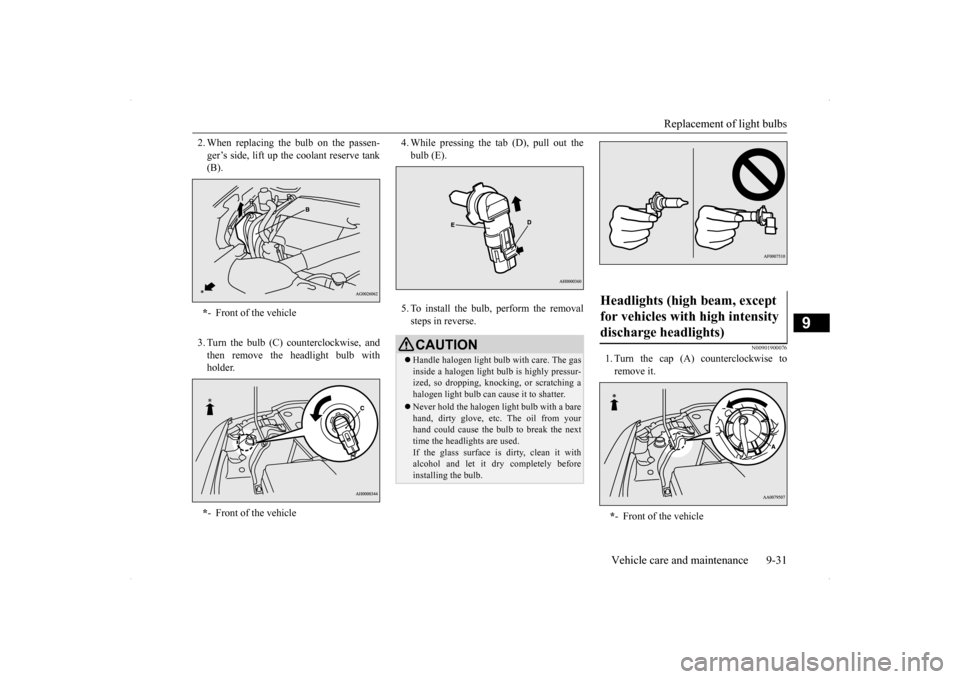
2. When replacing the bulb on the passen- ger’s side, lift up the coolant reserve tank (B). 3. Turn the bulb (C) counterclockwise, and then remove the headlight bulb with holder.
4. While pressing the tab (D), pull out the bulb (E). 5. To install the bulb, perform the removal steps in reverse.
N00901900076
1. Turn the cap (A) counterclockwise toremove it.
* - Front of the vehicle * - Front of the vehicle
CAUTIONHandle halogen light bulb with care. The gas inside a halogen light bulb is highly pressur-ized, so dropping, knocking, or scratching a halogen light bulb can cause it to shatter. Never hold the halogen light bulb with a bare hand, dirty glove, etc. The oil from your hand could cause the bulb to break the nexttime the headlights are used. If the glass surface is dirty, clean it with alcohol and let it dry completely beforeinstalling the bulb.
Headlights (high beam, except for vehicles with high intensity discharge headlights) * - Front of the vehicle
BK0200800US.bo
ok 31 ページ 2013年2月14日 木曜日 午後2時28分