transmission MITSUBISHI LANCER EVOLUTION 2014 10.G User Guide
[x] Cancel search | Manufacturer: MITSUBISHI, Model Year: 2014, Model line: LANCER EVOLUTION, Model: MITSUBISHI LANCER EVOLUTION 2014 10.GPages: 338, PDF Size: 40.99 MB
Page 123 of 338
Twin Clutch SST (Sportronic Shif
t Transmission) (if so equipped)
5-62 Features and controls
5
N00540100040
This position locks the transmission to pre- vent the vehicle from moving. The engine can be started from the “PARK” position. Move the lever to this position only after the vehicle has come to a complete stop. At this position, the transmission is disen- gaged. It is the same as the neutral position on a manual transaxle and should be used whenthe vehicle is not moving for an extended
length of time during driving, such as in a traffic jam. This position is used for most city and high- way driving. Engine shifting and braking are done automatically as needed, depending onroad conditions.
N00540200083
Select the control mode from the following three types to suit the driving conditions.
Gearshift lever positions (Main shift gate)
“P” PARK
“R” REVERSE
CAUTION Never shift into the “P” (PARK) or “R” (REVERSE) position while
the vehicle is in
motion. If the lever is shifted into the “P” (PARK) or “R” (REVERSE) position whilethe vehicle is in motion, the transmission may be damaged.
“N” NEUTRAL
WA R N I N G Never move the gearshift lever to the “N” (NEUTRAL) position while driving since you could accidentally slip it into the “P”(PARK) or “R”(REVERSE) position and the engine speed could rise, damaging the transmission. To prevent the vehicle from rolling when stopped on a slope, the engine should bestarted in the “P” (PARK) position. Although the engine can be started when the vehicle is in the “N” (NEUTRAL) posi-tion, for safety reasons, do not start the engine in the “N” (NEUTRAL) position. Always keep your foot on the brake pedal when the vehicle is in “N” (NEUTRAL) position, or when shifting into or out of“N” (NEUTRAL) position, to prevent roll- ing.
“D” DRIVE
CAUTION Never shift into the “D” (DRIVE) position from the “R” (REVERSE) position while the vehicle is in motion. If the lever is shifted into the “D” (DRIVE) from the “R” (REVERSE) position while thevehicle is in motion, the transmission may be damaged.NOTE
For information on manual shift gate opera- tion, please refer to “Manual shift” on page 5-64. When the engine is cold, upshifts occur at a higher vehicle speed than when the engine is warm.This control is performed to quickly warm up the engine. It does not indicate a malfunc- tion. After the vehicle
has been driven for a
while, upshifts will occur at the regular engine speeds.
Twin Clutch SST control mode
BK0200800US.bo
ok 62 ページ 2013年2月14日 木曜日 午後2時28分
Page 124 of 338
Twin Clutch SST (Sportronic Shif
t Transmission) (if so equipped) Features and controls 5-63
5
Tw i n C l u t c h SST control
mode
Characteristic
Normal (Control mode when engine is started)
Control mode for normal driving on local roads, free- ways, and the like. Smooth shifting is per-formed at low engine speeds for economical driving with good ride quality.
Sport
Control mode for driving on mountain roads, roads with uphill and downhill slopes, and freeways with long downhill slopes where engine braking is necessary. Compared to “Normal” mode, shifting occurs at higher engine speeds and is quicker. In addition, quick downshifting is possible when the accelerator pedal is depressed for quick accel-eration or when the brakes are applied.
S-Sport
(Super Sport)
In the “S-Sport” mode, shifting occurs at higher engine speeds and is even quicker than in the “Sport” mode. “S-Sport” mode is designed to be used while driving on closed circuit tracks. Do not use this mode on public roads.
NOTE
Damage to your vehicle caused by racing and/or driving on closed circuit tracks will not be covered under warranty. Please reviewthe “WARRANTY AND MAINTENANCE MANUAL: NEW VEHICLE LIMITED WARRANTY”.
Tw i n C l u t c h SST control
mode
Characteristic
When continuously driving on closed circuit racetracks or at other locations where the engine is operated at high speeds and under a heavy load, the Twin Clutch SST fluid tem- perature will have a tendency to rise.In this case, if the temperature rises too high, the warning display will appear on the information screen in the multi-information display to alert the driver. If the warning display appears, be sure to refer to “Warning display” on page 5-60 and follow the appropriate measures. The Twin Clutch SST control mode can be selected both when “D” range operation is selected and when manual shifting is selected. If you select “Sport” mode or “S-Sport” mode while the engine is cold, the transmis-sion may shift up at different speeds com- pared to that when the engine is warm. This is simply the operation of the controlsystem to warm the engine quickly. It does not indicate a malfunction. For slippery road surfaces, such as roads with accumulated snow, “Normal” mode is recommended for smooth shifting at low engine speeds.NOTE
BK0200800US.bo
ok 63 ページ 2013年2月14日 木曜日 午後2時28分
Page 125 of 338
Twin Clutch SST (Sportronic Shif
t Transmission) (if so equipped)
5-64 Features and controls
5
N00540300013
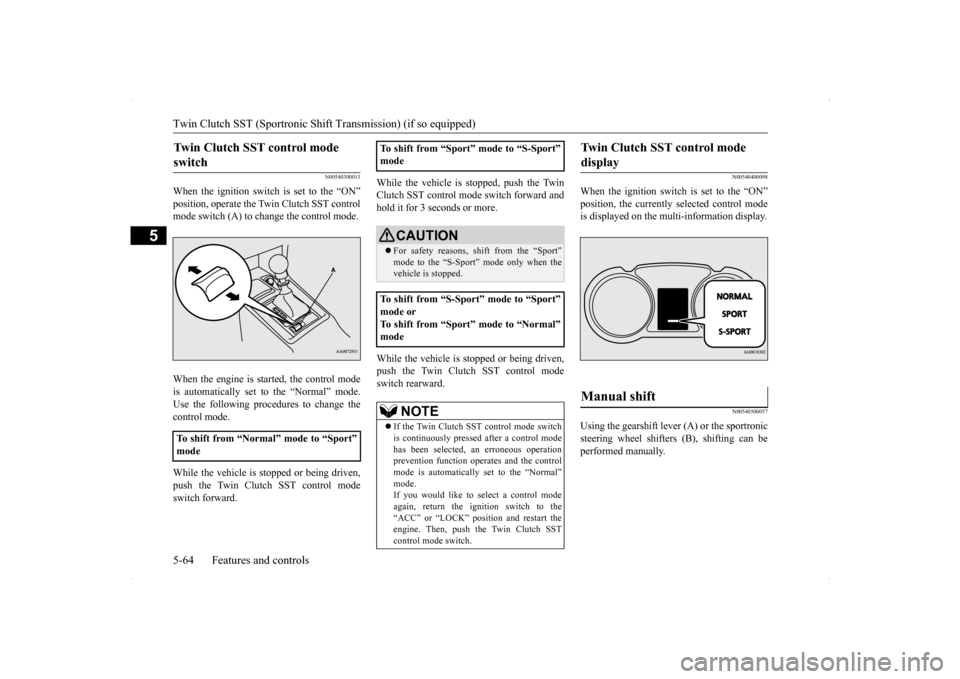
When the ignition switch is set to the “ON” position, operate the Twin Clutch SST control mode switch (A) to change the control mode. When the engine is started, the control mode is automatically set to the “Normal” mode. Use the following procedures to change the control mode. While the vehicle is stopped or being driven, push the Twin Clutch SST control modeswitch forward.
While the vehicle is stopped, push the Twin Clutch SST control mode switch forward and hold it for 3 seconds or more. While the vehicle is stopped or being driven, push the Twin Clutch SST control modeswitch rearward.
N00540400098
When the ignition switch is set to the “ON” position, the currently selected control mode is displayed on the multi-information display.
N00540500057
Using the gearshift lever (A) or the sportronic steering wheel shifters (B), shifting can be performed manually.
Twin Clutch SST control mode switch
To shift from “Normal” mode to “Sport” mode
To shift from “Sport” mode to “S-Sport” mode
CAUTION For safety reasons, shift from the “Sport” mode to the “S-Sport”
mode only when the
vehicle is stopped.
To shift from “S-Sport” mode to “Sport” mode or To shift from “Sport” mode to “Normal” mode
NOTE
If the Twin Clutch SST control mode switch is continuously pressed after a control mode has been selected, an erroneous operation prevention function operates and the control mode is automatically set to the “Normal” mode.If you would like to select a control mode again, return the ignition switch to the “ACC” or “LOCK” position and restart theengine. Then, push the Twin Clutch SST control mode switch.
Twin Clutch SST control mode display
Manual shift
BK0200800US.bo
ok 64 ページ 2013年2月14日 木曜日 午後2時28分
Page 126 of 338
Twin Clutch SST (Sportronic Shif
t Transmission) (if so equipped) Features and controls 5-65
5
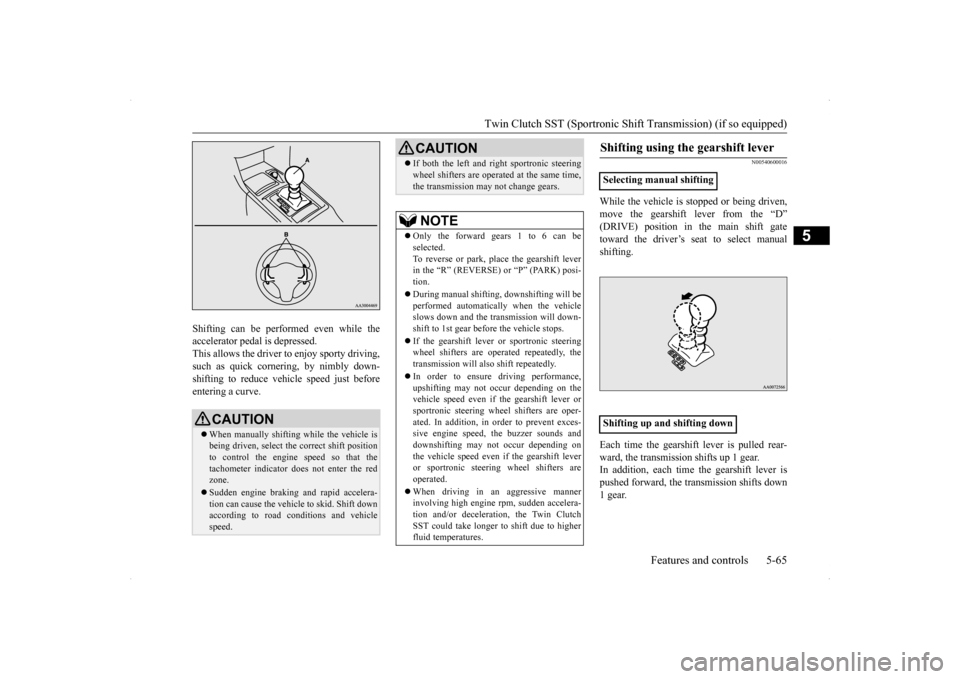
Shifting can be performed even while the accelerator pedal is depressed. This allows the driver to enjoy sporty driving,such as quick cornering, by nimbly down- shifting to reduce vehicle speed just before entering a curve.
N00540600016
While the vehicle is stopped or being driven, move the gearshift lever from the “D” (DRIVE) position in the main shift gatetoward the driver’s seat to select manual shifting. Each time the gearshift lever is pulled rear- ward, the transmission shifts up 1 gear.In addition, each time the gearshift lever is pushed forward, the transmission shifts down 1 gear.
CAUTION When manually shifting while the vehicle is being driven, select the correct shift positionto control the engine speed so that the tachometer indicator does not enter the red zone. Sudden engine braking and rapid accelera- tion can cause the vehicle to skid. Shift downaccording to road conditions and vehicle speed.
If both the left and right sportronic steering wheel shifters are operated at the same time, the transmission may not change gears.NOTE
Only the forward gears 1 to 6 can be selected. To reverse or park, place the gearshift leverin the “R” (REVERSE) or “P” (PARK) posi- tion. During manual shifting, downshifting will be performed automatically when the vehicle slows down and the transmission will down-shift to 1st gear before the vehicle stops. If the gearshift lever or sportronic steering wheel shifters are operated repeatedly, the transmission will also shift repeatedly. In order to ensure driving performance, upshifting may not occur depending on the vehicle speed even if the gearshift lever orsportronic steering wheel shifters are oper- ated. In addition, in order to prevent exces- sive engine speed, the buzzer sounds anddownshifting may not occur depending on the vehicle speed even if the gearshift lever or sportronic steering wheel shifters are operated. When driving in an aggressive manner involving high engine rpm, sudden accelera- tion and/or deceleration, the Twin ClutchSST could take longer to shift due to higher fluid temperatures.CAUTION
Shifting using the gearshift lever
Selecting manual shifting Shifting up and shifting downç
BK0200800US.bo
ok 65 ページ 2013年2月14日 木曜日 午後2時28分
Page 127 of 338
Twin Clutch SST (Sportronic Shif
t Transmission) (if so equipped)
5-66 Features and controls
5
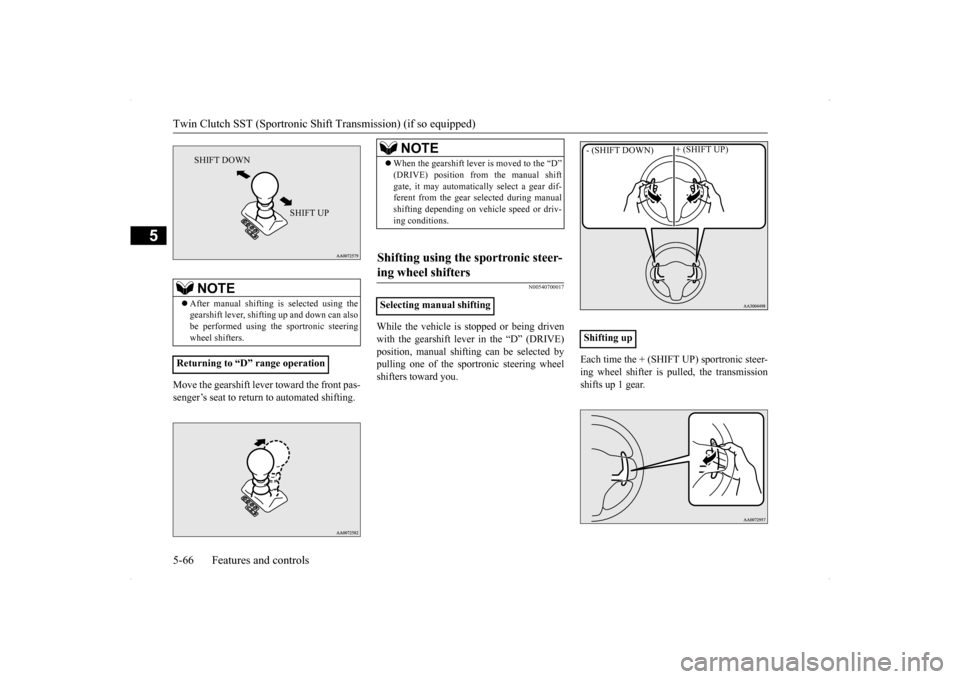
Move the gearshift lever toward the front pas- senger’s seat to return to automated shifting.
N00540700017
While the vehicle is stopped or being drivenwith the gearshift lever in the “D” (DRIVE) position, manual shifting can be selected by pulling one of the sportronic steering wheelshifters toward you.
Each time the + (SHIFT UP) sportronic steer- ing wheel shifter is pulled, the transmission shifts up 1 gear.
NOTE
After manual shifting is selected using the gearshift lever, shifting up and down can also be performed using the sportronic steeringwheel shifters.
Returning to “D” range operationç
SHIFT DOWN
SHIFT UP
ç
NOTE
When the gearshift lever is moved to the “D” (DRIVE) position from the manual shift gate, it may automatically select a gear dif- ferent from the gear selected during manual shifting depending on vehicle speed or driv-ing conditions.
Shifting using the sportronic steer- ing wheel shifters
Selecting manual shifting
Shifting up- (SHIFT DOWN)
+ (SHIFT UP)
ç
BK0200800US.bo
ok 66 ページ 2013年2月14日 木曜日 午後2時28分
Page 128 of 338
Twin Clutch SST (Sportronic Shif
t Transmission) (if so equipped) Features and controls 5-67
5
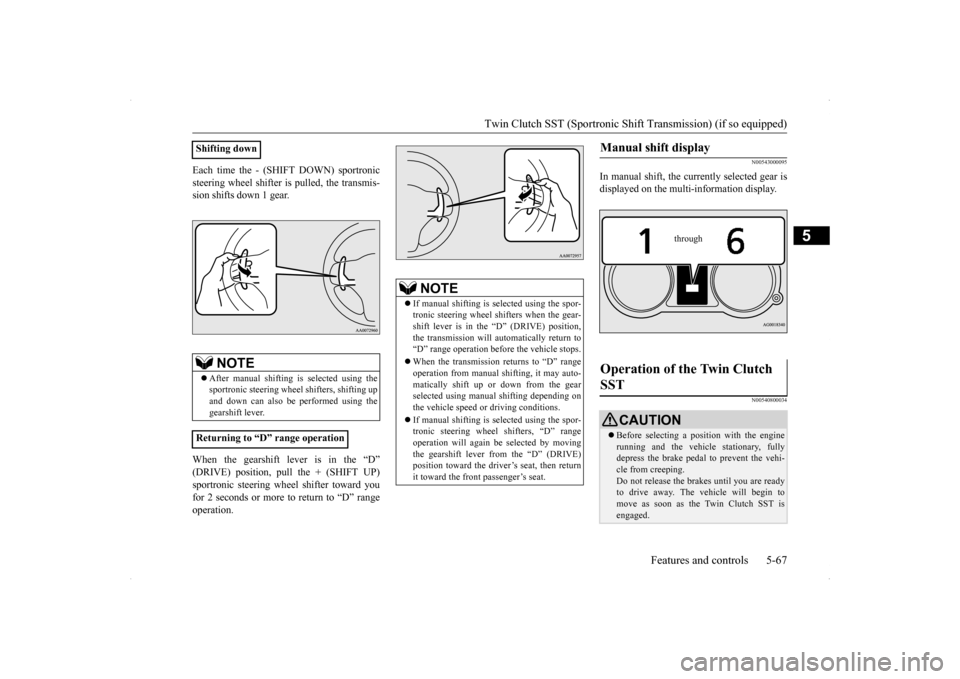
Each time the - (SHIFT DOWN) sportronic steering wheel shifter is pulled, the transmis- sion shifts down 1 gear. When the gearshift lever is in the “D” (DRIVE) position, pull the + (SHIFT UP) sportronic steering wheel shifter toward youfor 2 seconds or more to return to “D” range operation.
N00543000095
In manual shift, the currently selected gear is displayed on the multi-information display.
N00540800034
Shifting down
NOTE
After manual shifting is selected using the sportronic steering wheel
shifters, shifting up
and down can also be
performed using the
gearshift lever.
Returning to “D” range operationç
NOTE
If manual shifting is selected using the spor- tronic steering wheel shifters when the gear- shift lever is in the “D” (DRIVE) position,the transmission will automatically return to “D” range operation before the vehicle stops. When the transmission returns to “D” range operation from manual shifting, it may auto- matically shift up or down from the gearselected using manual shifting depending on the vehicle speed or driving conditions. If manual shifting is selected using the spor- tronic steering wheel shifters, “D” range operation will again be selected by movingthe gearshift lever from the “D” (DRIVE) position toward the driver’s seat, then return it toward the front passenger’s seat.
ç
Manual shift display
Operation of the Twin Clutch SST
CAUTION Before selecting a position with the engine running and the vehicle stationary, fullydepress the brake pedal to prevent the vehi- cle from creeping. Do not release the brakes until you are readyto drive away. The vehicle will begin to move as soon as the Twin Clutch SST is engaged.
through
BK0200800US.bo
ok 67 ページ 2013年2月14日 木曜日 午後2時28分
Page 129 of 338
Twin Clutch SST (Sportronic Shif
t Transmission) (if so equipped)
5-68 Features and controls
5
N00540900019
To gain extra acceleration in “D” (DRIVE) position (when passing another vehicle) pushthe accelerator to the floor if it is safe to do so in traffic conditions. The Twin Clutch SST will automatically downshift.
N00541600042
The Twin Clutch SST may not upshift to a higher shift position if the computer deter- mines the current speed cannot be maintainedonce a higher shift position is engaged. For smoother vehicle performance, if you release the throttle while climbing a steep grade, the Twin Clutch SST may not upshift.This is normal, as the computer is temporarily preventing shifting. After reaching the top of the hill, normal shift function will resume.
When traveling down steep grades, the com- puter may automatically select a lower shift
Depress the brake pedal with the right foot. Using the left foot could cause driver move- ment delay in case of an emergency. To prevent sudden acceleration, never run the engine at high rpms when shifting from the “P” (PARK) or “N” (NEUTRAL) posi- tion. Operating the accelerator pedal while the other foot is resting on the brake pedal willaffect braking efficiency, may cause prema- ture wear of brake pads and may cause engine damage. Use the gearshift lever in the correct shift position in accordance with driving condi-tions. Never coast downhill backward in the driv- ing shift position {“D” (DRIVE) or manualshifting} or coast forward in the “R” (REVERSE) position. Engine stopping and increased brake pedaland steering effort could lead to an accident. Do not rev the engine with the brake pedal pressed when the vehicle is stationary. This can cause sudden acceleration and dam- age the Twin Clutch SST.Also, when you depress the accelerator pedal while holding down the brake pedal with the gearshift lever in the “D” (DRIVE) position, the engine revolutions may not rise as high as when performing the same operation withthe gearshift lever in the “N” (NEUTRAL) position.CAUTION
Passing acceleration
NOTE
In manual shift, downshifts do not take place when the accelerator is depressed all the wayto the floor.
Uphill/downhill driving
DRIVING UPHILL
CAUTION Do not use the tendency of the vehicle to creep forward in order to drive at low speeds up hills. The transmission may be damaged and an accident may occur due to the following con-ditions.• The Twin Clutch SST fluid temperaturewill rise and can cause transmission dam- age.• If the vehicle is continuously driven at lowspeeds using the tendency of the vehicle to creep forward, the vehicle will vibrate or the warning display will appear on the information screen in the multi-information display to alert the driver that the Twin Clutch SST fluid temperature has risen.After that, if the Twin Clutch SST fluid temperature rises even higher, the transmis- sion protection control will operate.If this occurs, the vehicle may suddenly reverse as if the gearshift lever was in the “N” (NEUTRAL) position and cause anaccident. If the warning display appears or the transmission protection control operates, refer to “When warning display is showing” on page 5-60.
DRIVING DOWNHILL
BK0200800US.bo
ok 68 ページ 2013年2月14日 木曜日 午後2時28分
Page 130 of 338
Twin Clutch SST (Sportronic Shif
t Transmission) (if so equipped) Features and controls 5-69
5
position. This function assists engine braking efforts, reducing the need for using the ser- vice brakes.
N00541000046
For short waiting periods, such as at trafficlights, the vehicle can be left in gearshift lever position and held stationary with theservice brake.For longer waiting periods with the engine running, place the gearshift lever in the “N” (NEUTRAL) position and apply the parkingbrake, while holding the vehicle stationary with the service brake. Prior to moving off after having stopped thevehicle, make sure that the gearshift lever is in “D” (DRIVE) position or manual shift position.
N00541100018
To park the vehicle, first bring it to a com-plete stop, fully engage the parking brake, and then move the gearshift lever to the “P” (PARK) position.
N00541200077
If there is a malfunction in the Twin Clutch SST or engine electronic control module, the following may occur. Twin Clutch SST does not shift. Vehicle cannot move. Twin Clutch SST acceleration is slow. Vehicle does not creep. “Shift shock” is large. Shifting occurs at higher engine speed. Response is slow.
If any of these occurs, perform the following procedure. The temperature of Twin Clutch SST fluid is high. Refer to “Warning display” on page 5-60 and follow the appropriate measures. There could be a malfunction in the engine electronic control module.
Waiting
CAUTION Do not rev the engine unnecessarily while the vehicle is stationary. Unexpected acceler- ation may occur if the gearshift lever is in a position other than “P” (PARK) or “N” (NEUTRAL). Do not keep the vehicle in a stopped position on an uphill slope by depressing the acceler-ator pedal instead of the brake pedal. The transmission may be damaged and an accident may occur due to the following con-ditions.
• The Twin Clutch SST fluid temperature will rise and can cause transmission dam- age.• If the vehicle is kept in a stopped positionby depressing the accelerator pedal instead of the brake pedal, the vehicle will vibrate or the warning display will appear on the information screen in the multi-infor- mation display to alert the driver that theTwin Clutch SST fluid temperature has risen. After that, if the Twin Clutch SST fluid temperature rises even higher, the transmis- sion protection control will operate. If this occurs, the vehicle may suddenly reverse as if the gearshift lever was in the “N” (NEUTRAL) position and cause anaccident. If the warning display appears or the transmission protection control operates, refer to “When warning display is showing” on page 5-60.
Parking
CAUTION
What to do if the following occur with the Twin Clutch SST
When warning display is showing When the engine malfunction indicator (“SERVICE ENGINE SOON” or “Checkengine light”) comes on or blinking
BK0200800US.bo
ok 69 ページ 2013年2月14日 木曜日 午後2時28分
Page 235 of 338
Parking 6-6 Driving safety
6
N00629600320
When parking on a hill, set the parking brake, and turn the front wheels toward the curb on adownhill, or away from the curb on an uphill. If necessary, apply chocks to wheels. Place the gearshift lever into the “R” (Reverse) position when parking on a down-hill slope, into the 1s
t position when parking
on an uphill slope. Be sure that the parking brake is firmly set when parked and that the gearshift lever is in the “P” (PARK) position.When parking on a hill, it is important to set the parking brake before moving the gearshift lever to the “P” (PARK) position. This pre-vents loading the parking brake against the transmission gear. When this happens, it is difficult to move the gearshift lever out of the“P” (PARK) position.
Never leave the engi
ne running while you
take a short sleep/rest. Also, never leave the engine running in a closed or poorly venti- lated place. Your front bumper can be damaged if you scrape it over curbs or parking stop blocks.Be careful when traveling up or down steep slopes where your bumper can scrape the road.
When leaving the vehicle unattended, always carry the key and lock all doors.Always try to park your vehicle in a well lit area.
N00629900365
It is very important to know how much weight your vehicle can carry. This weight is called the vehicle capacity weight and includes the weight of all occupants, cargo(including the roof load) and non-factory- installed options. The tire and loading infor- mation placard located on the driver’s doorsill of your vehicle will show how much weight it may properly carry. It is important to familiarize yourself with the following terms before loading your vehicle:
Parking Parking on a hill For vehicles with manual trans- axle For vehicles with Twin Clutch SST
Parking with the engine run- ning
WA R N I N G Leaving the engine running risks injury or death from accidentally moving the gear-shift lever (manual transaxle) or the gear- shift lever (Twin Clutch SST) or from the accumulation of toxic exhaust fumes in thepassenger compartment.
Where you park
WA R N I N G Do not park your vehicle in areas where combustible materials such as dry grass orleaves can come in contact with a hot exhaust, since a fire could occur.
When leaving the vehicle Loading information
WA R N I N G Never overload your vehicle. Overloading can damage your vehicle, adversely affectvehicle performance, including handling and braking, cause tire failure, and result in an accident.
BK0200800US.bo
ok 6 ページ 2013年2月14日 木曜日 午後2時28分
Page 255 of 338
General information about your radio 7-16 Comfort controls
7
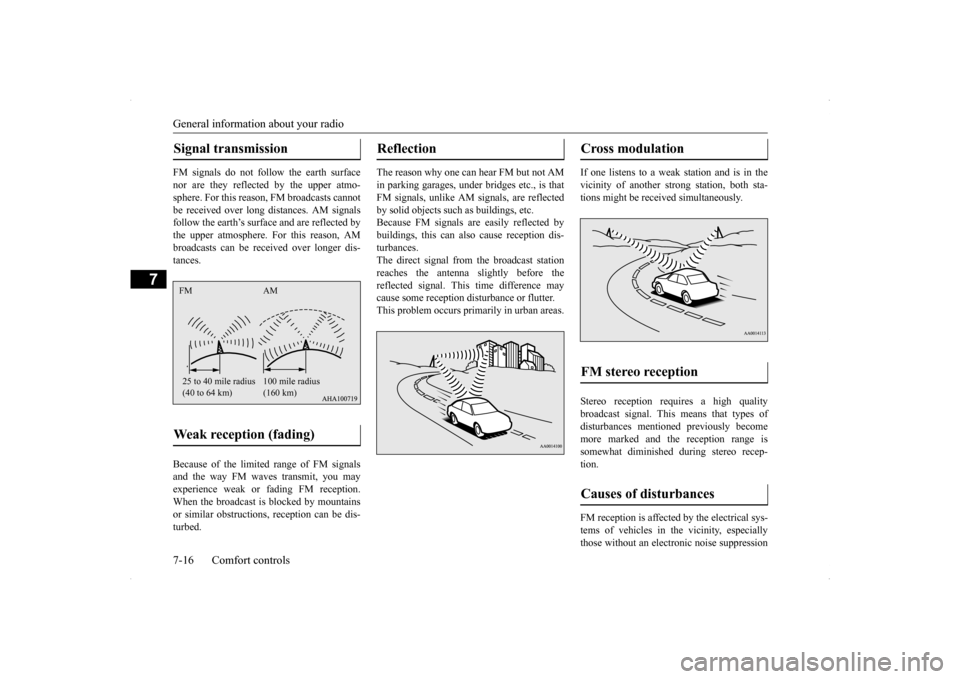
FM signals do not follow the earth surface nor are they reflected by the upper atmo- sphere. For this reason, FM broadcasts cannotbe received over long distances. AM signals follow the earth’s surface and are reflected by the upper atmosphere. For this reason, AMbroadcasts can be received over longer dis- tances. Because of the limited
range of FM signals
and the way FM waves transmit, you mayexperience weak or fading FM reception. When the broadcast is blocked by mountains or similar obstructions, reception can be dis-turbed.
The reason why one can hear FM but not AM in parking garages, under bridges etc., is that FM signals, unlike AM signals, are reflectedby solid objects such as buildings, etc. Because FM signals are easily reflected by buildings, this can also cause reception dis-turbances. The direct signal from the broadcast station reaches the antenna slightly before thereflected signal. This time difference maycause some reception disturbance or flutter. This problem occurs primarily in urban areas.
If one listens to a weak station and is in the vicinity of another strong station, both sta- tions might be received simultaneously. Stereo reception requires a high quality broadcast signal. This means that types of disturbances mentioned previously become more marked and the reception range issomewhat diminished during stereo recep- tion. FM reception is affected by the electrical sys- tems of vehicles in the vicinity, especially those without an electronic noise suppression
Signal transmission Weak reception (fading) FM AM 25 to 40 mile radius (40 to 64 km)
100 mile radius (160 km)
Reflection
Cross modulation FM stereo reception Causes of disturbances
BK0200800US.bo
ok 16 ページ 2013年2月14日 木曜日 午後2時28分