belt MITSUBISHI LANCER EVOLUTION 2014 10.G Owner's Manual
[x] Cancel search | Manufacturer: MITSUBISHI, Model Year: 2014, Model line: LANCER EVOLUTION, Model: MITSUBISHI LANCER EVOLUTION 2014 10.GPages: 338, PDF Size: 40.99 MB
Page 44 of 338
Maintenance and inspection of seat belts
Seat and restraint systems 4-19
4
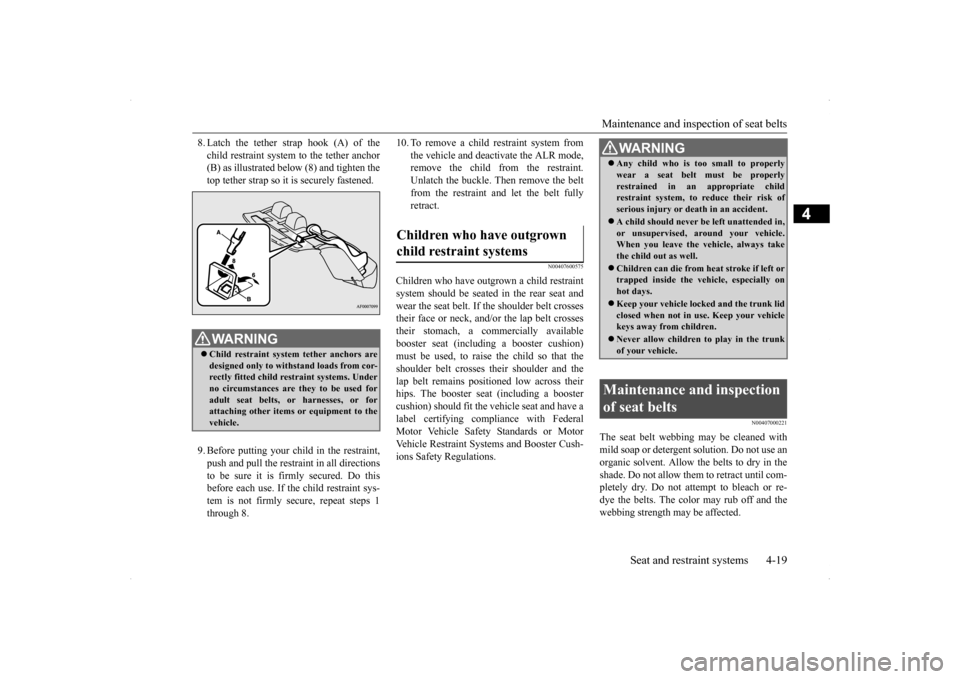
8. Latch the tether strap hook (A) of the child restraint system to the tether anchor (B) as illustrated below (8) and tighten the top tether strap so it is securely fastened. 9. Before putting your child in the restraint, push and pull the restraint in all directions to be sure it is firmly secured. Do this before each use. If the child restraint sys-tem is not firmly secure, repeat steps 1 through 8.
10. To remove a child restraint system from
the vehicle and deactivate the ALR mode, remove the child from the restraint. Unlatch the buckle. Then remove the beltfrom the restraint and let the belt fully retract.
N00407600575
Children who have outgrown a child restraintsystem should be seated in the rear seat and wear the seat belt. If the shoulder belt crossestheir face or neck, and/or the lap belt crosses their stomach, a commercially available booster seat (including a booster cushion)must be used, to raise the child so that the shoulder belt crosses their shoulder and the lap belt remains positioned low across theirhips. The booster seat (including a booster cushion) should fit the vehicle seat and have a label certifying compliance with FederalMotor Vehicle Safety Standards or Motor Vehicle Restraint Systems and Booster Cush- ions Safety Regulations.
N00407000221
The seat belt webbing may be cleaned withmild soap or detergent solution. Do not use anorganic solvent. Allow the belts to dry in the shade. Do not allow them to retract until com- pletely dry. Do not attempt to bleach or re-dye the belts. The color may rub off and the webbing strength may be affected.
WA R N I N G Child restraint system tether anchors are designed only to withstand loads from cor-rectly fitted child restraint systems. Under no circumstances are they to be used for adult seat belts, or harnesses, or forattaching other items or equipment to the vehicle.
Children who have outgrown child restraint systems
WA R N I N G Any child who is too small to properly wear a seat belt must be properly restrained in an appropriate child restraint system, to reduce their risk of serious injury or death in an accident. A child should never be left unattended in, or unsupervised, around your vehicle.When you leave the vehicle, always take the child out as well. Children can die from he
at stroke if left or
trapped inside the vehicle, especially on hot days. Keep your vehicle locked and the trunk lid closed when not in use. Keep your vehiclekeys away from children. Never allow children to play in the trunk of your vehicle.
Maintenance and inspection of seat belts
BK0200800US.bo
ok 19 ページ 2013年2月14日 木曜日 午後2時28分
Page 45 of 338
Supplemental Restraint System (SRS) - airbag 4-20 Seat and restraint systems
4
Regularly check your seat belt buckles and their release mechanisms for positive engage- ment and release of the latch plate. Check the retractors for automatic locking when in theAutomatic Locking Retractor function. The entire seat belt assembly should be replaced if the webbing shows any obvious cuts, tears, increase in thickness in any sec-tion of the webbing from broken fibers, or severe fading from sunlight. All of these con- ditions indicate a weakening of the belt,which may adversely affect seat belt perfor-mance in an accident.
N00407701746
This vehicle is equipped with a SupplementalRestraint System (SRS), which includes air-bags for the driver and passengers.
The SRS front airbags are designed to supple- ment the primary protection of the driver and front passenger seat belt systems by provid- ing those occupants with protection againsthead and chest injuries in certain moderate to severe frontal collisions. The SRS front airbags, together with sensorsat the front of the vehicle and sensors attached to the front seats, form an advanced airbag system. The SRS driver’s knee airbag is designed to supplement the primary protection of thedriver’s seat belt system. It can reduce the forward movement of the driver’s lower legs and provide increased overall body protectionin certain moderate to severe frontal colli- sions. The SRS side airbags and the curtain airbags are also designed to supplement the seat belts.The SRS side airbags provide the driver and front passenger with protection against chest injuries by deploying the bag on the sideimpacted in moderate to severe side impact collisions. The SRS curtain airbags provide the driver and passengers on the front seatand rear outboard seat with protection against head injuries by deploying a bag on the side impacted in moderate to severe side impactcollisions.
The SRS airbags are NOT
a substitute for use
of the seat belts. For maximum protection in all types of accidents, seat belts must ALWAYS be worn by everyone who drives orrides in this vehicle (with infants and small children in an appropriate child restraint sys- tem in the rear seat, and older children buck-led in the rear seat). Refer to “Child restraint systems” on page 4-12.
WA R N I N G Do not attempt to repair or replace any part of the seat belt assemblies. This work should be done by an authorized Mitsubishi Motors dealer. Failure to havean authorized Mitsubishi Motors dealer perform the work could reduce the effec- tiveness of the belts and could result in aserious injury or death in an accident.
Supplemental Restraint Sys- tem (SRS) - airbag
WA R N I N G IT IS VERY IMPORTANT TO ALWAYS WEAR YOUR SEAT BELT PROPERLY EVEN WITH AN AIRBAG.• Seat belts help keep the driver and pas-sengers properly positioned. This reduces the risk of injury in all collisions,and reduces the risk of serious injuries or death when the airbags inflate. During sudden braking just before a col-lision, an unrestrained or improperly restrained driver or passengers can move forward into direct contact with, orwithin close proximity to, the airbag when it begins to inflate. The beginning stage of airbag inflation isthe most forceful and can cause serious injuries or death if the occupant comes in contact with the airbag at this time. • Seat belts reduce the risk of injury inrollovers, rear impact collisions, and in lower-speed frontal collisions, because the airbags are not designed to inflate inthose situations.
BK0200800US.bo
ok 20 ページ 2013年2月14日 木曜日 午後2時28分
Page 46 of 338

Supplemental Restraint System (SRS) - airbag
Seat and restraint systems 4-21
4
• Seat belts reduce the risk of being thrown from your vehicle in a collision or rollover.
IT IS VERY IMPORTANT TO BE PROP- ERLY SEATED.• A driver or front passenger sitting tooclose to the steering wheel or instrument panel during airbag deployment can be seriously injured or killed.• Airbags inflate very quickly and withgreat force. If the driver and front pas-senger are not properly seated and restrained, the airbag may not provide the proper protection and can cause seri-ous injuries or death when it inflates.• To reduce the risk to the driver of seriousinjury or death due to a deploying driver’s airbag, always properly wear your seat belt and adjust the driver’s seatas far back as possible, maintaining a position that still allows the driver to have good control of the steering wheel,brake, accelerator, and other vehicle con- trols.• To reduce the risk to the front passengerof serious injury or death from a deploy- ing passenger’s airbag, make sure the passenger always wears the seat belt properly, remains seated upright and allthe way back in the seat, and positions the seat as far back as possible. WA R N I N G
• Seat all infants and children in the rearseat, properly restrained in an appropri- ate child restraint system.
Airbags inflate very quickly and with great force. Do not sit on the edge of the seat or sit with your lower legs too close to the instrument panel, or lean your head orchest close to the steering wheel or the instrument panel. Do not put your feet or legs on or against the instrument panel.WA R N I N G
WA R N I N G Infants and small children should never ride unrestrained, or lean against the instrument panel. They should never ride held in your arms or on your lap. They can be seriously injured or killed in anaccident, especially when the airbags inflate. Infants and children should be properly seated in the rear seat in anappropriate child restraint system. Refer to “Child restraint systems” on page 4-12.
BK0200800US.bo
ok 21 ページ 2013年2月14日 木曜日 午後2時28分
Page 47 of 338

Supplemental Restraint System (SRS) - airbag 4-22 Seat and restraint systems
4
N00407800519
The SRS includes the following components:
WA R N I N G NEVER put REAR-FACING CHILD RESTRAINT SYSTEMS or INFANT RESTRAINT SYSTEMS in the front pas- senger seat. This places the infant too close to the passenger airbag. Duringdeployment of the airbag, the infant can be seriously injured or killed. Rear-facing child restraint systems orinfant restraint systems must only be used in the rear seat.Airbag
WA R N I N G FRONT-FACING CHILD RESTRAINT SYSTEMS should be used in the rear seat whenever possible. If they must be used in the front passenger seat, move the seat to the most rearward position and make surethe child stays in the child restraint sys- tem, properly restrained. Failure to follow these instructions could result in seriousinjury or death to the child.WA R N I N G Older children should be seated in the rear seat with their seat belt properlyworn, and with an appropriate booster seat (including a booster cushion) if needed.Refer to “Children who have outgrown child restraint systems” on page 4-19.
How the Supplemental Restraint System works 1- Driver’s airbag 2- SRS warning light 3- Passenger’s airbag off indicator 4- Passenger’s front airbag5- Front impact sensors6- Driver’s knee airbag 7- Driver’s seat position sensor 8- Seat belt buckle switches9- Passenger’s seat weight sensors 10- Airbag control unit
BK0200800US.bo
ok 22 ページ 2013年2月14日 木曜日 午後2時28分
Page 48 of 338
Supplemental Restraint System (SRS) - airbag
Seat and restraint systems 4-23
4
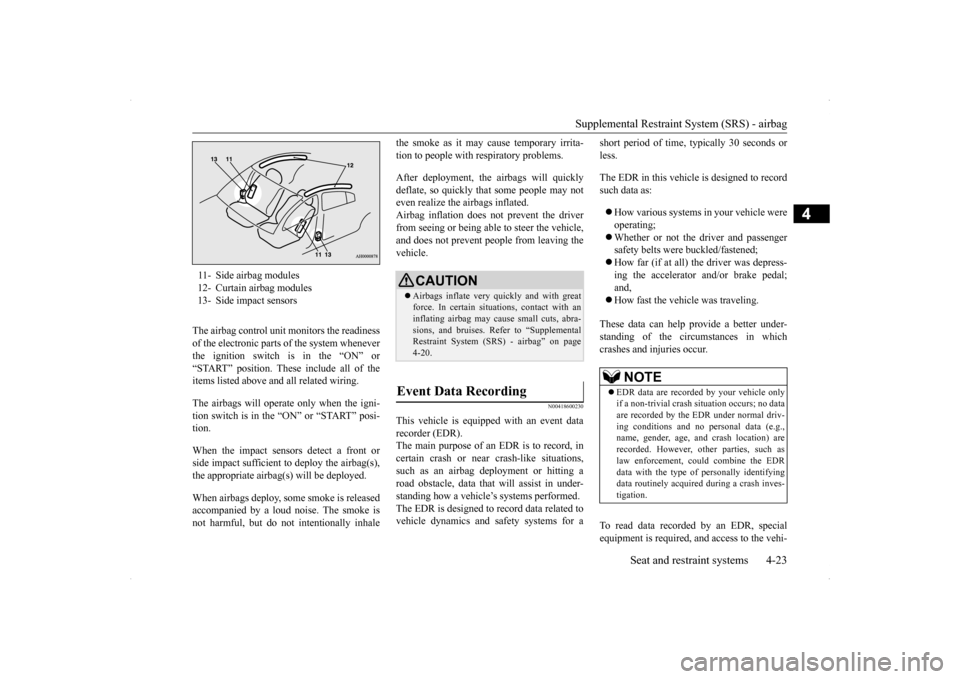
The airbag control unit monitors the readiness of the electronic parts of the system whenever the ignition switch is in the “ON” or “START” position. These include all of theitems listed above and all related wiring. The airbags will operate only when the igni- tion switch is in the “ON” or “START” posi- tion. When the impact sensors detect a front or side impact sufficient to deploy the airbag(s),the appropriate airbag(s) will be deployed. When airbags deploy, some smoke is released accompanied by a loud noise. The smoke is not harmful, but do not intentionally inhale
the smoke as it may cause temporary irrita- tion to people with respiratory problems. After deployment, the airbags will quickly deflate, so quickly that some people may not even realize the airbags inflated.Airbag inflation does not prevent the driver from seeing or being able to steer the vehicle, and does not prevent people from leaving thevehicle.
N00418600230
This vehicle is equipped with an event datarecorder (EDR). The main purpose of an EDR is to record, in certain crash or near crash-like situations,such as an airbag deployment or hitting a road obstacle, data that will assist in under- standing how a vehicle’s systems performed.The EDR is designed to record data related to vehicle dynamics and safety systems for a
short period of time, typically 30 seconds or less. The EDR in this vehicle is designed to record such data as: How various systems in your vehicle were operating; Whether or not the driver and passenger safety belts were buckled/fastened; How far (if at all) the driver was depress- ing the accelerator and/or brake pedal;and, How fast the vehicle was traveling.
These data can help provide a better under- standing of the circumstances in whichcrashes and injuries occur. To read data recorded by an EDR, special equipment is required, and access to the vehi-
11- Side airbag modules 12- Curtain airbag modules13- Side impact sensors
CAUTION Airbags inflate very quickly and with great force. In certain situations, contact with an inflating airbag may cause small cuts, abra-sions, and bruises. Refer to “Supplemental Restraint System (SRS) - airbag” on page 4-20.
Event Data Recording
NOTE
EDR data are recorded by your vehicle only if a non-trivial crash situation occurs; no data are recorded by the EDR under normal driv- ing conditions and no personal data (e.g.,name, gender, age, and crash location) are recorded. However, other parties, such as law enforcement, could combine the EDR data with the type of personally identifying data routinely acquired during a crash inves-tigation.
BK0200800US.bo
ok 23 ページ 2013年2月14日 木曜日 午後2時28分
Page 50 of 338

Supplemental Restraint System (SRS) - airbag
Seat and restraint systems 4-25
4
N00418100251
The passenger’s airbag off indicator is located in the instrument panel.
The indicator normally comes on when the ignition switch is turned to the “ON” positionand goes out a few seconds later. In the following situations, the indicator will stay on to show that the passenger’s front air-bag is not operational. The passenger’s seat weight sensors sense a weight of less than approximately 66 pounds (30 kg) on the front passenger seat. The front passenger’s seat is not occupied.
When the weight applied to the front passen- ger seat is sensed to be approximately 66 pounds (30 kg) or greater, the indicator goesout to show that the passenger’s front airbag is operational.
N00408300537
Warning light
• Do not use a seat cover or a cushion.• Do not modify or replace the seat and seat belt.• Do not place luggage or other objectsunder the seat.• Do not place the floor mat on the seatrails.• Do not expose the sensors to liquids orvapors.• Do not subject the sensors to shock.• Do not allow rear-seat occupants to push the front passenger seat with their feet or force the front passenger seat upward.• Do not allow rear-seat occupants to graspthe front passenger’s seatback or put their arms around it.• When attaching a child restraint systemin the rear seat, make sure it does notinterfere with the front seat.
If the vehicle is involved in a severe impact, have the SRS sensors inspected by an authorized Mitsubishi Motors dealer as soon as possible.
Passenger’s airbag off indicator
WA R N I N G
WA R N I N G If any of the following conditions occur, you should immediately have the airbag system in your vehicle inspected by an authorized Mitsubishi Motors dealer as soon as possible:• The passenger’s airbag off indicatorcomes on when an adult is sitting on thefront passenger seat.• The passenger’s airbag off indicator doesnot come on when the front passenger’s seat is not occupied.• The passenger’s airbag off indicator doesnot come on when the ignition switch is turned to the “ON” position.• The passenger’s airbag off indicatorcomes on and goes out repeatedly.
Do not attach any accessory to your vehi- cle that makes the passenger’s airbag offindicator difficult or impossible to see. You must be able to see the passenger’s airbag off indicator and verify the statusof the passenger’s airbag system.
SRS warning light/display
BK0200800US.bo
ok 25 ページ 2013年2月14日 木曜日 午後2時28分
Page 51 of 338
Supplemental Restraint System (SRS) - airbag 4-26 Seat and restraint systems
4
Warning display If there is an error in the system, the warning light will come on and the warning display will appear on the information screen in themulti-information display. Under normal conditions, the warning light comes on when the ignition switch is turnedto the “ON” position and goes off a few sec- onds later. The warning light will also come on andremain on when the SRS airbags and the seat belt pre-tensioner system have been acti- vated.The warning light/display is used for both SRS airbag warnings and seat belt pre-ten- sioner system warnings.
N00407900028
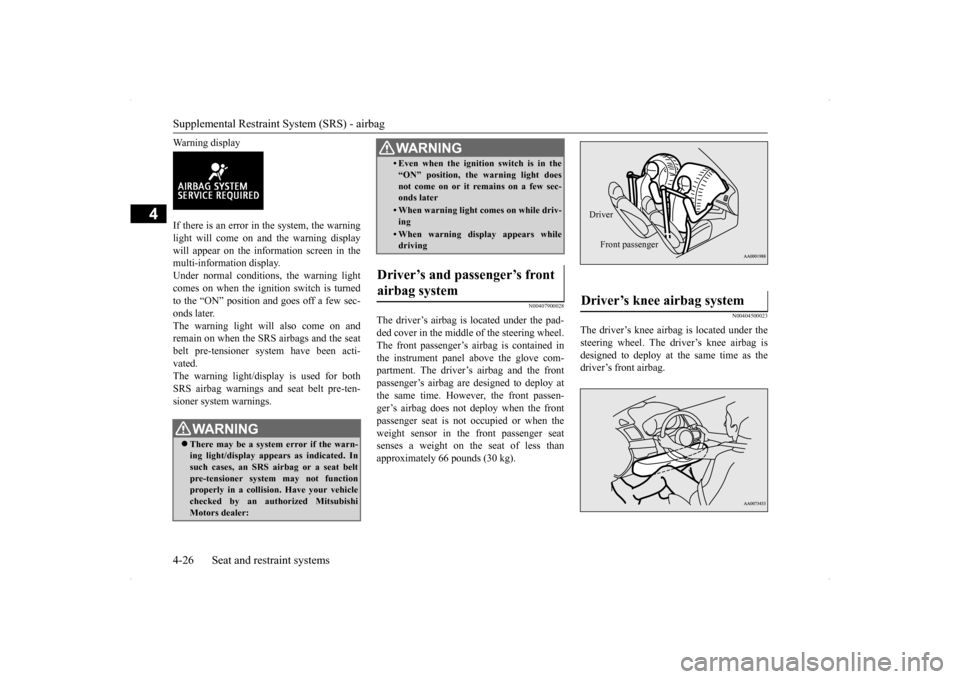
The driver’s airbag is located under the pad- ded cover in the middle of the steering wheel. The front passenger’s airbag is contained inthe instrument panel above the glove com- partment. The driver’s airbag and the front passenger’s airbag are designed to deploy atthe same time. However, the front passen- ger’s airbag does not deploy when the front passenger seat is not occupied or when theweight sensor in the front passenger seat senses a weight on the seat of less than approximately 66 pounds (30 kg).
N00404500023
The driver’s knee airbag
is located under the
steering wheel. The driver’s knee airbag isdesigned to deploy at the same time as the driver’s front airbag.
WA R N I N G There may be a system error if the warn- ing light/display appears as indicated. Insuch cases, an SRS airbag or a seat belt pre-tensioner system may not function properly in a collision. Have your vehiclechecked by an authorized Mitsubishi Motors dealer:
• Even when the ignition switch is in the“ON” position, the warning light does not come on or it remains on a few sec- onds later• When warning light comes on while driv-ing• When warning display appears whiledriving
Driver’s and passenger’s front airbag system
WA R N I N G
Driver’s knee airbag system Driver Front passenger
BK0200800US.bo
ok 26 ページ 2013年2月14日 木曜日 午後2時28分
Page 52 of 338
Supplemental Restraint System (SRS) - airbag
Seat and restraint systems 4-27
4
N00408000518
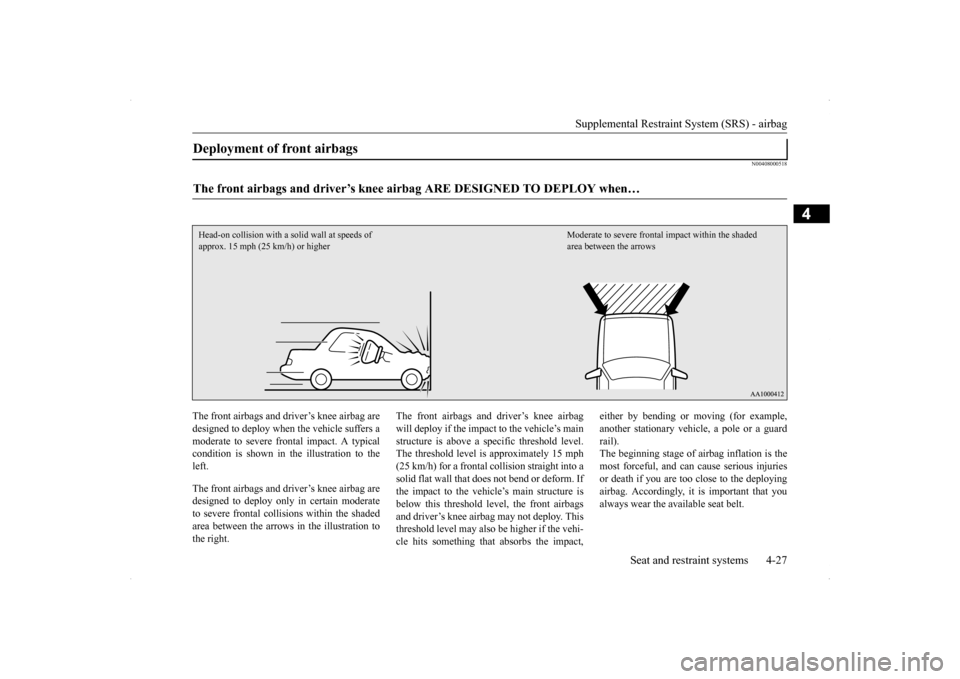
The front airbags and driver’s knee airbag are designed to deploy when the vehicle suffers amoderate to severe frontal impact. A typical condition is shown in th
e illustration to the
left. The front airbags and driver’s knee airbag are designed to deploy only in certain moderate to severe frontal collisions within the shaded area between the arrows in the illustration tothe right.
The front airbags and driver’s knee airbag will deploy if the impact to the vehicle’s mainstructure is above a specific threshold level. The threshold level is approximately 15 mph (25 km/h) for a frontal collision straight into asolid flat wall that does not bend or deform. If the impact to the vehicle’s main structure is below this threshold level, the front airbagsand driver’s knee airbag may not deploy. This threshold level may also be higher if the vehi- cle hits something that absorbs the impact,
either by bending or moving (for example, another stationary vehicle, a pole or a guardrail). The beginning stage of airbag inflation is the most forceful, and can cause serious injuriesor death if you are too close to the deploying airbag. Accordingly, it is important that you always wear the available seat belt.
Deployment of front airbags The front airbags and driver’s knee airb
ag ARE DESIGNED TO DEPLOY when…
Head-on collision with a so
lid wall at speeds of
approx. 15 mph (25 km/h) or higher
Moderate to severe frontal
impact within the shaded
area between the arrows
BK0200800US.bo
ok 27 ページ 2013年2月14日 木曜日 午後2時28分
Page 53 of 338
Supplemental Restraint System (SRS) - airbag 4-28 Seat and restraint systems
4
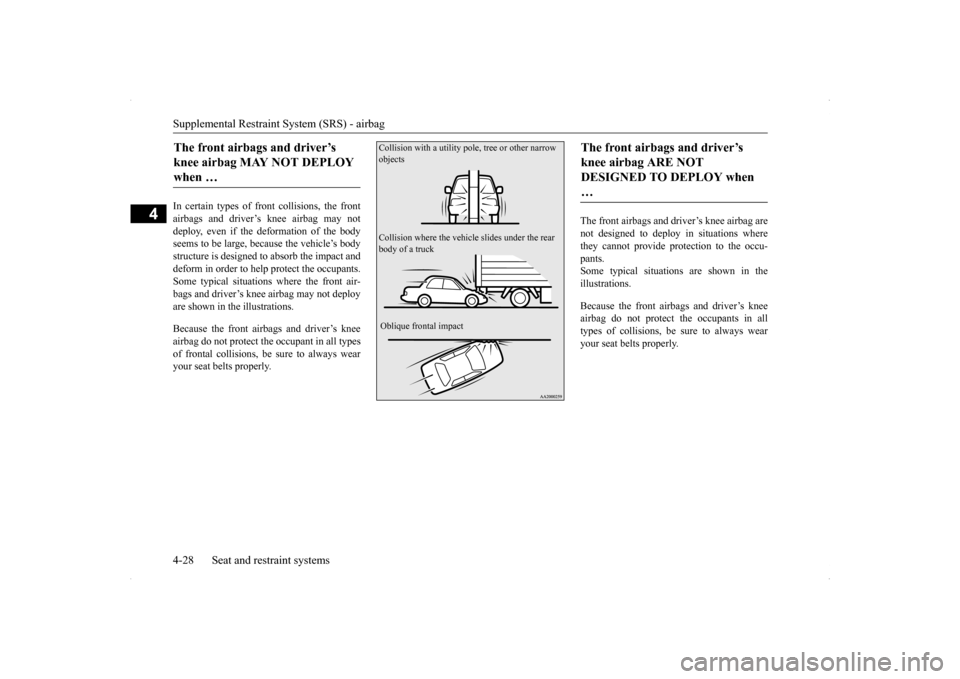
In certain types of fr
ont collisions, the front
airbags and driver’s knee airbag may not deploy, even if the deformation of the body seems to be large, because the vehicle’s bodystructure is designed to absorb the impact and deform in order to help protect the occupants. Some typical situations where the front air-bags and driver’s knee airbag may not deployare shown in the illustrations. Because the front airbags and driver’s knee airbag do not protect the occupant in all types of frontal collisions, be sure to always wearyour seat belts properly.
The front airbags and driver’s knee airbag are not designed to deploy in situations wherethey cannot provide protection to the occu- pants. Some typical situations are shown in theillustrations. Because the front airbags and driver’s knee airbag do not protect the occupants in all types of collisions, be sure to always wear your seat belts properly.
The front airbags and driver’s knee airbag MAY NOT DEPLOY when …
Collision with a utility pole
, tree or other narrow
objects Collision where the vehicle
slides under the rear
body of a truck Oblique frontal impact
The front airbags and driver’s knee airbag ARE NOT DESIGNED TO DEPLOY when …
BK0200800US.bo
ok 28 ページ 2013年2月14日 木曜日 午後2時28分
Page 54 of 338
Supplemental Restraint System (SRS) - airbag
Seat and restraint systems 4-29
4
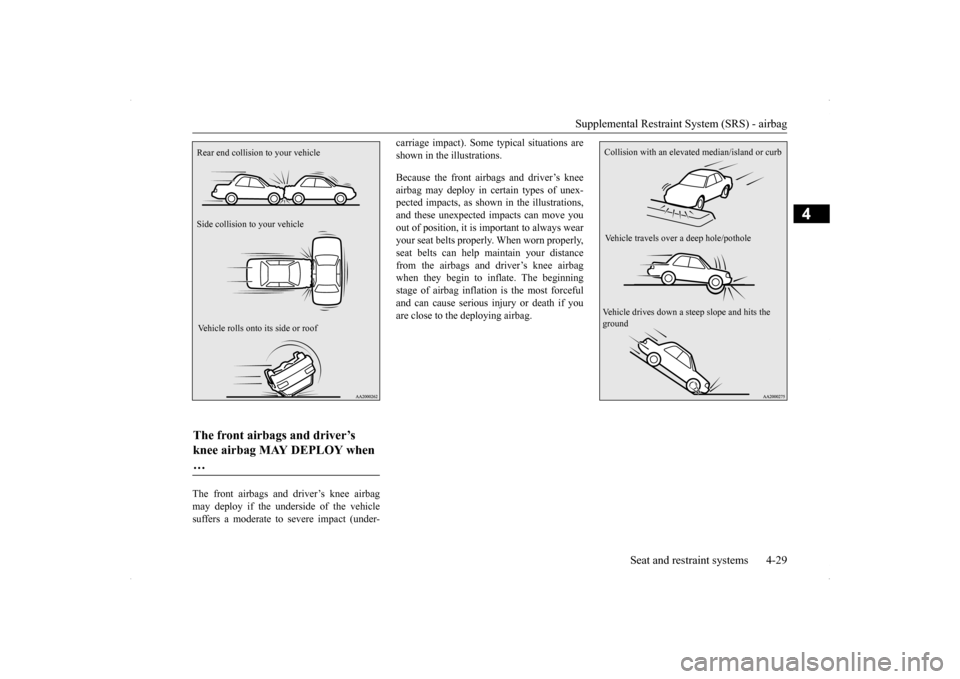
The front airbags and driver’s knee airbag may deploy if the underside of the vehicle suffers a moderate to severe impact (under-
carriage impact). Some typical situations are shown in the illustrations. Because the front airbags and driver’s knee airbag may deploy in certain types of unex- pected impacts, as shown in the illustrations,and these unexpected impacts can move you out of position, it is important to always wear your seat belts properly. When worn properly,seat belts can help maintain your distance from the airbags and driver’s knee airbag when they begin to inflate. The beginningstage of airbag inflation is the most forcefuland can cause serious injury or death if you are close to the deploying airbag.
The front airbags and driver’s knee airbag MAY DEPLOY when … Rear end collision
to your vehicle
Side collision to your vehicle Vehicle rolls onto its side or roof
Collision with an elevat
ed median/island or curb
Vehicle travels over a deep hole/pothole Vehicle drives down a steep slope and hits the ground
BK0200800US.bo
ok 29 ページ 2013年2月14日 木曜日 午後2時28分