roof MITSUBISHI LANCER EVOLUTION 2015 10.G User Guide
[x] Cancel search | Manufacturer: MITSUBISHI, Model Year: 2015, Model line: LANCER EVOLUTION, Model: MITSUBISHI LANCER EVOLUTION 2015 10.GPages: 338, PDF Size: 43.12 MB
Page 107 of 338
Parking brake 5-46 Features and controls
5
N00545000028
The sunshade can be opened or closed manu- ally while the sunroof is closed.When the sunroof is opened, the sunshade will also open automatically.
N00511400360
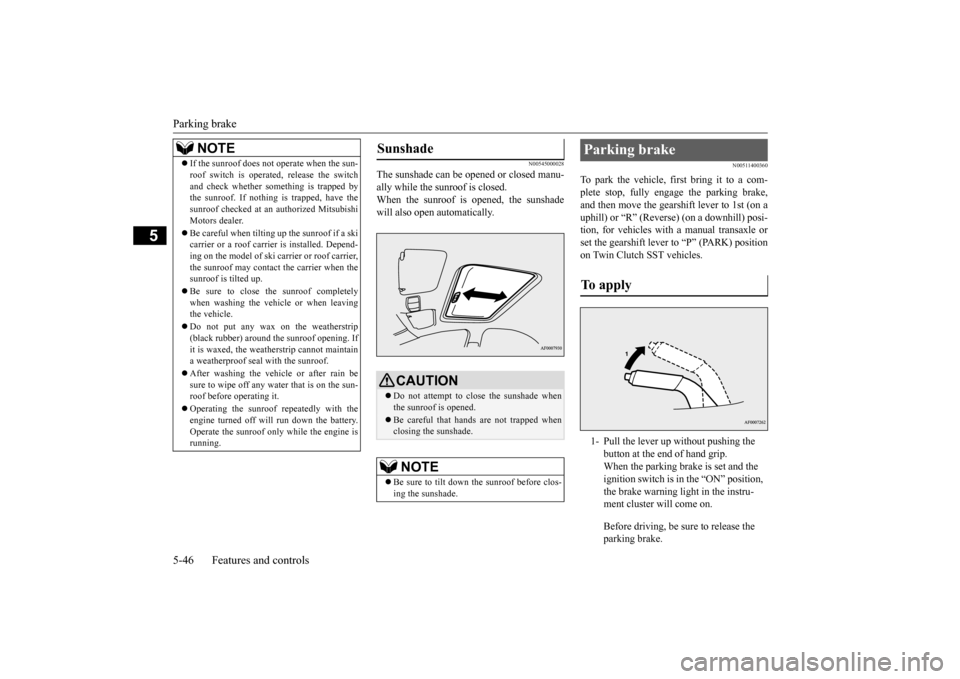
To park the vehicle, first bring it to a com- plete stop, fully engage the parking brake,and then move the gearshift lever to 1st (on a uphill) or “R” (Reverse) (on a downhill) posi- tion, for vehicles with a manual transaxle orset the gearshift lever to “P” (PARK) position on Twin Clutch SST vehicles.
If the sunroof does not operate when the sun- roof switch is operated, release the switch and check whether something is trapped by the sunroof. If nothing is trapped, have the sunroof checked at an authorized MitsubishiMotors dealer. Be careful when tilting
up the sunroof if a ski
carrier or a roof carrier is installed. Depend- ing on the model of ski car
rier or roof carrier,
the sunroof may contact the carrier when thesunroof is tilted up. Be sure to close the sunroof completely when washing the vehicle or when leaving the vehicle. Do not put any wax on the weatherstrip (black rubber) around the sunroof opening. If it is waxed, the weatherstrip cannot maintaina weatherproof seal with the sunroof. After washing the vehicle or after rain be sure to wipe off any water that is on the sun- roof before operating it. Operating the sunroof repeatedly with the engine turned off will run down the battery. Operate the sunroof only while the engine isrunning.NOTE
Sunshade
CAUTION Do not attempt to close the sunshade when the sunroof is opened. Be careful that hands are not trapped when closing the sunshade.NOTE
Be sure to tilt down the sunroof before clos- ing the sunshade.
Parking brake To apply 1- Pull the lever up without pushing the
button at the end of hand grip. When the parking brake is set and the ignition switch is in the “ON” position, the brake warning light in the instru-ment cluster will come on. Before driving, be sure to release the parking brake.
BK0210800US.bo
ok 46 ページ 2014年4月8日 火曜日 午前11時28分
Page 235 of 338
Loading information 6-6 Driving safety
6
Be sure that the parking brake is firmly set when parked and that the gearshift lever is inthe “P” (PARK) position. When parking on a hill, it is important to set the parking brake before moving the gearshiftlever to the “P” (PARK) position. This pre- vents loading the parking brake against the transmission gear. When this happens, it isdifficult to move the gearshift lever out of the“P” (PARK) position. Never leave the engi
ne running while you
take a short sleep/rest. Also, never leave the engine running in a closed or poorly venti-lated place.
Your front bumper can be damaged if you scrape it over curbs or parking stop blocks.Be careful when traveling up or down steep slopes where your bumper can scrape the road. When leaving the vehicle unattended, always carry the key and lock all doors. Always try to park your vehicle in a well litarea.
N00629900365
It is very important to know how muchweight your vehicle can carry. This weight is called the vehicle capacity weight and includes the weight of all occupants, cargo(including the roof load) and non-factory- installed options. The tire and loading infor-
mation placard located on the driver’s door sill of your vehicle will show how much weight it may properly carry. It is important to familiarize yourself with the following terms before loading your vehicle: Vehicle maximum load on the tire: load on an individual tire that is determined bydistributing to each axle its share of the maximum loaded vehicle weight and dividing by two. Vehicle normal load on the tire: load on an individual tire that is determined by dis- tributing to each axle its share of the curbweight, accessory weight, and normal occupant weight and dividing by two. Maximum loaded vehicle weight: the sum of - (a) Curb weight; (b) Accessory weight;(c) Vehicle capacity weight; and (d) Production options weight.
For vehicles with Twin Clutch SST Parking with the engine run- ning
WA R N I N G Leaving the engine running risks injury or death from accidentally moving the gear- shift lever (manual transaxle) or the gear-shift lever (Twin Clutch SST) or from the accumulation of toxic exhaust fumes in the passenger compartment.
Where you park
WA R N I N G Do not park your vehicle in areas where combustible materials such as dry grass orleaves can come in contact with a hot exhaust, since a fire could occur.
When leaving the vehicle Loading information
WA R N I N G Never overload your vehicle. Overloading can damage your vehicle, adversely affect vehicle performance, including handling and braking, cause tire failure, and resultin an accident.
BK0210800US.bo
ok 6 ページ 2014年4月8日 火曜日 午前11時28分
Page 236 of 338
Loading information Driving safety 6-7
6
Curb weight: the weight of a motor vehi- cle with standard equipment including the maximum capacity of fuel, oil, and cool- ant. Accessory weight: the combined weight (in excess of those standard items which may be replaced) of automatic transmis-sion, power steering, power brakes, power windows, power seats, radio, and heater, to the extent that these items are availableas factory- installed equipment (whetherinstalled or not). Vehicle capacity weight: the rated cargo and luggage load plus 150 lbs (68 kg)
*
times the vehicle’s designated seating capacity. Production options weight: the combined weight of those installed regular produc- tion options weighing over 5 lbs (2.3 kg) in excess of those standard items whichthey replace, not previously considered in curb weight or accessory weight, includ- ing heavy duty brakes, ride levelers, roofrack, heavy duty battery, and special trim. Normal occupant weight: 150 lbs (68 kg)
*
times the number of specified occupants.(In your vehicle the number is 3) Occupant distribution: distribution of occupants in a vehicle as specified. (Inyour vehicle the distribution is 2 in front, 1 in second row seat)
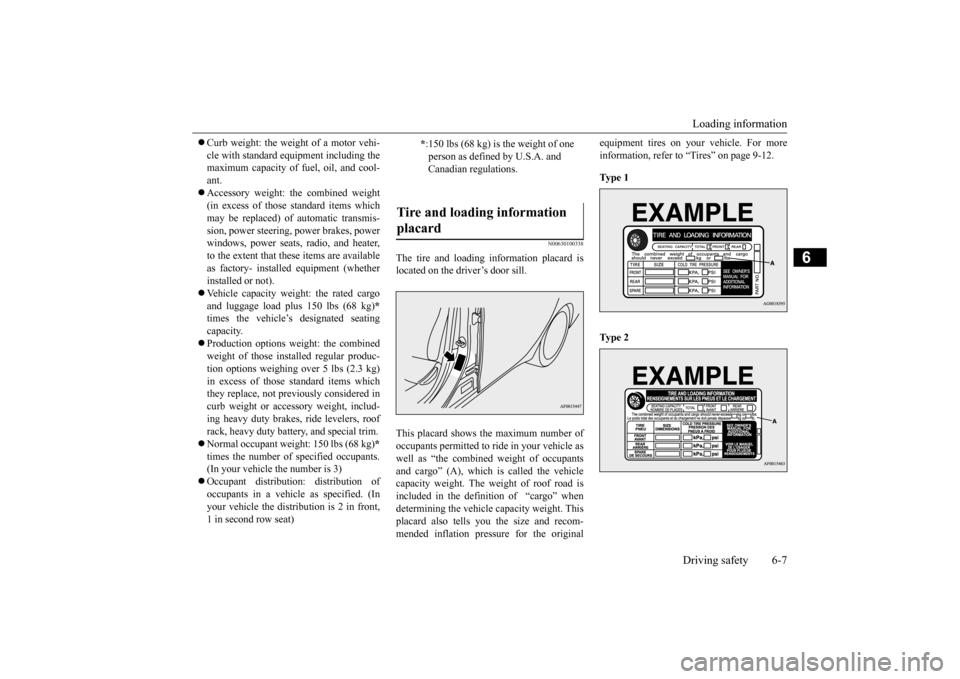
N00630100338
The tire and loading information placard islocated on the driver’s door sill. This placard shows the maximum number of occupants permitted to ride in your vehicle as well as “the combined weight of occupants and cargo” (A), which is called the vehiclecapacity weight. The weight of roof road is included in the definition of “cargo” when determining the vehicle capacity weight. Thisplacard also tells you the size and recom- mended inflation pressure for the original
equipment tires on your vehicle. For more information, refer to “Tires” on page 9-12. Ty p e 1 Ty p e 2
* :150 lbs (68 kg) is the weight of one person as defined by U.S.A. and Canadian regulations.
Tire and loading information placard
BK0210800US.bo
ok 7 ページ 2014年4月8日 火曜日 午前11時28分
Page 254 of 338
Air purifier
Comfort controls 7-15
7
The air conditioning should be operated for at least five minutes each week, even in coldweather. This includes the quick defrosting mode. Operating the air condition system weekly maintains lubrication of the compres-sor internal parts to keep the air conditioning in the best operating condition.
N00733800151
The air conditioning system is equipped with an air filter to remove pollen and dust. The air filter’s ability to collect pollen and dirt is reduced as it becomes dirty, so replaceit periodically. For the maintenance interval, refer to the “WARRANTY AND MAINTE- NANCE MANUAL”.
N00734200455
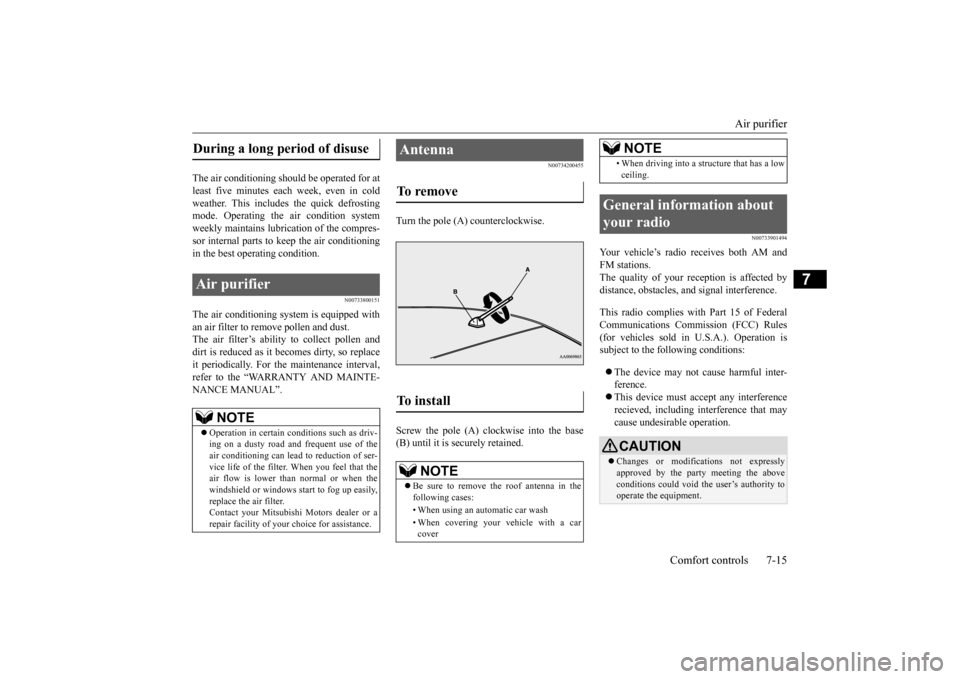
Turn the pole (A) counterclockwise. Screw the pole (A) clockwise into the base (B) until it is securely retained.
N00733901494
Your vehicle’s radio receives both AM and FM stations.The quality of your reception is affected by distance, obstacles, and signal interference. This radio complies with Part 15 of Federal Communications Commission (FCC) Rules(for vehicles sold in U.S.A.). Operation is subject to the following conditions: The device may not cause harmful inter- ference. This device must accept any interference recieved, including interference that may cause undesirable operation.
During a long period of disuse Air purifier
NOTE
Operation in certain conditions such as driv- ing on a dusty road and frequent use of the air conditioning can lead to reduction of ser- vice life of the filter.
When you feel that the
air flow is lower than
normal or when the
windshield or windows start to fog up easily, replace the air filter. Contact your Mitsubishi Motors dealer or arepair facility of your choice for assistance.
Antenna To remove To install
NOTE
Be sure to remove the roof antenna in the following cases: • When using an automatic car wash • When covering your vehicle with a car cover
• When driving into a structure that has a lowceiling.
General information about your radio
CAUTION Changes or modifications not expressly approved by the party meeting the above conditions could void the user’s authority to operate the equipment.NOTE
BK0210800US.bo
ok 15 ページ 2014年4月8日 火曜日 午前11時28分
Page 296 of 338
Fuses
Vehicle care and maintenance 9-25
9
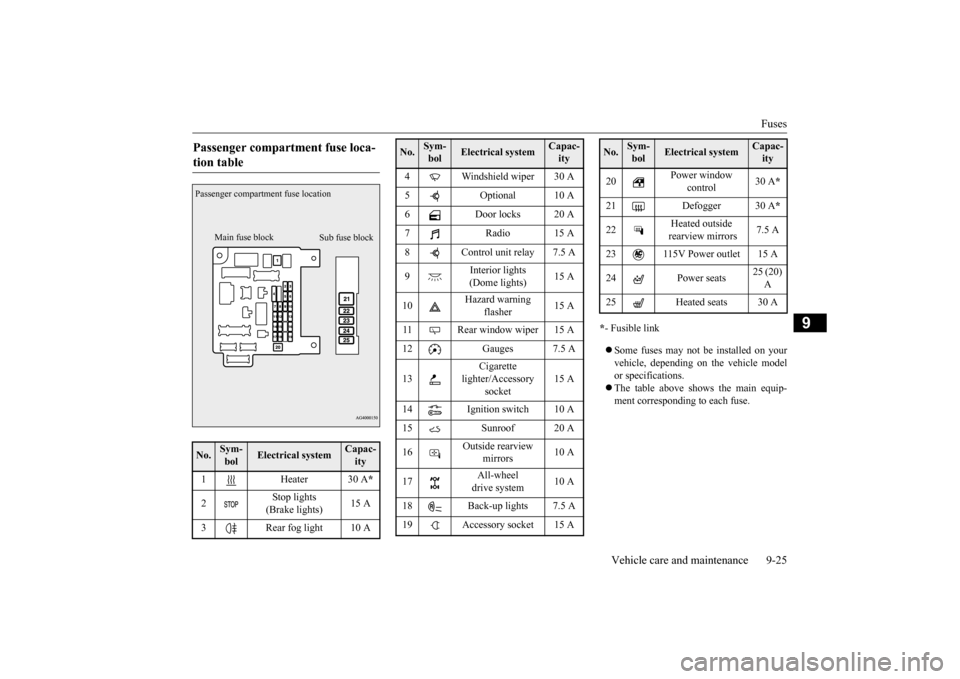
* - Fusible link Some fuses may not be installed on your vehicle, depending on the vehicle modelor specifications. The table above shows the main equip- ment corresponding to each fuse.
Passenger compartment fuse loca- tion table No.
Sym- bol
Electrical system
Capac-ity
1 Heater 30 A
*
2
Stop lights (Brake lights)
15 A
3 Rear fog light 10 APassenger compartment fuse location
Main fuse block
Sub fuse block
4 Windshield wiper 30 A 5 Optional 10 A 6 Door locks 20 A 7Radio15 A8 Control unit relay 7.5 A 9
Interior lights (Dome lights)
15 A
10
Hazard warning
flasher
15 A
11 Rear window wiper 15 A 12 Gauges 7.5 A 13
Cigarette
lighter/Accessory
socket
15 A
14 Ignition switch 10 A 15 Sunroof 20 A 16
Outside rearview
mirrors
10 A
17
All-wheel drive system
10 A
18 Back-up lights 7.5 A 19 Accessory socket 15 ANo.
Sym- bol
Electrical system
Capac-ity
20
Power window
control
30 A
*
21 Defogger 30 A
*
22
Heated outside rearview mirrors
7.5 A
23 115V Power outlet 15 A24 Power seats
25 (20) A
25 Heated seats 30 ANo.
Sym- bol
Electrical system
Capac-ity
BK0210800US.bo
ok 25 ページ 2014年4月8日 火曜日 午前11時28分
Page 314 of 338
Cleaning the outside of your vehicle Vehicle care and maintenance 9-43
9
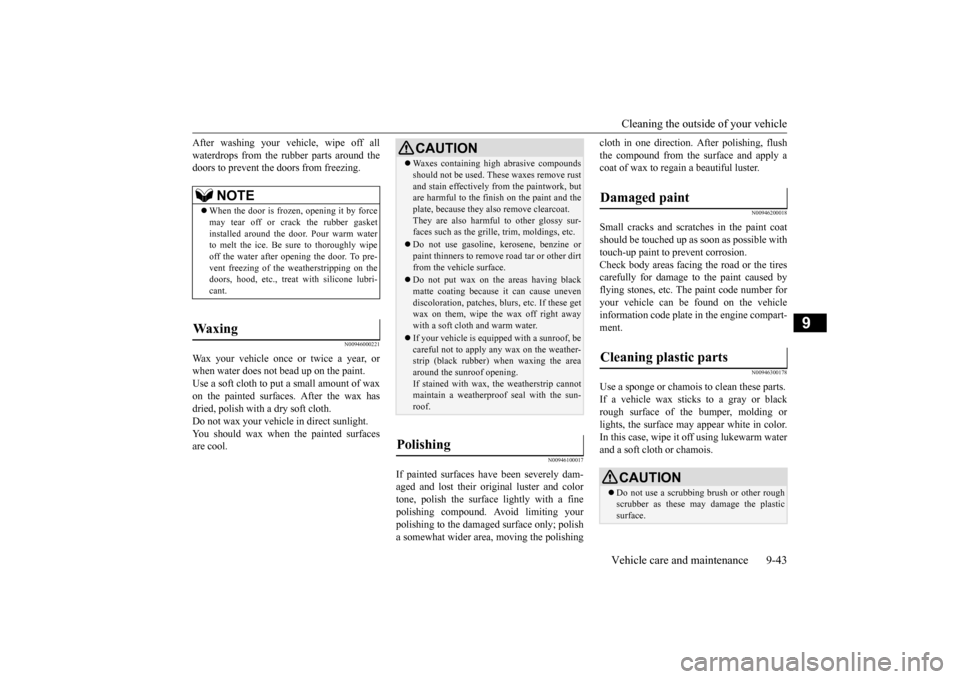
After washing your vehicle, wipe off all waterdrops from the rubber parts around the doors to prevent the doors from freezing.
N00946000221
Wax your vehicle once or twice a year, or when water does not bead up on the paint.Use a soft cloth to put a small amount of wax on the painted surfaces. After the wax has dried, polish with a dry soft cloth.Do not wax your vehicle in direct sunlight. You should wax when the painted surfaces are cool.
N00946100017
If painted surfaces have been severely dam- aged and lost their original luster and color tone, polish the surface lightly with a finepolishing compound. Avoid limiting your polishing to the damaged surface only; polish a somewhat wider area, moving the polishing
cloth in one direction. After polishing, flush the compound from the surface and apply a coat of wax to regain a beautiful luster.
N00946200018
Small cracks and scratches in the paint coatshould be touched up as soon as possible with touch-up paint to prevent corrosion.Check body areas facing the road or the tirescarefully for damage to the paint caused by flying stones, etc. The paint code number for your vehicle can be found on the vehicleinformation code plate in the engine compart- ment.
N00946300178
Use a sponge or chamois to clean these parts.If a vehicle wax sticks to a gray or black rough surface of the bumper, molding orlights, the surface may appear white in color. In this case, wipe it
off using lukewarm water
and a soft cloth or chamois.
NOTE
When the door is frozen, opening it by force may tear off or crack the rubber gasket installed around the door. Pour warm water to melt the ice. Be sure to thoroughly wipeoff the water after opening the door. To pre- vent freezing of the weatherstripping on the doors, hood, etc., treat
with silicone lubri-
cant.
Waxing
CAUTION Waxes containing high abrasive compounds should not be used. These waxes remove rust and stain effectively from the paintwork, but are harmful to the finish
on the paint and the
plate, because they also remove clearcoat.They are also harmful to other glossy sur- faces such as the grill
e, trim, moldings, etc.
Do not use gasoline, kerosene, benzine or paint thinners to remove road tar or other dirt from the vehicle surface. Do not put wax on the areas having black matte coating because it can cause unevendiscoloration, patches, blurs, etc. If these get wax on them, wipe the wax off right away with a soft cloth and warm water. If your vehicle is equipped with a sunroof, be careful not to apply any wax on the weather-strip (black rubber) when waxing the area around the sunroof opening. If stained with wax, the weatherstrip cannotmaintain a weatherproof seal with the sun- roof.
Polishing
Damaged paint Cleaning plastic parts
CAUTION Do not use a scrubbing brush or other rough scrubber as these may damage the plasticsurface.
BK0210800US.bo
ok 43 ページ 2014年4月8日 火曜日 午前11時28分
Page 315 of 338
Cleaning the outside of your vehicle 9-44 Vehicle care and maintenance
9
N00946400010
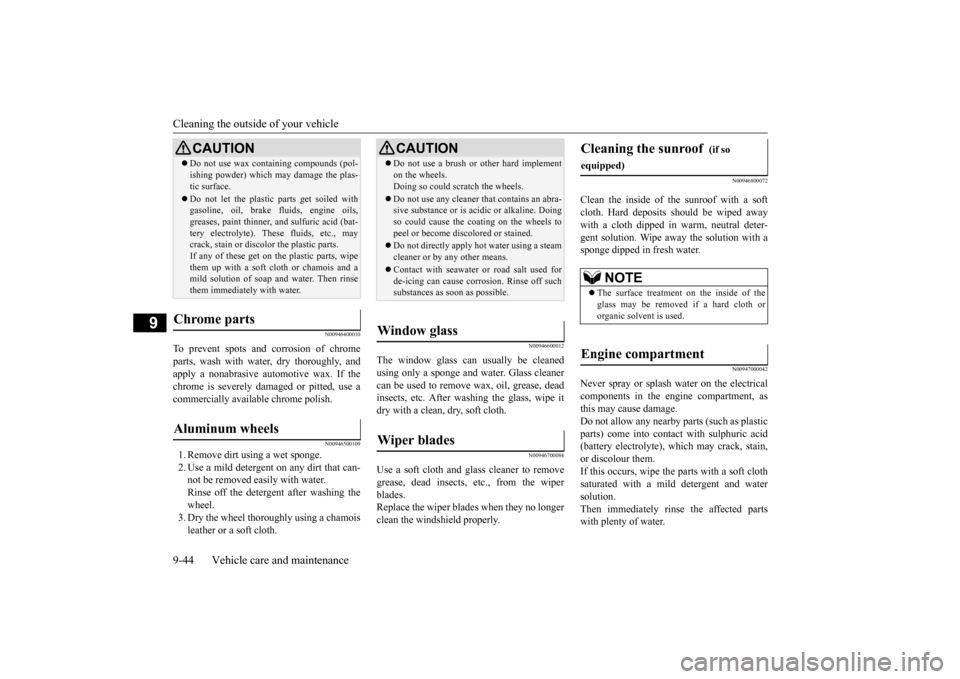
To prevent spots and corrosion of chrome parts, wash with water, dry thoroughly, and apply a nonabrasive automotive wax. If the chrome is severely damaged or pitted, use acommercially available chrome polish.
N00946500109
1. Remove dirt using a wet sponge.2. Use a mild detergent on any dirt that can- not be removed easily with water. Rinse off the detergent after washing thewheel. 3. Dry the wheel thoroug
hly using a chamois
leather or a soft cloth.
N00946600012
The window glass can usually be cleanedusing only a sponge and water. Glass cleanercan be used to remove
wax, oil, grease, dead
insects, etc. After washing the glass, wipe it dry with a clean, dry, soft cloth.
N00946700084
Use a soft cloth and glass cleaner to removegrease, dead insects, etc., from the wiperblades. Replace the wiper blades when they no longer clean the windshield properly.
N00946800072
Clean the inside of the sunroof with a soft cloth. Hard deposits should be wiped away with a cloth dipped in warm, neutral deter-gent solution. Wipe away the solution with a sponge dipped in fresh water.
N00947000042
Never spray or splash water on the electricalcomponents in the engine compartment, as this may cause damage.Do not allow any nearby parts (such as plastic parts) come into contact with sulphuric acid (battery electrolyte), which may crack, stain,or discolour them. If this occurs, wipe the parts with a soft cloth saturated with a mild detergent and watersolution. Then immediately rinse the affected parts with plenty of water.
Do not use wax containing compounds (pol- ishing powder) which may damage the plas- tic surface. Do not let the plastic parts get soiled with gasoline, oil, brake fluids, engine oils, greases, paint thinner, and sulfuric acid (bat- tery electrolyte). These fluids, etc., maycrack, stain or discolor the plastic parts. If any of these get on the plastic parts, wipe them up with a soft cloth or chamois and amild solution of soap and water. Then rinse them immediately with water.
Chrome parts Aluminum wheels
CAUTION
CAUTION Do not use a brush or other hard implement on the wheels. Doing so could scratch the wheels. Do not use any cleaner that contains an abra- sive substance or is acidic or alkaline. Doing so could cause the coating on the wheels to peel or become discolored or stained. Do not directly apply hot water using a steam cleaner or by any other means. Contact with seawater or road salt used for de-icing can cause corrosion. Rinse off suchsubstances as soon as possible.
Window glass Wiper blades
Cleaning the sunroof
(if so
equipped)
NOTE
The surface treatment on the inside of the glass may be removed if a hard cloth or organic solvent is used.
Engine compartment
BK0210800US.bo
ok 44 ページ 2014年4月8日 火曜日 午前11時28分
Page 330 of 338
Alphabetical index
12-1
12
A
Accessory (installation)
.........................
3-6
ACD (Active center differential system) 5-71Active stability control (ASC)
..............
5-76
ASC OFF indicator
.........................
5-78
ASC operation display
....................
5-78
ASC warning display
......................
5-78
Air cleaner filter
...................
................
9-8
Air conditioning
Automatic air conditioning
.........
7-4
, 7-9
Important air conditioning operating tips
..
7-14
Air purifier
....................
.....................
7-15
All-wheel drive system
........................
5-70
Aluminum wheels
...............................
9-44
Antenna
Roof antenna
.................
.................
7-15
Anti-lock braking system
.....................
5-74
Warning light / display
....................
5-75
Arm rest
........................
.......................
4-5
ASC
..........................
........................
5-76
Assist grip
.....................
...................
5-166
AWC Control fluid
Fluid
......................
........................
11-5
AWC control fluid
................
................
9-9
AYC (Active yaw control system)
........
5-71
AYC fluid
Fluid
.......................
......................
11-5
B
Back-up lights
Bulb capacity
..................
...............
9-28
Replacement
...................
...............
9-37
Ball joint, steering linkage seals and drive shaft boots
.....................
..................
9-22
Battery
........................
......................
9-11
Charging system warning light
.......
5-122
Disconection and connection
...........
9-12
During cold weather
.......................
9-11
Specification
...................
...............
11-5
Bluetooth 2.0 interface
.......................
5-136
Bottle holder
....................
.................
5-165
Brake
Anti-lock braking system
................
5-74
Braking
.......................
....................
6-5
Fluid
....................
.................
9-10
, 11-5
Hose
.......................
......................
9-22
Parking brake
..................
...............
5-46
Parking brake lever stroke
...............
9-19
Pedal
.......................
......................
5-79
Pedal free play
................
...............
9-19
Power brakes
..................
...............
5-79
Service brake
..................
...............
5-79
Brake assist
......................
..................
5-80
Braking
Warning lights
..............................
5-121
Break-in period
.....................
................
5-3
Bulb capacity
.....................
.................
9-28
C
California Perchlorate Materials Requirements
.....................
................
3-7
Capacities
.....................
.....................
11-5
Card holder
............................
5-160
, 5-163
Cargo loads
...................
.....................
6-10
Catalytic converter
................
................
9-2
Certification label
...............................
11-3
Charging system warning light
...........
5-122
Chassis number
..................
.................
11-2
Child restraints
..................
.................
4-13
Child safety locks for rear door
............
5-36
Cleaning
Inside of your vehicle
......................
9-40
Outside of your vehicle
...................
9-41
Clutch
Clutch pedal operation
.....................
5-56
Fluid
..................
...................
9-10
, 11-5
Pedal free play
...............
.................
9-19
Coat hooks
....................
...................
5-166
Combination headlights and dimmer switch
Headlight reminder buzzer
.............
5-127
Light auto-cutout function
.............
5-126
Consumer information
.........................
10-2
BK0210800US.bo
ok 1 ページ 2014年4月8日 火曜日 午前11時28分
Page 334 of 338
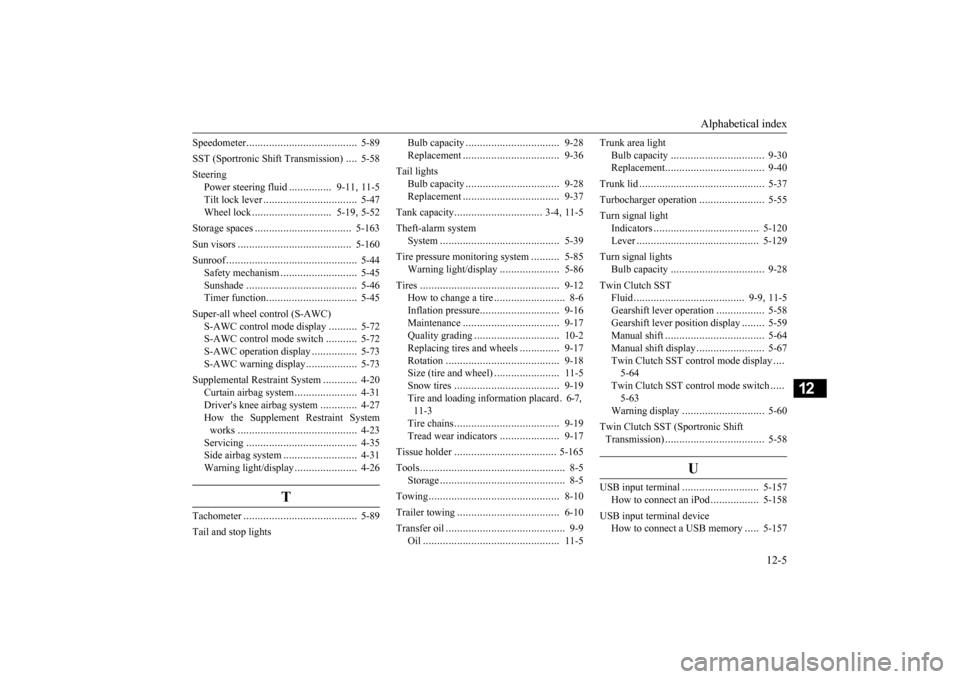
Alphabetical index
12-5
12
Speedometer
..................
.....................
5-89
SST (Sportronic Shift Transmission)
....
5-58
Steering
Power steering fluid
...............
9-11
, 11-5
Tilt lock lever
................
.................
5-47
Wheel lock
............................
5-19
, 5-52
Storage spaces
...................
...............
5-163
Sun visors
.....................
...................
5-160
Sunroof
......................
........................
5-44
Safety mechanism
...........................
5-45
Sunshade
..................
.....................
5-46
Timer function
...............
.................
5-45
Super-all wheel control (S-AWC)
S-AWC control mode display
..........
5-72
S-AWC control mode switch
...........
5-72
S-AWC operation display
................
5-73
S-AWC warning display
..................
5-73
Supplemental Restraint System
............
4-20
Curtain airbag system
......................
4-31
Driver's knee airbag system
.............
4-27
How the Supplement Restraint System works
.....................
.....................
4-23
Servicing
..................
.....................
4-35
Side airbag system
..........................
4-31
Warning light/display
......................
4-26
T
Tachometer
...................
.....................
5-89
Tail and stop lights
Bulb capacity
..................
...............
9-28
Replacement
...................
...............
9-36
Tail lights
Bulb capacity
..................
...............
9-28
Replacement
...................
...............
9-37
Tank capacity
...............
................
3-4
, 11-5
Theft-alarm system
System
........................
..................
5-39
Tire pressure monitoring system
..........
5-85
Warning light/display
.....................
5-86
Tires
...........................
......................
9-12
How to change a tire
.........................
8-6
Inflation pressure
............................
9-16
Maintenance
...................
...............
9-17
Quality grading
...............
...............
10-2
Replacing tires and wheels
..............
9-17
Rotation
......................
..................
9-18
Size (tire and wheel)
.......................
11-5
Snow tires
...................
..................
9-19
Tire and loading information placard
.6-7
,
11-3 Tire chains
...................
..................
9-19
Tread wear indicators
.....................
9-17
Tissue holder
...................
.................
5-165
Tools
...........................
........................
8-5
Storage
........................
....................
8-5
Towing
........................
......................
8-10
Trailer towing
.....................
...............
6-10
Transfer oil
......................
....................
9-9
Oil
..........................
......................
11-5
Trunk area light
Bulb capacity
................
.................
9-30
Replacement
..................
.................
9-40
Trunk lid
.......................
.....................
5-37
Turbocharger operation
.......................
5-55
Turn signal light
Indicators
..................
...................
5-120
Lever
........................
...................
5-129
Turn signal lights
Bulb capacity
................
.................
9-28
Twin Clutch SST
Fluid
..................
.....................
9-9
, 11-5
Gearshift lever operation
.................
5-58
Gearshift lever position display
........
5-59
Manual shift
..................
.................
5-64
Manual shift display
........................
5-67
Twin Clutch SST control mode display
....
5-64 Twin Clutch SST control mode switch
.....
5-63Warning display
.............................
5-60
Twin Clutch SST (Sportronic Shift Transmission)
..................
.................
5-58
U
USB input terminal
...........................
5-157
How to connect an iPod
.................
5-158
USB input terminal device
How to connect a USB memory
.....
5-157
BK0210800US.bo
ok 5 ページ 2014年4月8日 火曜日 午前11時28分