flat tire MITSUBISHI LANCER EVOLUTION 2015 10.G Owner's Manual
[x] Cancel search | Manufacturer: MITSUBISHI, Model Year: 2015, Model line: LANCER EVOLUTION, Model: MITSUBISHI LANCER EVOLUTION 2015 10.GPages: 338, PDF Size: 43.12 MB
Page 288 of 338
Tires
Vehicle care and maintenance 9-17
9
2 to 6 PSI from the cold inflation pressure. Do not let air out of the tires to get back to the specified cold pressure, or your tire pressure will be too low.Check your tires each time you refuel. If one tire looks lower than the others, check the pressure for all of them.You should also take the following safety pre- cautions: Keep your tires inflated to the recom- mended pressures. (See the tire and load-ing information placard attached to thedriver’s door sill.) Stay within the recommended load limits. Make sure that the weight of any load in your vehicle is evenly distributed. Drive at safe speeds. After filling your tires to the correct pres- sure, check them for damage and air leaks. Be sure to reinstall the caps on the valve stems.
N00939600397
N00939700037
The following maintenance steps are recom- mended: Check tire pressures regularly.
Have regular maintenance done on the wheel balance and front and rear suspen- sion alignment. Rotate your tires regularly as described in the “Tire rotation” section on page 9-18.
N00939800201
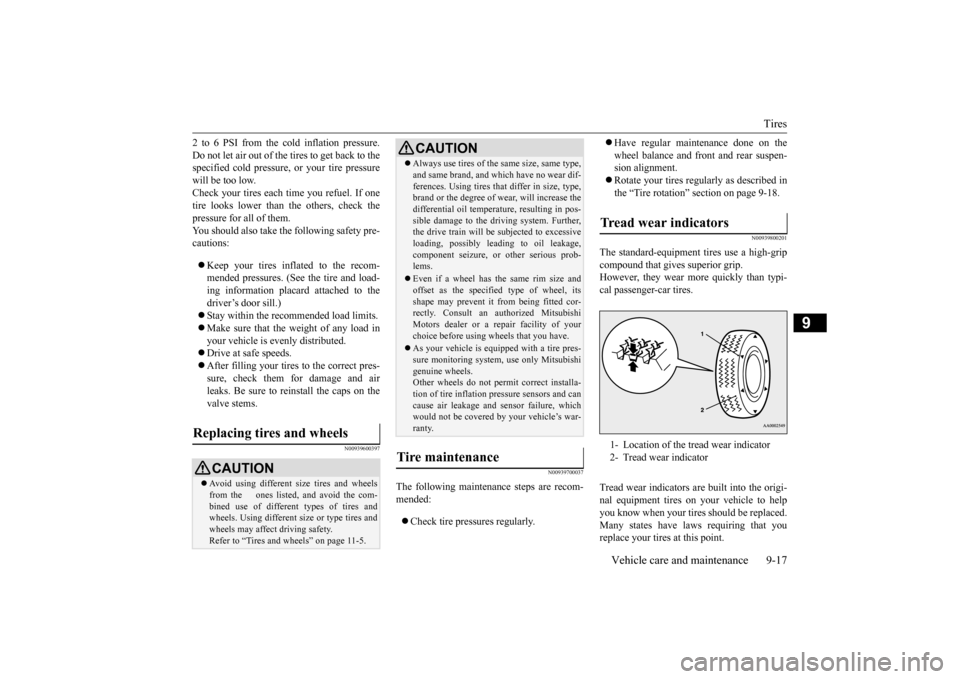
The standard-equipment tires use a high-gripcompound that gives superior grip.However, they wear more quickly than typi- cal passenger-car tires. Tread wear indicators are built into the origi- nal equipment tires on your vehicle to help you know when your tire
s should be replaced.
Many states have laws requiring that you replace your tires at this point.
Replacing tires and wheels
CAUTION Avoid using different size tires and wheels from the ones listed, and avoid the com- bined use of different types of tires and wheels. Using different size or type tires andwheels may affect driving safety. Refer to “Tires and wheels” on page 11-5.
Always use tires of the same size, same type, and same brand, and which have no wear dif- ferences. Using tires that differ in size, type, brand or the degree of wear, will increase the differential oil temperature, resulting in pos-sible damage to the driving system. Further, the drive train will be
subjected to excessive
loading, possibly leading to oil leakage,component seizure, or other serious prob- lems. Even if a wheel has the same rim size and offset as the specified type of wheel, its shape may prevent it from being fitted cor-rectly. Consult an authorized Mitsubishi Motors dealer or a repair facility of your choice before using wheels that you have. As your vehicle is equipped with a tire pres- sure monitoring system, use only Mitsubishigenuine wheels. Other wheels do not permit correct installa- tion of tire inflation pressure sensors and cancause air leakage and sensor failure, which would not be covered by your vehicle’s war- ranty.
Tire maintenance
CAUTION
Tread wear indicators 1- Location of the tread wear indicator 2- Tread wear indicator
BK0210800US.bo
ok 17 ページ 2014年4月8日 火曜日 午前11時28分
Page 319 of 338
Consumer information (For vehicles sold in U.S.A.) 10-2 Customer assistance/Reporting Safety Defects
10
N01047100100
This information is provided in compliance with the requirements of the National High-way Traffic Safety Administration, Depart- ment of Transportation. It provides the purchasers and/or prospective purchaserswith information on reporting safety defects. DOT quality grades - All passenger vehicle tires must conform to Federal Safety Require-ments in addition to these grades. The spe- cific grade rating in each grade category is shown on the side wall of the tires on yourvehicle. The treadwear grade is a comparative rating based on the wear rate of the tire when tested under controlled conditions on a specified government test course. For example, a tiregraded 150 would wear one and one-half (11/2) times as well on the government course
as a tire graded 100. The relative performance of tires depends upon the actual conditions of
their use, however, and may depart signifi- cantly from the norm due to variations in driving habits, service practices and differ- ences in road characteristics and climate. The traction grades, from highest to lowest, are AA, A, B and C. Those grades representthe tire’s ability to stop on wet pavement asmeasured under controlled conditions on specified government test surfaces of asphalt and concrete. A tire marked C may have poortraction performance. The temperature grades are A (the highest), B and C, representing the tire’s resistance to thegeneration of heat and its ability to dissipate heat when tested under controlled conditions on a specified indoor laboratory test wheel.Sustained high temperature can cause the
material of the tire to degenerate and reduce tire life, and excessive temperature can lead to sudden tire failure. The grade C corre- sponds to a level of performance which allpassenger car tires must meet under the Fed- eral Motor Vehicle Safety Standard No. 109. Grades B and A represent higher levels ofperformance on the laboratory test wheel than the minimum required by law.
N01047201485
If you believe that your vehicle has a defect which could cause a crash or could cause injury or death, you should immediately inform the National Highway Traffic SafetyAdministration (NHTSA) in addi- tion to notifying Mitsubishi Motors Corporation.
Consumer information (For vehicles sold in U.S.A.) Uniform tire quality grading Treadwear
Traction AA, A, B, C
WA R N I N G The traction grade assigned to this tire is based on straight-ahead braking traction tests, and does not include acceleration, cornering, hydroplaning, or peak tractioncharacteristics.
Temperature A, B, C
WA R N I N G The temperature grade for this tire is established for a tire that is properly inflated and not overloaded. Excessive speed, underinflation, or excessive load-ing, either separately or in combination, can cause heat buildup and possible tire failure.
Reporting Safety Defects
BK0210800US.bo
ok 2 ページ 2014年4月8日 火曜日 午前11時28分
Page 334 of 338
Alphabetical index
12-5
12
Speedometer
..................
.....................
5-89
SST (Sportronic Shift Transmission)
....
5-58
Steering
Power steering fluid
...............
9-11
, 11-5
Tilt lock lever
................
.................
5-47
Wheel lock
............................
5-19
, 5-52
Storage spaces
...................
...............
5-163
Sun visors
.....................
...................
5-160
Sunroof
......................
........................
5-44
Safety mechanism
...........................
5-45
Sunshade
..................
.....................
5-46
Timer function
...............
.................
5-45
Super-all wheel control (S-AWC)
S-AWC control mode display
..........
5-72
S-AWC control mode switch
...........
5-72
S-AWC operation display
................
5-73
S-AWC warning display
..................
5-73
Supplemental Restraint System
............
4-20
Curtain airbag system
......................
4-31
Driver's knee airbag system
.............
4-27
How the Supplement Restraint System works
.....................
.....................
4-23
Servicing
..................
.....................
4-35
Side airbag system
..........................
4-31
Warning light/display
......................
4-26
T
Tachometer
...................
.....................
5-89
Tail and stop lights
Bulb capacity
..................
...............
9-28
Replacement
...................
...............
9-36
Tail lights
Bulb capacity
..................
...............
9-28
Replacement
...................
...............
9-37
Tank capacity
...............
................
3-4
, 11-5
Theft-alarm system
System
........................
..................
5-39
Tire pressure monitoring system
..........
5-85
Warning light/display
.....................
5-86
Tires
...........................
......................
9-12
How to change a tire
.........................
8-6
Inflation pressure
............................
9-16
Maintenance
...................
...............
9-17
Quality grading
...............
...............
10-2
Replacing tires and wheels
..............
9-17
Rotation
......................
..................
9-18
Size (tire and wheel)
.......................
11-5
Snow tires
...................
..................
9-19
Tire and loading information placard
.6-7
,
11-3 Tire chains
...................
..................
9-19
Tread wear indicators
.....................
9-17
Tissue holder
...................
.................
5-165
Tools
...........................
........................
8-5
Storage
........................
....................
8-5
Towing
........................
......................
8-10
Trailer towing
.....................
...............
6-10
Transfer oil
......................
....................
9-9
Oil
..........................
......................
11-5
Trunk area light
Bulb capacity
................
.................
9-30
Replacement
..................
.................
9-40
Trunk lid
.......................
.....................
5-37
Turbocharger operation
.......................
5-55
Turn signal light
Indicators
..................
...................
5-120
Lever
........................
...................
5-129
Turn signal lights
Bulb capacity
................
.................
9-28
Twin Clutch SST
Fluid
..................
.....................
9-9
, 11-5
Gearshift lever operation
.................
5-58
Gearshift lever position display
........
5-59
Manual shift
..................
.................
5-64
Manual shift display
........................
5-67
Twin Clutch SST control mode display
....
5-64 Twin Clutch SST control mode switch
.....
5-63Warning display
.............................
5-60
Twin Clutch SST (Sportronic Shift Transmission)
..................
.................
5-58
U
USB input terminal
...........................
5-157
How to connect an iPod
.................
5-158
USB input terminal device
How to connect a USB memory
.....
5-157
BK0210800US.bo
ok 5 ページ 2014年4月8日 火曜日 午前11時28分