brake MITSUBISHI LANCER EVOLUTION 2015 10.G Repair Manual
[x] Cancel search | Manufacturer: MITSUBISHI, Model Year: 2015, Model line: LANCER EVOLUTION, Model: MITSUBISHI LANCER EVOLUTION 2015 10.GPages: 338, PDF Size: 43.12 MB
Page 272 of 338
9
Vehicle care and maintenanceService precautions .........
.................................................................9-2
Catalytic converter
.................................................
..........................9-2
Engine hood ..............................
.......................................................9-3
View of the engine comp
artment .....................................................9-5
Engine oil and oil filt
er ................................
....................................9-5
Engine coolant ................
.................................................................9-7
Air cleaner filter ....
.................................................
..........................9-8
Manual transaxle oil (if so
equipped) ...............................................9-9
Twin Clutch Sportronic shift transmission (Twin Clutch SST) fluid (i
f so equipped) ....................................9-9
Transfer oil ......................
.................................................................9-9
Rear axle oil ....................
.................................................................9-9
AWC control fluid ..........
.................................................................9-9
Washer fluid ....................
...............................................................9-10
Brake fluid/Clutch fluid (if
so equipped)........................................9-10
Power steering fluid
...............................................
........................ 9-11
Battery .......................................
..................................................... 9-11
Tires ..........................................
.....................................................9-12
Clutch pedal free play (if so equipped)...........................................9-19Brake pedal free play
.............................................
........................9-19
Parking brake lever stroke .............................................................9-19 Parking brake break-in
...........................................
........................9-20
Wiper blades ...................
...............................................................9-20
Emission-control system maintenance ..........................................9-20 General maintenance
.............................................
........................9-21
For cold and snowy weat
her ..........................................................9-23
Fusible links ....................
...............................................................9-23
Fuses .........................................
.....................................................9-23
Replacement of light bul
bs ...................................
......................... 9-28
Vehicle care precautions
.......................................
......................... 9-40
Cleaning the inside of you
r vehicle ............................................... 9-40
Cleaning the outside of your
vehicle ............................................. 9-41
BK0210800US.bo
ok 1 ページ 2014年4月8日 火曜日 午前11時28分
Page 276 of 338
View of the engine compartment
Vehicle care and maintenance 9-5
9
Unlatch the prop from the engine hood and put it back in its retainer. Slowly lower the engine hood about 8 inches (20 cm), then let it drop from its own weight.
N00937600641
N00937702037
It is normal for an engi
ne to use oil. You may
need to add oil between the recommended oil change intervals. Before starting the engine,check the engine oil level. Refill if necessary. To check the oil level, remove the dipstick, wipe it off, and gently insert it all the way into the crankcase. Slowly remove it again.The oil level must not go above the line on the dipstick. If the level does not reach the line, which shows the smallest amount of oil required,remove the oil filler cap on the engine valve cover, and fill to with
in the “Good” range.
To close
CAUTIONBe careful not to trap your hands or fingers when closing the engine hood. Make sure the engine hood is firmly closed before driving.If you drive without the engine hood com- pletely closed, it could open up while driv- ing.NOTE
If this does not close the engine hood prop- erly, drop it again from a slightly higher position.
Do not push down strongly on the engine hood. Depending on how strongly or where you push down, you could create a dent in the vehicle body. If you drive with the engine hood left open, warning display is displayed on the informa- tion screen in the multi-information display.
View of the engine compart- ment 1- Power steering fluid reservoir 2- Air cleaner filter 3- Brake fluid/Clutch fluid reservoir (if so
equipped)NOTE
4- Engine coolant reservoir 5- Engine oil level dipstick6- Radiator cap 7- Engine oil filler capEngine oil and oil filter To check and refill engine oil
BK0210800US.bo
ok 5 ページ 2014年4月8日 火曜日 午前11時28分
Page 281 of 338
Washer fluid 9-10 Vehicle care and maintenance
9
N00938600257
The windshield washer fluid reservoir is in the trunk. Check the washer fluid level at regular inter- vals and add washer fluid to reservoir if nec-essary.
When freezing weather is anticipated, flush out the water in the reservoir by operating the pump. Fill the reservoir with windshield anti-freeze (not radiator antifreeze), and operate the system for a few seconds to flush out the residual water.
N00938700232
The brake fluid and the clutch fluid share thereservoir tank.
The fluid level must be between the “MAX” and “MIN” marks on the reservoir. The fluid level falls slightly with wear of the brake pads, but this does not indicate any abnormality. The fluid in the master cylinder should be checked when doing other work under theengine hood. The brake system should also be checked for leaks at the same time. If the fluid level falls markedly in a shortlength of time, it indicates leaks from the brake system. If this occurs, have the vehicle checked by anauthorized Mitsubishi Motors dealer or a repair facility of your choice.
Fluid type Lubricant
MITSUBISHI MOTORS Genu-
ine ATF SP III
Washer fluid
NOTE
Do not spill the fluid onto the trunk. If the fluid spilled, wipe it up immediately.
During cold weather Brake fluid/Clutch fluid
(if so
equipped)
To check the fluid level
MAX MIN
BK0210800US.bo
ok 10 ページ 2014年4月8日 火曜日 午前11時28分
Page 282 of 338
Power steering fluid
Vehicle care and maintenance 9-11
9
Use brake fluid conforming to DOT 3 or DOT 4. The reservoir cap must be tightlysealed to keep dirt and water out.
N00939000391
Check the fluid level in the reservoir while the engine is idling. Check to make certain that the power steeringfluid level is always between the “MAX” and “MIN” level markings on the fluid reservoir and refill the fluid, if necessary.
N00939100725
The vehicle battery is installed in the trunkbehind a panel. The condition of the battery is very important for quick starting and to keep the vehicle’selectrical system working properly. Be sure to have an authorized Mitsubishi Motors dealer check the battery.
The battery is weaker in cold temperatures. This has to do with its chemical and physical properties and is why a very cold battery,especially one with a low charge, will have a hard time starting your vehicle. It is recommended that you have your batteryand charging system checked by an autho- rized Mitsubishi Motors dealer before the
Fluid type
CAUTION Do not let any petroleum-based fluid touch, mix with, or get into
the brake fluid. This
will damage the seals. Be careful when handling brake fluid. It can damage painted surfaces. Use only the listed brake fluid. Different brands of brake fluid have different addi-tives, and these can cause a chemical reac- tion. Do not mix brands of brake fluid. Keep the reservoir tank cap closed to keep the brake fluid from evaporating.
Power steering fluid To check the fluid level
Fluid type Lubricant
Mitsubishi Motors Genuine
Power Steering Fluid
Battery
WA R N I N G Be sure to have an authorized Mitsubishi Motors dealer charge the battery. Do not charge the battery yourself, as it shouldonly be charged after first being removed from the vehicle. In addition, never remove the batterylabel, upper cover, exhaust tube, or pipe. Flammable gases may leak and explode.
During cold weather
BK0210800US.bo
ok 11 ページ 2014年4月8日 火曜日 午前11時28分
Page 290 of 338
Clutch pedal free play (if so equipped) Vehicle care and maintenance 9-19
9
N00940000359
In some areas of the country, snow tires are required for winter driving. If snow tires arerequired in your area, you must choose snow tires of the same size and type as the original tires provided with your vehicle. Snow tiresshould also be installed on all four wheels. Otherwise your safety and vehicle handling can be reduced.Even where laws may permit it, snow tiresshould not be operated at sustained speeds over 75 mph (120 km/h).
N00940100015 N00940201097
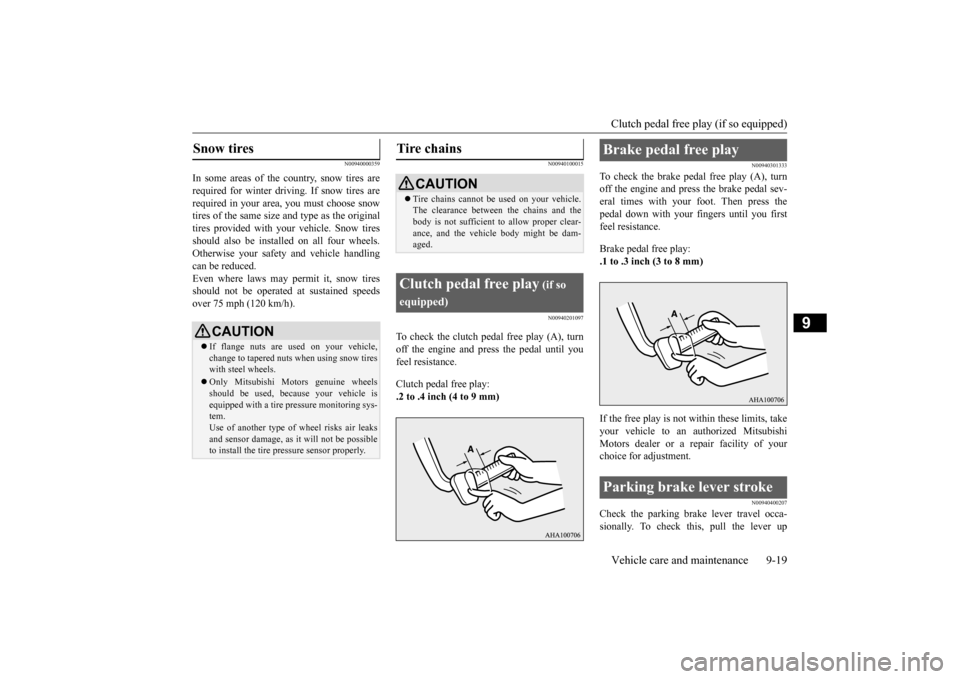
To check the clutch pedal free play (A), turn off the engine and press the pedal until you feel resistance. Clutch pedal free play: .2 to .4 inch (4 to 9 mm)
N00940301333
To check the brake pedal free play (A), turnoff the engine and press the brake pedal sev-eral times with your foot. Then press the pedal down with your fingers until you first feel resistance. Brake pedal free play: .1 to .3 inch (3 to 8 mm) If the free play is not within these limits, take your vehicle to an authorized Mitsubishi Motors dealer or a repair facility of your choice for adjustment.
N00940400207
Check the parking brake lever travel occa-sionally. To check this, pull the lever up
Snow tires
CAUTION If flange nuts are used on your vehicle, change to tapered nuts when using snow tireswith steel wheels. Only Mitsubishi Motors genuine wheels should be used, because your vehicle is equipped with a tire pressure monitoring sys- tem.Use of another type of wheel risks air leaks and sensor damage, as it will not be possible to install the tire pressure sensor properly.
Tire chains
CAUTION Tire chains cannot be used on your vehicle. The clearance between the chains and the body is not sufficient to allow proper clear- ance, and the vehicle body might be dam-aged.
Clutch pedal free play
(if so
equipped)
Brake pedal free play Parking brake lever stroke
BK0210800US.bo
ok 19 ページ 2014年4月8日 火曜日 午前11時28分
Page 291 of 338
Parking brake break-in 9-20 Vehicle care and maintenance
9
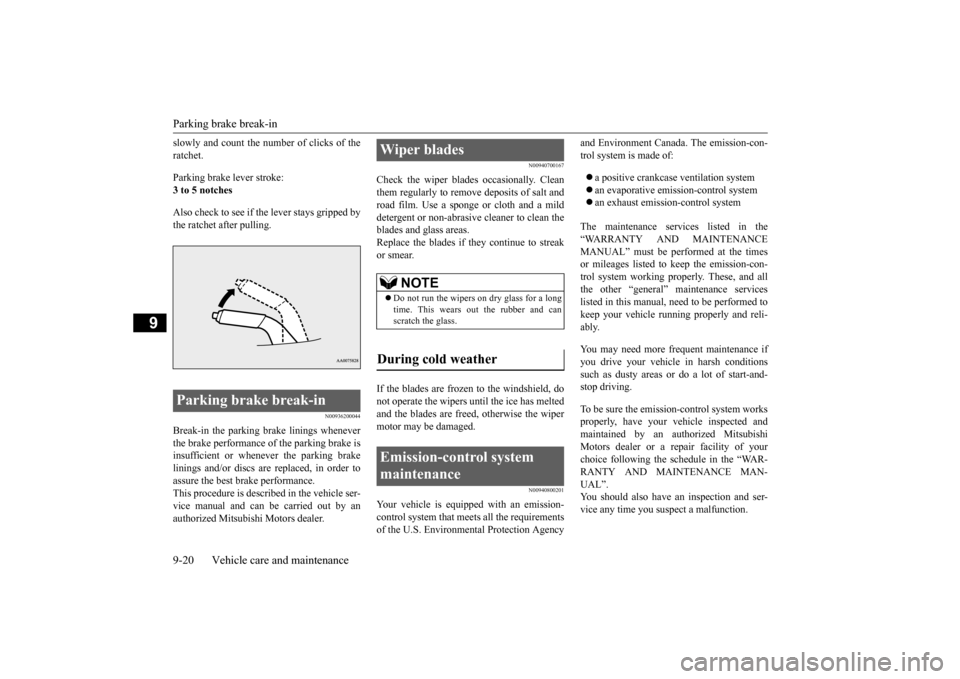
slowly and count the number of clicks of the ratchet. Parking brake lever stroke: 3 to 5 notches Also check to see if the lever stays gripped by the ratchet after pulling.
N00936200044
Break-in the parking brake linings wheneverthe brake performance of the parking brake is insufficient or whenever the parking brake linings and/or discs are replaced, in order toassure the best brake performance. This procedure is described in the vehicle ser- vice manual and can be carried out by anauthorized Mitsubishi Motors dealer.
N00940700167
Check the wiper blades occasionally. Cleanthem regularly to remove deposits of salt androad film. Use a sponge or cloth and a mild detergent or non-abrasive cleaner to clean the blades and glass areas.Replace the blades if they continue to streak or smear. If the blades are frozen to the windshield, do not operate the wipers until the ice has melted and the blades are freed, otherwise the wipermotor may be damaged.
N00940800201
Your vehicle is equipped with an emission-control system that meets all the requirements of the U.S. Environmental Protection Agency
and Environment Canada. The emission-con- trol system is made of: a positive crankcase ventilation system an evaporative emission-control system an exhaust emission-control system
The maintenance services listed in the “WARRANTY AND MAINTENANCE MANUAL” must be performed at the times or mileages listed to keep the emission-con-trol system working properly. These, and allthe other “general” maintenance services listed in this manual, need to be performed to keep your vehicle running properly and reli-ably. You may need more frequent maintenance if you drive your vehicle in harsh conditions such as dusty areas or
do a lot of start-and-
stop driving. To be sure the emission-control system works properly, have your vehicle inspected and maintained by an authorized MitsubishiMotors dealer or a repair facility of your choice following the schedule in the “WAR- RANTY AND MAINTENANCE MAN-UAL”. You should also have an inspection and ser- vice any time you suspect a malfunction.
Parking brake break-in
Wiper blades
NOTE
Do not run the wipers on dry glass for a long time. This wears out the rubber and can scratch the glass.
During cold weather Emission-control system maintenance
BK0210800US.bo
ok 20 ページ 2014年4月8日 火曜日 午前11時28分
Page 293 of 338
General maintenance 9-22 Vehicle care and maintenance
9
there are other parts which do not usually need regular maintenance. But, if any of these pa
rts stops working prop-
erly, your vehicle performance could suffer.Have these items checked if you notice a problem with them. See your authorized Mitsubishi Motors dealer for assistance, if you have any questions.
N00941600062
Good brakes are essential to safe driving. Check the brake pads for wear. For good braking performance, replace the brake padswith the same type pads as the originals.
N00941700047
Brake hoses and tubing should be checkedfor: Severe surface cracking, scuffing or worn spots. If the fabric casing of the hose is showing through any cracks or worn spotsin the rubber hose cover, the hose should be replaced. The brakes can fail if the hose wears through. Improper installation may cause twisting, or wheel, tire or chassis interference.
N00941800077
Check the following parts for damage and grease leaks: Ball joint boots of the front suspension and steering linkage Bellows on both ends of the drive shaft
N00942200108
The best way to k
eep carbon monoxide gas
from entering inside your vehicle is to have the engine exhaust system properly serviced. Have a competent mechanic inspect the com-plete exhaust system and nearby body areas for broken, damaged, deteriorated, or mispo- sitioned parts if you notice any of the follow-ing: A change in the sound of the exhaust sys- tem The smell of exhaust fumes inside the vehicle
The underside or rear of the vehicle is damaged
Also check the exhaust system each time the vehicle is raised for lubrication, oil changes, or required service. Any open seams or looseconnections could let dangerous exhaust fumes seep into the luggage compartment and passenger compartments. Check for holes or exhaust gas leaks caused by corrosion or damage. Check the joints and connections for looseness or exhaust gas leaks. Check the rubber hangers and brackets for damage.
N00942500042
The hood lock release mechanism and hood safety catch should be checked, cleaned, and oiled when needed for easy movement and tostop rust and wear. Use Multipurpose Grease NLGI Grade 2 sparingly for all sliding parts of the hood latch and release lever. Work thegrease into the hood lock mechanism until all the movable surfaces are covered.
Disc brake pads Brake hoses
Ball joint, steering linkage seals and drive shaft boots Exhaust system
WA R N I N G Carbon monoxide gas from your vehicle’s exhaust is poisonous. Breathing these fumes can cause unconsciousness or death.
Check for any of the following conditions: Hood lock release mechanism and safety catch
BK0210800US.bo
ok 22 ページ 2014年4月8日 火曜日 午前11時28分
Page 296 of 338
Fuses
Vehicle care and maintenance 9-25
9
* - Fusible link Some fuses may not be installed on your vehicle, depending on the vehicle modelor specifications. The table above shows the main equip- ment corresponding to each fuse.
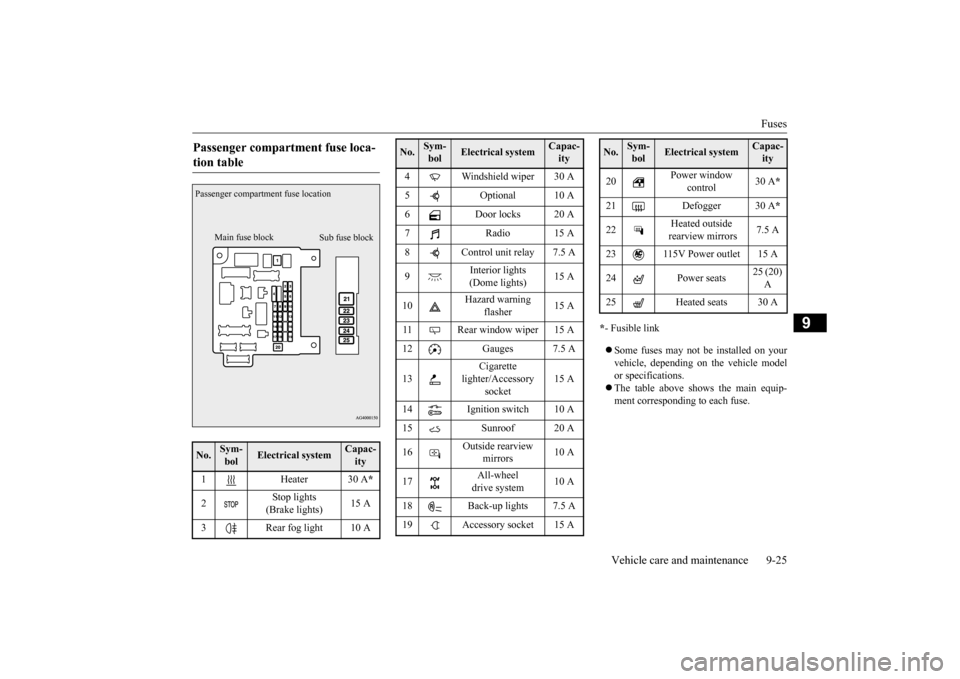
Passenger compartment fuse loca- tion table No.
Sym- bol
Electrical system
Capac-ity
1 Heater 30 A
*
2
Stop lights (Brake lights)
15 A
3 Rear fog light 10 APassenger compartment fuse location
Main fuse block
Sub fuse block
4 Windshield wiper 30 A 5 Optional 10 A 6 Door locks 20 A 7Radio15 A8 Control unit relay 7.5 A 9
Interior lights (Dome lights)
15 A
10
Hazard warning
flasher
15 A
11 Rear window wiper 15 A 12 Gauges 7.5 A 13
Cigarette
lighter/Accessory
socket
15 A
14 Ignition switch 10 A 15 Sunroof 20 A 16
Outside rearview
mirrors
10 A
17
All-wheel drive system
10 A
18 Back-up lights 7.5 A 19 Accessory socket 15 ANo.
Sym- bol
Electrical system
Capac-ity
20
Power window
control
30 A
*
21 Defogger 30 A
*
22
Heated outside rearview mirrors
7.5 A
23 115V Power outlet 15 A24 Power seats
25 (20) A
25 Heated seats 30 ANo.
Sym- bol
Electrical system
Capac-ity
BK0210800US.bo
ok 25 ページ 2014年4月8日 火曜日 午前11時28分
Page 313 of 338
Cleaning the outside of your vehicle 9-42 Vehicle care and maintenance
9
N00945900601
Chemicals contained in the dirt and dust picked up from air, rain, snow or road sur-faces can damage the paint and body of your vehicle if left on. Frequent washing and waxing is the best wayto protect your vehicle from this damage. Do not wash the vehicle in direct sunlight. Park the vehicle in the shade and spray it withwater to remove dust. Next, using plenty ofclean water and a car washing mitt or sponge, wash the vehicle from top to bottom. Use a mild car washing soap if necessary.Rinse thoroughly and wipe dry with a cham- ois or soft cloth. After washing the vehicle, carefully clean the joints and flanges of thedoors, hood, etc., where dirt is likely to remain.
Salt and other chemicals spread on winter roads in some geographical areas can have adetrimental effect on the vehicle underbody. You should flush the underbody with a high pressure hose every time you wash the out-side of your vehicle. Take special care to remove mud or other debris which could trap and hold salt andmoisture.
Wa s h i n g
CAUTION When washing the underside of your vehicle or the wheels, wear a pair of gloves to pro-tect your hands. This vehicle is equipped with a high perfor- mance brakes. Wash the wheels frequently to remove brake dust. The dust will be difficultto remove if left on the wheels for too long.
If your vehicle has rain sensor wipers, place the wiper switch lever in the “OFF” position to deactivate the rain sensor before washing the vehicle. Otherwise, the wipers will oper- ate in the presence of water spray on thewindshield and become damaged as a result. Never spray or splash water on the electrical parts in the engine compartment. This may damage them. Be careful also when washing the underbody. Do not spray water into theengine compartment. Avoid automatic car washers that use rotat- ing brushes. These brushes may scratch the paint surface and make it dull. Scratches are more noticeable on darker col-ored vehicles. Some hot water washing equipment uses high pressure and heat to clean your vehicle. This heated water may damage your vehi- cle’s resin parts. It can flood the interior ofthe vehicle. Therefore, be sure of the follow- ing:• Keep the washing nozzle at least 20 inches(50 cm) away from the vehicle body.• When washing around the door glass, holdthe nozzle at a distance of more than 20 inches (50 cm) and at right angles to the glass surface. CAUTION
When using high-pressure water to wash a vehicle equipped with the F.A.S.T.-key sys- tem, keep the water from spraying on the open button on the trunk. This could cause the trunk to open and flood the inside of thetrunk. Make sure to do the following when using an automatic car wash, with help from either this manual or the car wash operator, to avoid damaging your vehicle:• Fold the outside rear-view mirrors.• Remove the antenna.• If your vehicle is equipped with rearspoiler, check with the car wash operator before using the car wash.• If your vehicle has rain sensor wipers, placethe wiper switch lever in the “OFF” posi- tion to deactivate the rain sensor.
During cold weather
CAUTION
BK0210800US.bo
ok 42 ページ 2014年4月8日 火曜日 午前11時28分
Page 315 of 338
Cleaning the outside of your vehicle 9-44 Vehicle care and maintenance
9
N00946400010
To prevent spots and corrosion of chrome parts, wash with water, dry thoroughly, and apply a nonabrasive automotive wax. If the chrome is severely damaged or pitted, use acommercially available chrome polish.
N00946500109
1. Remove dirt using a wet sponge.2. Use a mild detergent on any dirt that can- not be removed easily with water. Rinse off the detergent after washing thewheel. 3. Dry the wheel thoroug
hly using a chamois
leather or a soft cloth.
N00946600012
The window glass can usually be cleanedusing only a sponge and water. Glass cleanercan be used to remove
wax, oil, grease, dead
insects, etc. After washing the glass, wipe it dry with a clean, dry, soft cloth.
N00946700084
Use a soft cloth and glass cleaner to removegrease, dead insects, etc., from the wiperblades. Replace the wiper blades when they no longer clean the windshield properly.
N00946800072
Clean the inside of the sunroof with a soft cloth. Hard deposits should be wiped away with a cloth dipped in warm, neutral deter-gent solution. Wipe away the solution with a sponge dipped in fresh water.
N00947000042
Never spray or splash water on the electricalcomponents in the engine compartment, as this may cause damage.Do not allow any nearby parts (such as plastic parts) come into contact with sulphuric acid (battery electrolyte), which may crack, stain,or discolour them. If this occurs, wipe the parts with a soft cloth saturated with a mild detergent and watersolution. Then immediately rinse the affected parts with plenty of water.
Do not use wax containing compounds (pol- ishing powder) which may damage the plas- tic surface. Do not let the plastic parts get soiled with gasoline, oil, brake fluids, engine oils, greases, paint thinner, and sulfuric acid (bat- tery electrolyte). These fluids, etc., maycrack, stain or discolor the plastic parts. If any of these get on the plastic parts, wipe them up with a soft cloth or chamois and amild solution of soap and water. Then rinse them immediately with water.
Chrome parts Aluminum wheels
CAUTION
CAUTION Do not use a brush or other hard implement on the wheels. Doing so could scratch the wheels. Do not use any cleaner that contains an abra- sive substance or is acidic or alkaline. Doing so could cause the coating on the wheels to peel or become discolored or stained. Do not directly apply hot water using a steam cleaner or by any other means. Contact with seawater or road salt used for de-icing can cause corrosion. Rinse off suchsubstances as soon as possible.
Window glass Wiper blades
Cleaning the sunroof
(if so
equipped)
NOTE
The surface treatment on the inside of the glass may be removed if a hard cloth or organic solvent is used.
Engine compartment
BK0210800US.bo
ok 44 ページ 2014年4月8日 火曜日 午前11時28分