Check MITSUBISHI LANCER RALLIART 2014 8.G User Guide
[x] Cancel search | Manufacturer: MITSUBISHI, Model Year: 2014, Model line: LANCER RALLIART, Model: MITSUBISHI LANCER RALLIART 2014 8.GPages: 434, PDF Size: 57.5 MB
Page 36 of 434
Head restraints
Seat and restraint systems 4-7
4
To reduce the risk of injury in an accident, adjust the head restraint height so that thecenter of the restraint is at your eye level when seated. Any person too tall for the restraint to reach their eye level when seated
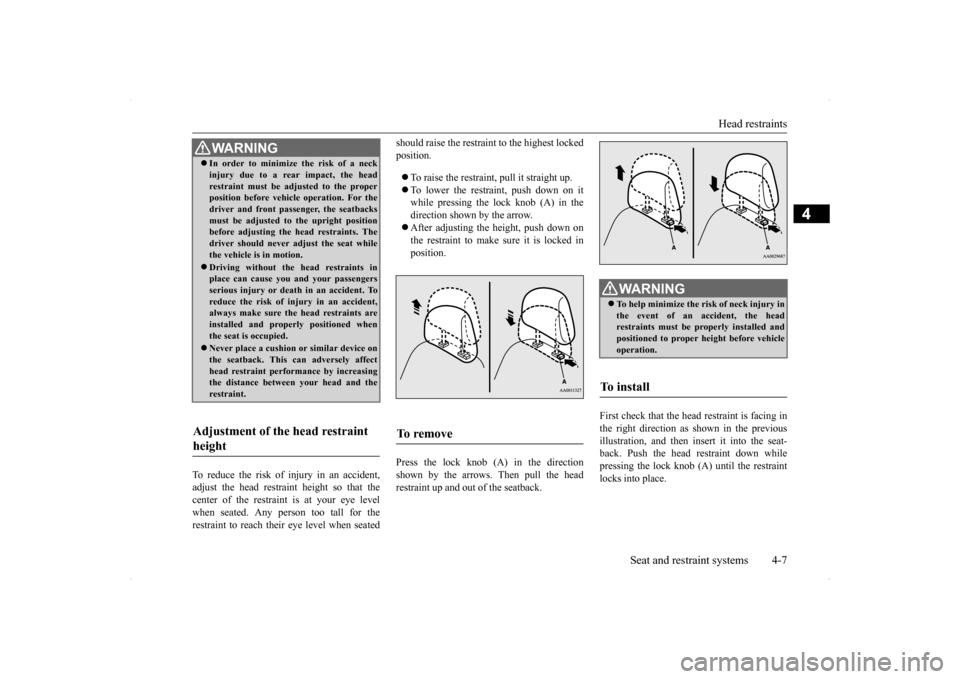
should raise the restraint to the highest locked position. To raise the restraint, pull it straight up. To lower the restraint, push down on it while pressing the lock knob (A) in thedirection shown by the arrow. After adjusting the height, push down on the restraint to make sure it is locked inposition.
Press the lock knob (A) in the direction shown by the arrows. Then pull the headrestraint up and out of the seatback.
First check that the head restraint is facing in the right direction as shown in the previous illustration, and then insert it into the seat-back. Push the head restraint down while pressing the lock knob (A) until the restraint locks into place.
WA R N I N G In order to minimize the risk of a neck injury due to a rear impact, the head restraint must be adjusted to the proper position before vehi
cle operation. For the
driver and front passenger, the seatbacksmust be adjusted to the upright position before adjusting the head restraints. The driver should never adjust the seat whilethe vehicle is in motion. Driving without the head restraints in place can cause you and your passengers serious injury or death in an accident. To reduce the risk of injury in an accident,always make sure the head restraints are installed and properly positioned when the seat is occupied. Never place a cushion or similar device on the seatback. This can adversely affecthead restraint performance by increasing the distance between your head and the restraint.
Adjustment of the head restraint height
To remove
WA R N I N G To help minimize the risk of neck injury in the event of an accident, the head restraints must be properly installed andpositioned to proper height before vehicle operation.
To install
Page 37 of 434
Seat belts 4-8 Seat and restraint systems
4
N00409500044
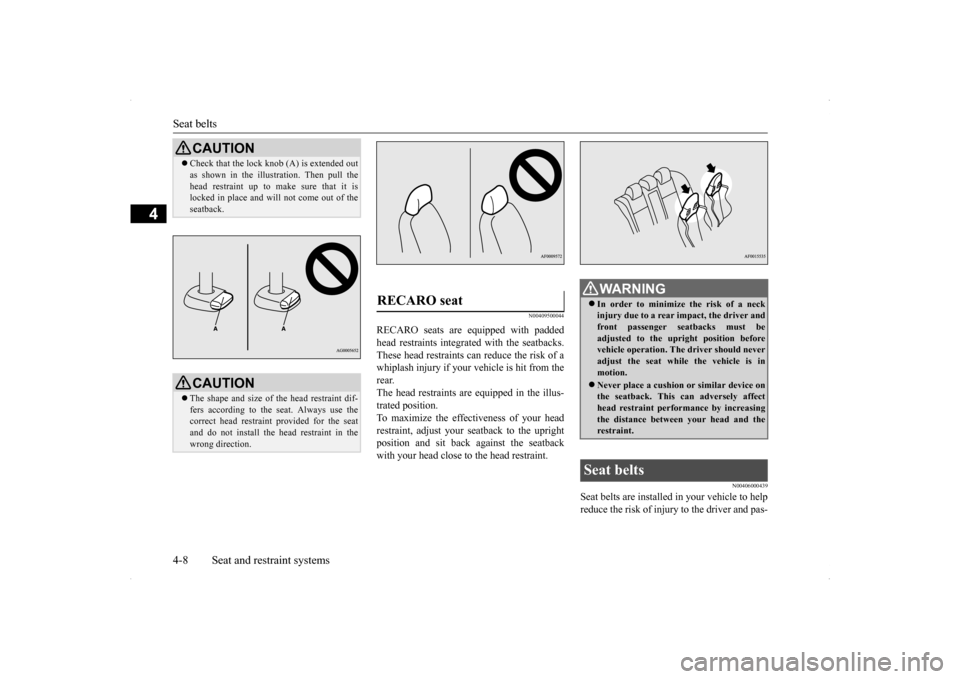
RECARO seats are equipped with padded head restraints integrated with the seatbacks. These head restraints can reduce the risk of a whiplash injury if your vehicle is hit from therear. The head restraints are equipped in the illus- trated position. To maximize the effectiveness of your headrestraint, adjust your seatback to the upright position and sit back against the seatback with your head close to the head restraint.
N00406000439
Seat belts are installed in your vehicle to helpreduce the risk of injury to the driver and pas-
CAUTION Check that the lock knob (A) is extended out as shown in the illustration. Then pull the head restraint up to make sure that it is locked in place and will not come out of the seatback.CAUTION The shape and size of the head restraint dif- fers according to the seat. Always use the correct head restraint provided for the seatand do not install the head restraint in the wrong direction.
RECARO seat
WA R N I N G In order to minimize the risk of a neck injury due to a rear impact, the driver and front passenger seatbacks must be adjusted to the upright position beforevehicle operation. The driver should never adjust the seat while the vehicle is in motion. Never place a cushion or similar device on the seatback. This can adversely affecthead restraint performance by increasing the distance between your head and the restraint.
Seat belts
Page 40 of 434
Seat belts
Seat and restraint systems 4-11
4
4. The lap part of the belt must always be worn low and snug across the hips. Pull up on the shoulder portion of the belt to take up any slack in the lap belt.
5. To release the belt, press the button on the buckle and allow the belt to retract. If the belt does not retract smoothly, pull itout and check for kinks or twists in the webbing. Then make sure it remains untwisted as it retracts.
N00418400300
Warning light
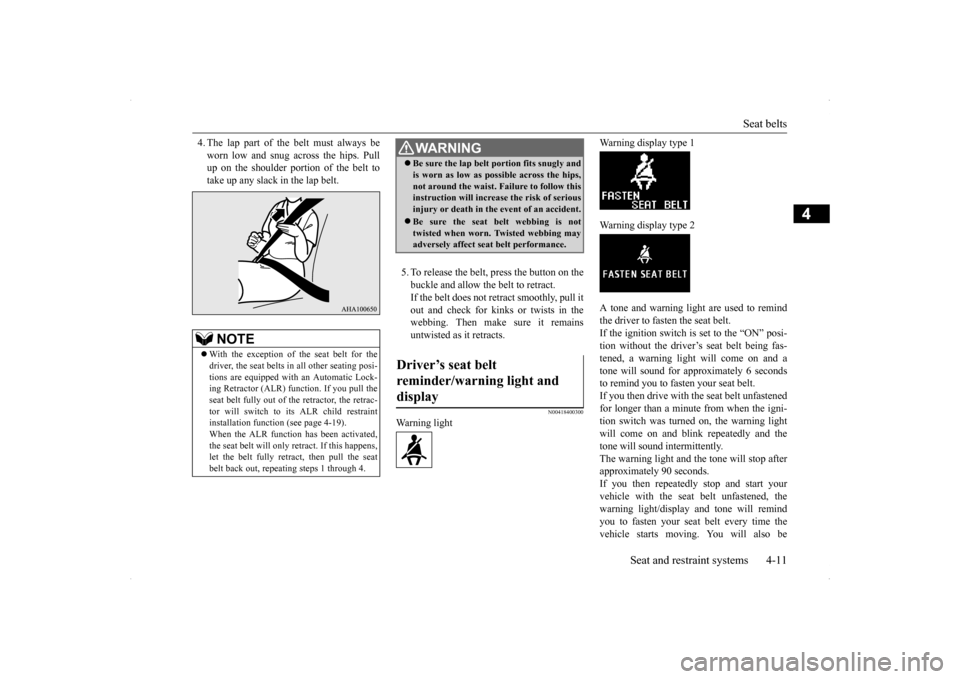
Warning display type 1 Warning display type 2 A tone and warning light are used to remind the driver to fasten the seat belt.If the ignition switch is set to the “ON” posi- tion without the driver’s seat belt being fas- tened, a warning light will come on and atone will sound for approximately 6 seconds to remind you to fasten your seat belt. If you then drive with
the seat belt unfastened
for longer than a minute from when the igni- tion switch was turned on, the warning light will come on and blink repeatedly and thetone will sound intermittently.The warning light and the tone will stop after approximately 90 seconds. If you then repeatedly stop and start yourvehicle with the seat belt unfastened, the warning light/display and tone will remind you to fasten your seat belt every time thevehicle starts moving. You will also be
NOTE
With the exception of the seat belt for the driver, the seat belts in all other seating posi- tions are equipped with an Automatic Lock- ing Retractor (ALR) function. If you pull theseat belt fully out of the retractor, the retrac- tor will switch to its ALR child restraint installation function (see page 4-19).When the ALR function has been activated, the seat belt will only retract. If this happens, let the belt fully retract, then pull the seatbelt back out, repeating steps 1 through 4.
WA R N I N G Be sure the lap belt portion fits snugly and is worn as low as possible across the hips, not around the waist. Failure to follow this instruction will increase the risk of serious injury or death in the
event of an accident.
Be sure the seat belt webbing is not twisted when worn. Twisted webbing mayadversely affect seat belt performance.
Driver’s seat belt reminder/warning light and display
Page 44 of 434
Child restraint systems
Seat and restraint systems 4-15
4
All children should be properly restrained in a restraint device that offers the maximum protection for their size and age. Be sure to check local, state, or provincialrequirements for child size and age that may vary from the recommendations listed below. Children less than 1 year old and children less than 20 pounds (9 kg) MUST ride in a rear-facing child safety seat that MUSTONLY be used in the rear seat. Children older than 1
year of age and who
weigh less than 40 pounds (18 kg) or whoare less than 40 inches (100 cm) tall must be in a forward-facing restraint used only in the rear seat. Children who weigh more than 40 pounds (18 kg) or who are more than 40 inches (100 cm) tall, regardless of age, shoulduse a suitable child seat or a booster seat (including a booster cushion) in the rear seat until the vehicle’s lap/shoulder beltfits them properly.
Guidelines for child restraint system selection
WA R N I N G All children must be seated in the rear seat, and properly restrained. Accident statistics show that children of all sizes and ages are safer when properly restrained in the rear seat, rather than inthe front seat. Any child who is too large to use a child restraint system should ride in the rear seat and wear the lap and shoulder belt properly. The shoulder belt must be posi-tioned over the shoulder and across the chest, not across their neck, and with the lap belt positioned low on the child’s hips,not across their stomach. If necessary, a booster seat (including a booster cushion) should be used to help achieve a properseat belt fit. Follow the booster seat (including a booster cushion) manufac- turer’s instructions. Only use a boosterseat (including a booster cushion) that is certified as complying with Federal Motor Vehicle Safety Standards or Motor VehicleRestraint Systems and Booster Cushions Safety Regulations.
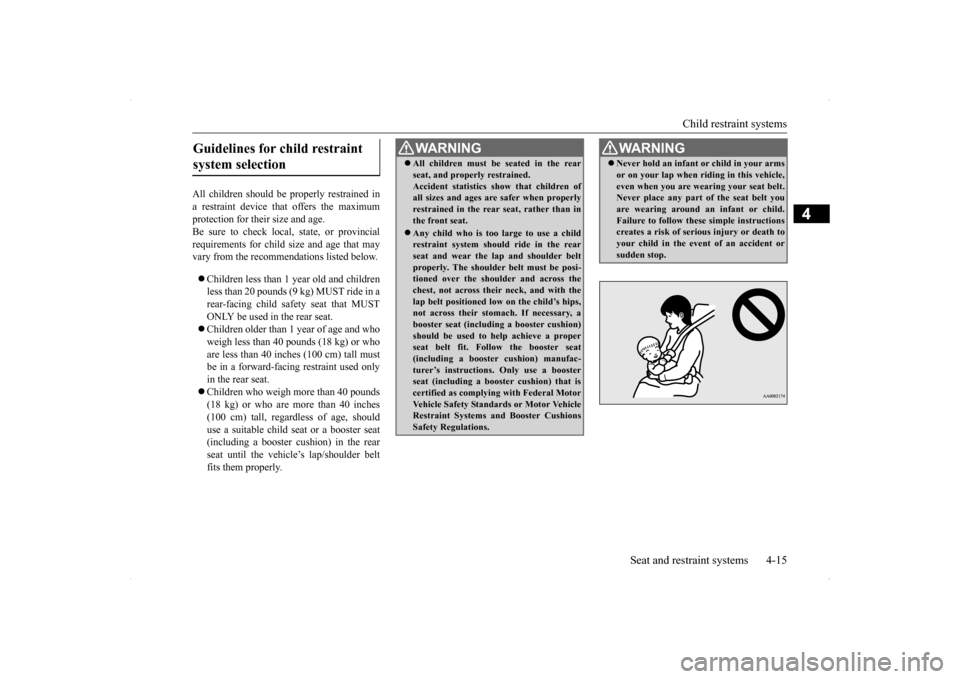
WA R N I N G Never hold an infant or child in your arms or on your lap when riding in this vehicle, even when you are wearing your seat belt. Never place any part of the seat belt you are wearing around an infant or child.Failure to follow these simple instructions creates a risk of serious injury or death to your child in the event of an accident orsudden stop.
Page 51 of 434
Supplemental Restraint System (SRS) - airbag 4-22 Seat and restraint systems
4
Regularly check your seat belt buckles and their release mechanisms for positive engage- ment and release of the latch plate. Check the retractors for automatic locking when in theAutomatic Locking Retractor function. The entire seat belt assembly should be replaced if the webbing shows any obvious cuts, tears, increase in thickness in any sec-tion of the webbing from broken fibers, or severe fading from sunlight. All of these con- ditions indicate a weakening of the belt,which may adversely affect seat belt perfor-mance in an accident.
N00407701720
This vehicle is equipped with a SupplementalRestraint System (SRS), which includes air-bags for the driver and passengers.
The SRS front airbags are designed to supple- ment the primary protection of the driver and front passenger seat belt systems by provid- ing those occupants with protection againsthead and chest injuries in certain moderate to severe frontal collisions. The SRS front airbags, together with sensorsat the front of the vehicle and sensors attached to the front seats, form an advanced airbag system. The SRS driver’s knee airbag is designed to supplement the primary protection of thedriver’s seat belt system. It can reduce the forward movement of the driver’s lower legs and provide increased overall body protectionin certain moderate to severe frontal colli- sions. The SRS side airbags (if so equipped) and the curtain airbags (if so equipped) are alsodesigned to supplement the seat belts. The SRS side airbags provide the driver and front passenger with protection against chest inju-ries by deploying the bag on the side impacted in moderate to severe side impact collisions. The SRS curtain airbags providethe driver and passengers on the front seat and rear outboard seat with protection against head injuries by deploying a bag on the sideimpacted in moderate to severe side impact collisions.
The SRS airbags are NOT
a substitute for use
of the seat belts. For maximum protection in all types of accidents, seat belts must ALWAYS be worn by everyone who drives orrides in this vehicle (with infants and small children in an appropriate child restraint sys- tem in the rear seat, and older children buck-led in the rear seat). Refer to “Child restraint systems” on page 4-14.
WA R N I N G Do not attempt to repair or replace any part of the seat belt assemblies. This work should be done by an authorized Mitsubishi Motors dealer. Failure to havean authorized Mitsubishi Motors dealer perform the work could reduce the effec- tiveness of the belts and could result in aserious injury or death in an accident.
Supplemental Restraint Sys- tem (SRS) - airbag
WA R N I N G IT IS VERY IMPORTANT TO ALWAYS WEAR YOUR SEAT BELT PROPERLY EVEN WITH AN AIRBAG.• Seat belts help keep the driver and pas-sengers properly positioned. This reduces the risk of injury in all collisions,and reduces the risk of serious injuries or death when the airbags inflate. During sudden braking just before a col-lision, an unrestrained or improperly restrained driver or passengers can move forward into direct contact with, orwithin close proximity to, the airbag when it begins to inflate. The beginning stage of airbag inflation isthe most forceful and can cause serious injuries or death if the occupant comes in contact with the airbag at this time. • Seat belts reduce the risk of injury inrollovers, rear impact collisions, and in lower-speed frontal collisions, because the airbags are not designed to inflate inthose situations.
Page 57 of 434
Supplemental Restraint System (SRS) - airbag 4-28 Seat and restraint systems
4
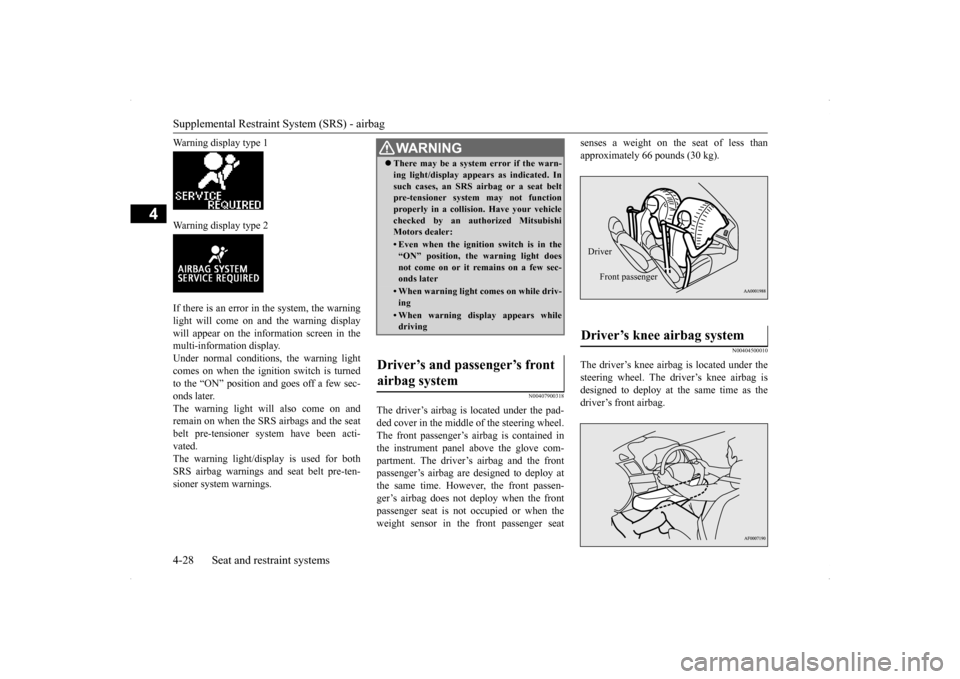
Warning display type 1 Warning display type 2If there is an error in the system, the warning light will come on and the warning displaywill appear on the information screen in the multi-information display. Under normal conditions, the warning lightcomes on when the ignition switch is turned to the “ON” position and goes off a few sec- onds later.The warning light will also come on and remain on when the SRS airbags and the seat belt pre-tensioner system have been acti-vated.The warning light/display is used for both SRS airbag warnings and seat belt pre-ten- sioner system warnings.
N00407900318
The driver’s airbag is located under the pad-ded cover in the middle of the steering wheel. The front passenger’s airbag is contained in the instrument panel above the glove com-partment. The driver’s airbag and the front passenger’s airbag are designed to deploy at the same time. However, the front passen-ger’s airbag does not deploy when the front passenger seat is not occupied or when the weight sensor in the front passenger seat
senses a weight on the seat of less than approximately 66 pounds (30 kg).
N00404500010
The driver’s knee airbag
is located under the
steering wheel. The driver’s knee airbag isdesigned to deploy at the same time as the driver’s front airbag.
WA R N I N G There may be a system error if the warn- ing light/display appears as indicated. In such cases, an SRS airbag or a seat belt pre-tensioner system may not function properly in a collision. Have your vehiclechecked by an authorized Mitsubishi Motors dealer:• Even when the ignition switch is in the“ON” position, the warning light does not come on or it remains on a few sec-onds later• When warning light comes on while driv-ing• When warning display appears whiledriving
Driver’s and passenger’s front airbag system
Driver’s knee airbag system Driver
Front passenger
Page 79 of 434
Free-hand Advanced Security Transmitter (F.A.S.T.-key) (if so equipped) 5-12 Features and controls
5
7. Place the remote control transmitter in the remote control transmitter case, then securely close the remote control trans- mitter case.8. Check the keyless entry system to see that it works.
N00503100052
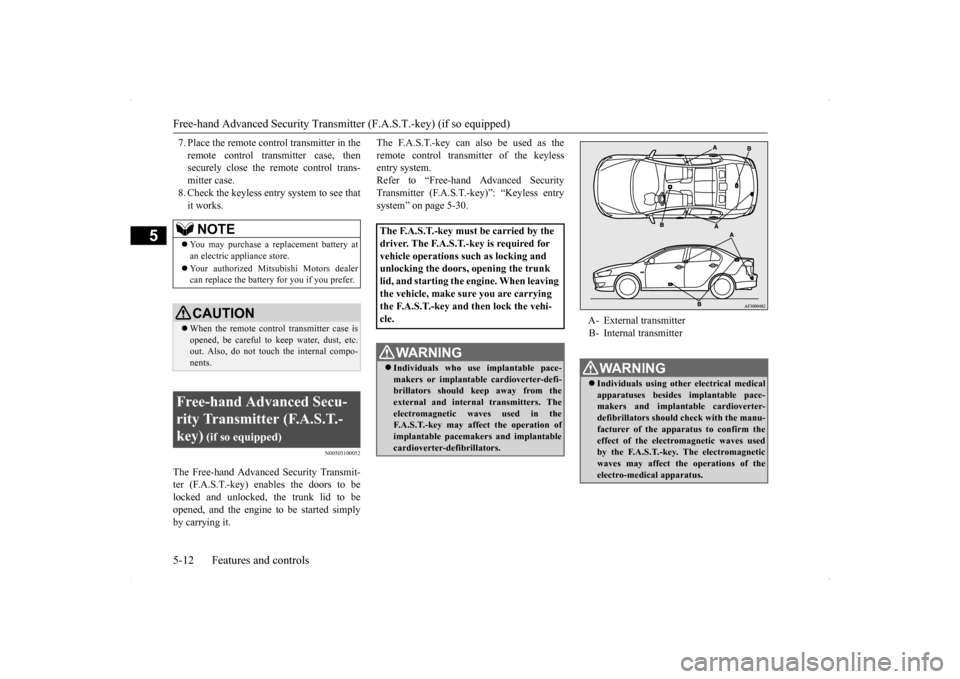
The Free-hand Advanced Security Transmit- ter (F.A.S.T.-key) enables the doors to be locked and unlocked, the trunk lid to be opened, and the engine to be started simplyby carrying it.
The F.A.S.T.-key can also be used as the remote control transmitter of the keyless entry system. Refer to “Free-hand Advanced SecurityTransmitter (F.A.S.T.-key)”: “Keyless entry system” on page 5-30.
NOTE
You may purchase a replacement battery at an electric appliance store. Your authorized Mitsubishi Motors dealer can replace the battery for you if you prefer.CAUTION When the remote control transmitter case is opened, be careful to keep water, dust, etc. out. Also, do not touch the internal compo-nents.
Free-hand Advanced Secu- rity Transmitter (F.A.S.T.-key)
(if so equipped)
The F.A.S.T.-key must be carried by the driver. The F.A.S.T.-key is required for vehicle operations such as locking and unlocking the doors, opening the trunk lid, and starting the engine. When leaving the vehicle, make sure you are carrying the F.A.S.T.-key and then lock the vehi-cle.
WA R N I N G Individuals who use implantable pace- makers or implantable cardioverter-defi- brillators should keep away from the external and internal
transmitters. The
electromagnetic waves used in the F.A.S.T.-key may affect the operation of implantable pacemakers and implantablecardioverter-defibrillators.
A- External transmitter B- Internal transmitterWA R N I N G Individuals using other electrical medical apparatuses besides implantable pace-makers and implantable cardioverter- defibrillators should check with the manu- facturer of the apparatus to confirm the effect of the electromagnetic waves used by the F.A.S.T.-key. The electromagneticwaves may affect the operations of the electro-medical apparatus.
Page 85 of 434
Free-hand Advanced Security Transmitter (F.A.S.T.-key) (if so equipped) 5-18 Features and controls
5
N00503500160
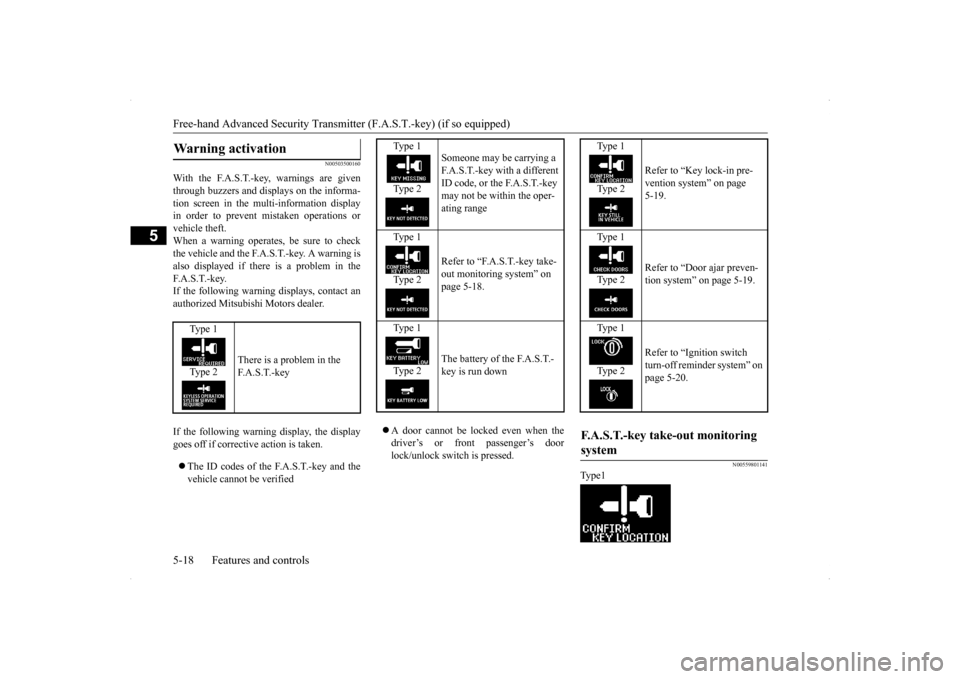
With the F.A.S.T.-key, warnings are given through buzzers and displays on the informa-tion screen in the multi-information display in order to prevent mistaken operations or vehicle theft.When a warning operates, be sure to check the vehicle and the F.A.S.T.-key. A warning is also displayed if there is a problem in theF. A . S . T. - k e y.If the following warning displays, contact an authorized Mitsubishi Motors dealer. If the following warning display, the display goes off if corrective action is taken. The ID codes of the F.A.S.T.-key and the vehicle cannot be verified
A door cannot be locked even when the driver’s or front passenger’s door lock/unlock switch is pressed.
N00559801141
Ty p e 1
Warning activation
Type 1 Type 2
There is a problem in the F. A . S . T. - k e y
Type 1 Type 2
Someone may be carrying a F.A.S.T.-key with a different ID code, or the F.A.S.T.-key may not be within the oper- ating range
Type 1 Type 2
Refer to “F.A.S.T.-key take- out monitoring system” on page 5-18.
Type 1 Type 2
The battery of the F.A.S.T.- key is run down
Type 1 Type 2
Refer to “Key lock-in pre- vention system” on page 5-19.
Type 1 Type 2
Refer to “Door ajar preven- tion system” on page 5-19.
Type 1 Type 2
Refer to “Ignition switch turn-off reminder system” on page 5-20.
F.A.S.T.-key take-out monitoring system
Page 90 of 434
Free-hand Advanced Security Transmit
ter (F.A.S.T.-key) (if so equipped)
Features and controls 5-23
5
N00514800020 N00515200148
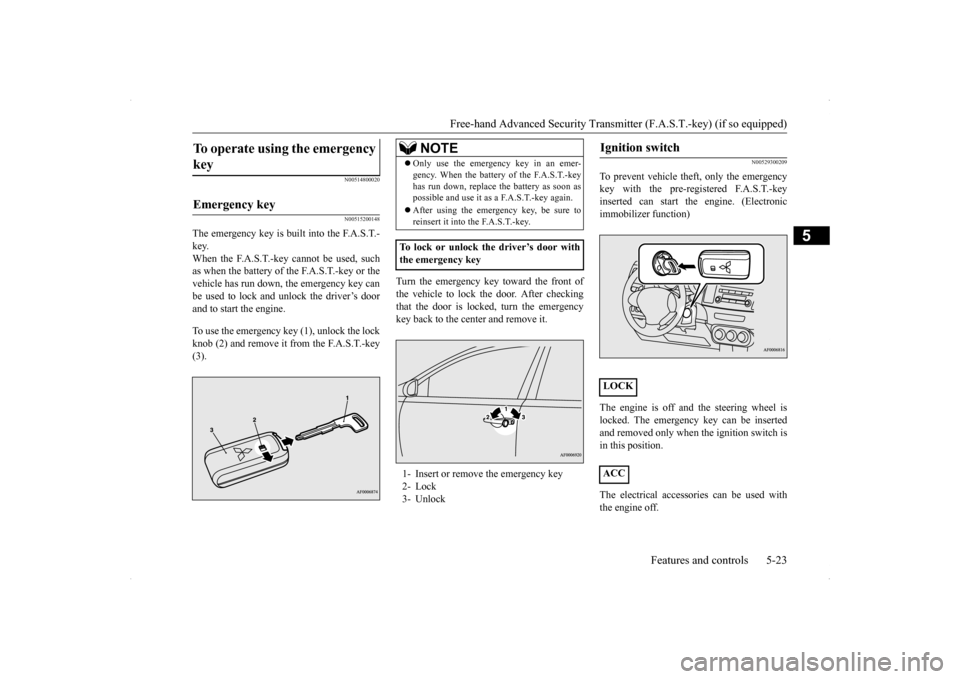
The emergency key is built into the F.A.S.T.- key. When the F.A.S.T.-key cannot be used, such as when the battery of the F.A.S.T.-key or thevehicle has run down, the emergency key canbe used to lock and unlock the driver’s door and to start the engine. To use the emergency key (1), unlock the lock knob (2) and remove it from the F.A.S.T.-key(3).
Turn the emergency key toward the front of the vehicle to lock the door. After checkingthat the door is locked, turn the emergency key back to the center and remove it.
N00529300209
To prevent vehicle theft, only the emergency key with the pre-registered F.A.S.T.-keyinserted can start the engine. (Electronic immobilizer function) The engine is off and the steering wheel is locked. The emergency key can be inserted and removed only when the ignition switch is in this position. The electrical accessories can be used with the engine off.
To operate using the emergency key
Emergency key
NOTE
Only use the emergency key in an emer- gency. When the battery of the F.A.S.T.-key has run down, replace the battery as soon as possible and use it as a F.A.S.T.-key again. After using the emergency key, be sure to reinsert it into the F.A.S.T.-key.
To lock or unlock the driver’s door with the emergency key 1- Insert or remove the emergency key 2- Lock3- Unlock
Ignition switch
LOCK ACC
Page 102 of 434
Free-hand Advanced Security Transmit
ter (F.A.S.T.-key) (if so equipped)
Features and controls 5-35
5
This device may not cause harmful inter- ference. This device must accept any interference received, including interference that maycause undesired operation.
N00561700081
1. Before replacing the battery, remove static electricity from your body by touching a metal grounded object.
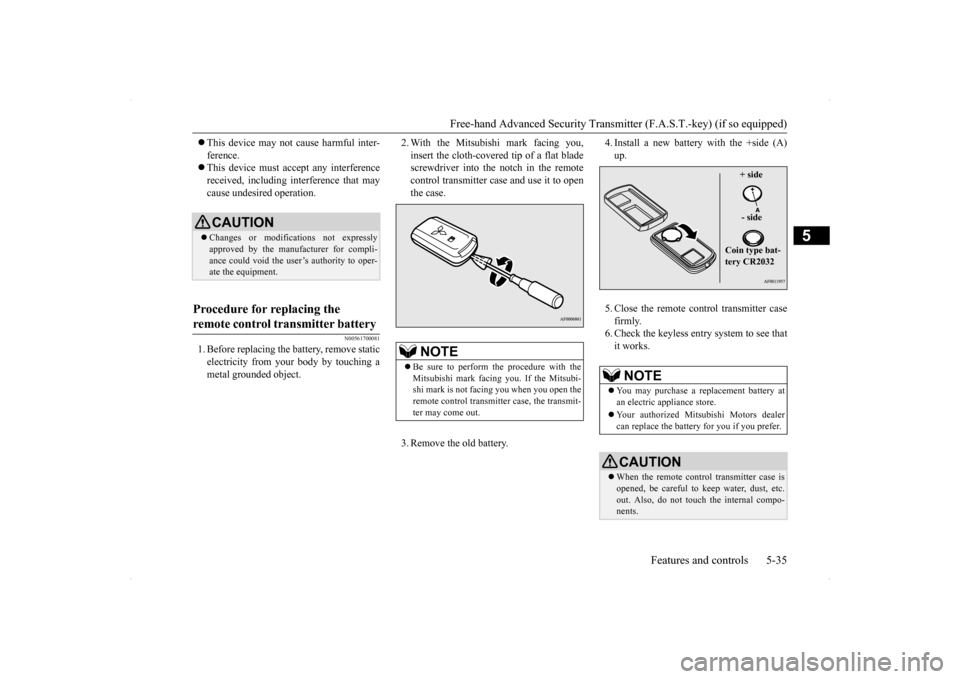
2. With the Mitsubishi mark facing you, insert the cloth-covered tip of a flat blade screwdriver into the notch in the remote control transmitter case and use it to openthe case. 3. Remove the old battery.
4. Install a new battery with the +side (A) up. 5. Close the remote control transmitter case firmly. 6. Check the keyless entry system to see thatit works.
CAUTION Changes or modifications not expressly approved by the manufacturer for compli- ance could void the user’s authority to oper-ate the equipment.
Procedure for replacing the remote control transmitter battery
NOTE
Be sure to perform the procedure with the Mitsubishi mark facing you. If the Mitsubi- shi mark is not facing you when you open theremote control transmitter case, the transmit- ter may come out.
NOTE
You may purchase a replacement battery at an electric appliance store. Your authorized Mitsubishi Motors dealer can replace the battery for you if you prefer.CAUTION When the remote control transmitter case is opened, be careful to keep water, dust, etc. out. Also, do not touch the internal compo- nents.
+ side - side
Coin type bat- tery CR2032