flat tire MITSUBISHI LANCER SPORTBACK 2014 8.G Owner's Manual
[x] Cancel search | Manufacturer: MITSUBISHI, Model Year: 2014, Model line: LANCER SPORTBACK, Model: MITSUBISHI LANCER SPORTBACK 2014 8.GPages: 422, PDF Size: 55.11 MB
Page 366 of 422
Tires
Vehicle care and maintenance 9-17
9
N00939201563
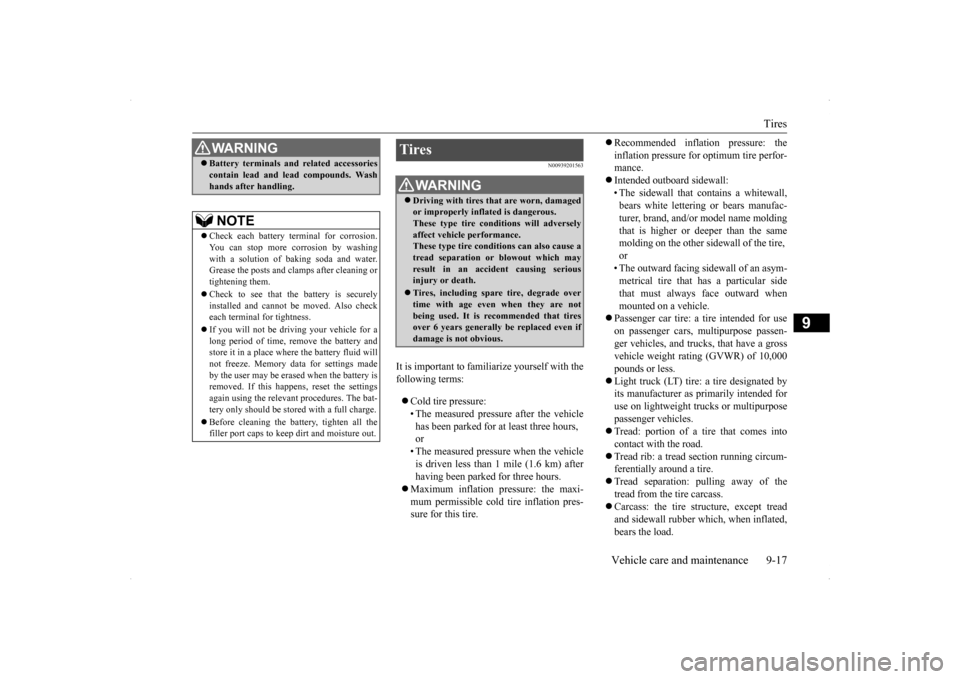
It is important to fami
liarize yourself with the
following terms: Cold tire pressure: • The measured pressure after the vehiclehas been parked for at least three hours, or • The measured pressure when the vehicleis driven less than 1 mile (1.6 km) after having been parked for three hours.
Maximum inflation pressure: the maxi- mum permissible cold tire inflation pres- sure for this tire.
Recommended inflation pressure: the inflation pressure for optimum tire perfor- mance. Intended outboard sidewall: • The sidewall that contains a whitewall, bears white lettering or bears manufac- turer, brand, and/or model name moldingthat is higher or deeper than the same molding on the other sidewall of the tire, or• The outward facing sidewall of an asym-metrical tire that has a particular side that must always face outward when mounted on a vehicle.
Passenger car tire: a tire intended for use on passenger cars, multipurpose passen- ger vehicles, and trucks, that have a grossvehicle weight rating (GVWR) of 10,000 pounds or less. Light truck (LT) tire: a tire designated by its manufacturer as primarily intended for use on lightweight trucks or multipurpose passenger vehicles. Tread: portion of a tire that comes into contact with the road. Tread rib: a tread section running circum- ferentially around a tire. Tread separation: pulling away of the tread from the tire carcass. Carcass: the tire structure, except tread and sidewall rubber which, when inflated, bears the load.
Battery terminals and related accessories contain lead and lead compounds. Wash hands after handling. NOTE
Check each battery terminal for corrosion. You can stop more corrosion by washing with a solution of baking soda and water.Grease the posts and clamps after cleaning or tightening them. Check to see that the battery is securely installed and cannot be moved. Also check each terminal for tightness. If you will not be driving your vehicle for a long period of time, remove the battery andstore it in a place where the battery fluid will not freeze. Memory data for settings made by the user may be erased when the battery isremoved. If this happens, reset the settings again using the relevant procedures. The bat- tery only should be stored with a full charge. Before cleaning the battery, tighten all the filler port caps to keep dirt and moisture out.WA R N I N G
Tires
WA R N I N G Driving with tires that are worn, damaged or improperly inflated is dangerous. These type tire conditions will adversely affect vehicle performance.These type tire conditions can also cause a tread separation or blowout which may result in an accident causing seriousinjury or death. Tires, including spare tire, degrade over time with age even when they are not being used. It is recommended that tires over 6 years generally be replaced even ifdamage is not obvious.
BK0200700US.bo
ok 17 ページ 2013年2月15日 金曜日 午後12時17分
Page 367 of 422

Tires 9-18 Vehicle care and maintenance
9
Sidewall: portion of a tire between the tread and bead. Section width: the linear distance between the exteriors of the sidewalls of aninflated tire, excluding elevations due to labeling, decoration, or protective bands. Bead: the part of the tire that is made of steel wires, wrapped or reinforced by ply cords and that is shaped to fit the rim. Ply: a layer of rubber-coated parallel cords. Cord: the strands forming the plies in the tire. Rim: a metal support for a tire or a tire and tube assembly upon which the tire beads are seated. Rim diameter: nominal diameter of the bead seat. Groove: the space between two adjacent tread ribs.
EXAMPLE:P215/65R15Tire Markings Size Designation P
Passenger car tire size based on U.S.A. design standards
215
Section width in millimeters (mm.)
65
Aspect ratio in percent (%) Ratio of section height to sec- tion width of tire.
R
Construction code •“R” means radial construc- tion. •“D” means diagonal or biasconstruction.
15 Rim diameter in inches (in)
NOTE
European/Japanese metric tire sizing is based on European/Jap- anese design standards. Tiresdesigned to these standards have the tire size molded into the sidewall beginning with the sec-tion width. The letter “P” is absent from this tire size desig- nation. Example: 215/65R1596H.
BK0200700US.bo
ok 18 ページ 2013年2月15日 金曜日 午後12時17分
Page 370 of 422
Tires
Vehicle care and maintenance 9-21
9
N00939301900
Proper tire inflation pressure is essential for the safe and satisfactory operation of yourvehicle. The wrong tire pressure will cause problems in three major areas: Safety Too little pressure increases flexing in thetire and can cause tire failure. Too muchpressure can cause a tire to lose its ability to cushion shock. Objects on the road and potholes could then cause tire damage thatmay result in tire failure. Economy The wrong tire pressure can cause unevenwear patterns in the tire tread. These abnormal wear patterns will reduce the tread life, and the tire will have to bereplaced sooner. Too little pressure also makes it harder for the tire to roll, and this uses up more fuel. Ride comfort and vehicle stability The superior riding experience built into your vehicle partly depends on the correcttire pressure. Too much pressure gives an uncomfortable and jarring ride. Too little pressure feels as if your vehicle is slow torespond. Unequal tire pressures can make steering your vehicle uneven and unpredictable.
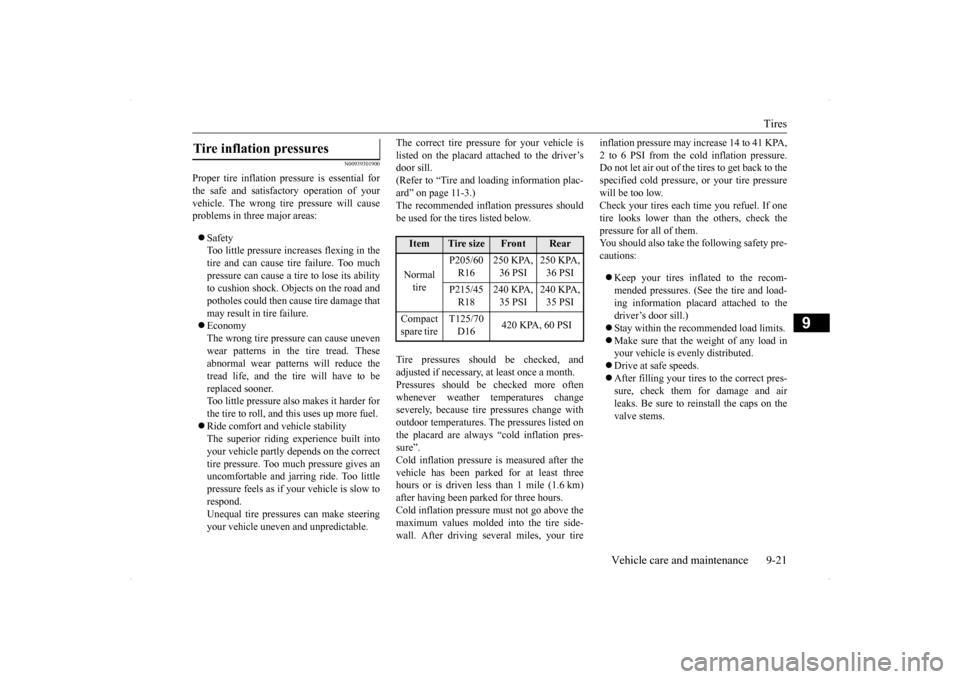
The correct tire pressure for your vehicle is listed on the placard attached to the driver’s door sill. (Refer to “Tire and loading information plac-ard” on page 11-3.) The recommended inflation pressures should be used for the tires listed below. Tire pressures should be checked, and adjusted if necessary, at least once a month. Pressures should be checked more oftenwhenever weather temperatures change severely, because tire pressures change with outdoor temperatures. The pressures listed onthe placard are always “cold inflation pres- sure”. Cold inflation pressure is measured after thevehicle has been parked for at least three hours or is driven less than 1 mile (1.6 km) after having been parked for three hours.Cold inflation pressure must not go above the maximum values molded into the tire side- wall. After driving several miles, your tire
inflation pressure may increase 14 to 41 KPA, 2 to 6 PSI from the cold inflation pressure. Do not let air out of the tires to get back to the specified cold pressure, or your tire pressurewill be too low. Check your tires each time you refuel. If one tire looks lower than the others, check thepressure for all of them. You should also take the following safety pre- cautions: Keep your tires inflated to the recom- mended pressures. (See the tire and load-ing information placard attached to the driver’s door sill.) Stay within the recommended load limits. Make sure that the weight of any load in your vehicle is evenly distributed. Drive at safe speeds. After filling your tires to the correct pres- sure, check them for damage and air leaks. Be sure to reinstall the caps on thevalve stems.
Tire inflation pressures
Item
Tire size
Front
Rear
Normal tire
P205/60 R16
250 KPA, 36 PSI
250 KPA, 36 PSI
P215/45 R18
240 KPA, 35 PSI
240 KPA, 35 PSI
Compact spare tire
T125/70 D16
420 KPA, 60 PSI
BK0200700US.bo
ok 21 ページ 2013年2月15日 金曜日 午後12時17分
Page 403 of 422

Consumer information (For vehicles sold in U.S.A.) 10-2 Customer assistance/Reporting Safety Defects
10
N01047100100
This information is provided in compliance with the requirements of the National High-way Traffic Safety Administration, Depart- ment of Transportation. It provides the purchasers and/or prospective purchaserswith information on reporting safety defects. DOT quality grades - All passenger vehicle tires must conform to Federal Safety Require-ments in addition to these grades. The spe- cific grade rating in each grade category is shown on the side wall of the tires on yourvehicle. The treadwear grade is a comparative rating based on the wear rate of the tire when tested under controlled conditions on a specified government test course. For example, a tiregraded 150 would wear one and one-half (11/2) times as well on the government course
as a tire graded 100. The relative performance of tires depends upon the actual conditions of
their use, however, and may depart signifi- cantly from the norm due to variations in driving habits, service practices and differ- ences in road characteristics and climate. The traction grades, from highest to lowest, are AA, A, B and C. Those grades representthe tire’s ability to stop on wet pavement asmeasured under controlled conditions on specified government test surfaces of asphalt and concrete. A tire marked C may have poortraction performance. The temperature grades are A (the highest), B and C, representing the tire’s resistance to thegeneration of heat and its ability to dissipate heat when tested under controlled conditions on a specified indoor laboratory test wheel.Sustained high temperature can cause the
material of the tire to degenerate and reduce tire life, and excessive temperature can lead to sudden tire failure. The grade C corre- sponds to a level of performance which allpassenger car tires must meet under the Fed- eral Motor Vehicle Safety Standard No. 109. Grades B and A represent higher levels ofperformance on the laboratory test wheel than the minimum required by law.
N01047201485
If you believe that your vehicle has a defect which could cause a crash or could cause injury or death, you should immediately inform the National Highway Traffic SafetyAdministration (NHTSA) in addi- tion to notifying Mitsubishi Motors Corporation.
Consumer information (For vehicles sold in U.S.A.) Uniform tire quality grading Treadwear
Traction AA, A, B, C
WA R N I N G The traction grade assigned to this tire is based on straight-ahead braking traction tests, and does not include acceleration, cornering, hydroplaning, or peak tractioncharacteristics.
Temperature A, B, C
WA R N I N G The temperature grade for this tire is established for a tire that is properly inflated and not overloaded. Excessive speed, underinflation, or excessive load-ing, either separately or in combination, can cause heat buildup and possible tire failure.
Reporting Safety Defects
BK0200700US.bo
ok 2 ページ 2013年2月15日 金曜日 午後12時17分
Page 420 of 422

Alphabetical index
12-5
12
T
Tail and stop lights
Bulb capacity
................
.................
9-33
Replacement
.................
.................
9-43
Tank capacity
..............................
3-4
, 11-6
Theft-alarm system
System
......................
.....................
5-41
Time Setting
..................
.....................
7-56
Tire pressure monitoring system
.........
5-100
Warning light/display
....................
5-101
Tires
..........................
........................
9-17
How to change a tire
.........................
8-6
Inflation pressure
............................
9-21
Maintenance
..................
.................
9-22
Quality grading
...............................
10-2
Replacing tires and wheels
...............
9-22
Rotation
....................
.....................
9-22
Size (tire and wheel)
.......................
11-5
Snow tires
.....................
.................
9-23
Tire and loading information placard
.6-7
,
11-3 Tire chains
....................
.................
9-24
Tread wear indicators
......................
9-22
Tissue holder
.....................
...............
5-189
Tools
.........................
..........................
8-6
Storage
.........................
...................
8-5
Towing
......................
........................
8-13
Trailer towing
....................
.................
6-11
Turbocharger operation
.......................
5-59
Turn signal lights
Bulb capacity
..................
...............
9-33
Indicators
....................
.................
5-141
Lever
......................
.....................
5-150
Replacement
...................
...............
9-40
Twin Clutch SST
Fluid
....................
.................
9-11
, 11-6
Gearshift lever operation
.................
5-70
Gearshift lever position display
........
5-72
Manual shift
....................
...............
5-76
Manual shift display
.......................
5-79
Twin Clutch SST control mode display
....
5-76Twin Clutch SST control mode switch
.....
5-76 Warning display
.............................
5-73
Twin Clutch SST (Sportronic Shift Transmission)
...................
...............
5-70
U
USB input terminal
............................
5-180
How to connect an iPod
.................
5-181
USB input terminal device
How to connect a USB memory
......
5-180
V
Vanity mirror
...................
.................
5-183
Vehicle care precautions
.....................
9-48
Vehicle dimensions
.............................
11-4
Vehicle labeling
.................
.................
11-2
Vehicle preparation before driving
..........
6-3
Vehicle weights
.................
.................
11-4
Vents
............................
.......................
7-2
W
Warning lights
...................
...............
5-142
Washer
Fluid
..................
...................
9-12
, 11-6
Rear window washer
.....................
5-156
Switch
......................
...................
5-155
Waxing
......................
........................
9-50
Weights
........................
.....................
11-4
Wheel
Covers
......................
.....................
8-12
Specification
.................
.................
11-5
Wiper
Rain sensor
.............
5-153
, 5-154
, 5-155
Rear window wiper
.......................
5-156
Switch
......................
...................
5-152
Wiper blades
.................
.................
9-25
BK0200700US.bo
ok 5 ページ 2013年2月15日 金曜日 午後12時17分