Temperature MITSUBISHI MIRAGE 2015 6.G Owners Manual
[x] Cancel search | Manufacturer: MITSUBISHI, Model Year: 2015, Model line: MIRAGE, Model: MITSUBISHI MIRAGE 2015 6.GPages: 300, PDF Size: 43.44 MB
Page 15 of 300
If this problem occurs... 2-6 Quick index
2
Cannot shift the selector lever from the “P” (PARK) position.(for vehicles with continuously variable transmission (CVT))
Shift the selector lever while pressing the brake pedal. Check that the ignition switch
or the operation mode is in ON.
P. 5-39
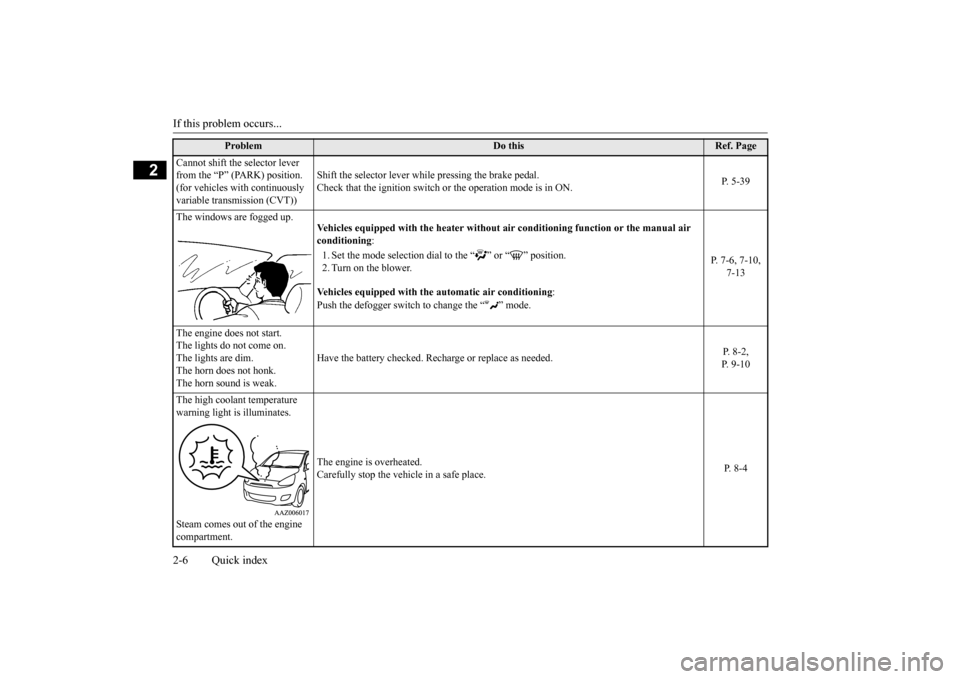
The windows are fogged up.
Vehicles equipped with the he
ater without air conditioning
function or th
e manual air
conditioning
:
1. Set the mode selection dial
to the “ ” or “ ” position.
2. Turn on the blower. Vehicles equipped with th
e automatic air conditioning
:
Push the defogger switch
to change the “ ” mode.
P. 7-6, 7-10,
7-13
The engine does not start. The lights do not come on. The lights are dim. The horn does not honk.The horn sound is weak.
Have the battery checked. Rech
arge or replace as needed.
P. 8-2, P. 9-10
The high coolant temperature warning light is illuminates. Steam comes out of the engine compartment.
The engine is overheated. Carefully stop the vehicle in a safe place.
P. 8-4
Problem
Do this
Ref. Page
BK0212400US.book 6 ページ 2014年4月1日 火曜日 午後2時21分
Page 30 of 300
Rear seats
Seat and restraint systems 4-5
4
N00402500221
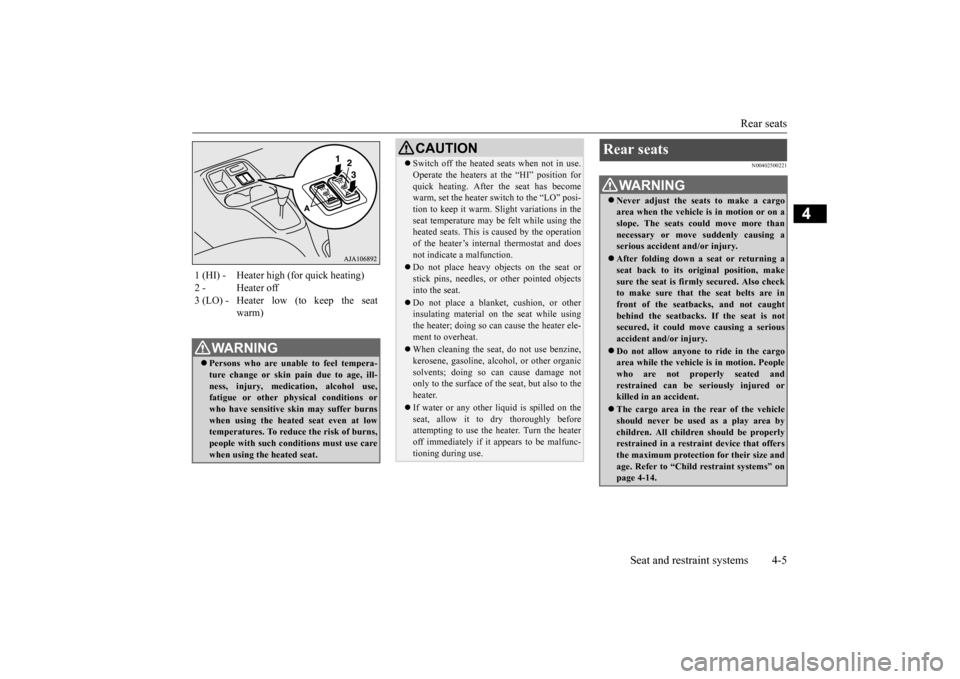
1 (HI) - Heater high (for quick heating) 2 - Heater off 3 (LO) - Heater low (to keep the seat
warm)
WA R N I N G Persons who are unable to feel tempera- ture change or skin
pain due to age, ill-
ness, injury, medication, alcohol use, fatigue or other phys
ical conditions or
who have sensitive sk
in may suffer burns
when using the heated seat even at low temperatures. To reduce the risk of burns,people with such conditions must use care when using the heated seat.
CAUTION Switch off the heated seats when not in use. Operate the heaters at the “HI” position forquick heating. After the seat has becomewarm, set the heater switch to the “LO” posi- tion to keep it warm. S
light variations in the
seat temperature may be
felt while using the
heated seats. This is caused by the operation of the heater’s internal thermostat and does not indicate a malfunction. Do not place heavy obj
ects on the seat or
stick pins, needles, or
other pointed objects
into the seat. Do not place a blanket,
cushion, or other
insulating material on
the seat while using
the heater; doing so can
cause the heater ele-
ment to overheat. When cleaning the seat, do not use benzine, kerosene, gasoline, alc
ohol, or other organic
solvents; doing so can cause damage not only to the surface of the seat, but also to the heater. If water or any other li
quid is spilled on the
seat, allow it to dry thoroughly beforeattempting to use the heater. Turn the heater off immediately if it
appears to be malfunc-
tioning during use.
Rear seats
WA R N I N G Never adjust the seats to make a cargo area when the vehicle is
in motion or on a
slope. The seats co
uld move more than
necessary or move suddenly causing a serious accident
and/or injury.
After folding down a
seat or returning a
seat back to its or
iginal position, make
sure the seat is firmly secured. Also check to make sure that the seat belts are in front of the seatbacks, and not caughtbehind the seatbacks. If the seat is not secured, it could move causing a serious accident and/or injury. Do not allow anyone to ride in the cargo area while the vehicle
is in motion. People
who are not properly seated and restrained can be seriously injured or killed in an accident. The cargo area in the
rear of the vehicle
should never be used as a play area bychildren. All children should be properly restrained in a restra
int device that offers
the maximum protection for their size andage. Refer to “Child restraint systems” on page 4-14.
BK0212400US.book 5 ページ 2014年4月1日 火曜日 午後2時21分
Page 64 of 300
![MITSUBISHI MIRAGE 2015 6.G Owners Manual Electronic immobilizer (Ant
i-theft starting system)
Features and controls 5-3
5
N00509100780
[For vehicles equipped with the Free-hand Advanced Security Transmitter (F.A.S.T.-key)] For information o](/img/19/7511/w960_7511-63.png "MITSUBISHI MIRAGE 2015 6.G Owners Manual Electronic immobilizer (Ant
i-theft starting system)
Features and controls 5-3
5
N00509100780
[For vehicles equipped with the Free-hand Advanced Security Transmitter (F.A.S.T.-key)] For information o")
Electronic immobilizer (Ant
i-theft starting system)
Features and controls 5-3
5
N00509100780
[For vehicles equipped with the Free-hand Advanced Security Transmitter (F.A.S.T.-key)] For information on operations for vehicles equipped with the Free-hand Advanced Secu-rity Transmitter (F.A
.S.T.-key), refer to
“Free-hand Advanced
Security Transmitter
(F.A.S.T.-key): Electr
onic immobilizer (Anti-
theft starting system)” on page 5-20. [Except for vehicles e
quipped with the Free-
hand Advanced Secu
rity Transmitter
(F.A.S.T.-key)]The electronic immobilizer is designed to sig- nificantly reduce the
possibility of vehicle
theft. The purpose of the system is to immo-bilize the vehicle if an invalid start is
1- F.A.S.T.-key
(with electronic immobilizer and key- less entry system function)
2- Emergency key3- Key number plate
NOTE
The keyless entry key and F.A.S.T.-key are a precision electr
onic device wi
th a built-in
signal transmitter. Please observe the follow- ing in order to prevent damage. • Do not leave where it may be exposed to heat caused by direct sunlight, such as on top of the dashboard. • Do not take the remote
control transmitter
apart. • Do not excessively bend the key or subject it to strong impacts. • Keep the remote control transmitter dry. • Keep away from magne
tic objects such as
key rings.
• Keep away from devi
ces that produce mag-
netism, such as audio systems, computersand televisions. • Keep away from device
s that emit strong
electromagnetic waves, such as cellularphones, wireless devices and high fre- quency equipment (i
ncluding medical
devices). • Do not clean with ultrasonic cleaners. • Do not leave the key where it may be exposed to high temperature or high humid- ity.
If you lose your key, to prevent the theft of the vehicle immediatel
y contact an autho-
rized Mitsubishi Motors dealer. If you notify an authorized Mitsubishi Motors dealer of the key number, they canmake a new key. The key number is stamped on the key number plate. Keep the key num- ber plate in a safe pl
ace separate from the
key itself. No keys other than those registered in advance can be used to start the engine. Refer to “Electronic immobilizer (Anti-theft starting system)” on page 5-3.Refer to “Free-hand Advanced Security Transmitter (F.A.S.T.-key): “Electronic immobilizer (Anti-thef
t starting system)” on
page 5-20.NOTE
When the theft-alarm is in the system opera- tional status, the alarm operates if a door orliftgate is opened after using the key, thedoor lock knob or the power door lock switch to unlock the vehicle. The system does not enter the preparation status if the keyless entry system or the F.A.S.T.-key was not used to lock the vehi-cle.
Electronic immobilizer (Anti-theft starting system)
NOTE
BK0212400US.book 3 ページ 2014年4月1日 火曜日 午後2時21分
Page 77 of 300
Free-hand Advanced
Security Transmitter (F.A.S
.T.-key) (if so equipped)
5-16 Features and controls
5
N00559900158
When the operation mode is in OFF, the F.A.S.T.-key is left in the passenger compart-ment, all the doors and the liftgate are closed, and someone tries to lock the vehicle by pressing the driver’s door switch or the lift-gate switch, the warning light blinks and the buzzer sounds for about
3 seconds as a warn-
ing, and the doors and the liftgate cannot belocked.
N00560000159
When the operation mode is in OFF, andsomeone tries to lock the vehicle by pressingthe driver’s door switch or the liftgate switch while one of the doors or the liftgate is not fully closed, the warning light blinks and thebuzzer sounds for about
3 seconds as a warn-
ing, and the doors and the liftgate cannot be locked.
N00560100150
When the operation m
ode is in any mode
other than OFF, all the doors and the liftgateare closed, and someone tries to lock the vehicle by pressing the driver’s door switch or the liftgate switch,
the warning light blinks
and the buzzer sounds fo
r about 3 seconds as
a warning, and the doors and the liftgate can- not be locked.
N00514601357
The operation mode ca
n be in any mode
to start the engine. The starter motor will be turning for up to approximately 15 seconds if the engine switch is released at once. Pressing the engine switch again while the starter motor is still turning will stop the starter motor. The starter motor will be turningfor up to approximately 30 seconds while the engine swit
ch is pressed.
If the engine does not start, wait for awhile and then attempt to start the engine again. Trying repeatedly with the starter motor still turning will damage the startermechanism. If the engine will not start because the bat- tery is weak or discharged, refer to“Jump-starting the engine” on page 8-2 for instructions. A longer warm up period will only con- sume extra fuel. The engine is warmed up enough for driv- ing when the low coolant temperatureindicator goes out. Refer to “Low coolant temperature indi- cator” on page 5-71.
NOTE
The F.A.S.T.-key take
-out monitoring system
does not function if the F.A.S.T.-key isremoved through a window without openinga door. This setting can be changed. See an authorized Mi
tsubishi Motors dealer
for details. The warning may display even if the F.A.S.T.-key is in the operating range for starting the engine a
nd changing the opera-
tion mode. The surrounding environment orelectromagnetic waves
may make it impossi-
ble to verify the ID codes of the F.A.S.T.-key and vehicle.
Key lock-in prevention system
Door ajar prevention system
Operation mode OFF reminder system
Starting and stopping the engine
Tips for starting
BK0212400US.book 16 ページ 2014年4月1日 火曜日 午後2時21分
Page 79 of 300
Free-hand Advanced
Security Transmitter (F.A.S
.T.-key) (if so equipped)
5-18 Features and controls
5
2. While depressing the brake pedal {contin- uously variable transmission (CVT)} orthe clutch pedal (manual transaxle), press the accelerator peda
l halfway and hold it
there, then crank th
e engine. Release the
accelerator pedal, immediately after the engine starts. 3. If the engine still will
not start, the engine
could be flooded with too much gasoline. While depressing the brake pedal (CVT) or the clutch pedal (manual transaxle), push the accelerator pedal all the way down and hold it there, then press theengine switch to crank the engine. If the engine does not start
after 5 to 6 seconds,
push the engine switch to stop crankingthe engine, and release the accelerator pedal. Put the opera
tion mode in OFF.
Wait a few seconds, and then press theengine switch to crank the engine again while depressing the brake pedal (CVT) or the clutch pedal (manual transaxle), butdo not push the accelerator pedal. If the engine fails to start, repeat these proce- dures. If the engine stil
l will not start, con-
tact your local Mitsubishi Motors dealer or a repair facility of your choice for assistance.
Startability of continuo
usly variable trans-
mission (CVT) vehicles with an ambient temperature of -4 °F (-20 °C) or lower
When the ambient temperature is -4 °F (-20 °C) or lower, it may not be possible to startfrom a standstill even wi
th the selector lever
in the “D” (DRIVE) or “R” (REVERSE) position.This phenomenon occurs because the trans- axle has not warmed up sufficiently; it does not indicate a problem.
If this occurs, place
the selector lever in the “P” (PARK) position and let the engine idle
for at least 10 minutes.
The transaxle will wa
rm up, and you will be
able to start normally. Do not leave the vehicle during warm-upoperation.
N00568200014
1. Stop the vehicle.2. Fully engage the parking brake while depressing the brake pedal. 3. On vehicles with
a manual transaxle,
press the engine switch to stop the engine, and then move the gearshift lever to the 1st (on a uphill) or “R” (Reverse) (on adownhill) position. On vehicles equippe
d with continuously
variable transmission (CVT), move theselector lever to the “P” (PARK) position, and then press the e
ngine switch to stop
the engine.
Stopping the engine
WA R N I N G Do not operate the en
gine switch while
driving except in an emergency. If the engine is stopped while driving, the brakeservomechanism will ce
ase to function and
braking efficiency will deteriorate. Also, the power steering system will not func-tion and it will require greater manual effort to operate the steering. This could result in a serious accident.
NOTE
If you have to bring the engine to an emer- gency stop while drivi
ng, press and hold the
engine switch for 3 seconds or more, or pressit quickly 3 times or
more. The engine will
stop and the operation mode will go to ACC. On vehicles equipped with continuously variable transmission (CVT), do not stop the engine with the selector
lever in any position
other than the “P” (PARK) position. If the engine is stopped with
the selector lever in
any position other than the “P” (PARK) posi-tion, the operation mode will go to ACC rather than OFF. Put the operation mode
in OFF after placing
the selector lever in the “P” (PARK) posi- tion.
BK0212400US.book 18 ページ 2014年4月1日 火曜日 午後2時21分
Page 97 of 300
![MITSUBISHI MIRAGE 2015 6.G Owners Manual Starting the engine 5-36 Features and controls
5
N00512601816
[For vehicles equipped with the Free-hand Advanced Security Transmitter (F.A.S.T.- key)]
For information on
operation for vehicles
equ](/img/19/7511/w960_7511-96.png "MITSUBISHI MIRAGE 2015 6.G Owners Manual Starting the engine 5-36 Features and controls
5
N00512601816
[For vehicles equipped with the Free-hand Advanced Security Transmitter (F.A.S.T.- key)]
For information on
operation for vehicles
equ")
Starting the engine 5-36 Features and controls
5
N00512601816
[For vehicles equipped with the Free-hand Advanced Security Transmitter (F.A.S.T.- key)]
For information on
operation for vehicles
equipped with the Free-hand Advanced Secu-rity Transmitter (F.A
.S.T.-key), refer to
“Free-hand Advanced
Security Transmitter
(F.A.S.T.-key): Starting and stopping theengine” on page 5-16. [Except for vehicles equipped with the Free-hand Advanced Se
curity Transmit-
ter (F.A.S.T.-key)] Do not operate the starter motor continu- ously for longer than 15 seconds as thiscould run the battery
down or damage the
starter motor. If the engine does not start, turn the ignition switch back to the “OFF”position, wait a few se
conds, and then try
again. Trying repeatedly with the engine or starter motor still turning will damagethe starter mechanism. If the engine will not
start because the bat-
tery is weak or discharged, refer to“Jump-starting the engine” (on page 8-2) for instructions. A longer warm up period will only con- sume extra fuel. The engine is warmed up enough for driving when the low coolant temperature indi
cator goes out.
Refer to “Low coolant temperature indi- cator” on page 5-71.
This model is equipped with an electronically controlled fuel injection system. This is a sys-tem that automatically controls fuel injection. There is usually no need to depress the accel- erator pedal when starting the engine.The starter should not be run for more than 15 seconds at a time. To prevent battery drain, wait a few secondsbetween attempts to restart the engine. 1. Make sure all occupants are properly seated with seat belts fastened.
CAUTION If the engine is stopped while driving, the brake servomechanism w
ill cease to function
and braking efficiency will deteriorate. Also, the power steering syst
em will not function
and it will require gr
eater manual effort to
operate the steering. Do not leave the key in
the “ON” position for
a long time when the engine is not running, doing so will cause th
e battery to be dis-
charged. Do not turn the key to the “START” position when the engine is running, doing so coulddamage the starter motor.
Starting the engine
Tips for starting
WA R N I N G Never run the engine in
a closed or poorly
ventilated area any longer than is neededto move your vehicle
out of the area. Car-
bon monoxide gas, wh
ich is odorless and
extremely poisonous, could build up and cause serious injury or death.CAUTION Do not push-start the vehicle.Do not run the engine at high rpms or drive at high speeds until
the engine has had a
chance to warm up. Release the ignition sw
itch as soon as the
engine starts. Otherwis
e, the starter motor
will be damaged.
Starting the engine
BK0212400US.book 36 ページ 2014年4月1日 火曜日 午後2時21分
Page 98 of 300

Starting the engine
Features and controls 5-37
5
2. Insert the ignition key. 3. Make sure the parking brake is applied.4. Press and hold the
brake pedal down with
your right foot. 5. Press and hold the clut
ch pedal all the way
down (manual transaxle). 6. On vehicles equipped with manual trans- axle, place the gearshift lever in the “N” (Neutral) position.On vehicles equippe
d with continuously
variable transmission (CVT), make sure the selector lever is in the “P” (PARK)position.
7. Turn the ignition switch to the “ON” posi- tion and make certain that all warninglights are functioning properly before starting the engine. 8. Turn the ignition switch to the “START”position without pre
ssing the accelerator
pedal. Release the key when the engine starts.
After several attempts
, you may experience
that the engine still does not start. 1. Make sure that all electric devices, such as lights, air conditi
oning blower and rear
window defogger, are turned off. 2. While depressing the brake pedal {contin- uously variable transmission (CVT)} orthe clutch pedal (manual transaxle), press the accelerator peda
l halfway and hold it
there, then crank th
e engine. Release the
accelerator pedal, immediately after the engine starts.
3. If the engine still wi
ll not start, the engine
could be flooded with too much gasoline.While depressing the brake pedal (CVT) or the clutch pedal (manual transaxle), push the accelerator pedal all the waydown and hold it there, then crank the engine for 5 to 6 seconds. Return the igni- tion switch to the “OFF” position andrelease the accelerator pedal. Wait a few seconds, and then crank the engine again for 5 to 6 seconds while depressing the brake pedal (CVT) or the clutch pedal (manual transaxle), but do not push theaccelerator pedal. Release the ignition key if the engine starts.
If the engine fails to
start, repeat these procedures. If theengine still will not
start, contact your
local Mitsubishi Motors dealer or a repair facility of your choi
ce for assistance.
When the ambient temperature is -4 °F (-20 °C) or lower, it may not be possible to start from a standstill even with the selector lever in the “D” (DRIVE) or “R” (REVERSE)position. This phenomenon occurs because the trans- axle has not warmed up sufficiently; it does
NOTE
On vehicles equipped
with manual transaxle,
the starter will not ope
rate unless the clutch
pedal is fully depresse
d (Clutch interlock).
NOTE
On vehicles equipped wi
th CVT, the starter
will not operate unless th
e selector lever is in
the “P” (PARK) or “N” (NEUTRAL) posi-tion.For safety reasons, start the engine in the “P” (PARK) position so that the wheels are locked.
NOTE
Minor noises may be he
ard on engine start-
up. These will disappear
as the engine warms
up.
When the engine is hard to start
Startability of CVT vehicle with ambient temperature of -4 °F (-20 °C) or lower
BK0212400US.book 37 ページ 2014年4月1日 火曜日 午後2時21分
Page 103 of 300
Continuously variable transmission (CVT) (if so equipped) 5-42 Features and controls
5
Move the lever to this
position only after the
vehicle has come to a complete stop. At this position, the transmission is disen- gaged. It is the same
as the neutral position on
a manual transaxle and should be used whenthe vehicle is not m
oving for an extended
length of time during driving, such as in a traffic jam.
This position is used fo
r most city and high-
way driving. The transmission will automati-cally and continuously ch
ange its gear ratio
depending on road and driving conditions. This position is for use when light engine braking at high-speed is needed, or driving up very steep hills and for
engine braking at low
speeds when descendi
ng steep gradients.
N00549500018 N00574601023
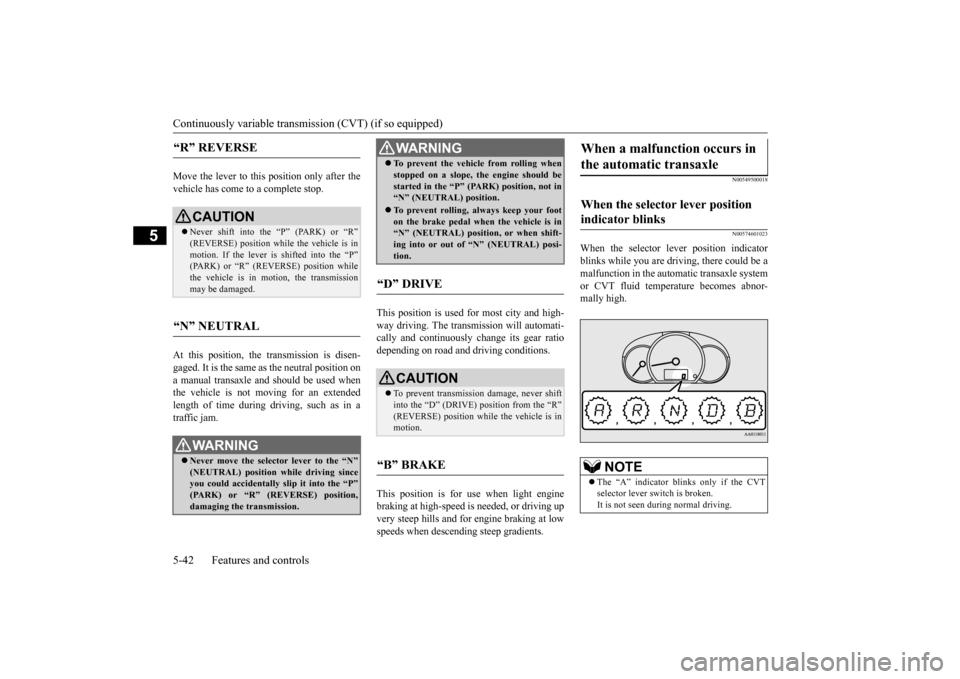
When the selector lever position indicator blinks while you are driving, there could be a malfunction in the automatic transaxle system or CVT fluid temperature becomes abnor- mally high.
“R” REVERSE
CAUTION Never shift into the “P” (PARK) or “R” (REVERSE) position while the vehicle is in motion. If the lever is shifted into the “P”(PARK) or “R” (REVERSE) position while the vehicle is in motion, the transmission may be damaged.
“N” NEUTRAL
WA R N I N G Never move the selector lever to the “N” (NEUTRAL) position while driving since you could accidentally
slip it into the “P”
(PARK) or “R” (REVERSE) position,damaging the transmission.
To prevent the vehicle from rolling when stopped on a slope,
the engine should be
started in the “P” (PARK) position, not in“N” (NEUTRAL) position. To prevent rolling,
always keep your foot
on the brake pedal when the vehicle is in “N” (NEUTRAL) positi
on, or when shift-
ing into or out of “N” (NEUTRAL) posi-tion.
“D” DRIVE
CAUTION To prevent transmission damage, never shift into the “D” (DRIVE) position from the “R”(REVERSE) position while the vehicle is in motion.
“B” BRAKE
WA R N I N G
When a malfunction occurs in the automatic transaxle
When the selector lever position indicator blinks
NOTE
The “A” indicator blinks only if the CVT selector lever switch is broken.It is not seen during normal driving.
BK0212400US.book 42 ページ 2014年4月1日 火曜日 午後2時21分
Page 105 of 300
Service brake 5-44 Features and controls
5
Prior to moving off after having stopped the vehicle, make sure that
the selector lever is in
“D” (DRIVE) position. To park the vehicle, first bring it to a com- plete stop, fully engage the parking brake,and then move the selector lever to the “P” (PARK) position. If the CVT does not shift while driving, or your vehicle does not pick up enough speed when starting on an uphill slope, it may be that there is something unusual happening inthe transmission, causi
ng a safety device to
activate. Have your ve
hicle checked at an
authorized Mitsubishi Motors dealer or a repair facility of your c
hoice as soon as possi-
ble.
N00517500318
Overuse of the brake can cause weakening, resulting in poor brake response and prema- ture wear of the brake pads.When driving down a long or steep hill, use engine braking by movi
ng the selector lever
to “B” (BRAKE) position.
N00517600436
Your vehicle is equipped with power brakes for more braking force with less brake pedal effort.Your brakes are designed to operate at full capacity, even if the power assist is not being used.If the power assist is not being used, the effort needed to press the brake pedal is greater. If you should lose the power assist for somereason, the brakes will still work. If the power brake unit or either of the two brake hydraulic systems stops working prop-erly, the rest of the brake system will still work, but the vehicle will not slow down as quickly.You will know this has happened if you find you need to press the brake down farther, or harder when slowing down or stopping, or ifthe brake warning light and the warning dis- play in the multi-information display come on. Have the brake system repaired at an
CAUTION To avoid transmission
overheating, never try
to keep your vehicle
stationary on a hill by
using the accelerator
pedal. Always apply
the parking brake and/or service brake. Do not rev the engine unnecessarily while the vehicle is stationary. Unexpected acceler- ation may occur if the selector lever is in aposition other than “P” (PARK) or “N” (NEUTRAL).
Parking
When the CVT makes no speed change
Service brake Brake pedal
WA R N I N G Do not leave any objects near the brake pedal or let a floor mat slide under it; doing so could prevent the full pedalstroke that would be necessary in an emergency. Make sure that the pedal can be operated freely at all times. Make surethe floor mat is securely held in place.
CAUTION It is important not to drive the vehicle with your foot resting on the brake pedal whenbraking is not required.
This practice can
result in very high brake temperatures, pre- mature lining wear, a
nd possible damage to
the brakes.
Power brakes
BK0212400US.book 44 ページ 2014年4月1日 火曜日 午後2時21分
Page 120 of 300
Tire pressure monitoring system (if so equipped)
Features and controls 5-59
5
The tire pressure monitoring system may not work normally in the following circum- stances: A wireless facility or device using the same frequency is near the vehicle. Snow or ice is stuck inside the fenders and/or on the wheels. The tire inflation pres
sure sensor’s battery
is dead. Wheels other than Mitsubishi Genuine wheels are being used. Wheels that are not fitted with tire infla- tion pressure sensors are being used. Wheels whose ID codes are not memo- rized by the vehicle are used. Compact spare tire (if so equipped) is fit- ted on a road wheel. A window tint that affects the radio wave signals is installed.
N00532900153
If new wheels with new tire inflation pressuresensors are installed, their ID codes must be programmed into the tire pressure monitoring system. Have tire and
wheel replacement per-
formed by an authorized Mitsubishi Motors dealer to avoid the ri
sk of damaging the tire
inflation pressure sensors. If the wheelreplacement is not done by an authorized Mitsubishi Motors dealer
, it is not covered by
your warranty.
N00533000236
Your tire pressure monitoring system oper- ates on a radio frequenc
y subject to Federal
Communications Commission (FCC) Rules(For vehicles sold in
U.S.A.) and Industry
Canada Rules (For vehicles sold in Canada). This device complies with part 15 of FCCRules and Industry Ca
nada licence-exempt
RSS standard(s). Operation is subject to the following two con- ditions. This device may not
cause harmful inter-
ference This device must ac
cept any interference
received, including interference that may cause undesired operation.
Do not use an aerosol puncture-repair spray on any tire.Such a spray could damage the tire inflationpressure sensors. Have any puncture repaired by an authorized Mitsubishi Motors dealer. Using the tire repair kit may damage the tire inflation pressure sensor. The vehicle mustpromptly be inspected and repaired by an authorized Mitsubishi Motors dealer after using the tire repair kit.NOTE
NOTE
Tire inflation pressures vary with the ambi- ent temperature. If the vehicle is subjected tolarge variations in ambient temperature, thetire inflation pressures may be under-inflated (causing the warning light come on) when the ambient temperature is relatively low. Ifthe warning light comes on, adjust the tire inflation pressure.
Whenever the tires and wheels are replaced with new ones
CAUTION The use of non-genuine wheels will prevent the proper fit of the tire inflation pressure sensors, resulting air
leakage or damage of
the sensors.
General information
WA R N I N G Changes or modifica
tions not expressly
approved by the manufacturer for compli- ance could void the
user’s authority to
operate the equipment.
BK0212400US.book 59 ページ 2014年4月1日 火曜日 午後2時21分