Temperature MITSUBISHI MIRAGE 2015 6.G Owner's Guide
[x] Cancel search | Manufacturer: MITSUBISHI, Model Year: 2015, Model line: MIRAGE, Model: MITSUBISHI MIRAGE 2015 6.GPages: 300, PDF Size: 43.44 MB
Page 253 of 300
Air cleaner filter 9-8 Vehicle care and maintenance
9
The radiator cap must be
sealed tight to pre-
vent losing coolant, which may result in engine damage. Only use a Genuine Mitsubishi Parts radiator
cap, or an approved
equivalent.
Do not overfill the reserve tank. Your vehicle uses a special radiator cap that stays sealed and lets the coolant flow from the reserve tank back to the radiator when the engine cools down. If you needto change the cap, use the exact same kind. Check the coolant freeze point in the radi- ator with the proper gauge, and only when it is safe. If you add antifreeze, the con- tents of the reserve tank must be protectedagainst freezing. Keep the front of the radiator and con- denser clean. If the engine coolant temperature does not rise after the engine is warmed-up, take your vehicle to an au
thorized Mitsubishi
Motors dealer or a repair facility of your choice to have the thermostat checked, and replaced if necessary.
N00937900413
The air cleaner filter
will get dirty and dusty
from use and not filter
properly. Replace it
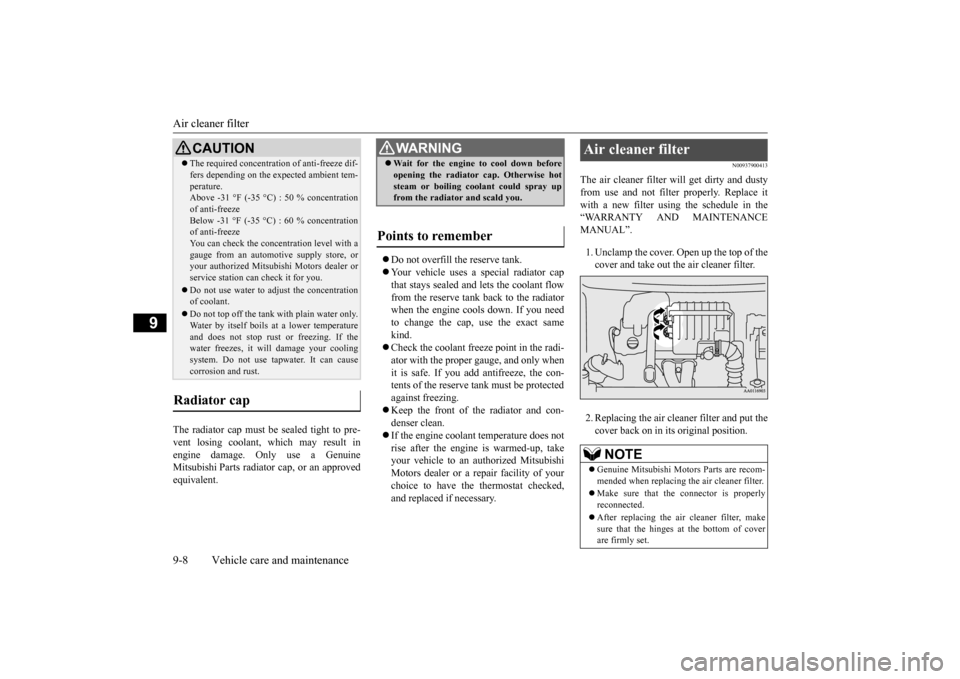
with a new filter using the schedule in the“WARRANTY AND MAINTENANCE MANUAL”. 1. Unclamp the cover. Open up the top of the cover and take out th
e air cleaner filter.
2. Replacing the air clea
ner filter and put the
cover back on in its original position.
The required concentrati
on of anti-freeze dif-
fers depending on the
expected ambient tem-
perature.Above -31 °F (-35 °C) : 50 % concentration of anti-freeze Below -31 °F (-35 °C) : 60 % concentrationof anti-freeze You can check the concentration level with a gauge from an automotive supply store, oryour authorized Mitsubi
shi Motors dealer or
service station can check it for you. Do not use water to adjust the concentration of coolant. Do not top off the tank with plain water only. Water by itself boils at a lower temperature and does not stop rust or freezing. If thewater freezes, it will
damage your cooling
system. Do not use tapwater. It can cause corrosion and rust.
Radiator cap
CAUTION
WA R N I N G Wait for the engine to cool down before opening the radiator
cap. Otherwise hot
steam or boiling c
oolant could spray up
from the radiator and scald you.
Points to remember
Air cleaner filter
NOTE
Genuine Mitsubishi Motors Parts are recom- mended when replacing th
e air cleaner filter.
Make sure that the
connector is properly
reconnected. After replacing the air cleaner filter, make sure that the hinges at the bottom of cover are firmly set.
BK0212400US.book 8 ページ 2014年4月1日 火曜日 午後2時21分
Page 256 of 300
Battery
Vehicle care and maintenance 9-11
9
N00901600060
The battery is weaker in cold temperatures. This has to do with it
s chemical and physical
properties and is why a very cold battery,especially one with a low charge, will have a hard time starting your vehicle. It is recommended th
at you have your battery
and charging system checked by an autho- rized Mitsubishi Motors dealer or a repair facility of your choice
before the start of cold
weather. If necessary, have it charged. This will provide more reliab
le starting, and longer
battery life.
N00901701130
To disconnect the battery cable, stop theengine. Disconne
ct the negative (-) terminal
first, then the positive
(+) terminal. To recon-
nect the battery, first
connect the positive (+)
terminal and then the negative (-) terminal,before starting the vehicle. If any of the caps has a loose fit, replace the battery.
During cold weather Disconnection and connection
WA R N I N G
NOTE
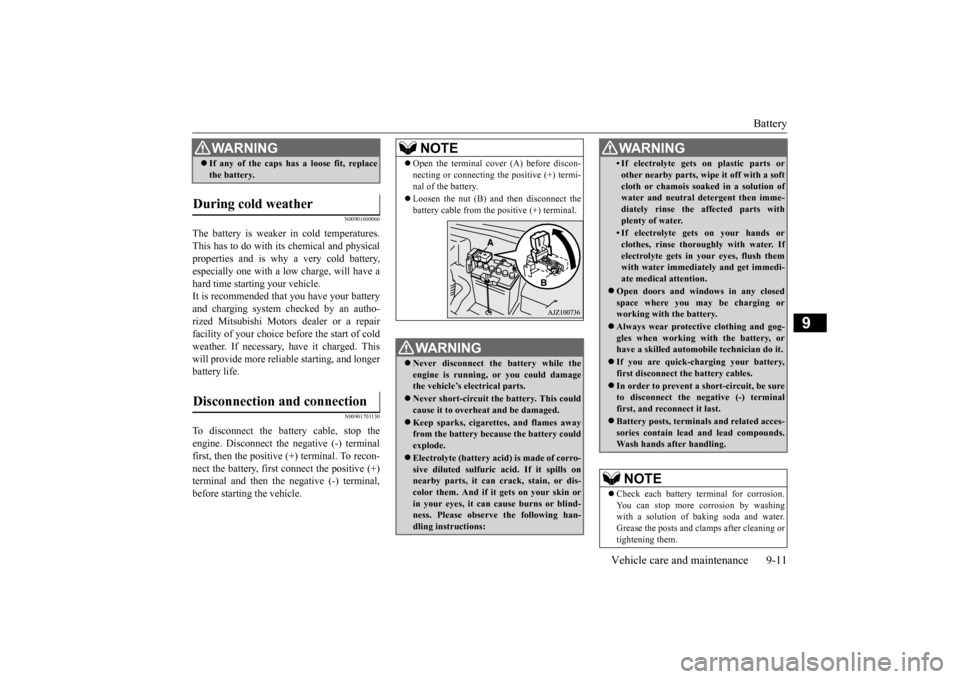
Open the terminal c
over (A) before discon-
necting or connecting
the positive (+) termi-
nal of the battery. Loosen the nut (B) and then disconnect the battery cable from the positive (+) terminal.WA R N I N G Never disconnect the battery while the engine is running, or you could damage the vehicle’s electrical parts. Never short-circuit the battery. This could cause it to overheat and be damaged. Keep sparks, cigarette
s, and flames away
from the battery because the battery couldexplode. Electrolyte (battery ac
id) is made of corro-
sive diluted sulfuric acid. If it spills on nearby parts, it can crack, stain, or dis- color them. And if it gets on your skin orin your eyes, it can cause burns or blind- ness. Please observe the following han- dling instructions:
• If electrolyte gets
on plastic parts or
other nearby parts, wi
pe it off with a soft
cloth or chamois soak
ed in a solution of
water and neutral detergent then imme- diately rinse the affected parts with plenty of water.• If electrolyte gets on your hands orclothes, rinse thoroughly with water. Ifelectrolyte gets in your eyes, flush them with water immediat
ely and get immedi-
ate medical attention.
Open doors and wind
ows in any closed
space where you may be charging orworking with the battery. Always wear protecti
ve clothing and gog-
gles when working with the battery, or have a skilled automobi
le technician do it.
If you are quick-charging your battery, first disconnect the battery cables. In order to prevent a short-circuit, be sure to disconnect the
negative (-) terminal
first, and reconnect it last. Battery posts, termin
als and related acces-
sories contain lead and lead compounds.Wash hands after handling.NOTE
Check each battery terminal for corrosion. You can stop more corrosion by washingwith a solution of baking soda and water. Grease the posts and cl
amps after cleaning or
tightening them.WA R N I N G
BK0212400US.book 11 ページ 2014年4月1日 火曜日 午後2時21分
Page 259 of 300

Tires 9-14 Vehicle care and maintenance
9
Maximum Pressure i
ndicates the maximum
permissible cold tire inflation pressure for this tire. The TIN may be found on one or both sides of the tire but the date code may only be on one side. Look for the TIN on the outboard side of tires as mounted on the vehicle. If theTIN is not found on the outboard side then you will find it on the inboard side of the tire. EXAMPLE: DOT MA L9 ABCD 1504
The treadwear grade is a comparative rating based on the wear rate of the tire when tested under controlled conditions on a specified government test course. For example, a tiregraded 150 would wear one and one-half (11/2) times as well on th
e government course
as a tire graded 100. The relative performance of tires depends upon the actual conditions of their use, however, and may depart signifi-cantly from the norm due to variations in driving habits, service practices and differ- ences in road characteristics and climate. The traction grades, from highest to lowest, are AA, A, B and C. Those grades represent the tire’s ability to
stop on wet pavement as
measured under controlled conditions on
specified government te
st surfaces of asphalt
and concrete. A tire
marked C may have poor
traction performance. The temperature grades are A (the highest), B and C, representing the tire’s resistance to the generation of heat and
its ability to dissipate
heat when tested under controlled conditions on a specified indoor la
boratory test wheel.
Sustained high temperature can cause the material of the tire to
degenerate and reduce
tire life, and excessive temperature can leadto sudden tire failure. The grade C corre- sponds to a level of performance which all passenger car tires must meet under the Fed-eral Motor Vehicle Safety Standard No. 109. Grades B and A represent higher levels of performance on the labora
tory test wheel than
the minimum required by law.
N00939300903
Proper tire inflation pressure is essential forthe safe and satisfactory operation of your vehicle. The wrong tire
pressure will cause
problems in three major areas: Safety
Maximum Pressure Tire Identification Number (TIN) DOT
Department of Transportation This symbol certifies that the tire is in compliance with the U.S. Department of Transportation tire safety standards, and is approved for highway use.
MA
Code representing the tire manu- facturing location. (2 digits)
L9 ABCD
Code representing th
e tire size. (2
digits) Code used by tire manufacturer. (1 to 4 digits)
15
Number representing the week in which the tire was manufactured. (2 digits)
04
Number representing the year in which the tire was manufactured. (2 digits)
Treadwear, Traction and Temper- ature Grades Treadwear Traction
TemperatureTire inflation pressures
BK0212400US.book 14 ページ 2014年4月1日 火曜日 午後2時21分
Page 260 of 300
Tires
Vehicle care and maintenance 9-15
9
Too little pressure increases flexing in the tire and can cause tire failure. Too muchpressure can cause a tire to lose its ability to cushion shock. Objects on the road and potholes could then ca
use tire damage that
may result in tire failure. Economy The wrong tire pressu
re can cause uneven
wear patterns in the tire tread. These abnormal wear patter
ns will reduce the
tread life, and the tire will have to be replaced sooner. Too little pressure also makes it harder forthe tire to roll, and this uses up more fuel. Ride comfort and vehicle stability The superior riding e
xperience built into
your vehicle partly de
pends on the correct
tire pressure. Too much pressure gives an uncomfortable and jarring ride. Too littlepressure feels as if
your vehicle is slow to
respond. Unequal tire pressure
s can make steering
your vehicle uneven
and unpredictable.
The tire pressure for your vehicle under nor- mal driving conditions is listed on the placard attached to the driver’s door sill.(Refer to “Tire and loading information plac- ard” on page 11-3.)
The recommended inflation pressures under normal driving conditions should be used forthe tires listed below. Tire pressures should be checked, and adjusted if necessary, at least once a month. Pressures should be checked more oftenwhenever weather temperatures change severely, becaus
e tire pressures change with
outdoor temperatures. The pressures listedare always “cold in
flation pressure”.
Cold inflation pressure is measured after the vehicle has been parked for at least threehours or is driven less than 1 mile (1.6 km) after having been parked for three hours. Cold inflation pressure must not go above themaximum values molded into the tire side- wall. After driving several miles, your tire inflation pressure may increase 2 to 6 psi (14to 41 kPa) from the cold inflation pressure. Do not let air out of the tires to get back to the
specified cold pressure, or your tires will be too low.Check your tires each t
ime you refuel. If one
tire looks lower than the others, check the pressure for all of them.You should also take the following safety pre- cautions: Keep your tires inflated to the recom- mended pressures. (See the tire and load-ing information placard attached to the driver’s door sill.) Stay within the recommended load limits. Make sure that the weight of any load in your vehicle is evenly distributed. Drive at safe speeds. After filling your tires to the correct pres- sure, check them for damage and airleaks. Be sure to reinstall the caps on the valve stems.
N00939600430
Item
Tire size
Front
Rear
Normal tire 165/65R14
240 kPa, 35 psi
240 kPa, 35 psi
Compact spare wheel
(if so equipped)
T115/70D14
420 kPa, 60
psi
Replacing tires and wheels
CAUTION Avoid using different size tires from the one listed and the combined use of different types of tires, as this can affect driving safety.Refer to “Tires and wheels” on page 11-5.
BK0212400US.book 15 ページ 2014年4月1日 火曜日 午後2時21分
Page 278 of 300
Cleaning the outside of your vehicle Vehicle care and maintenance 9-33
9
N00945600187
1. To clean, lightly wi
pe the leather with a
soft cloth soaked in a 5% solution of gen- tle soap and water.2. To rinse, dip the cloth in fresh water, wring it out well, and wipe off all the soap.3. To preserve and protect, use a leather pro- tecting agent on the genuine leather sur- face.
N00945700058
To protect your vehicle’s
finish, wash it often
and thoroughly. If desired, you may wax your vehicle using a nonabrasive automobile wax.
N00945800033
Industrial pollution, road tar, bird droppings,tree sap, insect remain
s, sea water and other
foreign matters can damage the finish on yourvehicle. Generally, the longer any foreign material stays on the finish, the worse the damage.Wash your vehicle as soon as possible when- ever the finish gets soiled.
N00945900630
Chemicals contained in the dirt and dustpicked up from air, rain, snow, or road sur- faces can damage the paint and body of yourvehicle if left on. Frequent washing and wa
xing is the best way
to protect your vehicle from this damage.Do not wash the vehicl
e in direct sunlight.
Park the vehicle in the shade and spray it with water to remove dust.
Next, using plenty of
clean water and a car
washing mitt or sponge,
wash the vehicle from top to bottom.Use a mild car washing soap if necessary. Rinse thoroughly and wipe
dry with a cham-
ois or soft cloth. Af
ter washing the vehicle,
carefully clean the join
ts and flanges of the
doors, hood, etc., wher
e dirt is likely to
remain.
NOTE
If fuzzing is difficult to remove from the seat upholstery, draw a suitable defuzzing brushover the surface in
one direction.
Genuine leather
(if so equipped)
NOTE
If genuine leather is we
t with water, wipe it
with a dry, soft cloth. If left damp, mildew may grow. The genuine leather su
rface can be damaged
if brushed with a nylon or synthetic fiberbrush. Organic solvents such as benzine, kerosene, alcohol, gasoline, or acid
or alkaline solvents
can discolor the genuine
leather surface and
should not be used. Genuine leather can
mildew if not kept
clean. Clean up any o
il stains immediately.
The genuine leather surface may harden and shrink if it is exposed to the direct sunlightfor long hours. When your vehicle is parked,place it in the shade as much as possible. When the temperature of the vehicle interior rises in summer, vinyl products left on the genuine leather seat
may deteriorate and
stick to the seat.
Cleaning the outside of your vehicle Foreign material
NOTE
Wa s h i n g
CAUTION When washing the underside of your vehicle or the wheels, wear a pair of gloves to pro- tect your hands. Never spray or splash water on the electrical parts in the engine compartment. This maydamage them. Be careful also when washing the underbody to ensure that water does not enter the engine compartment.
BK0212400US.book 33 ページ 2014年4月1日 火曜日 午後2時21分
Page 283 of 300
Consumer information (For vehicles sold in U.S.A.) 10-2 Customer assistance/Re
porting Safety Defects
10
N01047100171
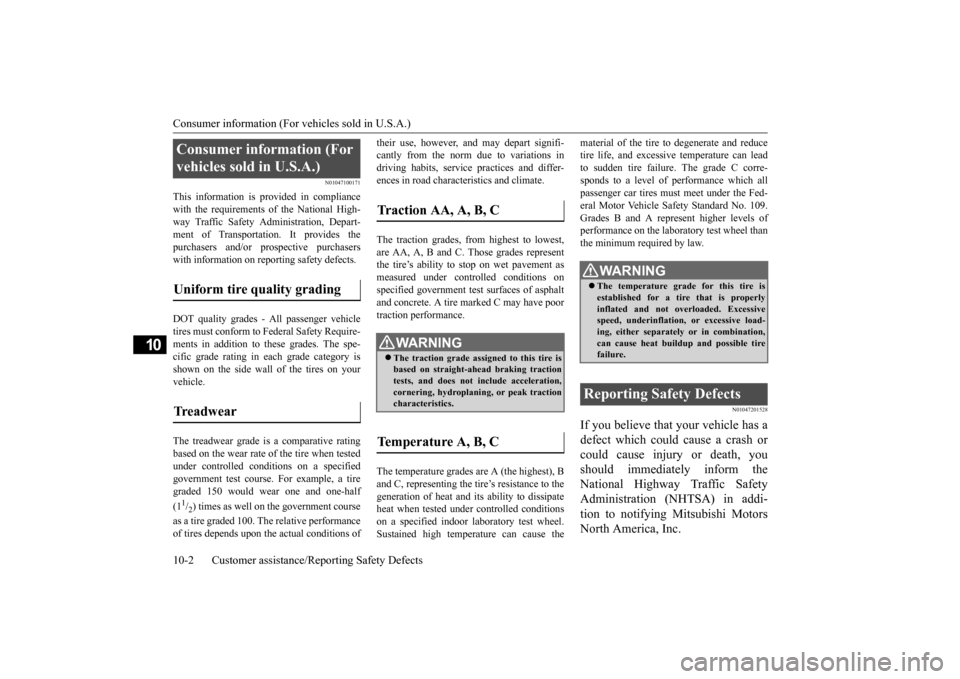
This information is provided in compliance with the requirements of the National High- way Traffic Safety Ad
ministration, Depart-
ment of Transportation. It provides the purchasers and/or prospective purchasers with information on repor
ting safety defects.
DOT quality grades - Al
l passenger vehicle
tires must conform to
Federal Safety Require-
ments in addition to these grades. The spe- cific grade rating in each grade category isshown on the side wall of the tires on your vehicle. The treadwear grade is a comparative rating based on the wear rate of
the tire when tested
under controlled conditions on a specifiedgovernment test course
. For example, a tire
graded 150 would wear one and one-half (11/2) times as well on the government course
as a tire graded 100.
The relative performance
of tires depends upon the actual conditions of
their use, however, and may depart signifi- cantly from the norm due to variations indriving habits, service practices and differ- ences in road characteristics and climate. The traction grades, from highest to lowest, are AA, A, B and C. Those grades represent the tire’s ability to
stop on wet pavement as
measured under controlled conditions on specified government te
st surfaces of asphalt
and concrete. A tire marked C may have poor traction performance. The temperature grades are A (the highest), B and C, representing the ti
re’s resistance to the
generation of heat and it
s ability to dissipate
heat when tested un
der controlled conditions
on a specified indoor
laboratory test wheel.
Sustained high temperature can cause the
material of the tire to
degenerate and reduce
tire life, and excessive temperature can leadto sudden tire failure. The grade C corre- sponds to a level of performance which all passenger car tires must meet under the Fed-eral Motor Vehicle Safety Standard No. 109. Grades B and A represent higher levels of performance on the labora
tory test wheel than
the minimum required by law.
N01047201528
If you believe that your vehicle has a defect which could cause a crash or could cause injury or death, you should immediately inform theNational Highway Traffic Safety Administration (NHTSA) in addi- tion to notifying Mitsubishi MotorsNorth America, Inc.
Consumer information (For vehicles sold in U.S.A.) Uniform tire quality grading Treadwear
Traction AA, A, B, C
WA R N I N G The traction grade assi
gned to this tire is
based on straight-ahead braking tractiontests, and does not include acceleration, cornering, hydroplani
ng, or peak traction
characteristics.
Temperature A, B, C
WA R N I N G The temperature grade for this tire is established for a tire that is properlyinflated and not overloaded. Excessive speed, underinflation
, or excessive load-
ing, either separately
or in combination,
can cause heat buildup and possible tire failure.
Reporting Safety Defects
BK0212400US.book 2 ページ 2014年4月1日 火曜日 午後2時21分
Page 291 of 300
Engine specifications 11-4 Specifications
11
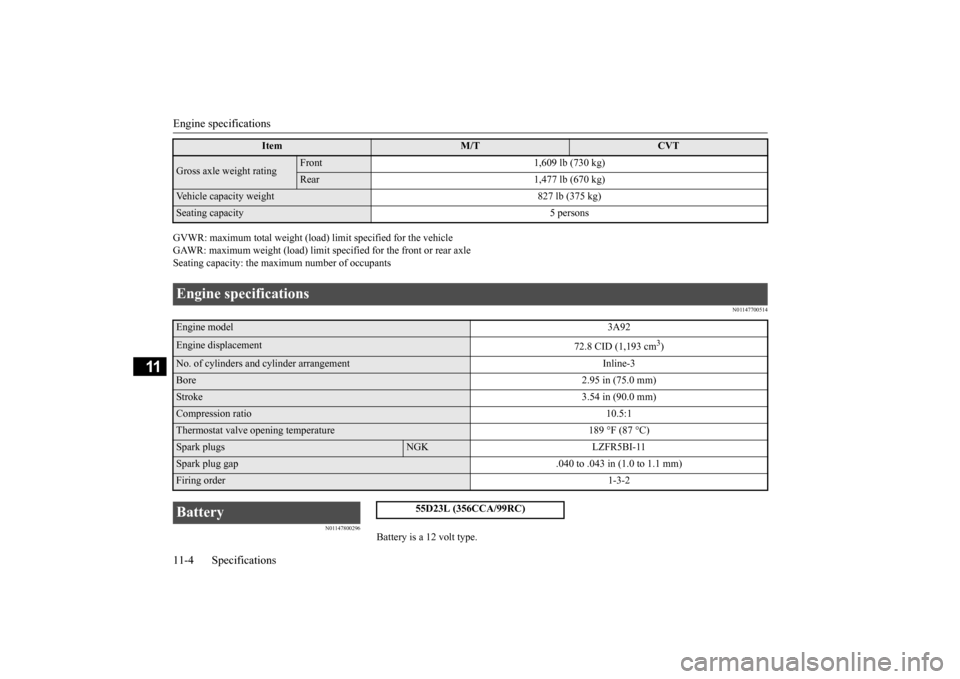
GVWR: maximum total weight (load) limit specified for the vehicle GAWR: maximum weight (load) limit sp
ecified for the front or rear axle
Seating capacity: the maxi
mum number of occupants
N01147700514
N01147800296
Battery is a 12 volt type.
Gross axle weight rating
Front 1,609 lb (730 kg)Rear 1,477 lb (670 kg)
Vehicle capacity weight 827 lb (375 kg)Seating capacity 5 personsEngine specifications Engine model
3A92
Engine displacement
72.8 CID (1,193 cm
3)
No. of cylinders and cy
linder arrangement Inline-3
Bore
2.95 in (75.0 mm)
Stroke
3.54 in (90.0 mm)
Compression ratio
10.5:1
Thermostat valve opening temperature 189 °F (87 °C)Spark plugs
NGK LZFR5BI-11
Spark plug gap .040 to .043 in (1.0 to 1.1 mm)Firing order
1-3-2
Item
M/T
CVT
Battery
55D23L (356CCA/99RC)
BK0212400US.book 4 ページ 2014年4月1日 火曜日 午後2時21分
Page 295 of 300

Alphabetical index 12-2
12
D
Daytime running lights
Bulb capacity
.................................
9-26
Defogger (rear window)
......................
5-80
Defrosting or defogging (windshield, door windows)
................................
7-10
, 7-16
Dimensions
........................................
11-3
Dimmer (high/lo
w beam change)
.........
5-76
Disc brake pads
..................................
9-20
Dome light
Bulb capacity
.................................
9-27
Door-ajar warning buzzer
....................
5-74
Door-ajar warning light
.......................
5-74
Doors
Lock
..............................................
5-24
Power door locks
............................
5-26
Driving during cold weather
..................
6-4
Driving, alcohol and drugs
.....................
6-2
E
Electric power steering system (EPS)
...
5-48
Electric rear win
dow defogger switch
...
5-80
Electronic immobilizer (Anti-theft starting system)
.....................................
5-3
, 5-20
Emission-control sy
stem maintenance
..9-19
Engine
Compartment
...................................
9-5
Coolant
...................................
9-7
, 11-5
High coolant temperature warning light
....
5-73 Hood
...............................................
9-4
Oil and oil filter
.......................
9-5
, 11-5
Overheating
.....................................
8-4
Serial number
.................................
11-2
Specification
...................................
11-4
Engine hood
........................................
9-4
Engine switch
.....................................
5-13
Error codes
.........................................
7-38
Exhaust system
...................................
9-21
F
Floor mat
.............................................
6-2
Fluid
Brake fluid
.....................................
11-5
Continuously variable
transmission (CVT)
fluid
......................................
9-9
, 11-5
Engine coolant
.........................
9-7
, 11-5
Manual transaxle
.............................
11-5
Washer fluid
............................
9-9
, 11-5
Fluid capacities and lubricants
..............
11-5
Free-hand advanced security transmitter (F.A.S.T.-key)
...................................
5-9
Front fog lights
Bulb capacity
..................................
9-26
Indicators
.......................................
5-71
Replacement
..................................
9-29
Switch
...........................................
5-77
Front seat adjustment
............................
4-3
Front side-marker lights
Bulb capacity
.................................
9-26
Replacement
..................................
9-28
Front turn signal light
Bulb capacity
.................................
9-26
Replacement
..................................
9-28
Fuel
Filling the fuel tank
...........................
3-3
Fuel economy
...................................
6-2
Fuel hoses
......................................
9-20
Fuel remaining warning display
.......
5-66
Fuel selection
...................................
3-2
Tank capacity
.................................
11-5
Fuel Pump Shut-off System
.................
8-20
Fuel remaining display
........................
5-66
Fuses
.................................................
9-22
Fusible links
.......................................
9-22
G
General maintenance
Maintenance
...................................
9-20
General vehicle data
............................
11-3
Genuine parts
.......................................
3-6
Glove compartment
...........................
5-108
BK0212400US.book 2 ページ 2014年4月1日 火曜日 午後2時21分
Page 296 of 300

Alphabetical index
12-3
12
H
Hazard warning
flasher switch
.............
5-77
Hazard warning lights
.........................
5-71
Head restraints
......................................
4-7
Headlights
Bulb capacity
.................................
9-26
Dimmer
.........................................
5-76
Headlight flasher
............................
5-76
Switch
...........................................
5-74
Heater without air conditioning function
.7-4
High beam indicator
............................
5-71
High coolant temperature warning light 5-73 High-mounted stop light
Bulb capacity
.................................
9-26
Hill start assist
....................................
5-45
Hood lock release me
chanism and safety
catch
................................................
9-21
Hook
Convenience hook
........................
5-109
Horn switch
........................................
5-81
I
If the vehicle breaks down
.....................
8-2
Ignition switch
....................................
5-35
Important facts to know in
case of an accident
10-4
Indicator and warning light package
.....
5-70
Indicators
..........................................
5-71
Information display
............................
5-63
Inside rearview mirror
.........................
5-32
Instrument panel li
ght dimmer control
..5-65
Interior lights
....................................
5-106
J
Jack
Garage jack up position
.....................
9-2
Storage
............................................
8-5
Jump-starting the engine
.......................
8-2
K
Key slot
.............................................
5-19
Keyless entry system
....................
5-6
, 5-21
Keys
...................................................
5-2
L
Labeling
............................................
11-2
License plate light
Bulb capacity
.................................
9-26
Replacement
..................................
9-31
Liftgate
.............................................
5-27
Link System
.......................................
5-81
Loading information
.............................
6-6
Lubricants
..........................................
11-5
M
Malfunction indicator light
..................
5-72
Manual air conditioning
.........................
7-7
Manual transaxle
.................................
5-38
Oil
..........................................
9-9
, 11-5
Shift points
.....................................
5-38
Manual window control
.......................
5-28
Modifications to and
racing of your vehicle
..
3-5 Multi-information display
....................
5-62
O
Octane rating
........................................
3-2
Oil
Engine oil
...............................
9-5
, 11-5
Manual transaxle oil
.................
9-9
, 11-5
Oil pressure warning light
....................
5-73
Operation mode
..................................
5-14
Operation under adverse driving conditions
..
8-18 Outside rearview mirrors
.....................
5-33
Overheating
..........................................
8-4
P
Parking
................................................
6-5
BK0212400US.book 3 ページ 2014年4月1日 火曜日 午後2時21分