light MITSUBISHI MIRAGE 2015 6.G Owners Manual
[x] Cancel search | Manufacturer: MITSUBISHI, Model Year: 2015, Model line: MIRAGE, Model: MITSUBISHI MIRAGE 2015 6.GPages: 300, PDF Size: 43.44 MB
Page 246 of 300
9
Vehicle care and maintenanceService precautions ..........................................................................9-2 Catalytic converter ...........................................................................9-3 Engine hood .........
...........
...........
............
...........
.........
........
.........
.....9-4
View of the engine compartment .....................................................9-5 Engine oil and oil filter ....................................................................9-5 Engine coolant .................................................................................9-7Air cleaner filter ...............................................................................9-8 Manual transaxle oil (if so equipped) ...............................................9-9 Continuously variable transmission (CVT) fluid (if so equipped) ...........................................................................9-9 Washer fluid .....................................................................................9-9 Brake fluid .....................................................................................9-10Battery ............................................................................................9-10 Tires ...............................................................................................9-12 Clutch pedal free play (if so equipped)...........................................9-18Brake pedal free play .....................................................................9-18 Parking brake .................................................................................9-18 Wiper blades ..................................................................................9-19Emission-control system maintenance ..........................................9-19 General maintenance .....................................................................9-20 For cold and snowy weather ..........................................................9-21Fusible links ...................................................................................9-22 Fuses ..............................................................................................9-22 Replacement of light bulbs ............................................................9-26Vehicle care precautions ................................................................9-31 Cleaning the inside of your vehicle .......
...........
...........
...........
.......9-32
Cleaning the outside of your vehicle .....
...........
...........
...........
.......9-33
BK0212400US.book 1 ページ 2014年4月1日 火曜日 午後2時21分
Page 250 of 300
View of the engine compartment
Vehicle care and maintenance 9-5
9
N00937600713
N00937702011
It is normal for an engi
ne to use oil. You may
need to add oil betwee
n the recommended oil
change intervals. Before starting the engine,check the engine oil level. Refill if necessary. To check the oil level, remove the dipstick, wipe it off, and gently
reinsert it all the way.
Slowly pull the dipsti
ck straight out and
check the oil level by checking the upper sur- face of the dipstick. Th
e oil level must not go
above the line on the dipstick. If the level does not reach the line which shows the minimum amo
unt of oil required,
remove the oil filler cap on the engine valve cover, and fill to within the “Good” range.
Make sure the engine hood is firmly closed before driving.If you drive without the engine hood com-pletely closed, it c
ould open up while driv-
ing.NOTE
If this does not clos
e the engine hood prop-
erly, drop it again from a slightly higher position. Do not push down strongly on the engine hood. Depending on how strongly or whereyou push down, you could create a dent in the vehicle body.CAUTION
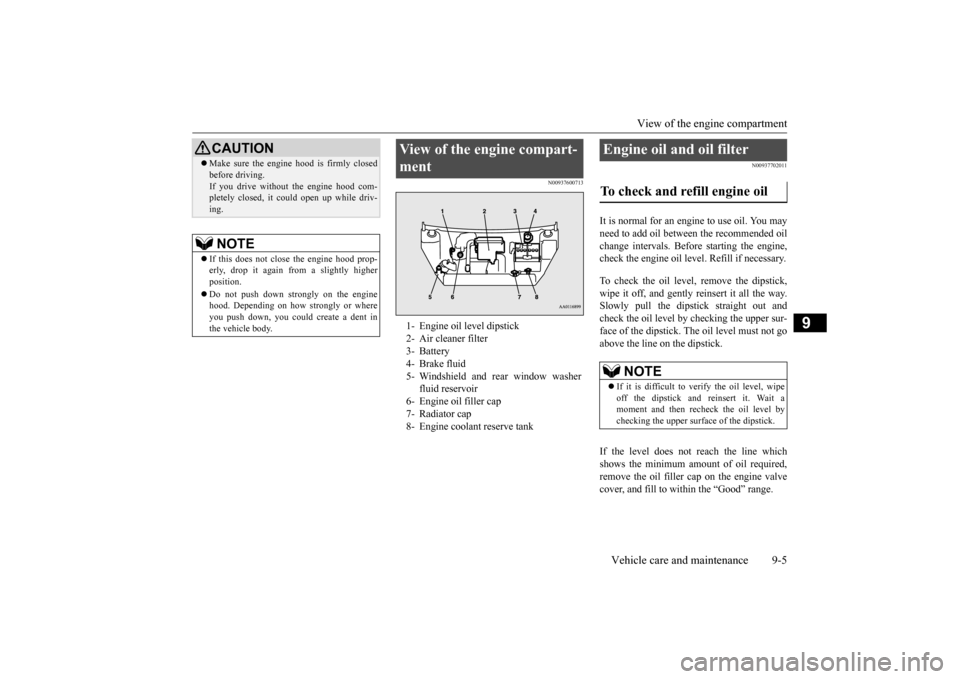
View of the engine compart- ment 1- Engine oil level dipstick 2- Air cleaner filter3- Battery 4- Brake fluid 5- Windshield and rear window washer
fluid reservoir
6- Engine oil filler cap 7- Radiator cap8- Engine coolan
t reserve tank
Engine oil and oil filter To check and refill engine oil
NOTE
If it is difficult to verify the oil level, wipe off the dipstick and
reinsert it. Wait a
moment and then recheck the oil level by checking the upper surfa
ce of the dipstick.
BK0212400US.book 5 ページ 2014年4月1日 火曜日 午後2時21分
Page 255 of 300
Brake fluid 9-10 Vehicle care and maintenance
9
N00938700274
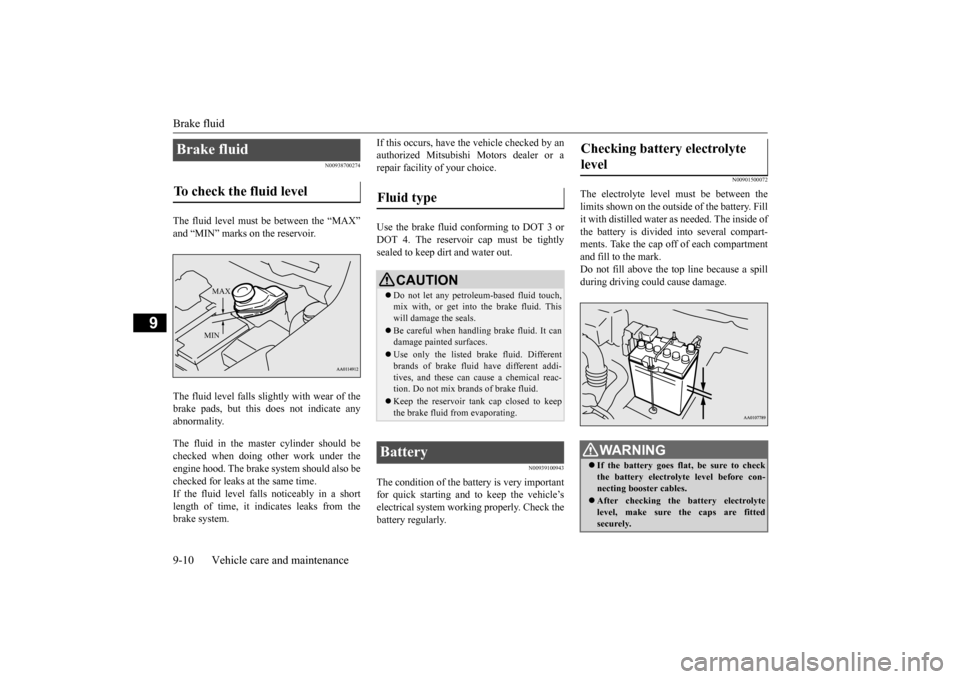
The fluid level must be between the “MAX” and “MIN” marks on the reservoir. The fluid level falls slightly with wear of the brake pads, but this
does not indicate any
abnormality. The fluid in the master cylinder should be checked when doing other work under the engine hood. The brake
system should also be
checked for leaks at the same time. If the fluid level falls noticeably in a short length of time, it indi
cates leaks from the
brake system.
If this occurs, have
the vehicle checked by an
authorized Mitsubishi Motors dealer or arepair facility of your choice. Use the brake fluid conforming to DOT 3 or DOT 4. The reservoir cap must be tightly sealed to keep dirt and water out.
N00939100943
The condition of the batte
ry is very important
for quick starting and to keep the vehicle’selectrical system working properly. Check the battery regularly.
N00901500072
The electrolyte level
must be between the
limits shown on the outside
of the battery. Fill
it with distilled water
as needed. The inside of
the battery is divided into several compart- ments. Take the cap off of each compartmentand fill to the mark. Do not fill above the t
op line because a spill
during driving could cause damage.
Brake fluid To check the fluid level
MAX MIN
Fluid type
CAUTION Do not let any petrol
eum-based fluid touch,
mix with, or get into the brake fluid. This will damage the seals. Be careful when handling brake fluid. It can damage painted surfaces. Use only the listed brake fluid. Different brands of brake fluid have different addi-tives, and these can cause a chemical reac- tion. Do not mix brands of brake fluid. Keep the reservoir ta
nk cap closed to keep
the brake fluid from evaporating.
Battery
Checking battery electrolyte level
WA R N I N G If the battery goes flat, be sure to check the battery electrolyte level before con- necting booster cables. After checking the battery electrolyte level, make sure the caps are fittedsecurely.
BK0212400US.book 10 ページ 2014年4月1日 火曜日 午後2時21分
Page 257 of 300
Tires 9-12 Vehicle care and maintenance
9
N00939200566
It is important to familiarize yourself with the following terms:
Cold tire pressure: • The measured pressure after the vehiclehas been parked for at least three hours, or • The measured pressure when the vehicleis driven less than 1 mile (1.6 km) after having been parked for three hours.
Maximum pressure: the maximum per- missible cold tire inflation pressure for this tire. Recommended inflation pressure: the inflation pressure for optimum tire perfor- mance. Intended outboard sidewall: • The sidewall that c
ontains a whitewall,
bears white letteri
ng or bears manufac-
turer, brand, and/or model name molding that is higher or deeper than the same molding on the other sidewall of the tire,or • The outward facing si
dewall of an asym-
metrical tire that has a particular sidethat must always face outward when mounted on a vehicle.
Passenger car tire: a
tire intended for use
on passenger cars, multipurpose passen- ger vehicles, and trucks that have a gross vehicle weight rati
ng (GVWR) of 10,000
pounds or less.
Light truck (LT) tire
: a tire designated by
its manufacturer as primarily intended foruse on lightweight tr
ucks or multipurpose
passenger vehicles. Tread: portion of a tire that comes into contact with the road. Tread rib: a tread se
ction running circum-
ferentially around a tire. Tread separation: pulling away of the tread from the tire carcass. Carcass: the tire structure, except tread and sidewall rubber which, when inflated, bears the load. Sidewall: portion of a tire between the tread and bead. Section width: the line
ar distance between
the exteriors of the sidewalls of an inflated tire, excluding elevations due to labeling, decoration, or protective bands. Bead: the part of the tire that is made of steel wires, wrapped
or reinforced by ply
cords and that is shaped to fit the rim. Ply: a layer of rubber-coated parallel cords. Cord: the strands forming the plies in the tire. Rim: a metal support for a tire or a tire and tube assembly upon which the tirebeads are seated. Rim diameter: nominal diameter of the bead seat.
Check to see that the battery is securely installed and cannot be moved. Also checkeach terminal for tightness. If you will not be driving your vehicle for a long period of time, remove the battery andstore it in a place where the battery fluid will not freeze. The battery only should be stored with a full charge. Before cleaning the battery, tighten all the filler port caps to keep
dirt and moisture out.
Tires
WA R N I N GDriving with tires that are worn, damaged or improperly inflated is dangerous. These type tire conditions will adverselyaffect vehicle performance. These type tire conditions can also cause a tread separation or blowout which mayresult in an accide
nt causing serious
injury or death. Tires, including spar
e tire, degrade over
time with age even when they are not being used. It is recommended that tires over 6 yearsgenerally be replaced even if damage is not obvious.NOTE
BK0212400US.book 12 ページ 2014年4月1日 火曜日 午後2時21分
Page 258 of 300
Tires
Vehicle care and maintenance 9-13
9
Groove: the space between two adjacent tread ribs.
EXAMPLE: P215/65R15
EXAMPLE: 95H
Maximum load indicates the maximum load this tire is designed to carry.
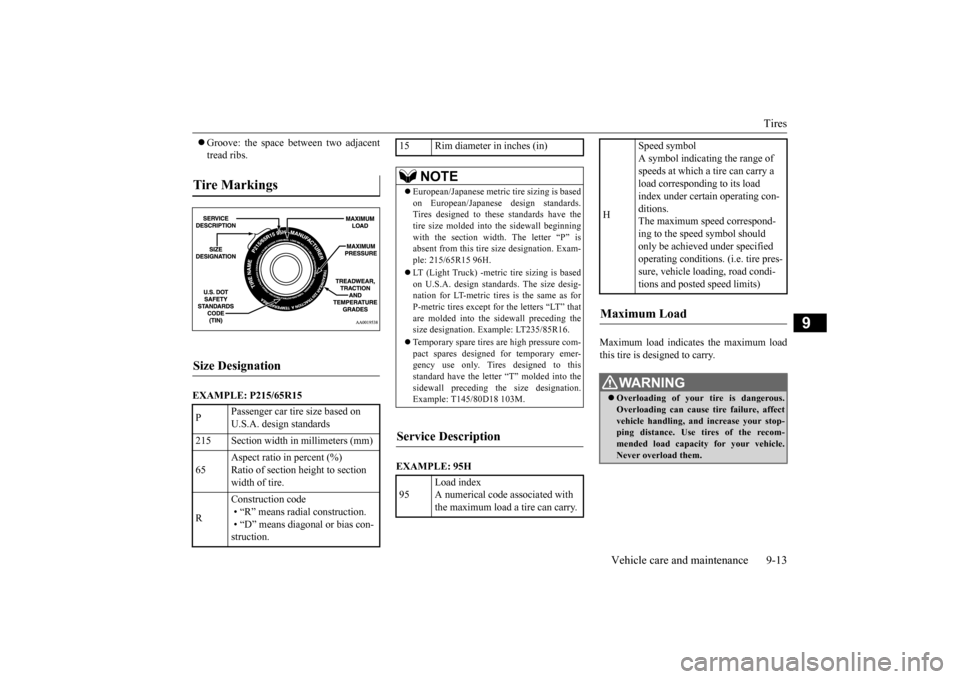
Tire Markings Size Designation P
Passenger car tir
e size based on
U.S.A. design standards
215 Section width in millimeters (mm) 65
Aspect ratio in percent (%) Ratio of section he
ight to section
width of tire.
R
Construction code • “R” means radial construction. • “D” means diagon
al or bias con-
struction.
15 Rim diameter in inches (in)
NOTE
European/Japanese metric tire sizing is based on European/Japanese design standards. Tires designed to these standards have thetire size molded into
the sidewall beginning
with the section width. The letter “P” is absent from this tire
size designation. Exam-
ple: 215/65R15 96H. LT (Light Truck) -metri
c tire sizing is based
on U.S.A. design standa
rds. The size desig-
nation for LT-metric tires is the same as for P-metric tires except for the letters “LT” thatare molded into the sidewall preceding the size designation. Example: LT235/85R16. Temporary spare tires are high pressure com- pact spares designed for temporary emer- gency use only. Tires designed to thisstandard have the letter “T” molded into the sidewall preceding th
e size designation.
Example: T145/80D18 103M.
Service Description 95
Load index A numerical code associated with the maximum load a tire can carry.
H
Speed symbol A symbol indicating the range of speeds at which a tire can carry a load corresponding to its load index under certai
n operating con-
ditions. The maximum speed correspond-ing to the speed symbol should only be achieved under specified operating conditions
. (i.e. tire pres-
sure, vehicle loading, road condi- tions and posted speed limits)
Maximum Load
WA R N I N G Overloading of your tire is dangerous. Overloading can cause tire failure, affectvehicle handling, and
increase your stop-
ping distance. Use tires of the recom- mended load capacity for your vehicle.Never overload them.
BK0212400US.book 13 ページ 2014年4月1日 火曜日 午後2時21分
Page 264 of 300
Wiper blades
Vehicle care and maintenance 9-19
9
N00940700138
Check the wiper blades occasionally. Clean them regularly to rem
ove deposits of salt and
road film. Use a sponge or cloth and a milddetergent or non-abrasive
cleaner to clean the
blades and glass areas. Replace the blades if they continue to streakor smear. If the blades are frozen to the windshield or rear window, do not operate the wipers until the ice has melted and the blades are freed, otherwise the wiper mo
tor may be damaged.
N00940800328
Your vehicle is equi
pped with an emission-
control system that meets all the requirementsof the U.S. Environm
ental Protection Agency
and Environment Canada. The emission-con- trol system is made of: a positive crankcase ventilation system an evaporative emission-control system an exhaust emission-control system
To be sure the emission-control system works properly, have your vehicle inspected andmaintained by an authorized Mitsubishi Motors dealer or a repair facility of your choice. This should be
done at the time or
mileage specified in the “WARRANTY AND MAINTENANCE MANUAL”.These, and all the other “general” mainte- nance services listed in this manual, need to be performed to keep your vehicle runningproperly and reliably. You should also have an inspection and ser- vice any time you suspect a malfunction.
N00940900228
Spark plugs must fire properly for good engine performance and emission-control. Do not reuse them by cleaning or regapping.Change them at the mileage listed in the “WARRANTY AND MAINTENANCE MANUAL”.
Wiper blades
NOTE
Do not run the wipers on dry glass for a long time. This wears out the rubber and canscratch the glass.
During cold weather Emission-control system maintenance
NOTE
To meet government
regulations and pro-
mote cleaner air, your
vehicle is equipped
with an onboard diagnostic system (OBD).The engine electroni
c control module that
controls OBD functions stores various data (especially about th
e exhaust emissions).
This data will be erased if the battery cable is disconnected, which c
ould make a rapid
diagnosis difficult. Do not disconnect thebattery cable when th
e engine malfunction
indicator (“SERVIC
E ENGINE SOON” or
“Check engine light”) is ON.
Spark plugs
NOTE
Use the spark plugs listed under “Engine specifications” on page
11-4 or plugs that are
exactly the same. Othe
r plugs could cause
engine damage, perf
ormance problems or
radio noise.
BK0212400US.book 19 ページ 2014年4月1日 火曜日 午後2時21分
Page 266 of 300
For cold and snowy weather
Vehicle care and maintenance 9-21
9
N00941800077
Check the following parts for damage and grease leaks: Ball joint boots of the front suspension and steering linkage Bellows on both ends of the drive shaft
N00942200111
The best way to keep carbon monoxide gas from entering inside your
vehicle is to have
the engine exhaust syst
em properly serviced.
Have a competent mechanic inspect the com- plete exhaust
system and nearby body areas
for broken, damaged, de
teriorated, or mispo-
sitioned parts if you not
ice any of the follow-
ing: A change in the sound of the exhaust sys- tem The smell of exhaust fumes inside the vehicle
The underside or rear of the vehicle is damaged
Also check the exhaust system each time the vehicle is raised for l
ubrication, oil changes,
or required service. Any open seams or loose connections could le
t dangerous exhaust
fumes seep into the
luggage and passenger
compartments. Check for holes or exhaust gas leaks caused by corrosion or damage. Check the joints and connections for looseness or exhaust gas leaks. Check the rubber hangers and brackets for damage.
N00942500127
The hood lock release mechanism and hood safety catch should be checked, cleaned, andoiled when needed for easy movement and to prevent rust and wear. Use Multipurpose Grease NLGI Grade 2 sparingly for all slidingparts of the hood latch and release lever. Work the grease into the hood lock mecha-
nism until all the m
ovable surfaces are cov-
ered.Also, put a light coat of the same grease on the safety catch wherev
er moving parts touch.
N00942600102
The ventilation slots in front of the wind- shield should be brus
hed clear after a heavy
snowfall so that the ope
ration of the heating
and ventilation systems
will not be impaired.
To prevent freezing of the weatherstripping on the doors, engine hood, etc., they should be treated with
silicone grease.
It is a good idea to carry a shovel or a short- handled spade in the vehicle during the win- ter so that you can clear away snow if you getstranded. A small hand-brush for sweeping
Ball joint, steering linkage seals and drive shaft boots Exhaust system
WA R N I N G Carbon monoxide gas
from your vehicle’s
exhaust is poisonous. Breathing thesefumes can cause unconsciousness or death.
Check for any of the following conditions: Hood lock release mechanism and safety catch
For cold and snowy weather Ventilation slots Weatherstripping Additional equipment (For regions where snow is encoun- tered)
BK0212400US.book 21 ページ 2014年4月1日 火曜日 午後2時21分
Page 268 of 300
Fuses
Vehicle care and maintenance 9-23
9
Some fuses may not be installed on your vehicle, depending on
the vehicle model
or specifications.
The table above shows the main equip- ment corresponding to each fuse.
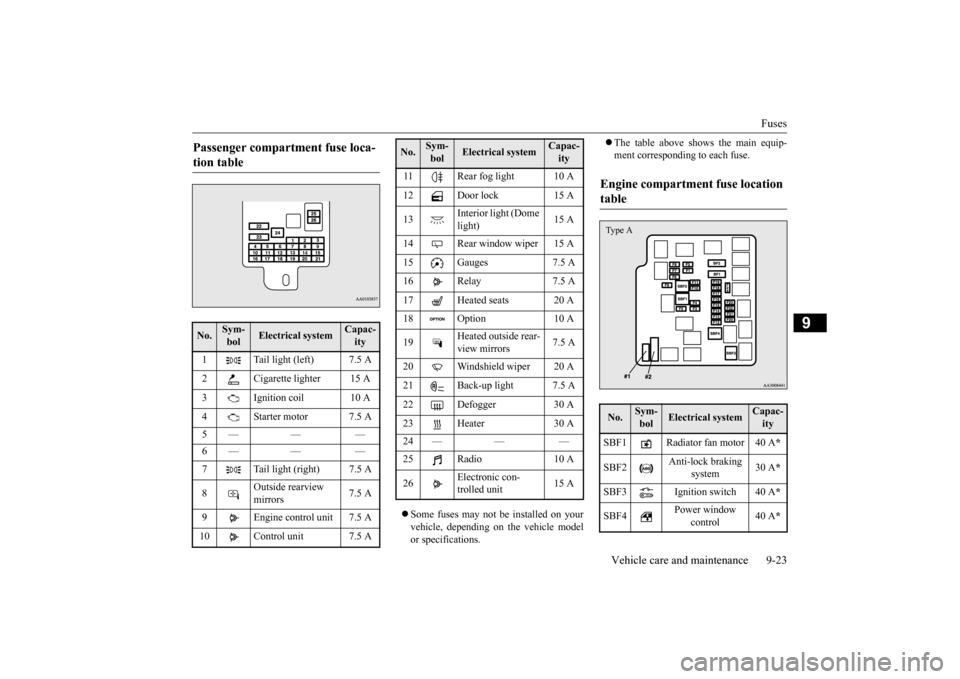
Passenger compartment fuse loca- tion table No.
Sym- bol
Electrical system
Capac-ity
1 Tail light (left) 7.5 A 2 Cigarette lighter 15 A3 Ignition coil 10 A 4 Starter motor 7.5 A 5— — — 6— — — 7 Tail light (right) 7.5 A 8
Outside rearview mirrors
7.5 A
9 Engine control unit 7.5 A 10 Control unit 7.5 A
11 Rear fog light 10 A12 Door lock 15 A 13
Interior light (Dome light)
15 A
14 Rear window wiper 15 A 15 Gauges 7.5 A16 Relay 7.5 A 17 Heated seats 20 A 18 Option 10 A 19
Heated outside rear- view mirrors
7.5 A
20 Windshield wiper 20 A 21 Back-up light 7.5 A22 Defogger 30 A 23 Heater 30 A 24 — — — 25 Radio 10 A 26
Electronic con- trolled unit
15 A
No.
Sym- bol
Electrical system
Capac-ity
Engine compartment fuse location table No.
Sym- bol
Electrical system
Capac-ity
SBF1 Radiator fan motor 40 A
*
SBF2
Anti-lock braking
system
30 A
*
SBF3 Ignition switch 40 A
*
SBF4
Power window
control
40 A
*
Type A
BK0212400US.book 23 ページ 2014年4月1日 火曜日 午後2時21分
Page 269 of 300
Fuses 9-24 Vehicle care and maintenance
9
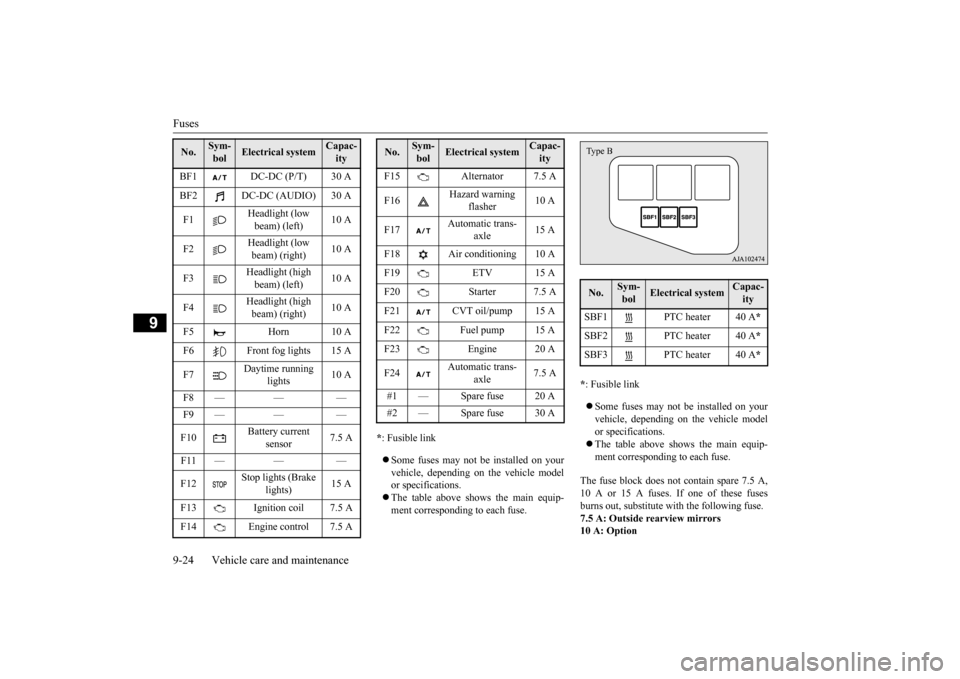
* : Fusible link Some fuses may not be installed on your vehicle, depending on
the vehicle model
or specifications. The table above show
s the main equip-
ment corresponding to each fuse.
* : Fusible link Some fuses may not be installed on your vehicle, depending on the vehicle modelor specifications. The table above shows the main equip- ment corresponding to each fuse.
The fuse block does not contain spare 7.5 A, 10 A or 15 A fuses. If one of these fuses burns out, substitute wi
th the following fuse.
7.5 A: Outside rearview mirrors10 A: Option
BF1 DC-DC (P/T) 30 A BF2 DC-DC (AUDIO) 30 A F1
Headlight (low beam) (left)
10 A
F2
Headlight (low beam) (right)
10 A
F3
Headlight (high beam) (left)
10 A
F4
Headlight (high beam) (right)
10 A
F5 Horn 10 A F6 Front fog lights 15 A F7
Daytime running
lights
10 A
F8 — — — F9 — — — F10
Battery current
sensor
7.5 A
F11 — — —F12
Stop lights (Brake
lights)
15 A
F13 Ignition coil 7.5 A F14 Engine control 7.5 ANo.
Sym- bol
Electrical system
Capac-ity
F15 Alternator 7.5 A F16
Hazard warning
flasher
10 A
F17
Automatic trans-
axle
15 A
F18 Air conditioning 10 A F19 ETV 15 AF20 Starter 7.5 A F21 CVT oil/pump 15 A F22 Fuel pump 15 A F23 Engine 20 A F24
Automatic trans-
axle
7.5 A
#1 — Spare fuse 20 A #2 — Spare fuse 30 ANo.
Sym- bol
Electrical system
Capac-ity
No.
Sym-bol
Electrical system
Capac-ity
SBF1 PTC heater 40 A
*
SBF2 PTC heater 40 A
*
SBF3 PTC heater 40 A
*
Type B
BK0212400US.book 24 ページ 2014年4月1日 火曜日 午後2時21分
Page 270 of 300
Fuses
Vehicle care and maintenance 9-25
9
15 A: Cigarette lighter When using a substitute
fuse, replace with a
fuse of the correct capa
city as soon as possi-
ble.
N00954900131
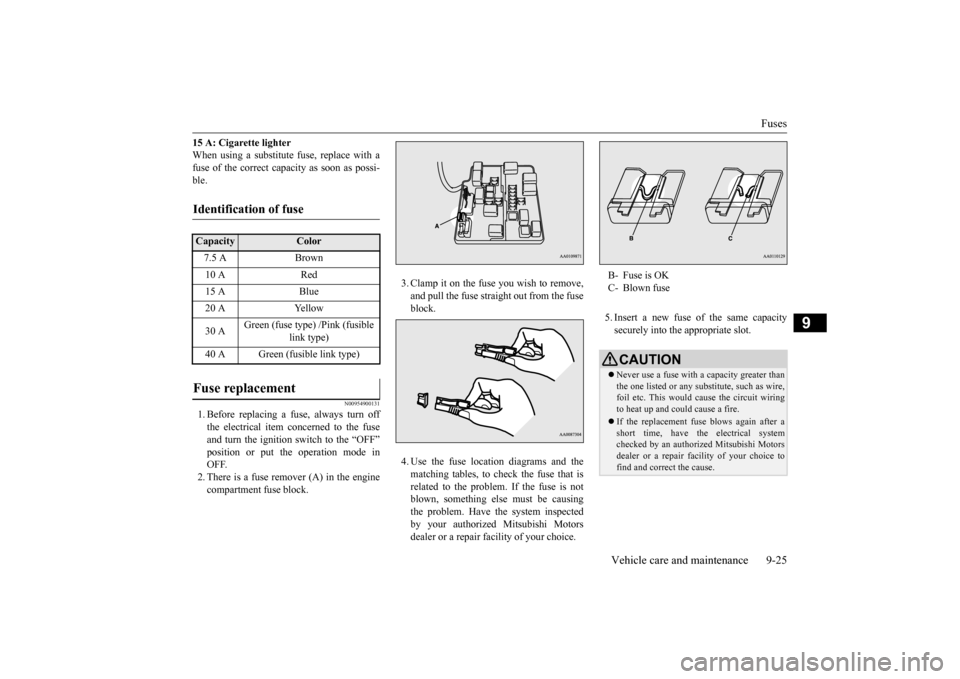
1. Before replacing a fuse, always turn off the electrical item concerned to the fuseand turn the ignition switch to the “OFF” position or put the operation mode in OFF.2. There is a fuse remover (A) in the engine compartment fuse block.
3. Clamp it on the fuse you wish to remove, and pull the fuse straight out from the fuseblock. 4. Use the fuse location diagrams and the matching tables, to check the fuse that is related to the problem. If the fuse is notblown, something else must be causing the problem. Have the system inspected by your authorized Mitsubishi Motors dealer or a repair fa
cility of your choice.
5. Insert a new fuse of the same capacity securely into the appropriate slot.
Identification of fuse Capacity
Color
7.5 A Brown 10 A Red 15 A Blue 20 A Yellow 30 A
Green (fuse type) /Pink (fusible
link type)
40 A Green (fusible link type)
Fuse replacement
B- Fuse is OK C- Blown fuseCAUTION Never use a fuse with a capacity greater than the one listed or any substitute, such as wire, foil etc. This would
cause the circuit wiring
to heat up and could cause a fire. If the replacement fuse blows again after a short time, have the electrical system checked by an authorized Mitsubishi Motors dealer or a repair fa
cility of your choice to
find and correct the cause.
BK0212400US.book 25 ページ 2014年4月1日 火曜日 午後2時21分