ECU MITSUBISHI MIRAGE 2015 6.G User Guide
[x] Cancel search | Manufacturer: MITSUBISHI, Model Year: 2015, Model line: MIRAGE, Model: MITSUBISHI MIRAGE 2015 6.GPages: 300, PDF Size: 43.44 MB
Page 42 of 300
Child restraint systems
Seat and restraint systems 4-17
4
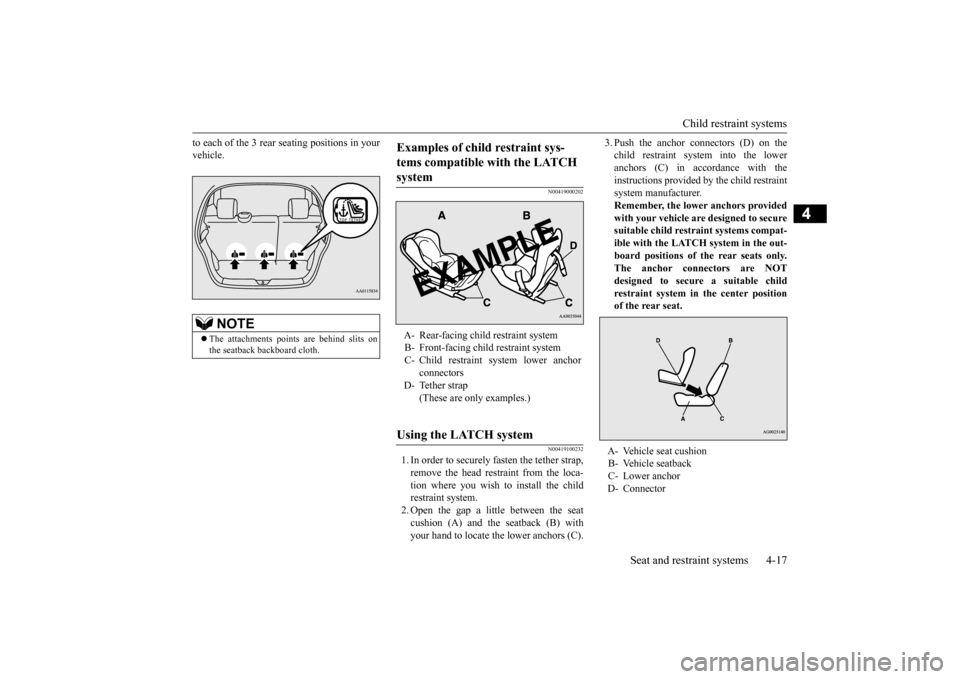
to each of the 3 rear
seating positions in your
vehicle.
N00419000202 N00419100232
1. In order to securely
fasten the tether strap,
remove the head restraint from the loca- tion where you wish to install the child restraint system.2. Open the gap a little between the seat cushion (A) and the seatback (B) with your hand to locate the lower anchors (C).
3. Push the anchor connectors (D) on the child restraint system into the loweranchors (C) in accordance with the instructions provided by the child restraint system manufacturer.Remember, the lower anchors provided with your vehicle are
designed to secure
suitable child restraint systems compat-ible with the LATCH
system in the out-
board positions of the rear seats only. The anchor connectors are NOT designed to secure a suitable child restraint system in the center positionof the rear seat.
NOTE
The attachments point
s are behind slits on
the seatback ba
ckboard cloth.
Examples of child restraint sys- tems compatible with the LATCH system A- Rear-facing child restraint system B- Front-facing child restraint system C- Child restraint system lower anchor
connectors
D- Tether strap
(These are only examples.)
Using the LATCH system
A- Vehicle seat cushion B- Vehicle seatbackC- Lower anchor D- Connector
BK0212400US.book 17 ページ 2014年4月1日 火曜日 午後2時21分
Page 43 of 300
Child restraint systems 4-18 Seat and restraint systems
4
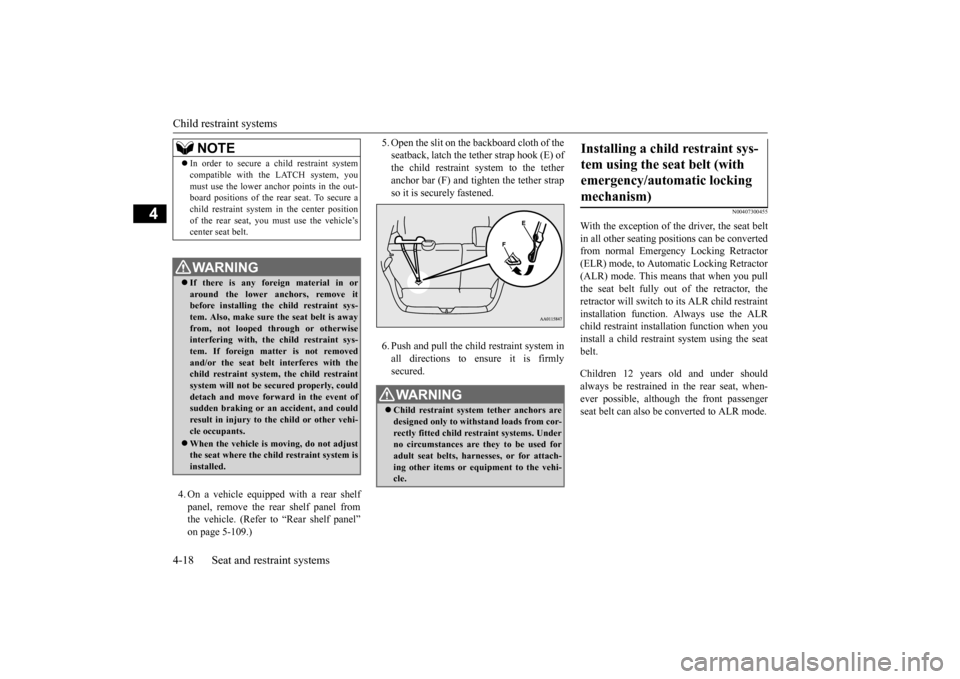
4. On a vehicle equipped with a rear shelf panel, remove the rear shelf panel from the vehicle. (Refer to “Rear shelf panel”on page 5-109.)
5. Open the slit on the backboard cloth of the seatback, latch the tether strap hook (E) ofthe child restraint system to the tether anchor bar (F) and tighten the tether strap so it is securely fastened. 6. Push and pull the child restraint system in all directions to en
sure it is firmly
secured.
N00407300455
With the exception of the driver, the seat belt in all other seating po
sitions can be converted
from normal Emergency Locking Retractor(ELR) mode, to Automatic Locking Retractor (ALR) mode. This mean
s that when you pull
the seat belt fully out of the retractor, the retractor will switch to its ALR child restraint installation function.
Always use the ALR
child restraint instal
lation function when you
install a child restraint system using the seat belt. Children 12 years old and under should always be restrained in the rear seat, when- ever possible, although the front passenger seat belt can also be
converted to ALR mode.
NOTE
In order to secure a child restraint system compatible with the LATCH system, youmust use the lower anchor points in the out-board positions of the rear seat. To secure a child restraint system in the center position of the rear seat, you mu
st use the vehicle’s
center seat belt.WA R N I N G If there is any foreign material in or around the lower anchors, remove it before installing the child restraint sys-tem. Also, make sure the seat belt is away from, not looped through or otherwise interfering with, the child restraint sys-tem. If foreign matter is not removed and/or the seat belt
interferes with the
child restraint system, the child restraintsystem will not be secured properly, could detach and move forward in the event of sudden braking or an
accident, and could
result in injury to the child or other vehi- cle occupants. When the vehicle is
moving, do not adjust
the seat where the child restraint system is installed.
WA R N I N G Child restraint system tether anchors are designed only to with
stand loads from cor-
rectly fitted child restraint systems. Under no circumstances are they to be used for adult seat belts, harnesses, or for attach-ing other items or eq
uipment to the vehi-
cle.
Installing a child restraint sys- tem using the seat belt (with emergency/auto
matic locking
mechanism)
BK0212400US.book 18 ページ 2014年4月1日 火曜日 午後2時21分
Page 44 of 300
Child restraint systems
Seat and restraint systems 4-19
4
1. Place the child restraint system on the seat where you wish to install it. To help assure proper fitting of the child restraint system, alwa
ys remove the head
restraint. 2. Route the seat belt through the child restraint system acco
rding to the instruc-
tions provided by the child restraint sys- tem’s manufacturer. Then insert the seat belt latch plate into
the buckle. Make sure
you hear a “click” when you insert the latch plate into the buckle.
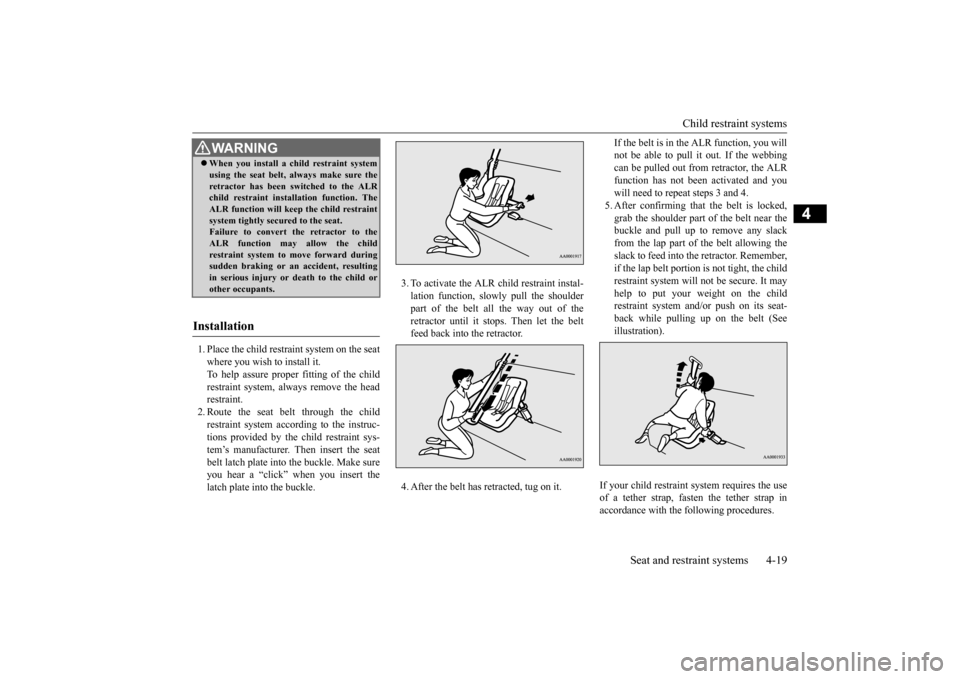
3. To activate the ALR child restraint instal- lation function, slowly pull the shoulderpart of the belt all the way out of the retractor until it stops. Then let the belt feed back into the retractor. 4. After the belt has retracted, tug on it.
If the belt is in the ALR function, you will not be able to pull it out. If the webbingcan be pulled out from retractor, the ALR function has not been activated and you will need to repeat steps 3 and 4.5. After confirming that the belt is locked, grab the shoulder part of the belt near the buckle and pull up to remove any slackfrom the lap part of the belt allowing the slack to feed into the retractor. Remember, if the lap belt portion is not tight, the child restraint system
will not be secure. It may
help to put your weight on the childrestraint system and/or push on its seat- back while pulling up on the belt (See illustration).
WA R N I N G When you install a child restraint system using the seat belt, al
ways make sure the
retractor has been switched to the ALRchild restraint installation function. The ALR function will keep the child restraint system tightly secured to the seat.Failure to convert the retractor to the ALR function may allow the child restraint system to move forward duringsudden braking
or an accide
nt, resulting
in serious injury or
death to the child or
other occupants.
Installation
If your child restraint system requires the use of a tether strap, fasten the tether strap inaccordance with the following procedures.
BK0212400US.book 19 ページ 2014年4月1日 火曜日 午後2時21分
Page 45 of 300
Maintenance and inspection of seat belts 4-20 Seat and restraint systems
4
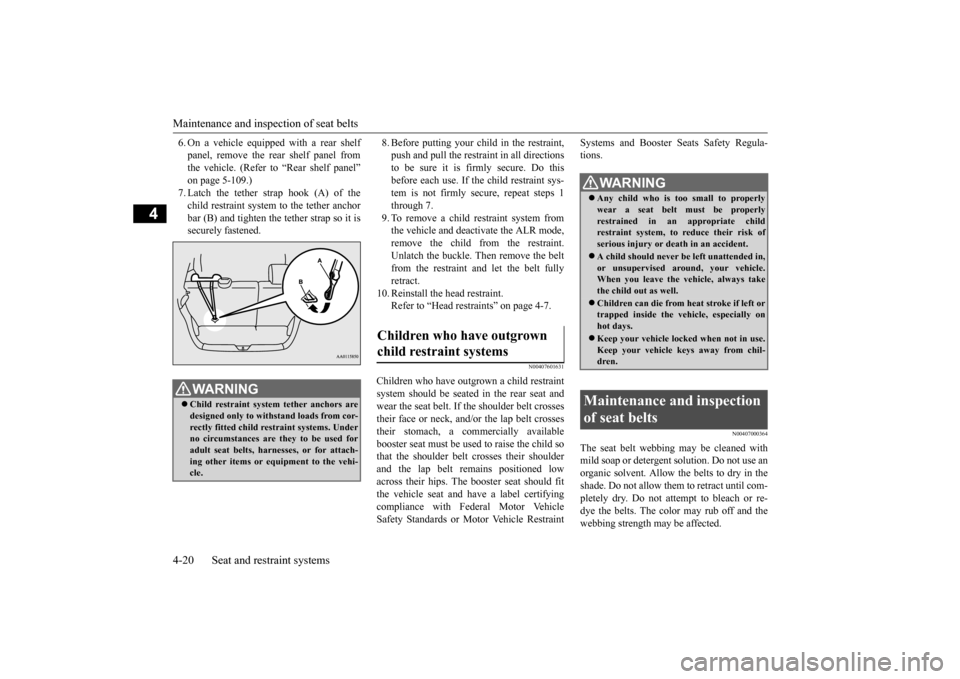
6. On a vehicle equipped with a rear shelf panel, remove the rear shelf panel fromthe vehicle. (Refer to “Rear shelf panel” on page 5-109.) 7. Latch the tether strap hook (A) of thechild restraint system to the tether anchor bar (B) and tighten the tether strap so it is securely fastened.
8. Before putting your child in the restraint, push and pull the restraint in all directionsto be sure it is firmly secure. Do this before each use. If the child restraint sys- tem is not firmly s
ecure, repeat steps 1
through 7. 9. To remove a child restraint system from the vehicle and deac
tivate the ALR mode,
remove the child from the restraint. Unlatch the buckle. Th
en remove the belt
from the restraint and let the belt fully retract.
10. Reinstall the head restraint.
Refer to “Head restraints” on page 4-7.
N00407601631
Children who have outgrown a child restraint system should be seated in the rear seat and wear the seat belt. If the shoulder belt crossestheir face or neck, and/
or the lap belt crosses
their stomach, a commercially available booster seat must be used to raise the child sothat the shoulder belt
crosses their shoulder
and the lap belt remains positioned low across their hips. The booster seat should fitthe vehicle seat and ha
ve a label certifying
compliance with Federal Motor Vehicle Safety Standards or Mo
tor Vehicle Restraint
Systems and Booster Se
ats Safety Regula-
tions.
N00407000364
The seat belt webbing may be cleaned withmild soap or detergent solution. Do not use anorganic solvent. Allow the belts to dry in the shade. Do not allow them to retract until com- pletely dry. Do not attempt to bleach or re-dye the belts. The color may rub off and the webbing strength may be affected.
WA R N I N G Child restraint system tether anchors are designed only to with
stand loads from cor-
rectly fitted child restraint systems. Under no circumstances are they to be used foradult seat belts, harnesses, or for attach- ing other items or e
quipment to the vehi-
cle.
Children who have outgrown child restraint systems
WA R N I N G Any child who is too small to properly wear a seat belt
must be properly
restrained in an appropriate child restraint system, to reduce their risk ofserious injury or de
ath in an
accident.
A child should never be
left unattended in,
or unsupervised around, your vehicle. When you leave the ve
hicle, always take
the child out as well. Children can die from heat stroke if left or trapped inside the vehicle, especially onhot days. Keep your vehicle locked when not in use. Keep your vehicle keys away from chil- dren.
Maintenance and inspection of seat belts
BK0212400US.book 20 ページ 2014年4月1日 火曜日 午後2時21分
Page 50 of 300
Supplemental Restraint System (SRS) - airbag
Seat and restraint systems 4-25
4
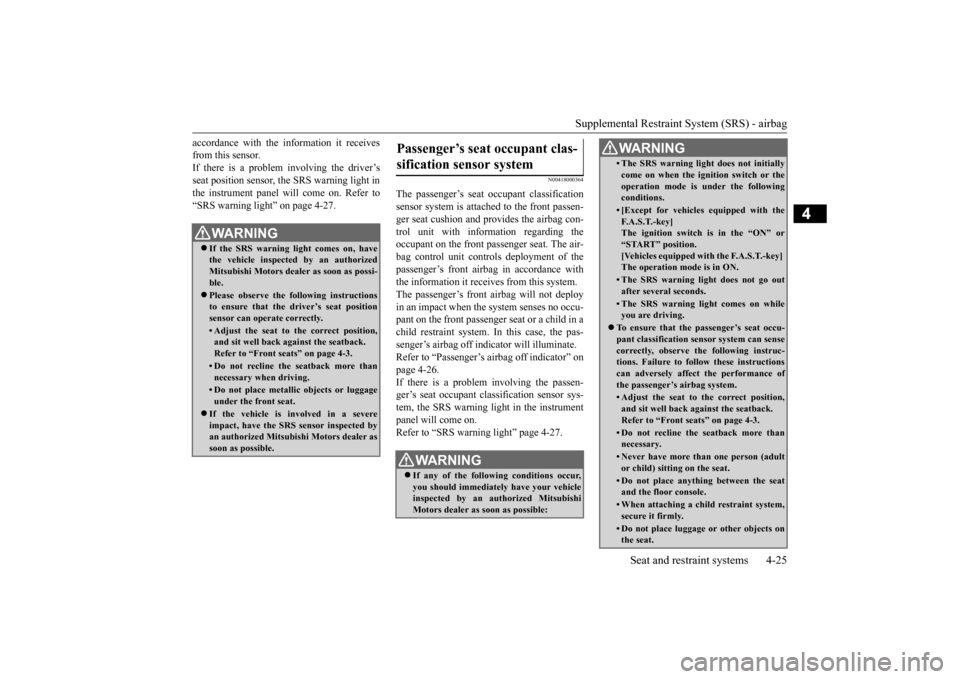
accordance with the information it receives from this sensor.If there is a problem involving the driver’s seat position sensor, the SRS warning light in the instrument panel will come on. Refer to“SRS warning light” on page 4-27.
N00418000364
The passenger’s seat oc
cupant classification
sensor system is attached to the front passen-ger seat cushion and provides the airbag con- trol unit with inform
ation regarding the
occupant on the front passenger seat. The air-bag control unit controls deployment of the passenger’s front airbag in accordance with the information it receives from this system. The passenger’s front airbag will not deploy in an impact when the system senses no occu-pant on the front passenger seat or a child in a child restraint system. In this case, the pas- senger’s airbag off indicator will illuminate.Refer to “Passenger’s airbag off indicator” on page 4-26. If there is a problem involving the passen-ger’s seat occupant cl
assification sensor sys-
tem, the SRS warning light in the instrument panel will come on.Refer to “SRS warning light” page 4-27.
WA R N I N G If the SRS warning
light comes on, have
the vehicle inspected by an authorizedMitsubishi Motors dealer as soon as possi- ble. Please observe the following instructions to ensure that the driver’s seat position sensor can operate correctly.• Adjust the seat to the correct position,and sit well back
against the seatback.
Refer to “Front seats” on page 4-3.• Do not recline the seatback more thannecessary when driving.• Do not place metallic objects or luggageunder the front seat.
If the vehicle is involved in a severe impact, have the SRS sensor inspected by an authorized
Mitsubishi Motors dealer as
soon as possible.
Passenger’s seat occupant clas- sification sensor system
WA R N I N G If any of the follow
ing conditions occur,
you should immediatel
y have your vehicle
inspected by an au
thorized Mitsubishi
Motors dealer as soon as possible:
• The SRS warning light does not initiallycome on when the ignition switch or theoperation mode is under the followingconditions.• [Except for vehicles equipped with theF. A . S . T. - k e y ] The ignition switch is in the “ON” or “START” position.[Vehicles equipped with the F.A.S.T.-key] The operation mode is in ON.• The SRS warning light does not go outafter several seconds.• The SRS warning li
ght comes on while
you are driving.
To ensure that the passenger’s seat occu- pant classification sensor system can sense correctly, observe the following instruc-tions. Failure to follow these instructions can adversely affect
the performance of
the passenger’s airbag system.• Adjust the seat to the correct position,and sit well back
against the seatback.
Refer to “Front seats” on page 4-3.• Do not recline the seatback more thannecessary.• Never have more th
an one person (adult
or child) sittin
g on the seat.
• Do not place anything between the seat and the floor console.• When attaching a child restraint system,secure it firmly.• Do not place luggage or other objects onthe seat.WA R N I N G
BK0212400US.book 25 ページ 2014年4月1日 火曜日 午後2時21分
Page 62 of 300
5
Features and controlsBreak-in recommendations ..............................................................5-2 Keys .................................................................................................5-2 Electronic immobilizer (Anti-theft starting system) ........................5-3Keyless entry system (if so equipped) ..............................................5-6 Free-hand Advanced Security
Transmitter (F.A.S.T.-key)
(if so equipped) ............................................................................5-9Door locks ......................................................................................5-24 Power door locks ......
...........
...........
...........
...........
...........
.........
.....5-26
Child safety locks for rear door ..........
...........
.........
.........
.........
.....5-27
Liftgate ...........................................................................................5-27 Manual window control (if so equipped)........................................5-28 Power window control ...................................................................5-29Parking brake .................................................................................5-31 Steering wheel height adjustment ..................................................5-32 Inside rearview mirror ...................................................................5-32Outside rearview mirrors ...............................................................5-33 Ignition switch ...............................................................................5-35 Starting the engine .........................................................................5-36Manual transaxle (if so equipped) ..................................................5-38 Continuously variable transmission
(CVT) (if so equipped)..........5-39
Service brake .................................................................................5-44Hill start assist (if so equipped) ......................................................5-45 Brake assist system ........................................................................5-46 Anti-lock braking system ...............................................................5-46Electric power steering system (EPS) ............................................5-48 Active stability control (ASC) .......................................................5-49 Cruise control (if so equipped) .......................................................5-52Tire pressure monitoring system (if so equipped) ..........................5-56
Rear-view camera (if so equipped)................................................. 5-60 Instrument cluster .......................................................................... 5-62 Multi-information display ............................................................. 5-62Indicator and warning light package ............................................. 5-70 Indicators ....................................................................................... 5-71 Warning lights ................................................................................ 5-72Combination headlights and dimmer switch ................................. 5-74 Turn signal lever ............................................................................ 5-76 Hazard warning flasher switch ...................................................... 5-77Front fog light switch (if so equipped) .......................................... 5-77 Wiper and washer switch ............................................................... 5-78 Electric rear window defogger switch ....
...........
...........
...........
...... 5-80
Horn switch ................................................................................... 5-81 Link System (if so equipped) ......................................................... 5-81 Bluetooth
® 2.0 interface (if so equipped)....................................... 5-81
USB input terminal (if so
equipped) ....
...........
.........
........
........... 5-101
Sun visors .................................................................................... 5-105 12 V power outlets ....................................................................... 5-106Interior lights ............................................................................... 5-106 Storage spaces .............................................................................. 5-107 Cup holders .................................................................................. 5-108Bottle holders ............................................................................... 5-108 Rear shelf panel (if so equipped) .................................................. 5-109 Convenience hook ............
...........
...........
...........
...........
...........
.... 5-109
Assist grips .................................................................................. 5-110
BK0212400US.book 1 ページ 2014年4月1日 火曜日 午後2時21分
Page 64 of 300
![MITSUBISHI MIRAGE 2015 6.G User Guide Electronic immobilizer (Ant
i-theft starting system)
Features and controls 5-3
5
N00509100780
[For vehicles equipped with the Free-hand Advanced Security Transmitter (F.A.S.T.-key)] For information o](/img/19/7511/w960_7511-63.png "MITSUBISHI MIRAGE 2015 6.G User Guide Electronic immobilizer (Ant
i-theft starting system)
Features and controls 5-3
5
N00509100780
[For vehicles equipped with the Free-hand Advanced Security Transmitter (F.A.S.T.-key)] For information o")
Electronic immobilizer (Ant
i-theft starting system)
Features and controls 5-3
5
N00509100780
[For vehicles equipped with the Free-hand Advanced Security Transmitter (F.A.S.T.-key)] For information on operations for vehicles equipped with the Free-hand Advanced Secu-rity Transmitter (F.A
.S.T.-key), refer to
“Free-hand Advanced
Security Transmitter
(F.A.S.T.-key): Electr
onic immobilizer (Anti-
theft starting system)” on page 5-20. [Except for vehicles e
quipped with the Free-
hand Advanced Secu
rity Transmitter
(F.A.S.T.-key)]The electronic immobilizer is designed to sig- nificantly reduce the
possibility of vehicle
theft. The purpose of the system is to immo-bilize the vehicle if an invalid start is
1- F.A.S.T.-key
(with electronic immobilizer and key- less entry system function)
2- Emergency key3- Key number plate
NOTE
The keyless entry key and F.A.S.T.-key are a precision electr
onic device wi
th a built-in
signal transmitter. Please observe the follow- ing in order to prevent damage. • Do not leave where it may be exposed to heat caused by direct sunlight, such as on top of the dashboard. • Do not take the remote
control transmitter
apart. • Do not excessively bend the key or subject it to strong impacts. • Keep the remote control transmitter dry. • Keep away from magne
tic objects such as
key rings.
• Keep away from devi
ces that produce mag-
netism, such as audio systems, computersand televisions. • Keep away from device
s that emit strong
electromagnetic waves, such as cellularphones, wireless devices and high fre- quency equipment (i
ncluding medical
devices). • Do not clean with ultrasonic cleaners. • Do not leave the key where it may be exposed to high temperature or high humid- ity.
If you lose your key, to prevent the theft of the vehicle immediatel
y contact an autho-
rized Mitsubishi Motors dealer. If you notify an authorized Mitsubishi Motors dealer of the key number, they canmake a new key. The key number is stamped on the key number plate. Keep the key num- ber plate in a safe pl
ace separate from the
key itself. No keys other than those registered in advance can be used to start the engine. Refer to “Electronic immobilizer (Anti-theft starting system)” on page 5-3.Refer to “Free-hand Advanced Security Transmitter (F.A.S.T.-key): “Electronic immobilizer (Anti-thef
t starting system)” on
page 5-20.NOTE
When the theft-alarm is in the system opera- tional status, the alarm operates if a door orliftgate is opened after using the key, thedoor lock knob or the power door lock switch to unlock the vehicle. The system does not enter the preparation status if the keyless entry system or the F.A.S.T.-key was not used to lock the vehi-cle.
Electronic immobilizer (Anti-theft starting system)
NOTE
BK0212400US.book 3 ページ 2014年4月1日 火曜日 午後2時21分
Page 65 of 300
Electronic immobilizer (Anti-theft starting system) 5-4 Features and controls
5
attempted. A valid st
art attempt can only be
achieved (subject to ce
rtain conditions) using
a key “registered” to the immobilizer system. All of the keys provided with your new vehi- cle have been program
med to the vehicle’s
electronics.
Only keys that have been programmed to the vehicle’s electronics can be used to start thevehicle. If you lose the key, you can order a key from your authorized Mitsubi
shi Motors dealer by
referring to the key number.To prevent vehicle theft, the ID code for the vehicle keys must be changed. Take your vehicle and all remaining keys toyour authorized Mitsubishi Motors dealer to have your ID code changed.
NOTE
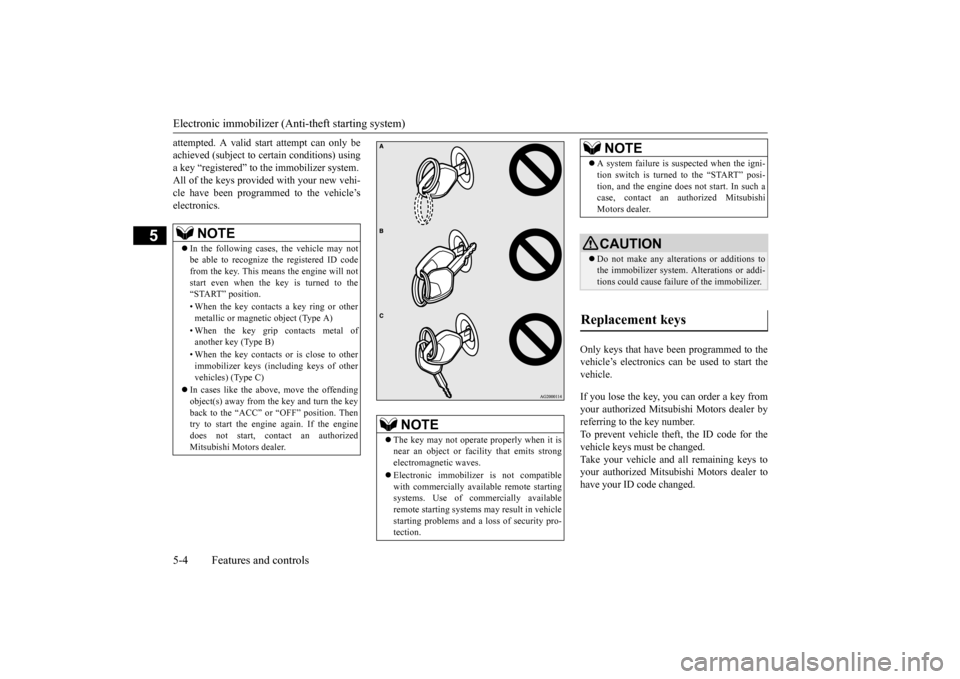
In the following cases, the vehicle may not be able to recognize
the registered ID code
from the key. This mean
s the engine will not
start even when the key is turned to the “START” position. • When the key contacts a key ring or other metallic or magnet
ic object (Type A)
• When the key grip contacts metal of another key (Type B) • When the key contacts
or is close to other
immobilizer keys (inc
luding keys of other
vehicles) (Type C)
In cases like the above, move the offending object(s) away from the key and turn the key back to the “ACC” or
“OFF” position. Then
try to start the engine again. If the enginedoes not start, cont
act an authorized
Mitsubishi Motors dealer.
NOTE
The key may not operate
properly when it is
near an object or facility that emits strong electromagnetic waves. Electronic immobilizer is not compatible with commercially available remote startingsystems. Use of commercially available remote starting systems may result in vehicle starting problems and a loss of security pro-tection.
A system failure is suspected when the igni- tion switch is turned to the “START” posi-tion, and the engine does
not start. In such a
case, contact an au
thorized Mitsubishi
Motors dealer.CAUTION Do not make any altera
tions or additions to
the immobilizer system.
Alterations or addi-
tions could cause failure of the immobilizer.
Replacement keys
NOTE
BK0212400US.book 4 ページ 2014年4月1日 火曜日 午後2時21分
Page 70 of 300
Free-hand Advanced Securi
ty Transmitter (F.A.S.T.-key) (if so equipped)
Features and controls 5-9
5
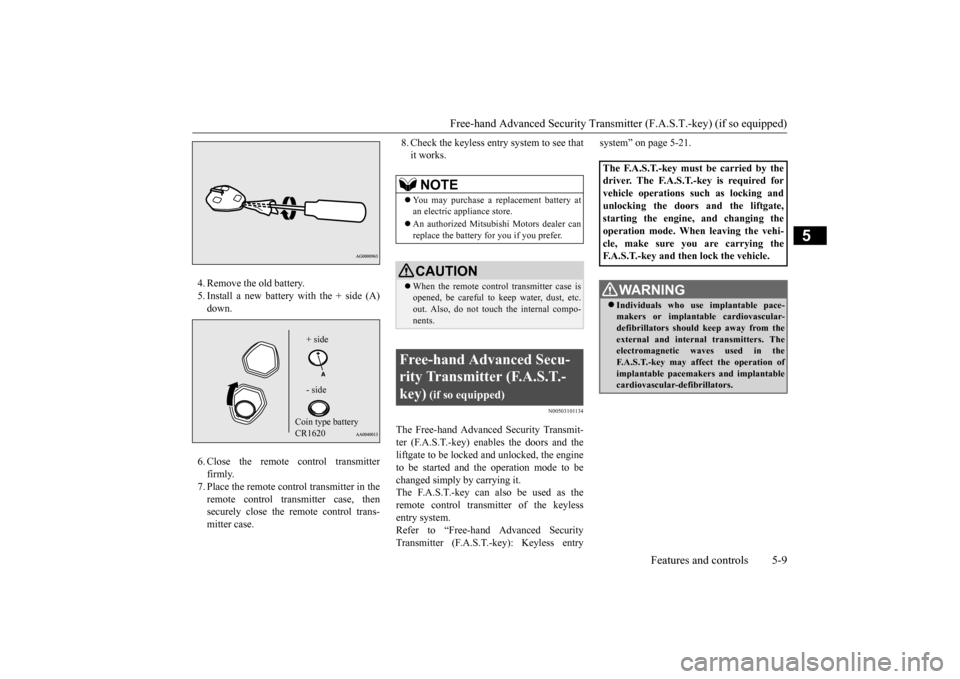
4. Remove the old battery. 5. Install a new battery with the + side (A)down. 6. Close the remote control transmitter firmly. 7. Place the remote control transmitter in the remote control transmitter case, then securely close the remote control trans-mitter case.
8. Check the keyless entry system to see that it works.
N00503101134
The Free-hand Advanced Security Transmit-ter (F.A.S.T.-key) enables the doors and theliftgate to be locked and unlocked, the engine to be started and the operation mode to be changed simply by carrying it.The F.A.S.T.-key can also be used as the remote control transmitter of the keyless entry system.Refer to “Free-hand Advanced Security Transmitter (F.A.S.T.-
key): Keyless entry
system” on page 5-21.
+ side - side Coin type battery CR1620
NOTE
You may purchase a replacement battery at an electric appliance store. An authorized Mitsubishi Motors dealer can replace the battery for you if you prefer.CAUTION When the remote control transmitter case is opened, be careful to
keep water, dust, etc.
out. Also, do not touch the internal compo-nents.
Free-hand Advanced Secu- rity Transmitter (F.A.S.T.-key)
(if so equipped)
The F.A.S.T.-key must be carried by the driver. The F.A.S.T.-key is required for vehicle operations su
ch as locking and
unlocking the doors and the liftgate,starting the engine, and changing the operation mode. When
leaving the vehi-
cle, make sure you are carrying theF.A.S.T.-key and then lock the vehicle.
WA R N I N G Individuals who use
implantable pace-
makers or implanta
ble cardiovascular-
defibrillators
should keep away from the
external and internal
transmitters. The
electromagnetic waves used in the F.A.S.T.-key may affect the operation of implantable pacemakers and implantablecardiovascular-defibrillators.
BK0212400US.book 9 ページ 2014年4月1日 火曜日 午後2時21分
Page 71 of 300
Free-hand Advanced
Security Transmitter (F.A.S
.T.-key) (if so equipped)
5-10 Features and controls
5
The operations possible with the F.A.S.T.- key can be modified
as stated below.
(Keyless entry operations are possible.) For details, contact an authorized Mitsubishi Motors dealer.• Enabling only the locking and unlocking of the doors and the liftgate • Enabling only the starting of the engine• Deactivating the F.A.S.T.-key
N00503200167
When a person enters the operating range ofthe F.A.S.T.-key while carrying the F.A.S.T.- key and presses the driver’s door lock/unlock switch the liftgate switch, verification of theID code is performed. The doors and the liftgate can only be locked and unlocked, the engine
can only be started
and the operation mode can only be changed when the ID codes of the vehicle and F. A . S . T. - k e y m a t c h .
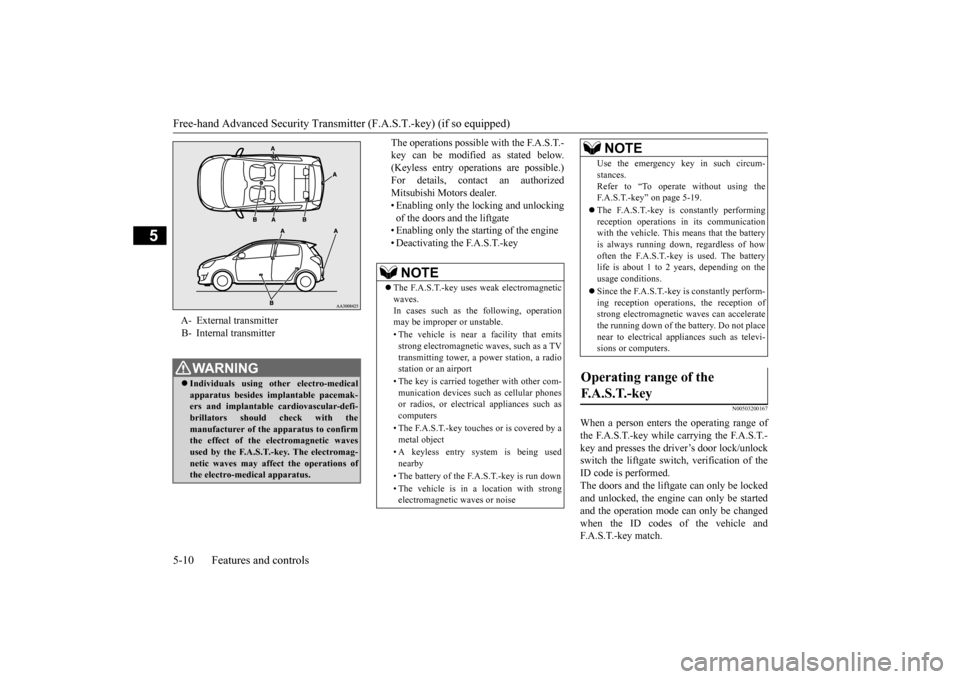
A- External transmitter B- Internal transmitterWA R N I N G Individuals using ot
her electro-medical
apparatus besides implantable pacemak- ers and implantable
cardiovascular-defi-
brillators should check with themanufacturer of the apparatus to confirm the effect of the electromagnetic waves used by the F.A.S.T.-key. The electromag-netic waves may affect
the operations of
the electro-medical apparatus.
NOTE
The F.A.S.T.-key uses weak electromagnetic waves.In cases such as the following, operation may be imprope
r or unstable.
• The vehicle is near a facility that emits strong electroma
gnetic waves, such as a TV
transmitting tower, a pow
er station, a radio
station or an airport • The key is carried together with other com- munication devices such
as cellular phones
or radios, or electrical appliances such as computers • The F.A.S.T.-key touches or is covered by a metal object • A keyless entry system is being used nearby • The battery of the F.A.S.T.-key is run down • The vehicle is in a location with strong electromagnetic
waves or noise
Use the emergency key in such circum- stances.Refer to “To operate
without using the
F.A.S.T.-key” on page 5-19. The F.A.S.T.-key is constantly performing reception operations
in its communication
with the vehicle. This means that the battery is always running down, regardless of howoften the F.A.S.T.-key is used. The battery life is about 1 to 2 years, depending on the usage conditions. Since the F.A.S.T.-key is constantly perform- ing reception operati
ons, the reception of
strong electrom
agnetic waves
can accelerate
the running down of the
battery. Do not place
near to electrical appliances such as televi-sions or computers.
Operating range of the F. A . S . T. - k e y
NOTE
BK0212400US.book 10 ページ 2014年4月1日 火曜日 午後2時21分