Gas MITSUBISHI MIRAGE 2015 6.G User Guide
[x] Cancel search | Manufacturer: MITSUBISHI, Model Year: 2015, Model line: MIRAGE, Model: MITSUBISHI MIRAGE 2015 6.GPages: 300, PDF Size: 43.44 MB
Page 128 of 300
Multi-information display
Features and controls 5-67
5
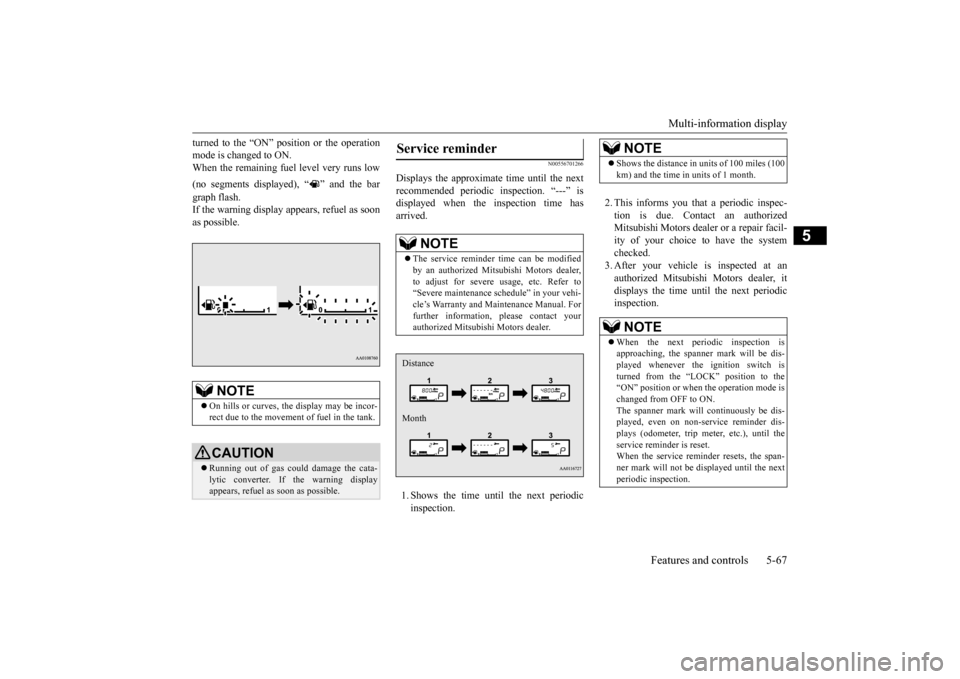
turned to the “ON” position or the operation mode is changed to ON.When the remaining fuel level very runs low (no segments displayed), “ ” and the bar graph flash. If the warning display appears, refuel as soonas possible.
N00556701266
Displays the approximate time until the next recommended periodic
inspection. “---” is
displayed when the inspection time hasarrived. 1. Shows the time until
the next periodic
inspection.
2. This informs you that a periodic inspec- tion is due. Contact an authorized Mitsubishi Motors dealer
or a repair facil-
ity of your choice to have the system checked. 3. After your vehicle
is inspected at an
authorized Mitsubishi Motors dealer, it displays the time unt
il the next periodic
inspection.
NOTE
On hills or curves, the display may be incor- rect due to the movement of fuel in the tank.CAUTION Running out of gas could damage the cata- lytic converter. If the warning display appears, refuel as soon as possible.
Service reminder
NOTE
The service reminder time can be modified by an authorized Mitsubishi Motors dealer,to adjust for severe usage, etc. Refer to “Severe maintenance sc
hedule” in your vehi-
cle’s Warranty and Ma
intenance Manual. For
further information,
please contact your
authorized Mitsubishi Motors dealer.Distance Month
NOTE
Shows the distance in units of 100 miles (100 km) and the time in units of 1 month.NOTE
When the next periodic inspection is approaching, the spanne
r mark will be dis-
played whenever the ignition switch is turned from the “LOCK” position to the “ON” position or when
the operation mode is
changed from OFF to ON. The spanner mark will
continuously be dis-
played, even on non-service reminder dis-plays (odometer, trip meter, etc.), until the service reminder is reset. When the service reminder resets, the span-ner mark will not be
displayed until the next
periodic inspection.
BK0212400US.book 67 ページ 2014年4月1日 火曜日 午後2時21分
Page 175 of 300
Safe driving techniques 6-4 Driving safety
6
Replace your tires before they are heavily worn out.On vehicles equipped with a tire pressure monitoring system, there
is a risk of damage
to the tire inflation pressure sensors when thetire is replaced on the
rim. Tire replacement
should, only be perform
ed by an authorized
Mitsubishi Motors dealer. Have someone watch while you turn all the exterior lights on and off. Also check the turn signal indicators and hi
gh-beam indicators on
the instrument panel. Check the ground under the vehicle after parking overnight, for
fuel, water, oil, or
other leaks. Make sure
all the fluid levels are
correct. Also, if you
can smell fuel, you need
to find out why imme
diately and have it
fixed.
N00629200137
Even this vehicle’s sa
fety equipment, and
your safest driving, ca
nnot guarantee that you
can avoid an accident or injury. However, if
you give extra attention to the following areas, you can better protect yourself andyour passengers: Drive defensively. Be aware of traffic, road and weather c
onditions. Leave plenty
of stopping distance
between your vehicle
and the vehicle ahead. Before changing lanes, check your mir- rors, your blind spots, and use your turn-signal light. While driving, watch the behavior of other drivers, bicycl
ists, and pedestrians.
Always obey applicab
le laws and regula-
tions. Be a polite and alert driver. Alwaysleave room for unexpected events, such as sudden braking. If you plan to drive in another country, obey their vehicle re
gistration laws and
make sure you will be able to get the right fuel.
N00629400474
Check the battery. At the same time, check the terminals and wiring. Duringextremely cold weather, the battery will not be as strong. Also, the battery power level may drop beca
use more power is
used for cold starting and driving.
Before driving the vehicle, check to see if the engine runs at the proper speed and ifthe headlights are as bright as normally. Charge or replace the battery if necessary. During extreme cold weather, it is possi-ble that a very low battery could freeze. Warm the engine sufficiently. After start- ing the engine, allow a short warm-up time to distribute oil to all cylinders. Then drive your vehicle slowly. Stay at low speeds at first so that the man- ual transaxle oil or the automatic transaxle fluid has time to spread to all the lubrica-tion points. Manual transaxle can be harder to shift in cold weather conditions. This is normaland shifting will get easier as the transaxle warms up. Check the engine antifreeze. If there is not enough coolant because of a leak or from engine overheating, add Mitsubishi Motors Genuine Super LongLife Coolant Premium or equivalent.
Lights Fluid leaks Safe driving techniques
Driving during cold weather
WA R N I N G The battery gives off explosive hydrogen gas. Any spark or flame can cause the bat- tery to explode, which could cause serious injury or death.Always wear protecti
ve clothes and a face
mask when working wi
th your battery, or
let a skilled mechanic do it.
BK0212400US.book 4 ページ 2014年4月1日 火曜日 午後2時21分
Page 227 of 300
If the vehicle breaks down 8-2 For emergencies
8
N00836300233
If your vehicle breaks down on the road, move to the shoulder and turn on the hazard warning flashers. If there is no shoulder, orthe shoulder is not safe, drive in the right lane slowly with the haza
rd lights flashing until
you come to a safe stopping place. Keep theflashers flashing. If the engine stops, there will be no power assist to the steering and brakes, making these difficult to use. The brake booster will not work, so the brakes will not grip well. The brake pedal will be harder to press than usual. Since there is no power steering assist, the steering wheel will be hard to turn.
Get help from your passengers, bystanders, etc. to push the vehicle
and move it to a safe
area.
N00836400768
If the engine cannot be started because the battery is weak or de
ad, you can start it with
the battery from anothe
r vehicle using jumper
cables. 1. Take off any metal jewelry such as watch bands or bracelets th
at might create an
accidental electrical contact. 2. Position the vehi
cles close enough
together so that the jumper cables canreach, but be sure the vehicles aren’t touching each other.
3. You could be injured if the vehicles move. Set the parking brake firmly on each vehi- cle. Put an automatic transaxle or CVT in “P” (PARK) or a manual transaxle in “N”(Neutral). 4. Turn the ignition switch to the “OFF” position or put the operation mode inOFF. 5. Make sure your battery electrolyte is at the proper level. (Refer to “Battery” on page 9-10.)
If the vehicle breaks down If the engine stops/fails When the engine fails at the intersection
Jump-starting the engine
WA R N I N G To reduce the risk of igniting flammable gas that may be emitted from the battery,carefully read this section before jump- starting the vehicle. Do not try to start you
r vehicle by pushing
or towing. This can cause an accident resulting in serious
injury or death and
can damage the vehicle.NOTE
Do not use jumper cables if they have dam- age or corrosion.
CAUTION Check the other vehicle.
It must have a 12-
volt battery. If the other system isn’t 12-volt,both systems can be damaged.NOTE
Turn off all lights, heat
er, and othe
r electrical
loads. This will avoid sparks and help save both batteries.WA R N I N G If the electrolyte fluid is not visible, or looks frozen, DO NOT ATTEMPT JUMPSTARTING!! The battery might spli
t open or explode if
the temperature is below the freezingpoint or if it is not filled to the proper level.
BK0212400US.book 2 ページ 2014年4月1日 火曜日 午後2時21分
Page 228 of 300
Jump-starting the engine For emergencies 8-3
8
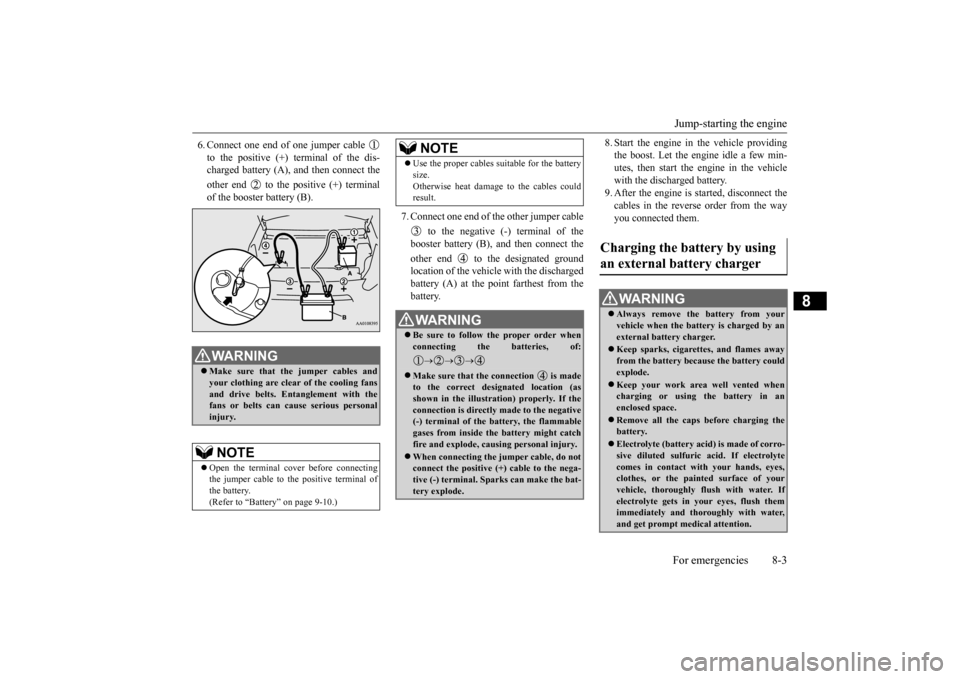
6. Connect one end of one jumper cable to the positive (+) terminal of the dis- charged battery (A),
and then connect the
other end to the positive (+) terminal of the booster battery (B).
7. Connect one end of the other jumper cable
to the negative (-) terminal of the booster battery (B), and then connect the other end to the designated ground location of the vehicle with the dischargedbattery (A) at the point farthest from the battery.
8. Start the engine in the vehicle providing the boost. Let the engine idle a few min-utes, then start the engine in the vehicle with the discharged battery. 9. After the engine is
started, disconnect the
cables in the reverse order from the way you connected them.
WA R N I N G Make sure that the jumper cables and your clothing are clear of the cooling fansand drive belts. Entanglement with the fans or belts can cause serious personal injury.NOTE
Open the terminal co
ver before connecting
the jumper cable to the positive terminal ofthe battery. (Refer to “Battery” on page 9-10.)
Use the proper cables suitable for the battery size.Otherwise heat damage
to the cables could
result.WA R N I N G Be sure to follow the proper order when connecting the batteries, of:
Make sure that the connection is made to the correct designated location (asshown in the illustration) properly. If the connection is directly made to the negative (-) terminal of the battery, the flammablegases from inside the battery might catch fire and explode, caus
ing personal injury.
When connecting the jumper cable, do not connect the positive (+) cable to the nega- tive (-) terminal. Sparks can make the bat-tery explode.NOTE
Charging the battery by using an external battery charger
WA R N I N G Always remove the battery from your vehicle when the battery is charged by an external battery charger. Keep sparks, cigarettes, and flames away from the battery because the battery couldexplode. Keep your work area well vented when charging or using
the battery in an
enclosed space. Remove all the caps
before charging the
battery. Electrolyte (battery acid) is made of corro- sive diluted sulfuric acid. If electrolyte comes in contact with your hands, eyes,clothes, or the pain
ted surface of your
vehicle, thoroughly flush with water. If electrolyte gets in your eyes, flush themimmediately and thoroughly with water, and get prompt medical attention.
BK0212400US.book 3 ページ 2014年4月1日 火曜日 午後2時21分
Page 248 of 300
Catalytic converter
Vehicle care and maintenance 9-3
9
N00937400450
The catalytic converter requires you to use unleaded fuel only. Leaded gasoline will destroy the emission-c
ontrol effectiveness of
the converter. Normally, the catalyti
c converter does not
require maintenance. However, it is important to keep the engine properly tuned for the con- verter to continue to work properly.
To reduce the possibili
ty of catalytic con-
verter damage: Use UNLEADED GASOLINE ONLY of the type of recommended in the “Fuel selection”. Do not drive with an extremely low fuel level. Running out of gas could damage the catalytic converter. Do not try to start the engine by pushing or towing the vehicle. If the battery is weak or run down, use jumper cables toproperly start the engine.
Do not idle the engine with any spark plug wires disconnected or
removed, such as
when performing diagnostic tests. Do not idle the engine for a long time if it is idling roughly or otherwise obviouslymalfunctioning. To prevent the catalytic converter from being damaged from unburned gas, do notrace the engine when stopping the engine. Stop driving the vehicle if you think the performance is noticeably low, or the engine has a malfunction such as with the ignition, etc. If you are not able to stopdriving immediately, slow down and drive for only a short time.
Have your vehicle
checked at an authorized MitsubishiMotors dealer or a repair facility of your choice as soon
as possible.
In unusual situations involving major engine problems, a burning odor may indicate severe a
nd abnormal catalytic
converter overheating. If this occurs, stopin a safe place, shut
the engine off and let
the vehicle cool. Once the engine is cool, immediately take your
vehicle to a dealer
or a repair facility of
your choice for ser-
vice.
WA R N I N G Set a garage jack only at the position shown here. If the gar
age jack is set a
wrong position, it could damage yourvehicle and/or your
vehicle might fall
from the jack causing injury or death. Do not use the jack on a tilted or soft sur- face. Otherwise, the jack might slip and causepersonal injury. Always
use the jack on a
flat, hard surface. Before setting the jack, make sure there are no sand or pebblesunder the jack base.
Catalytic converter
CAUTION Damage to the catalytic
converter can result
if your vehicle is not
kept in proper operating
condition. If the engine
malfunctions or mis-
fires, or if your vehi
cle performance suffers,
have it serviced
promptly. Running your
vehicle when it is ove
rheated may result in
damage to the conve
rter and vehicle.
WA R N I N GDo not park or run your vehicle in areas where combustible materials such as dry grass or leaves can come
in contact with a
hot exhaust, since a fire could occur. Do not put undercoat paint on the cata- lytic converter.
BK0212400US.book 3 ページ 2014年4月1日 火曜日 午後2時21分
Page 266 of 300
For cold and snowy weather
Vehicle care and maintenance 9-21
9
N00941800077
Check the following parts for damage and grease leaks: Ball joint boots of the front suspension and steering linkage Bellows on both ends of the drive shaft
N00942200111
The best way to keep carbon monoxide gas from entering inside your
vehicle is to have
the engine exhaust syst
em properly serviced.
Have a competent mechanic inspect the com- plete exhaust
system and nearby body areas
for broken, damaged, de
teriorated, or mispo-
sitioned parts if you not
ice any of the follow-
ing: A change in the sound of the exhaust sys- tem The smell of exhaust fumes inside the vehicle
The underside or rear of the vehicle is damaged
Also check the exhaust system each time the vehicle is raised for l
ubrication, oil changes,
or required service. Any open seams or loose connections could le
t dangerous exhaust
fumes seep into the
luggage and passenger
compartments. Check for holes or exhaust gas leaks caused by corrosion or damage. Check the joints and connections for looseness or exhaust gas leaks. Check the rubber hangers and brackets for damage.
N00942500127
The hood lock release mechanism and hood safety catch should be checked, cleaned, andoiled when needed for easy movement and to prevent rust and wear. Use Multipurpose Grease NLGI Grade 2 sparingly for all slidingparts of the hood latch and release lever. Work the grease into the hood lock mecha-
nism until all the m
ovable surfaces are cov-
ered.Also, put a light coat of the same grease on the safety catch wherev
er moving parts touch.
N00942600102
The ventilation slots in front of the wind- shield should be brus
hed clear after a heavy
snowfall so that the ope
ration of the heating
and ventilation systems
will not be impaired.
To prevent freezing of the weatherstripping on the doors, engine hood, etc., they should be treated with
silicone grease.
It is a good idea to carry a shovel or a short- handled spade in the vehicle during the win- ter so that you can clear away snow if you getstranded. A small hand-brush for sweeping
Ball joint, steering linkage seals and drive shaft boots Exhaust system
WA R N I N G Carbon monoxide gas
from your vehicle’s
exhaust is poisonous. Breathing thesefumes can cause unconsciousness or death.
Check for any of the following conditions: Hood lock release mechanism and safety catch
For cold and snowy weather Ventilation slots Weatherstripping Additional equipment (For regions where snow is encoun- tered)
BK0212400US.book 21 ページ 2014年4月1日 火曜日 午後2時21分
Page 271 of 300
Replacement of light bulbs 9-26 Vehicle care and maintenance
9
N00942900349
Before replacing the bulb, be sure the light is off. Do not touch the glass part of the new bulb with your bare fingers; the oil from yourskin will stay on the glass and dim or destroy the bulb when it gets hot.
N00943000132
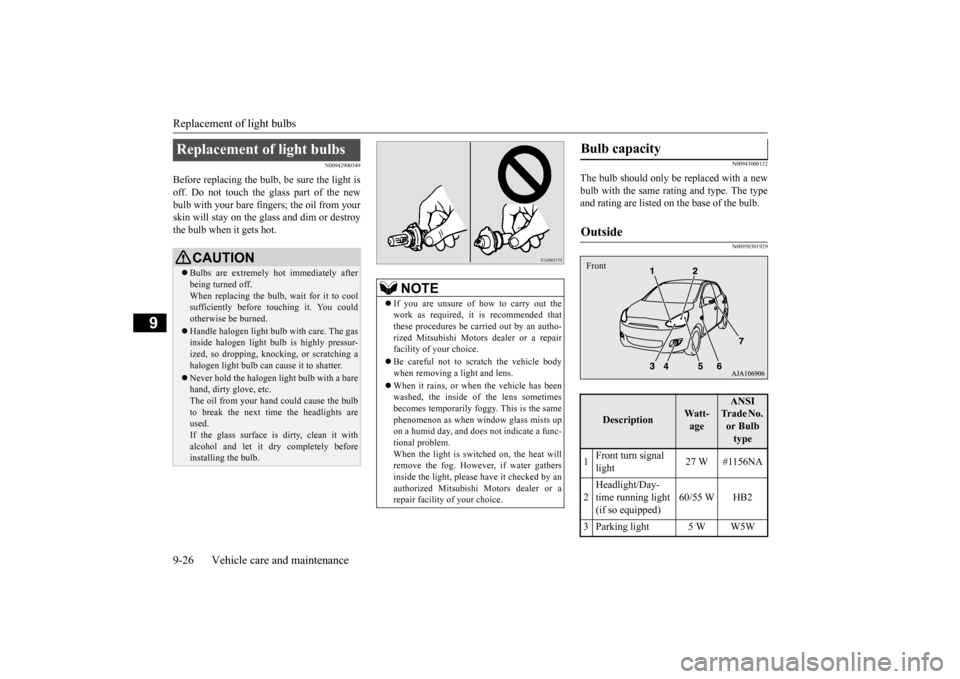
The bulb should only be replaced with a newbulb with the same rating and type. The type and rating are listed on the base of the bulb.
N00950301929
Replacement of light bulbs
CAUTION Bulbs are extremely hot immediately after being turned off. When replacing the bulb, wait for it to coolsufficiently before t
ouching it. You could
otherwise be burned. Handle halogen light bul
b with care. The gas
inside halogen light
bulb is highly pressur-
ized, so dropping, knocking, or scratching ahalogen light bulb can
cause it to shatter.
Never hold the halogen
light bulb with a bare
hand, dirty glove, etc. The oil from your hand could cause the bulb to break the next ti
me the headlights are
used. If the glass surface is dirty, clean it with alcohol and let it dr
y completely before
installing the bulb.
NOTE
If you are unsure of how to carry out the work as required, it is recommended that these procedures be ca
rried out by an autho-
rized Mitsubishi Motors dealer or a repairfacility of your choice. Be careful not to scratch the vehicle body when removing a light and lens. When it rains, or wh
en the vehicle has been
washed, the inside of the lens sometimes becomes temporarily foggy. This is the same phenomenon as when window glass mists upon a humid day, and does not indicate a func- tional problem. When the light is switched on, the heat willremove the fog. However, if water gathers inside the light, please
have it checked by an
authorized Mitsubishi Motors dealer or arepair facility of your choice.
Bulb capacity Outside
Description
Wa t t- age
ANSI Tr a d e N o . or Bulb type
1
Front turn signal light
27 W #1156NA
2
Headlight/Day- time running light (if so equipped)
60/55 W HB2
3 Parking light 5 W W5WFront
BK0212400US.book 26 ページ 2014年4月1日 火曜日 午後2時21分
Page 277 of 300
Cleaning the inside of your vehicle 9-32 Vehicle care and maintenance
9
These can all be dangerous, and they all can damage your vehicle.
N00945200095
After washing the inside of your vehicle withany cleaner, wipe it dry in a shady, well venti- lated area.
N00945300142
1. Lightly wipe these off with a soft clothsoaked in a 3% solution of gentle soap and water. 2. To rinse, dip the cloth in fresh water,wring it out well, and wipe off all the soap.
N00945500128
1. To maintain the value of your new vehi- cle, maintain the upholstery carefully andkeep the interior clean. Use a vacuum cleaner
and brush to clean
the seats. If stained,
vinyl and synthetic
leather should be cleaned with an appro- priate cleaner. Cloth fabrics can be cleaned with either upholstery cleaner or a3% solution of gentle soap in lukewarm water. 2. Clean the carpeting with a vacuumcleaner and remove any stains with carpet cleaner. Oil and grea
se can be removed by
lightly dabbing with
a clean white cloth
and spot remover.
CAUTION Cleaning products can be dangerous. Some are poisonous and othe
rs are highly flamma-
ble. Some are dangerous if you breathe theirfumes in a closed space. When you use any- thing in a container to
clean your vehicle, be
sure to follow the instructions. Always openyour vehicle doors or windows when you’re cleaning the inside. Never use the following chemicals to clean your vehicle:• Gasoline• Carbon Tetrachloride• Benzine• Kerosene• Naphtha• Acetone• Turpentine• Paint Thinner• Lacquer Thinner• Nail Polish Remover
Cleaning the inside of your vehicle
CAUTION Do not use organic s
ubstances (solvents,
benzine, kerosene, alc
ohol, gasoline, etc.) or
alkaline or acidic solutions.These chemicals can
cause discoloring,
staining or cracki
ng of the surface.
If you use cleaners or polishing agents, makesure their ingredients do not include the sub- stances mentioned above.NOTE
Always read the instru
ctions on the cleaner
label.
Plastic, vinyl leat
her, fabric and
flocked parts
NOTE
Do not use cleaners,
conditioners, and pro-
tectants containing
silicones or wax.
Such products, when applied to the instru-ment panels or other pa
rts, may cause reflec-
tions on the windshiel
d and obscure vision.
Also, if such products get on the switches ofthe electrical accessories, it may lead to fail- ure of these accessories.
Upholstery
BK0212400US.book 32 ページ 2014年4月1日 火曜日 午後2時21分
Page 278 of 300
Cleaning the outside of your vehicle Vehicle care and maintenance 9-33
9
N00945600187
1. To clean, lightly wi
pe the leather with a
soft cloth soaked in a 5% solution of gen- tle soap and water.2. To rinse, dip the cloth in fresh water, wring it out well, and wipe off all the soap.3. To preserve and protect, use a leather pro- tecting agent on the genuine leather sur- face.
N00945700058
To protect your vehicle’s
finish, wash it often
and thoroughly. If desired, you may wax your vehicle using a nonabrasive automobile wax.
N00945800033
Industrial pollution, road tar, bird droppings,tree sap, insect remain
s, sea water and other
foreign matters can damage the finish on yourvehicle. Generally, the longer any foreign material stays on the finish, the worse the damage.Wash your vehicle as soon as possible when- ever the finish gets soiled.
N00945900630
Chemicals contained in the dirt and dustpicked up from air, rain, snow, or road sur- faces can damage the paint and body of yourvehicle if left on. Frequent washing and wa
xing is the best way
to protect your vehicle from this damage.Do not wash the vehicl
e in direct sunlight.
Park the vehicle in the shade and spray it with water to remove dust.
Next, using plenty of
clean water and a car
washing mitt or sponge,
wash the vehicle from top to bottom.Use a mild car washing soap if necessary. Rinse thoroughly and wipe
dry with a cham-
ois or soft cloth. Af
ter washing the vehicle,
carefully clean the join
ts and flanges of the
doors, hood, etc., wher
e dirt is likely to
remain.
NOTE
If fuzzing is difficult to remove from the seat upholstery, draw a suitable defuzzing brushover the surface in
one direction.
Genuine leather
(if so equipped)
NOTE
If genuine leather is we
t with water, wipe it
with a dry, soft cloth. If left damp, mildew may grow. The genuine leather su
rface can be damaged
if brushed with a nylon or synthetic fiberbrush. Organic solvents such as benzine, kerosene, alcohol, gasoline, or acid
or alkaline solvents
can discolor the genuine
leather surface and
should not be used. Genuine leather can
mildew if not kept
clean. Clean up any o
il stains immediately.
The genuine leather surface may harden and shrink if it is exposed to the direct sunlightfor long hours. When your vehicle is parked,place it in the shade as much as possible. When the temperature of the vehicle interior rises in summer, vinyl products left on the genuine leather seat
may deteriorate and
stick to the seat.
Cleaning the outside of your vehicle Foreign material
NOTE
Wa s h i n g
CAUTION When washing the underside of your vehicle or the wheels, wear a pair of gloves to pro- tect your hands. Never spray or splash water on the electrical parts in the engine compartment. This maydamage them. Be careful also when washing the underbody to ensure that water does not enter the engine compartment.
BK0212400US.book 33 ページ 2014年4月1日 火曜日 午後2時21分
Page 279 of 300
Cleaning the outside of your vehicle 9-34 Vehicle care and maintenance
9
Salt and other chemicals spread on winter roads in some geographical areas can have a
detrimental effect on the vehicle underbody. You should flush the underbody with a highpressure hose every time you wash the out- side of your vehicle. Take special care to remove mud or otherdebris which could trap and hold salt and moisture. After washing your vehicle, wipe off allwaterdrops from the rubber parts around the doors to prevent the doors from freezing.
N00946000234
Wax your vehicle once or twice a year, or when water does not
bead up on the paint.
Use a soft cloth to put
a small amount of wax
on the painted surfaces. After the wax has dried, polish with a dry soft cloth.Do not wax your vehicle in direct sunlight. You should wax when the painted surfaces are cool.
N00946100046
If painted surfaces have
been severely dam-
aged and lost their original luster and colortone, polish the surface
lightly with a fine
polishing compound. Avoid limiting your polishing to the damage
d surface only; polish
a somewhat wider area, moving the polishing cloth in one direction.
After polishing, flush
the compound from the surface and apply acoat of wax to regain a beautiful luster.
Avoid automatic car washers that use rotat- ing brushes. These br
ushes may scratch the
paint surface a
nd make it dull.
Scratches are more not
iceable on darker col-
ored vehicles. Some hot water wash
ing equipment uses
high pressure and heat
to clean your vehicle.
Because hot water can da
mage plastics parts
and seep inside your ve
hicle, make sure you
do the following when using such equip- ment:• Keep the washing nozzle at least 28 inches(70 cm) away from the vehicle body.• When washing around the door glass, holdthe nozzle at a distance of more than 28inches (70 cm) and at a right angle to the glass surface.
Make sure to do the following when using an automatic car wash, with help from either this manual or the car wash operator, toavoid damaging your vehicle:• Fold the outside
rearview mirrors.
• Remove the antenna.• Tape the wiper arm assembly.• If your vehicle is
equipped with a rear
spoiler, check with
the car wash operator
before using the car wash.
During cold weather
CAUTION
NOTE
When the door is frozen, opening it by force may tear off or crack the rubber gasket installed around the door. Pour warm waterto melt the ice. Be
sure to thoroughly wipe
off the water after opening the door. To pre- vent freezing of the
weatherstripping on the
doors, hood, etc., treat
with silicone lubri-
cant.
Waxing
CAUTION Waxes containing high abrasive compounds should not be used. Th
ese waxes remove rust
and stain effectively fr
om the paintwork, but
are harmful to the finish of the paint, because they also remove
paint/clearcoat.
They are also harmful to other glossy sur-faces such as the grille, trim, moldings, etc. Do not use gasoline, benzine, kerosene or paint thinners to remove
road tar or other dirt
from the vehicle surface. Do not put wax on the areas having black matte coating because
it can cause uneven
discoloration, patches, bl
urs, etc. If these get
wax on them, wipe the wax off right away with a soft clot
h and warm water.
Polishing
BK0212400US.book 34 ページ 2014年4月1日 火曜日 午後2時21分