Gas MITSUBISHI MIRAGE 2015 6.G Owners Manual
[x] Cancel search | Manufacturer: MITSUBISHI, Model Year: 2015, Model line: MIRAGE, Model: MITSUBISHI MIRAGE 2015 6.GPages: 300, PDF Size: 43.44 MB
Page 19 of 300
Fuel selection 3-2 General information
3
N00301000912
Your vehicle is designe
d to use unleaded gas-
oline only. It is equipped with a fuel tank filler pipe specifically
designed to accept only
a small diameter unlea
ded gasoline dispens-
ing nozzle. In the United States, fuel suppliers are required by law to add detergents to their gas-
oline to minimize fuel-injector clogging and minimize intake-valve
deposits. Detergent
gasoline helps keep your engine in tune and your emission-control system working prop- erly. Your vehicle is de
signed to operate on
unleaded gasoline having a minimum octane number of 87 [(MON+RON)/2] or 91 RON. Gasoline sold at some
service stations con-
tains oxygenates such as ethanol, although the oxygenates may not be
identified by those
names. Oxygenates
are required in some
areas of the country. Such fuel can be used in your vehicle. A mixture of up to 10 % ethanol (grain alco- hol) and 90 % unleaded
gasoline may be used
in your vehicle, provided the octane number is at least as high as that recommended for unleaded gasoline.
Do not operate your vehicle on gasoline con- taining methanol (wood alcohol). Using this type of alcohol could adversely affect thevehicle’s performance
and damage critical
parts of the vehicl
e’s fuel system.
Many areas of the country require the use of cleaner burning fuel referred to as “Reformu-lated Gasoline”. Reformulated gasoline
contains oxygenates
and is specially ble
nded to reduce vehicle
emissions and improve air quality. Mitsubishi Motors Corporation strongly sup- ports the use of reformulated gasoline. Prop-erly blended reformul
ated gasoline has no
adverse effect on vehicle performance or the durability of the engine and fuel system. MMT is a manganese-
containing metallic
additive that is ble
nded into some gasolines
to increase the octane number. Mitsubishi Motors Corporation recommends using gaso-lines without MMT.
Fuel selection
WA R N I N G Gasoline is highly flammable and explo- sive. You could be burned, seriously injured or killed when handling it. When-ever you refuel your
vehicle, stop the
engine and keep fl
ames, sparks, and
smoking materials away from the vehicle.Always handle fuel in well-ventilated out- door areas.CAUTION Using leaded gasoline
in your vehicle will
damage the engine, ca
talytic converter, and
the oxygen sensors. Also, using leaded gaso- line is illegal, and
will void your warranty
coverage of the engine
, catalytic converter,
and oxygen sensors.
Gasoline detergent additives
Octane requirement Oxygenated gasoline Ethanol (Gasohol)
Methanol Reformulated gasoline MMT (methylcyclopentadienyl manganese tricarbonyl)
BK0212400US.book 2 ページ 2014年4月1日 火曜日 午後2時21分
Page 20 of 300
Filling the fuel tank
General information 3-3
3
Use of gasolines blended with MMT may adversely affect performance, and cause themalfunction indicator on your instrument panel to come on. If this happens, contact an authorized Mitsubishi Motors dealer or arepair facility of your
choice for assistance.
Your vehicle may have
been designed to sat-
isfy California’s low-emission regulations based on clean-burning low-sulfur gasoline.Gasoline sold in parts of the country other than California is allowed to have a higher sulfur content. Using such gasoline couldadversely affect the ve
hicle’s catalytic con-
verter and cause the e
ngine malfunction indi-
cator (“SERVICE ENGINE SOON” or“Check engine light”) to come on. Illumina- tion of this indicator while using high-sulfur gasoline does not necessarily mean the vehi-cle’s emission-control system is malfunction- ing. Your authorized Mitsubishi Motors dealer may suggest usi
ng a different, lower-
sulfur brand of unleaded gasoline to deter- mine if the problem
is fuel-related.
N00301100913
Sulfur in gasoline
NOTE
Poor-quality gasoline
can cause problems
such as hard starting, stalling during idling,abnormal engine noise
, and poor accelera-
tion. If you experience any of these prob- lems, try using a differ
ent brand of gasoline.
If the engine malfunc
tion indicator (“SER-
VICE ENGINE SOON”
or “Check engine
light”) flashes, have
the vehicle inspected as
soon as possible by the nearest authorizedMitsubishi Motors dealer
or a repair facility
of your choice. Repeatedly driving short distances at low speeds can cause deposits to form in the fuel system and engine, resulting in hard startingand poor acceleration.
If these problems
occur, you are advised to add a detergent additive to the gasoline when you refuel thevehicle. The additive
will remove the depos-
its, thereby returning the engine to a normal condition. Be sure to use a MitsubishiMotors Genuine cleani
ng additive. Using an
unsuitable additive c
ould make an engine
malfunction. For details,
please contact the
nearest authorized Mits
ubishi Motors dealer.
Filling the fuel tank
WA R N I N GWhen handling fuel, comply with the safety regulations displayed by garages and filling stations.
Gasoline is highly flammable and explo- sive. You could be burned, seriouslyinjured or killed when handling it. Whenrefueling your vehicle,
always turn the
engine off and keep
away from flames,
sparks, and smoking materials. Alwayshandle fuel in well-ventilated outdoor areas. Before removing the fuel tank filler cap, be sure to get rid of your body’s static electricity by touching a metal part of thecar or fuel pump. Any
static electricity on
your body could create a spark that ignites fuel vapor. Perform the whole
refueling process
(opening the fuel tank filler door, remov-ing the fuel tank filler cap, etc.) by your- self; do not let any other person near the fuel tank filler. If you allowed a person tohelp you and that person was carrying static electricity,
fuel vapor could be
ignited. Do not move away from the fuel tank filler until refueling is fi
nished. If you moved
away and did something
else (for example,
sitting on a seat) part-way through the refueling process, you could pick up afresh charge of st
atic electricity.
Be careful not to inhale fuel vapor. Fuel contains toxic substances. Keep the doors and wi
ndows closed while
refueling the vehicle. If they were open, fuel vapor could get into the cabin.WA R N I N G
BK0212400US.book 3 ページ 2014年4月1日 火曜日 午後2時21分
Page 21 of 300
Filling the fuel tank 3-4 General information
3
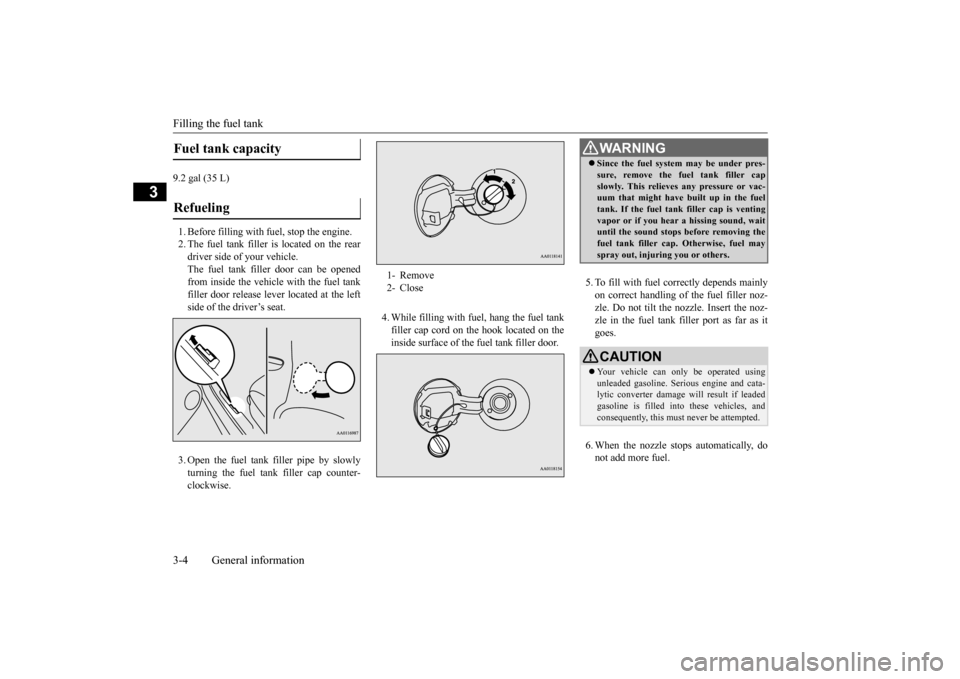
9.2 gal (35 L) 1. Before filling with
fuel, stop the engine.
2. The fuel tank filler is located on the reardriver side of your vehicle. The fuel tank filler door can be opened from inside the vehicle with the fuel tank filler door releas
e lever located at the left
side of the driver’s seat. 3. Open the fuel tank filler pipe by slowly turning the fuel tank filler cap counter- clockwise.
4. While filling with fuel, hang the fuel tank filler cap cord on the hook located on theinside surface of the fuel tank filler door.
5. To fill with fuel correctly depends mainly on correct handling of the fuel filler noz- zle. Do not tilt the nozzle. Insert the noz- zle in the fuel tank filler port as far as itgoes. 6. When the nozzle stops automatically, do not add more fuel.
Fuel tank capacity Refueling
1- Remove 2- Close
WA R N I N G Since the fuel system may be under pres- sure, remove the fuel tank filler capslowly. This relieves
any pressure or vac-
uum that might have built up in the fuel tank. If the fuel tank filler cap is venting vapor or if you hear
a hissing sound, wait
until the sound stops before removing the fuel tank filler cap. Otherwise, fuel may spray out, injuring you or others.CAUTION Your vehicle can onl
y be operated using
unleaded gasoline. Seri
ous engine and cata-
lytic converter
damage will result if leaded
gasoline is filled into these vehicles, and consequently, this must
never be attempted.
BK0212400US.book 4 ページ 2014年4月1日 火曜日 午後2時21分
Page 30 of 300
Rear seats
Seat and restraint systems 4-5
4
N00402500221
1 (HI) - Heater high (for quick heating) 2 - Heater off 3 (LO) - Heater low (to keep the seat
warm)
WA R N I N G Persons who are unable to feel tempera- ture change or skin
pain due to age, ill-
ness, injury, medication, alcohol use, fatigue or other phys
ical conditions or
who have sensitive sk
in may suffer burns
when using the heated seat even at low temperatures. To reduce the risk of burns,people with such conditions must use care when using the heated seat.
CAUTION Switch off the heated seats when not in use. Operate the heaters at the “HI” position forquick heating. After the seat has becomewarm, set the heater switch to the “LO” posi- tion to keep it warm. S
light variations in the
seat temperature may be
felt while using the
heated seats. This is caused by the operation of the heater’s internal thermostat and does not indicate a malfunction. Do not place heavy obj
ects on the seat or
stick pins, needles, or
other pointed objects
into the seat. Do not place a blanket,
cushion, or other
insulating material on
the seat while using
the heater; doing so can
cause the heater ele-
ment to overheat. When cleaning the seat, do not use benzine, kerosene, gasoline, alc
ohol, or other organic
solvents; doing so can cause damage not only to the surface of the seat, but also to the heater. If water or any other li
quid is spilled on the
seat, allow it to dry thoroughly beforeattempting to use the heater. Turn the heater off immediately if it
appears to be malfunc-
tioning during use.
Rear seats
WA R N I N G Never adjust the seats to make a cargo area when the vehicle is
in motion or on a
slope. The seats co
uld move more than
necessary or move suddenly causing a serious accident
and/or injury.
After folding down a
seat or returning a
seat back to its or
iginal position, make
sure the seat is firmly secured. Also check to make sure that the seat belts are in front of the seatbacks, and not caughtbehind the seatbacks. If the seat is not secured, it could move causing a serious accident and/or injury. Do not allow anyone to ride in the cargo area while the vehicle
is in motion. People
who are not properly seated and restrained can be seriously injured or killed in an accident. The cargo area in the
rear of the vehicle
should never be used as a play area bychildren. All children should be properly restrained in a restra
int device that offers
the maximum protection for their size andage. Refer to “Child restraint systems” on page 4-14.
BK0212400US.book 5 ページ 2014年4月1日 火曜日 午後2時21分
Page 78 of 300
Free-hand Advanced Securi
ty Transmitter (F.A.S.T.-key) (if so equipped)
Features and controls 5-17
5
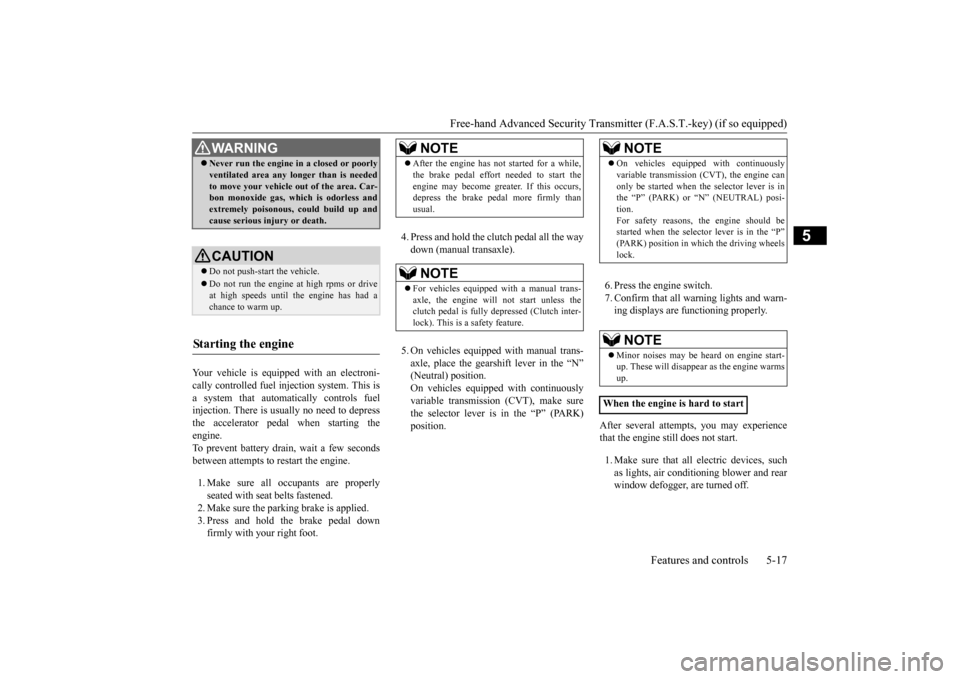
Your vehicle is equipped with an electroni- cally controlled fuel in
jection system. This is
a system that automatically controls fuelinjection. There is usually no need to depress the accelerator pedal when starting the engine.To prevent battery drai
n, wait a few seconds
between attempts to restart the engine. 1. Make sure all occupants are properly seated with seat belts fastened.2. Make sure the parking brake is applied. 3. Press and hold the brake pedal down firmly with your right foot.
4. Press and hold the clutch pedal all the way down (manual transaxle). 5. On vehicles equippe
d with manual trans-
axle, place the gearshift lever in the “N” (Neutral) position.On vehicles equipped with continuously variable transmission (CVT), make sure the selector lever is in the “P” (PARK)position.
6. Press the engine switch. 7. Confirm that all wa
rning lights and warn-
ing displays are functioning properly.
After several attempts, you may experience that the engine still does not start. 1. Make sure that all electric devices, such as lights, air conditio
ning blower and rear
window defogger, are turned off.
WA R N I N G Never run the engine in
a closed or poorly
ventilated area any lo
nger than is needed
to move your vehicle out of the area. Car-bon monoxide gas, whic
h is odorless and
extremely poisonous, could build up and cause serious injury or death.CAUTION Do not push-start the vehicle.Do not run the engine at high rpms or drive at high speeds until th
e engine has had a
chance to warm up.
Starting the engine
NOTE
After the engine has not
started for a while,
the brake pedal effort needed to start theengine may become grea
ter. If this occurs,
depress the brake pedal more firmly than usual.NOTE
For vehicles equipped with a manual trans- axle, the engine will
not start unless the
clutch pedal is fully
depressed (Clutch inter-
lock). This is a safety feature.
NOTE
On vehicles equippe
d with continuously
variable transmission (C
VT), the engine can
only be started when th
e selector lever is in
the “P” (PARK) or “N” (NEUTRAL) posi- tion. For safety reasons, the engine should bestarted when the selector lever is in the “P” (PARK) position in which the driving wheels lock.NOTE
Minor noises may be heard on engine start- up. These will disappear as the engine warms up.
When the engine is hard to start
BK0212400US.book 17 ページ 2014年4月1日 火曜日 午後2時21分
Page 79 of 300
Free-hand Advanced
Security Transmitter (F.A.S
.T.-key) (if so equipped)
5-18 Features and controls
5
2. While depressing the brake pedal {contin- uously variable transmission (CVT)} orthe clutch pedal (manual transaxle), press the accelerator peda
l halfway and hold it
there, then crank th
e engine. Release the
accelerator pedal, immediately after the engine starts. 3. If the engine still will
not start, the engine
could be flooded with too much gasoline. While depressing the brake pedal (CVT) or the clutch pedal (manual transaxle), push the accelerator pedal all the way down and hold it there, then press theengine switch to crank the engine. If the engine does not start
after 5 to 6 seconds,
push the engine switch to stop crankingthe engine, and release the accelerator pedal. Put the opera
tion mode in OFF.
Wait a few seconds, and then press theengine switch to crank the engine again while depressing the brake pedal (CVT) or the clutch pedal (manual transaxle), butdo not push the accelerator pedal. If the engine fails to start, repeat these proce- dures. If the engine stil
l will not start, con-
tact your local Mitsubishi Motors dealer or a repair facility of your choice for assistance.
Startability of continuo
usly variable trans-
mission (CVT) vehicles with an ambient temperature of -4 °F (-20 °C) or lower
When the ambient temperature is -4 °F (-20 °C) or lower, it may not be possible to startfrom a standstill even wi
th the selector lever
in the “D” (DRIVE) or “R” (REVERSE) position.This phenomenon occurs because the trans- axle has not warmed up sufficiently; it does not indicate a problem.
If this occurs, place
the selector lever in the “P” (PARK) position and let the engine idle
for at least 10 minutes.
The transaxle will wa
rm up, and you will be
able to start normally. Do not leave the vehicle during warm-upoperation.
N00568200014
1. Stop the vehicle.2. Fully engage the parking brake while depressing the brake pedal. 3. On vehicles with
a manual transaxle,
press the engine switch to stop the engine, and then move the gearshift lever to the 1st (on a uphill) or “R” (Reverse) (on adownhill) position. On vehicles equippe
d with continuously
variable transmission (CVT), move theselector lever to the “P” (PARK) position, and then press the e
ngine switch to stop
the engine.
Stopping the engine
WA R N I N G Do not operate the en
gine switch while
driving except in an emergency. If the engine is stopped while driving, the brakeservomechanism will ce
ase to function and
braking efficiency will deteriorate. Also, the power steering system will not func-tion and it will require greater manual effort to operate the steering. This could result in a serious accident.
NOTE
If you have to bring the engine to an emer- gency stop while drivi
ng, press and hold the
engine switch for 3 seconds or more, or pressit quickly 3 times or
more. The engine will
stop and the operation mode will go to ACC. On vehicles equipped with continuously variable transmission (CVT), do not stop the engine with the selector
lever in any position
other than the “P” (PARK) position. If the engine is stopped with
the selector lever in
any position other than the “P” (PARK) posi-tion, the operation mode will go to ACC rather than OFF. Put the operation mode
in OFF after placing
the selector lever in the “P” (PARK) posi- tion.
BK0212400US.book 18 ページ 2014年4月1日 火曜日 午後2時21分
Page 88 of 300
Child safety locks for rear door Features and controls 5-27
5
N00509400291
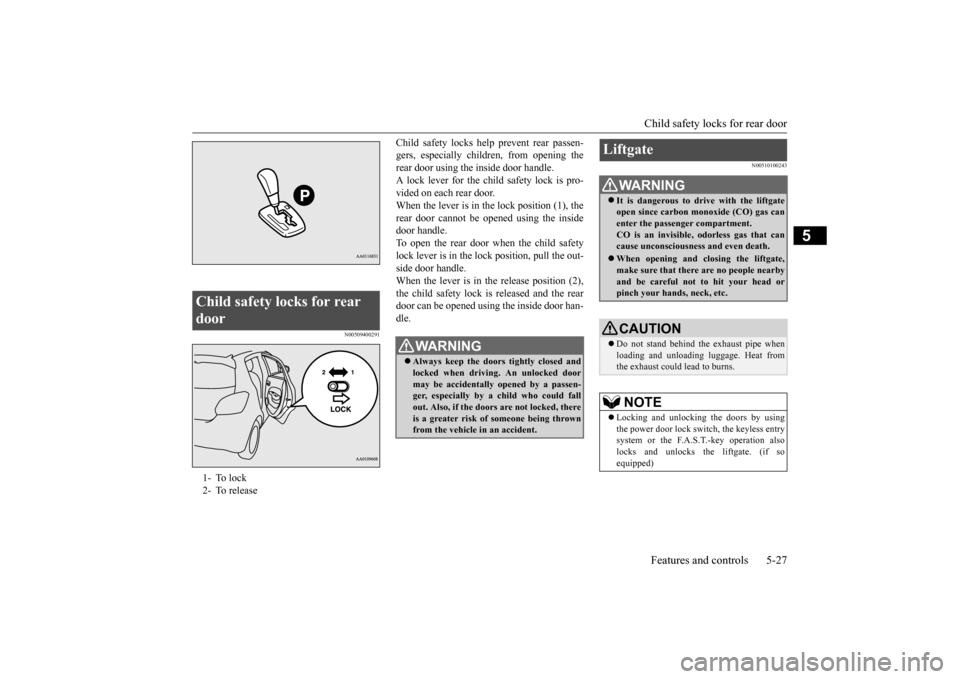
Child safety locks help prevent rear passen- gers, especially children, from opening therear door using the inside door handle. A lock lever for the child safety lock is pro- vided on each rear door.When the lever is in the lock position (1), the rear door cannot be opened using the inside door handle.To open the rear door when the child safety lock lever is in the lock position, pull the out- side door handle. When the lever is in the release position (2), the child safety lock is released and the reardoor can be opened using the inside door han- dle.
N00510100243
Child safety locks for rear door 1- To lock 2- To release
WA R N I N G Always keep the door
s tightly closed and
locked when driving. An unlocked doormay be accidentally
opened by a passen-
ger, especially by
a child who could fall
out. Also, if the doors are not locked, thereis a greater risk of someone being thrown from the vehicle
in an ac
cident.
Liftgate
WA R N I N GIt is dangerous to drive with the liftgate open since carbon mo
noxide (CO) gas can
enter the passenger compartment. CO is an invisible,
odorless gas that can
cause unconsciousness and even death. When opening and closing the liftgate, make sure that there are no people nearbyand be careful not to hit your head or pinch your hands, neck, etc.CAUTION Do not stand behind th
e exhaust pipe when
loading and unloading
luggage. Heat from
the exhaust could lead to burns.NOTE
Locking and unlocking the doors by using the power door lock swit
ch, the keyless entry
system or the F.A.S.T.-key operation also locks and unlocks the liftgate. (if soequipped)
BK0212400US.book 27 ページ 2014年4月1日 火曜日 午後2時21分
Page 89 of 300
Manual window control (if so equipped) 5-28 Features and controls
5
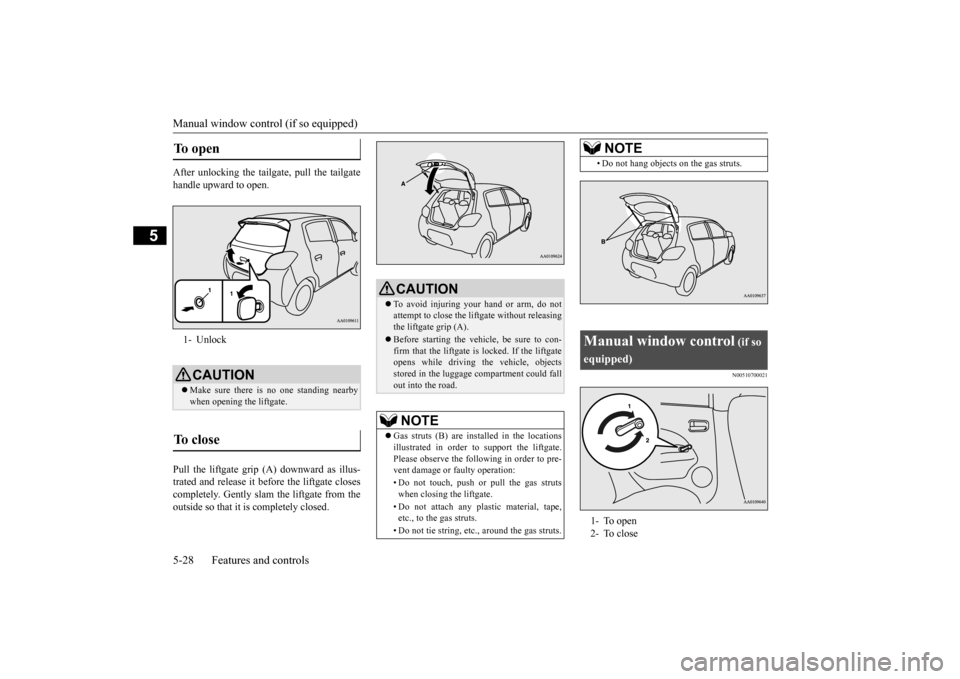
After unlocking the tail
gate, pull the tailgate
handle upward to open. Pull the liftgate grip (A) downward as illus- trated and release it before the liftgate closes completely. Gently slam the liftgate from the outside so that it is completely closed.
N00510700021
To open 1- UnlockCAUTION Make sure there is no one standing nearby when opening the liftgate.
To close
CAUTION To avoid injuring your hand or arm, do not attempt to close the lift
gate without releasing
the liftgate grip (A). Before starting the vehi
cle, be sure to con-
firm that the liftgate is locked. If the liftgate opens while driving
the vehicle, objects
stored in the luggage compartment could fallout into the road.NOTE
Gas struts (B) are installed in the locations illustrated in order to
support the liftgate.
Please observe the following in order to pre- vent damage or faulty operation: • Do not touch, push or pull the gas struts when closing the liftgate. • Do not attach any pl
astic material, tape,
etc., to the gas struts. • Do not tie string, etc., around the gas struts.
• Do not hang objects on the gas struts.
Manual window control
(if so
equipped)1- To open 2- To close
NOTE
BK0212400US.book 28 ページ 2014年4月1日 火曜日 午後2時21分
Page 97 of 300
![MITSUBISHI MIRAGE 2015 6.G Owners Manual Starting the engine 5-36 Features and controls
5
N00512601816
[For vehicles equipped with the Free-hand Advanced Security Transmitter (F.A.S.T.- key)]
For information on
operation for vehicles
equ](/img/19/7511/w960_7511-96.png "MITSUBISHI MIRAGE 2015 6.G Owners Manual Starting the engine 5-36 Features and controls
5
N00512601816
[For vehicles equipped with the Free-hand Advanced Security Transmitter (F.A.S.T.- key)]
For information on
operation for vehicles
equ")
Starting the engine 5-36 Features and controls
5
N00512601816
[For vehicles equipped with the Free-hand Advanced Security Transmitter (F.A.S.T.- key)]
For information on
operation for vehicles
equipped with the Free-hand Advanced Secu-rity Transmitter (F.A
.S.T.-key), refer to
“Free-hand Advanced
Security Transmitter
(F.A.S.T.-key): Starting and stopping theengine” on page 5-16. [Except for vehicles equipped with the Free-hand Advanced Se
curity Transmit-
ter (F.A.S.T.-key)] Do not operate the starter motor continu- ously for longer than 15 seconds as thiscould run the battery
down or damage the
starter motor. If the engine does not start, turn the ignition switch back to the “OFF”position, wait a few se
conds, and then try
again. Trying repeatedly with the engine or starter motor still turning will damagethe starter mechanism. If the engine will not
start because the bat-
tery is weak or discharged, refer to“Jump-starting the engine” (on page 8-2) for instructions. A longer warm up period will only con- sume extra fuel. The engine is warmed up enough for driving when the low coolant temperature indi
cator goes out.
Refer to “Low coolant temperature indi- cator” on page 5-71.
This model is equipped with an electronically controlled fuel injection system. This is a sys-tem that automatically controls fuel injection. There is usually no need to depress the accel- erator pedal when starting the engine.The starter should not be run for more than 15 seconds at a time. To prevent battery drain, wait a few secondsbetween attempts to restart the engine. 1. Make sure all occupants are properly seated with seat belts fastened.
CAUTION If the engine is stopped while driving, the brake servomechanism w
ill cease to function
and braking efficiency will deteriorate. Also, the power steering syst
em will not function
and it will require gr
eater manual effort to
operate the steering. Do not leave the key in
the “ON” position for
a long time when the engine is not running, doing so will cause th
e battery to be dis-
charged. Do not turn the key to the “START” position when the engine is running, doing so coulddamage the starter motor.
Starting the engine
Tips for starting
WA R N I N G Never run the engine in
a closed or poorly
ventilated area any longer than is neededto move your vehicle
out of the area. Car-
bon monoxide gas, wh
ich is odorless and
extremely poisonous, could build up and cause serious injury or death.CAUTION Do not push-start the vehicle.Do not run the engine at high rpms or drive at high speeds until
the engine has had a
chance to warm up. Release the ignition sw
itch as soon as the
engine starts. Otherwis
e, the starter motor
will be damaged.
Starting the engine
BK0212400US.book 36 ページ 2014年4月1日 火曜日 午後2時21分
Page 98 of 300

Starting the engine
Features and controls 5-37
5
2. Insert the ignition key. 3. Make sure the parking brake is applied.4. Press and hold the
brake pedal down with
your right foot. 5. Press and hold the clut
ch pedal all the way
down (manual transaxle). 6. On vehicles equipped with manual trans- axle, place the gearshift lever in the “N” (Neutral) position.On vehicles equippe
d with continuously
variable transmission (CVT), make sure the selector lever is in the “P” (PARK)position.
7. Turn the ignition switch to the “ON” posi- tion and make certain that all warninglights are functioning properly before starting the engine. 8. Turn the ignition switch to the “START”position without pre
ssing the accelerator
pedal. Release the key when the engine starts.
After several attempts
, you may experience
that the engine still does not start. 1. Make sure that all electric devices, such as lights, air conditi
oning blower and rear
window defogger, are turned off. 2. While depressing the brake pedal {contin- uously variable transmission (CVT)} orthe clutch pedal (manual transaxle), press the accelerator peda
l halfway and hold it
there, then crank th
e engine. Release the
accelerator pedal, immediately after the engine starts.
3. If the engine still wi
ll not start, the engine
could be flooded with too much gasoline.While depressing the brake pedal (CVT) or the clutch pedal (manual transaxle), push the accelerator pedal all the waydown and hold it there, then crank the engine for 5 to 6 seconds. Return the igni- tion switch to the “OFF” position andrelease the accelerator pedal. Wait a few seconds, and then crank the engine again for 5 to 6 seconds while depressing the brake pedal (CVT) or the clutch pedal (manual transaxle), but do not push theaccelerator pedal. Release the ignition key if the engine starts.
If the engine fails to
start, repeat these procedures. If theengine still will not
start, contact your
local Mitsubishi Motors dealer or a repair facility of your choi
ce for assistance.
When the ambient temperature is -4 °F (-20 °C) or lower, it may not be possible to start from a standstill even with the selector lever in the “D” (DRIVE) or “R” (REVERSE)position. This phenomenon occurs because the trans- axle has not warmed up sufficiently; it does
NOTE
On vehicles equipped
with manual transaxle,
the starter will not ope
rate unless the clutch
pedal is fully depresse
d (Clutch interlock).
NOTE
On vehicles equipped wi
th CVT, the starter
will not operate unless th
e selector lever is in
the “P” (PARK) or “N” (NEUTRAL) posi-tion.For safety reasons, start the engine in the “P” (PARK) position so that the wheels are locked.
NOTE
Minor noises may be he
ard on engine start-
up. These will disappear
as the engine warms
up.
When the engine is hard to start
Startability of CVT vehicle with ambient temperature of -4 °F (-20 °C) or lower
BK0212400US.book 37 ページ 2014年4月1日 火曜日 午後2時21分