heating MITSUBISHI MIRAGE 2015 6.G User Guide
[x] Cancel search | Manufacturer: MITSUBISHI, Model Year: 2015, Model line: MIRAGE, Model: MITSUBISHI MIRAGE 2015 6.GPages: 300, PDF Size: 43.44 MB
Page 187 of 300
Heater without air conditioning function (if so equipped) 7-6 Comfort controls
7
N00738400035
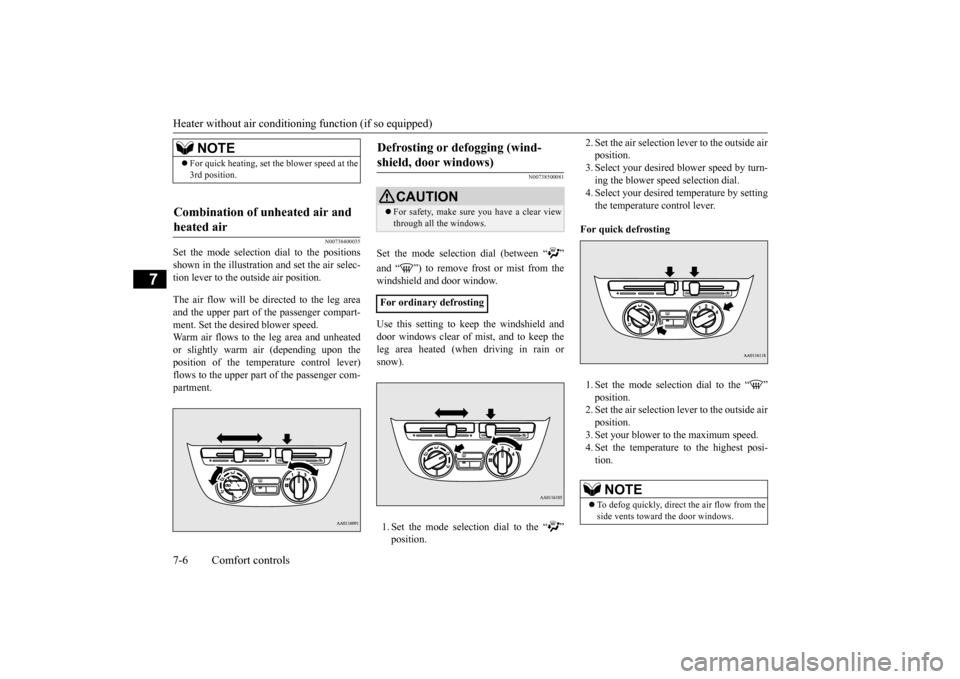
Set the mode selection dial to the positions shown in the illustrati
on and set the air selec-
tion lever to the out
side air position.
The air flow will be directed to the leg area and the upper part of the passenger compart- ment. Set the desired blower speed. Warm air flows to the leg area and unheatedor slightly warm air (depending upon the position of the temper
ature control lever)
flows to the upper part of the passenger com-partment.
N00738500081
Set the mode selection dial (between “ ” and “ ”) to remove frost or mist from the windshield and door window. Use this setting to ke
ep the windshield and
door windows clear of mist, and to keep the leg area heated (when driving in rain or snow). 1. Set the mode selection dial to the “ ” position.
2. Set the air selection lever to the outside air position.3. Select your desired blower speed by turn- ing the blower speed selection dial. 4. Select your desired temperature by settingthe temperature control lever.
For quick defrosting 1. Set the mode selection dial to the “ ” position. 2. Set the air selection lever to the outside airposition. 3. Set your blower to the maximum speed. 4. Set the temperature to the highest posi-tion.
NOTE
For quick heating, set the blower speed at the 3rd position.
Combination of unheated air and heated air
Defrosting or defogging (wind- shield, door windows)
CAUTION For safety, make sure
you have a clear view
through all the windows.
For ordinary defrosting
NOTE
To defog quickly, direct the air flow from the side vents toward the door windows.
BK0212400US.book 6 ページ 2014年4月1日 火曜日 午後2時21分
Page 189 of 300
Manual air conditioning (if so equipped) 7-8 Comfort controls
7
N00736800413
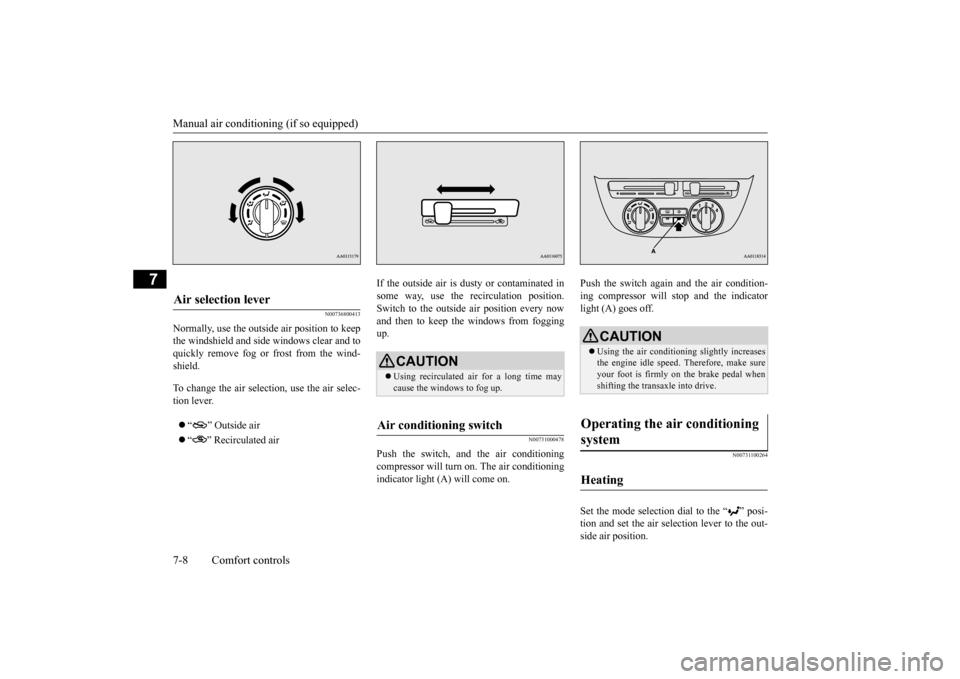
Normally, use the outside air position to keep the windshield and side windows clear and to quickly remove fog or frost from the wind- shield. To change the air selection, use the air selec- tion lever. “ ” Outside air “ ” Recirculated air
If the outside air is dusty or contaminated in some way, use the recirculation position.Switch to the outside
air position every now
and then to keep the windows from fogging up.
N00731000478
Push the switch, and the air conditioningcompressor will turn on. The air conditioning indicator light (A) will come on.
Push the switch again and the air condition- ing compressor will stop and the indicatorlight (A) goes off.
N00731100264
Set the mode selection dial to the “ ” posi-tion and set the air sele
ction lever to the out-
side air position.
Air selection lever
CAUTION Using recirculated ai
r for a long time may
cause the windows to fog up.
Air conditioning switch
CAUTION Using the air conditioni
ng slightly increases
the engine idle
speed. Therefore, make sure
your foot is firmly on the brake pedal when shifting the transaxle into drive.
Operating the air conditioning system
Heating
BK0212400US.book 8 ページ 2014年4月1日 火曜日 午後2時21分
Page 190 of 300
Manual air conditioning (if so equipped)
Comfort controls 7-9
7
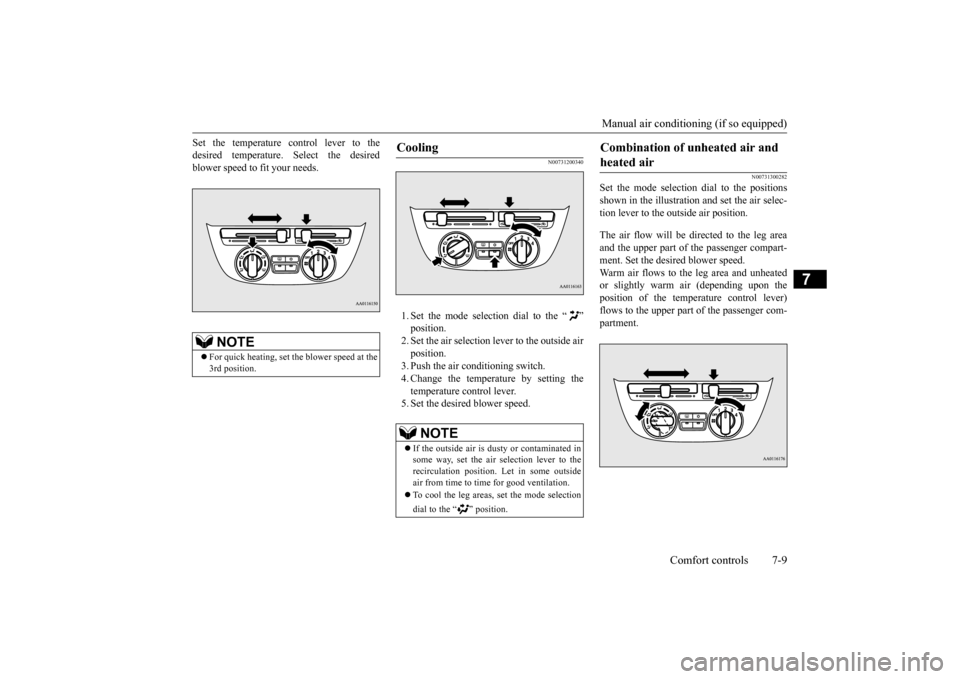
Set the temperature control lever to the desired temperature.
Select the desired
blower speed to fit your needs.
N00731200340
1. Set the mode selection dial to the “ ”position. 2. Set the air selection lever to the outside air position.3. Push the air conditioning switch. 4. Change the temperature by setting the temperature control lever.5. Set the desired blower speed.
N00731300282
Set the mode selection
dial to the positions
shown in the illustration and set the air selec- tion lever to the outside air position. The air flow will be directed to the leg area and the upper part of
the passenger compart-
ment. Set the desired blower speed. Warm air flows to the leg area and unheated or slightly warm
air (depending upon the
position of the temperature control lever) flows to the upper part of the passenger com-partment.
NOTE
For quick heating, set th
e blower speed at the
3rd position.
Cooling
NOTE
If the outside air is dusty or contaminated in some way, set the air selection lever to the recirculation position.
Let in some outside
air from time to time for good ventilation. To cool the leg areas, set the mode selection dial to the “ ” position.
Combination of unheated air and heated air
BK0212400US.book 9 ページ 2014年4月1日 火曜日 午後2時21分
Page 193 of 300
Automatic air conditioning (if so equipped) 7-12 Comfort controls
7
N00736900179
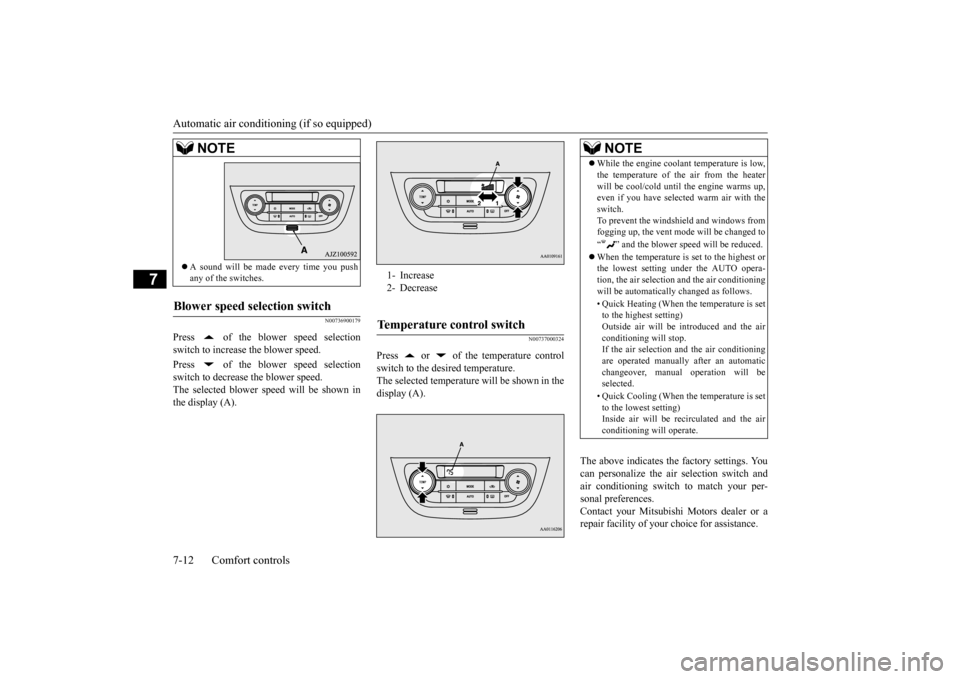
Press of the blower speed selection switch to increase the blower speed. Press of the blower speed selection switch to decrease the blower speed.The selected blower sp
eed will be shown in
the display (A).
N00737000324
Press or of the temperature controlswitch to the desired temperature. The selected temperature will be shown in thedisplay (A).
The above indicates the
factory settings. You
can personalize the air
selection switch and
air conditioning switch to match your per- sonal preferences. Contact your Mitsubishi Motors dealer or arepair facility of your choice for assistance.
A sound will be made every time you push any of the switches.
Blower speed selection switch
NOTE
1- Increase 2- DecreaseTemperature control switch
NOTE
While the engine coolant temperature is low, the temperature of the air from the heaterwill be cool/cold until
the engine warms up,
even if you have selected warm air with the switch. To prevent the windshield and windows fromfogging up, the vent mode will be changed to “ ” and the blower sp
eed will be reduced.
When the temperature is set to the highest or the lowest setting under the AUTO opera- tion, the air selection
and the air conditioning
will be automatically changed as follows. • Quick Heating (When th
e temperature is set
to the highest setting) Outside air will be introduced and the air conditioning will stop.If the air selection
and the air conditioning
are operated ma
nually after an automatic
changeover, manual
operation will be
selected. • Quick Cooling (When th
e temperature is set
to the lowest setting) Inside air will be recirculated and the air conditioning wi
ll operate.
BK0212400US.book 12 ページ 2014年4月1日 火曜日 午後2時21分
Page 226 of 300
8
For emergenciesIf the vehicle breaks down ...............................................................8-2 Jump-starting the engine ..................................................................8-2 Engine overheating ..........................................................................8-4Jack and tools ...................................................................................8-5 Tire repair kit (if so equipped) ..........................................................8-6 How to change a tire (Vehicles equipped with spare tire) ............. 8-11Towing ...........................................................................................8-17 Operation under adverse driving conditions
...........
.........
.........
.....8-18
Fuel Pump Shut-off System ...........................................................8-20
BK0212400US.book 1 ページ 2014年4月1日 火曜日 午後2時21分
Page 229 of 300
Engine overheating 8-4 For emergencies
8
If you drive your vehicle with a low battery charge after the engine has been started byusing jumper cables, the engine may misfire. This can cause the an
ti-lock braking system
warning light to blink on and off. This is onlydue to the low battery voltage. It is not a problem with the brak
e system. If this hap-
pens, fully charge the battery and ensure thecharging system is operating properly.
N00836500365
If the high coolant temperature warning lightilluminates during the engine is running, the engine may be overheating. If this happens: 1. Stop the vehicle in a safe place. Turn on the hazard warning flashers.2. With the engine st
ill running, carefully
raise the engine hood to vent the engine compartment.
3. Check that the cooling fan is running. If the fan is not turning, stop the engineimmediately and contact an authorized Mitsubishi Motors dealer or a repair facil- ity of your choice for assistance. 4. If you see steam or spray coming from under the hood, turn off the engine. 5. If you do not see stea
m or spray coming
from under the hood, leave the engine onuntil the high coolant temperature warn- ing light goes off. After the high coolant temperature warning light has gone off,you can start driving again. If the high coolant temperature warning light stays on, turn off the engine.
6. When you do not see any more steam or spray, open the hood. Look for obviousleaks, such as a split radiator hose. Be careful as components will be hot. Any leak source must be repaired.7. If there is no obvious leak source, check the coolant level in the engine coolant reserve tank. If there is none, or if it is toolow, slowly add coolant. 8. If the engine coolant reserve tank needs coolant, you will probably also need to add coolant to the radiator. Do not loosen or remove the radiator cap until the enginehas cooled down. 9. Start the engine, and slowly add coolant, up to the bottom of the filler neck. Use plain water if you have to (and replace itwith the right coolant as soon as possible).
Always wear protective clothing and gog- gles when working near the battery. Keep the battery out of the reach of chil- dren.
As your vehicle has anti-lock brakes Engine overheating
WA R N I N G
WA R N I N G To avoid personal injury
, keep hands, hair,
jewelry and clothes aw
ay from the cooling
fan. The cooling fan ca
n start at any time.
WA R N I N GBefore raising the engine hood, check to see if there is steam or spray coming fromunder the hood. Steam or spray comingfrom an overheated en
gine could seriously
scald you. Do not open the hood until there is nosteam or spray.
WA R N I N G Removing the radiat
or cap could scald
you with escaping hot water or steam. When checking the radiator level, coverthe cap with a cloth before trying to remove it. Turn it slowly counterclock- wise, without pressing down, to the firstnotch. The pressure in the system will then be let out. When the pressure is COM- PLETELY LET OUT, press down andkeep turning the cap counterclockwise until it comes off.
BK0212400US.book 4 ページ 2014年4月1日 火曜日 午後2時21分
Page 235 of 300
Tire repair kit (if so equipped) 8-10 For emergencies
8
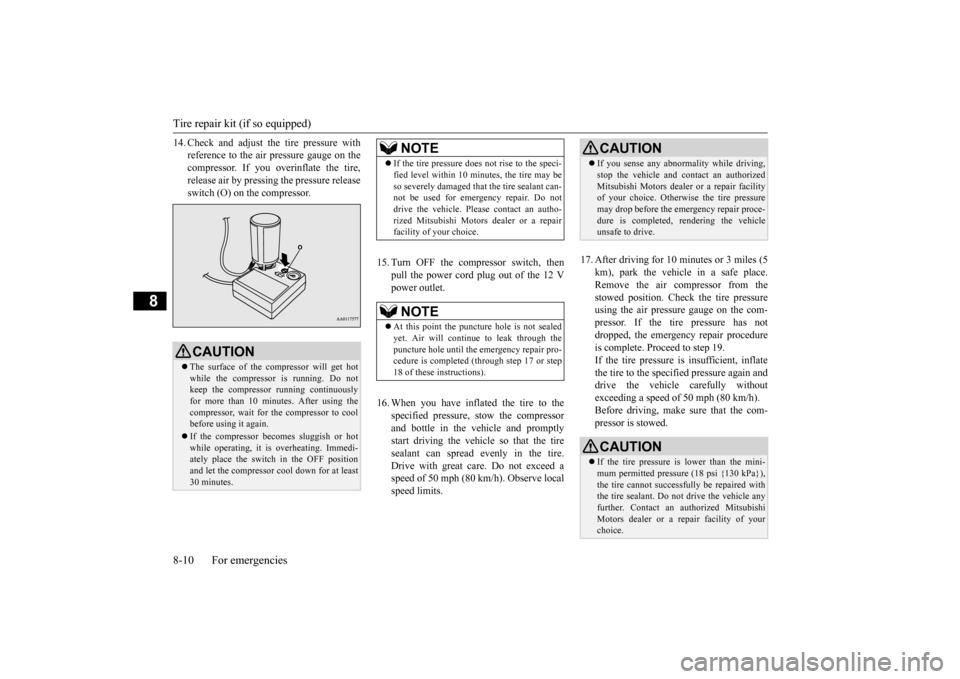
14. Check and adjust the tire pressure with
reference to the air pressure gauge on thecompressor. If you overinflate the tire, release air by pressing the pressure release switch (O) on the compressor.
15. Turn OFF the compressor switch, then
pull the power cord plug out of the 12 V power outlet.
16. When you have inflated the tire to the
specified pressure, stow the compressor and bottle in the vehicle and promptly start driving the vehicle so that the tiresealant can spread evenly in the tire. Drive with great care. Do not exceed a speed of 50 mph (80
km/h). Observe local
speed limits.
17. After driving for 10 minutes or 3 miles (5
km), park the vehicl
e in a safe place.
Remove the air compressor from the stowed position. Check the tire pressure using the air pressure gauge on the com-pressor. If the tire pressure has not dropped, the emergency repair procedure is complete. Proceed to step 19.If the tire pressure is insufficient, inflate the tire to the specified pressure again and drive the vehicle carefully withoutexceeding a speed of 50 mph (80 km/h). Before driving, make sure that the com- pressor is stowed.
CAUTION The surface of the compressor will get hot while the compressor is running. Do not keep the compressor running continuously for more than 10 minutes. After using thecompressor, wait for the compressor to cool before using it again. If the compressor becomes sluggish or hot while operating, it is
overheating. Immedi-
ately place the switch in the OFF positionand let the compressor cool down for at least 30 minutes.
NOTE
If the tire pressure does not rise to the speci- fied level within 10 minutes, the tire may beso severely damaged that
the tire sealant can-
not be used for emergency repair. Do not drive the vehicle. Plea
se contact an autho-
rized Mitsubishi Motors dealer or a repairfacility of your choice.NOTE
At this point the punctu
re hole is
not sealed
yet. Air will continue to leak through thepuncture hole until the emergency repair pro- cedure is completed (through step 17 or step 18 of these instructions).
CAUTION If you sense any abnorma
lity while driving,
stop the vehicle and c
ontact an authorized
Mitsubishi Motors dealer
or a repair facility
of your choice. Otherw
ise the tire pressure
may drop before the emergency repair proce- dure is completed,
rendering the vehicle
unsafe to drive.CAUTION If the tire pressure is lower than the mini- mum permitted pressure
(18 psi {130 kPa}),
the tire cannot successful
ly be repaired with
the tire sealant. Do not drive the vehicle any further. Contact an
authorized Mitsubishi
Motors dealer or a repair facility of yourchoice.
BK0212400US.book 10 ページ 2014年4月1日 火曜日 午後2時21分
Page 243 of 300
Operation under adverse driving conditions 8-18 For emergencies
8
Set the gearshift lever to the “N” (Neutral) position. Secure the steering whee
l in a straight-ahead
position with a rope or tie-down strap.
Release the parking brake. Place the gearshift lever in the “N” (Neutral)position (manual transaxle) or the selector lever in the “N” (NEUTRAL) position (CVT).
N00837200750
If your vehicle becomes
stuck in snow, sand,
or mud, it can often be moved by a rocking motion. Rock your vehicle back and forth tofree it. Do not rev the engine or spin the wheels. Constant efforts to free a stuck vehicle cancause overheating and tr
ansaxle failure. Let
the engine idle for a few minutes to cool the transaxle before trying again.If your vehicle is still
stuck after several rock-
ing attempts, call for a commercial tow truck service.
Towing the vehicle by a tow truck
CAUTION This vehicle must not be towed by a tow truck using sling lift
type equipment (Type
A) as illustrated. Usi
ng a sling lift will dam-
age the bumper and front end. Do not tow continuously variable transmis- sion (CVT) vehicles with the driving wheels on the ground (Type B) as illustrated. If the vehicle is towed like
this, the continuously
variable transmission (CVT) fluid may not reach all parts of the transmission, thus dam- aging it.If you tow CVT vehicles, use Type C, D or E equipment. If the manual transaxle is malfunctioning or damaged, transport the
vehicle with the driv-
ing wheels on a carriage (Type C, D or E) asillustrated.
If the vehicle is towed with the ignition switch in the “ON” pos
ition or the operation
mode in ON and only the front wheels oronly the rear wheels raised off the ground (Type B or C), the Acti
ve Stability Control
(ASC) may operate, resul
ting in an accident.
When towing the vehicle with the rear wheels raised, turn the ignition switch to the “ACC” position or put
the operation mode in
ACC. When towing the vehicle with the front wheels raised, ke
ep the ignition switch
or the operation mode as follows.[Except for vehicles equipped with the F. A . S . T. - k e y ] The ignition switch is in “OFF” or “ACC”position. [Vehicles equipped with the F.A.S.T.-key] The operation mode is in OFF or ACC.
Towing with rear wheels off the ground (Type B - M/T vehicles only)
CAUTION
Towing a front-wheel drive vehi- cle with front wheels off the ground (Type C) Operation under adverse driving conditions If your vehicle becomes stuck in sand, mud or snow
BK0212400US.book 18 ページ 2014年4月1日 火曜日 午後2時21分
Page 248 of 300
Catalytic converter
Vehicle care and maintenance 9-3
9
N00937400450
The catalytic converter requires you to use unleaded fuel only. Leaded gasoline will destroy the emission-c
ontrol effectiveness of
the converter. Normally, the catalyti
c converter does not
require maintenance. However, it is important to keep the engine properly tuned for the con- verter to continue to work properly.
To reduce the possibili
ty of catalytic con-
verter damage: Use UNLEADED GASOLINE ONLY of the type of recommended in the “Fuel selection”. Do not drive with an extremely low fuel level. Running out of gas could damage the catalytic converter. Do not try to start the engine by pushing or towing the vehicle. If the battery is weak or run down, use jumper cables toproperly start the engine.
Do not idle the engine with any spark plug wires disconnected or
removed, such as
when performing diagnostic tests. Do not idle the engine for a long time if it is idling roughly or otherwise obviouslymalfunctioning. To prevent the catalytic converter from being damaged from unburned gas, do notrace the engine when stopping the engine. Stop driving the vehicle if you think the performance is noticeably low, or the engine has a malfunction such as with the ignition, etc. If you are not able to stopdriving immediately, slow down and drive for only a short time.
Have your vehicle
checked at an authorized MitsubishiMotors dealer or a repair facility of your choice as soon
as possible.
In unusual situations involving major engine problems, a burning odor may indicate severe a
nd abnormal catalytic
converter overheating. If this occurs, stopin a safe place, shut
the engine off and let
the vehicle cool. Once the engine is cool, immediately take your
vehicle to a dealer
or a repair facility of
your choice for ser-
vice.
WA R N I N G Set a garage jack only at the position shown here. If the gar
age jack is set a
wrong position, it could damage yourvehicle and/or your
vehicle might fall
from the jack causing injury or death. Do not use the jack on a tilted or soft sur- face. Otherwise, the jack might slip and causepersonal injury. Always
use the jack on a
flat, hard surface. Before setting the jack, make sure there are no sand or pebblesunder the jack base.
Catalytic converter
CAUTION Damage to the catalytic
converter can result
if your vehicle is not
kept in proper operating
condition. If the engine
malfunctions or mis-
fires, or if your vehi
cle performance suffers,
have it serviced
promptly. Running your
vehicle when it is ove
rheated may result in
damage to the conve
rter and vehicle.
WA R N I N GDo not park or run your vehicle in areas where combustible materials such as dry grass or leaves can come
in contact with a
hot exhaust, since a fire could occur. Do not put undercoat paint on the cata- lytic converter.
BK0212400US.book 3 ページ 2014年4月1日 火曜日 午後2時21分
Page 266 of 300
For cold and snowy weather
Vehicle care and maintenance 9-21
9
N00941800077
Check the following parts for damage and grease leaks: Ball joint boots of the front suspension and steering linkage Bellows on both ends of the drive shaft
N00942200111
The best way to keep carbon monoxide gas from entering inside your
vehicle is to have
the engine exhaust syst
em properly serviced.
Have a competent mechanic inspect the com- plete exhaust
system and nearby body areas
for broken, damaged, de
teriorated, or mispo-
sitioned parts if you not
ice any of the follow-
ing: A change in the sound of the exhaust sys- tem The smell of exhaust fumes inside the vehicle
The underside or rear of the vehicle is damaged
Also check the exhaust system each time the vehicle is raised for l
ubrication, oil changes,
or required service. Any open seams or loose connections could le
t dangerous exhaust
fumes seep into the
luggage and passenger
compartments. Check for holes or exhaust gas leaks caused by corrosion or damage. Check the joints and connections for looseness or exhaust gas leaks. Check the rubber hangers and brackets for damage.
N00942500127
The hood lock release mechanism and hood safety catch should be checked, cleaned, andoiled when needed for easy movement and to prevent rust and wear. Use Multipurpose Grease NLGI Grade 2 sparingly for all slidingparts of the hood latch and release lever. Work the grease into the hood lock mecha-
nism until all the m
ovable surfaces are cov-
ered.Also, put a light coat of the same grease on the safety catch wherev
er moving parts touch.
N00942600102
The ventilation slots in front of the wind- shield should be brus
hed clear after a heavy
snowfall so that the ope
ration of the heating
and ventilation systems
will not be impaired.
To prevent freezing of the weatherstripping on the doors, engine hood, etc., they should be treated with
silicone grease.
It is a good idea to carry a shovel or a short- handled spade in the vehicle during the win- ter so that you can clear away snow if you getstranded. A small hand-brush for sweeping
Ball joint, steering linkage seals and drive shaft boots Exhaust system
WA R N I N G Carbon monoxide gas
from your vehicle’s
exhaust is poisonous. Breathing thesefumes can cause unconsciousness or death.
Check for any of the following conditions: Hood lock release mechanism and safety catch
For cold and snowy weather Ventilation slots Weatherstripping Additional equipment (For regions where snow is encoun- tered)
BK0212400US.book 21 ページ 2014年4月1日 火曜日 午後2時21分