light MITSUBISHI MIRAGE 2015 6.G User Guide
[x] Cancel search | Manufacturer: MITSUBISHI, Model Year: 2015, Model line: MIRAGE, Model: MITSUBISHI MIRAGE 2015 6.GPages: 300, PDF Size: 43.44 MB
Page 20 of 300
Filling the fuel tank
General information 3-3
3
Use of gasolines blended with MMT may adversely affect performance, and cause themalfunction indicator on your instrument panel to come on. If this happens, contact an authorized Mitsubishi Motors dealer or arepair facility of your
choice for assistance.
Your vehicle may have
been designed to sat-
isfy California’s low-emission regulations based on clean-burning low-sulfur gasoline.Gasoline sold in parts of the country other than California is allowed to have a higher sulfur content. Using such gasoline couldadversely affect the ve
hicle’s catalytic con-
verter and cause the e
ngine malfunction indi-
cator (“SERVICE ENGINE SOON” or“Check engine light”) to come on. Illumina- tion of this indicator while using high-sulfur gasoline does not necessarily mean the vehi-cle’s emission-control system is malfunction- ing. Your authorized Mitsubishi Motors dealer may suggest usi
ng a different, lower-
sulfur brand of unleaded gasoline to deter- mine if the problem
is fuel-related.
N00301100913
Sulfur in gasoline
NOTE
Poor-quality gasoline
can cause problems
such as hard starting, stalling during idling,abnormal engine noise
, and poor accelera-
tion. If you experience any of these prob- lems, try using a differ
ent brand of gasoline.
If the engine malfunc
tion indicator (“SER-
VICE ENGINE SOON”
or “Check engine
light”) flashes, have
the vehicle inspected as
soon as possible by the nearest authorizedMitsubishi Motors dealer
or a repair facility
of your choice. Repeatedly driving short distances at low speeds can cause deposits to form in the fuel system and engine, resulting in hard startingand poor acceleration.
If these problems
occur, you are advised to add a detergent additive to the gasoline when you refuel thevehicle. The additive
will remove the depos-
its, thereby returning the engine to a normal condition. Be sure to use a MitsubishiMotors Genuine cleani
ng additive. Using an
unsuitable additive c
ould make an engine
malfunction. For details,
please contact the
nearest authorized Mits
ubishi Motors dealer.
Filling the fuel tank
WA R N I N GWhen handling fuel, comply with the safety regulations displayed by garages and filling stations.
Gasoline is highly flammable and explo- sive. You could be burned, seriouslyinjured or killed when handling it. Whenrefueling your vehicle,
always turn the
engine off and keep
away from flames,
sparks, and smoking materials. Alwayshandle fuel in well-ventilated outdoor areas. Before removing the fuel tank filler cap, be sure to get rid of your body’s static electricity by touching a metal part of thecar or fuel pump. Any
static electricity on
your body could create a spark that ignites fuel vapor. Perform the whole
refueling process
(opening the fuel tank filler door, remov-ing the fuel tank filler cap, etc.) by your- self; do not let any other person near the fuel tank filler. If you allowed a person tohelp you and that person was carrying static electricity,
fuel vapor could be
ignited. Do not move away from the fuel tank filler until refueling is fi
nished. If you moved
away and did something
else (for example,
sitting on a seat) part-way through the refueling process, you could pick up afresh charge of st
atic electricity.
Be careful not to inhale fuel vapor. Fuel contains toxic substances. Keep the doors and wi
ndows closed while
refueling the vehicle. If they were open, fuel vapor could get into the cabin.WA R N I N G
BK0212400US.book 3 ページ 2014年4月1日 火曜日 午後2時21分
Page 22 of 300
Modifications to and racing of your vehicle
General information 3-5
3
7. To close, turn the fuel tank filler cap slowly clockwise un
til you hear clicking
sounds, then gently push the fuel tankfiller door closed.
N00301600194
This vehicle should not be modified withnon-Mitsubishi Motors genuine parts. Mitsubishi Motors designs and manufactures high quality vehicles
with an emphasis on
safety and durability.
Modifications using
non-Mitsubishi Motors genuine parts may affect the performance, safety and/or durabil-ity of your vehicle,
and may violate applica-
ble state and/or fe
deral regulations.
DAMAGE OR PERFORMANCE PROB- LEMS RESULTING FROM MODIFICA-TIONS TO OR RACING OF YOUR
VEHICLE ARE NOT COVERED UNDER WARRANTY. Examples of modifications to your vehicle that can cause damage or performance prob- lems include the following: Failure to use Mits
ubishi Motors genuine
parts Failure to use required fuel and fluids Failure to use proper
size tires and wheels
Modification of the fu
el, intake, exhaust,
emission, suspension,
engine, drive train
or electrical wiring systems Modification of any onboard com- puter/control module, including repro- gramming, or replac
ing/adding chips to
any onboard computer/control module
Review the Warranty
and Maintenance Man-
ual for further details
regarding warranty cov-
erage.
N00301700212
CAUTION To avoid fuel spillage
and overfilling, do not
“top-off” the fuel tank. Spilled fuel coulddiscolor, stain, or cr
ack the vehicle’s paint-
work. If fuel spills on the paintwork, wipe it off with a soft cloth.WA R N I N G Make sure the fuel tank filler cap is securely closed. If the fuel tank filler cap were loose, fuel coul
d leak, resulting in a
fire.CAUTION If you need to replace the fuel tank filler cap, use only the fuel tank filler cap specified for your model vehicle.
NOTE
If the fuel tank filler cap is not tight while driving, the engine
malfunction indicator
(“SERVICE ENGINE SOON” or “Checkengine light”) may come on when the onboard diagnostic (OBD) system performs a self check.Always tighten the fu
el tank filler cap until
you hear at least 3 clicks. The indicator will go of
f after several driving
cycles. If the indicato
r does not go off, con-
tact your authorized
Mitsubishi Motors
dealer or a repair faci
lity of your choice as
soon as possible.
Modifications to and racing of your vehicle
Installation of accessories
CAUTION Before any electrical or electronic accesso- ries are installed,
consult an authorized
Mitsubishi Motors dealer.
BK0212400US.book 5 ページ 2014年4月1日 火曜日 午後2時21分
Page 28 of 300
Front seats
Seat and restraint systems 4-3
4
Safety equipment cannot prevent injury or death in all motor ve
hicle accidents. How-
ever, you can help reduce the risk of injury or death by following the
instructions in this
manual.
N00401800403
Position the driver’s seat
as far back as possi-
ble while maintaining a position that still enables you to fully apply the pedals, easily control the steering wh
eel and safely operate
the vehicle.
N00401900316
Pull the seat adjusting lever up and slide theseat forward or backwa
rd to the desired posi-
tion. Release the adjusting lever to lock the seat in place.
N00402000369
To adjust the seatback,
lean forward slightly,
gently pull the seatback lock lever up, then lean backward to a comfortable position and
Front seats
WA R N I N G Do not attempt to adjust the seat while driving. This can cause loss of vehicle con- trol and result
in an accident.
After adjusting the se
at, make sure that
seat is securely locked into position.
To reduce the risk to the driver of serious injury or death during deployment of thedriver’s airbag, always
properly wear the
seat belt and adjust th
e driver’s seat as far
back as possible while maintaining a posi- tion that still enables
you to fully apply the
pedals, easily control the steering wheel, and safely operate the vehicle. To reduce the risk to the front passenger of serious injury or
death during deploy-
ment of the passeng
er’s airbag, always
properly wear the seat
belt and adjust the
front passenger’s seat as far back as possi- ble. Always place childr
en 12 years old and
under in the rear seat
and use appropriate
child restraint systems.CAUTION Make sure that the seat is adjusted by an adult. If it is adjusted by a child, an unex- pected accident might occur. Do not place a cushion
or the like between
your back and the seatback while driving. The effectiveness of the head restraints willbe reduced in the event of an accident. When sliding the seats, be careful not to catch your hand or leg. When sliding or reclining the seat rearward, pay careful attention to
the rear seat passen-
gers.WA R N I N G
To adjust the seat forward or backward
WA R N I N G To make sure that the seat is securely locked, try to move
it forward or back-
ward without using
the adjusting lever.
To adjust the seatbacks
BK0212400US.book 3 ページ 2014年4月1日 火曜日 午後2時21分
Page 29 of 300
Front seats 4-4 Seat and restraint systems
4
release the lever. The seatback will lock in place.
N00402100243
To adjust the seat height, turn the dial as shown in the illustration.
N00435601418
The heated seats can
be operated by pushing
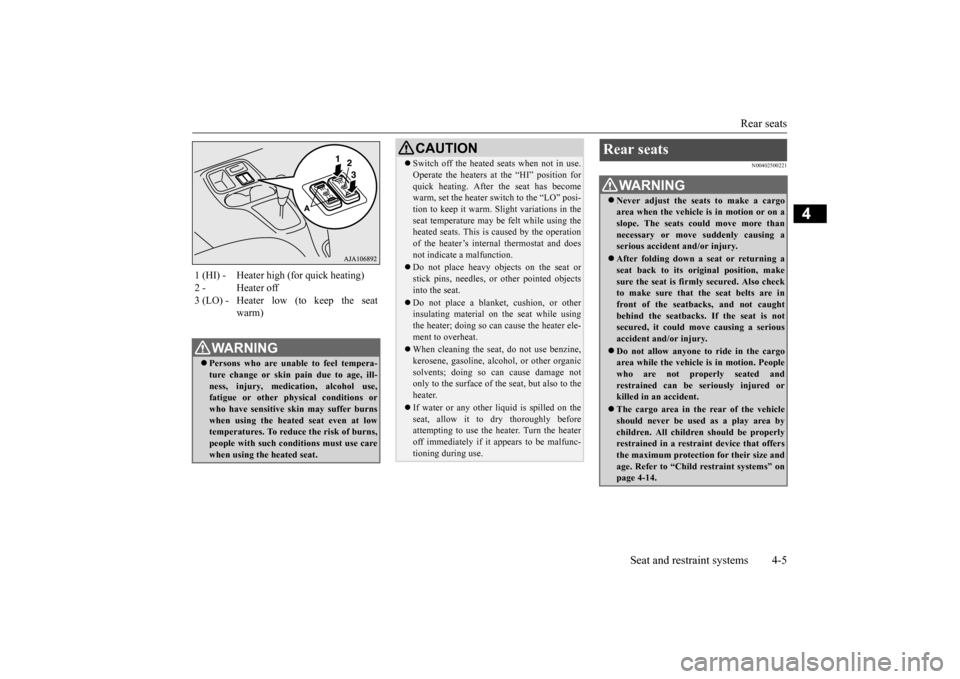
the switch when the ignition switch or the operation mode is in ON. The indicator light (A) will illuminate while the heater is on.
CAUTION The reclining mechanism used in the seat- back is spring loaded, and will cause the seatback to return quickly to the verticalposition when the lock lever is operated. When pulling the lever, sit close to the seat- back or hold the seatback with your hand tocontrol its return motion.
WA R N I N G To reduce the risk of serious injury or death in the event of
an accident or sud-
den stop, all seatbacks should be kept inthe upright position while the vehicle is in motion. Seat belt performance during an accidentcan be adversely affect
ed if the seatbacks
are reclined. The more a seatback is reclined, the more likely seat belt perfor-mance will be advers
ely affected. If the
seat belt is not prop
erly positioned against
the body during an accident, there isincreased risk you will slide under the belt and receive serious
injury or death.
To adjust the seat height (Driver’s seat only, if so equipped)
1- To move the seat cushion up 2- To move the seat cushion downHeated seats
(if so equipped)
BK0212400US.book 4 ページ 2014年4月1日 火曜日 午後2時21分
Page 30 of 300
Rear seats
Seat and restraint systems 4-5
4
N00402500221
1 (HI) - Heater high (for quick heating) 2 - Heater off 3 (LO) - Heater low (to keep the seat
warm)
WA R N I N G Persons who are unable to feel tempera- ture change or skin
pain due to age, ill-
ness, injury, medication, alcohol use, fatigue or other phys
ical conditions or
who have sensitive sk
in may suffer burns
when using the heated seat even at low temperatures. To reduce the risk of burns,people with such conditions must use care when using the heated seat.
CAUTION Switch off the heated seats when not in use. Operate the heaters at the “HI” position forquick heating. After the seat has becomewarm, set the heater switch to the “LO” posi- tion to keep it warm. S
light variations in the
seat temperature may be
felt while using the
heated seats. This is caused by the operation of the heater’s internal thermostat and does not indicate a malfunction. Do not place heavy obj
ects on the seat or
stick pins, needles, or
other pointed objects
into the seat. Do not place a blanket,
cushion, or other
insulating material on
the seat while using
the heater; doing so can
cause the heater ele-
ment to overheat. When cleaning the seat, do not use benzine, kerosene, gasoline, alc
ohol, or other organic
solvents; doing so can cause damage not only to the surface of the seat, but also to the heater. If water or any other li
quid is spilled on the
seat, allow it to dry thoroughly beforeattempting to use the heater. Turn the heater off immediately if it
appears to be malfunc-
tioning during use.
Rear seats
WA R N I N G Never adjust the seats to make a cargo area when the vehicle is
in motion or on a
slope. The seats co
uld move more than
necessary or move suddenly causing a serious accident
and/or injury.
After folding down a
seat or returning a
seat back to its or
iginal position, make
sure the seat is firmly secured. Also check to make sure that the seat belts are in front of the seatbacks, and not caughtbehind the seatbacks. If the seat is not secured, it could move causing a serious accident and/or injury. Do not allow anyone to ride in the cargo area while the vehicle
is in motion. People
who are not properly seated and restrained can be seriously injured or killed in an accident. The cargo area in the
rear of the vehicle
should never be used as a play area bychildren. All children should be properly restrained in a restra
int device that offers
the maximum protection for their size andage. Refer to “Child restraint systems” on page 4-14.
BK0212400US.book 5 ページ 2014年4月1日 火曜日 午後2時21分
Page 36 of 300
Seat belts
Seat and restraint systems 4-11
4
5. To release the belt,
press the button on the
buckle and allow the belt to retract. If the belt does not retract smoothly, pull it out and check for kinks or twists in thewebbing. Then make sure it remains untwisted as it retracts.
N00418400384
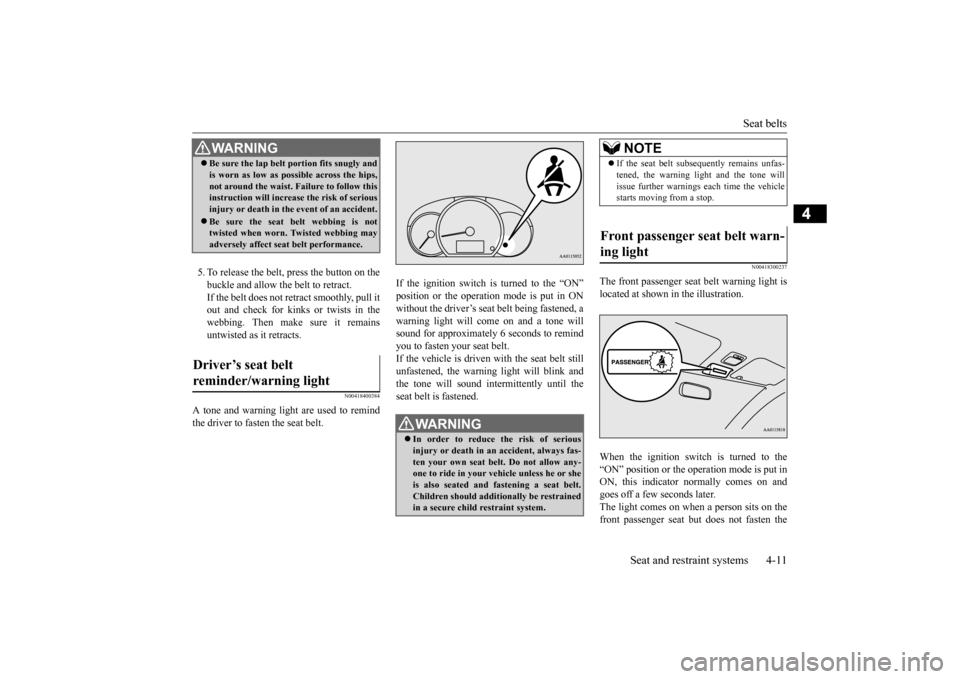
A tone and warning light are used to remind the driver to fasten the seat belt.
If the ignition switch is turned to the “ON” position or the operation mode is put in ONwithout the driver’s seat belt being fastened, a warning light will co
me on and a tone will
sound for approximately
6 seconds to remind
you to fasten your seat belt. If the vehicle is driven with the seat belt still unfastened, the warning light will blink andthe tone will sound inte
rmittently until the
seat belt is fastened.
N00418300237
The front passenger seat
belt warning light is
located at shown in the illustration. When the ignition switch is turned to the “ON” position or the operation mode is put inON, this indicator
normally comes on and
goes off a few seconds later. The light comes on when a person sits on thefront passenger seat bu
t does not fasten the
WA R N I N GBe sure the lap belt portion fits snugly and is worn as low as possible across the hips,not around the waist. Failure to follow thisinstruction will increase the risk of serious injury or death in the
event of an accident.
Be sure the seat belt webbing is not twisted when worn. Twisted webbing may adversely affect seat
belt performance.
Driver’s seat belt reminder/warning light
WA R N I N G In order to reduce the risk of serious injury or death in an
accident, always fas-
ten your own seat belt
. Do not allow any-
one to ride in your ve
hicle unless he or she
is also seated and fastening a seat belt.Children should additi
onally be restrained
in a secure child restraint system.
NOTE
If the seat belt subs
equently remains unfas-
tened, the warning li
ght and the tone will
issue further warnings
each time the vehicle
starts moving from a stop.
Front passenger seat belt warn- ing light
BK0212400US.book 11 ページ 2014年4月1日 火曜日 午後2時21分
Page 37 of 300
Seat belt use during pregnancy 4-12 Seat and restraint systems
4
seat belt. It goes off wh
en the seat belt is sub-
sequently fastened.
N00406300357
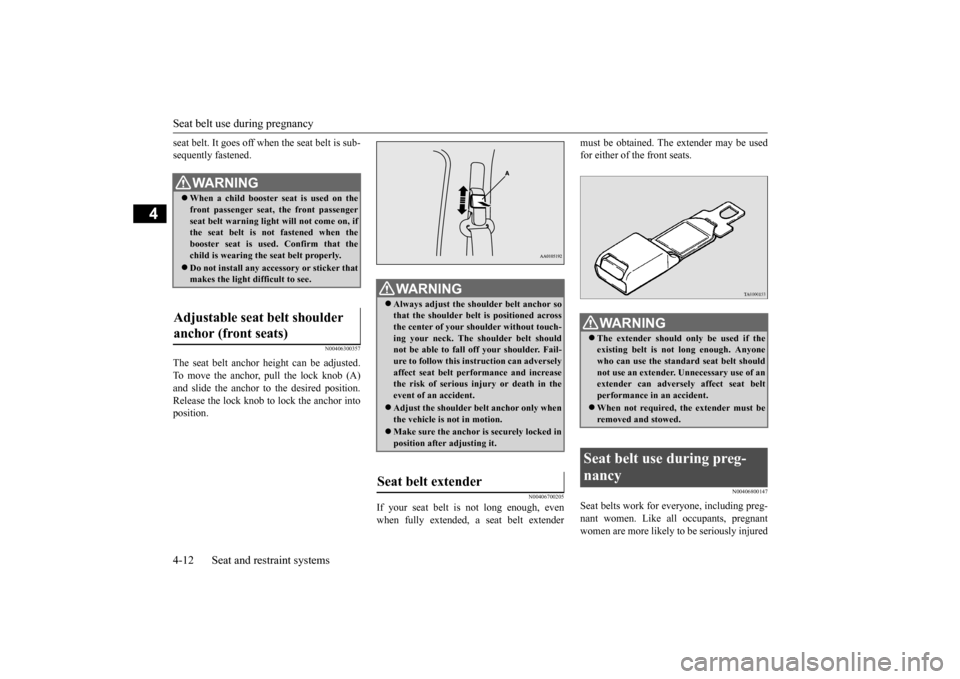
The seat belt anchor height can be adjusted.To move the anchor, pull the lock knob (A) and slide the anchor to the desired position. Release the lock knob to lock the anchor intoposition.
N00406700205
If your seat belt is
not long enough, even
when fully extended,
a seat belt extender
must be obtained. The extender may be used for either of the front seats.
N00406800147
Seat belts work for
everyone, including preg-
nant women. Like al
l occupants, pregnant
women are more likely to be seriously injured
WA R N I N G When a child booster se
at is used on the
front passenger seat, the front passenger seat belt warning ligh
t will not come on, if
the seat belt is not fastened when thebooster seat is used
. Confirm that the
child is wearing the
seat belt properly.
Do not install any acce
ssory or sticker that
makes the light difficult to see.
Adjustable seat belt shoulder anchor (front seats)
WA R N I N G Always adjust the shou
lder belt anchor so
that the shoulder belt
is positioned across
the center of your shoulder without touch- ing your neck. The sh
oulder belt should
not be able to fall off your shoulder. Fail-ure to follow this instruction can adversely affect seat belt performance and increase the risk of serious in
jury or death in the
event of an accident. Adjust the shoulder be
lt anchor only when
the vehicle is not in motion. Make sure the anchor is securely locked in position after adjusting it.
Seat belt extender
WA R N I N G The extender should only be used if the existing belt is not long enough. Anyonewho can use the standard seat belt should not use an extender. Unnecessary use of an extender can adversel
y affect seat belt
performance in an accident. When not required, the extender must be removed and stowed.
Seat belt use during preg- nancy
BK0212400US.book 12 ページ 2014年4月1日 火曜日 午後2時21分
Page 38 of 300
Seat belt pre-tensioner an
d force limiter systems
Seat and restraint systems 4-13
4
or killed in an accident if they do not wear seat belts.
N00417701723
The driver’s and front passenger’s seats eachhave a seat belt equippe
d with a pre-tensioner
system and force limiter system. The driver and front pa
ssenger seat
belts are
equipped with a seat
belt pre-tensioner sys-
tem. In a moderate-to-severe frontal or sidecollision, the pre-tens
ioner system operates
simultaneously with the deployment of the front airbags, side airbags or curtain airbags.The seat belt pre-tensioners are located within the seat belt retractors
(A). When activated,
the pre-tensioners quickly
draw back seat belt
webbing and increase se
at belt performance.
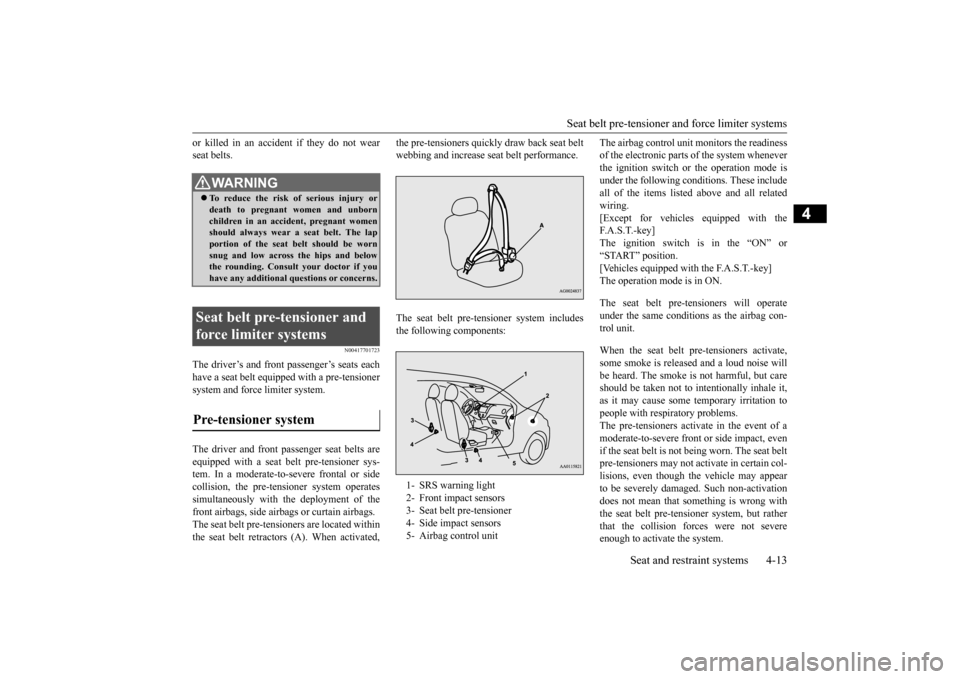
The seat belt pre-tens
ioner system includes
the following components:
The airbag control unit monitors the readiness of the electronic parts of the system wheneverthe ignition switch or the operation mode is under the following conditions. These include all of the items listed
above and all related
wiring. [Except for vehicles
equipped with the
F.A.S.T.-key] The ignition switch is in the “ON” or “START” position. [Vehicles equipped with the F.A.S.T.-key] The operation mode is in ON. The seat belt pre-tensioners will operate under the same conditions as the airbag con-trol unit. When the seat belt pr
e-tensioners activate,
some smoke is released and a loud noise will be heard. The smoke is
not harmful, but care
should be taken not to in
tentionally inhale it,
as it may cause some temporary irritation to people with respiratory problems.The pre-tensioners activate in the event of a moderate-to-severe front or side impact, even if the seat belt is not being worn. The seat beltpre-tensioners may not
activate in certain col-
lisions, even though the vehicle may appear to be severely damage
d. Such non-activation
does not mean that something is wrong with the seat belt pre-tensioner system, but rather that the collision fo
rces were not severe
enough to activate the system.
WA R N I N G To reduce the risk of serious injury or death to pregnant women and unborn children in an accident, pregnant women should always wear
a seat belt. The lap
portion of the seat belt should be worn snug and low across the hips and below the rounding. Consult your doctor if youhave any additional qu
estions or concerns.
Seat belt pre-tensioner and force limiter systems Pre-tensioner system
1- SRS warning light 2- Front impact sensors 3- Seat belt pre-tensioner 4- Side impact sensors 5- Airbag control unit
BK0212400US.book 13 ページ 2014年4月1日 火曜日 午後2時21分
Page 39 of 300
Child restraint systems 4-14 Seat and restraint systems
4
N00408700137
This warning light tells you if there is a prob- lem involving the SRS airbags and/or the seat belt pre-tensioner sy
stem. Refer to “SRS
warning light” on page 4-27.
N00408900142
In the event of an accident, the seat belt forcelimiter system will help reduce the forceapplied to the driver and front seat passenger.
N00407101753
When transporting infants or small childrenin your vehicle, an appropriate child restraint system must always be
used. This is required
by law in the U.S. and Canada.
Child restraint systems specifically designed for infants and small ch
ildren are offered by
several manufacturers. Choose only a child restraint system with a label certifying that it complies with Federal Motor Vehicle SafetyStandard 213 (FMVSS 213) or Motor Vehicle Restraint Systems and
Booster Seats Safety
Regulations (RSSR).
Look for the manufac-
turer’s statement of compliance on the box and child restraint system itself. The child restraint syst
em should be appropri-
ate for your child’s weight and height, and should properly fit your
vehicle’s seat.
For detailed information, refer to the instruc-tion manual accompanying the child restraint system. All children should be
properly restrained in
a restraint device that offers the maximumprotection for their size and age. Be sure to check local, state, or provincial requirements for child si
ze and age that may
vary from the recommendations listed below. Children less than 1 year old and who weigh 22 pounds (10 kg) or less MUST ride in a rear-facing ch
ild safety seat that
MUST ONLY be used in the rear seat.
Children older than 1 year of age and who weigh less than 40 pounds (18 kg) or whoare less than 40 inches (100 cm) tall must be in a forward-facing restraint used only in the rear seat. Children who weigh more than 40 pounds (18 kg) or who are more than 40 inches (100 cm) tall, regard
less of age, should
use a suitable child seat or a booster seat in the rear seat until
the vehicle’s lap-and-
shoulder belt fits
them properly.
WA R N I N GThe seat belt pre-tensioner system is designed to work only
once. After the seat
belt pre-tensioners have been activated,they will not work again. They must promptly be replaced and the entire seat belt pre-tensioner system inspected by anauthorized Mitsubis
hi Motors dealer.
SRS warning light Force limiter system Child restraint systems
Guidelines for child restraint system selection
WA R N I N G All children must be seated in the rear seat, and properly restrained. Accident statistics show that children of all sizes and ages are
safer when properly
restrained in the rear seat, rather than in the front seat. Be sure to select a child restraint system that is appropriate not only for the child’s size and age but also for your vehicle.Some child restraint systems may not fit your vehicle properly.
BK0212400US.book 14 ページ 2014年4月1日 火曜日 午後2時21分
Page 48 of 300
Supplemental Restraint System (SRS) - airbag
Seat and restraint systems 4-23
4
N00407800522
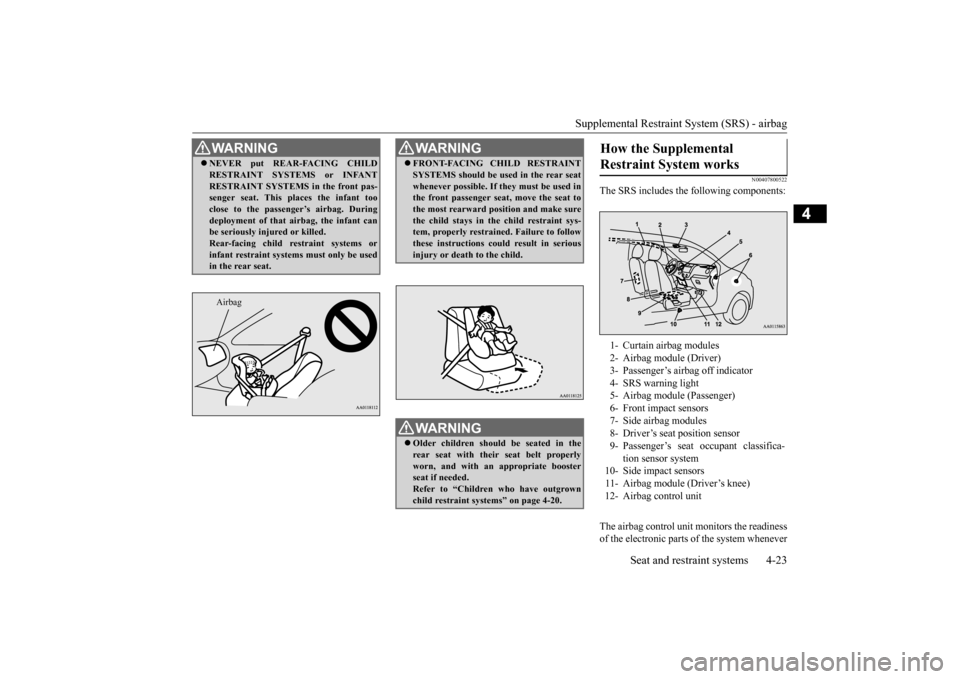
The SRS includes the following components: The airbag control unit monitors the readiness of the electronic parts of the system whenever
WA R N I N G NEVER put REAR-FACING CHILD RESTRAINT SYSTEMS or INFANTRESTRAINT SYSTEMS in the front pas-senger seat. This pl
aces the infant too
close to the passenger’s airbag. During deployment of that airbag, the infant canbe seriously inju
red or killed.
Rear-facing child restraint systems or infant restraint systems must only be usedin the rear seat.Airbag
WA R N I N G FRONT-FACING CHILD RESTRAINT SYSTEMS should be used in the rear seatwhenever possible. If they must be used inthe front passenger seat, move the seat to the most rearward po
sition and make sure
the child stays in the child restraint sys-tem, properly restrained. Failure to follow these instructions could result in serious injury or death to the child.WA R N I N G Older children should be seated in the rear seat with thei
r seat belt properly
worn, and with an
appropriate booster
seat if needed.Refer to “Children
who have outgrown
child restraint systems” on page 4-20.
How the Supplemental Restraint System works 1- Curtain airbag modules 2- Airbag module (Driver) 3- Passenger’s airb
ag off indicator
4- SRS warning light5- Airbag module (Passenger) 6- Front impact sensors 7- Side airbag modules8- Driver’s seat
position sensor
9- Passenger’s seat oc
cupant classifica-
tion sensor system
10- Side impact sensors 11- Airbag module (Driver’s knee) 12- Airbag control unit
BK0212400US.book 23 ページ 2014年4月1日 火曜日 午後2時21分