lock MITSUBISHI MIRAGE 2015 6.G User Guide
[x] Cancel search | Manufacturer: MITSUBISHI, Model Year: 2015, Model line: MIRAGE, Model: MITSUBISHI MIRAGE 2015 6.GPages: 300, PDF Size: 43.44 MB
Page 31 of 300
Rear seats 4-6 Seat and restraint systems
4
N00402901222
The rear seatbacks can be folded forward to provide additional l
uggage compartment
space. 1. Place each head restraint in its lowest position. (Refer to
“Head restraints” on
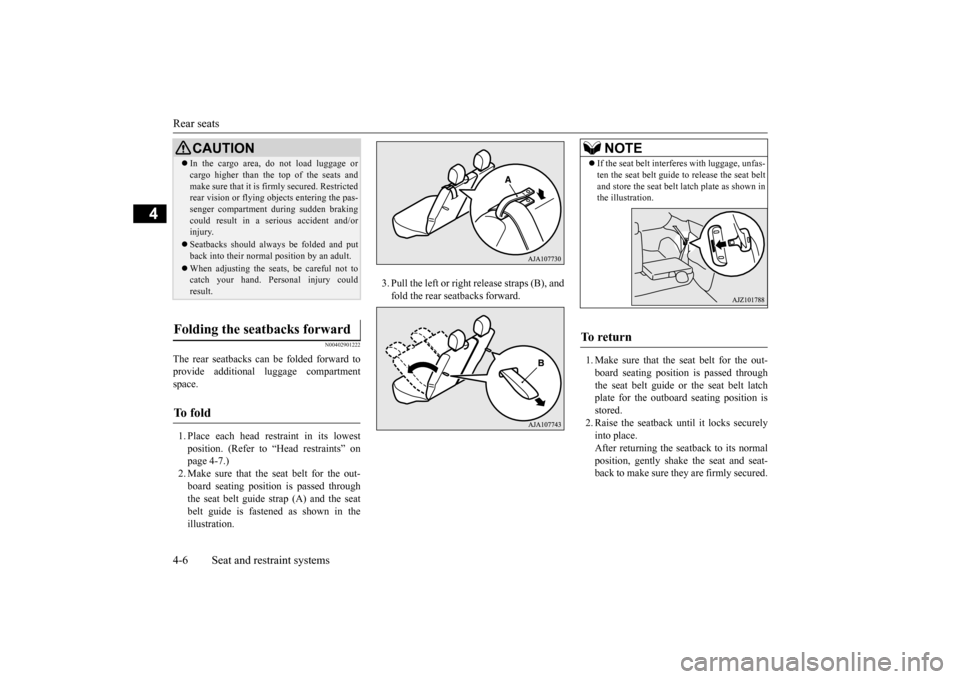
page 4-7.) 2. Make sure that the seat belt for the out- board seating position is passed throughthe seat belt guide
strap (A) and the seat
belt guide is fastened as shown in the illustration.
3. Pull the left or right release straps (B), and fold the rear seatbacks forward.
1. Make sure that the seat belt for the out- board seating position is passed through the seat belt guide or
the seat belt latch
plate for the outboard
seating position is
stored. 2. Raise the seatback until it locks securelyinto place. After returning the seatback to its normal position, gently shake the seat and seat-back to make sure they are firmly secured.
CAUTION In the cargo area, do not load luggage or cargo higher than the top of the seats andmake sure that it is firmly secured. Restrictedrear vision or flying obj
ects entering the pas-
senger compartment during sudden braking could result in a se
rious accident and/or
injury. Seatbacks shoul
d always be folded and put
back into their normal position by an adult. When adjusting the seats, be careful not to catch your hand. Pers
onal injury could
result.
Folding the seatbacks forward To f o l d
NOTE
If the seat belt interfer
es with luggage, unfas-
ten the seat belt guide
to release the seat belt
and store the seat belt
latch plate as shown in
the illustration.
To r e t u r n
BK0212400US.book 6 ページ 2014年4月1日 火曜日 午後2時21分
Page 32 of 300
Head restraints
Seat and restraint systems 4-7
4
N00404300584
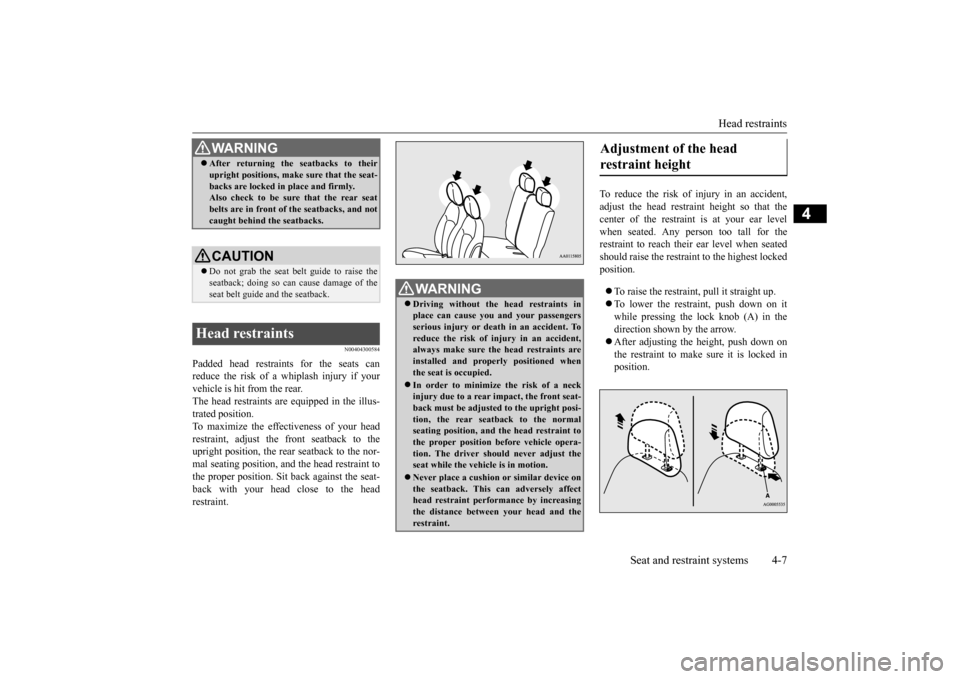
Padded head restraints for the seats can reduce the risk of a whiplash injury if your vehicle is hit from the rear. The head restraints are equipped in the illus-trated position. To maximize the effectiveness of your head restraint, adjust the front seatback to theupright position, the rear seatback to the nor- mal seating position, a
nd the head restraint to
the proper position. Sit back against the seat-back with your head close to the head restraint.
To reduce the risk of injury in an accident, adjust the head restraint height so that thecenter of the restraint is at your ear level when seated. Any person too tall for the restraint to reach their ear level when seatedshould raise the restrain
t to the highest locked
position. To raise the restraint,
pull it straight up.
To lower the restraint, push down on it while pressing the lock knob (A) in the direction shown by the arrow. After adjusting the height, push down on the restraint to make sure it is locked in position.
WA R N I N G After returning the seatbacks to their upright positions, make sure that the seat-backs are locked in place and firmly.Also check to be sure that the rear seat belts are in front of
the seatbacks, and not
caught behind the seatbacks.CAUTION Do not grab the seat be
lt guide to raise the
seatback; doing so can
cause damage of the
seat belt guide
and the seatback.
Head restraints
WA R N I N GDriving without the
head restraints in
place can cause you and your passengersserious injury or deat
h in an accident. To
reduce the risk of in
jury in an accident,
always make sure the head restraints areinstalled and proper
ly positioned when
the seat is occupied. In order to minimize
the risk of a neck
injury due to a rear impact, the front seat- back must be adjusted to the upright posi-tion, the rear seatback to the normal seating position, and
the head restraint to
the proper position
before vehicle opera-
tion. The driver shou
ld never adjust the
seat while the vehicle is in motion. Never place a cushion
or similar device on
the seatback. This can adversely affect head restraint performance by increasingthe distance betwee
n your head and the
restraint.
Adjustment of the head restraint height
BK0212400US.book 7 ページ 2014年4月1日 火曜日 午後2時21分
Page 33 of 300
Seat belts 4-8 Seat and restraint systems
4
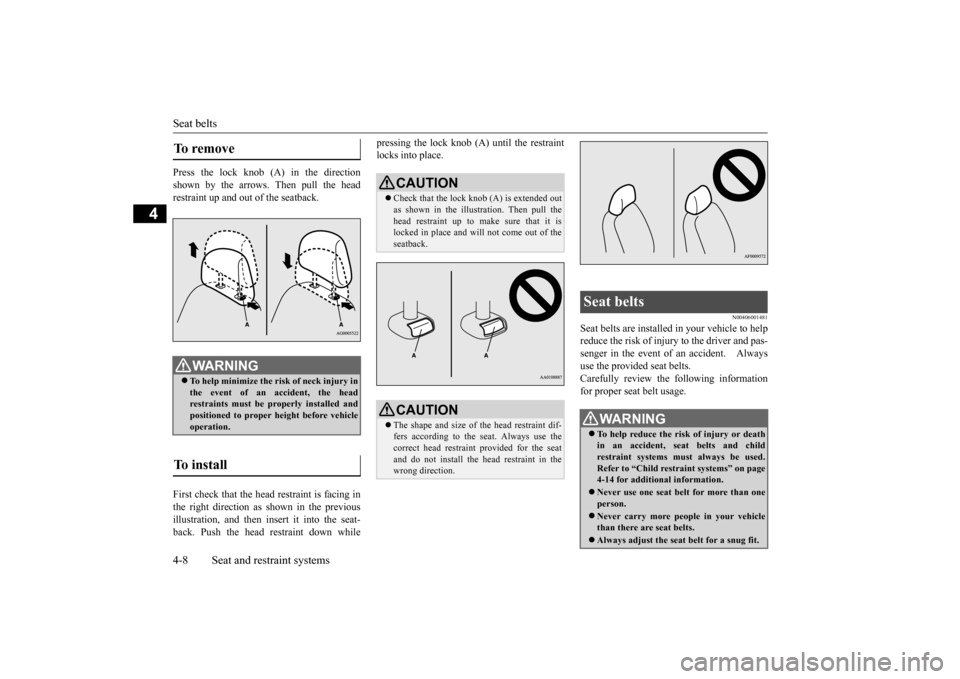
Press the lock knob (A) in the direction shown by the arrows. Then pull the head restraint up and out of the seatback. First check that the head restraint is facing in the right direction as
shown in the previous
illustration, and then insert it into the seat- back. Push the head restraint down while
pressing the lock knob (A) until the restraint locks into place.
N00406001481
Seat belts are in
stalled in your vehicle to help
reduce the risk of injury to the driver and pas-senger in the event of an accident. Always use the provided seat belts. Carefully review the
following information
for proper seat belt usage.
To remove
WA R N I N G To help minimize the risk of neck injury in the event of an
accident, the head
restraints must be properly installed and positioned to proper height before vehicle operation.
To install
CAUTION Check that the lock knob (A) is extended out as shown in the illustration. Then pull the head restraint up to make sure that it is locked in place and will
not come out of the
seatback.CAUTION The shape and size of the head restraint dif- fers according to the seat. Always use the correct head restrain
t provided for the seat
and do not install the he
ad restraint in the
wrong direction.
Seat belts
WA R N I N G To help reduce the risk of injury or death in an accident, se
at belts and child
restraint systems must always be used. Refer to “Child restraint systems” on page 4-14 for additional information. Never use one seat belt
for more than one
person. Never carry more peop
le in you
r vehicle
than there are seat belts. Always adjust the seat
belt for a snug fit.
BK0212400US.book 8 ページ 2014年4月1日 火曜日 午後2時21分
Page 34 of 300
Seat belts
Seat and restraint systems 4-9
4
N00406200460
All seats are equipped with a seat belt which uses one combined lap-
and-shoulder belt with
an emergency locking retractor. This system is designed to provide both com- fort and safety. It pe
rmits full extension and
automatic retraction of the belts during nor- mal vehicle operation.
A sensing device
inside the belt retractor is designed to lock the retractor in the event of a sudden change inthe vehicle’s motion. 1. Occupants shoul
d always sit back in their
seats with their backs against the upright seatback. To reduce the risk of seriousinjury or death during deployment of the airbag, adjust the driver’s seat as far back as possible while maintaining a positionthat still enables you to fully apply the pedals, easily contro
l the steering wheel,
and safely operate the vehicle. The frontpassenger seat should
also be moved as
far back as possible. Refer to “Supple- mental Restraint System (SRS) - airbag”on page 4-21. Also refe
r to “To adjust the
seat forward or backward” on page 4-3.
Always place the shou
lder belt over your
shoulder and across you
r chest. Never put
it behind you or
under your arm.
Always wear the lap belt as low as possible across your hips, not around your waist. Never modify or alter the seat belts in your vehicle. To reduce the risk to the driver of serious injury or death durin
g deployment of the
driver’s airbag, always
properly wear the
seat belt and adjust th
e driver’s seat as far
back as possible while maintaining a posi-tion that still enables
you to fully apply the
pedals, easily control the steering wheel, and safely operate the vehicle. To reduce the risk to a front seat passen- ger of serious injury or death from adeploying airbag, make sure the passenger always wears the seat belt properly, remains seated all the way back andupright in their seat, and moves the seat as far back as possible. Refer to “Supplemen- tal Restraint System (SRS) - airbag” onpage 4-21 for additional information. Never hold an infant
or child in your arms
or on your lap when ri
ding in this vehicle
even when you are wearing your seat belt. Never place any part of the seat belt youare wearing around an
infant or child.
Failure to follow these simple instructions creates a risk of serious injury or death toyour child in the even
t of an accident or
sudden stop.WA R N I N G
Children 12 years ol
d and under should
always ride in the re
ar seat and be prop-
erly restrained. This reduces their risk ofserious injury or de
ath in an accident,
especially due to a deploying front passen- ger’s airbag. Refer to
“Child restraint sys-
tems” on page 4-
14 for additional
information. Any child who is too small to properly wear a seat belt
must be properly
restrained in an
appropriate child
restraint system. Infants MUST be plac
ed in a rear-facing
child safety seat and positioned in the rear seat. In the event of an ac
cident, all seat belt
assemblies, including retractors and attachment hardware, should be inspectedby an authorized
Mitsubishi Motors
dealer to determine whether replacement is necessary.
Seat belt instructions
WA R N I N G
NOTE
For instructions on installing a child restraint system using a seat belt
, refer to “Installing a
child restraint system
using the seat belt” on
page 4-18.
BK0212400US.book 9 ページ 2014年4月1日 火曜日 午後2時21分
Page 35 of 300
Seat belts 4-10 Seat and restraint systems
4
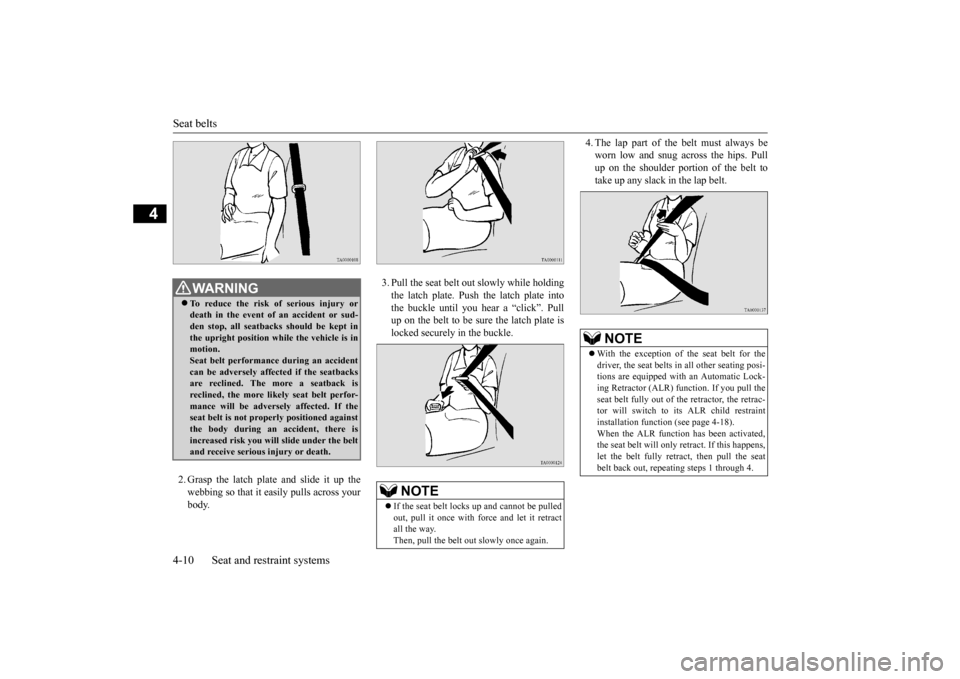
2. Grasp the latch plate and slide it up the webbing so that it ea
sily pulls across your
body.
3. Pull the seat belt out
slowly while holding
the latch plate. Push the latch plate into the buckle until you he
ar a “click”. Pull
up on the belt to be sure the latch plate islocked securely in the buckle.
4. The lap part of the belt must always be worn low and snug across the hips. Pullup on the shoulder portion of the belt to take up any slack in the lap belt.
WA R N I N G To reduce the risk of serious injury or death in the event of
an accident or sud-
den stop, all seatbacks should be kept in the upright position while the vehicle is inmotion. Seat belt performance during an accident can be adversely affect
ed if the seatbacks
are reclined. The more a seatback is reclined, the more likely seat belt perfor- mance will be adversely affected. If theseat belt is not proper
ly positioned against
the body during an accident, there is increased risk you will slide under the beltand receive serious
injury or death.
NOTE
If the seat belt lock
s up and cannot be pulled
out, pull it once with fo
rce and let it retract
all the way. Then, pull the belt out
slowly once again.
NOTE
With the exception of the seat belt for the driver, the seat belts in
all other seating posi-
tions are equipped with an Automatic Lock- ing Retractor (ALR) function. If you pull the seat belt fully out of th
e retractor, the retrac-
tor will switch to its ALR child restraint installation function (see page 4-18). When the ALR function has been activated,the seat belt will only re
tract. If this happens,
let the belt fully retract, then pull the seat belt back out, repeating steps 1 through 4.
BK0212400US.book 10 ページ 2014年4月1日 火曜日 午後2時21分
Page 37 of 300
Seat belt use during pregnancy 4-12 Seat and restraint systems
4
seat belt. It goes off wh
en the seat belt is sub-
sequently fastened.
N00406300357
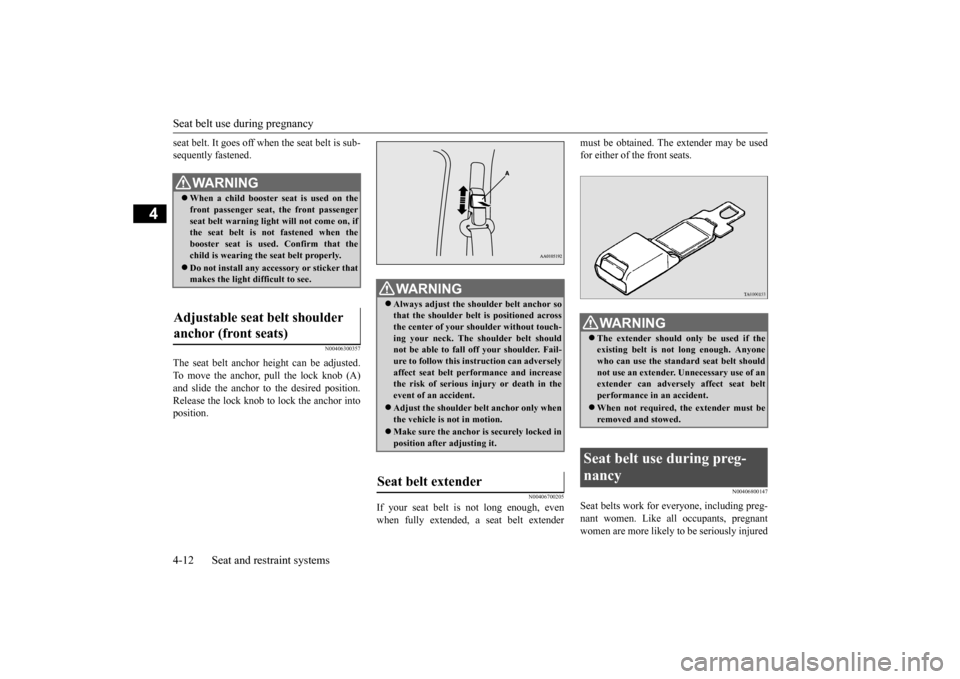
The seat belt anchor height can be adjusted.To move the anchor, pull the lock knob (A) and slide the anchor to the desired position. Release the lock knob to lock the anchor intoposition.
N00406700205
If your seat belt is
not long enough, even
when fully extended,
a seat belt extender
must be obtained. The extender may be used for either of the front seats.
N00406800147
Seat belts work for
everyone, including preg-
nant women. Like al
l occupants, pregnant
women are more likely to be seriously injured
WA R N I N G When a child booster se
at is used on the
front passenger seat, the front passenger seat belt warning ligh
t will not come on, if
the seat belt is not fastened when thebooster seat is used
. Confirm that the
child is wearing the
seat belt properly.
Do not install any acce
ssory or sticker that
makes the light difficult to see.
Adjustable seat belt shoulder anchor (front seats)
WA R N I N G Always adjust the shou
lder belt anchor so
that the shoulder belt
is positioned across
the center of your shoulder without touch- ing your neck. The sh
oulder belt should
not be able to fall off your shoulder. Fail-ure to follow this instruction can adversely affect seat belt performance and increase the risk of serious in
jury or death in the
event of an accident. Adjust the shoulder be
lt anchor only when
the vehicle is not in motion. Make sure the anchor is securely locked in position after adjusting it.
Seat belt extender
WA R N I N G The extender should only be used if the existing belt is not long enough. Anyonewho can use the standard seat belt should not use an extender. Unnecessary use of an extender can adversel
y affect seat belt
performance in an accident. When not required, the extender must be removed and stowed.
Seat belt use during preg- nancy
BK0212400US.book 12 ページ 2014年4月1日 火曜日 午後2時21分
Page 43 of 300
Child restraint systems 4-18 Seat and restraint systems
4
4. On a vehicle equipped with a rear shelf panel, remove the rear shelf panel from the vehicle. (Refer to “Rear shelf panel”on page 5-109.)
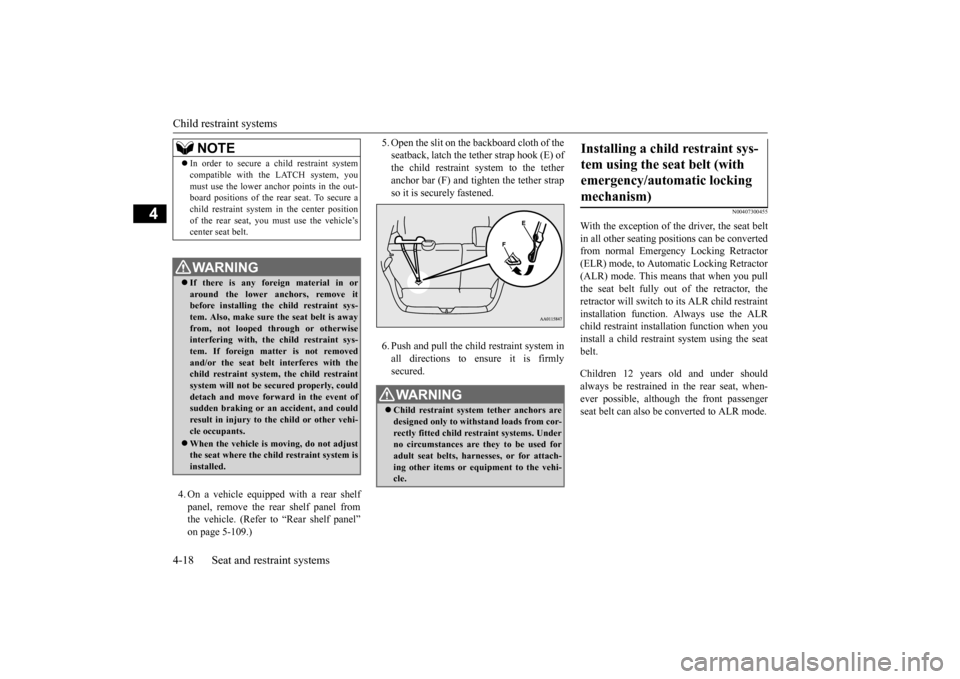
5. Open the slit on the backboard cloth of the seatback, latch the tether strap hook (E) ofthe child restraint system to the tether anchor bar (F) and tighten the tether strap so it is securely fastened. 6. Push and pull the child restraint system in all directions to en
sure it is firmly
secured.
N00407300455
With the exception of the driver, the seat belt in all other seating po
sitions can be converted
from normal Emergency Locking Retractor(ELR) mode, to Automatic Locking Retractor (ALR) mode. This mean
s that when you pull
the seat belt fully out of the retractor, the retractor will switch to its ALR child restraint installation function.
Always use the ALR
child restraint instal
lation function when you
install a child restraint system using the seat belt. Children 12 years old and under should always be restrained in the rear seat, when- ever possible, although the front passenger seat belt can also be
converted to ALR mode.
NOTE
In order to secure a child restraint system compatible with the LATCH system, youmust use the lower anchor points in the out-board positions of the rear seat. To secure a child restraint system in the center position of the rear seat, you mu
st use the vehicle’s
center seat belt.WA R N I N G If there is any foreign material in or around the lower anchors, remove it before installing the child restraint sys-tem. Also, make sure the seat belt is away from, not looped through or otherwise interfering with, the child restraint sys-tem. If foreign matter is not removed and/or the seat belt
interferes with the
child restraint system, the child restraintsystem will not be secured properly, could detach and move forward in the event of sudden braking or an
accident, and could
result in injury to the child or other vehi- cle occupants. When the vehicle is
moving, do not adjust
the seat where the child restraint system is installed.
WA R N I N G Child restraint system tether anchors are designed only to with
stand loads from cor-
rectly fitted child restraint systems. Under no circumstances are they to be used for adult seat belts, harnesses, or for attach-ing other items or eq
uipment to the vehi-
cle.
Installing a child restraint sys- tem using the seat belt (with emergency/auto
matic locking
mechanism)
BK0212400US.book 18 ページ 2014年4月1日 火曜日 午後2時21分
Page 44 of 300
Child restraint systems
Seat and restraint systems 4-19
4
1. Place the child restraint system on the seat where you wish to install it. To help assure proper fitting of the child restraint system, alwa
ys remove the head
restraint. 2. Route the seat belt through the child restraint system acco
rding to the instruc-
tions provided by the child restraint sys- tem’s manufacturer. Then insert the seat belt latch plate into
the buckle. Make sure
you hear a “click” when you insert the latch plate into the buckle.
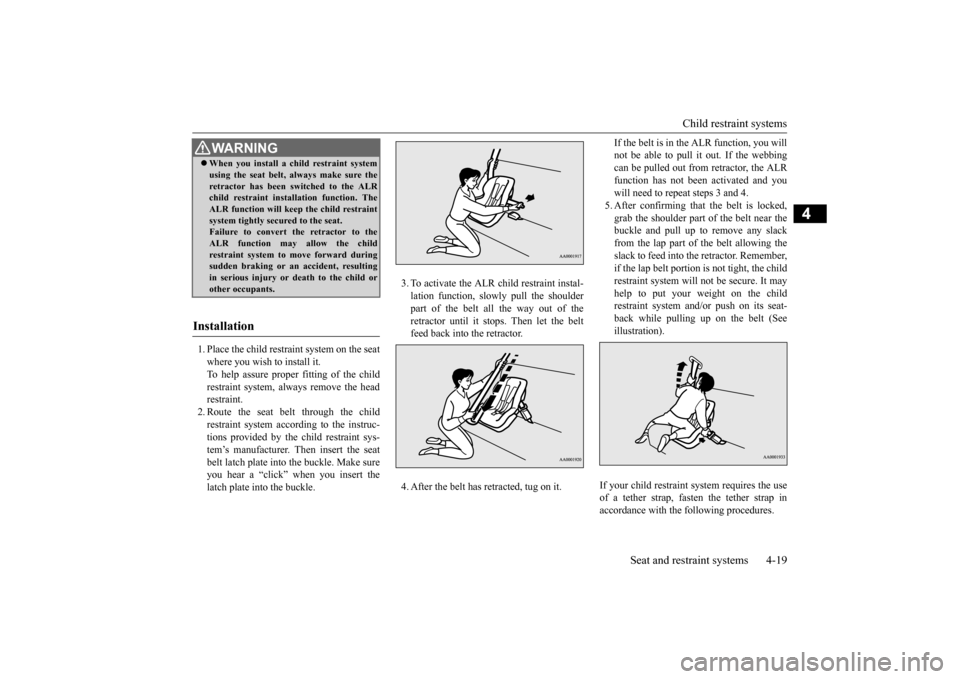
3. To activate the ALR child restraint instal- lation function, slowly pull the shoulderpart of the belt all the way out of the retractor until it stops. Then let the belt feed back into the retractor. 4. After the belt has retracted, tug on it.
If the belt is in the ALR function, you will not be able to pull it out. If the webbingcan be pulled out from retractor, the ALR function has not been activated and you will need to repeat steps 3 and 4.5. After confirming that the belt is locked, grab the shoulder part of the belt near the buckle and pull up to remove any slackfrom the lap part of the belt allowing the slack to feed into the retractor. Remember, if the lap belt portion is not tight, the child restraint system
will not be secure. It may
help to put your weight on the childrestraint system and/or push on its seat- back while pulling up on the belt (See illustration).
WA R N I N G When you install a child restraint system using the seat belt, al
ways make sure the
retractor has been switched to the ALRchild restraint installation function. The ALR function will keep the child restraint system tightly secured to the seat.Failure to convert the retractor to the ALR function may allow the child restraint system to move forward duringsudden braking
or an accide
nt, resulting
in serious injury or
death to the child or
other occupants.
Installation
If your child restraint system requires the use of a tether strap, fasten the tether strap inaccordance with the following procedures.
BK0212400US.book 19 ページ 2014年4月1日 火曜日 午後2時21分
Page 45 of 300
Maintenance and inspection of seat belts 4-20 Seat and restraint systems
4
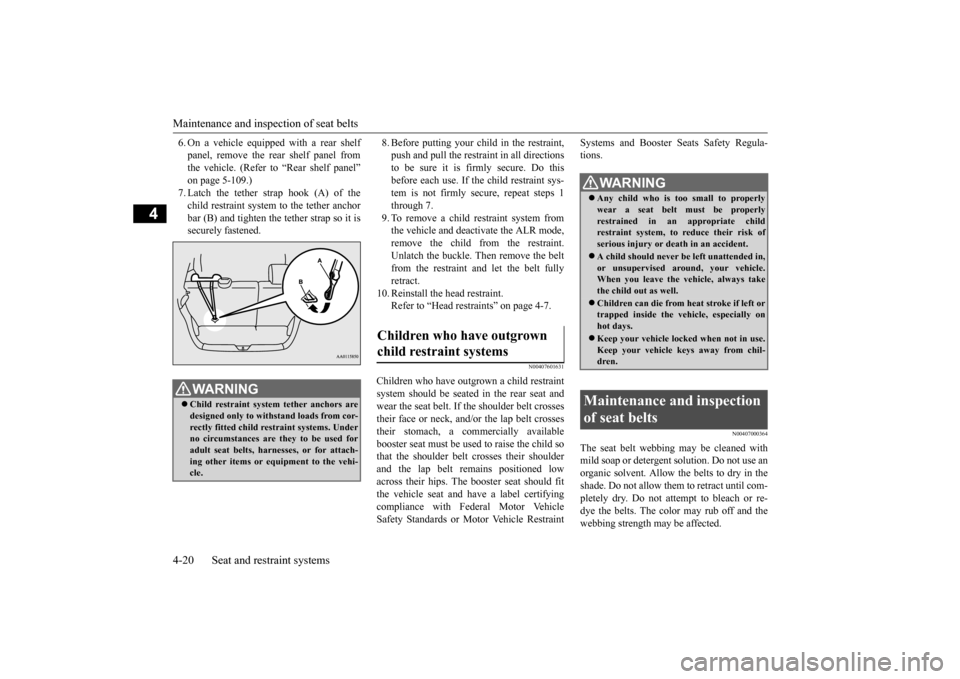
6. On a vehicle equipped with a rear shelf panel, remove the rear shelf panel fromthe vehicle. (Refer to “Rear shelf panel” on page 5-109.) 7. Latch the tether strap hook (A) of thechild restraint system to the tether anchor bar (B) and tighten the tether strap so it is securely fastened.
8. Before putting your child in the restraint, push and pull the restraint in all directionsto be sure it is firmly secure. Do this before each use. If the child restraint sys- tem is not firmly s
ecure, repeat steps 1
through 7. 9. To remove a child restraint system from the vehicle and deac
tivate the ALR mode,
remove the child from the restraint. Unlatch the buckle. Th
en remove the belt
from the restraint and let the belt fully retract.
10. Reinstall the head restraint.
Refer to “Head restraints” on page 4-7.
N00407601631
Children who have outgrown a child restraint system should be seated in the rear seat and wear the seat belt. If the shoulder belt crossestheir face or neck, and/
or the lap belt crosses
their stomach, a commercially available booster seat must be used to raise the child sothat the shoulder belt
crosses their shoulder
and the lap belt remains positioned low across their hips. The booster seat should fitthe vehicle seat and ha
ve a label certifying
compliance with Federal Motor Vehicle Safety Standards or Mo
tor Vehicle Restraint
Systems and Booster Se
ats Safety Regula-
tions.
N00407000364
The seat belt webbing may be cleaned withmild soap or detergent solution. Do not use anorganic solvent. Allow the belts to dry in the shade. Do not allow them to retract until com- pletely dry. Do not attempt to bleach or re-dye the belts. The color may rub off and the webbing strength may be affected.
WA R N I N G Child restraint system tether anchors are designed only to with
stand loads from cor-
rectly fitted child restraint systems. Under no circumstances are they to be used foradult seat belts, harnesses, or for attach- ing other items or e
quipment to the vehi-
cle.
Children who have outgrown child restraint systems
WA R N I N G Any child who is too small to properly wear a seat belt
must be properly
restrained in an appropriate child restraint system, to reduce their risk ofserious injury or de
ath in an
accident.
A child should never be
left unattended in,
or unsupervised around, your vehicle. When you leave the ve
hicle, always take
the child out as well. Children can die from heat stroke if left or trapped inside the vehicle, especially onhot days. Keep your vehicle locked when not in use. Keep your vehicle keys away from chil- dren.
Maintenance and inspection of seat belts
BK0212400US.book 20 ページ 2014年4月1日 火曜日 午後2時21分
Page 46 of 300
Supplemental Restraint System (SRS) - airbag
Seat and restraint systems 4-21
4
Regularly check your se
at belt buckles and
their release mechanisms
for positive engage-
ment and release of the
latch plate. Check the
retractors for automatic locking when in the Automatic Locking Retractor function. The entire seat belt assembly should be replaced if the webbing shows any obvious cuts, tears, increase in thickness in any sec- tion of the webbing from broken fibers, orsevere fading from sunlig
ht. All of these con-
ditions indicate a weakening of the belt, which may adversely affe
ct seat belt perfor-
mance in an accident.
N00407701791
This vehicle is equippe
d with a Supplemental
Restraint System (SRS), which includes air- bags for the driver and passengers.
The SRS front airbags are designed to supple- ment the primary protection of the driver andfront passenger seat belt systems by provid- ing those occupants w
ith protection against
head and chest injuries
in certain moderate to
severe frontal collisi
ons. The SRS front air-
bags, together with sensors at the front of the vehicle and sensors attached to the frontseats, form an advanced airbag system. The SRS driver’s knee airbag is designed to supplement the primary protection of the driver’s seat belt system. It can reduce the forward movement of the driver’s lower legs and provide increased
overall body protection
in certain moderate to
severe frontal colli-
sions. The SRS side airbags and the curtain airbags are also designed to supp
lement the seat belts.
The SRS side airbags provide the driver and front passenger with pr
otection against chest
injuries by deploying the bag on the sideimpacted in moderate
to severe side impact
collisions. The SRS curtain airbags provide the driver and passengers on the front seatand rear outboard seat
with protection against
head injuries by deploying a bag on the side impacted in moderate
to severe side impact
collisions. The SRS airbags are NOT a substitute for use of the seat belts. For maximum protection in
all types of accident
s, seat belts must
ALWAYS be worn by everyone who drives orrides in this vehicle
(with infants and small
children in an appropriate child restraint sys- tem in the rear seat, and older children buck-led in the rear seat). Refer to “Child restraint systems” on page 4-14.
WA R N I N G Do not attempt to repair or replace any part of the seat belt assemblies. This workshould be done
by an authorized
Mitsubishi Motors dealer. Failure to have an authorized Mitsub
ishi Motors dealer
perform the work could reduce the effec- tiveness of the belts and could result in a serious injury or de
ath in an accident.
Supplemental Restraint Sys- tem (SRS) - airbag
WA R N I N G IT IS VERY IMPORTANT TO ALWAYS WEAR YOUR SEAT BELT PROPERLY EVEN WITH AN AIRBAG.• Seat belts help keep the driver and pas-sengers properly positioned. Thisreduces the risk of injury in all collisions, and reduces the risk of serious injuries or death when the
airbags inflate.
During sudden braking just before a col- lision, an unrestra
ined or
improperly
restrained driver or passengers can moveforward into direct contact with, or within close proximi
ty to, the airbag
when it begins to inflate.The beginning stage of
airbag inflation is
the most forceful and can cause serious injuries or death if the occupant comes incontact with the airbag at this time.• Seat belts reduce the risk of injury inrollovers, in rear impact collisions, and in lower-speed frontal collisions because the airbags are not de
signed to inflate in
those situations.
BK0212400US.book 21 ページ 2014年4月1日 火曜日 午後2時21分