seats MITSUBISHI MIRAGE 2015 6.G User Guide
[x] Cancel search | Manufacturer: MITSUBISHI, Model Year: 2015, Model line: MIRAGE, Model: MITSUBISHI MIRAGE 2015 6.GPages: 300, PDF Size: 43.44 MB
Page 38 of 300
Seat belt pre-tensioner an
d force limiter systems
Seat and restraint systems 4-13
4
or killed in an accident if they do not wear seat belts.
N00417701723
The driver’s and front passenger’s seats eachhave a seat belt equippe
d with a pre-tensioner
system and force limiter system. The driver and front pa
ssenger seat
belts are
equipped with a seat
belt pre-tensioner sys-
tem. In a moderate-to-severe frontal or sidecollision, the pre-tens
ioner system operates
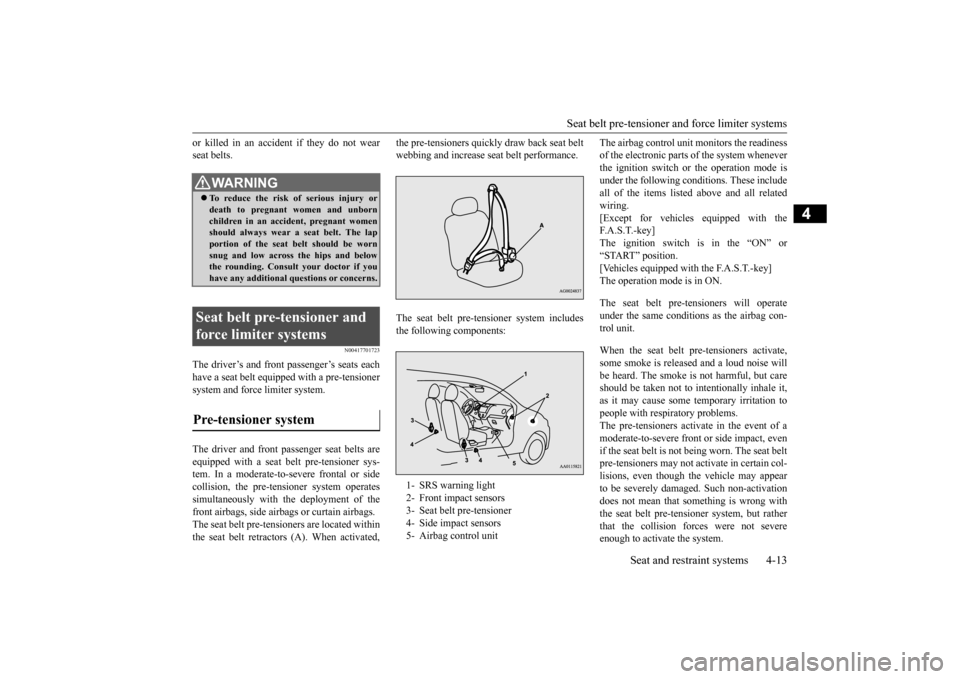
simultaneously with the deployment of the front airbags, side airbags or curtain airbags.The seat belt pre-tensioners are located within the seat belt retractors
(A). When activated,
the pre-tensioners quickly
draw back seat belt
webbing and increase se
at belt performance.
The seat belt pre-tens
ioner system includes
the following components:
The airbag control unit monitors the readiness of the electronic parts of the system wheneverthe ignition switch or the operation mode is under the following conditions. These include all of the items listed
above and all related
wiring. [Except for vehicles
equipped with the
F.A.S.T.-key] The ignition switch is in the “ON” or “START” position. [Vehicles equipped with the F.A.S.T.-key] The operation mode is in ON. The seat belt pre-tensioners will operate under the same conditions as the airbag con-trol unit. When the seat belt pr
e-tensioners activate,
some smoke is released and a loud noise will be heard. The smoke is
not harmful, but care
should be taken not to in
tentionally inhale it,
as it may cause some temporary irritation to people with respiratory problems.The pre-tensioners activate in the event of a moderate-to-severe front or side impact, even if the seat belt is not being worn. The seat beltpre-tensioners may not
activate in certain col-
lisions, even though the vehicle may appear to be severely damage
d. Such non-activation
does not mean that something is wrong with the seat belt pre-tensioner system, but rather that the collision fo
rces were not severe
enough to activate the system.
WA R N I N G To reduce the risk of serious injury or death to pregnant women and unborn children in an accident, pregnant women should always wear
a seat belt. The lap
portion of the seat belt should be worn snug and low across the hips and below the rounding. Consult your doctor if youhave any additional qu
estions or concerns.
Seat belt pre-tensioner and force limiter systems Pre-tensioner system
1- SRS warning light 2- Front impact sensors 3- Seat belt pre-tensioner 4- Side impact sensors 5- Airbag control unit
BK0212400US.book 13 ページ 2014年4月1日 火曜日 午後2時21分
Page 39 of 300
Child restraint systems 4-14 Seat and restraint systems
4
N00408700137
This warning light tells you if there is a prob- lem involving the SRS airbags and/or the seat belt pre-tensioner sy
stem. Refer to “SRS
warning light” on page 4-27.
N00408900142
In the event of an accident, the seat belt forcelimiter system will help reduce the forceapplied to the driver and front seat passenger.
N00407101753
When transporting infants or small childrenin your vehicle, an appropriate child restraint system must always be
used. This is required
by law in the U.S. and Canada.
Child restraint systems specifically designed for infants and small ch
ildren are offered by
several manufacturers. Choose only a child restraint system with a label certifying that it complies with Federal Motor Vehicle SafetyStandard 213 (FMVSS 213) or Motor Vehicle Restraint Systems and
Booster Seats Safety
Regulations (RSSR).
Look for the manufac-
turer’s statement of compliance on the box and child restraint system itself. The child restraint syst
em should be appropri-
ate for your child’s weight and height, and should properly fit your
vehicle’s seat.
For detailed information, refer to the instruc-tion manual accompanying the child restraint system. All children should be
properly restrained in
a restraint device that offers the maximumprotection for their size and age. Be sure to check local, state, or provincial requirements for child si
ze and age that may
vary from the recommendations listed below. Children less than 1 year old and who weigh 22 pounds (10 kg) or less MUST ride in a rear-facing ch
ild safety seat that
MUST ONLY be used in the rear seat.
Children older than 1 year of age and who weigh less than 40 pounds (18 kg) or whoare less than 40 inches (100 cm) tall must be in a forward-facing restraint used only in the rear seat. Children who weigh more than 40 pounds (18 kg) or who are more than 40 inches (100 cm) tall, regard
less of age, should
use a suitable child seat or a booster seat in the rear seat until
the vehicle’s lap-and-
shoulder belt fits
them properly.
WA R N I N GThe seat belt pre-tensioner system is designed to work only
once. After the seat
belt pre-tensioners have been activated,they will not work again. They must promptly be replaced and the entire seat belt pre-tensioner system inspected by anauthorized Mitsubis
hi Motors dealer.
SRS warning light Force limiter system Child restraint systems
Guidelines for child restraint system selection
WA R N I N G All children must be seated in the rear seat, and properly restrained. Accident statistics show that children of all sizes and ages are
safer when properly
restrained in the rear seat, rather than in the front seat. Be sure to select a child restraint system that is appropriate not only for the child’s size and age but also for your vehicle.Some child restraint systems may not fit your vehicle properly.
BK0212400US.book 14 ページ 2014年4月1日 火曜日 午後2時21分
Page 40 of 300
Child restraint systems
Seat and restraint systems 4-15
4
Any child who is too large to use a child restraint system should ride in the rearseat and wear the la
p-and-shoulder belt
properly. The shoulder belt must be posi- tioned over the should
er and across the
chest, not across their neck, and with thelap belt positioned low on the child’s hips, not across their stomach. If necessary, a booster seat should be
used to help achieve
a proper seat belt fit. Follow the booster seat manufacturer’s instructions. Only use a booster seat that is
certified as comply-
ing with Federal Motor Vehicle Safety Standards or Motor Vehicle Restraint Sys- tems and Booster Seats Safety Regula-tions. Never hold an infant
or child in your arms
or on your lap when ri
ding in this vehicle,
even when you are wearing your seat belt. Never place any part of the seat belt youare wearing around an
infant or child.
Failure to follow these simple instructions creates a risk of serious injury or death toyour child in the even
t of an accident or
sudden stop.WA R N I N G
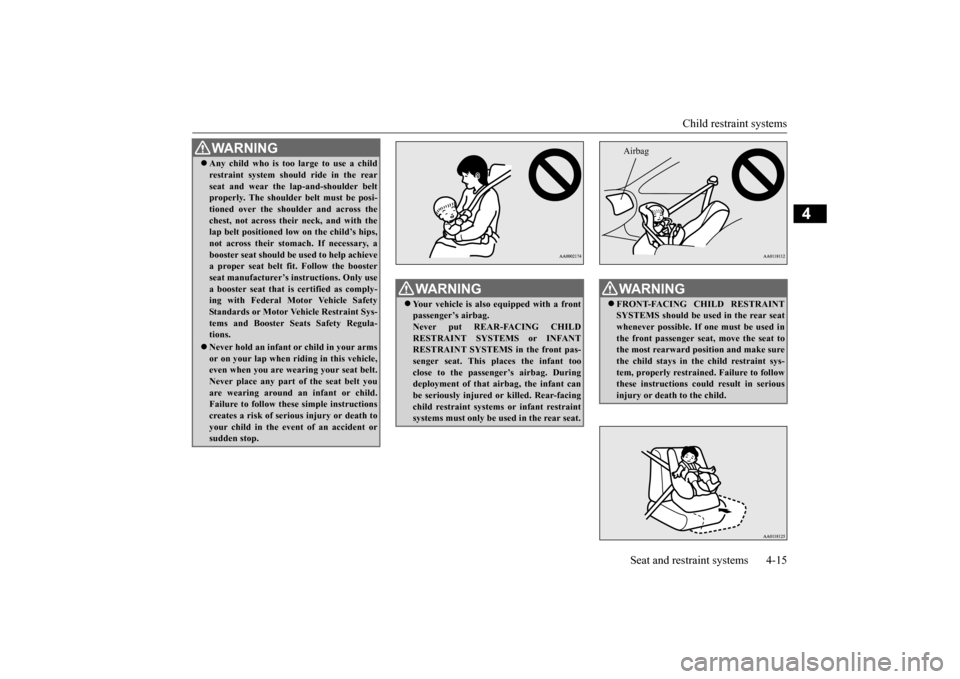
WA R N I N G Your vehicle is also
equipped with a front
passenger’s airbag.Never put REAR-FACING CHILD RESTRAINT SYSTEMS or INFANT RESTRAINT SYSTEMS in the front pas-senger seat. This places the infant too close to the passenger’s airbag. During deployment of that airbag, the infant canbe seriously injured
or killed.
Rear-facing
child restraint systems or infant restraint systems must only be used in the rear seat.
WA R N I N G FRONT-FACING CHILD RESTRAINT SYSTEMS should be used in the rear seatwhenever possible. If one must be used in the front passenger seat, move the seat to the most rearward position and make surethe child stays in the child restraint sys- tem, properly restrained. Failure to follow these instructions could result in seriousinjury or death to the child.Airbag
BK0212400US.book 15 ページ 2014年4月1日 火曜日 午後2時21分
Page 42 of 300
Child restraint systems
Seat and restraint systems 4-17
4
to each of the 3 rear
seating positions in your
vehicle.
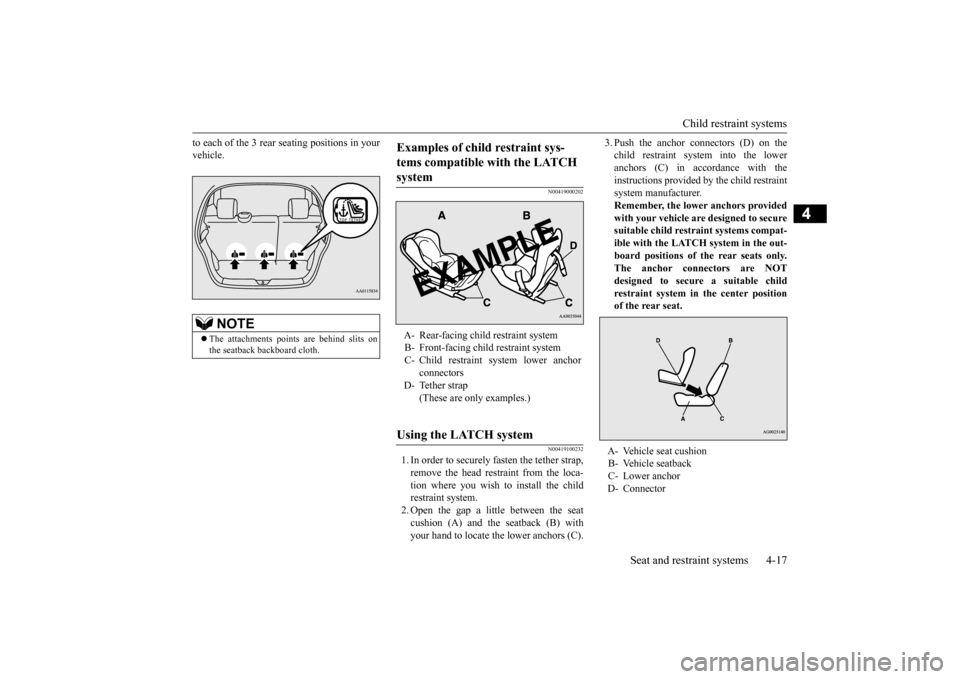
N00419000202 N00419100232
1. In order to securely
fasten the tether strap,
remove the head restraint from the loca- tion where you wish to install the child restraint system.2. Open the gap a little between the seat cushion (A) and the seatback (B) with your hand to locate the lower anchors (C).
3. Push the anchor connectors (D) on the child restraint system into the loweranchors (C) in accordance with the instructions provided by the child restraint system manufacturer.Remember, the lower anchors provided with your vehicle are
designed to secure
suitable child restraint systems compat-ible with the LATCH
system in the out-
board positions of the rear seats only. The anchor connectors are NOT designed to secure a suitable child restraint system in the center positionof the rear seat.
NOTE
The attachments point
s are behind slits on
the seatback ba
ckboard cloth.
Examples of child restraint sys- tems compatible with the LATCH system A- Rear-facing child restraint system B- Front-facing child restraint system C- Child restraint system lower anchor
connectors
D- Tether strap
(These are only examples.)
Using the LATCH system
A- Vehicle seat cushion B- Vehicle seatbackC- Lower anchor D- Connector
BK0212400US.book 17 ページ 2014年4月1日 火曜日 午後2時21分
Page 46 of 300
Supplemental Restraint System (SRS) - airbag
Seat and restraint systems 4-21
4
Regularly check your se
at belt buckles and
their release mechanisms
for positive engage-
ment and release of the
latch plate. Check the
retractors for automatic locking when in the Automatic Locking Retractor function. The entire seat belt assembly should be replaced if the webbing shows any obvious cuts, tears, increase in thickness in any sec- tion of the webbing from broken fibers, orsevere fading from sunlig
ht. All of these con-
ditions indicate a weakening of the belt, which may adversely affe
ct seat belt perfor-
mance in an accident.
N00407701791
This vehicle is equippe
d with a Supplemental
Restraint System (SRS), which includes air- bags for the driver and passengers.
The SRS front airbags are designed to supple- ment the primary protection of the driver andfront passenger seat belt systems by provid- ing those occupants w
ith protection against
head and chest injuries
in certain moderate to
severe frontal collisi
ons. The SRS front air-
bags, together with sensors at the front of the vehicle and sensors attached to the frontseats, form an advanced airbag system. The SRS driver’s knee airbag is designed to supplement the primary protection of the driver’s seat belt system. It can reduce the forward movement of the driver’s lower legs and provide increased
overall body protection
in certain moderate to
severe frontal colli-
sions. The SRS side airbags and the curtain airbags are also designed to supp
lement the seat belts.
The SRS side airbags provide the driver and front passenger with pr
otection against chest
injuries by deploying the bag on the sideimpacted in moderate
to severe side impact
collisions. The SRS curtain airbags provide the driver and passengers on the front seatand rear outboard seat
with protection against
head injuries by deploying a bag on the side impacted in moderate
to severe side impact
collisions. The SRS airbags are NOT a substitute for use of the seat belts. For maximum protection in
all types of accident
s, seat belts must
ALWAYS be worn by everyone who drives orrides in this vehicle
(with infants and small
children in an appropriate child restraint sys- tem in the rear seat, and older children buck-led in the rear seat). Refer to “Child restraint systems” on page 4-14.
WA R N I N G Do not attempt to repair or replace any part of the seat belt assemblies. This workshould be done
by an authorized
Mitsubishi Motors dealer. Failure to have an authorized Mitsub
ishi Motors dealer
perform the work could reduce the effec- tiveness of the belts and could result in a serious injury or de
ath in an accident.
Supplemental Restraint Sys- tem (SRS) - airbag
WA R N I N G IT IS VERY IMPORTANT TO ALWAYS WEAR YOUR SEAT BELT PROPERLY EVEN WITH AN AIRBAG.• Seat belts help keep the driver and pas-sengers properly positioned. Thisreduces the risk of injury in all collisions, and reduces the risk of serious injuries or death when the
airbags inflate.
During sudden braking just before a col- lision, an unrestra
ined or
improperly
restrained driver or passengers can moveforward into direct contact with, or within close proximi
ty to, the airbag
when it begins to inflate.The beginning stage of
airbag inflation is
the most forceful and can cause serious injuries or death if the occupant comes incontact with the airbag at this time.• Seat belts reduce the risk of injury inrollovers, in rear impact collisions, and in lower-speed frontal collisions because the airbags are not de
signed to inflate in
those situations.
BK0212400US.book 21 ページ 2014年4月1日 火曜日 午後2時21分
Page 50 of 300
Supplemental Restraint System (SRS) - airbag
Seat and restraint systems 4-25
4
accordance with the information it receives from this sensor.If there is a problem involving the driver’s seat position sensor, the SRS warning light in the instrument panel will come on. Refer to“SRS warning light” on page 4-27.
N00418000364
The passenger’s seat oc
cupant classification
sensor system is attached to the front passen-ger seat cushion and provides the airbag con- trol unit with inform
ation regarding the
occupant on the front passenger seat. The air-bag control unit controls deployment of the passenger’s front airbag in accordance with the information it receives from this system. The passenger’s front airbag will not deploy in an impact when the system senses no occu-pant on the front passenger seat or a child in a child restraint system. In this case, the pas- senger’s airbag off indicator will illuminate.Refer to “Passenger’s airbag off indicator” on page 4-26. If there is a problem involving the passen-ger’s seat occupant cl
assification sensor sys-
tem, the SRS warning light in the instrument panel will come on.Refer to “SRS warning light” page 4-27.
WA R N I N G If the SRS warning
light comes on, have
the vehicle inspected by an authorizedMitsubishi Motors dealer as soon as possi- ble. Please observe the following instructions to ensure that the driver’s seat position sensor can operate correctly.• Adjust the seat to the correct position,and sit well back
against the seatback.
Refer to “Front seats” on page 4-3.• Do not recline the seatback more thannecessary when driving.• Do not place metallic objects or luggageunder the front seat.
If the vehicle is involved in a severe impact, have the SRS sensor inspected by an authorized
Mitsubishi Motors dealer as
soon as possible.
Passenger’s seat occupant clas- sification sensor system
WA R N I N G If any of the follow
ing conditions occur,
you should immediatel
y have your vehicle
inspected by an au
thorized Mitsubishi
Motors dealer as soon as possible:
• The SRS warning light does not initiallycome on when the ignition switch or theoperation mode is under the followingconditions.• [Except for vehicles equipped with theF. A . S . T. - k e y ] The ignition switch is in the “ON” or “START” position.[Vehicles equipped with the F.A.S.T.-key] The operation mode is in ON.• The SRS warning light does not go outafter several seconds.• The SRS warning li
ght comes on while
you are driving.
To ensure that the passenger’s seat occu- pant classification sensor system can sense correctly, observe the following instruc-tions. Failure to follow these instructions can adversely affect
the performance of
the passenger’s airbag system.• Adjust the seat to the correct position,and sit well back
against the seatback.
Refer to “Front seats” on page 4-3.• Do not recline the seatback more thannecessary.• Never have more th
an one person (adult
or child) sittin
g on the seat.
• Do not place anything between the seat and the floor console.• When attaching a child restraint system,secure it firmly.• Do not place luggage or other objects onthe seat.WA R N I N G
BK0212400US.book 25 ページ 2014年4月1日 火曜日 午後2時21分
Page 57 of 300
Supplemental Restraint System (SRS) - airbag 4-32 Seat and restraint systems
4
N00419200217
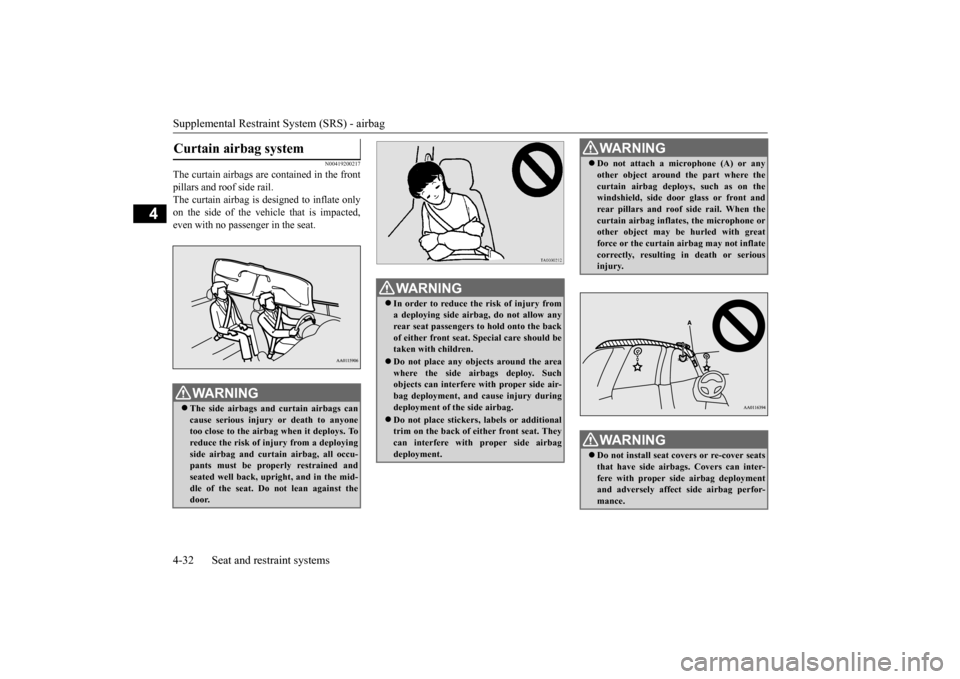
The curtain airbags are contained in the front pillars and roof side rail. The curtain airbag is designed to inflate onlyon the side of the vehi
cle that is impacted,
even with no passenger in the seat.Curtain airbag system
WA R N I N G The side airbags and
curtain airbags can
cause serious injury
or death to anyone
too close to the airb
ag when it deploys. To
reduce the risk of in
jury from a deploying
side airbag and curtai
n airbag, all occu-
pants must be properly restrained and seated well back, upri
ght, and in the mid-
dle of the seat. Do not lean against thedoor.
WA R N I N G In order to reduce the risk of injury from a deploying side airb
ag, do not allow any
rear seat passengers to hold onto the back of either front seat. Special care should betaken with children. Do not place any objects around the area where the side airbags deploy. Such objects can interfere with proper side air- bag deployment, and
cause injury during
deployment of the side airbag. Do not place stickers, labels or additional trim on the back of either front seat. They can interfere with proper side airbag deployment.
WA R N I N G Do not attach a microphone (A) or any other object around
the part where the
curtain airbag deploys
, such as on the
windshield, side door
glass or front and
rear pillars and roof
side rail. When the
curtain airbag inflates, the microphone orother object may be
hurled with great
force or the curtain airbag may not inflate correctly, resulting
in death or serious
injury.WA R N I N G Do not install seat c
overs or re-cover seats
that have side airbag
s. Covers can inter-
fere with proper si
de airbag deployment
and adversely affect
side airbag perfor-
mance.
BK0212400US.book 32 ページ 2014年4月1日 火曜日 午後2時21分
Page 60 of 300
Supplemental Restraint System (SRS) - airbag
Seat and restraint systems 4-35
4
N00408501725
SRS servicing
WA R N I N G Any maintenance performed on or near the components of the SRS should be per-formed only by an
authorized Mitsubishi
Motors dealer. Do not permit anyone else to do any service, inspection, maintenanceor repair on any SR
S components or wir-
ing. Similarly, no part of the SRS should ever be handled, removed or disposed byanyone except an au
thorized Mitsubishi
Motors dealer. Improper work meth
ods on the SRS com-
ponents or wiring could result in an acci- dental airbag deployment or could make the SRS inoperable. Ei
ther of these situa-
tions could result in serious injury or death. Do not modify your steering wheel or any other SRS component or related vehicle part. For example, replacement of thesteering wheel, or modifications to the front bumper or body structure can adversely affect SR
S performance and
may lead to injury. If your vehicle has
received any damage,
you should have the
SRS inspected by an
authorized Mitsubishi
Motors dealer to
make sure it is in
proper work
ing order.
Do not modify your front seats, center pil- lar or center console. Such modificationscan adversely affect
SRS performance and
may lead to injury. Also, if you discove
r any tear or open
seam in the seat fabr
ic near the side air-
bag, have the seat in
spected by an autho-
rized Mitsubishi Motors dealer. If you have found an
y scratch, crack or
damage to the portion of the front and rear pillars and roof
side rail, you should
have the SRS inspected by an authorized Mitsubishi Motors dealer.NOTE
When you transfer ownership of the vehicle to another person, we
urge you to alert the
new owner that it is
equipped with the SRS
and refer that owner to the applicable sec- tions in this owner’s manual. If you decide to junk or scrap your vehicle, we urge you to first take it to an authorized Mitsubishi Motors dealer so that the SRS canbe made safe for disposal. If any of the following parts needs to be modified for use by a handicapped person,the advanced airbag sy
stem will be greatly
affected. Please consult an authorized Mitsubishi Motors dealer. • Driver’s seat • Front passenger seat • Front seat beltWA R N I N G
• Steering wheel • Instrument panel[For vehicles sold in U.S.A.] To contact Mitsubishi Motors North America, Inc.call 1-888-648-7820 or write to: Mitsubishi Motors North Amer- ica, Inc.Customer Relations Depart- ment P.O. Box 6400Cypress, CA 90630-0064 [For vehicles sold in Canada] To contact Mitsubishi Motor Sales of Canada, Inc.call 1-888-576-4878 or write to: Mitsubishi Motor Sales of Can- ada, Inc.Customer Relations Depart- ment P.O. Box 410094141 Dixie Road Mississauga, ON L4W 5C9NOTE
BK0212400US.book 35 ページ 2014年4月1日 火曜日 午後2時21分
Page 174 of 300
Vehicle preparatio
n before driving
Driving safety 6-3
6
N00629000702
For a safer and more enjoyable trip, always check for the following: Before starting the vehicle, make certain that you and all passengers are seated andwearing their seat
belts properly (with
children in the rear seat, in appropriate restraints), and that
all the doors and the
liftgate are locked.
Move the driver’s seat as far backward as possible, while keeping good visibility,and good control of the steering wheel, brakes, accelerator, and controls. Check the instrument panel indicators and multi-information display for any possible prob- lem. Similarly, the front
passenger seat should
also be moved as fa
r back as possible.
Make sure that infants and small children are properly restrained in accordance with all laws and regulations.
Check these by selectin
g the defroster mode,
and set the blower switch on high. You should be able to feel the air blowing against thewindshield. Refer to “Defrosti
ng or defogging (wind-
shield, door windows)” on page 7-10, 7-16. Check all the tires for heavy tread wear or uneven wear patterns. Look for stones, nails,glass, or other objects
stuck in the tread. Look
for any tread cuts or
sidewall cracks. Check
the wheel nuts for tightness, and the tires(including spare tire) for proper pressure.
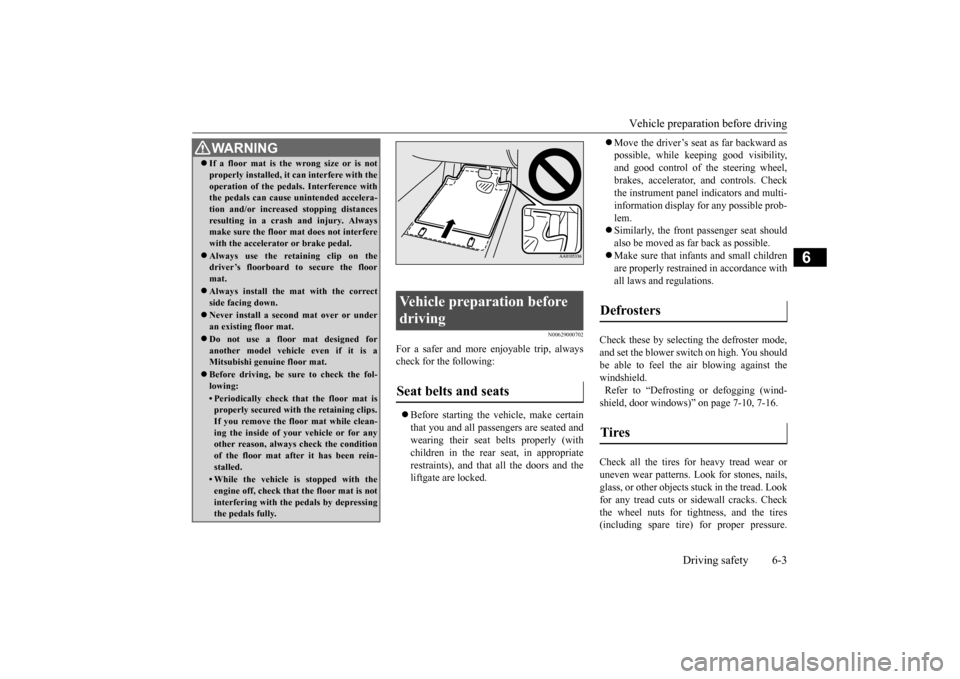
WA R N I N G If a floor mat is the
wrong size or is not
properly installed, it can interfere with theoperation of the pedals. Interference withthe pedals can cause unintended accelera- tion and/or increase
d stopping distances
resulting in a cras
h and injury. Always
make sure the floor mat does not interfere with the accelerator or brake pedal. Always use the retaining clip on the driver’s floorboard to secure the floor mat. Always install the mat with the correct side facing down. Never install a second mat over or under an existing floor mat. Do not use a floor mat designed for another model vehicle even if it is aMitsubishi genu
ine floor mat.
Before driving, be sure to check the fol- lowing:• Periodically check that the floor mat isproperly secured with the retaining clips. If you remove the fl
oor mat while clean-
ing the inside of you
r vehicle or for any
other reason, always
check the condition
of the floor mat afte
r it has been rein-
stalled.• While the vehicle is stopped with theengine off, check that
the floor mat is not
interfering with the pedals by depressing the pedals fully.
Vehicle preparation before driving Seat belts and seats
Defrosters Tires
BK0212400US.book 3 ページ 2014年4月1日 火曜日 午後2時21分
Page 177 of 300
Loading information 6-6 Driving safety
6
Your front bumper can be damaged if you scrape it over curbs or parking stop blocks. Be careful when traveling up or down steepslopes where your bumper can scrape the road. More effort could be required to turn the steering wheel. Refer to “Electric power steering system(EPS)” on page 5-48.
Always carry the key and lock all doors and the liftgate when leaving the vehicle unat- tended.Always try to park your vehicle in a well lit area.
N00629900424
It is very importa
nt to know how much
weight your vehicle can carry. This weight iscalled the vehicle capacity weight and includes the weight of
all occupants, cargo,
non-factory-installed options, if any, beingtowed. The tire and load
ing information plac-
ard located on the driver’s door sill of your vehicle will show how
much weight it may
properly carry. It is important to fami
liarize yourself with the
following terms before loading your vehicle:
Vehicle maximum load on the tire: load on an individual tire th
at is determined by
distributing to each ax
le its share of the
maximum loaded vehicle weight and dividing by two. Vehicle normal load on the tire: load on an individual tire that is
determined by dis-
tributing to each axle its share of the curbweight, accessory
weight, and normal
occupant weight and dividing by two. Maximum loaded vehicle weight: the sum of - (a) Curb weight;(b) Accessory weight; (c) Vehicle capacity weight; and (d) Production options weight. Curb weight: the weight of a motor vehi- cle with standard equipment including the maximum capacity of
fuel, oil, and cool-
ant. Accessory weight: the combined weight (in excess of those standard items whichmay be replaced) of automatic transmis- sion, power steering
, power brakes, power
windows, power seats,
radio, and heater,
to the extent that these items are available as factory- installe
d equipment (whether
installed or not). Vehicle capacity weight: the rated cargo and luggage load plus 150 lbs (68 kg)
*
times the vehicle’s designated seatingcapacity.
WA R N I N G Leaving the engine ru
nning risks injury or
death from accidentally moving the gear-shift lever (manual transaxle) or the selec-tor lever (CVT) or from the accumulation of toxic exhaust fumes in the passenger compartment.
Where you park
WA R N I N G Do not park your vehicle in areas where combustible materials such as dry grass orleaves can come in
contact with a hot
exhaust, since a fire could occur.
Do not keep the steering wheel fully turned for a long time
When leaving the vehicle Loading information
WA R N I N G Never overload your ve
hicle. Overloading
can damage your vehicl
e, adversely affect
vehicle performance, including handling and braking, cause tire failure, and resultin an accident.
BK0212400US.book 6 ページ 2014年4月1日 火曜日 午後2時21分