wheel MITSUBISHI MIRAGE 2015 6.G Workshop Manual
[x] Cancel search | Manufacturer: MITSUBISHI, Model Year: 2015, Model line: MIRAGE, Model: MITSUBISHI MIRAGE 2015 6.GPages: 300, PDF Size: 43.44 MB
Page 262 of 300
Tires
Vehicle care and maintenance 9-17
9
N00940000418
In some areas of the country, snow tires are required for winter driving. If snow tires are required in your area, you must choose snowtires of the same size
and type as the original
tires provided with your
vehicle. Snow tires
should also be
installed on all four wheels.
Otherwise your safety
and vehicle handling
can be reduced. Even where laws may permit it, snow tires should not be operated
at sustained speeds
over 75 mph (120 km/h).
N00940100116
CAUTION A compact spare tire (i
f so equipped) can be
installed temporarily in place of a tire that has been removed duri
ng the tire rotation.
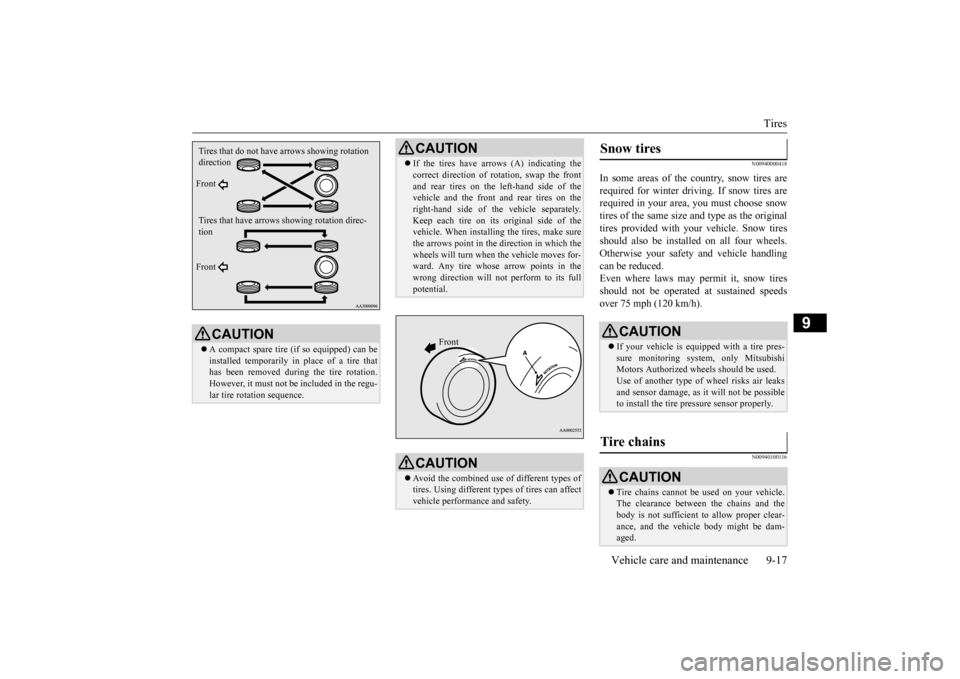
However, it must not be included in the regu- lar tire rotation sequence.Tires that do not have arrows showing rotation direction Front Tires that have arrows
showing rotation direc-
tion Front
CAUTION If the tires have arrows (A) indicating the correct direction of rotation, swap the frontand rear tires on the left-hand side of thevehicle and the front and rear tires on the right-hand side of th
e vehicle separately.
Keep each tire on its original side of thevehicle. When installing the tires, make sure the arrows point in the
direction in which the
wheels will turn when the vehicle moves for-ward. Any tire whose
arrow points in the
wrong direction will not
perform to its full
potential.CAUTION Avoid the combined use of different types of tires. Using different t
ypes of tires can affect
vehicle performance and safety.
Front
Snow tires
CAUTION If your vehicle is equipped with a tire pres- sure monitoring system, only Mitsubishi Motors Authorized wheels should be used.Use of another type of wheel risks air leaks and sensor damage, as it
will not be possible
to install the tire pressure sensor properly.
Tire chains
CAUTION Tire chains cannot be
used on your vehicle.
The clearance between the chains and thebody is not sufficient
to allow proper clear-
ance, and the vehicle body might be dam- aged.
BK0212400US.book 17 ページ 2014年4月1日 火曜日 午後2時21分
Page 265 of 300
General maintenance 9-20 Vehicle care and maintenance
9
N00941000040
Check the hose surfaces for any heat and mechanical damage, ha
rd and brittle rubber,
cracking, tears, cuts
and abrasions. Pay spe-
cial attention to the hos
es closest to high heat
sources such as the exhaust manifold. Check all the hose connections, such as clamps andcouplings, to make sure they are secure and that there are no leaks. If you see any wear or damage, replace the hoses immediately.
N00950100050
Have the valve clea
rance checked at an
authorized Mitsubishi Motors dealer at the mileage specified in the “WARRANTY AND MAINTENANCE MANUAL”.If the engine sounds a
bnormally loud, have
adjustments made by an authorized Mitsubishi Motors dealer.
N00941300173
Check these regularly for damage or leaks in the fuel lines and conne
ctions. Check the fuel
tank filler cap for dama
ge or looseness. Pay
special attention to the fuel lines closest to
high heat sources such
as the exhaust mani-
fold.
N00941400187
If the fuel-vapor vent line is clogged or dam-aged, the fuel-vapor mixture will escape, pol- luting the air. Have the system checked at an authorizedMitsubishi Motors dealer at the mileage spec- ified in the “WARRANTY AND MAINTE- NANCE MANUAL”.
N00941500292
The next pages list th
e maintenance service
recommended by Mitsubishi Motors Corpo-ration. In addition to the general maintenance that needs to be performed at the times listed,
there are other parts which do not usually need regular maintenance.But, if any of these parts stops working prop- erly, your vehicle performance could suffer. Have these items ch
ecked if you notice a
problem with them. If you have any questions, see your autho- rized Mitsubishi Motors
dealer for assistance.
N00941600059
Good brakes are essential for safe driving. Check the brake pads for wear. For goodbraking performance, replace the brake pads with the same type pads as the originals.
N00941700076
Brake hoses and tubing should be checkedfor: Severe surface cracki
ng, scuffing or worn
spots. If the fabric casing of the hose isshowing through any cracks or worn spots in the rubber hose cover, the hose should be replaced. The brakes can fail if thehose wears through. Improper installation
may cause twisting,
or wheel, tire or chassis interference.
Fuel hoses Intake valve clearance Fuel system (tank, pipe line and connection, and fuel tank filler cap)
WA R N I N G If you see a fuel leak
or if you smell fuel,
do not run the engine. Any spark (includ- ing from the ignition
), flame or smoking
material could cause an explosion or fire.Call an authorized Mitsubishi Motors dealer or a repair fa
cility of your choice
for assistance.
Evaporative emission control system (except evaporative emission canister) General maintenance
Disc brake pads Brake hoses
BK0212400US.book 20 ページ 2014年4月1日 火曜日 午後2時21分
Page 274 of 300
Replacement of light bulbs
Vehicle care and maintenance 9-29
9
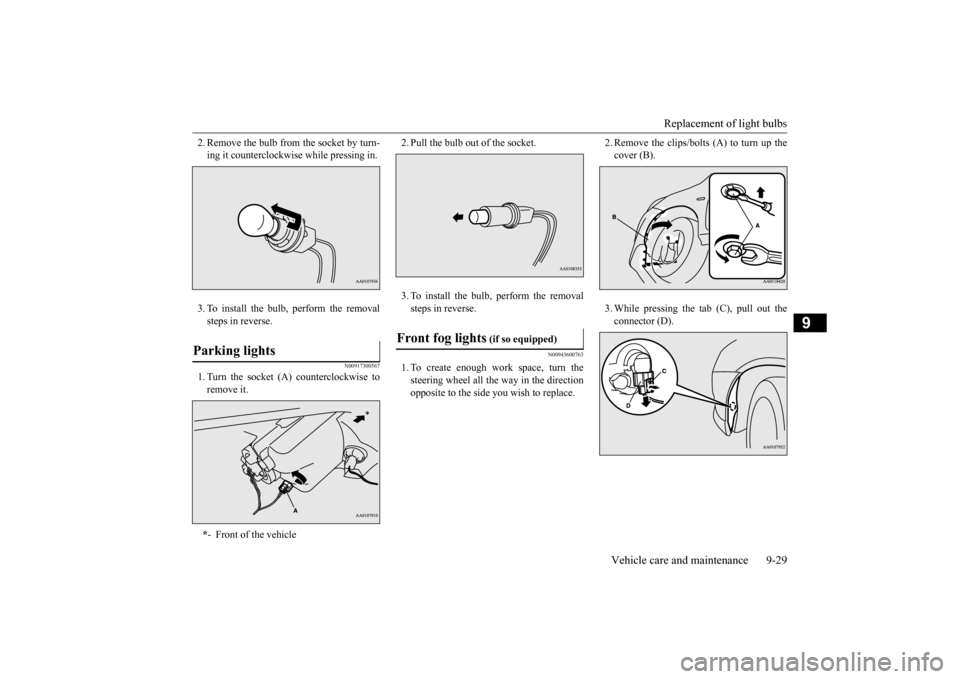
2. Remove the bulb from the socket by turn- ing it counterclockwis
e while pressing in.
3. To install the bulb, perform the removal steps in reverse.
N00917300567
1. Turn the socket (A
) counterclockwise to
remove it.
2. Pull the bulb out of the socket. 3. To install the bulb, perform the removal steps in reverse.
N00943600763
1. To create enough work space, turn thesteering wheel all the way in the direction opposite to the side you wish to replace.
2. Remove the clips/bolts (A) to turn up the cover (B). 3. While pressing the tab (C), pull out the connector (D).
Parking lights * - Front of the vehicle
Front fog lights
(if so equipped)
BK0212400US.book 29 ページ 2014年4月1日 火曜日 午後2時21分
Page 278 of 300
Cleaning the outside of your vehicle Vehicle care and maintenance 9-33
9
N00945600187
1. To clean, lightly wi
pe the leather with a
soft cloth soaked in a 5% solution of gen- tle soap and water.2. To rinse, dip the cloth in fresh water, wring it out well, and wipe off all the soap.3. To preserve and protect, use a leather pro- tecting agent on the genuine leather sur- face.
N00945700058
To protect your vehicle’s
finish, wash it often
and thoroughly. If desired, you may wax your vehicle using a nonabrasive automobile wax.
N00945800033
Industrial pollution, road tar, bird droppings,tree sap, insect remain
s, sea water and other
foreign matters can damage the finish on yourvehicle. Generally, the longer any foreign material stays on the finish, the worse the damage.Wash your vehicle as soon as possible when- ever the finish gets soiled.
N00945900630
Chemicals contained in the dirt and dustpicked up from air, rain, snow, or road sur- faces can damage the paint and body of yourvehicle if left on. Frequent washing and wa
xing is the best way
to protect your vehicle from this damage.Do not wash the vehicl
e in direct sunlight.
Park the vehicle in the shade and spray it with water to remove dust.
Next, using plenty of
clean water and a car
washing mitt or sponge,
wash the vehicle from top to bottom.Use a mild car washing soap if necessary. Rinse thoroughly and wipe
dry with a cham-
ois or soft cloth. Af
ter washing the vehicle,
carefully clean the join
ts and flanges of the
doors, hood, etc., wher
e dirt is likely to
remain.
NOTE
If fuzzing is difficult to remove from the seat upholstery, draw a suitable defuzzing brushover the surface in
one direction.
Genuine leather
(if so equipped)
NOTE
If genuine leather is we
t with water, wipe it
with a dry, soft cloth. If left damp, mildew may grow. The genuine leather su
rface can be damaged
if brushed with a nylon or synthetic fiberbrush. Organic solvents such as benzine, kerosene, alcohol, gasoline, or acid
or alkaline solvents
can discolor the genuine
leather surface and
should not be used. Genuine leather can
mildew if not kept
clean. Clean up any o
il stains immediately.
The genuine leather surface may harden and shrink if it is exposed to the direct sunlightfor long hours. When your vehicle is parked,place it in the shade as much as possible. When the temperature of the vehicle interior rises in summer, vinyl products left on the genuine leather seat
may deteriorate and
stick to the seat.
Cleaning the outside of your vehicle Foreign material
NOTE
Wa s h i n g
CAUTION When washing the underside of your vehicle or the wheels, wear a pair of gloves to pro- tect your hands. Never spray or splash water on the electrical parts in the engine compartment. This maydamage them. Be careful also when washing the underbody to ensure that water does not enter the engine compartment.
BK0212400US.book 33 ページ 2014年4月1日 火曜日 午後2時21分
Page 280 of 300
Cleaning the outside of your vehicle Vehicle care and maintenance 9-35
9
N00946200092
Small cracks and scratches in the paint coat should be touched up as
soon as possible with
touch-up paint to prevent corrosion.Check body areas facing the road or the tires carefully for damage to the paint caused by flying stones, etc. The
paint code number for
your vehicle can be found on the vehicle information code plat
e on the front passenger
door sill.
N00946300194
Use a sponge or chamois to clean these parts.If a vehicle wax sticks to a gray or black rough surface of the bumper, molding or lights, the surface may appear white in color.In this case, wipe it
off using lukewarm water
and a soft cloth or chamois.
N00946400052
To prevent spots and corrosion of chrome parts, wash with water, dry thoroughly, and apply a nonabrasive automotive wax. If the chrome is severely da
maged or pitted, use a
commercially available chrome polish.
N00946500183
1. Remove dirt using a wet sponge.2. Use a mild detergent on any dirt that can- not be removed ea
sily with water.
Rinse off the detergent after washing thewheel. 3. Dry the wheel thoroughly using a chamois leather or a soft cloth.
N00946600054
The window glass can
usually be cleaned
using only a sponge and
water. Glass cleaner
can be used to remove
wax, oil, grease, dead
insects, etc. After washing the glass, wipe it dry with a clean, dry, soft cloth.
N00946700068
Use a soft cloth and gl
ass cleaner to remove
grease, dead insects, etc., from the wiperblades. Replace the wiper blades when they no longer clean the windshield and rear window prop-erly.
Damaged paint Cleaning plastic parts
CAUTION Do not use a scrubbing brush or other rough scrubber as these may
damage the plastic
surface. Do not use wax containing compounds (pol- ishing powder) which
may damage the plas-
tic surface.
Do not let plastic parts get soiled with gaso- line, oil, brake fluids
, engine oils, greases,
paint thinner, and sulfur
ic acid (battery elec-
trolyte), as such substa
nces will cause stains,
cracks, or discoloration. If any of these get on a plastic part, wipethem up with a soft cloth or chamois and a mild solution of soap and water. Then rinse them immediately with water.
Chrome parts Aluminum wheels
(if so equipped)
CAUTION
CAUTION Do not use a brush or
other hard implement
on the wheels. Do not use any cleaner th
at contains an abra-
sive substance or is ac
idic or alkaline. Doing
so could cause the coating on the wheels topeel or become disc
olored or stained.
Do not directly apply
hot water using a steam
cleaner or by any other means. Contact with seawater or road salt used for de-icing can cause corr
osion. Rinse off such
substances as soon as possible.
Window glass Wiper blades
BK0212400US.book 35 ページ 2014年4月1日 火曜日 午後2時21分
Page 283 of 300
Consumer information (For vehicles sold in U.S.A.) 10-2 Customer assistance/Re
porting Safety Defects
10
N01047100171
This information is provided in compliance with the requirements of the National High- way Traffic Safety Ad
ministration, Depart-
ment of Transportation. It provides the purchasers and/or prospective purchasers with information on repor
ting safety defects.
DOT quality grades - Al
l passenger vehicle
tires must conform to
Federal Safety Require-
ments in addition to these grades. The spe- cific grade rating in each grade category isshown on the side wall of the tires on your vehicle. The treadwear grade is a comparative rating based on the wear rate of
the tire when tested
under controlled conditions on a specifiedgovernment test course
. For example, a tire
graded 150 would wear one and one-half (11/2) times as well on the government course
as a tire graded 100.
The relative performance
of tires depends upon the actual conditions of
their use, however, and may depart signifi- cantly from the norm due to variations indriving habits, service practices and differ- ences in road characteristics and climate. The traction grades, from highest to lowest, are AA, A, B and C. Those grades represent the tire’s ability to
stop on wet pavement as
measured under controlled conditions on specified government te
st surfaces of asphalt
and concrete. A tire marked C may have poor traction performance. The temperature grades are A (the highest), B and C, representing the ti
re’s resistance to the
generation of heat and it
s ability to dissipate
heat when tested un
der controlled conditions
on a specified indoor
laboratory test wheel.
Sustained high temperature can cause the
material of the tire to
degenerate and reduce
tire life, and excessive temperature can leadto sudden tire failure. The grade C corre- sponds to a level of performance which all passenger car tires must meet under the Fed-eral Motor Vehicle Safety Standard No. 109. Grades B and A represent higher levels of performance on the labora
tory test wheel than
the minimum required by law.
N01047201528
If you believe that your vehicle has a defect which could cause a crash or could cause injury or death, you should immediately inform theNational Highway Traffic Safety Administration (NHTSA) in addi- tion to notifying Mitsubishi MotorsNorth America, Inc.
Consumer information (For vehicles sold in U.S.A.) Uniform tire quality grading Treadwear
Traction AA, A, B, C
WA R N I N G The traction grade assi
gned to this tire is
based on straight-ahead braking tractiontests, and does not include acceleration, cornering, hydroplani
ng, or peak traction
characteristics.
Temperature A, B, C
WA R N I N G The temperature grade for this tire is established for a tire that is properlyinflated and not overloaded. Excessive speed, underinflation
, or excessive load-
ing, either separately
or in combination,
can cause heat buildup and possible tire failure.
Reporting Safety Defects
BK0212400US.book 2 ページ 2014年4月1日 火曜日 午後2時21分
Page 288 of 300

11
SpecificationsVehicle labeling ............................................................................. 11-2 Vehicle dimensions ........................................................................ 11-3 Vehicle weights .............................................................................. 11-3Engine specifications ..................................................................... 11-4 Battery ............................................................................................ 11-4 Tires and wheels ............................................................................ 11-5Capacity ......................................................................................... 11-5
BK0212400US.book 1 ページ 2014年4月1日 火曜日 午後2時21分
Page 290 of 300
Vehicle dimensions
Specifications 11-3
11
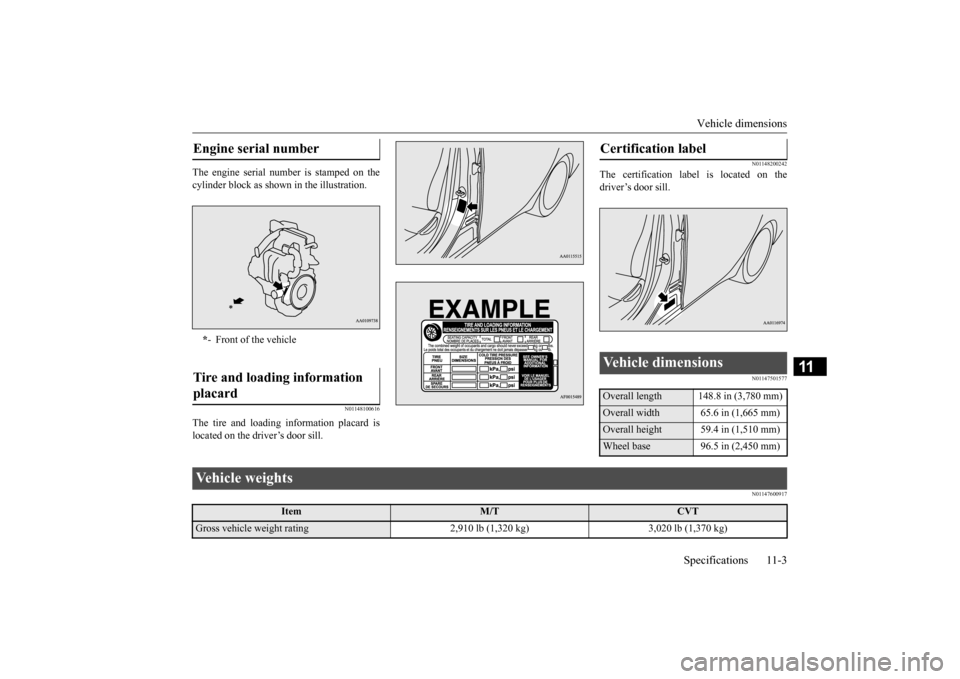
The engine serial num
ber is stamped on the
cylinder block as show
n in the illustration.
N01148100616
The tire and loading information placard is located on the driver’s door sill.
N01148200242
The certification label is located on thedriver’s door sill.
N01147501577 N01147600917
Engine serial number * - Front of the vehicle
Tire and loading information placard
Certification label Vehicle dimensions Overall length 148.8 in (3,780 mm)Overall width 65.6 in (1,665 mm)Overall height 59.4 in (1,510 mm)Wheel base 96.5 in (2,450 mm)
Vehicle weights
Item
M/T
CVT
Gross vehicle weight
rating 2,910 lb (1,320 kg) 3,020 lb (1,370 kg)
BK0212400US.book 3 ページ 2014年4月1日 火曜日 午後2時21分
Page 292 of 300
Tires and wheels
Specifications 11-5
11
N01147900747
PCD: Pitch Circle Diameter (installation holes)
N01148002130
Tires and wheels Tire 165/65R14Wheel
Size 14 x 4 1/2JPCD 3.93 in (100 mm)Offset 1.81 in (46 mm)
NOTE
Contact an authorized Mitsubishi Motors dealer for details on the combination used on your vehicle. These tires satisfy ve
hicle loading conditions
described in this owner’s manual.
Capacity
Item
Capacity
Lubricants
Fuel (approximate)
9.2 gal (35 L) Refer to “Fue
l selection” on page 3-2
Engine oil
Oil pan 2.9 qt (2.8 L) Engine
oils displaying the ILSAC
certification mark (“star-
burst” symbol) on the container. If these oils are not available, an API classification SN or higher can be used.
Oil filter .21 qt (0.2 L)
Manual transaxle 1.7 qt (1.6 L)
Mitsubishi Motors Genuine
NEW MULTI GEAR OIL ECO
API classification GL-4 SAE 75W-80
Continuously variable transm
ission (CVT) 7.4 qt (7.0 L)
Refer to “Continuously variable
transmission (CVT) fluid” on
page 9-9.
Brake As required Conforming to Brake fluid DOT3 or DOT4Hood lock release mechanism and
safety catch As required Multipurpo
se type grease NLGI Grade 2
Engine coolant {Includes .53 qt (0.5 L) in reserve tank}
M/T 4.2 qt (4.0 L)
Mitsubishi Motors Genuine S
uper Long Life Coolant Premium
or equivalent
*
CVT 4.8 qt (4.6 L)
BK0212400US.book 5 ページ 2014年4月1日 火曜日 午後2時21分
Page 294 of 300

Alphabetical index
12-1
12
A
Accessory (installation)
.........................
3-5
Active stability control (ASC)
..............
5-49
Air bag
..............................................
4-21
Air cleaner filter
...................................
9-8
Air conditioning
Automatic air conditioning
..............
7-11
Important air condi
tioning operating tips
..
7-17 Manual air conditioning
....................
7-7
Air purifier
.........................................
7-18
Aluminum wheels
...............................
9-35
Antenna
Roof antenna
..................................
7-41
Anti-lock braking system
.....................
5-46
Assist grip
........................................
5-110
Audio
AM/FM electronically
tuned radio with
CD player
....................................
7-18
Error codes
.....................................
7-38
Handling of compact discs
...............
7-40
Automatic air conditioning
..................
7-11
B
Back-up light
Bulb capacity
.................................
9-26
Ball joint, steering li
nkage seals and drive
shaft boots
.......................................
9-21
Battery
..............................................
9-10
Charging system warning light
........
5-73
Checking battery
electrolyte level
....
9-10
Disconnection and connection
.........
9-11
During cold weather
.......................
9-11
Specification
..................................
11-4
Bluetooth® 2.0 interface
.....................
5-81
Bottle holders
....................................
5-108
Brake
Fluid
.............................................
11-5
Brake assist system
.............................
5-46
Braking
...............................................
6-5
Anti-lock braking system
................
5-46
Hose
.............................................
9-20
Pad wear alarm
..............................
5-45
Parking brake
.................................
5-31
Pedal
.............................................
5-44
Pedal free play
...............................
9-18
Power brakes
.................................
5-44
Service brake
.................................
5-44
Warning lights
...............................
5-72
Break-in recommendations
....................
5-2
Bulb capacity
.....................................
9-26
C
California Perchl
orate Materials
Requirements
.....................................
3-7
Capacities
..........................................
11-5
Card holder
......................................
5-105
Cargo loads
........................................
6-10
Cargo room light
Bulb capacity
.................................
9-27
Catalytic converter
................................
9-3
Certification label
...............................
11-3
Charging system warning light
.............
5-73
Child restraint systems
........................
4-14
Child safety locks for rear door
............
5-27
Cleaning
Inside of your vehicle
......................
9-32
Outside of your vehicle
...................
9-33
Clutch
Pedal free play
................................
9-18
Consumer information
.........................
10-2
Continuously variable transmission (CVT)
...
5-39 Fluid
.......................................
9-9
, 11-5
Selector lever operation
...................
5-40
Selector lever positions
....................
5-41
Convenience hook
.............................
5-109
Coolant (engine)
..........................
9-7
, 11-5
Cruise control
.....................................
5-52
Cup holders
......................................
5-108
BK0212400US.book 1 ページ 2014年4月1日 火曜日 午後2時21分