brake MITSUBISHI MIRAGE 2015 6.G Owners Manual
[x] Cancel search | Manufacturer: MITSUBISHI, Model Year: 2015, Model line: MIRAGE, Model: MITSUBISHI MIRAGE 2015 6.GPages: 300, PDF Size: 43.44 MB
Page 4 of 300
Instruments and controls
Overview 1-2
1
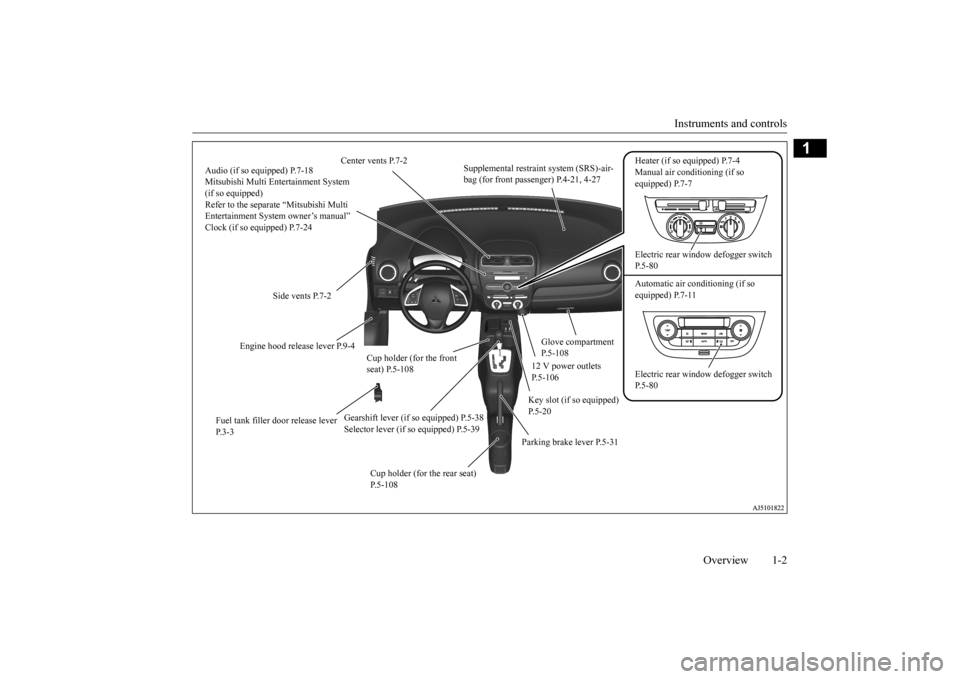
Center vents P.7-2
Supplemental restraint system (SRS)-air- bag (for front passenger) P.4-21, 4-27
Heater (if so equipped) P.7-4 Manual air conditioning (if so equipped) P.7-7
Audio (if so equipped) P.7-18 Mitsubishi Multi Entertainment System (if so equipped) Refer to the separate “Mitsubishi Multi Entertainment System owner’s manual” Clock (if so equipped) P.7-24
Electric rear window defogger switch P.5-80 Automatic air conditioning (if so equipped) P.7-11
Side vents P.7-2
Glove compartment P.5-108
Engine hood release lever P.9-4
Cup holder (for the front seat) P.5-108
12 V power outlets P.5-106
Electric rear window defogger switch P.5-80
Key slot (if so equipped) P.5-20
Gearshift lever (if so equipped) P.5-38 Selector lever (if so equipped) P.5-39
Fuel tank filler do
or release lever
P. 3 - 3
Parking brake lever P.5-31
Cup holder (for the rear seat) P.5-108
BK0212400US.book 2 ページ 2014年4月1日 火曜日 午後2時21分
Page 11 of 300
If this warning light comes on or flashes while you’re driving... 2-2 Quick index
2
or
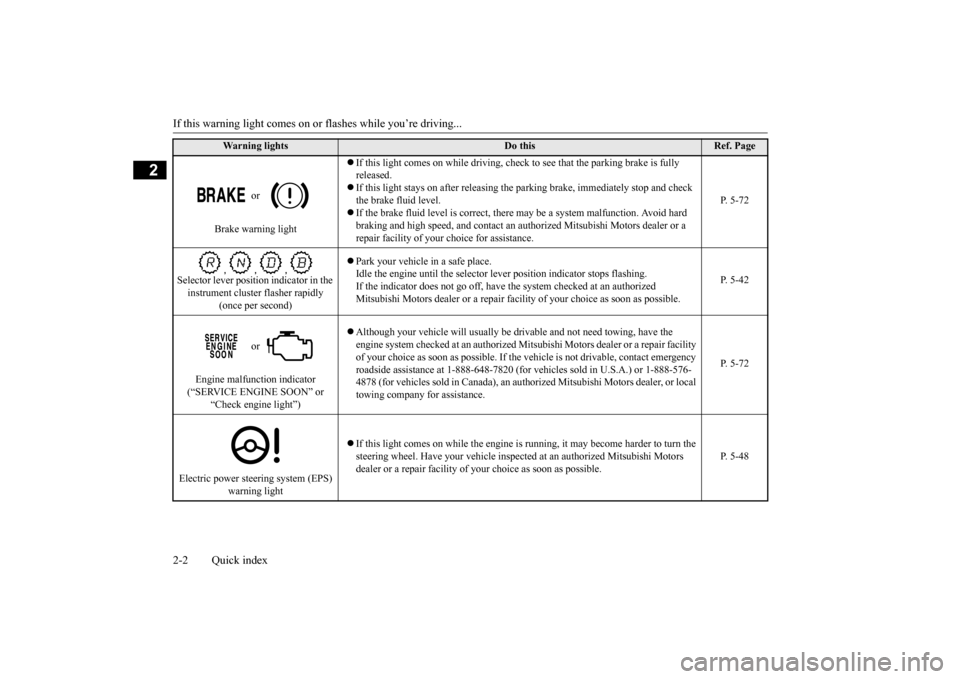
Brake warning light
If this light comes on while driving, chec
k to see that the parking brake is fully
released. If this light stays on after releasing the
parking brake, immediately stop and check
the brake fluid level. If the brake fluid level is correct, there
may be a system malfunction. Avoid hard
braking and high speed, and contact an au
thorized Mitsubishi Motors dealer or a
repair facility of your
choice for assistance.
P. 5-72
Selector lever position indicator in the instrument cluster flasher rapidly
(once per second)
Park your vehicle in a safe place. Idle the engine until the selector le
ver position indicato
r stops flashing.
If the indicator does not go off, have
the system checked at an authorized
Mitsubishi Motors dealer or a repair facili
ty of your choice as soon as possible.
P. 5-42
or
Engine malfunction indicator (“SERVICE ENGINE SOON” or
“Check engine light”)
Although your vehicle will usually be dr
ivable and not need towing, have the
engine system checked at an authorized M
itsubishi Motors dealer
or a repair facility
of your choice as soon as possible. If the
vehicle is not drivab
le, contact emergency
roadside assistance at 1-888-648-7820 (for
vehicles sold in U.S.A.) or 1-888-576-
4878 (for vehicles sold in Canada), an auth
orized Mitsubishi Moto
rs dealer, or local
towing company for assistance.
P. 5-72
Electric power stee
ring system (EPS)
warning light
If this light comes on while the engine is
running, it may become harder to turn the
steering wheel. Have your ve
hicle inspected at an aut
horized Mitsubishi Motors
dealer or a repair facility of
your choice as soon as possible.
P. 5-48
Warning lights
Do this
Ref. Page
BK0212400US.book 2 ページ 2014年4月1日 火曜日 午後2時21分
Page 14 of 300
If this problem occurs...
Quick index 2-5
2
N00200900870
If this problem occurs...
Problem
Do this
Ref. Page
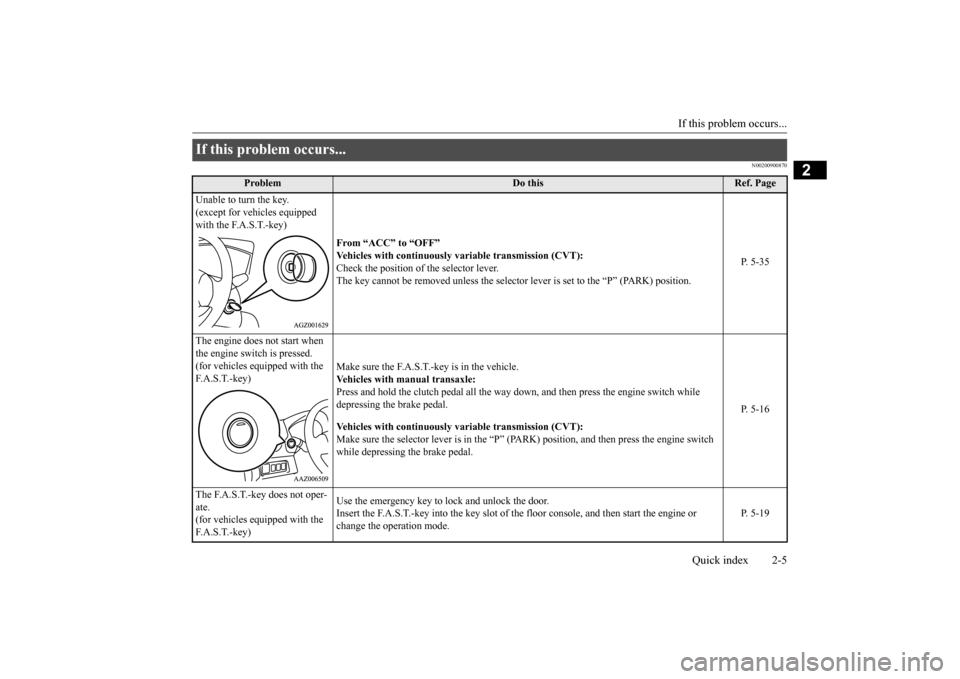
Unable to turn the key. (except for vehicles equipped with the F.A.S.T.-key)
From “ACC” to “OFF” Vehicles with cont
inuously variable
transmission (CVT):
Check the position of the selector lever. The key cannot be removed unless the selector
lever is set to the “P” (PARK) position.
P. 5-35
The engine does not start when the engine switch is pressed. (for vehicles equipped with the F. A . S . T. - k e y )
Make sure the F.A.S.T.-key is in the vehicle. Vehicles with ma
nual transaxle:
Press and hold the clutch pedal all the way dow
n, and then press the
engine switch while
depressing the brake pedal. Vehicles with cont
inuously variable
transmission (CVT):
Make sure the selector lever is in the “P” (P
ARK) position, and then press the engine switch
while depressing the brake pedal.
P. 5-16
The F.A.S.T.-key does not oper- ate. (for vehicles equipped with the F. A . S . T. - k e y )
Use the emergency key to lock and unlock the door. Insert the F.A.S.T.-key into the key slot of th
e floor console, and then start the engine or
change the operation mode.
P. 5-19
BK0212400US.book 5 ページ 2014年4月1日 火曜日 午後2時21分
Page 15 of 300
If this problem occurs... 2-6 Quick index
2
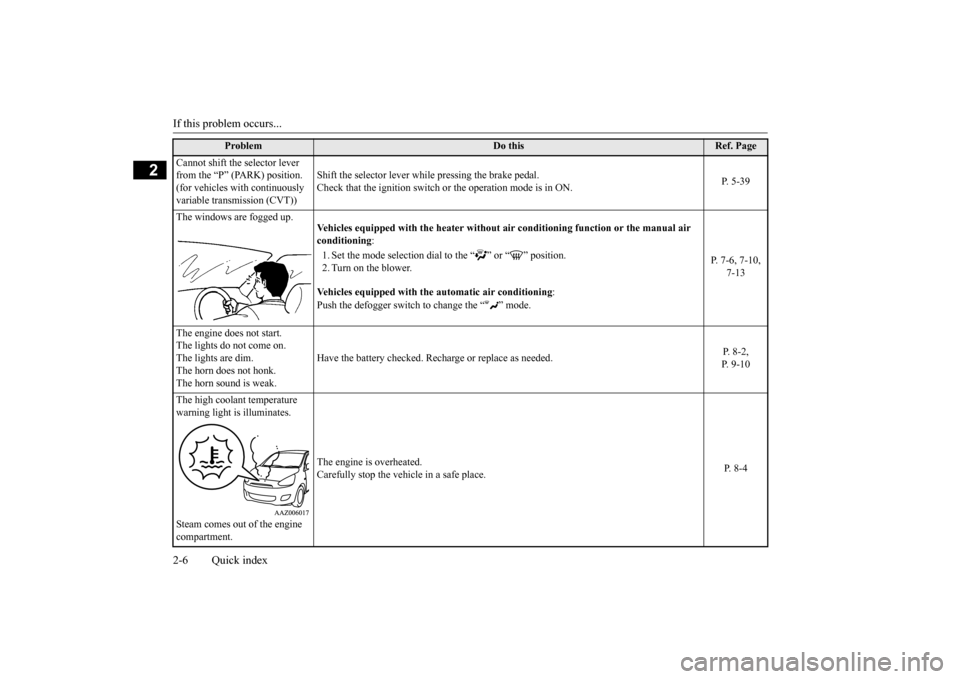
Cannot shift the selector lever from the “P” (PARK) position.(for vehicles with continuously variable transmission (CVT))
Shift the selector lever while pressing the brake pedal. Check that the ignition switch
or the operation mode is in ON.
P. 5-39
The windows are fogged up.
Vehicles equipped with the he
ater without air conditioning
function or th
e manual air
conditioning
:
1. Set the mode selection dial
to the “ ” or “ ” position.
2. Turn on the blower. Vehicles equipped with th
e automatic air conditioning
:
Push the defogger switch
to change the “ ” mode.
P. 7-6, 7-10,
7-13
The engine does not start. The lights do not come on. The lights are dim. The horn does not honk.The horn sound is weak.
Have the battery checked. Rech
arge or replace as needed.
P. 8-2, P. 9-10
The high coolant temperature warning light is illuminates. Steam comes out of the engine compartment.
The engine is overheated. Carefully stop the vehicle in a safe place.
P. 8-4
Problem
Do this
Ref. Page
BK0212400US.book 6 ページ 2014年4月1日 火曜日 午後2時21分
Page 16 of 300
If this problem occurs...
Quick index 2-7
2
The vehicle is
stuck in sand,
mud or snow
Rock your vehicle back and forth to free it. P. 8-18
WA R N I N G When attempting to rock your vehicle out of
a stuck position, be sure that
no one is near the vehicl
e. The rocking motion may c
ause the vehicle to
suddenly lurch forward or backward, possibly injuring bystanders. Avoid revving the engine or spin
ning the wheels. Prolonged efforts to free a st
uck vehicle may result in
overheating and transa
xle failure.
If the vehicle remains stuck after several rocking attempts, have a towing service pull the vehicle out.
Problem
Do this
Ref. Page
The brakes are not functioning properly after crossing a puddle or stream.
Dry out the brakes by driving slowly while
lightly pressing the brake pedal. P. 6-5
The continuously variable trans- mission (CVT) makes no shift change when accelerating. The initial movement of the vehicle is slow when the vehicle starts moving.(for vehicles with CVT)
There may be a problem in the CVT. Have the vehicle inspected by an
authorized Mitsubishi Motors dealer or a repair facility of
your choice.
P. 5-42
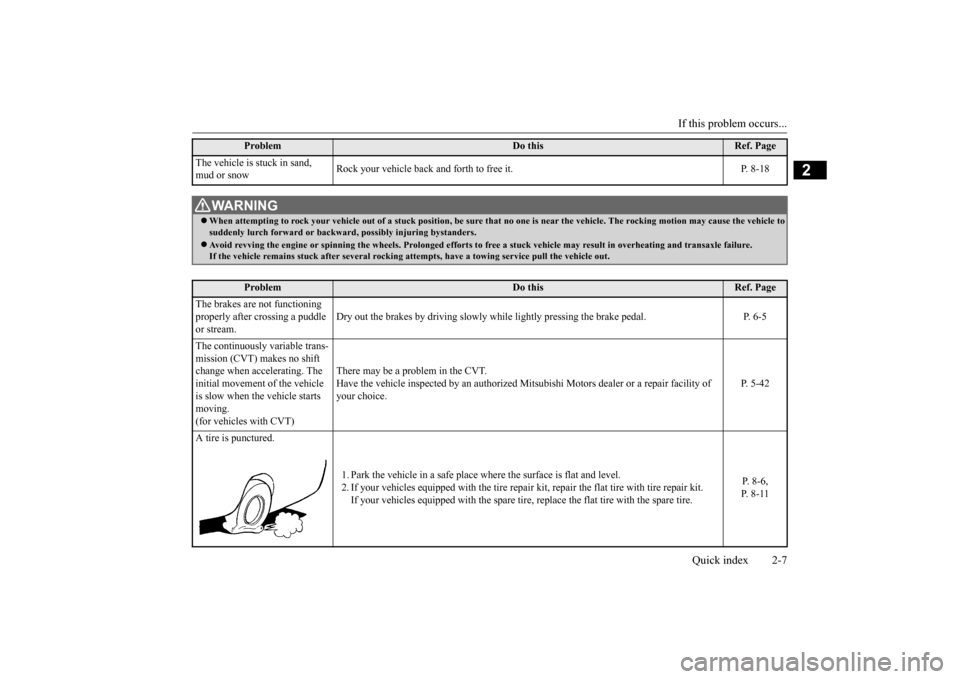
A tire is punctured.
1. Park the vehicle in a safe place where the surface is flat and level. 2. If your vehicles equipped with th
e tire repair kit, repair the flat tire with tire repair kit.
If your vehicles equipped with the spare tire, replace the flat tire with the spare tire.
P. 8-6, P. 8 - 1 1
Problem
Do this
Ref. Page
BK0212400US.book 7 ページ 2014年4月1日 火曜日 午後2時21分
Page 47 of 300
Supplemental Restraint System (SRS) - airbag 4-22 Seat and restraint systems
4
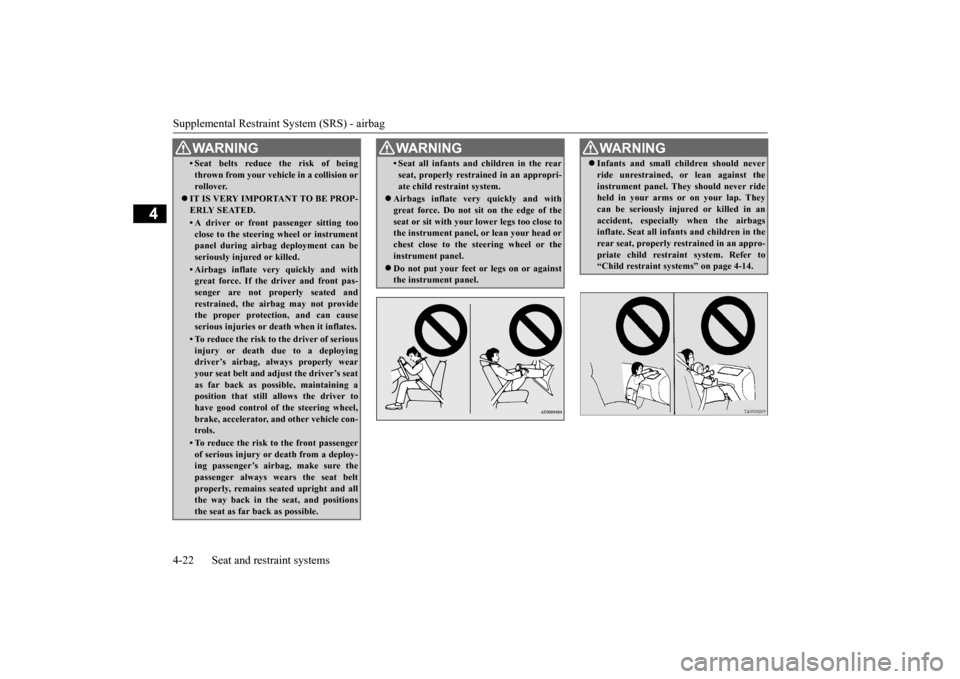
• Seat belts reduce the risk of being thrown from your vehi
cle in a collision or
rollover.
IT IS VERY IMPORTANT TO BE PROP- ERLY SEATED.• A driver or front passenger sitting tooclose to the steering wheel or instrumentpanel during airbag deployment can be seriously injured or killed.• Airbags inflate very quickly and withgreat force. If the driver and front pas- senger are not properly seated andrestrained, the airbag may not provide the proper protection, and can cause serious injuries or death when it inflates.• To reduce the risk to the driver of seriousinjury or death due to a deployingdriver’s airbag, al
ways properly wear
your seat belt and adjust the driver’s seat as far back as possible, maintaining aposition that still allows the driver to have good control of the steering wheel, brake, accelerator,
and other vehicle con-
trols.• To reduce the risk to the front passengerof serious injury or
death from a deploy-
ing passenger’s airbag, make sure the passenger always wears the seat beltproperly, remains seat
ed upright and all
the way back in the
seat, and positions
the seat as far back as possible.WA R N I N G
• Seat all infants and children in the rearseat, properly restrain
ed in an appropri-
ate child restraint system.
Airbags inflate very
quickly and with
great force. Do not sit on the edge of theseat or sit with your
lower legs too close to
the instrument panel, or lean your head or chest close to the steering wheel or theinstrument panel. Do not put your feet or
legs on or against
the instrument panel.WA R N I N G
WA R N I N G Infants and small children should never ride unrestrained, or lean against theinstrument panel. They should never rideheld in your arms or
on your lap. They
can be seriously inju
red or killed in an
accident, especially when the airbagsinflate. Seat all infa
nts and children in the
rear seat, properly re
strained in an appro-
priate child restraint system. Refer to“Child restraint systems” on page 4-14.
BK0212400US.book 22 ページ 2014年4月1日 火曜日 午後2時21分
Page 49 of 300
Supplemental Restraint System (SRS) - airbag 4-24 Seat and restraint systems
4
the ignition switch or the operation mode is under the following condi
tions. These include
all of the item
s listed above a
nd all related
wiring. [Except for vehicles equipped with theF.A.S.T.-key] The ignition switch is in the “ON” or “START” position.[Vehicles equipped with the F.A.S.T.-key] The operation mode is in ON. The airbags will operate under the same con- ditions as the airbag control unit. When the impact sensors detect a sufficient front or side impact to deploy the airbag(s), the appropriate airbag
(s) will be deployed.
When airbags deploy, so
me smoke is released
accompanied by a loud noise. The smoke is not harmful, but do not intentionally inhale the smoke as it may ca
use temporary irrita-
tion to people with respiratory problems. An inflated airbag will deflate quickly, so you may not even notice that the airbag was inflated.Airbag inflation does
not prevent the driver
from seeing or being able
to steer the vehicle,
and does not prevent people from leaving thevehicle.
N00418600256
This vehicle is equipped with an event datarecorder (EDR). The main purpose of an EDR is to record, in certain crash or near
crash-like situations,
such as an airbag deployment or hitting a road obstacle, data that
will assist in under-
standing how a vehicl
e’s systems performed.
The EDR is designed to record data related to vehicle dynamics and safety systems for a short period of time,
typically 30 seconds or
less. The EDR in this vehicle is designed to record such data as: How various systems
in your vehicle were
operating; Whether or not the driver and front pas- senger safety belts we
re buckled/fastened;
How far (if at all) the driver was depress- ing the accelerator and/or brake pedal; and, How fast the vehicle was traveling.
These data can help provide a better under- standing of the circumstances in whichcrashes and injuries occur. To read data recorded by an EDR, special equipment is required, and access to the vehi- cle or the EDR is needed. In addition to thevehicle manufacturer, ot
her parties, such as
law enforcement, that have the special equip- ment, can read the information if they haveaccess to the vehicle or the EDR.
N00417900223
The driver’s seat position sensor is attachedto the seat rail and provides the airbag control unit with information on the seat’s fore-aft position. The airbag control unit controlsdeployment of the driver’s front airbag in
CAUTION Airbags inflate very quickly and with great force. In certain situ
ations, contact with an
inflating airbag may cause small cuts, abra-sions, and bruises.
Event Data Recording
NOTE
EDR data are recorded by your vehicle only if a non-trivial crash si
tuation occurs; no data
are recorded by the EDR under normal driv- ing conditions and no personal data (e.g., name, gender, age, and crash location) arerecorded. However, ot
her parties, such as
law enforcement, could combine the EDR data with the type of
personally identifying
data routinely acquire
d during a crash inves-
tigation.
Driver’s seat position sensor
BK0212400US.book 24 ページ 2014年4月1日 火曜日 午後2時21分
Page 62 of 300
5
Features and controlsBreak-in recommendations ..............................................................5-2 Keys .................................................................................................5-2 Electronic immobilizer (Anti-theft starting system) ........................5-3Keyless entry system (if so equipped) ..............................................5-6 Free-hand Advanced Security
Transmitter (F.A.S.T.-key)
(if so equipped) ............................................................................5-9Door locks ......................................................................................5-24 Power door locks ......
...........
...........
...........
...........
...........
.........
.....5-26
Child safety locks for rear door ..........
...........
.........
.........
.........
.....5-27
Liftgate ...........................................................................................5-27 Manual window control (if so equipped)........................................5-28 Power window control ...................................................................5-29Parking brake .................................................................................5-31 Steering wheel height adjustment ..................................................5-32 Inside rearview mirror ...................................................................5-32Outside rearview mirrors ...............................................................5-33 Ignition switch ...............................................................................5-35 Starting the engine .........................................................................5-36Manual transaxle (if so equipped) ..................................................5-38 Continuously variable transmission
(CVT) (if so equipped)..........5-39
Service brake .................................................................................5-44Hill start assist (if so equipped) ......................................................5-45 Brake assist system ........................................................................5-46 Anti-lock braking system ...............................................................5-46Electric power steering system (EPS) ............................................5-48 Active stability control (ASC) .......................................................5-49 Cruise control (if so equipped) .......................................................5-52Tire pressure monitoring system (if so equipped) ..........................5-56
Rear-view camera (if so equipped)................................................. 5-60 Instrument cluster .......................................................................... 5-62 Multi-information display ............................................................. 5-62Indicator and warning light package ............................................. 5-70 Indicators ....................................................................................... 5-71 Warning lights ................................................................................ 5-72Combination headlights and dimmer switch ................................. 5-74 Turn signal lever ............................................................................ 5-76 Hazard warning flasher switch ...................................................... 5-77Front fog light switch (if so equipped) .......................................... 5-77 Wiper and washer switch ............................................................... 5-78 Electric rear window defogger switch ....
...........
...........
...........
...... 5-80
Horn switch ................................................................................... 5-81 Link System (if so equipped) ......................................................... 5-81 Bluetooth
® 2.0 interface (if so equipped)....................................... 5-81
USB input terminal (if so
equipped) ....
...........
.........
........
........... 5-101
Sun visors .................................................................................... 5-105 12 V power outlets ....................................................................... 5-106Interior lights ............................................................................... 5-106 Storage spaces .............................................................................. 5-107 Cup holders .................................................................................. 5-108Bottle holders ............................................................................... 5-108 Rear shelf panel (if so equipped) .................................................. 5-109 Convenience hook ............
...........
...........
...........
...........
...........
.... 5-109
Assist grips .................................................................................. 5-110
BK0212400US.book 1 ページ 2014年4月1日 火曜日 午後2時21分
Page 75 of 300
Free-hand Advanced
Security Transmitter (F.A.S
.T.-key) (if so equipped)
5-14 Features and controls
5
The indicator light on th
e engine switch turns
off.On vehicles equipped
with continuously vari-
able transmission (CVT), the operation mode cannot be put in OFF wh
en the selector lever
is in any position other than the “P” (PARK) position. Allows operation of some electrical accesso- ries. The indicator light on the engine switch illu- minates orange. All electrical accessories can be used. The indicator light on the engine switch illu- minates green. The indicator light turns off when the engineis running.
N00568000025
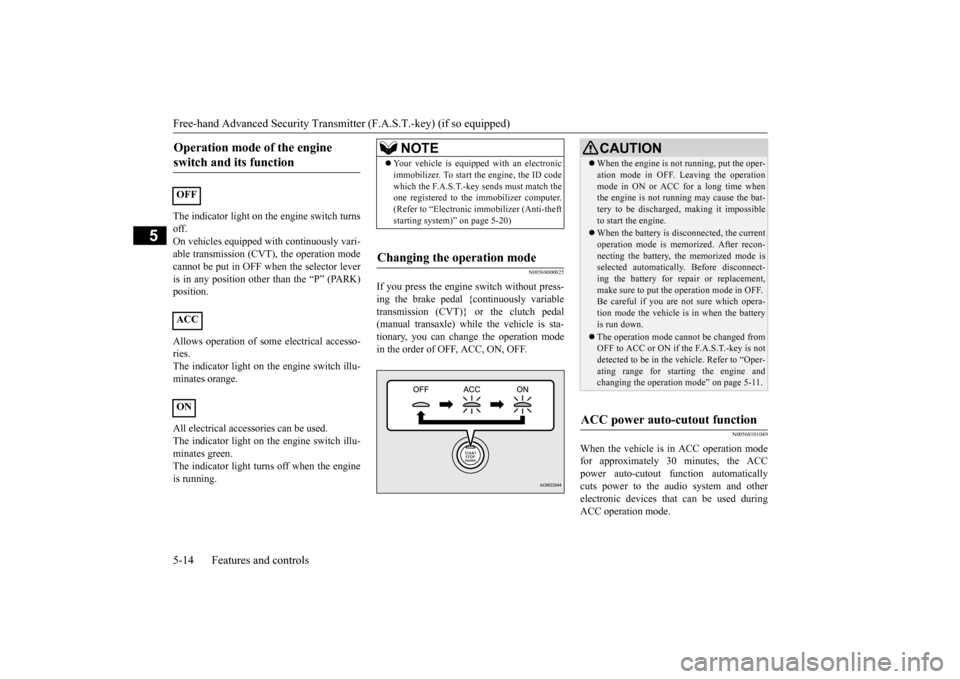
If you press the engine
switch without press-
ing the brake pedal {continuously variable transmission (CVT)} or the clutch pedal(manual transaxle) while the vehicle is sta- tionary, you can change the operation mode in the order of OFF, ACC, ON, OFF.
N00568101049
When the vehicle is
in ACC operation mode
for approximately 30 minutes, the ACC power auto-cutout fu
nction automatically
cuts power to the audio system and otherelectronic devices that
can be used during
ACC operation mode.
Operation mode of the engine switch and its function
OFF ACC ON
NOTE
Your vehicle is equippe
d with an electronic
immobilizer. To start the engine, the ID codewhich the F.A.S.T.-key sends must match theone registered to the immobilizer computer. (Refer to “Electronic immobilizer (Anti-theft starting system)” on page 5-20)
Changing the operation mode
CAUTION When the engine is not running, put the oper- ation mode in OFF. Leaving the operationmode in ON or ACC for a long time whenthe engine is not r
unning may cause the bat-
tery to be discharged, making it impossible to start the engine. When the battery is disconnected, the current operation mode is memorized. After recon-necting the battery, the memorized mode is selected auto
matically. Before disconnect-
ing the battery for repair or replacement,make sure to put the
operation mode in OFF.
Be careful if you are not sure which opera- tion mode the vehicle is
in when the battery
is run down. The operation mode cannot be changed from OFF to ACC or ON if the F.A.S.T.-key is not detected to be in the
vehicle. Refer to “Oper-
ating range for starting the engine andchanging the operation mode” on page 5-11.
ACC power auto-cutout function
BK0212400US.book 14 ページ 2014年4月1日 火曜日 午後2時21分
Page 78 of 300
Free-hand Advanced Securi
ty Transmitter (F.A.S.T.-key) (if so equipped)
Features and controls 5-17
5
Your vehicle is equipped with an electroni- cally controlled fuel in
jection system. This is
a system that automatically controls fuelinjection. There is usually no need to depress the accelerator pedal when starting the engine.To prevent battery drai
n, wait a few seconds
between attempts to restart the engine. 1. Make sure all occupants are properly seated with seat belts fastened.2. Make sure the parking brake is applied. 3. Press and hold the brake pedal down firmly with your right foot.
4. Press and hold the clutch pedal all the way down (manual transaxle). 5. On vehicles equippe
d with manual trans-
axle, place the gearshift lever in the “N” (Neutral) position.On vehicles equipped with continuously variable transmission (CVT), make sure the selector lever is in the “P” (PARK)position.
6. Press the engine switch. 7. Confirm that all wa
rning lights and warn-
ing displays are functioning properly.
After several attempts, you may experience that the engine still does not start. 1. Make sure that all electric devices, such as lights, air conditio
ning blower and rear
window defogger, are turned off.
WA R N I N G Never run the engine in
a closed or poorly
ventilated area any lo
nger than is needed
to move your vehicle out of the area. Car-bon monoxide gas, whic
h is odorless and
extremely poisonous, could build up and cause serious injury or death.CAUTION Do not push-start the vehicle.Do not run the engine at high rpms or drive at high speeds until th
e engine has had a
chance to warm up.
Starting the engine
NOTE
After the engine has not
started for a while,
the brake pedal effort needed to start theengine may become grea
ter. If this occurs,
depress the brake pedal more firmly than usual.NOTE
For vehicles equipped with a manual trans- axle, the engine will
not start unless the
clutch pedal is fully
depressed (Clutch inter-
lock). This is a safety feature.
NOTE
On vehicles equippe
d with continuously
variable transmission (C
VT), the engine can
only be started when th
e selector lever is in
the “P” (PARK) or “N” (NEUTRAL) posi- tion. For safety reasons, the engine should bestarted when the selector lever is in the “P” (PARK) position in which the driving wheels lock.NOTE
Minor noises may be heard on engine start- up. These will disappear as the engine warms up.
When the engine is hard to start
BK0212400US.book 17 ページ 2014年4月1日 火曜日 午後2時21分