fuel MITSUBISHI MIRAGE 2017 6.G User Guide
[x] Cancel search | Manufacturer: MITSUBISHI, Model Year: 2017, Model line: MIRAGE, Model: MITSUBISHI MIRAGE 2017 6.GPages: 307, PDF Size: 9.02 MB
Page 99 of 307
Starting the engine 5-38 Features and controls
5
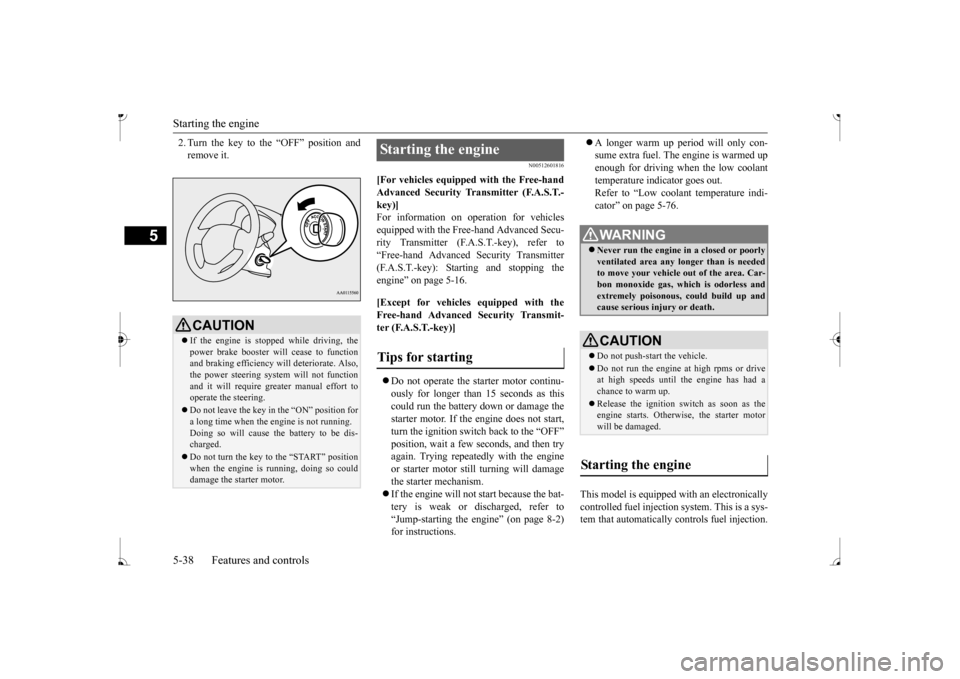
2. Turn the key to the “OFF” position and remove it.
N00512601816
[For vehicles equipped with the Free-hand Advanced Security Tr
ansmitter (F.A.S.T.-
key)]For information on
operation for vehicles
equipped with the Free-hand Advanced Secu- rity Transmitter (F.A
.S.T.-key), refer to
“Free-hand Advanced
Security Transmitter
(F.A.S.T.-key): Starting and stopping the engine” on page 5-16. [Except for vehicles equipped with the Free-hand Advanced Se
curity Transmit-
ter (F.A.S.T.-key)] Do not operate the starter motor continu- ously for longer than 15 seconds as this could run the battery
down or damage the
starter motor. If the engine does not start, turn the ignition switch back to the “OFF” position, wait a few se
conds, and then try
again. Trying repeatedly with the engine or starter motor still turning will damage the starter mechanism. If the engine will not
start because the bat-
tery is weak or discharged, refer to “Jump-starting the engine” (on page 8-2)for instructions.
A longer warm up period will only con- sume extra fuel. The engine is warmed upenough for driving when the low coolant temperature indicator goes out. Refer to “Low coolant temperature indi-cator” on page 5-76.
This model is equipped with an electronically controlled fuel injection system. This is a sys- tem that automatically controls fuel injection.
CAUTION If the engine is stopped while driving, the power brake booster will
cease to function
and braking efficiency will deteriorate. Also,the power steering syst
em will not function
and it will require gr
eater manual effort to
operate the steering. Do not leave the key in
the “ON” position for
a long time when the engine is not running.Doing so will cause the battery to be dis- charged. Do not turn the key to the “START” position when the engine is running, doing so could damage the starter motor.
Starting the engine Tips for starting
WA R N I N G Never run the engine in
a closed or poorly
ventilated area any longer than is neededto move your vehicle
out of the area. Car-
bon monoxide gas, wh
ich is odorless and
extremely poisonous, could build up andcause serious injury or death.CAUTION Do not push-start the vehicle.Do not run the engine at high rpms or drive at high speeds until
the engine has had a
chance to warm up. Release the ignition sw
itch as soon as the
engine starts. Otherwis
e, the starter motor
will be damaged.
Starting the engine
BK0236100US.book 38 ページ 2016年2月1日 月曜日 午前10時15分
Page 101 of 307
Manual transaxle (if so equipped) 5-40 Features and controls
5
When the ambient temperature is -4 °F (-20 °C) or lower, it may not be possible to startfrom a standstill even with the selector lever in the “D” (DRIVE) or “R” (REVERSE) position.This phenomenon occurs
because the trans-
axle has not warmed up sufficiently; it does not indicate a problem.
If this occurs, place
the selector lever in the “P” (PARK) position and let the engine idle
for at least 10 minutes.
The transaxle will wa
rm up, and you will be
able to start normally. Do not leave the vehicle during warm-upoperation.
N00512701181
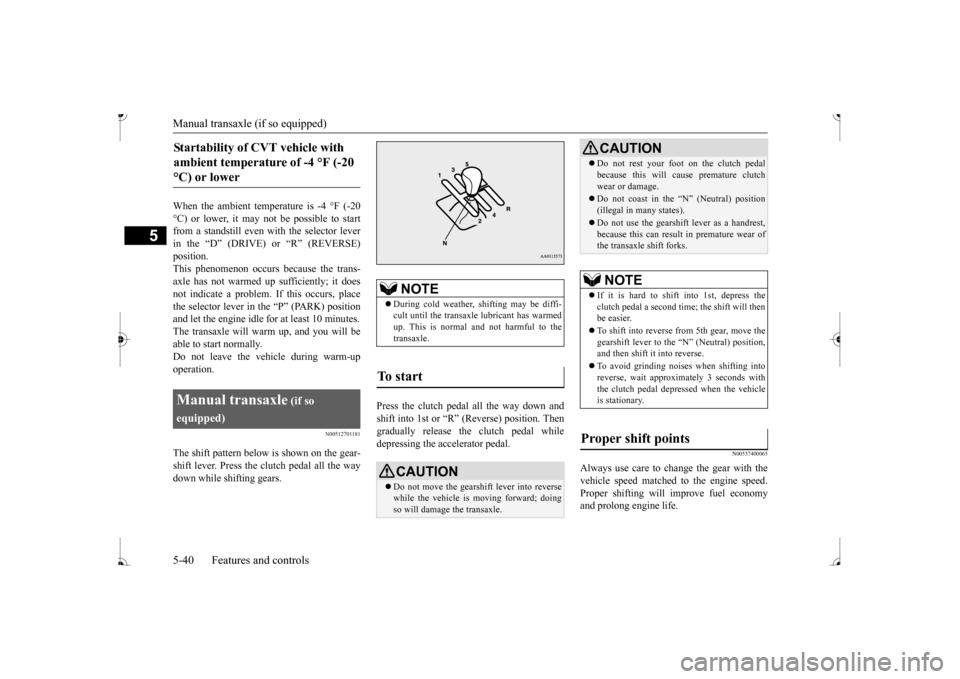
The shift pattern below is shown on the gear- shift lever. Press the clutch pedal all the way down while shifting gears.
Press the clutch pedal all the way down and shift into 1st or “R” (Reverse) position. Then gradually release the
clutch pedal while
depressing the accelerator pedal.
N00537400065
Always use care to change the gear with thevehicle speed matched
to the engine speed.
Proper shifting will improve fuel economy and prolong engine life.
Startability of CVT vehicle with ambient temperature of -4 °F (-20 °C) or lower Manual transaxle
(if so
equipped)
During cold weather, shifting may be diffi- cult until the transaxl
e lubricant has warmed
up. This is normal and not harmful to the transaxle.
To start
CAUTION Do not move the gearsh
ift lever into reverse
while the vehicle is moving forward; doing so will damage the transaxle.
Do not rest your foot on the clutch pedal because this will ca
use premature clutch
wear or damage. Do not coast in the “N” (Neutral) position (illegal in many states). Do not use the gearshift lever as a handrest, because this can result in premature wear ofthe transaxle shift forks.NOTE
If it is hard to shift into 1st, depress the clutch pedal a second ti
me; the shift will then
be easier. To shift into reverse from 5th gear, move the gearshift lever to the “N” (Neutral) position, and then shift it into reverse. To avoid grinding noises when shifting into reverse, wait approxima
tely 3 seconds with
the clutch pedal depre
ssed when the vehicle
is stationary.
Proper shift points
CAUTION
BK0236100US.book 40 ページ 2016年2月1日 月曜日 午前10時15分
Page 102 of 307
Manual transaxle (if so equipped)
Features and controls 5-41
5
N00512900131
For the best fuel ec
onomy and performance in
using your manual transaxl
e, upshift as listed
below. At low altitude locations, shift at the vehicle speeds listed. Upshifting earlier during cruiseconditions (relativel
y steady speeds) will
improve your fuel economy.
At high altitude locati
ons, upshift as listed
below.
N00513000096
It is recommended that you downshift to alower gear when needed to maintain the desired speed, according to the table. Avoid downshifting at too high a speed. Theengine may suffer damage. To maintain a safe speed and prolong brake life, shift down to 2nd or 1st when descend-ing a steep hill. Downshifting is also important to avoid “lug- ging” the engine at t
oo low a speed, such as
when turning a corner or when driving up a steep hill.
N00513100244
Do not use the gearshift lever as a han- drest. This can result
in premature wear of
the transaxle shift forks. The table above shows the maximum rec- ommended driving speed for in each gear. Do not drive near or at these speeds forprolonged periods of time.
CAUTION Avoid downshifting that may cause the tachometer pointer to enter the red zone.This puts the engine at risk of being dam-aged.
Upshifting
Shift point
Upshift speeds
Acceleration
Cruise
1st gear to 2nd gear
15 mph (24 km/h)
15 mph (24 km/h)
2nd gear to 3rd gear
28 mph (45 km/h)
19 mph (31 km/h)
3rd gear to 4th gear
36 mph (58 km/h)
33 mph (53 km/h)
4th gear to 5th gear
45 mph (72 km/h)
45 mph (72 km/h)
Shift point
Upshift speeds
1st gear to 2nd gear 15 mph (24 km/h)2nd gear to 3rd gear 25 mph (40 km/h)3rd gear to 4th gear 40 mph (64 km/h)4th gear to 5th gear 45 mph (72 km/h)Downshifting
Recommended downshifting speed
Downshifting speed
Shift point
Under 20 mph (32 km/h)
Shift down from cur- rent gear to 2nd gear.
20 to 30 mph (32 to
48 km/h)
Shift down from cur- rent gear to 3rd gear.
Driving precautions
Maximum possible driving speed
Shift points
Maximum possible driving
speed
1st gear 28 mph (45 km/h)2nd gear 53 mph (85 km/h)3rd gear 78 mph (125 km/h)4th gear 105 mph (170 km/h)Downshifting speed
Shift point
BK0236100US.book 41 ページ 2016年2月1日 月曜日 午前10時15分
Page 103 of 307
Continuously variable transmission (CVT) (if so equipped) 5-42 Features and controls
5
N00560200050
The CVT will automati
cally and continuously
change its gear ratio depending on road anddriving conditions. This helps achieve smooth driving and excellent fuel efficiency. The transmission prevents unnecessary upshifts even when the accelerator pedal isreleased and ensures smooth driving. According to the conditions, the transmission will automatically shift to a lower gear ratio to achieve stronger engine braking. This may help reduce your need to use the servicebrake.
N00560301087
As an additional safe
ty precaution, models
equipped with a conti
nuously variable trans-
mission have a shift-lo
ck device that holds
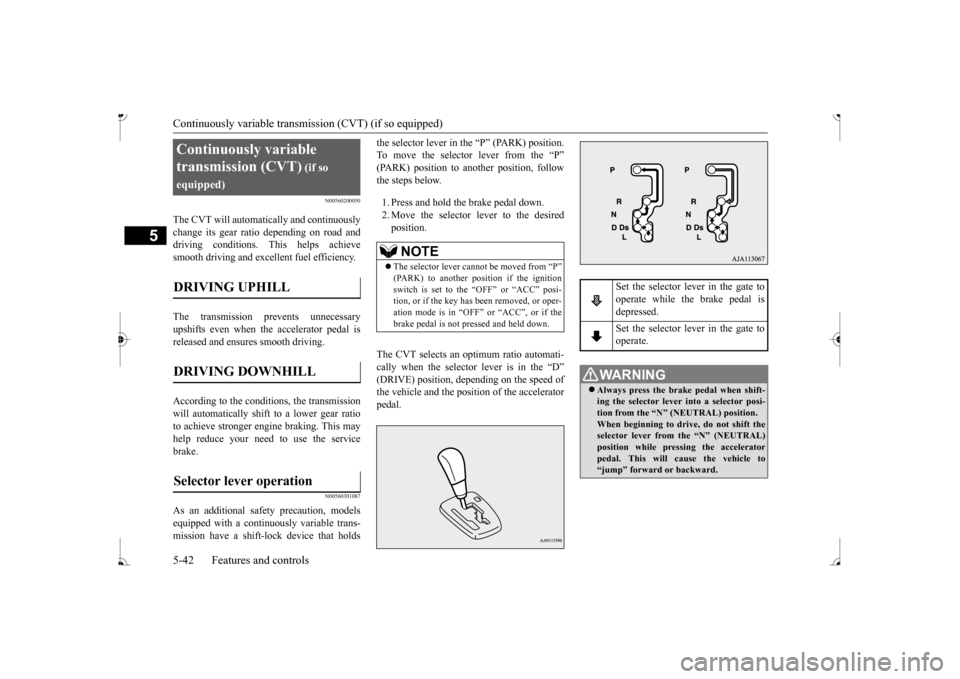
the selector lever in the “P” (PARK) position. To move the selector lever from the “P” the steps below. 1. Press and hold the brake pedal down. 2. Move the selector lever to the desiredposition.
The CVT selects an optimum ratio automati- cally when the selector lever is in the “D”
nding on the speed of
the vehicle and the position of the acceleratorpedal.
Continuously variable transmission (CVT)
(if so
equipped)
DRIVING DOWNHILL
Selector lever operation
NOTE
The selector lever cannot
be moved from “P” sition if the ignition
switch is set to the “OFF” or “ACC” posi- tion, or if the key has been removed, or oper-ation mode is in “OFF” or “ACC”, or if the brake pedal is not pressed and held down.
Set the selector lever in the gate to operate while the brake pedal is depressed. Set the selector lever in the gate to operate.
WA R N I N G Always press the brake pedal when shift- ing the selector lever into a selector posi- tion from the “N”
(NEUTRAL) position.
When beginning to drive, do not shift theselector lever from
the “N” (NEUTRAL)
position while pressing the accelerator pedal. This will cause the vehicle to“jump” forward or backward.
BK0236100US.book 42 ページ 2016年2月1日 月曜日 午前10時15分
Page 121 of 307
Tire pressure monitoring
system (if so equipped)
5-60 Features and controls
5
Each tire, including the spare, should be checked monthly when cold and inflated tothe inflation pressure recommended by the vehicle manufac
turer on the vehicle placard
or tire inflation pressu
re label. (If your vehi-
cle has tires of a different size than the size indicated on the vehicle
placard or tire infla-
tion pressure label, yo
u should determine the
proper tire inflation pr
essure for those tires.)
As an added safety feature, your vehicle has been equipped with a tire pressure monitoring system (TPMS) that illuminates a low tire pressure telltale when
one or more of your
tires is significant
ly under-inflated.
Accordingly, when the low tire pressure tell- tale illuminates, you should stop and checkyour tires as soon as possible, and inflate them to the proper pressure. Driving on a sig- nificantly under-inflated
tire causes the tire to
overheat and can lead
to tire failure.
Under-inflation also reduces fuel efficiency and tire tread life, and may affect the vehi-cle’s handling and stopping ability. Please note that the TPMS is not a substitute for proper tire maintenance, and it is the driver’sresponsibility to mainta
in correct tire pres-
sure, even if under-inf
lation has not
reached
the level to trigger illumination of the TPMSlow tire pressure telltale. Your vehicle has also been equipped with a TPMS malfunction indicator to indicate when
the system is not operating properly. The TPMS malfunction indicator is combinedwith the low tire pressure telltale. When the system detects a malfunction, the telltale will flash for approximately one min-ute and then remain c
ontinuously illuminated.
This sequence will c
ontinue upon subsequent
vehicle start-ups as long as the malfunctionexists. When the malfunction indicator is illumi- nated, the system may not
be able to detect or
signal low tire pr
essure as intended.
TPMS malfunctions may
occur for a variety
of reasons, including the installation of replacement or alternate tires or wheels on the vehicle that prevent the TPMS from function-ing properly. Always
check the TPMS mal-
function telltale after replacing one or more tires or wheels on your vehicle to ensure thatthe replacement or alternate tires and wheels allow the TPMS to continue to function prop- erly.
N00532801540
1. If the tire pressure monitoring systemwarning light illum
inates, avoid hard
braking, sharp steering maneuvers and high speeds. You should stop and adjust the tires to the proper inflation pressure assoon as possible. Adjust the spare tire at the same time. Refer to “Tires” on page 9-12.
If the warning light illuminates while driving
NOTE
When inspecting or adjusting the tire pres- sure, do not apply excessive force to the valve stem to
avoid breakage.
After inspecting or adjusting the tire pres- sure, always reinstall the valve cap on thevalve stem. Without the valve cap, di
rt or moisture could
get into the valve, resulting in damage to thetire inflation pressure sensor. Do not use metal valve caps, which may cause a metal reaction,
resulting in corrosion
and damage of the tire
inflation pressure sen-
sors. Once adjustments have
been made, the warn-
ing light will go off after a few minutes ofdriving.
BK0236100US.book 60 ページ 2016年2月1日 月曜日 午前10時15分
Page 126 of 307
Multi-information display
Features and controls 5-65
5
N00519201332
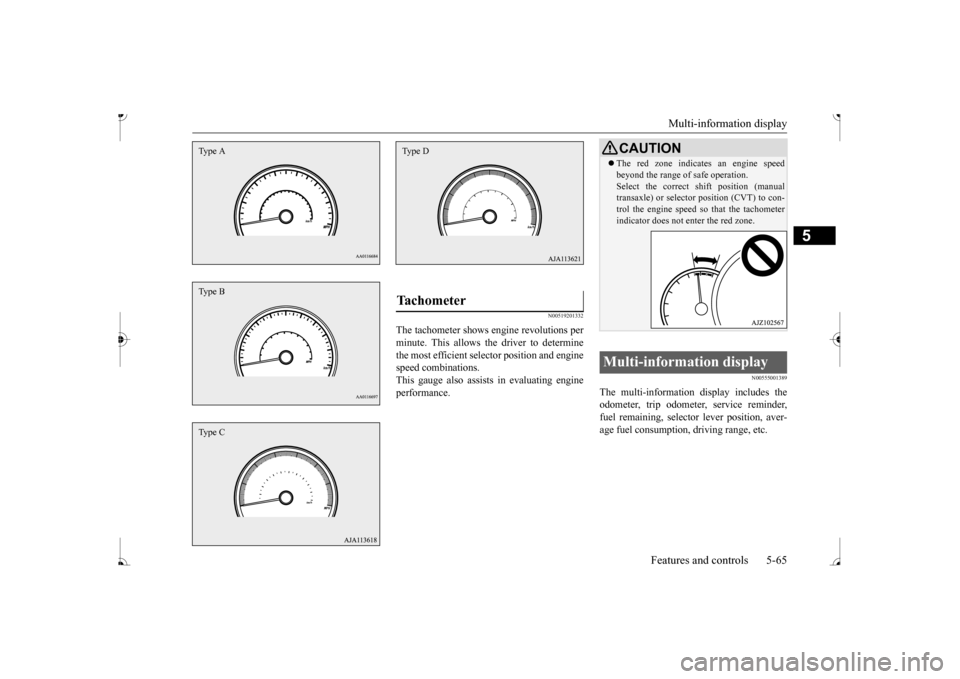
The tachometer shows e
ngine revolutions per
minute. This allows the driver to determine the most efficient sele
ctor position and engine
speed combinations.This gauge also assists in evaluating engine performance.
N00555001389
The multi-information display includes the odometer, trip odometer, service reminder, fuel remaining, selector lever position, aver- age fuel consumption, driving range, etc.
Type AType BType C
Tachometer Type D
CAUTION The red zone indicates an engine speed beyond the range of safe operation.Select the correct sh
ift position (manual
transaxle) or selector position (CVT) to con- trol the engine speed
so that the tachometer
indicator does not en
ter the red zone.
Multi-information display
BK0236100US.book 65 ページ 2016年2月1日 月曜日 午前10時15分
Page 127 of 307
Multi-information display 5-66 Features and controls
5
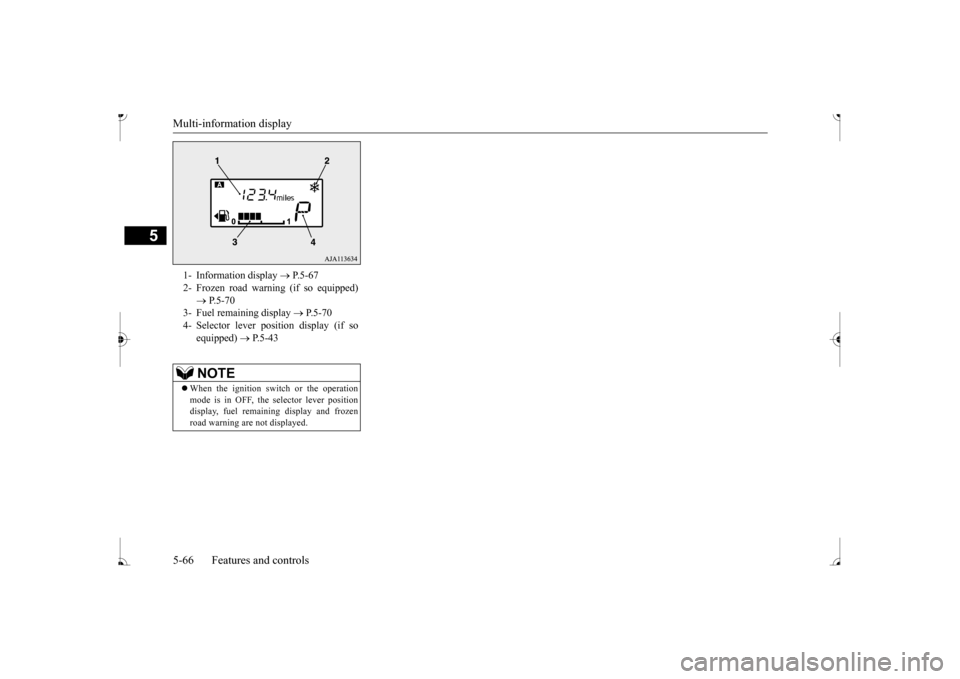
1- Information display
P.5-67
2- Frozen road warning (if so equipped)
P.5-70
3- Fuel remaining display
P.5-70
4- Selector lever position display (if so
equipped)
P.5-43
NOTE
When the ignition swit
ch or the operation
mode is in OFF, the
selector lever position
display, fuel remaining display and frozenroad warning are not displayed.
BK0236100US.book 66 ページ 2016年2月1日 月曜日 午前10時15分
Page 128 of 307
Multi-information display
Features and controls 5-67
5
N00574801054
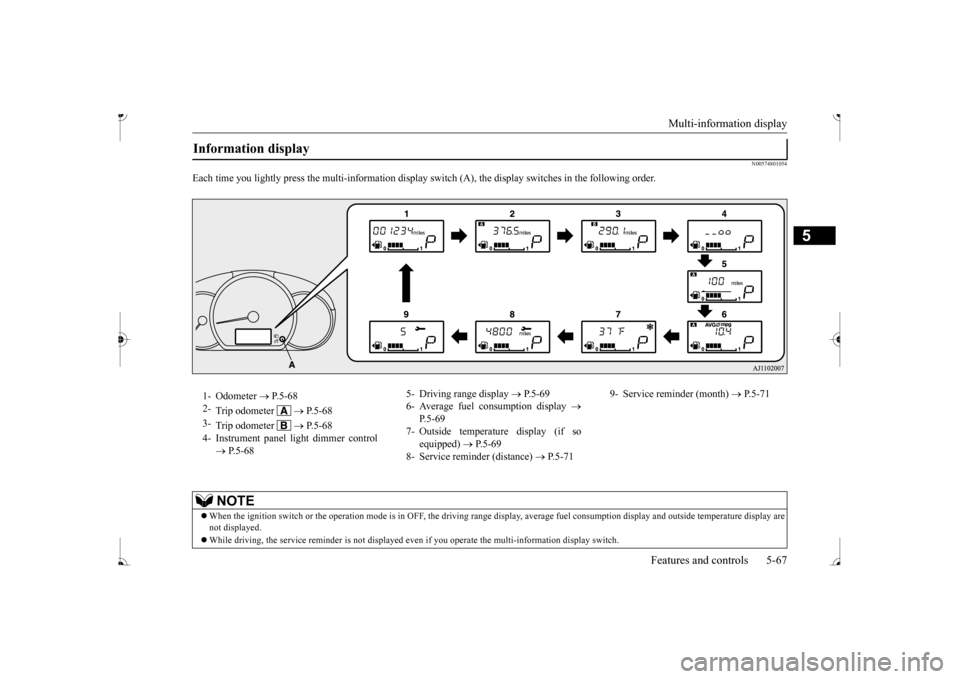
Each time you lightly press the multi-inf
ormation display switch (A), the disp
lay switches in the following order.
Information display 1- Odometer
P.5-68
2-
Trip odometer
P.5-68
3-
Trip odometer
P.5-68
4- Instrument panel li
ght dimmer control
P.5-68
5- Driving range display
P.5-69
6- Average fuel consumption display
P.5-69
7- Outside temperature display (if so
equipped)
P.5-69
8- Service reminder (distance)
P.5-71
9- Service reminder (month)
P.5-71
NOTE
When the ignition switch or the
operation mode is in OFF, the driving range di
splay, average fuel cons
umption display and outsi
de temperature display are
not displayed. While driving, the service reminder is
not displayed even if you operate th
e multi-information
display switch.
BK0236100US.book 67 ページ 2016年2月1日 月曜日 午前10時15分
Page 130 of 307
Multi-information display
Features and controls 5-69
5
N00575201042
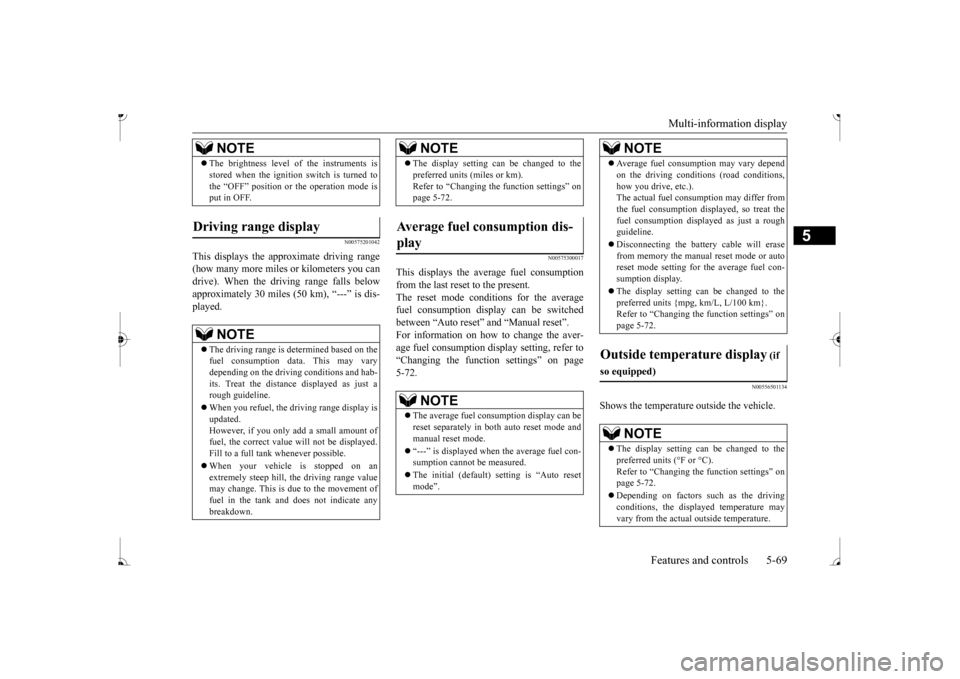
This displays the approximate driving range (how many more miles or
kilometers you can
drive). When the driving range falls below approximately 30 miles (
50 km), “---” is dis-
played.
N00575300017
This displays the average fuel consumptionfrom the last reset to the present. The reset mode conditions for the average fuel consumption disp
lay can be switched
between “Auto reset”
and “Manual reset”.
For information on how to change the aver- age fuel consumption di
splay setting, refer to
“Changing the function settings” on page 5-72.
N00556501134
Shows the temperature
outside the vehicle.
The brightness level of the instruments is stored when the ignition switch is turned tothe “OFF” position or the operation mode isput in OFF.
Driving range display
NOTE
The driving range is determined based on the fuel consumption da
ta. This may vary
depending on the drivi
ng conditions and hab-
its. Treat the distance displayed as just a rough guideline. When you refuel, the driving range display is updated. However, if you only add a small amount offuel, the correct value
will not be displayed.
Fill to a full tank whenever possible. When your vehicle is stopped on an extremely steep hill, the driving range value may change. This is due to the movement of fuel in the tank and does not indicate anybreakdown.NOTE
The display setting ca
n be changed to the
preferred units (miles or km).Refer to “Changing th
e function settings” on
page 5-72.
Average fuel consumption dis- play
NOTE
The average fuel cons
umption display can be
reset separately in both auto reset mode andmanual reset mode. “---” is displayed when the average fuel con- sumption cannot be measured. The initial (default) setting is “Auto reset mode”.NOTE
Average fuel consumption may vary depend on the driving conditi
ons (road conditions,
how you drive, etc.).The actual fuel consum
ption may differ from
the fuel consumption displayed, so treat the fuel consumption displayed as just a roughguideline. Disconnecting the batter
y cable wi
ll erase
from memory the manual reset mode or auto reset mode setting for the average fuel con- sumption display. The display setting ca
n be changed to the
preferred units {mpg, km/L, L/100 km}.Refer to “Changing the function settings” on page 5-72.
Outside temperature display
(if
so equipped) The display setting ca
n be changed to the
preferred units (
Page 131 of 307
Multi-information display 5-70 Features and controls
5
N00579000041
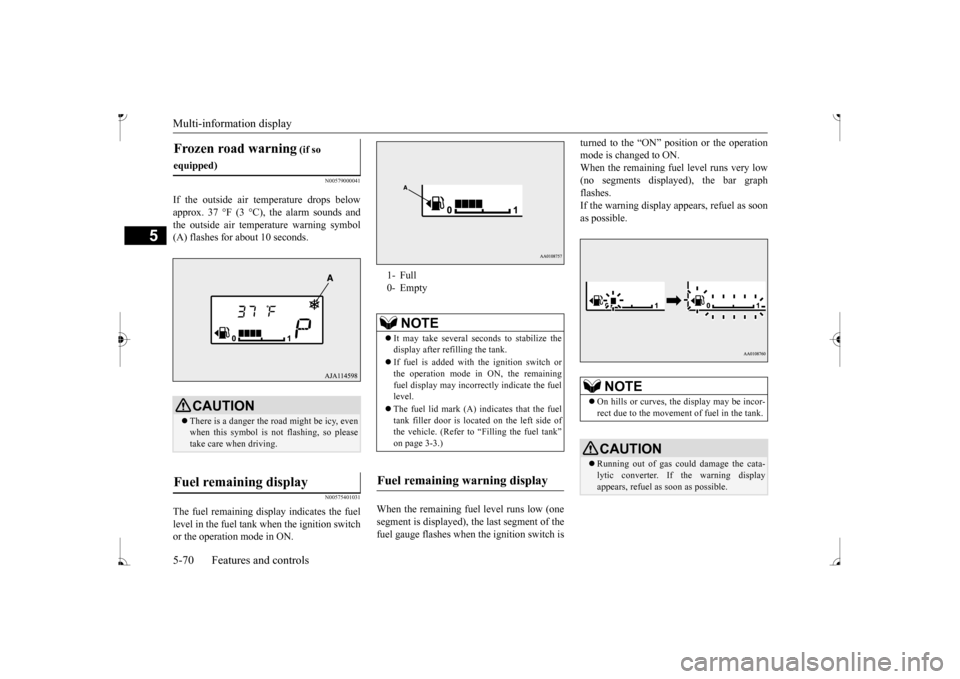
If the outside air temperature drops below approx. 37 °F (3 °C), the alarm sounds and the outside air temperature warning symbol (A) flashes for about 10 seconds.
N00575401031
The fuel remaining disp
lay indicates the fuel
level in the fuel tank
when the ignition switch
or the operation mode in ON.
When the remaining fuel level runs low (one segment is displayed), the last segment of the fuel gauge flashes when
the ignition switch is
turned to the “ON” position or the operation mode is changed to ON.When the remaining fuel level runs very low (no segments displayed), the bar graph flashes.If the warning display a
ppears, refuel as soon
as possible.
Frozen road warning
(if so
equipped)
CAUTION There is a danger the ro
ad might be icy, even
when this symbol is not flashing, so please take care when driving.
Fuel remaining display
1- Full 0- Empty
NOTE
It may take several se
conds to stabilize the
display after re
filling the tank.
If fuel is added with
the ignition switch or
the operation mode in ON, the remainingfuel display may incorre
ctly indicate the fuel
level. The fuel lid mark (A) indicates that the fuel tank filler door is located on the left side of the vehicle. (Refer to “Filling the fuel tank”
Fuel remaining warning display
NOTE
On hills or curves, the display may be incor- rect due to the movement
of fuel in the tank.
CAUTIONRunning out of gas coul
d damage the cata-
lytic converter. If the warning displayappears, refuel as soon as possible.
BK0236100US.book 70 ページ 2016年2月1日 月曜日 午前10時15分