lock MITSUBISHI MIRAGE 2017 6.G User Guide
[x] Cancel search | Manufacturer: MITSUBISHI, Model Year: 2017, Model line: MIRAGE, Model: MITSUBISHI MIRAGE 2017 6.GPages: 307, PDF Size: 9.02 MB
Page 33 of 307
Seat belts 4-8 Seat and restraint systems
4
N00406200460
All seats are equipped with a seat belt which uses one combined lap-and-shoulder belt with an emergency locking retractor. This system is designed to provide both com- fort and safety. It perm
its full extension and
automatic retraction of the belts during nor- mal vehicle operation.
A sensing device
inside the belt retractor is designed to lock theretractor in the event of a sudden change in the vehicle’s motion.
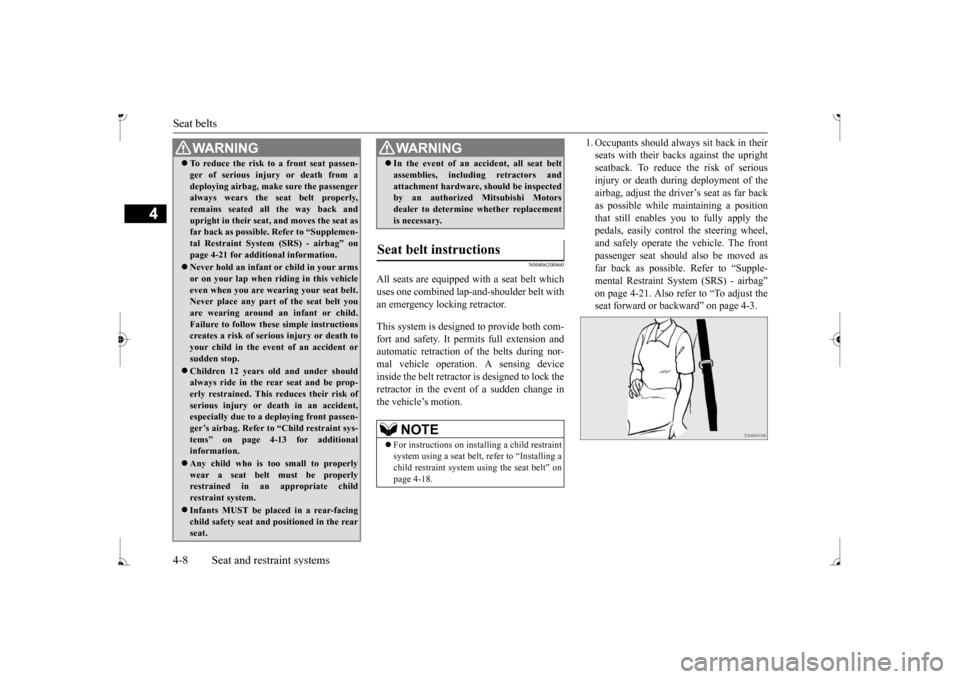
1. Occupants should always
sit back in their
seats with their backs against the uprightseatback. To reduce
the risk of serious
injury or death during deployment of the airbag, adjust the driver’s seat as far backas possible while maintaining a position that still enables you to fully apply the pedals, easily contro
l the steering wheel,
and safely operate the vehicle. The front passenger seat should also be moved as far back as possible.
Refer to “Supple-
mental Restraint Syst
em (SRS) - airbag
Page 34 of 307
Seat belts
Seat and restraint systems 4-9
4
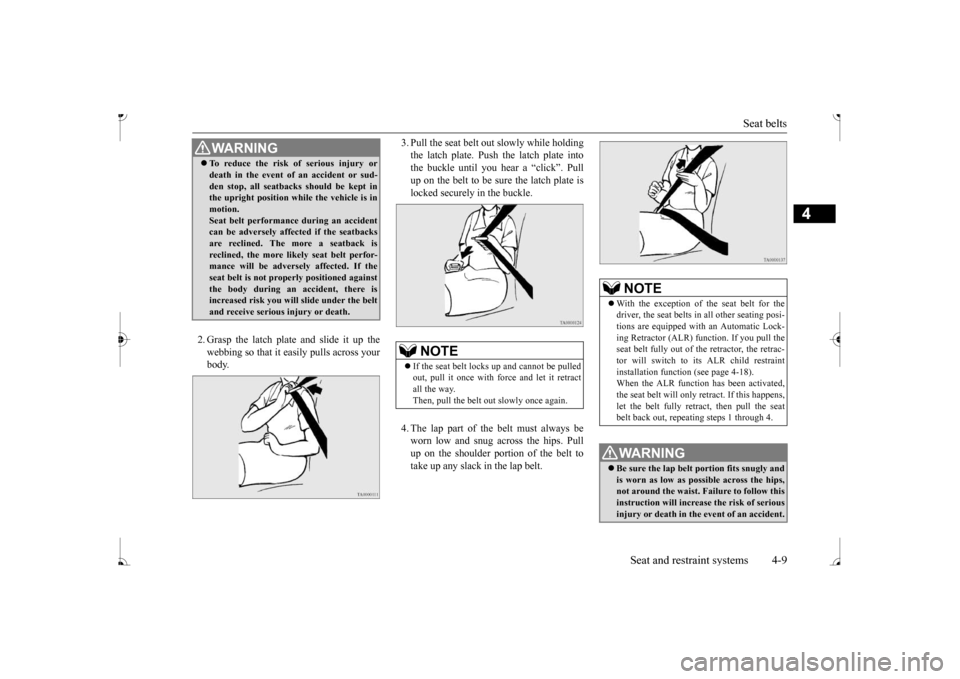
2. Grasp the latch plate and slide it up the webbing so that it easily pulls across your body.
3. Pull the seat belt out slowly while holding the latch plate. Push the latch plate intothe buckle until you hear a “click”. Pull up on the belt to be sure the latch plate is locked securely in the buckle. 4. The lap part of the belt must always be worn low and snug across the hips. Pullup on the shoulder portion of the belt to take up any slack in the lap belt.
WA R N I N G To reduce the risk of serious injury or death in the event of
an accident or sud-
den stop, all seatbacks should be kept inthe upright position wh
ile the vehicle is in
motion. Seat belt performance during an accidentcan be adversely affect
ed if the seatbacks
are reclined. The more a seatback is reclined, the more likely seat belt perfor-mance will be advers
ely affected. If the
seat belt is not prop
erly positioned against
the body during an accident, there isincreased risk you will slide under the belt and receive serious
injury or death.
NOTE
If the seat belt locks
up and cannot be pulled
out, pull it once with force and let it retract all the way. Then, pull the belt out
slowly once again.
NOTE
With the exception of the seat belt for the driver, the seat belts in all other seating posi- tions are equipped with an Automatic Lock- ing Retractor (ALR) function. If you pull theseat belt fully out of the retractor, the retrac- tor will switch to its ALR child restraint installation function
(see page 4-18).
When the ALR function has been activated, the seat belt will only re
tract. If this happens,
let the belt fully retract, then pull the seatbelt back out, repeating steps 1 through 4.WA R N I N G Be sure the lap belt portion fits snugly and is worn as low as possible across the hips, not around the waist. Failure to follow thisinstruction will increase the risk of serious injury or death in the
event of an accident.
BK0236100US.book 9 ページ 2016年2月1日 月曜日 午前10時15分
Page 36 of 307
Seat belts
Seat and restraint systems 4-11
4
N00406300357
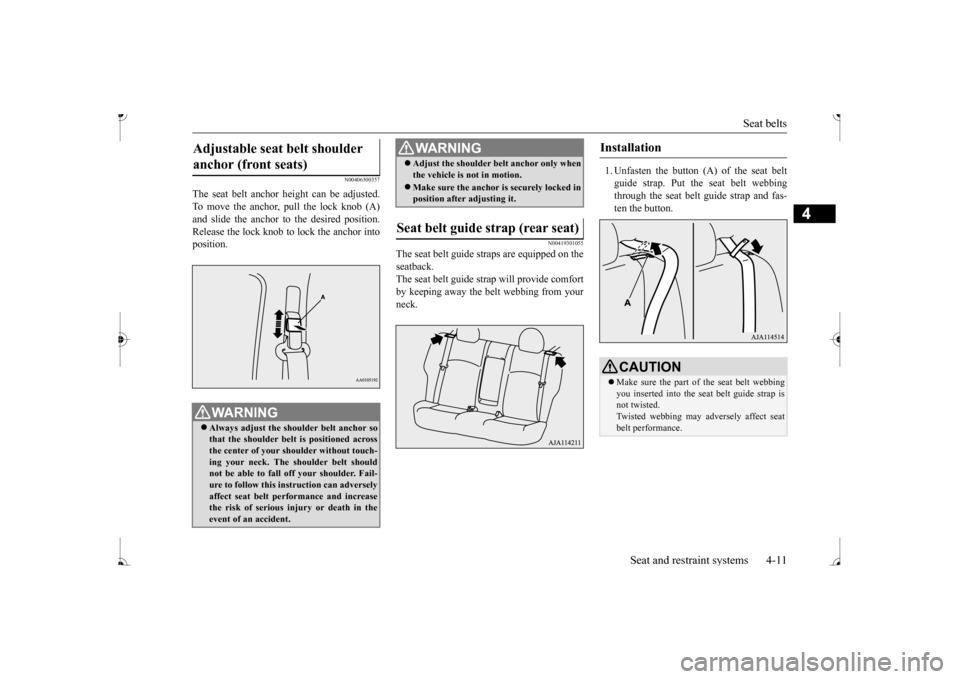
The seat belt anchor height can be adjusted. To move the anchor, pull the lock knob (A)and slide the anchor to the desired position. Release the lock knob to lock the anchor into position.
N00419301055
The seat belt guide st
raps are equipped on the
seatback. The seat belt guide strap will provide comfortby keeping away the belt webbing from your neck.
1. Unfasten the button (A) of the seat belt guide strap. Put the seat belt webbing through the seat belt guide strap and fas- ten the button.
Adjustable seat belt shoulder anchor (front seats)
WA R N I N G Always adjust the shou
lder belt anchor so
that the shoulder belt
is positioned across
the center of your shoulder without touch-ing your neck. The sh
oulder belt should
not be able to fall off your shoulder. Fail- ure to follow this instruction can adverselyaffect seat belt performance and increase the risk of serious in
jury or death in the
event of an accident.
Adjust the shoulder be
lt anchor only when
the vehicle is not in motion. Make sure the anchor is securely locked in position after adjusting it.
Seat belt guide strap (rear seat)
WA R N I N G
Installation
CAUTION Make sure the part of
the seat belt webbing
you inserted into the se
at belt guide strap is
not twisted. Twisted webbing may a
dversely affect seat
belt performance.
BK0236100US.book 11 ページ 2016年2月1日 月曜日 午前10時15分
Page 43 of 307
Child restraint systems 4-18 Seat and restraint systems
4
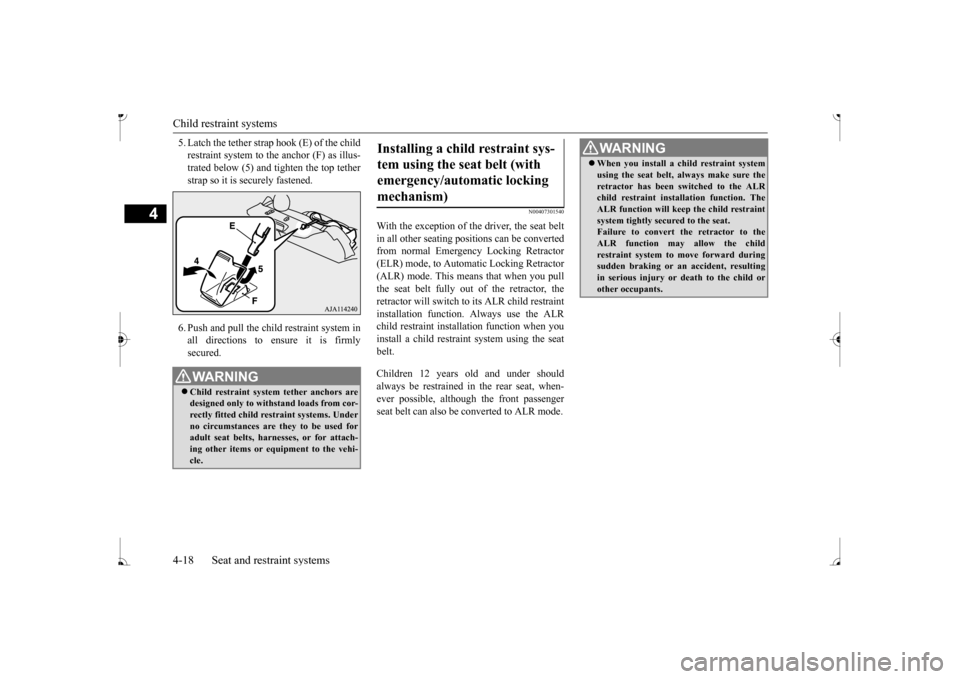
5. Latch the tether strap hook (E) of the child restraint system to the anchor (F) as illus-trated below (5) and tighten the top tether strap so it is securely fastened. 6. Push and pull the child restraint system in all directions to ensure it is firmlysecured.
N00407301540
With the exception of the driver, the seat belt in all other seating pos
itions can be converted
from normal Emergency Locking Retractor(ELR) mode, to Automatic Locking Retractor (ALR) mode. This means that when you pull the seat belt fully out of the retractor, the retractor will switch to its ALR child restraint installation function.
Always use the ALR
child restraint installation function when you install a child restraint system using the seat belt. Children 12 years old and under should always be restrained in the rear seat, when- ever possible, although the front passenger seat belt can also be converted to ALR mode.
WA R N I N G Child restraint system tether anchors are designed only to with
stand loads from cor-
rectly fitted child restraint systems. Underno circumstances are they to be used for adult seat belts, harnesses, or for attach- ing other items or e
quipment to the vehi-
cle.
Installing a child restraint sys- tem using the seat belt (with emergency/automatic locking mechanism)
WA R N I N G When you install a child restraint system using the seat belt, always make sure theretractor has been switched to the ALRchild restraint instal
lation function. The
ALR function will keep the child restraint system tightly secured to the seat.Failure to convert the retractor to the ALR function may allow the child restraint system to move forward duringsudden braking
or an accide
nt, resulting
in serious injury or
death to the child or
other occupants.
BK0236100US.book 18 ページ 2016年2月1日 月曜日 午前10時15分
Page 45 of 307
Child restraint systems 4-20 Seat and restraint systems
4
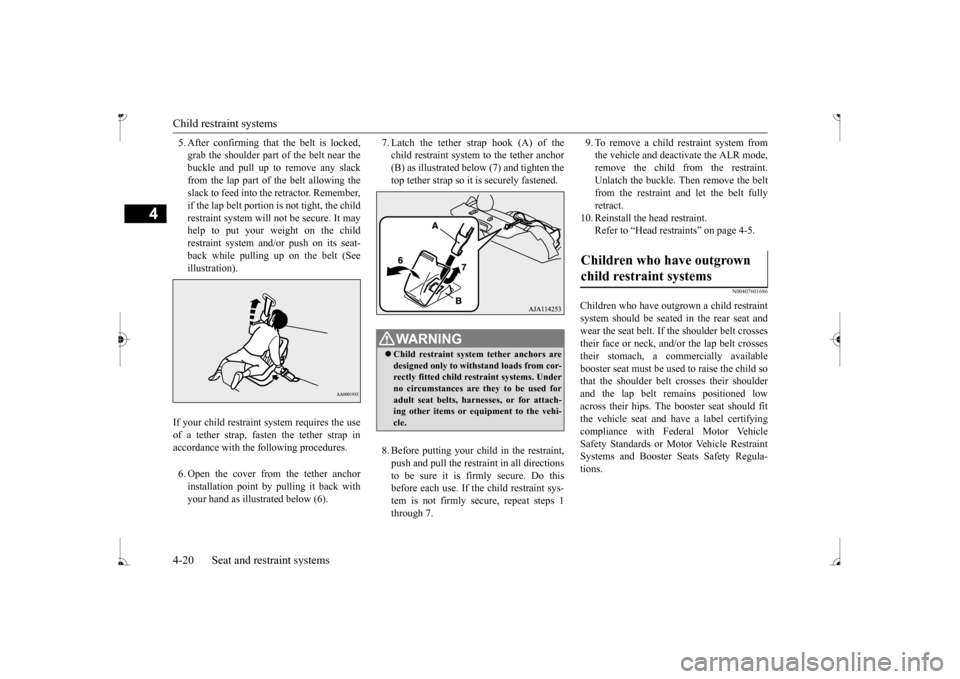
5. After confirming that the belt is locked, grab the shoulder part of the belt near thebuckle and pull up to remove any slack from the lap part of the belt allowing the slack to feed into the retractor. Remember,if the lap belt portion is not tight, the child restraint system will
not be secure. It may
help to put your weight on the childrestraint system and/or push on its seat- back while pulling up on the belt (See illustration). 6. Open the cover from the tether anchor installation point by pulling it back with your hand as illustrated below (6).
7. Latch the tether strap hook (A) of the child restraint system to the tether anchor(B) as illustrated below (7) and tighten the top tether strap so it is securely fastened. 8. Before putting your child in the restraint, push and pull the restraint in all directions to be sure it is firmly secure. Do this before each use. If the child restraint sys-tem is not firmly s
ecure, repeat steps 1
through 7.
9. To remove a child restraint system from the vehicle and deactivate the ALR mode,remove the child from the restraint. Unlatch the buckle. Then remove the belt from the restraint and let the belt fullyretract.
10. Reinstall the head restraint.
Refer to “Head rest
raints” on page 4-5.
N00407601686
Children who have outgrown a child restraint system should be
seated in the rear seat and
wear the seat belt. If the shoulder belt crossestheir face or neck, and/or the lap belt crosses their stomach, a commercially available booster seat must be used
to raise the child so
that the shoulder belt
crosses their shoulder
and the lap belt re
mains positioned low
across their hips. The
booster seat should fit
the vehicle seat and ha
ve a label certifying
compliance with Federal Motor Vehicle Safety Standards or Motor Vehicle RestraintSystems and Booster Se
ats Safety Regula-
tions.
If your child restraint system requires the use of a tether strap, fasten the tether strap in accordance with the following procedures.
WA R N I N G Child restraint system tether anchors are designed only to with
stand loads from cor-
rectly fitted child restraint systems. Underno circumstances are they to be used for adult seat belts, harnesses, or for attach- ing other items or eq
uipment to the vehi-
cle.
Children who have outgrown child restraint systems
BK0236100US.book 20 ページ 2016年2月1日 月曜日 午前10時15分
Page 46 of 307
Maintenance and inspection of seat belts
Seat and restraint systems 4-21
4
N00407000364
The seat belt webbing
may be cleaned with
mild soap or detergent solution. Do not use an organic solvent. Allow the belts to dry in theshade. Do not allow them to retract until com- pletely dry. Do not attempt to bleach or re- dye the belts. The color may rub off and thewebbing strength may be affected.
Regularly check your seat belt buckles and their release mechanisms for positive engage-ment and release of the latch plate. Check the retractors for automatic locking when in the Automatic Locking Retractor function. The entire seat belt assembly should be replaced if the webbing shows any obvious cuts, tears, increase in thickness in any sec- tion of the webbing from broken fibers, orsevere fading from sunl
ight. All of these con-
ditions indicate a we
akening of the belt,
which may adversely affect seat belt perfor- mance in an accident.
N00407701850
This vehicle is equippe
d with a Supplemental
Restraint System (SRS), which includes air- bags for the driver and passengers.
The SRS front airbags are designed to supple- ment the primary protection of the driver andfront passenger seat
belt systems by provid-
ing those occupants wi
th protection against
head and chest injuries
in certain moderate to
severe frontal collisions. The SRS front air- bags, together with sens
ors at the front of the
vehicle and sensors attached to the frontseats, form an advanced airbag system. The SRS driver’s knee airbag is designed to supplement the primar
y protection of the
driver’s seat belt system. It can reduce the forward movement of the driver’s lower legs and provide increased
overall body protection
in certain moderate to
severe frontal colli-
sions. The SRS side airbags and the curtain airbags are also designed to supplement the seat belts.The SRS side airbags provide the driver and front passenger with protection against chest injuries by deploying the bag on the sideimpacted in moderate
to severe side impact
collisions. The SRS curtain airbags provide the driver and passengers on the front seatand rear outboard seat
with protection against
head injuries by deploying the curtain airbag on the side impacted
in moderate to severe
side impact collisions
and by deploying both
curtain airbags when a rollover is detected. The curtain airbags are also designed to helpreduce the risk of comp
lete and partial ejec-
WA R N I N GAny child who is t
oo small to properly
wear a seat belt must be properlyrestrained in an appropriate childrestraint system, to reduce their risk of serious injury or de
ath in an accident.
A child should never be left unattended in, or unsupervised around, your vehicle. When you leave the ve
hicle, always take
the child out as well. Children can die from heat stroke if left or trapped inside the vehicle, especially on hot days. Keep your vehicle locked and the trunk lid closed when not in use. Keep your vehicle keys away from children. Never allow children to play in the trunk of your vehicle.
Maintenance and inspection of seat belts
WA R N I N G Do not attempt to repair or replace any part of the seat belt assemblies. This workshould be done by an authorized Mitsubishi Motors deal
er. Failure to have
an authorized Mitsub
ishi Motors dealer
perform the work could reduce the effec- tiveness of the belts and could result in a serious injury or de
ath in an
accident.
Supplemental Restraint Sys- tem (SRS) - airbag
BK0236100US.book 21 ページ 2016年2月1日 月曜日 午前10時15分
Page 62 of 307
5
Features and controlsBreak-in recommendations ..............................................................5-2 Keys .................................................................................................5-2 Electronic immobilizer (Anti-theft starting system) ........................5-3Keyless entry system (if so equipped) ..............................................5-6 Free-hand Advanced Security
Transmitter (F.A.S.T.-key)
(if so equipped) ............................................................................5-9Door locks ......................................................................................5-24 Power door locks ......
...........
...........
...........
...........
...........
.........
.....5-25
Child safety locks for rear door ..........
...........
.........
.........
.........
.....5-26
Trunk lid ................
............
...........
...........
...........
...........
...........
.....5-27
Inside emergency trunk lid release ................................................5-28 Manual window control (if so equipped)........................................5-29Power window control ...................................................................5-29 Parking brake .................................................................................5-32 Steering wheel height adjustment ..................................................5-33Inside rearview mirror ...................................................................5-34 Outside rearview mirrors ...............................................................5-36 Ignition switch ...............................................................................5-37Starting the engine .........................................................................5-38 Manual transaxle (if so equipped) ..................................................5-40 Continuously variable transmission
(CVT) (if so equipped)..........5-42
Service brake .................................................................................5-46 Hill start assist ................................................................................5-47 Brake assist system ........................................................................5-49Anti-lock braking system ...............................................................5-49 Electric power steering system (EPS) ............................................5-51 Active stability control (ASC) .......................................................5-52Cruise control (if so equipped) .......................................................5-54
Tire pressure monitoring system (if so equipped) .......................... 5-58 Rear-view camera (if so equipped)................................................. 5-62 Instrument cluster .......................................................................... 5-64Multi-information display ............................................................. 5-65 Indicator and warning light package ............................................. 5-75 Indicators ....................................................................................... 5-76Warning lights ................................................................................ 5-76 Combination headlights and dimmer switch ................................. 5-79 Turn signal lever ............................................................................ 5-81Hazard warning flasher switch ...................................................... 5-82 Front fog light switch (if so equipped) .......................................... 5-82 Wiper and washer switch ............................................................... 5-82Electric rear window defogger switch ....
...........
...........
...........
...... 5-84
Horn switch ................................................................................... 5-85 Link System (if so equipped) ......................................................... 5-85 Bluetooth
® 2.0 interface (if so equipped)....................................... 5-85
USB input terminal (if so
equipped) ....
...........
.........
........
........... 5-105
Sun visors .................................................................................... 5-10912 V power outlets ....................................................................... 5-110 HomeLink
® Wireless Control System (if so equipped) ............... 5-110
Interior lights ............................................................................... 5-115Storage spaces .............................................................................. 5-116 Cup holders .................................................................................. 5-117 Bottle holders ............................................................................... 5-118Convenience hook ............
...........
...........
...........
...........
...........
.... 5-118
Assist grips .................................................................................. 5-119
BK0236100US.book 1 ページ 2016年2月1日 月曜日 午前10時15分
Page 63 of 307
Break-in recommendations 5-2 Features and controls
5
N00508701382
Advanced automobile manufacturing tech- niques permit you to operate your new vehi- cle without requiring
a long break-in period
of low-speed driving. However, you can add to the future perfor- mance and economy of your vehicle byobserving the followi
ng precautions during
the first 300 miles (500 km). Drive your vehicle at moderate speeds during the break-in period. Avoid revving the engine. Avoid rough driving such as sudden starts, sudden acceleration, prolonged high- speed driving and sudden braking. These would have a detrimen
tal effect on the
engine and also cause increased fuel and oil consumption, wh
ich could result in
malfunction of the engine components. Beparticularly careful to
avoid full accelera-
tion while in low shift position (low gears). Do not overload the ve
hicle. Stay within
the seating capacity. (Refer to “Cargo load precautions” on page 6-10.) Do not use this vehi
cle for trailer towing.
N00508801703
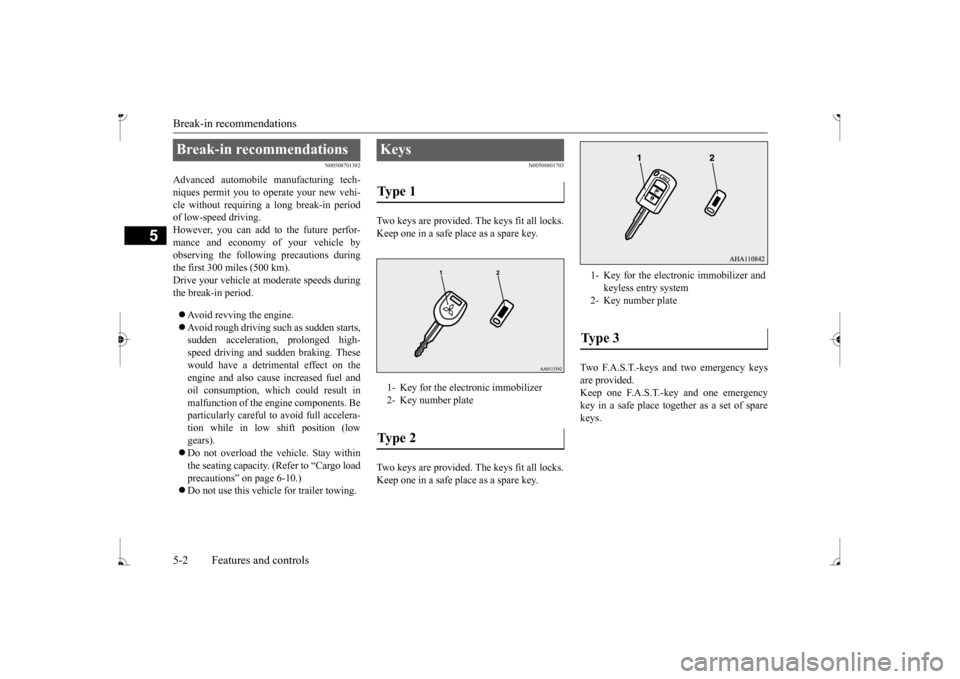
Two keys are provided. The keys fit all locks. Keep one in a safe place as a spare key. Two keys are provided. The keys fit all locks. Keep one in a safe place as a spare key.
Two F.A.S.T.-keys and two emergency keys are provided. Keep one F.A.S.T.-key and one emergency key in a safe place together as a set of sparekeys.
Break-in recommendations
Keys Type 1 1- Key for the electronic immobilizer2- Key number plateType 2
1- Key for the electr
onic immobi
lizer and
keyless entry system
2- Key number plateTy p e 3
BK0236100US.book 2 ページ 2016年2月1日 月曜日 午前10時15分
Page 64 of 307
![MITSUBISHI MIRAGE 2017 6.G User Guide Electronic immobilizer (Ant
i-theft starting system)
Features and controls 5-3
5
N00509100780
[For vehicles equipped with the Free-hand Advanced Security Transmitter (F.A.S.T.-key)] For information o](/img/19/7512/w960_7512-63.png "MITSUBISHI MIRAGE 2017 6.G User Guide Electronic immobilizer (Ant
i-theft starting system)
Features and controls 5-3
5
N00509100780
[For vehicles equipped with the Free-hand Advanced Security Transmitter (F.A.S.T.-key)] For information o")
Electronic immobilizer (Ant
i-theft starting system)
Features and controls 5-3
5
N00509100780
[For vehicles equipped with the Free-hand Advanced Security Transmitter (F.A.S.T.-key)] For information on operations for vehicles equipped with the Free-hand Advanced Secu-rity Transmitter (F.A
.S.T.-key), refer to
“Free-hand Advanced
Security Transmitter
(F.A.S.T.-key): Electr
onic immobilizer (Anti-
theft starting system)” on page 5-19. [Except for vehicles e
quipped with the Free-
hand Advanced Secu
rity Transmitter
(F.A.S.T.-key)]The electronic immobilizer is designed to sig- nificantly reduce the
possibility of vehicle
theft. The purpose of the system is to immo-bilize the vehicle if an invalid start is
1- F.A.S.T.-key
(with electronic immobilizer and key-less entry system function)
2- Emergency key 3- Key number plate
NOTE
The keyless entry key and F.A.S.T.-key are a precision electr
onic device wi
th a built-in
signal transmitter. Please observe the follow- ing in order to prevent damage. • Do not leave where it may be exposed to heat caused by direct sunlight, such as on top of the dashboard. • Do not take the remote
control transmitter
apart. • Do not excessively bend the key or subject it to strong impacts. • Keep the remote control transmitter dry. • Keep away from magne
tic objects such as
key rings.
• Keep away from devi
ces that produce mag-
netism, such as audio systems, computersand televisions. • Keep away from device
s that emit strong
electromagnetic waves, such as cellularphones, wireless devices and high fre- quency equipment (i
ncluding medical
devices). • Do not clean with ultrasonic cleaners. • Do not leave the key where it may be exposed to high temperature or high humid- ity.
If you lose your key, to prevent the theft of the vehicle immediatel
y contact an autho-
rized Mitsubishi Motors dealer. If you notify an authorized Mitsubishi Motors dealer of the key number, they canmake a new key. The key number is stamped on the key number plate. Keep the key num- ber plate in a safe pl
ace separate from the
key itself. No keys other than those registered in advance can be used to start the engine. Refer to “Electronic immobilizer (Anti-theft starting system)” on page 5-3.Refer to “Free-hand Advanced Security Transmitter (F.A.S.T.-key): “Electronic immobilizer (Anti-thef
t starting system)” on
page 5-19.NOTE
When the theft-alarm is in the system opera- tional status, the alar
m operates if a door is
opened after using th
e key, the door lock
knob or the power door lock switch to unlock the vehicle. The system does not enter the preparation status if the keyless entry system or the F.A.S.T.-key was not used to lock the vehi-cle.
Electronic immobilizer (Anti-theft starting system)
NOTE
BK0236100US.book 3 ページ 2016年2月1日 月曜日 午前10時15分
Page 67 of 307

Keyless entry system (if so equipped) 5-6 Features and controls
5
N00562300097
Your electronic imm
obilizer operates on a
radio frequency subject
to Federal Communi-
cations Commission (FCC) Rules (For vehi-cles sold in U.S.A.) and Industry Canada Rules (For vehicles so
ld in Canada). This
device complies with part 15 of FCC Rulesand Industry Canada licence-exempt RSS standard(s). Operation is subject to the following two con- ditions. This device may not
cause harmful inter-
ference. This device must ac
cept any interference
received, including interference that may cause undesired operation of this device.
N00509002015
Press the remote control transmitter buttonsto lock or unlock the doors.It can also help you
signal for attention by
setting off the panic alarm. Press the LOCK button (1) to lock all the doors. The turn signal lights
will also blink once.
Press the UNLOCK button (2) to unlock the driver’s door only.Within about 2 seconds, press the UNLOCK button one more time to unlock all the doors. The dome light will turn on for 30 seconds.The turn signal lights will also blink twice. The horn of the keyless entry system answer- back function can be changed as required. This is done with the key removed from the ignition switch. The answerback function can be set in the following three ways.
General information
WA R N I N G Changes or modifications not expressly approved by the part
y responsible for
compliance could void
the user’s authority
to operate the equipment.
Keyless entry system
(if so
equipped)1-
LOCK ( ) button
2-
UNLOCK ( ) button
3- PANIC button 4- Indicator lightTo l o c k
NOTE
If you press the LOCK button (1) twice the horn will sound once.
To u n l o c k
Answerback function
NOTE
The answerback functi
on will not operate if
any of the doors are open.
Horn deactivation/reactivation
BK0236100US.book 6 ページ 2016年2月1日 月曜日 午前10時15分