weight MITSUBISHI MIRAGE 2017 6.G User Guide
[x] Cancel search | Manufacturer: MITSUBISHI, Model Year: 2017, Model line: MIRAGE, Model: MITSUBISHI MIRAGE 2017 6.GPages: 307, PDF Size: 9.02 MB
Page 260 of 307
View of the engine compartment
Vehicle care and maintenance 9-5
9
Unlatch the prop from the engine hood and put it back in its retainer. Slowly lower the engi
ne hood approximately
8 inches (20 cm), then let it drop from its own weight.
N00937601781
N00937702011
It is normal for an engi
ne to use oil. You may
need to add oil betwee
n the recommended oil
change intervals. Before starting the engine,check the engine oil level. Refill if necessary. To check the oil level, remove the dipstick, wipe it off, and gently
reinsert it all the way.
Slowly pull the dipsti
ck straight out and
check the oil level by checking the upper sur- face of the dipstick. Th
e oil level must not go
above the line on the dipstick. If the level does not reach the line which shows the minimum amo
unt of oil required,
remove the oil filler cap on the engine valve cover, and fill to within the “Good” range.
To close
CAUTION Be careful not to trap your hands or fingers when closing the engine hood. Make sure the engine hood is firmly closed before driving.If you drive without the engine hood com- pletely closed, it c
ould open up while driv-
ing.
NOTE
If this does not clos
e the engine hood prop-
erly, drop it again from a slightly higherposition. Do not push down strongly on the engine hood. Depending on how strongly or whereyou push down, you could create a dent in the vehicle body.
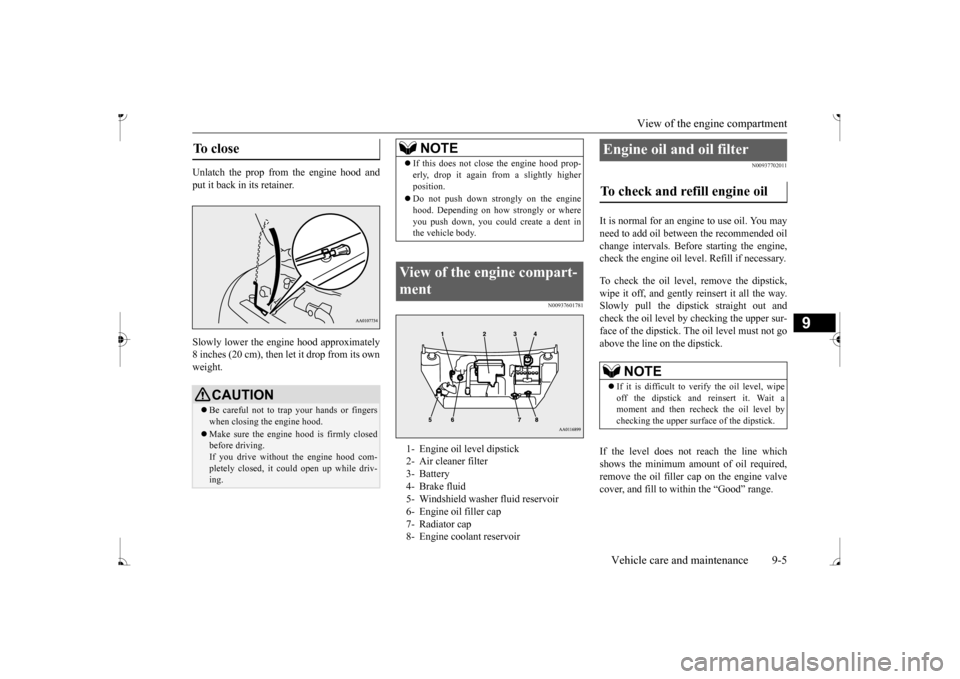
View of the engine compart- ment 1- Engine oil level dipstick 2- Air cleaner filter 3- Battery 4- Brake fluid5- Windshield washer fluid reservoir 6- Engine oil filler cap 7- Radiator cap8- Engine cool
ant reservoir
Engine oil and oil filter To check and refill engine oil
NOTE
If it is difficult to verify the oil level, wipe off the dipstick and
reinsert it. Wait a
moment and then recheck the oil level by checking the upper surfa
ce of the dipstick.
BK0236100US.book 5 ページ 2016年2月1日 月曜日 午前10時15分
Page 267 of 307
Tires 9-12 Vehicle care and maintenance
9
N00939201635
It is important to fami
liarize yourself with the
following terms:
Cold tire pressure: • The measured pressure after the vehiclehas been parked for
at least three hours,
or • The measured pressure when the vehicleis driven less than 1 mile (1.6 km) after having been parked for three hours.
Maximum pressure: the maximum per- missible cold tire inflation pressure for this tire. Recommended inflation pressure: the inflation pressure for optimum tire perfor- mance. Intended outboard sidewall: • The sidewall that
contains a whitewall,
bears white lettering or bears manufac-turer, brand, and/or model name molding that is higher or deeper than the same molding on the other sidewall of the tire,or • The outward facing sidewall of an asym- metrical tire that has a particular sidethat must always face outward when mounted on a vehicle.
Passenger car tire: a tire intended for use on passenger cars,
multipurpose passen-
ger vehicles, and trucks
that have a gross
vehicle weight rating (GVWR) of 10,000pounds or less.
• If electrolyte gets on plastic parts or other nearby parts, wipe it off with a softcloth or chamois soak
ed in a solution of
water and neutral detergent then imme- diately rinse the affected parts with plenty of water.• If electrolyte gets on your hands orclothes, rinse thoroughly with water. Ifelectrolyte gets in
your eyes, flush them
with water immediately and get immedi- ate medical attention.
Open doors and wind
ows in any closed
space where you may be charging orworking with the battery. Always wear protective clothing and gog- gles when working with the battery, or have a skilled automobi
le technician do it.
If you are quick-charging your battery, first disconnect the battery cables. In order to prevent a
short-circuit, be sure
to disconnect the negative (-) terminal first, and reconnect it last. Battery posts, terminals and related acces- sories contain lead
and lead compounds.
Wash hands after handling.NOTE
Check each battery terminal for corrosion. You can stop more corrosion by washingwith a solution of baking soda and water. Grease the posts and cl
amps after cleaning or
tightening them.WA R N I N G
Check to see that the battery is securely installed and cannot be
moved. Also check
each terminal for tightness. If you will not be driv
ing your vehicle for a
long period of time, re
move the battery and
store it in a place where the battery fluid will not freeze. The batter
y only should be stored
with a full charge. Before cleaning the ba
ttery, tighten all the
filler port caps to keep
dirt and moisture out.
Tires
WA R N I N GDriving with tires that are worn, damaged or improperly infl
ated is dangerous.
These type tire conditions will adverselyaffect vehicle performance. These type tire conditions can also cause a tread separation or blowout which mayresult in an accident causing serious injury or death. Tires, including spar
e tire, degrade over
time with age even when they are not being used. It is recommended that tires over 6 yearsgenerally be replaced
even if damage is
not obvious.NOTE
BK0236100US.book 12 ページ 2016年2月1日 月曜日 午前10時15分
Page 268 of 307
Tires
Vehicle care and maintenance 9-13
9
Light truck (LT) tire: a tire designated by its manufacturer as primarily intended foruse on lightweight truc
ks or multipurpose
passenger vehicles. Tread: portion of a tire that comes into contact with the road. Tread rib: a tread se
ction running circum-
ferentially around a tire. Tread separation: pulling away of the tread from the tire carcass. Carcass: the tire structure, except tread and sidewall rubber which, when inflated, bears the load. Sidewall: portion of
a tire between the
tread and bead. Section width: the lin
ear distance between
the exteriors of th
e sidewalls of an
inflated tire, excludi
ng elevations due to
labeling, decoration,
or protective bands.
Bead: the part of the tire that is made of steel wires, wrapped or reinforced by ply cords and that is shaped to fit the rim. Ply: a layer of rubber-coated parallel cords. Cord: the strands forming the plies in the tire. Rim: a metal support for a tire or a tire and tube assembly upon which the tirebeads are seated. Rim diameter: nominal diameter of the bead seat.
Groove: the space between two adjacent tread ribs.
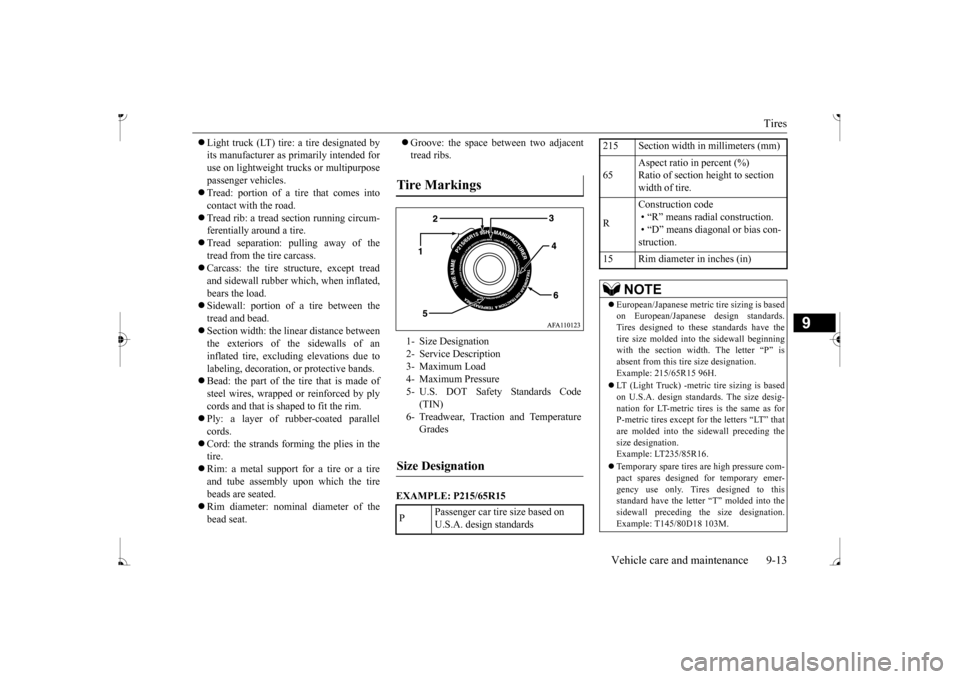
EXAMPLE: P215/65R15Tire Markings 1- Size Designation 2- Service Description 3- Maximum Load 4- Maximum Pressure 5- U.S. DOT Safety Standards Code
(TIN)
6- Treadwear, Traction and Temperature
Grades
Size Designation P
Passenger car tire
size based on
U.S.A. design standards
215 Section width in millimeters (mm) 65
Aspect ratio in percent (%) Ratio of section height to section width of tire.
R
Construction code • “R” means radial construction. • “D” means diagon
al or bias con-
struction.
15 Rim diameter in inches (in)
NOTE
European/Japanese metric tire sizing is based on European/Japanese design standards. Tires designed to these standards have the tire size molded into the sidewall beginningwith the section width. The letter “P” is absent from this tire size designation. Example: 215/65R15 96H. LT (Light Truck) -metri
c tire sizing is based
on U.S.A. design standards. The size desig-nation for LT-metric tires is the same as for P-metric tires except for the letters “LT” that are molded into the sidewall preceding thesize designation. Example: LT235/85R16. Temporary spare tires are high pressure com- pact spares designed
for temporary emer-
gency use only. Tires designed to thisstandard have the letter “T” molded into the sidewall preceding th
e size designation.
Example: T145/80D18 103M.
BK0236100US.book 13 ページ 2016年2月1日 月曜日 午前10時15分
Page 271 of 307
Tires 9-16 Vehicle care and maintenance
9
specified cold pressure, or your tires will be too low.Check your tires each time you refuel. If one tire looks lower than the others, check the pressure for all of them.You should also take the following safety pre- cautions: Keep your tires inflated to the recom- mended pressures. (See the tire and load-ing information placard attached to the driver’s door sill.) Stay within the recommended load limits. Make sure that the weight of any load in your vehicle is evenly distributed. Drive at safe speeds. After filling your tires to the correct pres- sure, check them for damage and airleaks. Be sure to reinstall the caps on the valve stems.
N00939601453
N00939701193
The following maintenance steps are recom- mended: Check tire pressures regularly. Have regular maintenance done on the wheel balance and front and rear suspen-sion alignment. Rotate your tires regul
arly as described in
the “Tire rotation” section on page 9-17.
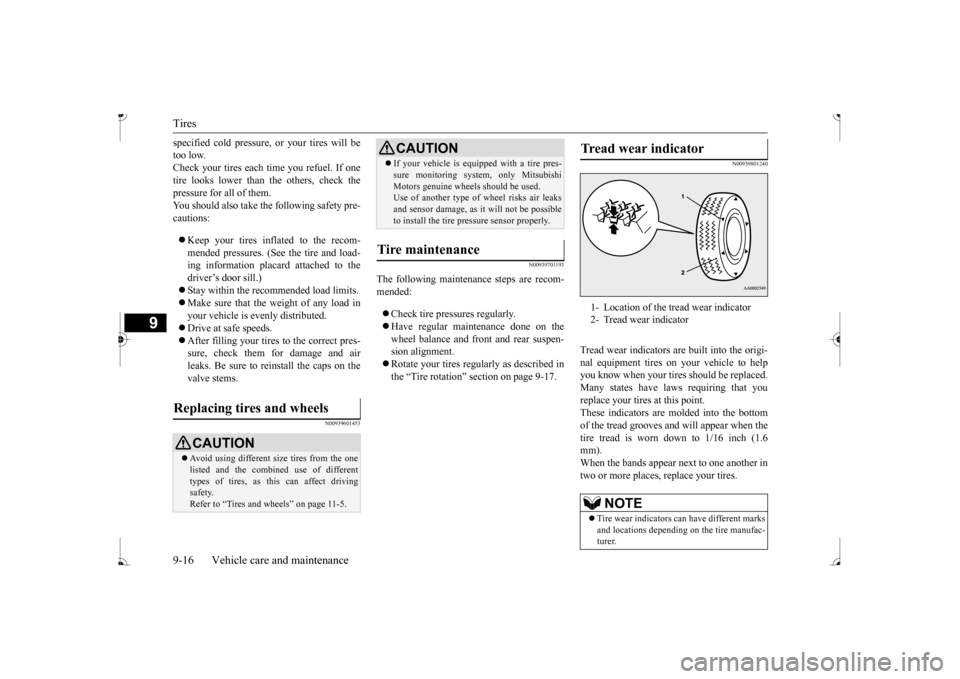
N00939801240
Tread wear indicators are built into the origi-nal equipment tires on your vehicle to helpyou know when your tires should be replaced. Many states have la
ws requiring that you
replace your tires at this point.These indicators are molded into the bottom of the tread grooves and will appear when the tire tread is worn down to 1/16 inch (1.6mm). When the bands appear next to one another in two or more places
, replace your tires.
Replacing tires and wheels
CAUTIONAvoid using different size tires from the one listed and the combined use of different types of tires, as this can affect driving safety.Refer to “Tires and wheels” on page 11-5.
If your vehicle is equipped with a tire pres- sure monitoring system, only MitsubishiMotors genuine wheels should be used.Use of another type of wheel risks air leaks and sensor damage, as it
will not be possible
to install the tire pressure sensor properly.
Tire maintenance
CAUTION
Tread wear indicator 1- Location of the tread wear indicator 2- Tread wear indicator
NOTE
Tire wear indicators ca
n have different marks
and locations depending
on the tire manufac-
turer.
BK0236100US.book 16 ページ 2016年2月1日 月曜日 午前10時15分
Page 296 of 307
11
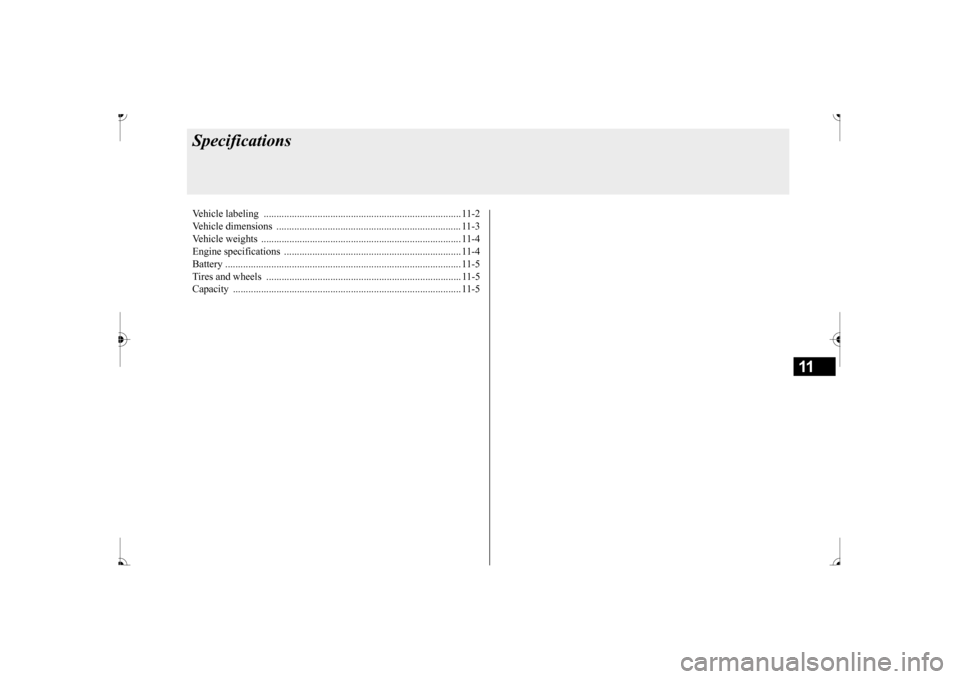
SpecificationsVehicle labeling ............................................................................. 11-2 Vehicle dimensions ........................................................................ 11-3 Vehicle weights .............................................................................. 11-4Engine specifications ..................................................................... 11-4 Battery ............................................................................................ 11-5 Tires and wheels ............................................................................ 11-5Capacity ......................................................................................... 11-5
BK0236100US.book 1 ページ 2016年2月1日 月曜日 午前10時15分
Page 299 of 307
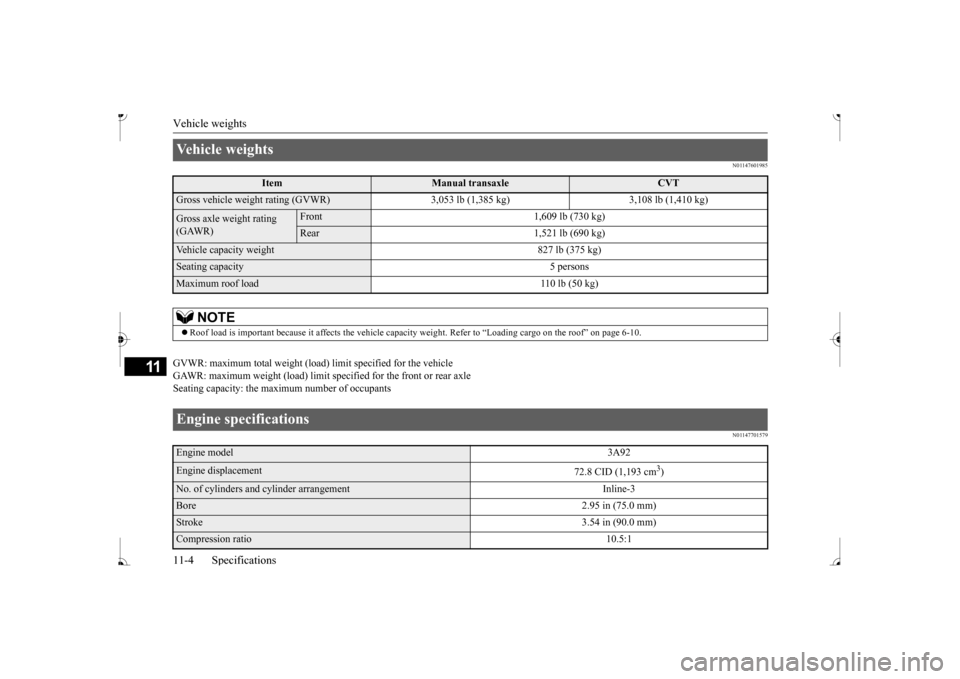
Vehicle weights 11-4 Specifications
11
N01147601985
GVWR: maximum total weight (load) limit specified for the vehicle GAWR: maximum weight (load) limit sp
ecified for the front or rear axle
Seating capacity: the maxi
mum number of occupants
N01147701579
Ve h i c l e w e i g h t s
Item
Manual transaxle
CVT
Gross vehicle weight ra
ting (GVWR) 3,053 lb (1,385 kg) 3,108 lb (1,410 kg)
Gross axle weight rating (GAWR)
Front 1,609 lb (730 kg)
Seating capacity 5 personsMaximum roof load 110 lb (50 kg)
NOTE
Roof load is important because it affe
cts the vehicle capacity weight. Refer to
“Loading cargo on the roof” on page 6-10.
Engine specifications Engine model
3A92
Engine displacement
72.8 CID (1,193 cm
3)
No. of cylinders and cy
linder arrangement Inline-3
Bore
2.95 in (75.0 mm)
Stroke
3.54 in (90.0 mm)
Compression ratio
10.5:1
BK0236100US.book 4 ページ 2016年2月1日 月曜日 午前10時15分
Page 306 of 307

Alphabetical index
12-5
12
Quality grading
...............................
10-2
Replacing tires and wheels
...............
9-16
Rotation
.........................................
9-17
Size (tire and wheel)
.......................
11-5
Snow tires
......................................
9-18
Tire and loading information placard 11-3 Tire chains
.....................................
9-18
To change a tire
................................
8-6
Tread wear indicator
.......................
9-16
Tools
...................................................
8-5
Storage
............................................
8-5
Towing
..............................................
8-12
Trailer towing
.....................................
6-11
Trunk lid
............................................
5-27
Turn signal light
Indicators
.......................................
5-76
Lever
.............................................
5-81
U
USB input terminal
...........................
5-105
How to connect a USB memory device
....
5-106 How to connect an iPod
.................
5-107
V
Vanity mirror
...................................
5-109
Vehicle care precautions
......................
9-32
Vehicle dimensions
.............................
11-3
Vehicle labeling
..................................
11-2
Vehicle preparation before driving
.........
6-3
Vehicle weights
..................................
11-4
Vents
..................................................
7-2
W
Warning lights
...................................
5-76
Washer
Fluid
.......................................
9-9
, 11-5
Switch
...................................
5-82
, 5-83
Washing
............................................
9-33
Waxing
.............................................
9-34
Weights
.............................................
11-4
Wheel
Covers
...........................................
8-11
Specification
..................................
11-5
Wiper
Switch
...........................................
5-82
Wiper blades
..................................
9-19
BK0236100US.book 5 ページ 2016年2月1日 月曜日 午前10時15分