wheel size MITSUBISHI MIRAGE 2017 6.G User Guide
[x] Cancel search | Manufacturer: MITSUBISHI, Model Year: 2017, Model line: MIRAGE, Model: MITSUBISHI MIRAGE 2017 6.GPages: 307, PDF Size: 9.02 MB
Page 270 of 307
Tires
Vehicle care and maintenance 9-15
9
The traction grades, from highest to lowest, are AA, A, B and C. Those grades representthe tire’s ability to
stop on wet pavement as
measured under controlled conditions on specified government te
st surfaces of asphalt
and concrete. A tire marked C may have poor traction performance. The temperature grades are A (the highest), B and C, representing the ti
re’s resistance to the
generation of heat and it
s ability to dissipate
heat when tested un
der controlled conditions
on a specified indoor
laboratory test wheel.
Sustained high temperature can cause the material of the tire to
degenerate and reduce
tire life, and excessive temperature can lead to sudden tire failure. The grade C corre- sponds to a level of
performance which all
passenger car tires must
meet under the Fed-
eral Motor Vehicle Safety Standard No. 109. Grades B and A represent higher levels ofperformance on the laboratory test wheel than the minimum required by law.
N00939301984
Proper tire inflation pre
ssure is essential for
the safe and satisfac
tory operation of your
vehicle. The wrong tire pressure will cause problems in three major areas: Safety Too little pressure increases flexing in the tire and can cause tire failure. Too much pressure can cause a tire to lose its abilityto cushion shock. Objects on the road and potholes could then cause tire damage that may result in tire failure. Economy The wrong tire pressure can cause uneven wear patterns in the tire tread. These abnormal wear patterns will reduce the tread life, and the tire will have to bereplaced sooner. Too little pressure also
makes it harder for
the tire to roll, and this uses up more fuel. Ride comfort and vehicle stability The superior riding ex
perience built into
your vehicle partly depends on the correcttire pressure. Too much pressure gives an uncomfortable and ja
rring ride. Too little
pressure feels as if
your vehicle is slow to
respond. Unequal tire pressure
s can make steering
your vehicle uneven
and unpredictable.
The tire pressure for your vehicle under nor- mal driving conditions is listed on the placard attached to the driver’s door sill. (Refer to “Tire and loading information plac-ard” on page 11-3.)
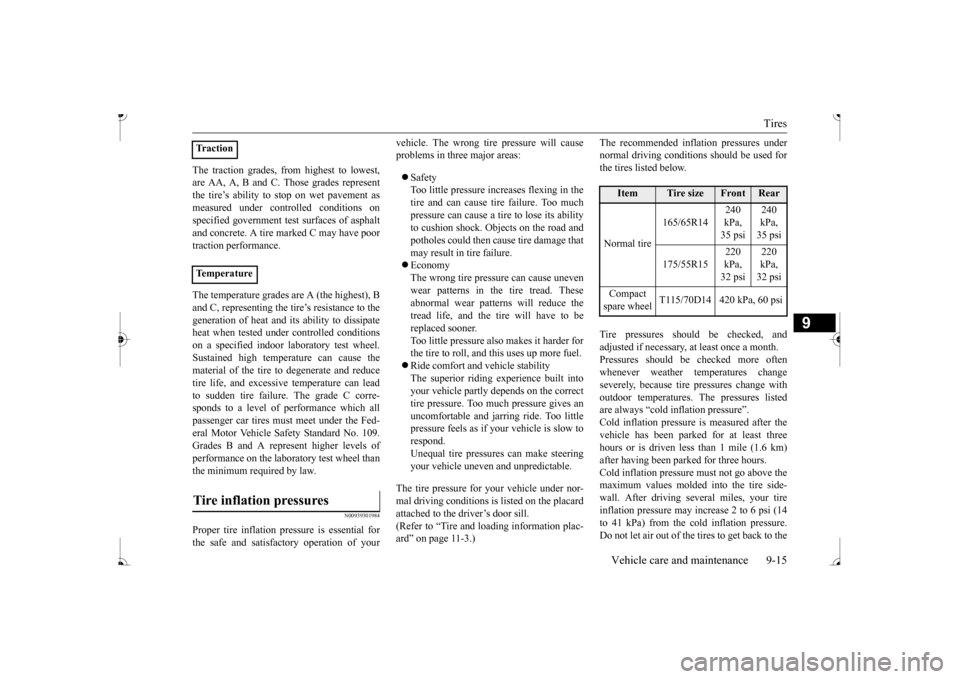
The recommended infl
ation pressures under
normal driving conditions should be used forthe tires listed below. Tire pressures should be checked, and adjusted if necessary,
at least once a month.
Pressures should be checked more often whenever weather temperatures changeseverely, becaus
e tire pressures change with
outdoor temperatures. The pressures listed are always “cold inflation pressure”.Cold inflation pressure is measured after the vehicle has been parked
for at least three
hours or is driven less than 1 mile (1.6 km)after having been parked for three hours. Cold inflation pressure
must not go above the
maximum values molded into the tire side-wall. After driving se
veral miles, your tire
inflation pressure may increase 2 to 6 psi (14 to 41 kPa) from the cold inflation pressure.Do not let air out of the tires to get back to the
Traction TemperatureTire inflation pressures
Item
Tire size
Front
Rear
Normal tire
165/65R14
240 kPa, 35 psi
240 kPa, 35 psi
175/55R15
220 kPa, 32 psi
220 kPa, 32 psi
Compact spare wheel
T115/70D14 420 kPa, 60 psi
BK0236100US.book 15 ページ 2016年2月1日 月曜日 午前10時15分
Page 271 of 307
Tires 9-16 Vehicle care and maintenance
9
specified cold pressure, or your tires will be too low.Check your tires each time you refuel. If one tire looks lower than the others, check the pressure for all of them.You should also take the following safety pre- cautions: Keep your tires inflated to the recom- mended pressures. (See the tire and load-ing information placard attached to the driver’s door sill.) Stay within the recommended load limits. Make sure that the weight of any load in your vehicle is evenly distributed. Drive at safe speeds. After filling your tires to the correct pres- sure, check them for damage and airleaks. Be sure to reinstall the caps on the valve stems.
N00939601453
N00939701193
The following maintenance steps are recom- mended: Check tire pressures regularly. Have regular maintenance done on the wheel balance and front and rear suspen-sion alignment. Rotate your tires regul
arly as described in
the “Tire rotation” section on page 9-17.
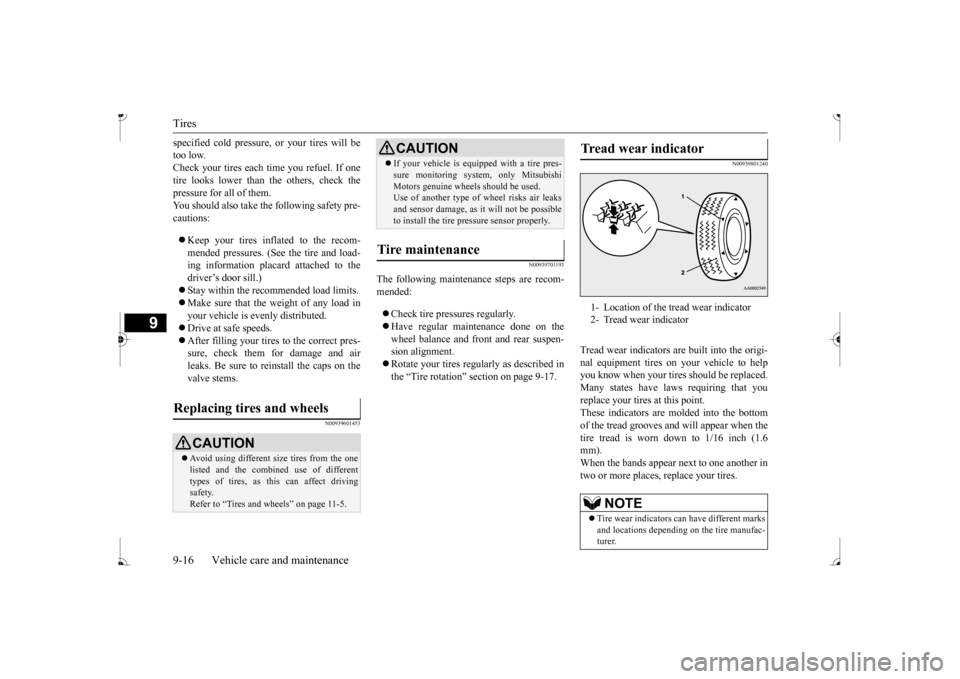
N00939801240
Tread wear indicators are built into the origi-nal equipment tires on your vehicle to helpyou know when your tires should be replaced. Many states have la
ws requiring that you
replace your tires at this point.These indicators are molded into the bottom of the tread grooves and will appear when the tire tread is worn down to 1/16 inch (1.6mm). When the bands appear next to one another in two or more places
, replace your tires.
Replacing tires and wheels
CAUTIONAvoid using different size tires from the one listed and the combined use of different types of tires, as this can affect driving safety.Refer to “Tires and wheels” on page 11-5.
If your vehicle is equipped with a tire pres- sure monitoring system, only MitsubishiMotors genuine wheels should be used.Use of another type of wheel risks air leaks and sensor damage, as it
will not be possible
to install the tire pressure sensor properly.
Tire maintenance
CAUTION
Tread wear indicator 1- Location of the tread wear indicator 2- Tread wear indicator
NOTE
Tire wear indicators ca
n have different marks
and locations depending
on the tire manufac-
turer.
BK0236100US.book 16 ページ 2016年2月1日 月曜日 午前10時15分
Page 273 of 307
Clutch pedal free play (if so equipped) 9-18 Vehicle care and maintenance
9
N00940001428
In some areas of the country, snow tires are required for winter driving. If snow tires are required in your area, you must choose snowtires of the same size
and type as the original
tires provided with your vehicle. Snow tires should also be installe
d on all four wheels.
Otherwise your safety and vehicle handling can be reduced. Even where laws may permit it, snow tires should not be operated
at sustained speeds
over 75 mph (120 km/h).
N00940100116
N00940200090
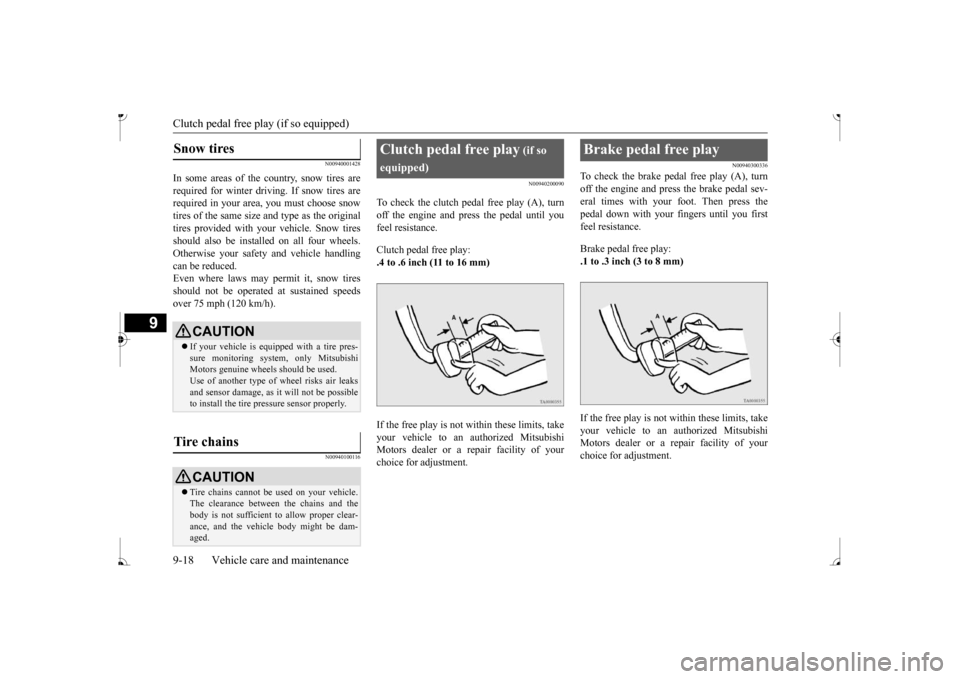
To check the clutch pedal free play (A), turn off the engine and pr
ess the pedal until you
feel resistance. Clutch pedal free play: .4 to .6 inch (11 to 16 mm) If the free play is not within these limits, take your vehicle to an
authorized Mitsubishi
Motors dealer or a repair facility of yourchoice for adjustment.
N00940300336
To check the brake pedal free play (A), turn off the engine and press the brake pedal sev- eral times with your foot. Then press thepedal down with your fingers until you first feel resistance. Brake pedal free play: .1 to .3 inch (3 to 8 mm) If the free play is not within these limits, take your vehicle to an authorized Mitsubishi Motors dealer or a repair facility of yourchoice for adjustment.
Snow tires
CAUTION If your vehicle is equippe
d with a tire pres-
sure monitoring system, only Mitsubishi Motors genuine wheels should be used.Use of another type of
wheel risks air leaks
and sensor damage, as
it will not be possible
to install the tire pressure sensor properly.
Tire chains
CAUTION Tire chains cannot be used on your vehicle. The clearance between
the chains and the
body is not sufficient to allow proper clear- ance, and the vehicle body might be dam- aged.
Clutch pedal free play
(if so
equipped)
Brake pedal free play
BK0236100US.book 18 ページ 2016年2月1日 月曜日 午前10時15分
Page 306 of 307

Alphabetical index
12-5
12
Quality grading
...............................
10-2
Replacing tires and wheels
...............
9-16
Rotation
.........................................
9-17
Size (tire and wheel)
.......................
11-5
Snow tires
......................................
9-18
Tire and loading information placard 11-3 Tire chains
.....................................
9-18
To change a tire
................................
8-6
Tread wear indicator
.......................
9-16
Tools
...................................................
8-5
Storage
............................................
8-5
Towing
..............................................
8-12
Trailer towing
.....................................
6-11
Trunk lid
............................................
5-27
Turn signal light
Indicators
.......................................
5-76
Lever
.............................................
5-81
U
USB input terminal
...........................
5-105
How to connect a USB memory device
....
5-106 How to connect an iPod
.................
5-107
V
Vanity mirror
...................................
5-109
Vehicle care precautions
......................
9-32
Vehicle dimensions
.............................
11-3
Vehicle labeling
..................................
11-2
Vehicle preparation before driving
.........
6-3
Vehicle weights
..................................
11-4
Vents
..................................................
7-2
W
Warning lights
...................................
5-76
Washer
Fluid
.......................................
9-9
, 11-5
Switch
...................................
5-82
, 5-83
Washing
............................................
9-33
Waxing
.............................................
9-34
Weights
.............................................
11-4
Wheel
Covers
...........................................
8-11
Specification
..................................
11-5
Wiper
Switch
...........................................
5-82
Wiper blades
..................................
9-19
BK0236100US.book 5 ページ 2016年2月1日 月曜日 午前10時15分