tires MITSUBISHI MIRAGE 2017 6.G Owner's Manual
[x] Cancel search | Manufacturer: MITSUBISHI, Model Year: 2017, Model line: MIRAGE, Model: MITSUBISHI MIRAGE 2017 6.GPages: 307, PDF Size: 9.02 MB
Page 270 of 307
Tires
Vehicle care and maintenance 9-15
9
The traction grades, from highest to lowest, are AA, A, B and C. Those grades representthe tire’s ability to
stop on wet pavement as
measured under controlled conditions on specified government te
st surfaces of asphalt
and concrete. A tire marked C may have poor traction performance. The temperature grades are A (the highest), B and C, representing the ti
re’s resistance to the
generation of heat and it
s ability to dissipate
heat when tested un
der controlled conditions
on a specified indoor
laboratory test wheel.
Sustained high temperature can cause the material of the tire to
degenerate and reduce
tire life, and excessive temperature can lead to sudden tire failure. The grade C corre- sponds to a level of
performance which all
passenger car tires must
meet under the Fed-
eral Motor Vehicle Safety Standard No. 109. Grades B and A represent higher levels ofperformance on the laboratory test wheel than the minimum required by law.
N00939301984
Proper tire inflation pre
ssure is essential for
the safe and satisfac
tory operation of your
vehicle. The wrong tire pressure will cause problems in three major areas: Safety Too little pressure increases flexing in the tire and can cause tire failure. Too much pressure can cause a tire to lose its abilityto cushion shock. Objects on the road and potholes could then cause tire damage that may result in tire failure. Economy The wrong tire pressure can cause uneven wear patterns in the tire tread. These abnormal wear patterns will reduce the tread life, and the tire will have to bereplaced sooner. Too little pressure also
makes it harder for
the tire to roll, and this uses up more fuel. Ride comfort and vehicle stability The superior riding ex
perience built into
your vehicle partly depends on the correcttire pressure. Too much pressure gives an uncomfortable and ja
rring ride. Too little
pressure feels as if
your vehicle is slow to
respond. Unequal tire pressure
s can make steering
your vehicle uneven
and unpredictable.
The tire pressure for your vehicle under nor- mal driving conditions is listed on the placard attached to the driver’s door sill. (Refer to “Tire and loading information plac-ard” on page 11-3.)
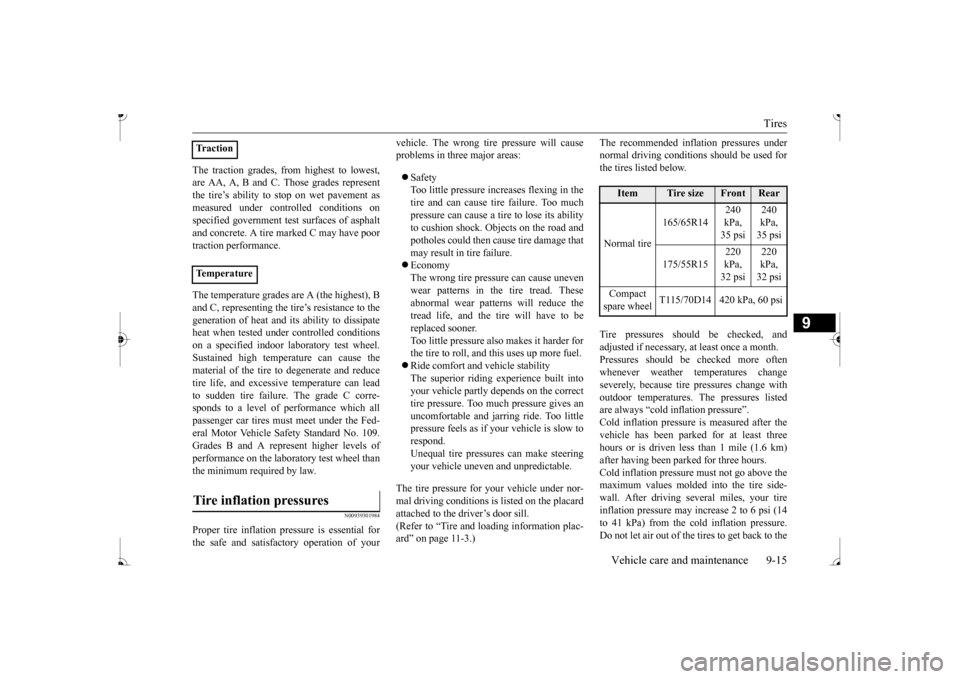
The recommended infl
ation pressures under
normal driving conditions should be used forthe tires listed below. Tire pressures should be checked, and adjusted if necessary,
at least once a month.
Pressures should be checked more often whenever weather temperatures changeseverely, becaus
e tire pressures change with
outdoor temperatures. The pressures listed are always “cold inflation pressure”.Cold inflation pressure is measured after the vehicle has been parked
for at least three
hours or is driven less than 1 mile (1.6 km)after having been parked for three hours. Cold inflation pressure
must not go above the
maximum values molded into the tire side-wall. After driving se
veral miles, your tire
inflation pressure may increase 2 to 6 psi (14 to 41 kPa) from the cold inflation pressure.Do not let air out of the tires to get back to the
Traction TemperatureTire inflation pressures
Item
Tire size
Front
Rear
Normal tire
165/65R14
240 kPa, 35 psi
240 kPa, 35 psi
175/55R15
220 kPa, 32 psi
220 kPa, 32 psi
Compact spare wheel
T115/70D14 420 kPa, 60 psi
BK0236100US.book 15 ページ 2016年2月1日 月曜日 午前10時15分
Page 271 of 307
Tires 9-16 Vehicle care and maintenance
9
specified cold pressure, or your tires will be too low.Check your tires each time you refuel. If one tire looks lower than the others, check the pressure for all of them.You should also take the following safety pre- cautions: Keep your tires inflated to the recom- mended pressures. (See the tire and load-ing information placard attached to the driver’s door sill.) Stay within the recommended load limits. Make sure that the weight of any load in your vehicle is evenly distributed. Drive at safe speeds. After filling your tires to the correct pres- sure, check them for damage and airleaks. Be sure to reinstall the caps on the valve stems.
N00939601453
N00939701193
The following maintenance steps are recom- mended: Check tire pressures regularly. Have regular maintenance done on the wheel balance and front and rear suspen-sion alignment. Rotate your tires regul
arly as described in
the “Tire rotation” section on page 9-17.
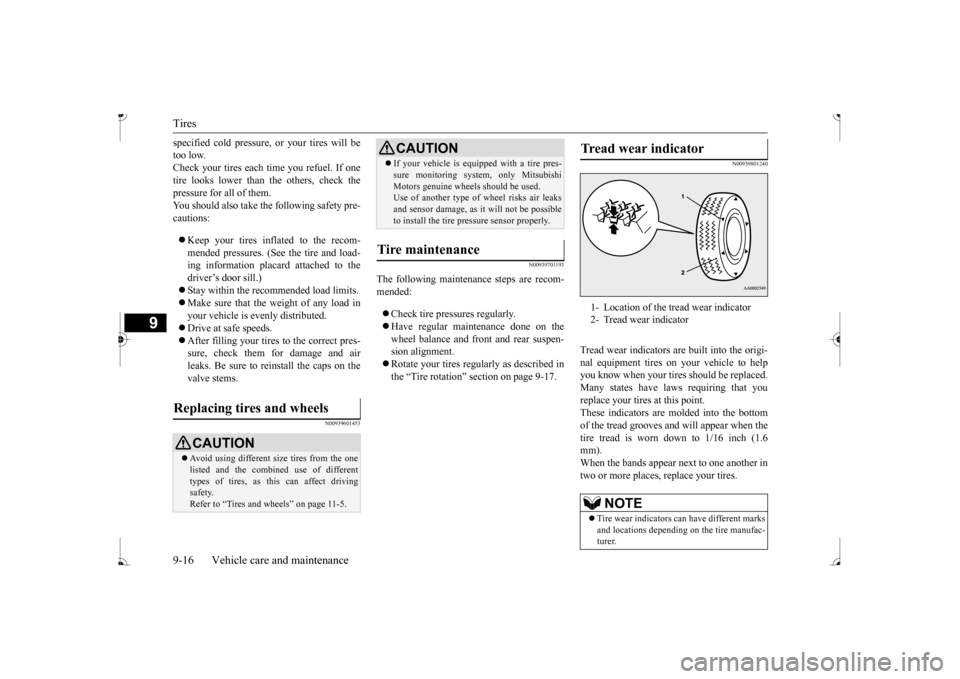
N00939801240
Tread wear indicators are built into the origi-nal equipment tires on your vehicle to helpyou know when your tires should be replaced. Many states have la
ws requiring that you
replace your tires at this point.These indicators are molded into the bottom of the tread grooves and will appear when the tire tread is worn down to 1/16 inch (1.6mm). When the bands appear next to one another in two or more places
, replace your tires.
Replacing tires and wheels
CAUTIONAvoid using different size tires from the one listed and the combined use of different types of tires, as this can affect driving safety.Refer to “Tires and wheels” on page 11-5.
If your vehicle is equipped with a tire pres- sure monitoring system, only MitsubishiMotors genuine wheels should be used.Use of another type of wheel risks air leaks and sensor damage, as it
will not be possible
to install the tire pressure sensor properly.
Tire maintenance
CAUTION
Tread wear indicator 1- Location of the tread wear indicator 2- Tread wear indicator
NOTE
Tire wear indicators ca
n have different marks
and locations depending
on the tire manufac-
turer.
BK0236100US.book 16 ページ 2016年2月1日 月曜日 午前10時15分
Page 272 of 307
Tires
Vehicle care and maintenance 9-17
9
N00939901557
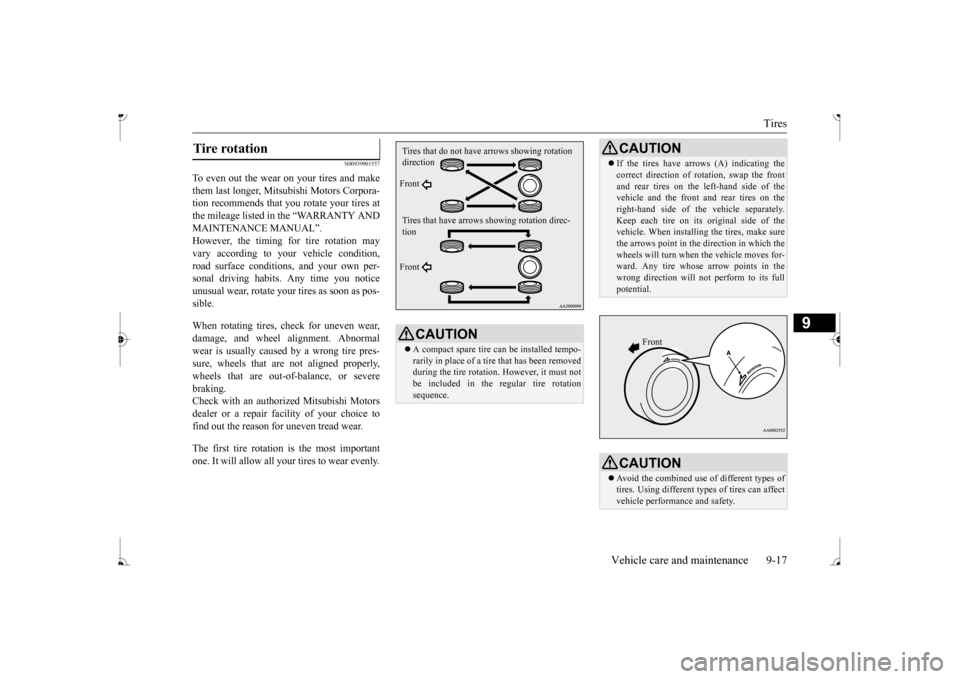
To even out the wear on your tires and make them last longer, Mitsubishi Motors Corpora- tion recommends that you rotate your tires atthe mileage listed in the “WARRANTY AND MAINTENANCE MANUAL”. However, the timing for tire rotation mayvary according to your vehicle condition, road surface conditions, and your own per- sonal driving habits. Any time you notice unusual wear, rotate your
tires as soon as pos-
sible. When rotating tires, check for uneven wear, damage, and wheel al
ignment. Abnormal
wear is usually caused by a wrong tire pres- sure, wheels that are not aligned properly,wheels that are out-of-balance, or severe braking. Check with an authorized Mitsubishi Motorsdealer or a repair fac
ility of your choice to
find out the reason for uneven tread wear. The first tire rotation is the most important one. It will allow all your tires to wear evenly.Tire rotation
CAUTION A compact spare tire can be installed tempo- rarily in place of a tire
that has been removed
during the tire rotation.
However, it must not
be included in the re
gular tire rotation
sequence.Tires that do not have arrows showing rotation direction Front Tires that have arrows
showing rotation direc-
tion Front
CAUTION If the tires have arrows (A) indicating the correct direction of ro
tation, swap the front
and rear tires on the le
ft-hand side of the
vehicle and the front
and rear tires on the
right-hand side of th
e vehicle separately.
Keep each tire on its
original side of the
vehicle. When installing the tires, make sure the arrows point in the direction in which the wheels will turn when the vehicle moves for-ward. Any tire whose arrow points in the wrong direction will not
perform to its full
potential.CAUTION Avoid the combined use of different types of tires. Using different t
ypes of tires can affect
vehicle performa
nce and safety.
Front
BK0236100US.book 17 ページ 2016年2月1日 月曜日 午前10時15分
Page 273 of 307
Clutch pedal free play (if so equipped) 9-18 Vehicle care and maintenance
9
N00940001428
In some areas of the country, snow tires are required for winter driving. If snow tires are required in your area, you must choose snowtires of the same size
and type as the original
tires provided with your vehicle. Snow tires should also be installe
d on all four wheels.
Otherwise your safety and vehicle handling can be reduced. Even where laws may permit it, snow tires should not be operated
at sustained speeds
over 75 mph (120 km/h).
N00940100116
N00940200090
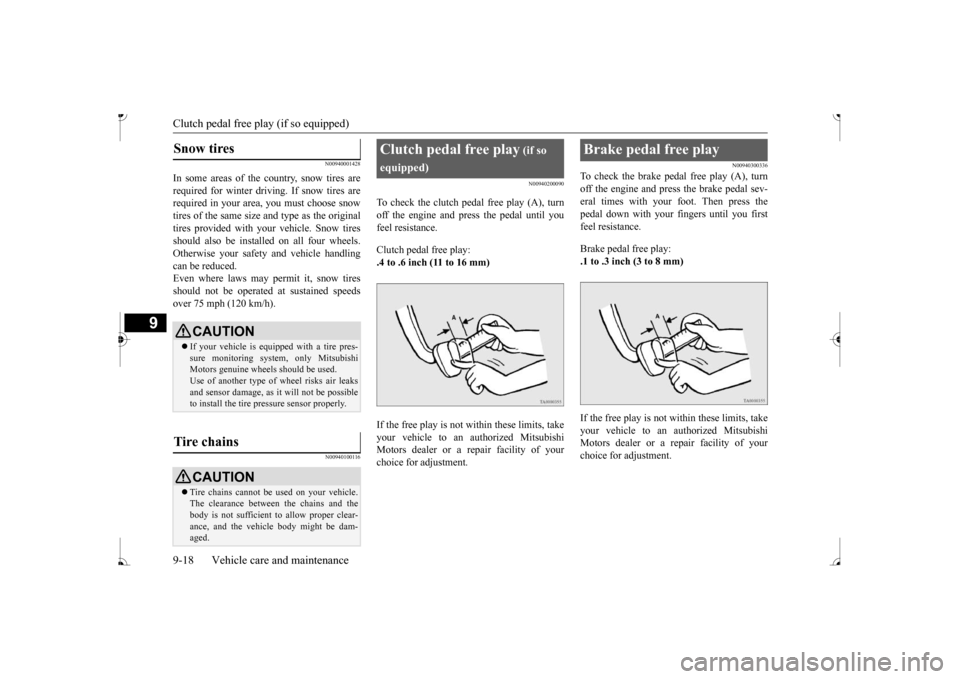
To check the clutch pedal free play (A), turn off the engine and pr
ess the pedal until you
feel resistance. Clutch pedal free play: .4 to .6 inch (11 to 16 mm) If the free play is not within these limits, take your vehicle to an
authorized Mitsubishi
Motors dealer or a repair facility of yourchoice for adjustment.
N00940300336
To check the brake pedal free play (A), turn off the engine and press the brake pedal sev- eral times with your foot. Then press thepedal down with your fingers until you first feel resistance. Brake pedal free play: .1 to .3 inch (3 to 8 mm) If the free play is not within these limits, take your vehicle to an authorized Mitsubishi Motors dealer or a repair facility of yourchoice for adjustment.
Snow tires
CAUTION If your vehicle is equippe
d with a tire pres-
sure monitoring system, only Mitsubishi Motors genuine wheels should be used.Use of another type of
wheel risks air leaks
and sensor damage, as
it will not be possible
to install the tire pressure sensor properly.
Tire chains
CAUTION Tire chains cannot be used on your vehicle. The clearance between
the chains and the
body is not sufficient to allow proper clear- ance, and the vehicle body might be dam- aged.
Clutch pedal free play
(if so
equipped)
Brake pedal free play
BK0236100US.book 18 ページ 2016年2月1日 月曜日 午前10時15分
Page 290 of 307
Cleaning the outside of your vehicle Vehicle care and maintenance 9-35
9
cloth in one direction.
After polishing, flush
the compound from the surface and apply acoat of wax to regain a beautiful luster.
N00946200092
Small cracks and scratches in the paint coatshould be touched up as
soon as possible with
touch-up paint to prevent corrosion. Check body areas facing the road or the tires carefully for damage to the paint caused by flying stones, etc. The
paint code number for
your vehicle can be found on the vehicle information code plat
e on the front passenger
door sill.
N00946300194
Use a sponge or chamois to clean these parts.If a vehicle wax sticks to a gray or blackrough surface of the bumper, molding or lights, the surface may appear white in color. In this case, wipe it
off using lukewarm water
and a soft cloth or chamois.
N00946400052
To prevent spots and corrosion of chromeparts, wash with water, dry thoroughly, andapply a nonabrasive automotive wax. If the chrome is severely da
maged or pitted, use a
commercially available chrome polish.
N00946500183
1. Remove dirt using a wet sponge.2. Use a mild detergent on any dirt that can-not be removed ea
sily with water.
Rinse off the detergent after washing the wheel.3. Dry the wheel thoroughly using a chamois leather or a soft cloth.
N00946600054
The window glass can
usually be cleaned
using only a sponge and
water. Glass cleaner
can be used to remove
wax, oil, grease, dead
insects, etc. After washing the glass, wipe it dry with a clean, dry, soft cloth.
N00946700084
Use a soft cloth and gl
ass cleaner to remove
grease, dead insects, etc., from the wiperblades. Replace the wiper blades when they no longer clean the windshield properly.
Damaged paint Cleaning plastic parts
CAUTION Do not use a scrubbing brush or other rough scrubber as these may
damage the plastic
surface.
Do not use wax containing compounds (pol- ishing powder) which ma
y damage the plas-
tic surface. Do not let plastic parts get soiled with gaso- line, oil, brake fluids
, engine oils, greases,
paint thinner, and sulfur
ic acid (battery elec-
trolyte), as such substa
nces will cause stains,
cracks, or discoloration.If any of these get on a plastic part, wipe them up with a soft cloth or chamois and a mild solution of soap and water. Then rinsethem immediately with water.
Chrome parts Aluminum wheels
(if so equipped)
CAUTION
CAUTION Do not use a brush or
other hard implement
on the wheels. Do not use any cleaner th
at contains an abra-
sive substance or is ac
idic or alkaline. Doing
so could cause the coating on the wheels topeel or become disc
olored or stained.
Do not directly apply
hot water using a steam
cleaner or by any other means. Contact with seawater or road salt used for de-icing can cause corr
osion. Rinse off such
substances as soon as possible.
Window glass Wiper blades
BK0236100US.book 35 ページ 2016年2月1日 月曜日 午前10時15分
Page 293 of 307
Consumer information (For vehicles sold in U.S.A.) 10-2 Customer assistance/Re
porting Safety Defects
10
N01047101208
This information is provided in compliance with the requirements of the National High- way Traffic Safety Ad
ministration, Depart-
ment of Transportation. It provides the purchasers and/or prospective purchasers with information on repor
ting safety defects.
DOT quality grades - Al
l passenger vehicle
tires must conform to
Federal Safety Require-
ments in addition to these grades. The spe- cific grade rating in each grade category isshown on the side wall of the tires on your vehicle. The treadwear grade is a comparative rating based on the wear rate of
the tire when tested
under controlled conditions on a specifiedgovernment test course
. For example, a tire
graded 150 would wear one and one-half (11/2) times as well on the government course
as a tire graded 100.
The relative performance
of tires depends upon the actual conditions of
their use, however, and may depart signifi- cantly from the norm due to variations indriving habits, service practices and differ- ences in road characteristics and climate. The traction grades, from highest to lowest, are AA, A, B and C. Those grades represent the tire’s ability to
stop on wet pavement as
measured under controlled conditions on specified government te
st surfaces of asphalt
and concrete. A tire marked C may have poor traction performance. The temperature grades are A (the highest), B and C, representing the ti
re’s resistance to the
generation of heat and it
s ability to dissipate
heat when tested un
der controlled conditions
on a specified indoor
laboratory test wheel.
Sustained high temperature can cause the
material of the tire to
degenerate and reduce
tire life, and excessive temperature can leadto sudden tire failure. The grade C corre- sponds to a level of performance which all passenger car tires must meet under the Fed-eral Motor Vehicle Safety Standard No. 109. Grades B and A represent higher levels of performance on the labora
tory test wheel than
the minimum required by law.
N01047201544
If you believe that your vehicle has a defect which could cause a crash or could cause injury or death, you should immediately inform theNational Highway Traffic Safety Administration (NHTSA) in addi- tion to notifying Mitsubishi MotorsNorth America, Inc.
Consumer information (For vehicles sold in U.S.A.) Uniform tire quality grading Treadwear
Traction AA, A, B, C
WA R N I N G The traction grade assi
gned to this tire is
based on straight-ahead braking tractiontests, and does not include acceleration, cornering, hydroplani
ng, or peak traction
characteristics.
Temperature A, B, C
WA R N I N G The temperature grade for this tire is established for a tire that is properlyinflated and not overloaded. Excessive speed, underinflation
, or excessive load-
ing, either separately
or in combination,
can cause heat buildup and possible tire failure.
Reporting Safety Defects
BK0236100US.book 2 ページ 2016年2月1日 月曜日 午前10時15分
Page 296 of 307
11
SpecificationsVehicle labeling ............................................................................. 11-2 Vehicle dimensions ........................................................................ 11-3 Vehicle weights .............................................................................. 11-4Engine specifications ..................................................................... 11-4 Battery ............................................................................................ 11-5 Tires and wheels ............................................................................ 11-5Capacity ......................................................................................... 11-5
BK0236100US.book 1 ページ 2016年2月1日 月曜日 午前10時15分
Page 305 of 307

Alphabetical index 12-4
12
P
Parking
................................................
6-5
Parking brake lever stroke
...............
9-19
Parking brake
............................
5-32
, 9-19
Parking lights
Bulb capacity
.................................
9-27
Replacement
..................................
9-29
Polishing
............................................
9-34
Power brakes
......................................
5-47
Power outlet
.....................................
5-110
Power windows
..................................
5-29
Puncture (Tire changing)
.......................
8-6
R
Radio
AM/FM electronically tuned radio withCD player
....................................
7-19
General information about your radio 7-44
Rear combination lights
Bulb capacity
.................................
9-27
Replacement
..................................
9-30
Rear seat
..............................................
4-5
Rear side-marker lights
Bulb capacity
.................................
9-27
Replacement
..................................
9-30
Rear turn signal lights
Bulb capacity
.................................
9-27
Replacement
...................................
9-30
Rear-view camera
...............................
5-62
Rearview mirror
Inside rearview mirror
.....................
5-34
Outside rearview mirrors
.................
5-36
Replacement of light bulbs
...................
9-26
Replacing tires and wheels
...................
9-16
Reporting Safety Defects
.....................
10-2
S
Safe driving techniques
.........................
6-4
Seat belts
.............................................
4-7
Adjustable seat be
lt shoulder anchor
.4-11
Child restraint systems
.....................
4-13
Front passenger seat belt warning light
.....
4-10 Maintenance and inspection
.............
4-21
Seat belt extender
............................
4-12
Seat belt force limitter system
..........
4-13
Seat belt instructions
........................
4-8
Seat belt pre-tensioners
....................
4-12
Seat belt use
during pregnancy
.........
4-12
Seats
...................................................
4-2
Arm rest
..........................................
4-5
Front seats
.......................................
4-2
Head restraints
.................................
4-5
Heated seats
.....................................
4-4
Seats and restraint systems
................
4-2
Service brake
......................................
5-46
Service precautions
...............................
9-2
Side turn signal lights
Bulb capacity
.................................
9-27
Snow tires
..........................................
9-18
Spark plugs
........................................
9-20
Starting the engine
..............................
5-38
Steering
Electric power steeri
ng system (EPS) 5-51
Steering wheel he
ight adjustment
.....
5-33
Stop lights
Bulb capacity
.................................
9-27
Replacement
..................................
9-30
Storage spaces
..................................
5-116
Sun visors
........................................
5-109
Supplemental Restraint System
............
4-21
How the Supplementa
l Restraint System
works
..........................................
4-24
Maintenance service
.......................
4-35
T
Tail lights
Bulb capacity
.................................
9-27
Replacement
..................................
9-30
Tank capacity
.....................................
11-5
Tire pressure monitoring system
...........
5-58
Tires
..................................................
9-12
Inflation pressures
..........................
9-15
Maintenance
...................................
9-16
BK0236100US.book 4 ページ 2016年2月1日 月曜日 午前10時15分
Page 306 of 307

Alphabetical index
12-5
12
Quality grading
...............................
10-2
Replacing tires and wheels
...............
9-16
Rotation
.........................................
9-17
Size (tire and wheel)
.......................
11-5
Snow tires
......................................
9-18
Tire and loading information placard 11-3 Tire chains
.....................................
9-18
To change a tire
................................
8-6
Tread wear indicator
.......................
9-16
Tools
...................................................
8-5
Storage
............................................
8-5
Towing
..............................................
8-12
Trailer towing
.....................................
6-11
Trunk lid
............................................
5-27
Turn signal light
Indicators
.......................................
5-76
Lever
.............................................
5-81
U
USB input terminal
...........................
5-105
How to connect a USB memory device
....
5-106 How to connect an iPod
.................
5-107
V
Vanity mirror
...................................
5-109
Vehicle care precautions
......................
9-32
Vehicle dimensions
.............................
11-3
Vehicle labeling
..................................
11-2
Vehicle preparation before driving
.........
6-3
Vehicle weights
..................................
11-4
Vents
..................................................
7-2
W
Warning lights
...................................
5-76
Washer
Fluid
.......................................
9-9
, 11-5
Switch
...................................
5-82
, 5-83
Washing
............................................
9-33
Waxing
.............................................
9-34
Weights
.............................................
11-4
Wheel
Covers
...........................................
8-11
Specification
..................................
11-5
Wiper
Switch
...........................................
5-82
Wiper blades
..................................
9-19
BK0236100US.book 5 ページ 2016年2月1日 月曜日 午前10時15分