park assist MITSUBISHI MIRAGE 2017 6.G Owners Manual
[x] Cancel search | Manufacturer: MITSUBISHI, Model Year: 2017, Model line: MIRAGE, Model: MITSUBISHI MIRAGE 2017 6.GPages: 307, PDF Size: 9.02 MB
Page 11 of 307
If this warning light comes on or flashes while you’re driving... 2-2 Quick index
2
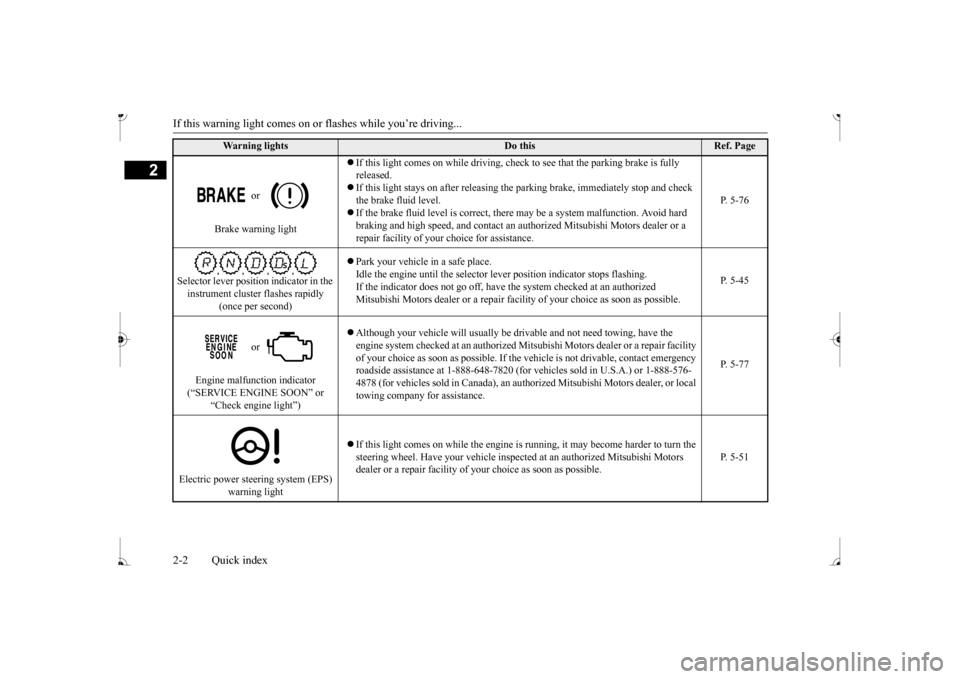
or
Brake warning light
If this light comes on while driving, chec
k to see that the parking brake is fully
released. If this light stays on after releasing the
parking brake, immediately stop and check
the brake fluid level. If the brake fluid level is correct, there
may be a system malfunction. Avoid hard
braking and high speed, and contact an au
thorized Mitsubishi Motors dealer or a
repair facility of your
choice for assistance.
P. 5-76
Selector lever position indicator in the instrument cluster flashes rapidly
(once per second)
Park your vehicle in a safe place. Idle the engine until the selector le
ver position indicato
r stops flashing.
If the indicator does not go off, have
the system checked at an authorized
Mitsubishi Motors dealer or a repair facili
ty of your choice as soon as possible.
P. 5-45
or
Engine malfunction indicator (“SERVICE ENGINE SOON” or
“Check engine light”)
Although your vehicle will usually be dr
ivable and not need towing, have the
engine system checked at an authorized M
itsubishi Motors dealer
or a repair facility
of your choice as soon as possible. If the
vehicle is not drivab
le, contact emergency
roadside assistance at 1-888-648-7820 (for
vehicles sold in U.S.A.) or 1-888-576-
4878 (for vehicles sold in Canada), an auth
orized Mitsubishi Moto
rs dealer, or local
towing company for assistance.
P. 5-77
Electric power stee
ring system (EPS)
warning light
If this light comes on while the engine is
running, it may become harder to turn the
steering wheel. Have your ve
hicle inspected at an aut
horized Mitsubishi Motors
dealer or a repair facility of
your choice as soon as possible.
P. 5-51
Warning lights
Do this
Ref. Page
BK0236100US.book 2 ページ 2016年2月1日 月曜日 午前10時15分
Page 13 of 307
If this warning light comes on or flashes while you’re driving... 2-4 Quick index
2
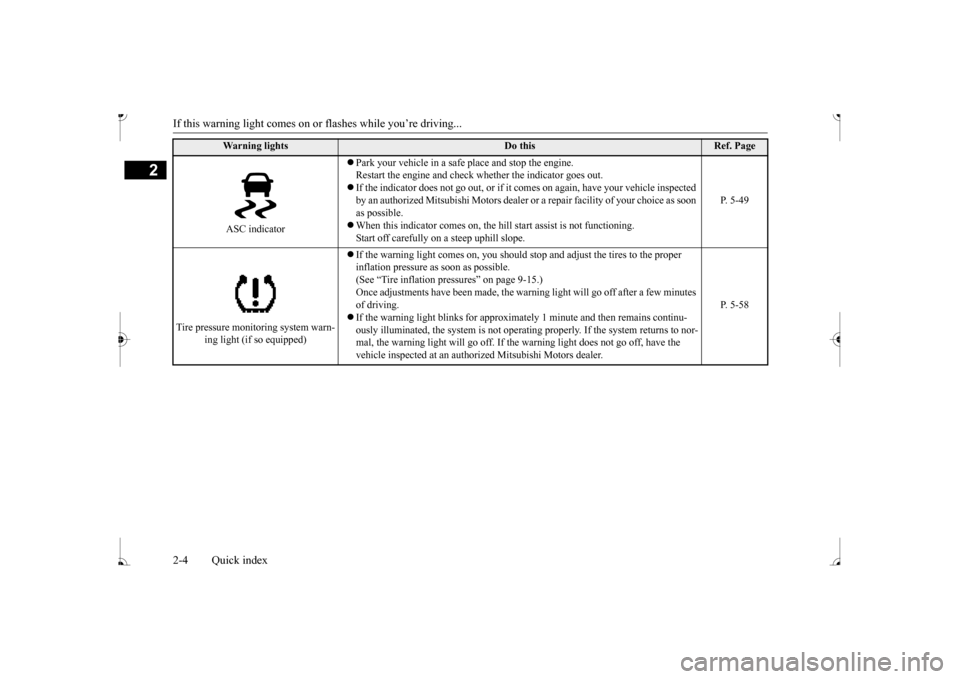
ASC indicator
Park your vehicle in a safe
place and stop the engine.
Restart the engine and check wh
ether the indicator goes out.
If the indicator does not go out, or if it co
mes on again, have your vehicle inspected
by an authorized Mitsubishi Motors dealer
or a repair facility of
your choice as soon
as possible. When this indicator comes on, the hi
ll start assist
is not functioning.
Start off carefully on a steep uphill slope.
P. 5-49
Tire pressure monito
ring system warn-
ing light (if so equipped)
If the warning light comes
on, you should stop and adju
st the tires to the proper
inflation pressure as
soon as possible.
(See
Page 20 of 307
Filling the fuel tank
General information 3-3
3
Use of gasolines blended with MMT may adversely affect performance, and cause themalfunction indicator on your instrument panel to come on. If this happens, contact an authorized Mitsubishi Motors dealer or arepair facility of your
choice for assistance.
Your vehicle may have
been designed to sat-
isfy California’s low-emission regulations based on clean-burning low-sulfur gasoline.Gasoline sold in parts of the country other than California is allowed to have a higher sulfur content. Using such gasoline couldadversely affect the ve
hicle’s catalytic con-
verter and cause the e
ngine malfunction indi-
cator (“SERVICE ENGINE SOON” or“Check engine light”) to come on. Illumina- tion of this indicator while using high-sulfur gasoline does not necessarily mean the vehi-cle’s emission-control system is malfunction- ing. Your authorized Mitsubishi Motors dealer may suggest usi
ng a different, lower-
sulfur brand of unleaded gasoline to deter- mine if the problem
is fuel-related.
N00301101981
Sulfur in gasoline
NOTE
Poor-quality gasoline
can cause problems
such as hard starting, stalling during idling,abnormal engine noise
, and poor accelera-
tion. If you experience any of these prob- lems, try using a differ
ent brand of gasoline.
If the engine malfunc
tion indicator (“SER-
VICE ENGINE SOON” light”) flashes, have
the vehicle inspected as
soon as possible by the nearest authorizedMitsubishi Motors dealer
or a repair facility
of your choice. Repeatedly driving short distances at low speeds can cause deposits to form in the fuel system and engine, resulting in hard startingand poor acceleration.
If these problems
occur, you are advised to add a detergent additive to the gasoline when you refuel thevehicle. The additive
will remove the depos-
its, thereby returning the engine to a normal condition. Be sure to use a MitsubishiMotors Genuine cleani
ng additive. Using an
unsuitable additive c
ould make an engine
malfunction. For details,
please contact the
nearest authorized Mits
ubishi Motors dealer.
Filling the fuel tank
WA R N I N GWhen handling fuel, comply with the safety regulations displayed by garages and filling stations.
Gasoline is highly flammable and explo- sive. You could be burned, seriouslyinjured or killed when handling it. Whenrefueling your vehicle,
always turn the
engine off and keep
away from flames,
sparks, and smoking materials. Alwayshandle fuel in well-ventilated outdoor areas. Before removing the fuel tank filler cap, be sure to get rid of your body’s static electricity by touching a metal part of thecar or fuel pump. Any
static electricity on
your body could create a spark that ignites fuel vapor. Perform the whole
refueling process
(opening the fuel tank filler door, remov-ing the fuel tank filler cap, etc.) by your- self; do not let any other person near the fuel tank filler. If you allowed a person tohelp you and that person was carrying static electricity,
fuel vapor could be
ignited. Do not move away from the fuel tank filler until refueling is fi
nished. If you moved
away and did something
else (for example,
sitting on a seat) part-way through the refueling process, you could pick up afresh charge of st
atic electricity.
Be careful not to inhale fuel vapor. Fuel contains toxic substances. Keep the doors and wi
ndows closed while
refueling the vehicle. If they were open, fuel vapor could get into the cabin.WA R N I N G
BK0236100US.book 3 ページ 2016年2月1日 月曜日 午前10時15分
Page 62 of 307
5
Features and controlsBreak-in recommendations ..............................................................5-2 Keys .................................................................................................5-2 Electronic immobilizer (Anti-theft starting system) ........................5-3Keyless entry system (if so equipped) ..............................................5-6 Free-hand Advanced Security
Transmitter (F.A.S.T.-key)
(if so equipped) ............................................................................5-9Door locks ......................................................................................5-24 Power door locks ......
...........
...........
...........
...........
...........
.........
.....5-25
Child safety locks for rear door ..........
...........
.........
.........
.........
.....5-26
Trunk lid ................
............
...........
...........
...........
...........
...........
.....5-27
Inside emergency trunk lid release ................................................5-28 Manual window control (if so equipped)........................................5-29Power window control ...................................................................5-29 Parking brake .................................................................................5-32 Steering wheel height adjustment ..................................................5-33Inside rearview mirror ...................................................................5-34 Outside rearview mirrors ...............................................................5-36 Ignition switch ...............................................................................5-37Starting the engine .........................................................................5-38 Manual transaxle (if so equipped) ..................................................5-40 Continuously variable transmission
(CVT) (if so equipped)..........5-42
Service brake .................................................................................5-46 Hill start assist ................................................................................5-47 Brake assist system ........................................................................5-49Anti-lock braking system ...............................................................5-49 Electric power steering system (EPS) ............................................5-51 Active stability control (ASC) .......................................................5-52Cruise control (if so equipped) .......................................................5-54
Tire pressure monitoring system (if so equipped) .......................... 5-58 Rear-view camera (if so equipped)................................................. 5-62 Instrument cluster .......................................................................... 5-64Multi-information display ............................................................. 5-65 Indicator and warning light package ............................................. 5-75 Indicators ....................................................................................... 5-76Warning lights ................................................................................ 5-76 Combination headlights and dimmer switch ................................. 5-79 Turn signal lever ............................................................................ 5-81Hazard warning flasher switch ...................................................... 5-82 Front fog light switch (if so equipped) .......................................... 5-82 Wiper and washer switch ............................................................... 5-82Electric rear window defogger switch ....
...........
...........
...........
...... 5-84
Horn switch ................................................................................... 5-85 Link System (if so equipped) ......................................................... 5-85 Bluetooth
® 2.0 interface (if so equipped)....................................... 5-85
USB input terminal (if so
equipped) ....
...........
.........
........
........... 5-105
Sun visors .................................................................................... 5-10912 V power outlets ....................................................................... 5-110 HomeLink
® Wireless Control System (if so equipped) ............... 5-110
Interior lights ............................................................................... 5-115Storage spaces .............................................................................. 5-116 Cup holders .................................................................................. 5-117 Bottle holders ............................................................................... 5-118Convenience hook ............
...........
...........
...........
...........
...........
.... 5-118
Assist grips .................................................................................. 5-119
BK0236100US.book 1 ページ 2016年2月1日 月曜日 午前10時15分
Page 78 of 307
Free-hand Advanced Securi
ty Transmitter (F.A.S.T.-key) (if so equipped)
Features and controls 5-17
5
1. Make sure all occupants are properly seated with seat belts fastened.2. Make sure the parking brake is applied. 3. Press and hold the brake pedal down firmly with your right foot. 4. Press and hold the clut
ch pedal all the way
down (manual transaxle). 5. On vehicles equipped with manual trans- axle, place the gearshift lever in the “N”On vehicles equippe
d with continuously
variable transmission (CVT), make sure the selector lever is in the “P” (PARK)position.
6. Press the engine switch. 7. Confirm that all warning lights and warn-ing displays are functioning properly.
After several attempts
, you may experience
that the engine still does not start. 1. Make sure that all electric devices, such as lights, air conditi
oning blower and rear
window defogger, are turned off.
2. While depressing the brake pedal {contin- uously variable transmission (CVT)} orthe clutch pedal (manual transaxle), press the accelerator peda
l halfway and hold it
there, then crank the engine. Release theaccelerator pedal, immediately after the engine starts. 3. If the engine still wi
ll not start, the engine
could be flooded with too much gasoline. While depressing the brake pedal (CVT) or the clutch pedal (manual transaxle), push the accelerator pedal all the way down and hold it there, then press theengine switch to crank the engine. If the engine does not start after 5 to 6 seconds, push the engine switch to stop crankingthe engine, and release the accelerator pedal. Put the operation mode in OFF. Wait a few seconds, and then press theengine switch to cr
ank the engine again
while depressing the brake pedal (CVT) or the clutch pedal (manual transaxle), butdo not push the accelerator pedal. If the engine fails to start, repeat these proce- dures. If the engine sti
ll will not start, con-
tact your local Mitsubishi Motors dealer or a repair facility of your choice for assistance.
Startability of conti
nuously variable trans-
mission (CVT) vehicles with an ambient temperature of -4 °F (-20 °C) or lower
NOTE
After the engine has not started for a while, the brake pedal effort needed to start the engine may become grea
ter. If this occurs,
depress the brake pedal more firmly than usual.NOTE
For vehicles equipped with a manual trans- axle, the engine will not start unless the clutch pedal is fully depressed (Clutch inter- lock). This is a safety feature.
NOTE
On vehicles equippe
d with continuously
variable transmission (C
VT), the engine can
only be started when th
e selector lever is in
the
Page 100 of 307
Starting the engine
Features and controls 5-39
5
There is usually no need to depress the accel- erator pedal when starting the engine.The starter should not be run for more than 15 seconds at a time. To prevent battery drai
n, wait a few seconds
between attempts to restart the engine. 1. Make sure all occupants are properly seated with seat belts fastened. 2. Insert the ignition key.3. Make sure the parking brake is applied. 4. Press and hold the
brake pedal down with
your right foot. 5. Press and hold the clut
ch pedal all the way
down (manual transaxle). 6. On vehicles equipped with manual trans- axle, place the gearshift lever in the “N” On vehicles equippe
d with continuously
variable transmission (CVT), make surethe selector lever is in the “P” (PARK) position.
7. Turn the ignition switch to the “ON” posi- tion and make certain that all warning lights are functioning properly beforestarting the engine. 8. Turn the ignition switch to the “START”
ssing the accelerator
pedal. Release the key when the engine starts.
After several attempts
, you may experience
that the engine still does not start. 1. Make sure that all electric devices, such as lights, air conditi
oning blower and rear
window defogger, are turned off.
2. While depressing the brake pedal {contin- uously variable transmission (CVT)} orthe clutch pedal (manual transaxle), press the accelerator peda
l halfway and hold it
there, then crank the engine. Release theaccelerator pedal, immediately after the engine starts. 3. If the engine still wi
ll not start, the engine
could be flooded with too much gasoline. While depressing the brake pedal (CVT) or the clutch pedal (manual transaxle), push the accelerator pedal all the way down and hold it there, then crank theengine for 5 to 6 seconds. Return the igni- tion switch to the “OFF” position and release the accelerator pedal. Wait a fewseconds, and then crank the engine again for 5 to 6 seconds while depressing the brake pedal (CVT) or the clutch pedal(manual transaxle), but do not push the accelerator pedal. Release the ignition key if the engine starts.
If the engine fails to
start, repeat these procedures. If the engine still will not
start, contact your
local Mitsubishi Motors dealer or a repairfacility of your choi
ce for assistance.
NOTE
On vehicles equipped
with manual transaxle,
the starter will not ope
rate unless the clutch
pedal is fully depresse
d (Clutch interlock).
NOTE
On vehicles equipped
with CVT, the starter
will not operate unless the selector lever is inthe
Page 110 of 307
Brake assist system
Features and controls 5-49
5
N00562800092
If an abnormal condition occurs in the sys- tem, the following i
ndicator will turn on.
N00567301116
The brake assist system is a device assisting drivers who cannot depress the brake pedalfirmly such as in em
ergency stop situations
and provides greater braking force.
If the brake pedal is depressed suddenly, the brakes will be applied with more force thanusual.
N00517900338
The anti-lock braking
system helps prevent
the wheels from locking up when braking. This helps maintain vehicle drivability andsteering wheel handling. When using the anti-lock brakes (sudden braking), steering is slightly different from normal driving conditions. Use the steering wheel carefully. Always keep a safe distance from the vehicle in front of you. Even if your vehi- cle is equipped with
the anti-lock braking
system, leave a greater braking distance when: • Driving on gravel or snow-coveredroads. • Driving on uneven road surfaces. Operation of anti-lock braking system is not restricted situations where brakes are applied suddenly. This system may also prevent the wheels from locking whenyou drive over manholes, steel roadwork plates, road markings
, or any uneven road
surface.
Warning indicator
-
ASC indicator
CAUTION If the warning is displayed, the hill start assist will not
operate. Start off carefully.
Park your vehicle in a
safe place and stop the
engine.Restart the engine and check whether the indicator goes out, in wh
ich case the hill start
assist is again working normally. If they remain displayed or reappear fre- quently, it is not necessa
ry to stop the vehicle
immediately, but th
e vehicle should be
inspected by an authorized Mitsubishi Motors dealer or a repair facility of your choice as soon
as possible.
Brake assist system
CAUTIONThe brake assist system is not a device designed to exercise
braking force greater
than its capacity. Make
sure to always keep a
sufficient distance be
tween your vehicle and
a vehicle in front of you without relying toomuch on the brake assist system.NOTE
Once the brake assist system is operational, it maintains great braking force even if the brake pedal is lightly released.To stop its operation, completely remove your foot from the brake pedal. When the brake assist system is in use while driving, you may feel as if the depressed brake pedal is soft, the pedal moves in smallmotions in conjunction with the operation noise, or the vehicle body and the steering wheel vibrate. This occurs when the brakeassist system is ope
rating normally and does
not indicate faulty
operation. Continue to
depress the brake pedal. When the anti-lock brake system warning light is illuminated, th
e brake assist system is
not functioning.
Anti-lock braking system Driving hints
BK0236100US.book 49 ページ 2016年2月1日 月曜日 午前10時15分
Page 112 of 307
Electric power steering system (EPS)
Features and controls 5-51
5
The anti-lock braking system and brake force distribution function ma
y not work, so hard
braking could make the vehicle unstable. Avoid hard braking and high-speed driving.Stop the vehicle in a safe place and contact an authorized MITSUBISHI MOTORS dealer or repair facility
of your choice.
N00529200080
After driving on snow or icy roads, remove any snow and ice which may have be leftaround the wheels. On vehicles that have an anti-lock braking syst
em, be careful not to
damage the wheel spee
d sensors (A) or the
cables located at each wheel.
N00568400074
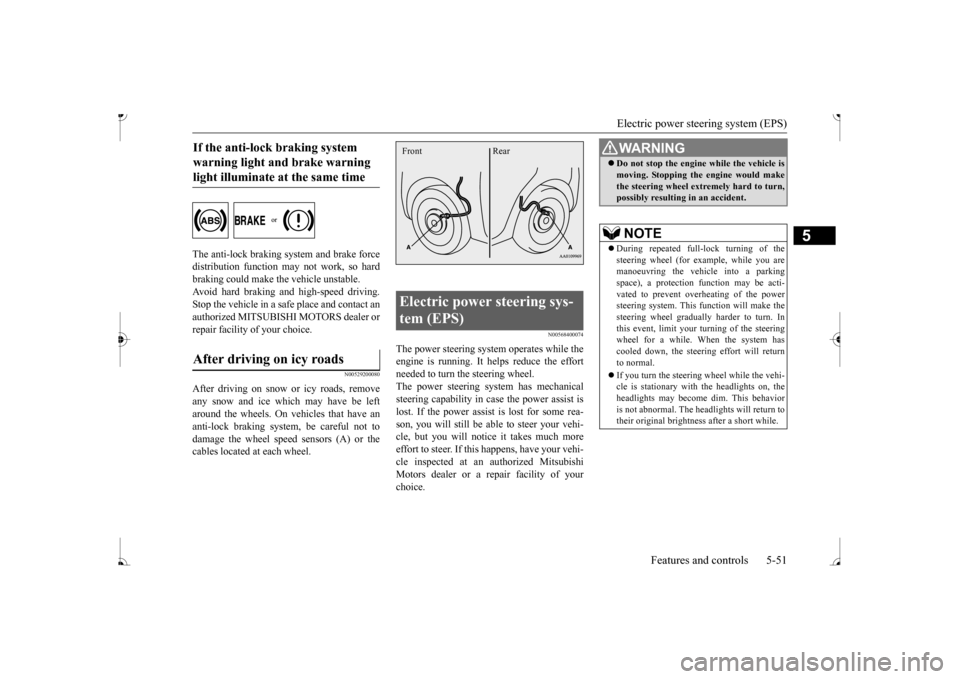
The power steering system operates while theengine is running. It helps reduce the effort needed to turn the steering wheel. The power steering sy
stem has mechanical
steering capability in case the power assist is lost. If the power assist is lost for some rea- son, you will still be able to steer your vehi-cle, but you will notice it takes much more effort to steer. If this happens, have your vehi- cle inspected at an authorized MitsubishiMotors dealer or a repair facility of your choice.
If the anti-lock braking system warning light and brake warning light illuminate at the same time After driving on icy roads
Electric power steering sys- tem (EPS) Front Rear
WA R N I N G Do not stop the engine while the vehicle is moving. Stopping the engine would makethe steering wheel extremely hard to turn,possibly resulting
in an accident.
NOTE
During repeated full-lock turning of the steering wheel (for example, while you are manoeuvring the vehicle into a parkingspace), a protection f
unction may be acti-
vated to prevent overheating of the power steering system. This f
unction will make the
steering wheel graduall
y harder to turn. In
this event, limit your turning of the steering wheel for a while. When the system hascooled down, the steering effort will return to normal. If you turn the steering wheel while the vehi- cle is stationary with the headlights on, the headlights may become
dim. This behavior
is not abnormal. The he
adlights will return to
their original brightness after a short while.
BK0236100US.book 51 ページ 2016年2月1日 月曜日 午前10時15分
Page 241 of 307
If the vehicle breaks down 8-2 For emergencies
8
N00836300233
If your vehicle breaks down on the road, move to the shoulder and turn on the hazard warning flashers. If there is no shoulder, orthe shoulder is not safe, drive in the right lane slowly with the haza
rd lights flashing until
you come to a safe stopping place. Keep theflashers flashing. If the engine stops, there will be no power assist to the steering and brakes, making these difficult to use. The brake booster will not work, so the brakes will not grip well. The brake pedal will be harder to press than usual. Since there is no power steering assist, the steering wheel will be hard to turn.
Get help from your passengers, bystanders, etc. to push the vehicle
and move it to a safe
area.
N00836401837
If the engine cannot be started because the battery is weak or de
ad, you can start it with
the battery from anothe
r vehicle using jumper
cables. 1. Take off any metal jewelry such as watch bands or bracelets th
at might create an
accidental electrical contact. 2. Position the vehi
cles close enough
together so that the jumper cables canreach, but be sure the vehicles aren’t touching each other.
3. You could be injured if the vehicles move. Set the parking brake firmly on each vehi- cle. Put an automatic transaxle or CVT in “P” (PARK) or a manual transaxle in “N”(Neutral). 4. Turn the ignition switch to the “OFF”OFF. 5. Make sure your battery electrolyte is at the proper level. (Refer to “Battery” on page 9-10.)
If the vehicle breaks down If the engine stops/fails When the engine fails at the intersection
Jump-starting the engine
WA R N I N G To reduce the risk of igniting flammable gas that may be emitted from the battery,carefully read this section before jump- starting the vehicle. Do not try to start you
r vehicle by pushing
or towing. This can cause an accident resulting in serious
injury or death and
can damage the vehicle.NOTE
Do not use jumper cables if they have dam- age or corrosion.
CAUTION Check the other vehicle.
It must have a 12-
volt battery. If the other system isn’t 12-volt,both systems can be damaged.NOTE
Turn off all lights, heat
er, and othe
r electrical
loads. This will avoid sparks and help save both batteries.WA R N I N G If the electrolyte fluid is not visible, or looks frozen, DO NOT ATTEMPT JUMPSTARTING!! The battery might spli
t open or explode if
the temperature is below the freezingpoint or if it is not filled to the proper level.
BK0236100US.book 2 ページ 2016年2月1日 月曜日 午前10時15分
Page 275 of 307
General maintenance 9-20 Vehicle care and maintenance
9
N00940900228
Spark plugs must fire properly for good engine performance
and emission-control.
Do not reuse them by cleaning or regapping.Change them at the mileage listed in the “WARRANTY AND MAINTENANCE MANUAL”.
N00941000040
Check the hose surfaces for any heat and mechanical damage, hard and brittle rubber, cracking, tears, cuts and abrasions. Pay spe-cial attention to the hos
es closest to high heat
sources such as the exhaust manifold. Check all the hose connections
, such as clamps and
couplings, to make sure
they are secure and
that there are no leaks. If you see any wear or damage, replace the
hoses immediately.
N00950100050
Have the valve clearance checked at an authorized Mitsubishi Motors dealer at the mileage specified in the “WARRANTY AND MAINTENANCE MANUAL”.If the engine sounds abnormally loud, have adjustments made by an authorized Mitsubishi Motors dealer.
N00941300173
Check these regularly for damage or leaks in the fuel lines and connections. Check the fuel tank filler cap for dama
ge or looseness. Pay
special attention to the fuel lines closest to
high heat sources such
as the exhaust mani-
fold.
N00941400187
If the fuel-vapor vent line is clogged or dam-aged, the fuel-vapor mixture will escape, pol- luting the air. Have the system checked at an authorizedMitsubishi Motors dealer at the mileage spec- ified in the “WARRANTY AND MAINTE- NANCE MANUAL”.
N00941500292
The next pages list th
e maintenance service
recommended by Mitsubishi Motors Corpo-ration. In addition to the general maintenance that needs to be performed at the times listed,
NOTE
To meet government regulations and pro- mote cleaner air, your
vehicle is equipped
with an onboard dia
gnostic system (OBD).
The engine electronic control module that controls OBD functions stores various data (especially about th
e exhaust emissions).
This data will be erased if the battery cable is disconnected, which could make a rapid diagnosis difficult.
Do not disconnect the
battery cable when the engine malfunction indicator (“SERVICE ENGINE SOON” or “Check engine
light”) is ON.
Spark plugs
NOTE
Use the spark plugs listed under “Engine specifications” on page 11
-4 or plugs that are
exactly the same. Other plugs could cause engine damage, performance problems orradio noise.
Fuel hoses Intake valve clearance Fuel system (tank, pipe line and connection, and fuel tank filler cap)
WA R N I N G If you see a fuel leak
or if you smell fuel,
do not run the engine. Any spark (includ- ing from the ignition
), flame or smoking
material could cause an explosion or fire.Call an authorized Mitsubishi Motors dealer or a repair fa
cility of your choice
for assistance.
Evaporative emission control system (except evaporative emission canister) General maintenance
BK0236100US.book 20 ページ 2016年2月1日 月曜日 午前10時15分